Why Setting up Company in Vietnam is the Strategic Choice for 2026?
The year 2026 marks a pivotal turning point for foreign investors in Vietnam. With significant reforms in the Law on Investment and a roadmap to reduce conditional business lines, the process for setting up a company in Vietnam is becoming more transparent and streamlined than ever.
However, to operate legally in specialized sectors such as retail, distribution, or logistics, investors must follow a structured path from obtaining an IRC and ERC to securing a specific business license.
1. Why Foreign Investors Need a Clear Roadmap in 2026
Starting a business in Vietnam as a foreigner offers immense potential, but understanding the 2026 regulatory landscape is crucial to avoiding delays or rejected applications.
a. FDI Opportunities in 2026
Vietnam maintains its position as Southeast Asia’s “global factory” based on four key pillars:
- Extensive FTA Network: Leverage tariff incentives from the CPTPP, EVFTA, and RCEP.
- New Incentive Policies: Strong focus on high-tech projects, circular economy, and renewable energy.
- Flexible Ownership Structures: 100% foreign ownership is permitted in most sectors, including manufacturing, IT, consulting, and trading.
- Digitalized Procedures: Significant reduction in waiting times through the National Business Registration Portal.
b. When is a Business License (Trading License) Mandatory?
While many sectors are open, a Business License (Trading License or Retail Distribution License) is still mandatory for foreign investors in “conditional” sectors under WTO commitments and Vietnamese Law.
Even with eased regulations, a separate Business License is required after company formation for:
- Retail Sales: Directly providing goods to end consumers.
- Distribution & Import: Applied to restricted or specialized commodity groups.
- Specialized Services: Logistics, education, healthcare, and F&B.
- Important Note: By July 1, 2026, sectors like accounting and insurance brokerage will see further liberalization. However, for Retail & Distribution, investors must still seek approval from the Ministry/Department of Industry and Trade.
c. Distinguishing IRC vs. ERC vs. Business License
Understanding these three acronyms is vital for any foreigner setting up a company in Vietnam:
| Permit Type | Issuing Authority | Primary Role |
| IRC (Investment Registration Certificate) | Department of Planning and Investment (DPI) | Approves the investment project (capital, objectives, location). |
| ERC (Enterprise Registration Certificate) | Business Registration Office | Creates the legal entity and issues the Tax ID. |
| Business License | Relevant Ministry or Department | Grants permission to operate in conditional sectors (Retail, etc.). |
The Standard Sequence: IRC (Project Approval) → ERC (Company Formation) → Business License (For specific sectors).
2. 5-Step Process for Setting Up Company in Vietnam in 2026
The average timeline for completion ranges from 1 to 2 months, depending on the complexity of your business lines.
Step 1: Choose a Legal Structure & Check Ownership Limits
The most common choice is a Limited Liability Company (LLC) due to its flexibility and limited liability protection. Foreigners must verify if their specific sector requires a Joint Venture (JV) with a Vietnamese partner.
Step 2: Obtain the Investment Registration Certificate (IRC)
Investors submit the application to the DPI. Key documents include:
- Detailed Investment Project Proposal.
- Proof of Financial Capacity (Bank statements or audited reports).
- Office Lease Agreement or Memorandum of Understanding (MOU).
- Timeline: 15 – 35 working days.
Step 3: Obtain the Enterprise Registration Certificate (ERC)
Once the IRC is issued, the ERC application is typically processed within 3 – 7 working days. This step officially grants your business its legal status.
Step 4: Post-Registration Procedures (Operational Compliance)
Obtaining the ERC is only the beginning. Within 90 days, investors must fulfill these mandatory obligations:
- Open a Direct Investment Capital Account (DICA): This is the most critical step. All capital contributions, profit repatriations, and share transfers must flow through this account.
- Capital Contribution: Ensure the total committed capital is transferred into the DICA within 90 days of ERC issuance.
- Online Investment Reporting: Businesses must report project progress quarterly and annually on the National Investment Information System. Missing these deadlines can lead to heavy administrative fines.
- Initial Tax & Accounting Setup: Register digital signatures, set up e-invoice templates, and pay Business License Tax (License Fees). Appointing a Chief Accountant or an outsourced accounting representative is a legal requirement for signing financial statements.
Step 5: Specialized Business License (If applicable)
For retail and distribution entities, authorities will assess the application based on local planning and socio-economic impact. Note the Economic Needs Test (ENT) requirement if you plan to open a second retail outlet or more.

Get a free 30-minutes consultation
3. Required Documents & Checklist
All foreign documents must be Consularly Legalized, translated into Vietnamese, and notarized.
- Individual Investors: Notarized passport + Bank balance confirmation.
- Corporate Investors: Parent company’s Certificate of Incorporation + Audited financial statements (last 2 years) + Resolution appointing the authorized representative.
- Project Documents: Detailed Business Plan and proof of right to use the business location.
4. Vina TPT: Your Trusted Partner for FDI Success in Vietnam
Establishing a legal entity is just the start. To thrive in the Vietnamese market, businesses need a solid foundation in Accounting, Tax, and HR from day one.
Vina TPT is proud to be a strategic partner, helping foreign investors remove language barriers and navigate local legal complexities:
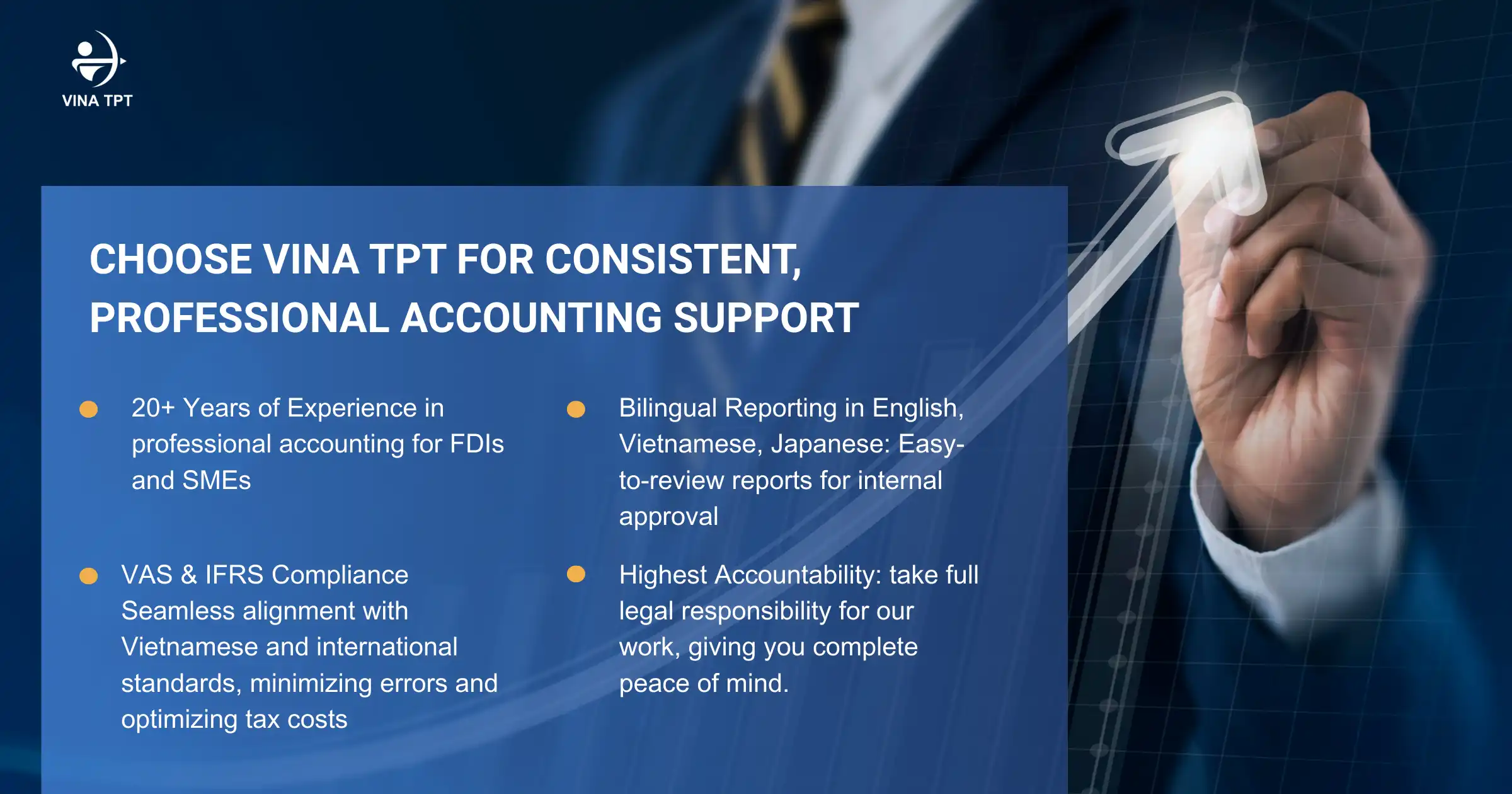
- Expert Consulting: From initial setup to tax structure optimization. We keep you updated on the latest regulations, including Global Minimum Tax and 2026 tax incentives.
- Payroll & HR Management: We handle labor contracts, Social Health & Unemployment Insurance (SHUI), and Personal Income Tax (PIT) finalization for both expats and locals, ensuring absolute confidentiality.
- Lifecycle Partnership: With over 20 years of experience, Vina TPT provides an “All-in-one” ecosystem. You focus on growth; we handle the administration.
- No Language Barrier: Our trilingual team (English – Japanese – Vietnamese) ensures transparent communication and seamless management reporting.
Optimize your resources and minimize legal risks with Vina TPT. Contact us today for a 1-on-1 specialized consultation for your 2026 project.