Top Companies Providing the Best Outsourced Accounting Services in Ho Chi Minh City

Top Companies Providing the Best Outsourced Accounting Services in hO CHI MINH CITY

Top Companies Providing the Best Outsourced Accounting Services in hO CHI MINH CITY

1. Why Businesses Look for The Best outsourced accounting services in Ho Chi Minh City

Ho Chi Minh City is the largest economic center in Vietnam, accounting for more than 23% of the country’s total GDP and attracting over 40% of new FDI projects annually (according to data from the Ministry of Planning and Investment). FDI enterprises and small and medium-sized enterprises in Ho Chi Minh City have to handle a dense volume of reports: monthly tax declarations, quarterly reports, annual financial reports according to VAS standards, along with obligations such as corporate income tax/personal income tax settlement and labor reports. The level of inspection and audit in Ho Chi Minh City is also higher than in many other provinces and cities, making the requirements for accuracy and compliance more stringent.

In that context, businesses seek accounting firms not only to “make reports”, but also to have a partner who has a deep understanding of Vietnamese Accounting Standards (VAS), and at the same time meets the need to prepare parallel reports for headquarters in Japan, Korea, the EU or the US. FDI enterprises often have to reconcile data between VAS and IFRS/J-GAAP/K-GAAP, so they need a team capable of handling exchange rate differences, classifying fixed assets, and recording prepaid expenses according to international standards. A suitable accounting firm helps enterprises reduce errors, limit tax penalty risks, optimize cash flow, and significantly reduce the administrative burden for internal departments.

GET EXPERT ACCOUNTING SUPPORT

2. Types of Accounting Firms Commonly Chosen in Ho Chi Minh City

The accounting services market in Ho Chi Minh City is diverse, serving more than 330,000 active businesses, from SMEs to large FDI corporations. Depending on the size, budget and complexity of the reports, businesses often choose between three main groups of providers, each with distinct advantages and disadvantages.

Criteria International Firms (Big 4 & Global) Mid-Tier Firms Boutique / Professional Firms
Ideal Clients Large FDI corporations, multinational groups, IFRS reporting, mandatory audits Mid-sized FDI companies, Vietnamese firms with complex transactions SMEs, FDI startups, businesses needing flexible and cost-effective services
Representative Firms Deloitte, PwC, EY, KPMG Grant Thornton, RSM Vietnam, A&C BDO Vietnam, boutique/non-Big firms (e.g., small approved audit firms)
Expertise Strong in IFRS/J-GAAP/K-GAAP, globally standardized processes Solid VAS + IFRS capability, strong in consolidated reporting and advisory Industry-focused, strong practical accounting capabilities
Response Speed Fast but structured; larger teams with layered review Fast, more flexible client communication, good customer care Fastest, direct work with senior team members, highly adaptable
FDI Handling Capability Excellent, best fit for large global or regional FDI operations (high cost) Very good for mid-sized FDI companies with structured operations Suitable for new or simple FDI setups
Key Strengths Global credibility, standardized reporting, highest reliability Good balance of cost, quality, service Flexible, cost-effective, highly personalized service
Notes on Representative Firms Deloitte – strong in large FDI audits 

PwC – comprehensive service line 

EY – long-established, strong advisory 

KPMG – wide presence (HN/HCMC/Da Nang)

Grant Thornton – flexible, strong advisory 

RSM – strong in outsourcing & mid-FDI audit 

A&C – top non-Big option for VN firms + mid-FDI

BDO Vietnam – part of BDO global network, ideal for SMEs 

Other boutique firms – suitable for startups, small FDI, custom service needs


3. Why Vina TPT Is a Trusted Choice for International Companies

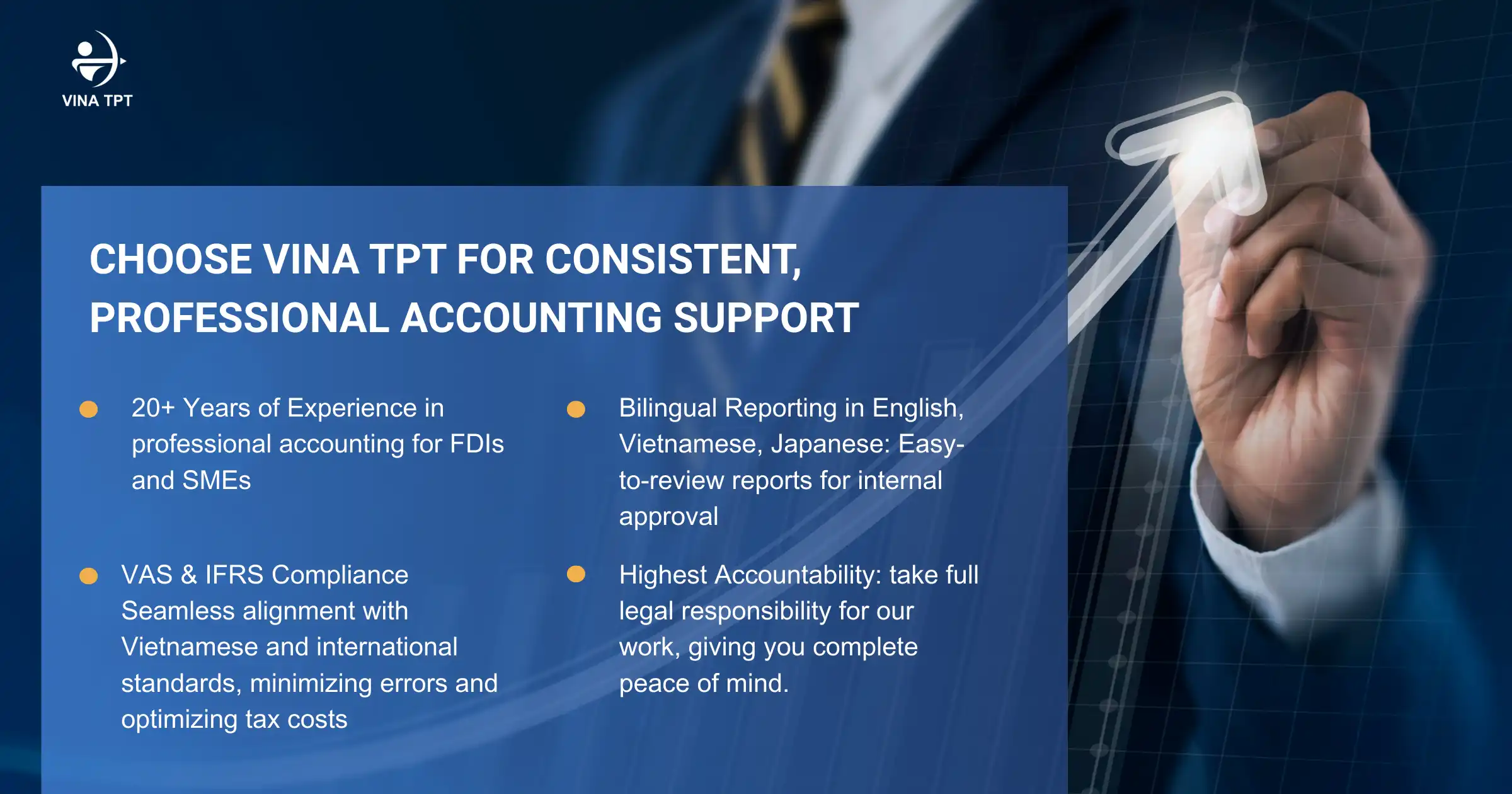
Vina TPT has become a preferred partner for many FDI enterprises in Ho Chi Minh City by offering a practical balance between local compliance expertise and the reporting expectations of overseas headquarters. As foreign-invested companies navigate increasingly strict tax regulations, frequent monthly and quarterly reporting cycles, and complex cross-border coordination, they need an accounting provider that is both technically reliable and agile enough to support their day-to-day operations. Vina TPT fits this need exceptionally well, especially for Japanese, Korean, Singaporean, and European investors establishing or expanding their presence in Vietnam.

Vina TPT stands out thanks to:

  • Deep knowledge of VAS and international reporting standards
  • Bilingual support in English and Japanese for smooth communication
  • Flexible and comprehensive services covering bookkeeping, tax, payroll, and compliance
  • An optimized cost structure specifically designed for FDI companies
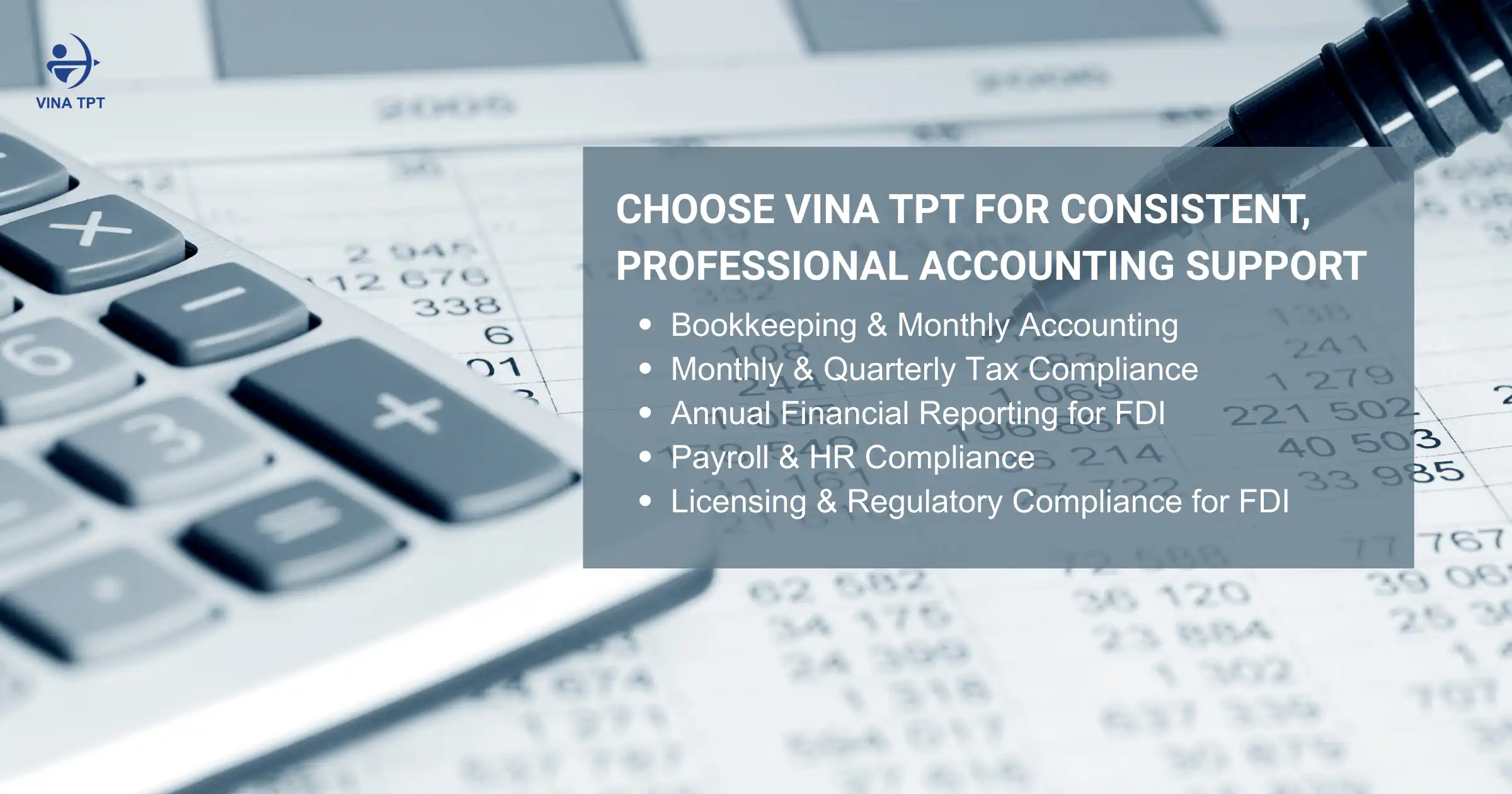
Choose Vina TPT for consistent, professional accounting support

4. Factors to Consider When Choosing an Accounting Firm in HCM

When selecting an accounting partner, businesses should evaluate:

  • FDI experience and understanding of foreign-invested business operations
  • Accuracy and timeliness of reports
  • Multilingual support and clear communication
  • Transparency of service scope and fees
  • Responsiveness and reliability

Choosing the best outsourced accounting services in HCM ensures accurate reporting, full compliance, and peace of mind for your business operations.

Contact Vina TPT today to receive a complete accounting solution, optimize costs and ensure compliance for your business in Ho Chi Minh City!

Get Your Accounting Solution

accounting service Vietnam for FDI company vtpt

Capital Contribution and Business Setup for Foreign Investment in Vietnam

Capital-Contribution-and-Business-Setup-for-Foreign-Investment-in-Vietnam-Vina-TPT

Capital-Contribution-and-Business-Setup-for-Foreign-Investment-in-Vietnam-Vina-TPT

1. Understanding Capital Contribution Requirements for Foreign investment in vietnam

Capital contribution is the most important step when establishing an FDI enterprise. According to Vietnamese law, foreign investors should note:

  • Minimum capital: Vietnam does not require a general legal capital level, but the charter capital must be appropriate and demonstrate the ability to implement the business model. Some specific industries (education, real estate, e-commerce, etc.) have higher capital requirements.
  • Form of capital contribution: Investors can contribute capital in cash, machinery and equipment, assets, intellectual property rights, or other legal assets.
  • Capital contribution period: Usually must be completed within 90 days from the date of issuance of the Certificate of Business Registration (or according to the period stated in the Investment Registration Certificate).

Determining capital accurately from the beginning helps reduce legal risks and limit capital adjustments later.

2. Types of Foreign Investment in Vietnam

When choosing a form of investment in Vietnam, investors need to consider their business objectives, project scale, level of control and desired scope of operations. Vietnam allows for a variety of flexible legal models, from establishing a new business to opening a branch or representative office. Each form carries different levels of risk, costs and compliance obligations, so choosing the right one at the outset will have a big impact on investment performance and long-term strategy.

Below are the most common forms of FDI in Vietnam:

Type Suitable for Advantages Disadvantages
Limited Liability Company (LLC) Small & medium enterprises

Investors needing strong control

Simple structure

Easy to operate

High control

Fast setup

Hard to raise capital

Extra procedures to convert to JSC

Joint Stock Company (JSC) Businesses expanding strongly

Companies seeking fundraising

Easy capital raising Fit for large/multinational projects

Flexible share transfer

Good for future IPO

Complex governance

More management bodies required

Higher compliance cost

Branch of Foreign Traders Foreign companies in eligible sectors Can conduct profit-making activities

No new legal entity required

Operate under parent company

Limited to specific industries

Dependent on parent company

Hard to scale like an independent entity

Representative Office (RO) Market research stage

Building partner networks

Simple setup

Low cost

No CIT applied

Cannot generate revenue

Cannot sign commercial contracts

Not suitable for long-term investment

Choosing the appropriate form of FDI helps investors optimize costs, reduce legal risks and ensure that their business strategy in Vietnam is effectively implemented. For small and medium-sized projects, LLC is often the optimal choice; for strong expansion plans or many shareholders, JSC is more suitable. Meanwhile, branches and representative offices serve the purpose of market presence without the need to establish a new legal entity.

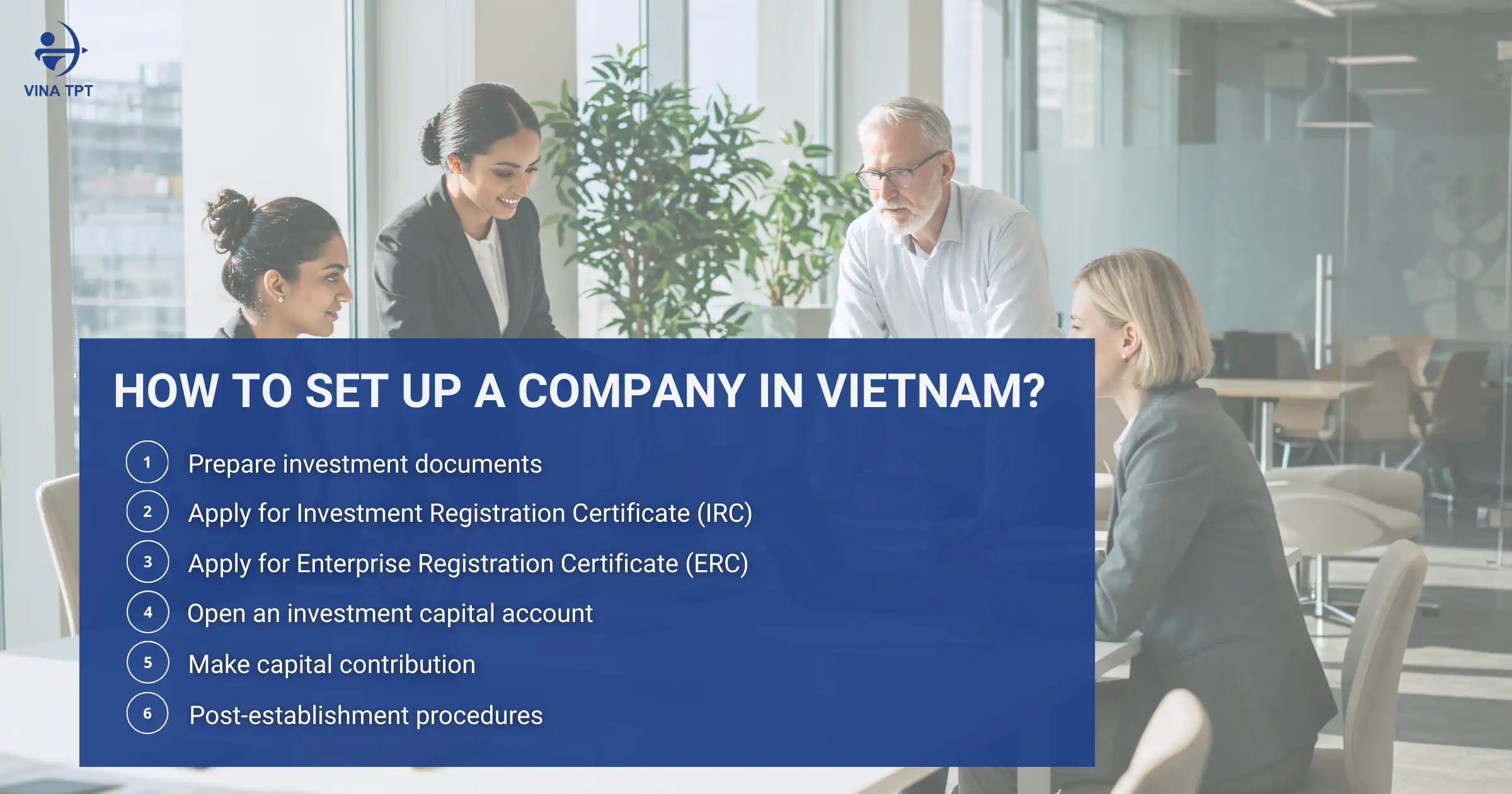
3. Steps to Set Up a Company with Capital Contribution

When setting up a Foreign investment in Vietnam, investors need to take the following main steps:

Step 1: Prepare investment documents

  • Investor information
  • Financial capacity report
  • Business plan
  • Headquarters lease contract, company charter

Step 2: Apply for Investment Registration Certificate (IRC): Confirm investment project and capital structure. Processing time: 15-30 days.

Step 3: Apply for Enterprise Registration Certificate (ERC): Officially establish the enterprise. Time: 3-5 days.

Step 4: Open an investment capital account: Required for FDI enterprises, used to receive capital from abroad.

Step 5: Make capital contribution: Investors transfer capital on time and complete the report.

Step 6: Post-establishment procedures

  • Tax registration
  • Digital signature
  • Corporate seal
  • Labor and insurance registration (if required)

Capital-Contribution-and-Business-Setup-for-Foreign-Investment-in-Vietnam-Vina-TPT

4. Compliance and Reporting Obligations

Foreign investment in Vietnam must ensure full compliance with the following regulations:

  • Capital contribution progress report
  • Accounting and bookkeeping according to VAS standards
  • Periodic tax declaration (VAT, CIT, PIT)
  • Annual financial report
  • Notification of changes in capital, headquarters, and representative

Non-compliance may result in administrative fines, restrictions on operations, or capital adjustment requirements.

AVOID COSTLY COMPLIANCE RISKS

5. Benefits of Proper Capital Contribution Management

Managing and implementing capital contribution in accordance with regulations is not only a legal requirement but also brings many practical values ​​to FDI enterprises in Vietnam:

Avoid legal risks and penalties

  • Contributing capital on time helps avoid administrative penalties.
  • Avoid being required to reduce charter capital or adjust the Investment Certificate.
  • Limit risks when checking, inspecting or working with banks.

Protecting investors’ ownership rights and capital contribution ratios

  • Clearly record the ownership ratio, voting rights and interests of each shareholder.
  • Avoid internal disputes, especially with investors from many different countries.
  • Increase transparency when planning to transfer shares or raise capital.

Increase the level of trust with banks, partners and management agencies

  • Adequate charter capital is an important factor in expanding credit limits.
  • Demonstrate the financial capacity and long-term commitment of investors in Vietnam.
  • Help partners and suppliers feel secure when signing contracts.

Optimize taxes and cash flow

  • A reasonable capital structure helps reduce the risk of transfer pricing adjustments and avoid tax disputes.
  • Easily control cash flow in and out through investment capital accounts.
  • Increase the ability to plan finances and operating budgets.

Create a solid foundation for expansion

  • Easy to add capital, open more branches or change the scope of the project.
  • Convenient when upgrading the type of business or expanding to a new industry.
  • Support the process of calling for more investors or strategic cooperation.

Increase long-term enterprise value

  • Enterprises with a transparent history of capital contribution are often highly appreciated when evaluating M&A.
  • Increase attractiveness to investment funds and global partners.
  • Create a competitive advantage when negotiating large contracts.

Minimize risks during divestment

  • Easily determine the value of the capital contribution when the investor wants to withdraw capital.
  • Reduce disputes due to the difference between actual capital contribution and registered capital.
  • Optimize tax benefits when transferring capital.

6. How Vina TPT Supports FDI Company Formation

Vina TPT Company Formation provides a complete package of support for the process of establishing and operating FDI enterprises:

  • Consulting on conditions for capital contribution and business lines
  • Preparing and submitting IRC & ERC documents
  • Shareholding structure, ownership ratio, charter
  • Support for opening investment capital accounts, guidance on capital contribution
  • Accounting – tax services – compliance with Vietnamese regulations
  • Consulting throughout for investors in operations and expansion

With experience working with international enterprises, Vina TPT ensures that the investment process in Vietnam becomes clear, safe and effective.

BOOK A FREE CONSULTATION

Laywer-Establish-business-Vietnam-VinaTPT

When to Switch Accounting Services in Vietnam: Key Indicators for Businesses

Switch your accounting service, upgrade your operations

1. Key Indicators Bookkeeping Service Should Improve

Businesses should consider improving their accounting services when they notice the following signs:

  • Inaccurate or opaque reporting, making it difficult to assess the financial situation.
  • Delays in preparing monthly/quarterly/annual reports, affecting business decisions and legal compliance.
  • Service costs are too high compared to the quality and scope of service.
  • Lack of financial strategy consulting support, preventing businesses from optimizing cash flow or budget.
  • Expanding business but current services are not meeting the increased volume of books and reports.

These signs are signals to consider finding a more reliable accounting partner.

2. Assessing Your Business Requirements

To decide whether to switch to a new bookkeeping or accounting service, businesses need to conduct a comprehensive assessment of their current needs. A correct assessment will help you choose the right type of service, the right level of support and optimize costs.

2.1 Assess the volume of documents and the complexity of transactions

Businesses need to answer the following questions:

  • Is the number of input and output invoices increasing each month?
  • Are there complex transactions such as: import, export, transfer pricing, authorization, cross-border service contracts?
  • Do the transactions require cost allocation, depreciation, asset capitalization, and exchange rate difference handling?
  • If the volume of documents is increasing or the transactions are complicated, businesses need an accounting unit with in-depth expertise, instead of just simple bookkeeping.

2.2 Assessing Tax Compliance

Vietnam has many taxes with constantly updated regulations: VAT, CIT, PIT, FCT, electronic invoices…

Enterprises need to consider:

  • Are tax reports submitted on time?
  • Have you ever been fined for incorrect declaration or late submission?
  • Does the current unit warn the business of new regulations or tax risks?
  • Does it ensure complete documentation when the tax authority inspects?

If the answer to any question is “No”, the business should consider changing to a unit with stronger tax consulting capacity.

REVIEW YOUR CURRENT SYSTEM

2.3 Reporting frequency and transparency level

Each business has different reporting needs:

  • Internal management reports by month/quarter
  • Reports as required by the parent company (e.g., for Japanese, Korean, Singaporean businesses)
  • Reports analyzing costs, cash flow, and profits by segment

Businesses need to evaluate whether the current unit:

  • Does it provide reports on time and in the required format?
  • Does it explain the data clearly, or does it just send files without consulting?
  • Does it support customizing reports according to management needs?
  • If it does not meet these requirements, the business needs a more professional partner.

Reports matter, clarity matters even more

2.4 Ability to accompany the business when it expands

You need to consider:

  • Does the business plan to open branches, increase capital, or increase staff size in the coming year?
  • Can the current accounting unit meet the increased workload?
  • Do they have experience in handling FDI or large-scale enterprise records?

A small or unsystematic unit often has difficulty keeping up with the growth rate of the enterprise.

2.5 Evaluate the appropriate bookkeeping service model

When assessing the needs, you also need to determine the ideal model:

  • Fully outsource?
  • Specialized service?
  • A combination of internal + outsourced bookkeeping?

Part 3 below will have a comparison table to help you decide exactly which model is most suitable.

3. Comparing Bookkeeping and Accounting Options

Below is a comparison table of popular options: full outsourcing, hiring specialized services, and building an internal accounting team.

Evaluation Criteria Outsourced Bookkeeping / Full Accounting Outsourcing Specialized Accounting Services (Tax, Review, Financial Reporting) Internal Accounting Team
Operating cost Low, fixed monthly fee Medium, depends on the specialized service scope High, includes salary, social insurance, training, and management cost
Professional expertise High, especially with reputable firms such as Vina TPT Very high, suitable for complex financial and tax matters Varies by individual capability, risk of dependency
Tax advisory capability Good, with regular regulation updates Excellent, strong in tax planning and risk management Limited, as internal staff have less exposure to diverse industries
Staff stability Stable due to dedicated service teams Very stable Unstable, employees may resign and require rehiring and retraining
Best suited for SMEs, FDI companies, fast growing businesses Companies needing deep tax expertise, reviews, or complex reporting Large enterprises that require strong internal control
Speed of implementation Fast, can start immediately Depends on scope or project complexity Slow, requires recruitment and training
Data control Good when handover processes are well managed Very strong and detailed Good but depends heavily on internal personnel
Legal compliance risk Low due to expert handling Very low due to constant regulatory updates Higher if the internal team is not updated on tax regulations
Scalability Flexible based on business growth Flexible based on project needs Limited, scaling requires hiring additional staff
Best case to choose this option When businesses want cost savings and on time reports When advanced tax, audit support, or financial management expertise is required When the company is large and needs deep internal control


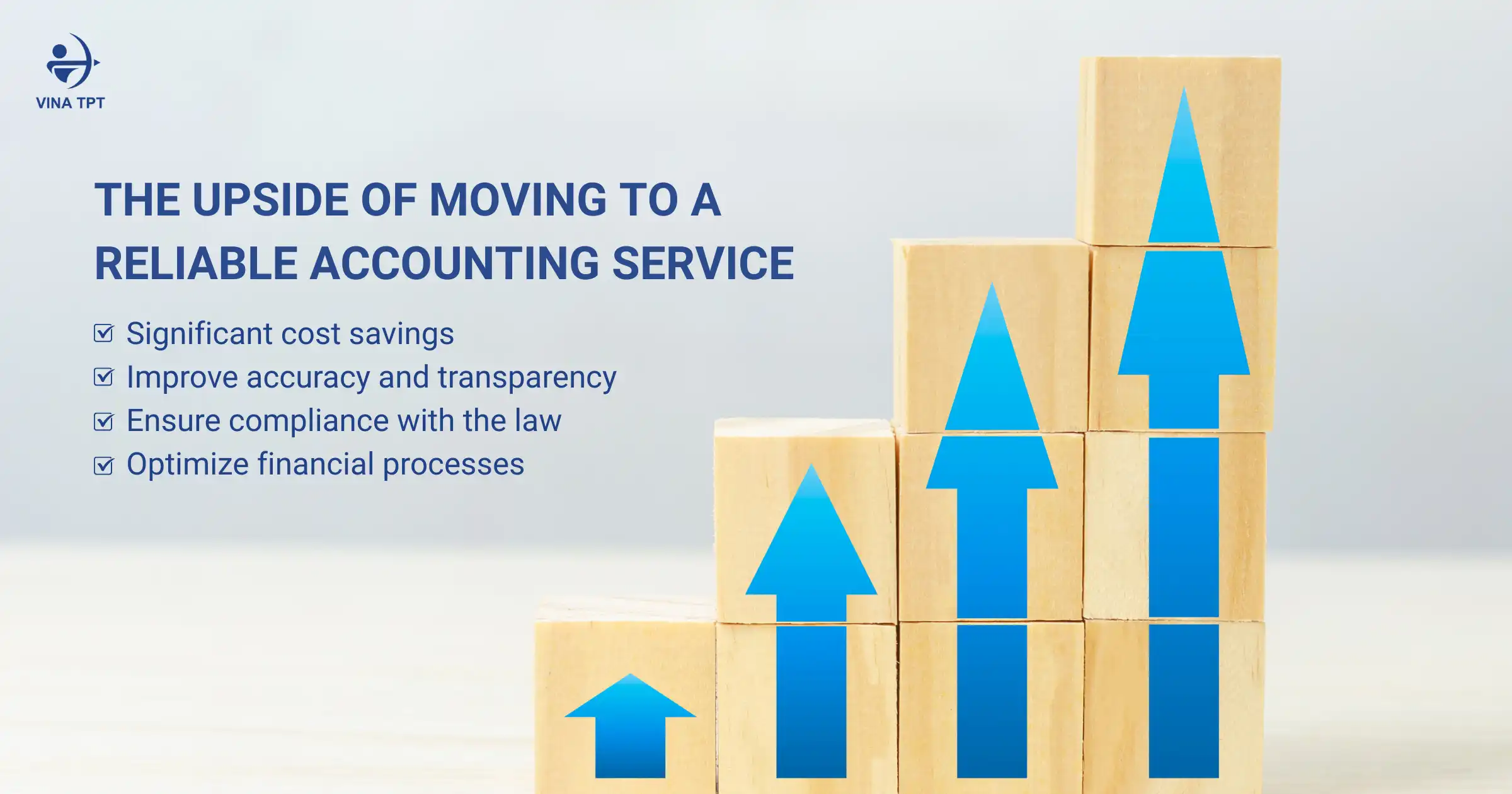
4. Key Benefits of Switching to a Reliable Bookkeeping Service Partner

When switching to a better service provider, businesses will receive:

  • Significant cost savings: No need to recruit, train, or maintain an internal accounting team.
  • Improve accuracy and transparency: Bookkeeping is standardized, consistent, and in compliance with regulations.
  • Ensure compliance with the law: Tax reporting and financial reporting are done on time and in compliance with regulations, avoiding the risk of being fined.
  • Optimize financial processes: A scientifically organized accounting system supports better decision making for the board of directors.

The Upside of Moving to a Reliable Accounting Service

5. Steps to Seamlessly Transition Bookkeeping Service

Transitioning to a new accounting unit will go smoothly if the business prepares properly. Here are simple but effective steps to reduce risks and avoid reporting disruptions:

Step 1: Assess the current state of bookkeeping services

Businesses need to review the quality of reports, progress of declaration submission, accuracy and coordination ability of the current accounting unit. From there, accurately determine the reason for the transition and specific requirements for the new unit.

Step 2: Prepare documents & data for handover

Including financial reports, books, tax declarations, labor contracts, software accounting data, and related documents. Arranging complete documents will help the new unit to receive quickly and not miss tax obligations.

Step 3: Make a detailed transition plan

Agree with the new accounting unit on the scope of work, start time, responsibilities of each party and method of receiving data. In this step, the business also determines the closing time to avoid duplication.

Step 4: Handover of books & check for completeness

All data is handed over according to the agreed list. The new unit will check for completeness, compare data and detect problems (if any) before official operation.

Step 5: Trial operation & adjustment

In the first 1-2 cycles (month or quarter), the new accounting unit will re-check the accounting, ensuring that tax reports and management reports are prepared correctly. If there are any discrepancies from the old unit, the two parties will immediately adjust to avoid tax risks.

Step 6: Officially switch to stable operation

After testing and comparison, the business can operate stably with the new accounting provider, ensuring a smooth, transparent process and in accordance with management requirements.

6. Why Vina TPT Is the Preferred Choice for Businesses

Vina TPT is considered the best bookkeeping services in Vietnam with many outstanding advantages:

Comprehensive and specialized services: From bookkeeping services, accounting services to complex tax consulting for FDI enterprises.

Ability to receive books at any time: Whether the enterprise transfers accounting services at the beginning, middle or end of the year, Vina TPT still ensures:

  • Review old data
  • Adjust errors
  • Complete unfinished records
  • Continue to record books for the next phase

All are done quickly – transparently – in compliance with the law.

Smooth transition process: Vina TPT has experience in handling interrupted records, incomplete books, or delayed tax reports.

Highly specialized team: Accounting – tax experts with many years of experience, knowledgeable about FDI enterprises and domestic enterprises.

BOOK A FREE CONSULTATION

 bookkeeping-services


Full-Service Accounting and Tax Solutions for Businesses in Vietnam

Professional accounting services Vietnam for businesses

1. Why Businesses in Vietnam Need Integrated Accounting and Tax Services

The legal environment in Vietnam requires businesses to comply with many strict regulations on accounting services Vietnam, tax services for businesses, social insurance and financial reporting. Changes in Vietnam Accounting Standards (VAS), regulations on electronic invoices or new tax policies often make it difficult for many businesses, especially SMEs and FDI companies, to update and apply.

Separating accounting and tax services can easily lead to overlaps, errors or inconsistent reporting, thereby increasing the risk of being overcharged, fined or losing credibility with management agencies. Therefore, integrated accounting services Vietnam or full-service accounting solutions that combine accounting and tax management in the same system – such as the professional accounting Vietnam model provided by Vina TPT – help businesses save costs, minimize errors and ensure comprehensive compliance.

2. Understanding the Scope of Full-Service Accounting Solution

To understand the value that full-service accounting solutions bring, businesses need to understand the comprehensive range of services that this model includes. A complete solution does not stop at simply recording and processing accounting books, but also fully integrates important service areas such as accounting services Vietnam, tax services for businesses, financial statement preparation and annual audit coordination (mandatory for all FDI companies), legal compliance consulting, and cash flow management support.. Especially for FDI companies or businesses that are expanding in scale, this service covers monthly bilingual financial statements (including the Income Statement), preparation of consolidated reports for the parent company, and reconciliation between Vietnamese Accounting Standards (VAS) and international standards such as IFRS (if any) or US GAAP.

Another difference of this model compared to traditional services is the integration between accounting and tax. Instead of having to work with many individual suppliers, businesses only need a single point of contact to ensure that all processes – from recording transactions, managing electronic invoices, preparing quarterly tax reports to year-end tax settlement – are implemented synchronously and accurately. This helps save a significant amount of time and personnel costs, while minimizing the risk of errors in auditing or tax inspection.

With a team of experienced experts in the field of professional accounting Vietnam, solutions from Vina TPT also bring strategic benefits when businesses can take advantage of accurate financial data systems to plan budgets, analyze profits and make timely investment decisions.

3. Key Tax Services That Support Business Growth and Compliance

Tax services for businesses play an important role in protecting finances and supporting business growth. In Vietnam, a comprehensive tax service package often includes:

  • Tax Planning & Advisory: Consulting on tax strategies to optimize financial obligations while still complying with the law.
  • Corporate Income Tax & VAT: Preparing and submitting corporate income tax and value-added tax declarations accurately and on time.
  • Personal Income Tax for Expatriates: Managing personal income tax for foreign employees, including declaration and settlement.
  • Tax Audit Support: Representing businesses in working with tax authorities during inspections and audits.

These services help businesses minimize the risk of late payment penalties, avoid additional costs and maintain a reputable image in the eyes of investors.

Professional accounting services Vietnam for businesses

4. How Professional Accounting Enhances Transparency and Efficiency

Using professional accounting Vietnam not only provides accurate financial reports but also increases transparency in the entire business operations. With a data system that is processed, standardized and continuously updated, the management board can monitor business performance in real time, thereby making faster and more accurate decisions on strategic issues such as capital allocation, cost control or investment planning. In particular, when combined with full-service accounting solutions including accounting services Vietnam and tax services for businesses, the business will own an integrated financial platform where all information from accounting to tax is managed synchronously and transparently. 

A professional accounting system also acts as an “early warning system”, helping to promptly detect potential problems such as unstable cash flow, over-budget costs, errors in electronic invoices or even signs of internal fraud. This is the key factor for businesses to proactively prevent risks, avoid administrative fines due to violations of tax and accounting regulations, and optimize financial management processes. 

With the support of reputable units such as Vina TPT, businesses also receive outstanding added value thanks to a team of experienced experts who understand Vietnamese accounting standards (VAS) and international accounting standards (IFRS, US GAAP – applied only when required by the parent company for consolidation). The combination of professional accounting services Vietnam and in-depth tax consulting services helps companies, especially SMEs and FDI, to ensure compliance with the law and improve financial forecasting capabilities, thereby increasing profits and consolidating their position in the Vietnamese and international markets.

START BUILDING TRANSPARENCY TODAY

5. Unlocking Strategic Value from Combined Accounting and Tax Solutions

Combining full-service accounting solutions with tax services for businesses not only helps businesses reduce the burden of procedures but also opens up many strategic values ​​for sustainable development. When accounting services Vietnam and tax services are deployed in the same system, all financial data – from recording transactions, preparing financial statements to tax settlement – are managed synchronously, ensuring accuracy and consistency. This is a key factor for the board of directors to make investment decisions, expand the market or restructure the business based on reliable data.

A prominent advantage of integrating accounting and tax services is the ability to provide real-time information. Standardized and continuously updated data helps businesses promptly identify profit trends, cost fluctuations, or cash flow risks. With this platform, managers can quickly adjust budget plans, optimize tax structures, and improve financial management efficiency without depending on many separate service providers. In particular, FDI enterprises or companies that are expanding their scale will benefit from bilingual reporting services, preparing consolidated reports according to Vietnamese accounting standards (VAS) and international accounting standards (IFRS, US GAAP). This not only helps meet the requirements of domestic management agencies but also supports financial data transparency for parent corporations and international investors.

Special Notes for FDI Companies

  • Monthly bilingual financial statements (including Income Statement) are prepared for parent company review.
  • Annual audit of financial statements is mandatory under Vietnamese regulations.
  • IFRS reporting is optional and only required when the parent company requests consolidated reports; VAS remains the primary standard for local compliance.

6. Partnering with Vina TPT for Reliable Financial Reporting

To achieve accuracy and transparency in both accounting and tax, choosing a reputable partner is a decisive factor. Vina TPT is a provider of full-service accounting solutions and tax services for businesses trusted by many FDI enterprises and SMEs in Vietnam.

With a team of experts with more than 15 years of experience and a deep understanding of Vietnamese accounting and tax laws, Vina TPT provides bilingual Vina TPT financial reporting (Vietnamese – English), ensuring compliance with both domestic management requirements and international standards.

From professional accounting to tax declaration and financial reporting services, Vina TPT not only ensures legal compliance but also acts as a strategic advisor, helping businesses optimize costs and maintain long-term competitive advantages.

Contact Vina TPT today for trusted full-service accounting and tax solutions in Vietnam.

BOOK A FREE CONSULTATION

Vina TPT Accounting services