Vietnam continues to be an attractive destination for FDI capital thanks to its strategic location, competitive costs, and continuously improving business environment. With the Law on Investment 2025 taking effect from March 1, 2026, the company incorporation process has become more flexible. In many cases, investors can now obtain the Enterprise Registration Certificate (ERC) before the Investment Registration Certificate (IRC).
However, understanding the legal procedures, required documents, timelines, and ongoing compliance obligations remains a challenge for many new foreign investors.
This article compiles the 12 most frequently asked questions by foreign investors when starting a business in Vietnam. The content is organized by stage to give you a clear overview of the entire process – from preparation to operation.
12 most frequently asked questions about starting a business in Vietnam 2026

1. Can foreigners own 100% of a company in Vietnam in 2026?
Most business sectors in Vietnam allow 100% foreign ownership. According to Vietnam’s WTO commitments and the Law on Investment 2025, only a few sectors, such as advertising, logistics, tourism, and education, may have ownership restrictions or require joint ventures with Vietnamese partners.
Tip: Check the business line code and market access conditions carefully before planning to avoid having to amend your application during the appraisal process.
2. What is the minimum charter capital required for a foreign-owned company?
Vietnamese law does not set a universal minimum charter capital for all sectors. However, the registered capital must be appropriate to the project scale and will be reviewed by the licensing authority.
In practice, common reference levels include:
- Trading and distribution: USD 10,000 – 50,000 (USD 10,000 is often considered the practical minimum)
- Fintech: around USD 2 million, depending on the business model and licensing requirements
- Commercial banks: approximately USD 120 million (under specialized regulations)
- Real estate: No fixed minimum, but a minimum equity ratio of 20% (for projects under 20 hectares) or 15% (for projects of 20 hectares and above) is required.
Important note: Charter capital must be fully contributed within 90 days from the date the Enterprise Registration Certificate (ERC) is issued. Failure to do so may result in administrative penalties and affect the company’s credibility with authorities and partners.
3. What documents must foreign investors prepare and do they require consular legalization?
Document preparation is a critical step when starting a business in Vietnam. The main required documents include:
- Application for investment project implementation
- Proof of the investor’s legal status (passport for individuals; Certificate of Incorporation for organizations)
- Investment project proposal (including objectives, scale, total investment capital, funding plan, location, timeline, and socio-economic impact assessment)
- Proof of financial capacity (bank statements or parent company support letter)
- Documents proving the project location (office lease agreement or proof of legal right to use the premises)
- Technology explanation (if the project requires technology appraisal)
- Business Cooperation Contract (BCC)
Important: All foreign documents must be consular legalized, notarized, and officially translated into Vietnamese. This is a mandatory requirement for the application to be accepted.
4. Which business lines are still conditional or restricted for foreign investors?
Approximately 80% of business lines in Vietnam have no conditions, allowing relatively straightforward operations after company registration.
However, investors should pay attention to:
- Conditional business lines: Education, healthcare, logistics, tourism, advertising, real estate, etc. (require sub-licenses, facilities, or professional capacity)
- Restricted market access sectors: May limit foreign ownership percentage or require joint ventures with Vietnamese partners
- Prohibited sectors: As stipulated by Vietnamese law
From July 1, 2026, the updated list of conditional business lines under the Law on Investment 2025 will be fully applied. Always verify your business line code and specific conditions before registration.
5. Should I choose a Limited Liability Company (LLC) or Joint Stock Company (JSC)?
The choice depends on your investment objectives, project scale, and future development plans.
- Limited Liability Company (LLC): Most popular among foreign investors due to its simple structure, high flexibility, and suitability for startups or medium-sized businesses.
- Joint Stock Company (JSC): Better suited for companies planning to raise capital from multiple investors or prepare for future listing.
For the initial stage of starting a business in Vietnam, an LLC is usually recommended. You can later convert to a JSC when scaling or seeking larger investments.

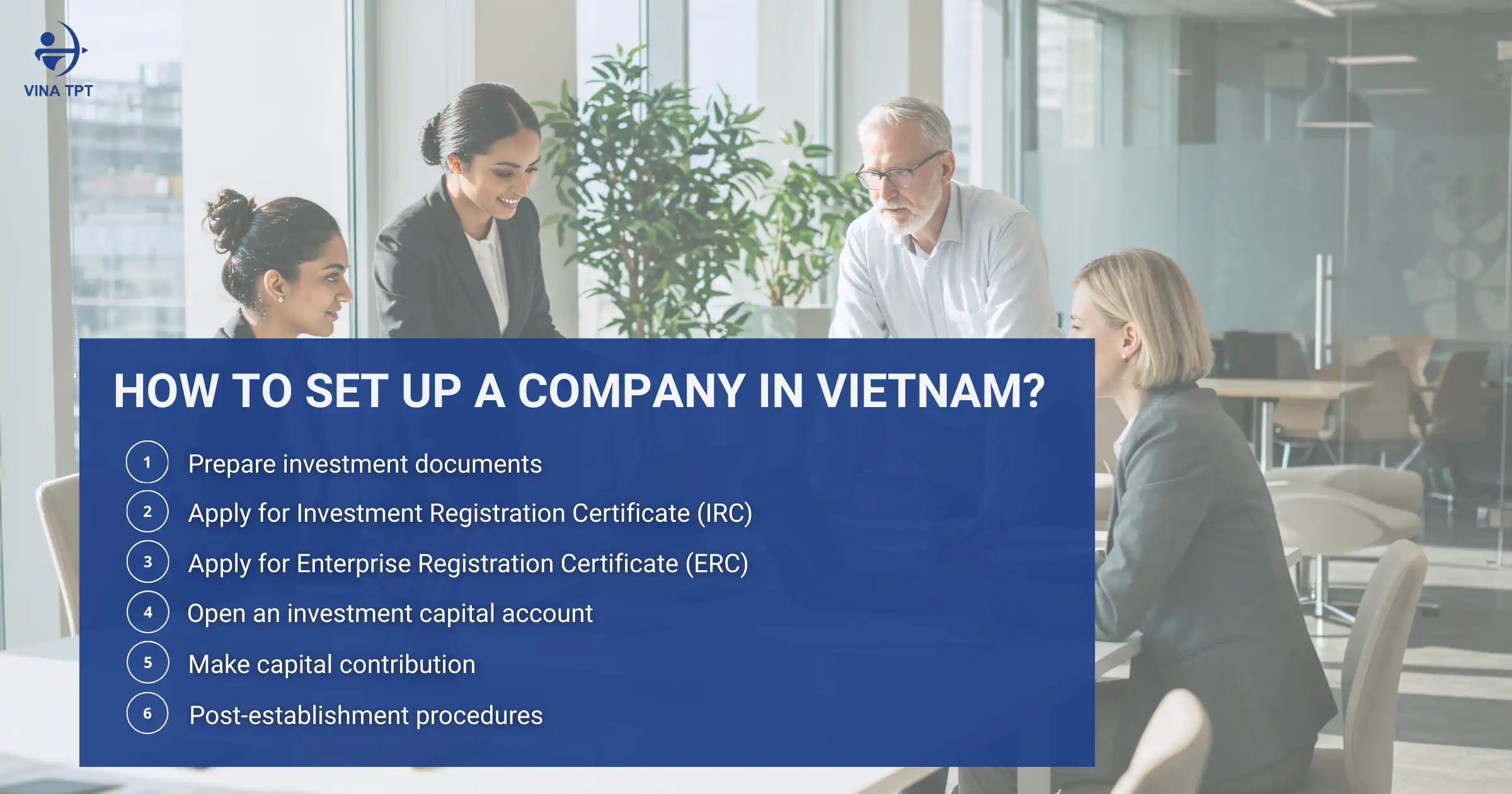
6. What is the difference between IRC and ERC under the new Investment Law 2026?
- IRC (Investment Registration Certificate): Approves the investment project, including capital, business lines, location, and incentives (if any).
- ERC (Enterprise Registration Certificate): Establishes the company’s legal entity status, including the tax code and business registration details.
Under the Law on Investment 2025, in non-restricted sectors, investors can apply for the ERC before the IRC. This allows the company to obtain legal status earlier for opening bank accounts, leasing offices, or applying for visas.
7. How long does it actually take to register a company in Vietnam in 2026?
The timeline depends on the project type and document quality. The process typically includes:
- Investment Registration Certificate (IRC): 30 – 45 working days
- Enterprise Registration Certificate (ERC): 7 – 10 working days after IRC approval
With complete and valid documents, the total process usually takes 6 to 8 weeks. Proper preparation and working with an experienced consultant can significantly reduce delays.
8. Do I need a Vietnamese legal representative or director?
Every company in Vietnam must have at least one legal representative residing in Vietnam. This person can be a Vietnamese citizen or a foreigner holding a valid Temporary Residence Card (TRC).
Foreign investors can serve as the legal representative themselves if they meet the residency requirements.
>>> You may also be interested in: Nominee Director in Vietnam: Legal Risks, Requirements, and Safer Alternatives for Foreign Investors (2026 Guide)
9. Can I apply for a Temporary Residence Card (TRC) during or right after registration?
Yes. Investors can apply for a TRC after the company receives its ERC and holds an appropriate DT visa (DT1-DT3 depending on capital contribution).
Processing time is typically 5-15 working days. Many investors apply for the TRC immediately after company registration to secure long-term residency.
>>> You may also be interested in: Guide to Securing a TRC Vietnam for Foreign Investors in 2026

10. What must I do immediately after receiving the Enterprise Registration Certificate (ERC)?
After receiving the ERC, you should promptly complete the following:
- Open an investment capital account (DICA) and fully contribute charter capital within 90 days
- Register for tax, obtain a digital signature, and issue electronic invoices
- Register and announce the company seal (if required)
- Register employees and social insurance (if hiring staff)
11. What are the key ongoing compliance obligations (tax, reporting, IAR…)?
Once operational, companies in Vietnam must fulfill regular compliance obligations, including:
- Declaration and payment of VAT, Corporate Income Tax (CIT), and Personal Income Tax (PIT)
- Submission of Investment Activity Reports (IAR) – quarterly and annually for FDI companies
- Preparation of annual financial statements (some companies require statutory audit)
- Updating any changes in company registration (capital, business lines, legal representative, etc.)
12. When and why should I consider outsourced financial accounting services?
It is highly recommended to engage outsourced accounting services from the early stage if you do not yet have an internal team familiar with VAS and Vietnamese tax regulations.
Outsourcing helps control costs, minimize compliance risks, and ensures timely, accurate financial reports for both management and investors.
Looking for a reliable accounting partner? Explore Vina TPT’s outsourced accounting services to find the right solution for your business.
Why choose Vina TPT for starting and operating your business in Vietnam
With over 20 years of experience supporting FDI enterprises, Vina TPT provides comprehensive solutions for foreign investors when starting a business in Vietnam:
- Full support for IRC, ERC, TRC, and work permit procedures
- Qualified Chief Accountant and outsourced finance & accounting services (bookkeeping, tax, payroll)
- Bilingual and multilingual reporting (Vietnamese – English – Japanese)
- End-to-end support from company formation through operations and expansion
Each client is supported by a multi-level expert team (Assistant – Senior – Manager), ensuring accuracy and timeliness.

Conclusion
With the Law on Investment 2025, starting a business in Vietnam has become more transparent and flexible. However, thorough preparation regarding documents, capital, and compliance obligations remains essential for success.
Partnering with a professional consulting firm will help you save time, reduce risks, and focus on your core business activities.
Contact Vina TPT today for personalized consultation and a tailored solution for your investment plan in Vietnam.