Starting a business in Vietnam: 12 frequently asked questions by foreign investors

starting-a-business-in-vietnam-12-frequently-asked-questions-by-foreign-investors

Vietnam continues to be an attractive destination for FDI capital thanks to its strategic location, competitive costs, and continuously improving business environment. With the Law on Investment 2025 taking effect from March 1, 2026, the company incorporation process has become more flexible. In many cases, investors can now obtain the Enterprise Registration Certificate (ERC) before the Investment Registration Certificate (IRC).

However, understanding the legal procedures, required documents, timelines, and ongoing compliance obligations remains a challenge for many new foreign investors.

This article compiles the 12 most frequently asked questions by foreign investors when starting a business in Vietnam. The content is organized by stage to give you a clear overview of the entire process – from preparation to operation.

12 most frequently asked questions about starting a business in Vietnam 2026

starting-a-business-in-vietnam-12-frequently-asked-questions-by-foreign-investors

1. Can foreigners own 100% of a company in Vietnam in 2026?

Most business sectors in Vietnam allow 100% foreign ownership. According to Vietnam’s WTO commitments and the Law on Investment 2025, only a few sectors, such as advertising, logistics, tourism, and education, may have ownership restrictions or require joint ventures with Vietnamese partners.

Tip: Check the business line code and market access conditions carefully before planning to avoid having to amend your application during the appraisal process.

2. What is the minimum charter capital required for a foreign-owned company?

Vietnamese law does not set a universal minimum charter capital for all sectors. However, the registered capital must be appropriate to the project scale and will be reviewed by the licensing authority.

In practice, common reference levels include:

  • Trading and distribution: USD 10,000 – 50,000 (USD 10,000 is often considered the practical minimum)
  • Fintech: around USD 2 million, depending on the business model and licensing requirements
  • Commercial banks: approximately USD 120 million (under specialized regulations)
  • Real estate: No fixed minimum, but a minimum equity ratio of 20% (for projects under 20 hectares) or 15% (for projects of 20 hectares and above) is required.

Important note: Charter capital must be fully contributed within 90 days from the date the Enterprise Registration Certificate (ERC) is issued. Failure to do so may result in administrative penalties and affect the company’s credibility with authorities and partners.

3. What documents must foreign investors prepare and do they require consular legalization?

Document preparation is a critical step when starting a business in Vietnam. The main required documents include:

  1. Application for investment project implementation
  2. Proof of the investor’s legal status (passport for individuals; Certificate of Incorporation for organizations)
  3. Investment project proposal (including objectives, scale, total investment capital, funding plan, location, timeline, and socio-economic impact assessment)
  4. Proof of financial capacity (bank statements or parent company support letter)
  5. Documents proving the project location (office lease agreement or proof of legal right to use the premises)
  6. Technology explanation (if the project requires technology appraisal)
  7. Business Cooperation Contract (BCC)

Important: All foreign documents must be consular legalized, notarized, and officially translated into Vietnamese. This is a mandatory requirement for the application to be accepted.

EXPLORE OUR SERVICES

4. Which business lines are still conditional or restricted for foreign investors?

Approximately 80% of business lines in Vietnam have no conditions, allowing relatively straightforward operations after company registration.

However, investors should pay attention to:

  • Conditional business lines: Education, healthcare, logistics, tourism, advertising, real estate, etc. (require sub-licenses, facilities, or professional capacity)
  • Restricted market access sectors: May limit foreign ownership percentage or require joint ventures with Vietnamese partners
  • Prohibited sectors: As stipulated by Vietnamese law

From July 1, 2026, the updated list of conditional business lines under the Law on Investment 2025 will be fully applied. Always verify your business line code and specific conditions before registration.

5. Should I choose a Limited Liability Company (LLC) or Joint Stock Company (JSC)?

The choice depends on your investment objectives, project scale, and future development plans.

  • Limited Liability Company (LLC): Most popular among foreign investors due to its simple structure, high flexibility, and suitability for startups or medium-sized businesses.
  • Joint Stock Company (JSC): Better suited for companies planning to raise capital from multiple investors or prepare for future listing.

For the initial stage of starting a business in Vietnam, an LLC is usually recommended. You can later convert to a JSC when scaling or seeking larger investments.

starting-a-business-in-vietnam-12-frequently-asked-questions-by-foreign-investors

6. What is the difference between IRC and ERC under the new Investment Law 2026?

  • IRC (Investment Registration Certificate): Approves the investment project, including capital, business lines, location, and incentives (if any).
  • ERC (Enterprise Registration Certificate): Establishes the company’s legal entity status, including the tax code and business registration details.

Under the Law on Investment 2025, in non-restricted sectors, investors can apply for the ERC before the IRC. This allows the company to obtain legal status earlier for opening bank accounts, leasing offices, or applying for visas.

7. How long does it actually take to register a company in Vietnam in 2026?

The timeline depends on the project type and document quality. The process typically includes:

  • Investment Registration Certificate (IRC): 30 – 45 working days
  • Enterprise Registration Certificate (ERC): 7 – 10 working days after IRC approval

With complete and valid documents, the total process usually takes 6 to 8 weeks. Proper preparation and working with an experienced consultant can significantly reduce delays.

EXPLORE OUR SERVICES

8. Do I need a Vietnamese legal representative or director?

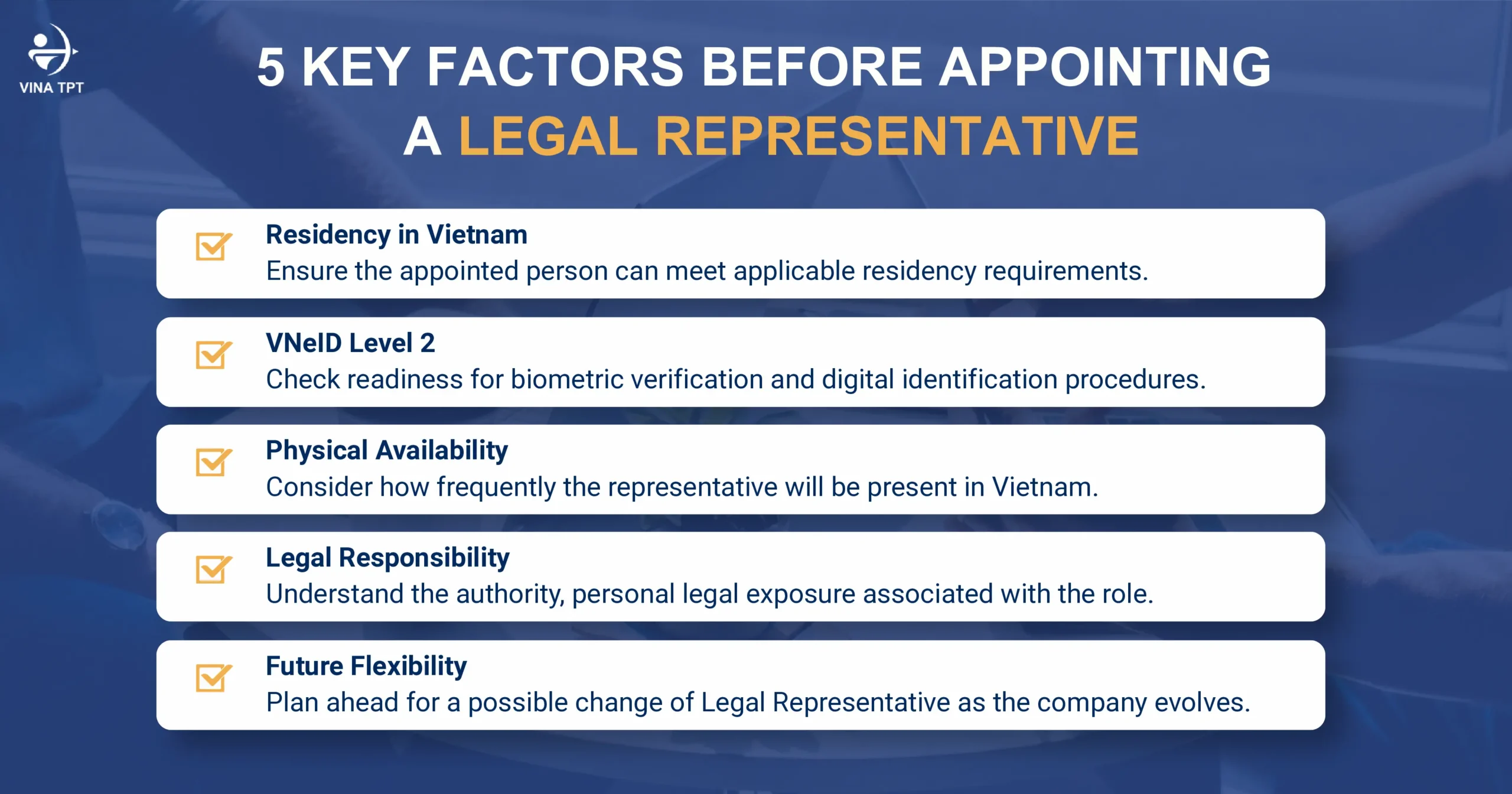
Every company in Vietnam must have at least one legal representative residing in Vietnam. This person can be a Vietnamese citizen or a foreigner holding a valid Temporary Residence Card (TRC).

Foreign investors can serve as the legal representative themselves if they meet the residency requirements.

>>> You may also be interested in: Nominee Director in Vietnam: Legal Risks, Requirements, and Safer Alternatives for Foreign Investors (2026 Guide)

9. Can I apply for a Temporary Residence Card (TRC) during or right after registration?

Yes. Investors can apply for a TRC after the company receives its ERC and holds an appropriate DT visa (DT1-DT3 depending on capital contribution).

Processing time is typically 5-15 working days. Many investors apply for the TRC immediately after company registration to secure long-term residency.

>>> You may also be interested in: Guide to Securing a TRC Vietnam for Foreign Investors in 2026

starting-a-business-in-vietnam-12-frequently-asked-questions-by-foreign-investors

10. What must I do immediately after receiving the Enterprise Registration Certificate (ERC)?

After receiving the ERC, you should promptly complete the following:

  • Open an investment capital account (DICA) and fully contribute charter capital within 90 days
  • Register for tax, obtain a digital signature, and issue electronic invoices
  • Register and announce the company seal (if required)
  • Register employees and social insurance (if hiring staff)

11. What are the key ongoing compliance obligations (tax, reporting, IAR…)?

Once operational, companies in Vietnam must fulfill regular compliance obligations, including:

  • Declaration and payment of VAT, Corporate Income Tax (CIT), and Personal Income Tax (PIT)
  • Submission of Investment Activity Reports (IAR) – quarterly and annually for FDI companies
  • Preparation of annual financial statements (some companies require statutory audit)
  • Updating any changes in company registration (capital, business lines, legal representative, etc.)

12. When and why should I consider outsourced financial accounting services?

It is highly recommended to engage outsourced accounting services from the early stage if you do not yet have an internal team familiar with VAS and Vietnamese tax regulations.

Outsourcing helps control costs, minimize compliance risks, and ensures timely, accurate financial reports for both management and investors.

Looking for a reliable accounting partner? Explore Vina TPT’s outsourced accounting services to find the right solution for your business.

Explore Accounting Service

Why choose Vina TPT for starting and operating your business in Vietnam

With over 20 years of experience supporting FDI enterprises, Vina TPT provides comprehensive solutions for foreign investors when starting a business in Vietnam:

  • Full support for IRC, ERC, TRC, and work permit procedures
  • Qualified Chief Accountant and outsourced finance & accounting services (bookkeeping, tax, payroll)
  • Bilingual and multilingual reporting (Vietnamese – English – Japanese)
  • End-to-end support from company formation through operations and expansion

Each client is supported by a multi-level expert team (Assistant – Senior – Manager), ensuring accuracy and timeliness.

starting-a-business-in-vietnam-12-frequently-asked-questions-by-foreign-investors

Conclusion

With the Law on Investment 2025, starting a business in Vietnam has become more transparent and flexible. However, thorough preparation regarding documents, capital, and compliance obligations remains essential for success.

Partnering with a professional consulting firm will help you save time, reduce risks, and focus on your core business activities.

Contact Vina TPT today for personalized consultation and a tailored solution for your investment plan in Vietnam.

BOOK A FREE CONSULTATION

Nominee Director Vietnam: Legal risks, requirements, and safer alternatives for foreign investors (2026 Guide)

nominee-director-in-vietnam

Foreign investors often face challenges when establishing a company in Vietnam, particularly in appointing a legal representative. Vietnamese law requires at least one individual who resides in Vietnam to serve in this role. As a result, many investors consider using a Nominee Director Vietnam – a person who appears on official documents but does not actively participate in day-to-day management.

However, significant changes took effect in 2025-2026. The amended Law on Enterprises 2025 and Decree 168/2025 introduced strict requirements for disclosing Ultimate Beneficial Owners (UBO). A Nominee Director is no longer a simple way to maintain anonymity. Attempting to conceal the true owner can lead to heavy administrative fines, legal disputes, and even loss of control over the company.

This article explains the concept, reasons for use, legal requirements, and major risks of using a Nominee Director in Vietnam. It also presents safer, more transparent alternatives for FDI enterprises.

1. What is a Nominee Director Vietnam?

A Nominee Director in Vietnam is an individual appointed as the legal representative on official company registration documents, mainly to satisfy the legal requirement that at least one legal representative must reside in Vietnam. In most cases, this person does not participate in the company’s actual management.

To understand clearly, it is important to distinguish three key concepts:

  • Legal Representative: Under the Law on Enterprises 2025, every company in Vietnam must have at least one legal representative who resides in Vietnam. This person bears full legal responsibility for signing contracts, representing the company before state authorities, banks, and partners, and ensuring compliance with tax and labor obligations.
  • Nominee Director: This is a method of appointing a legal representative where the individual is named on paper to satisfy legal requirements but does not participate in actual management. Real control remains with the foreign investor through internal agreements.
  • Nominee Shareholder: This relates to ownership of shares or capital contributions. The nominee holds the shares on paper but is not necessarily the legal representative. These are two entirely different roles.

Even with internal agreements, Vietnamese law still holds the appointed legal representative fully accountable. Therefore, a Nominee Director Vietnam is only a temporary solution and carries significant risks – especially after mandatory transparent UBO disclosure began in 2025.

2. Why do foreign investors consider using a Nominee Director Vietnam?

Although the risks are increasing, many foreign investors still consider using a Nominee Director in Vietnam during the early stages of starting a business in Vietnam. Here are the most common reasons:

  • They do not yet reside permanently in Vietnam or lack a TRC and work permit: Most foreign investors are not ready or able to relocate to Vietnam immediately. Obtaining a Temporary Residence Card (TRC) and work permit requires time and separate procedures. While waiting, they need a legally residing representative to allow the company to operate. A Nominee Director serves as a temporary solution to meet the legal requirement of having a representative who resides in Vietnam.
  • They want to speed up the company incorporation process: The IRC/ERC registration process can sometimes be delayed due to project approval or document preparation. Appointing a Nominee Director allows the company to complete registration faster, open bank accounts, and begin certain operations without waiting for the main investor to be physically present in Vietnam.
  • Certain business sectors require clear “local presence”: Even though the Law on Investment 2025 has opened the market further, some conditional or restricted sectors – such as logistics, education, advertising, and tourism – still exist. In these cases, having a Vietnamese-named legal representative on paper can make the application smoother and create a stronger impression of “local presence” when dealing with partners and government authorities.
  • To reduce the initial administrative and management burden on the parent company: When establishing a subsidiary or branch in Vietnam, headquarters often prefer to focus on high-level strategy rather than daily administrative tasks. Using a Nominee Director helps reduce the workload related to legal procedures, signing minor contracts, and dealing with state agencies in the early phase – saving time and internal resources for the parent company.

Important Note: While these reasons may seem practical in the initial stage, using a Nominee Director should only be a temporary solution. With the mandatory Ultimate Beneficial Owner (UBO) disclosure requirements effective from 2025, long-term use of a Nominee Director has become increasingly risky and is no longer aligned with Vietnam’s push toward greater transparency in the investment environment.

3. Legal requirements for Directors and Legal Representatives in Vietnam

According to the Law on Enterprises and related regulations, a legal representative must meet these conditions:

  • Be an individual (Vietnamese or foreign) residing in Vietnam.
  • Be at least 18 years old and have full legal capacity.
  • Be responsible for signing contracts, representing the company before authorities, and ensuring overall compliance.
  • Have no prohibitions on establishing or managing enterprises in Vietnam (including no bankruptcy declarations).

Companies must always maintain at least one legal representative residing in Vietnam. If this person leaves the country, they must provide a written power of attorney to another resident. They remain fully responsible for the actions of the authorized person.

DISCOVER HOW WE SUPPORT YOUR BUSINESS GROWTH

4. Major legal risks of using a Nominee Director Vietnam

This is the highest-risk area for foreign investors, especially after the UBO regulations took effect:

  • Loss of company control: The Nominee Director has actual legal authority to sign contracts, borrow money, transfer assets, or even dissolve the company. In disputes, courts typically recognize the nominee as the legitimate representative.
  • UBO disclosure risks: Hiding or misdeclaring the ultimate beneficial owner violates Decree 168/2025. This can result in heavy administrative fines or even revocation of the investment project if considered a “sham transaction.”
  • Civil and criminal liability: Both the nominee and the real beneficial owner may be jointly liable for tax debts, labor violations, or economic crimes. Cases where the nominee “disappears” or demands extra benefits often lead to prolonged litigation.
  • Internal agreements are often unenforceable: Powers of attorney or indemnity agreements can be declared invalid by courts if they are seen as attempts to conceal the true purpose.
  • Risks to FDI projects: Authorities may revoke the Investment Registration Certificate (IRC) or Enterprise Registration Certificate (ERC) if a nominee structure is found to circumvent foreign ownership restrictions.

In practice, many disputes have resulted in asset loss, operational disruption, and significant financial damage for foreign investors.

nominee-director-in-vietnam

5. Are there safer alternatives to a Nominee Director Vietnam?

Yes. Foreign investors can choose more transparent and secure options that still meet the legal representative requirement while maintaining control and complying with UBO disclosure rules.

Recommended alternatives include:

  • Appointing the foreign investor directly as director combined with obtaining a TRC Vietnam
  • Using a Qualified Chief Accountant service (a licensed professional who can serve as legal representative)
  • Implementing a dual legal representative mechanism (one local and one foreign)
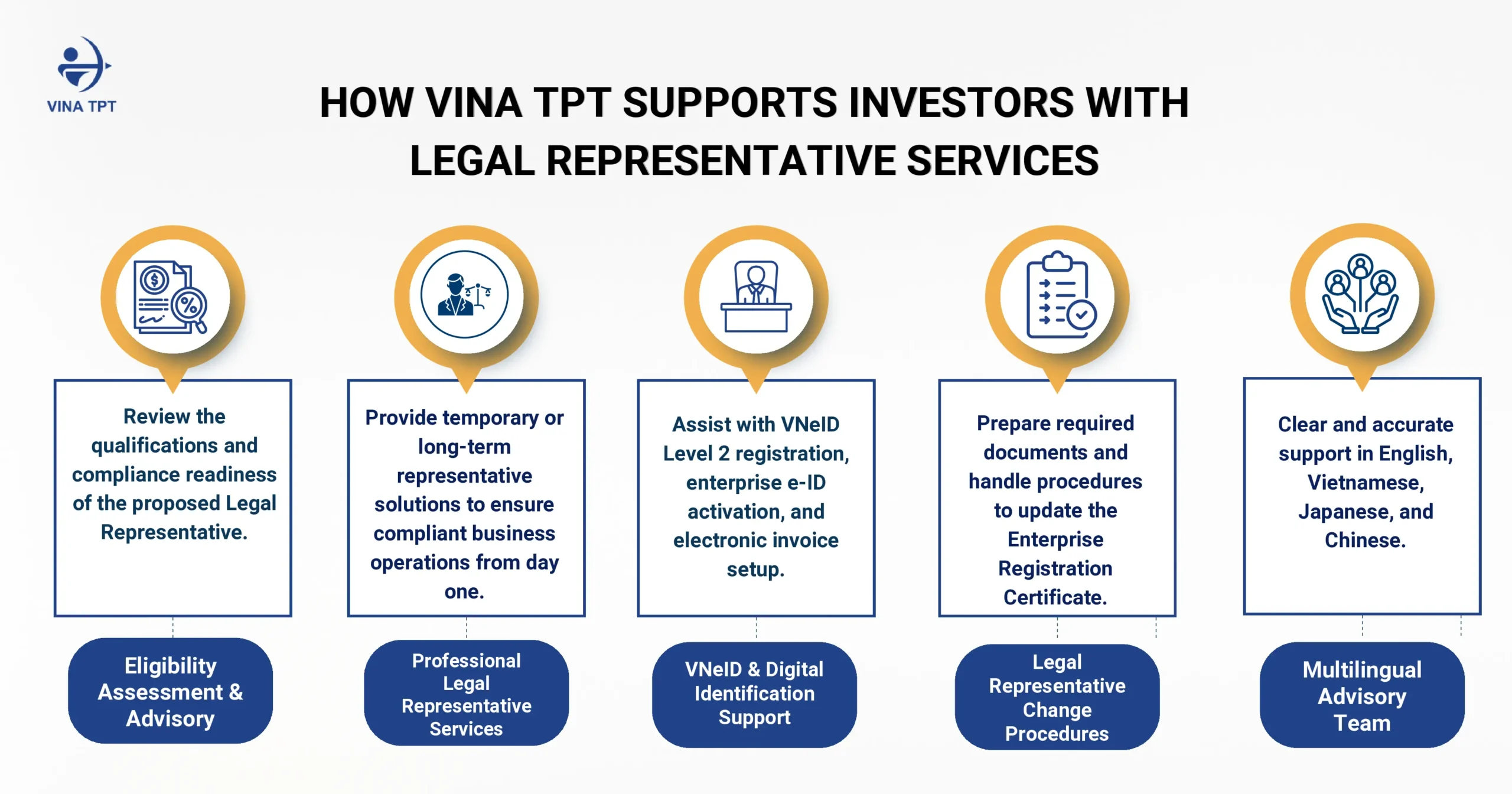
  • Engaging a professional legal representative service

These solutions prioritize transparency, reduce risks, and support long-term sustainable operations. However, in certain transitional situations, such as when the investor is still abroad or has not yet completed legal requirements, a Nominee Director may still be used temporarily with strong safeguards.

nominee-director-in-vietnam

6. How to choose a reliable Nominee Director Vietnam service (If Needed)

If you still need a nominee director during the transition period, pay close attention to these factors to minimize risks:

  • Clear and robust contracts: The agreement must clearly define responsibilities, indemnity clauses, scope of power of attorney, and control mechanisms to ensure real control remains with the investor.
  • Reputable service provider: Choose a provider with a clear legal entity, proven experience, and the ability to support UBO compliance under Decree 168/2025.
  • Independent legal review: Have an independent legal advisor review all contracts to avoid gaps and ensure balanced rights between parties.
  • Avoid choosing based solely on price: Low-cost services that lack transparency or proper control processes often carry hidden long-term risks.

A Nominee Director should only be used when truly necessary and for a short period. Combine it with strong internal controls to limit future disputes or legal liability.

How Vina TPT supports foreign investors with company setup & compliance

With more than 20 years of experience assisting FDI enterprises, Vina TPT understands the challenges foreign investors face during company incorporation — especially when considering a Nominee Director to meet legal requirements.

Instead of relying on high-risk solutions, Vina TPT offers comprehensive and transparent alternatives, including:

  • Advice on capital structuring and FDI company establishment (IRC/ERC)
  • Support for appointing a suitable legal representative, including Qualified Chief Accountant services
  • Outsourced finance and accounting, tax compliance, and payroll services
  • Assistance with TRC Vietnam applications and work permit exemptions for investors
  • Guidance on UBO disclosure and compliance under Decree 168/2025

In an environment where UBO regulations are increasingly strict, using a Nominee Director is no longer a safe long-term option. Non-transparent structures can lead to legal, financial, and operational risks.

Choosing a transparent structure, working with professional services, and ensuring full legal compliance not only minimizes risks but also enhances credibility and supports sustainable growth for your FDI business in Vietnam.

Contact Vina TPT today for expert advice on company establishment, capital structuring, legal representative appointment, and tailored finance & accounting solutions for your investment model.

BOOK A FREE CONSULTATION