Capital Contribution and Business Setup for Foreign Investment in Vietnam

Capital-Contribution-and-Business-Setup-for-Foreign-Investment-in-Vietnam-Vina-TPT

Capital-Contribution-and-Business-Setup-for-Foreign-Investment-in-Vietnam-Vina-TPT

1. Understanding Capital Contribution Requirements for Foreign investment in vietnam

Capital contribution is the most important step when establishing an FDI enterprise. According to Vietnamese law, foreign investors should note:

  • Minimum capital: Vietnam does not require a general legal capital level, but the charter capital must be appropriate and demonstrate the ability to implement the business model. Some specific industries (education, real estate, e-commerce, etc.) have higher capital requirements.
  • Form of capital contribution: Investors can contribute capital in cash, machinery and equipment, assets, intellectual property rights, or other legal assets.
  • Capital contribution period: Usually must be completed within 90 days from the date of issuance of the Certificate of Business Registration (or according to the period stated in the Investment Registration Certificate).

Determining capital accurately from the beginning helps reduce legal risks and limit capital adjustments later.

2. Types of Foreign Investment in Vietnam

When choosing a form of investment in Vietnam, investors need to consider their business objectives, project scale, level of control and desired scope of operations. Vietnam allows for a variety of flexible legal models, from establishing a new business to opening a branch or representative office. Each form carries different levels of risk, costs and compliance obligations, so choosing the right one at the outset will have a big impact on investment performance and long-term strategy.

Below are the most common forms of FDI in Vietnam:

Type Suitable for Advantages Disadvantages
Limited Liability Company (LLC) Small & medium enterprises

Investors needing strong control

Simple structure

Easy to operate

High control

Fast setup

Hard to raise capital

Extra procedures to convert to JSC

Joint Stock Company (JSC) Businesses expanding strongly

Companies seeking fundraising

Easy capital raising Fit for large/multinational projects

Flexible share transfer

Good for future IPO

Complex governance

More management bodies required

Higher compliance cost

Branch of Foreign Traders Foreign companies in eligible sectors Can conduct profit-making activities

No new legal entity required

Operate under parent company

Limited to specific industries

Dependent on parent company

Hard to scale like an independent entity

Representative Office (RO) Market research stage

Building partner networks

Simple setup

Low cost

No CIT applied

Cannot generate revenue

Cannot sign commercial contracts

Not suitable for long-term investment

Choosing the appropriate form of FDI helps investors optimize costs, reduce legal risks and ensure that their business strategy in Vietnam is effectively implemented. For small and medium-sized projects, LLC is often the optimal choice; for strong expansion plans or many shareholders, JSC is more suitable. Meanwhile, branches and representative offices serve the purpose of market presence without the need to establish a new legal entity.

3. Steps to Set Up a Company with Capital Contribution

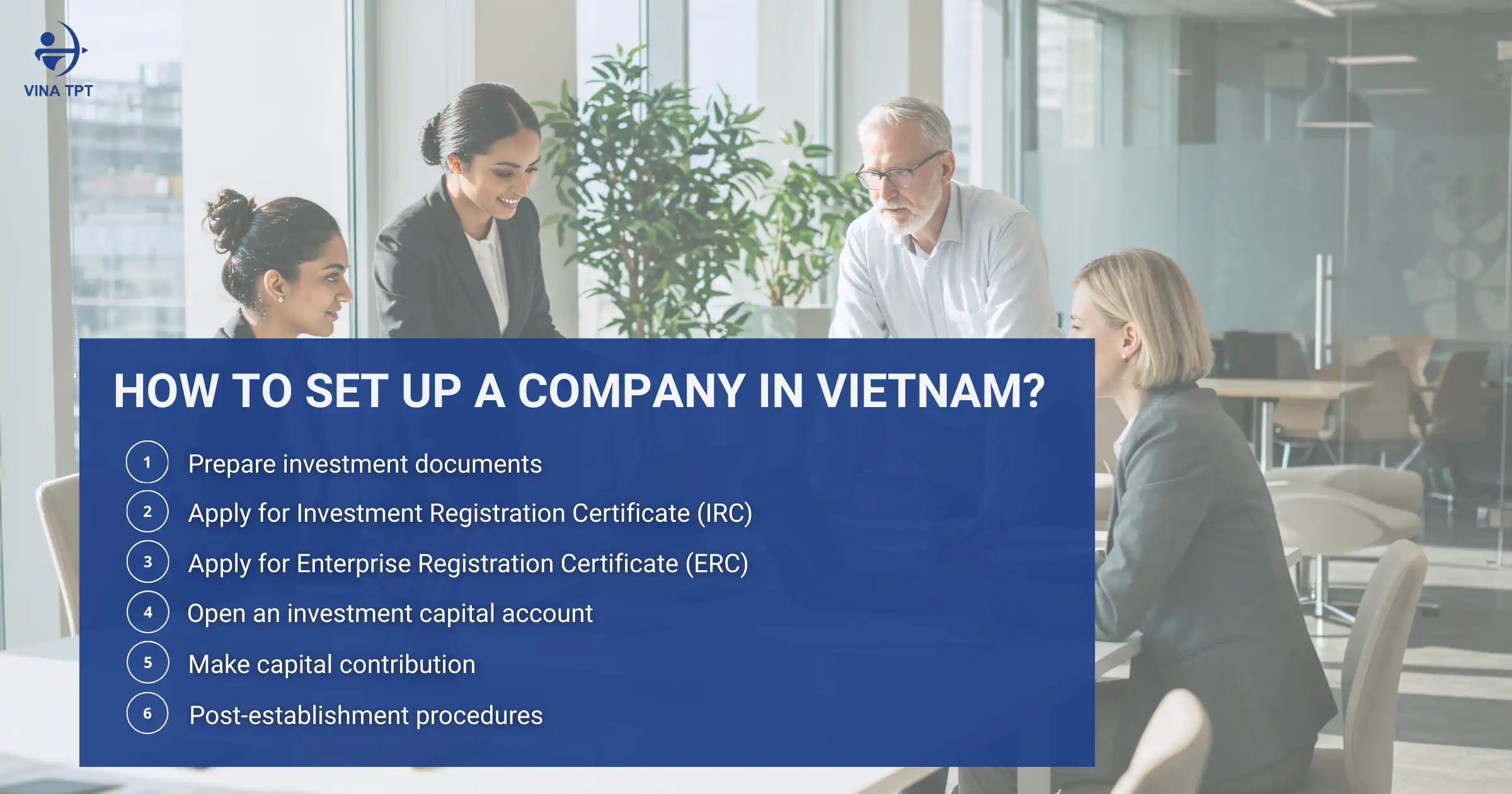
When setting up a Foreign investment in Vietnam, investors need to take the following main steps:

Step 1: Prepare investment documents

  • Investor information
  • Financial capacity report
  • Business plan
  • Headquarters lease contract, company charter

Step 2: Apply for Investment Registration Certificate (IRC): Confirm investment project and capital structure. Processing time: 15-30 days.

Step 3: Apply for Enterprise Registration Certificate (ERC): Officially establish the enterprise. Time: 3-5 days.

Step 4: Open an investment capital account: Required for FDI enterprises, used to receive capital from abroad.

Step 5: Make capital contribution: Investors transfer capital on time and complete the report.

Step 6: Post-establishment procedures

  • Tax registration
  • Digital signature
  • Corporate seal
  • Labor and insurance registration (if required)
Capital-Contribution-and-Business-Setup-for-Foreign-Investment-in-Vietnam-Vina-TPT

4. Compliance and Reporting Obligations

Foreign investment in Vietnam must ensure full compliance with the following regulations:

  • Capital contribution progress report
  • Accounting and bookkeeping according to VAS standards
  • Periodic tax declaration (VAT, CIT, PIT)
  • Annual financial report
  • Notification of changes in capital, headquarters, and representative

Non-compliance may result in administrative fines, restrictions on operations, or capital adjustment requirements.

AVOID COSTLY COMPLIANCE RISKS

5. Benefits of Proper Capital Contribution Management

Managing and implementing capital contribution in accordance with regulations is not only a legal requirement but also brings many practical values ​​to FDI enterprises in Vietnam:

Avoid legal risks and penalties

  • Contributing capital on time helps avoid administrative penalties.
  • Avoid being required to reduce charter capital or adjust the Investment Certificate.
  • Limit risks when checking, inspecting or working with banks.

Protecting investors’ ownership rights and capital contribution ratios

  • Clearly record the ownership ratio, voting rights and interests of each shareholder.
  • Avoid internal disputes, especially with investors from many different countries.
  • Increase transparency when planning to transfer shares or raise capital.

Increase the level of trust with banks, partners and management agencies

  • Adequate charter capital is an important factor in expanding credit limits.
  • Demonstrate the financial capacity and long-term commitment of investors in Vietnam.
  • Help partners and suppliers feel secure when signing contracts.

Optimize taxes and cash flow

  • A reasonable capital structure helps reduce the risk of transfer pricing adjustments and avoid tax disputes.
  • Easily control cash flow in and out through investment capital accounts.
  • Increase the ability to plan finances and operating budgets.

Create a solid foundation for expansion

  • Easy to add capital, open more branches or change the scope of the project.
  • Convenient when upgrading the type of business or expanding to a new industry.
  • Support the process of calling for more investors or strategic cooperation.

Increase long-term enterprise value

  • Enterprises with a transparent history of capital contribution are often highly appreciated when evaluating M&A.
  • Increase attractiveness to investment funds and global partners.
  • Create a competitive advantage when negotiating large contracts.

Minimize risks during divestment

  • Easily determine the value of the capital contribution when the investor wants to withdraw capital.
  • Reduce disputes due to the difference between actual capital contribution and registered capital.
  • Optimize tax benefits when transferring capital.

6. How Vina TPT Supports FDI Company Formation

Vina TPT Company Formation provides a complete package of support for the process of establishing and operating FDI enterprises:

  • Consulting on conditions for capital contribution and business lines
  • Preparing and submitting IRC & ERC documents
  • Shareholding structure, ownership ratio, charter
  • Support for opening investment capital accounts, guidance on capital contribution
  • Accounting – tax services – compliance with Vietnamese regulations
  • Consulting throughout for investors in operations and expansion

With experience working with international enterprises, Vina TPT ensures that the investment process in Vietnam becomes clear, safe and effective.

BOOK A FREE CONSULTATION

Laywer-Establish-business-Vietnam-VinaTPT

Business setup and operational licensing for Chinese hotpot and bubble tea chains in Vietnam

Business setup and operational licensing for Chinese hotpot and bubble tea chains in Vietnam

Business setup and operational licensing for Chinese hotpot and bubble tea chains in Vietnam

1. Why Chinese Hotpot and Bubble Tea Chains Are Eyeing Vietnam Now

In recent years, Vietnam has become a top attractive destination to register a company in the fields of hotpot and bubble tea chains from China. This attraction comes from the impressive growth rate of the F&B market, the strong expansion of the middle class, and the experiential consumption trend of Gen Z in large cities such as Ho Chi Minh City, Hanoi and Da Nang.

According to a report by Vietnam Briefing (2024), the scale of the food service industry in Vietnam has reached 688.8 trillion VND, equivalent to about 27.3 billion USD, an increase of 16.6% compared to the previous year. Similarly, research by iPOS.vn and Nestlé Professional shows that the Vietnamese F&B industry will maintain a growth rate of about 9.6% per year in the period 2024-2025. Looking further ahead, Mordor Intelligence estimates that the Vietnamese food-service market will reach a size of 41.22 billion USD by 2030, with an average growth rate of 10.7%/year.

These figures clearly reflect the huge potential of the Vietnamese culinary industry, where the demand for dine-out and chain models is growing. With advantages in raw material supply, reasonable premises costs and a young population that loves to experience, Vietnam is becoming a “golden land” for hotpot and bubble tea brands from China.

However, opportunities always go hand in hand with challenges. To be successful, brands not only need to understand the procedures for registering a company or the company formation process, but also need to deeply understand local culinary culture, taste and consumer behavior, key factors that help turn the market boom into a sustainable advantage.

2. The Real Challenge: Localization, Not Just Licensing

Many Chinese brands entering Vietnam face difficulties not in licensing, but in adapting to the market (localization).

Vietnamese people prefer lighter, less spicy, less greasy tastes compared to Chinese cuisine. In addition, rental costs in central areas are increasing rapidly, while requirements for experience space, especially for high-end hotpot models, are increasingly strict.

Human resources to operate a chain of many branches is also a big challenge. Chinese brands inherently have a methodical process, but when applied in Vietnam, they need to standardize training, quality control and service processes to ensure consistency.

Therefore, licensing is just the tip of the iceberg. The bigger problem lies in adapting the operating model to suit the consumer culture and legal environment in Vietnam.

register-a-company

3. Choosing the Right Entry Model: Direct Ownership vs. Master Franchise

Before starting to register a company, investors need to determine the market penetration model. There are two popular strategies:

Direct Ownership (Self-investment and operation)

  • Advantages: Full control over the brand, product quality and customer experience.
  • Disadvantages: High investment costs, longer time to apply for licenses and set up operations.
  • Suitable for: Large brands that want to build a high-end image, create the first flagship store in Vietnam.

Master Franchise (Regional franchising)

  • Advantages: Helps brands expand quickly, reduce financial risks and take advantage of local networks.
  • Disadvantages: Requires a clear mechanism for quality monitoring, training and profit sharing.
  • Suitable for: Bubble tea chains or fast-casual hotpots that want to quickly cover the market.

In fact, many Chinese brands have chosen to combine both models: opening the first store directly to control the image, then franchising to expand to other provinces and cities.

Whichever direction is chosen, investors need to follow the company formation process and comply with the legal regulations on franchise business in Vietnam – including registering the franchise contract with the Ministry of Industry and Trade and periodically declaring taxes.

GET EXPERT GUIDANCE ON ENTRY MODELS

4. Building a Compliant but Scalable Operation

For hotpot or bubble tea chains to expand sustainably in Vietnam, building a legal foundation and licensing right from the beginning is a vital factor. Many international F&B brands have encountered difficulties when developing in Vietnam not because of their products or marketing strategies, but because they have not established a tight legal and operational system from the beginning. When starting a business in Vietnam, F&B businesses need to complete the following procedures:

  • Investment Registration Certificate (IRC) if there is a foreign capital element.
  • Enterprise Registration Certificate (ERC) to legally establish a company in Vietnam.
  • Registering conditional business codes: including food and beverage (5610), food processing (1079), and beverages (4722).

The estimated time for completion is:

  • Document preparation: 1-2 weeks, depending on the volume of documents and the level of complexity.
  • IRC appraisal: 20-45 working days.
  • ERC issuance: 10-20 working days after IRC (or similar if the enterprise is a domestic enterprise).

Applying for “sub-licenses” (operational licenses) including:

  • Food Safety Certificate.
  • Fire prevention and fighting license for each facility.
  • Alcohol sales license (if any).
  • Registering environmental and labor hygiene according to the scale of the restaurant.

These licenses are issued by different agencies (Department of Finance, Department of Food Safety, Fire Police…), so it requires smooth coordination in the documents. 

5. Your Strategic Next Step

As the Vietnamese F&B market is entering a period of fierce competition, having a consulting partner with a good understanding of the local legal and business environment will not only help businesses “open a shop”, but also “build a sustainable brand”. This is the value that Vina TPT company registration brings to F&B chains from China.

With more than 20 years of experience in registering a company and consulting on company formation for foreign businesses, Vina TPT has a deep understanding of each stage that a brand must go through – from the initial market survey, choosing an investment model, to completing legal documents and implementing chain operations.

Vina TPT’s team of experts not only handles administrative procedures, but also accompanies businesses as strategic advisors, helping them:

  • Consulting on suitable legal models: choosing between 100% foreign capital, joint ventures, or franchise business to optimize control and cost advantages.
  • Set up a complete investment profile & business registration package: prepare all IRC, ERC documents, register conditional industry codes for F&B, and apply for operating licenses.
  • Ensure compliance with local regulations: detailed guidance on tax, accounting, human resource management, and standardize operating procedures to meet inspection and testing requirements.

With professional support from Vina TPT company registration, businesses no longer have to worry about legal risks or complicated procedures – instead, they can focus all their efforts on developing their brand, improving customer experience and expanding market share in one of the most dynamic F&B markets in Southeast Asia.

Let Vina TPT become your strategic partner to help you start your business journey in Vietnam legally, effectively and sustainably.

CONTACT YOUR EXPERTS

register-a-company

Starting a Korean BBQ or Café in Vietnam? Here’s a 4-Step Registration Guide

 business-license-in-vietnam

1. Why Korean F&B Brands Are Thriving in Vietnam

Business license in Vietnam is a crucial step for any foreign F&B brand looking to enter the market. In recent years, Vietnam has become one of the fastest growing F&B markets in Southeast Asia, with spending on food and entertainment accounting for more than 35% of young consumers’ total disposable income. The booming middle class, the growing popularity of “eating out”, and the strong influence of Hallyu (Korean Wave) culture have created ideal conditions for Korean food brands to expand their business.

From Korean BBQ chains, Seoul-style cafes, to dessert shops, Vietnamese consumers especially Gen Z and Millennials see enjoying Korean food as a cultural experience rather than just eating. This explains why many Korean brands, from traditional restaurants to franchised coffee chains, are choosing Vietnam as their second strategic move after Korea.

However, behind that attractive potential are a series of legal challenges that foreign investors need to understand. Many Korean brands encounter difficulties when setting up a business in Vietnam (enterprise registration), applying for an F&B business license, or completing food safety and hygiene certifications. Therefore, understanding the correct legal establishment process is the first factor that determines success when establishing a business in Vietnam.

Before going into the licensing process, you can consider a few concepts that are very popular in Vietnam: Korean tabletop BBQ, K-café & dessert, fast-casual K-food (fried chicken, mixed rice), and fusion/comfort food concepts. Each concept will affect the scale, location, and type of license required, so you should determine the concept before starting

 business-license-in-vietnam


2. Step 1 – Understanding Vietnam’s F&B Business License Requirements

To open a restaurant or cafe in Vietnam, Korean investors need the following types of business licenses in Vietnam:

  • Investment Registration Certificate (IRC): certifying that the company legally authorizes an investment project and records its key details
  • Enterprise Registration Certificate (ERC): certifying that the company is legal and allowed to operate in Vietnam.
  • Food Safety and Hygiene Certificate: required for food processing or serving establishments.
  • Fire Safety Certificate: ensures that the location meets fire prevention and fighting standards.
  • Other local permits: such as sign registration, environmental license (if there is a food production scale).

Full preparation of these business license in Vietnam helps companies operate legally, avoiding the risk of being fined or having their business suspended. 

3. Step 2 – Choosing the Right Legal Structure for Korean Investors

When setting up a business in Vietnam, Korean investors can choose one of three popular legal forms:

  • 100% foreign-owned company: Full management, suitable for brands with experience and large capital.
  • Joint Venture: Cooperate with Vietnamese partners, helping to understand the market and process licenses faster.
  • Franchise model: Flexible solution for BBQ or cafe chains that want to expand their brand without directly managing operations.

Each model has its own advantages and disadvantages, depending on the scale, capital, and long-term development strategy of the Korean brand in Vietnam. In addition, at this stage, the most important thing is to determine whether to apply for an Investment Registration Certificate (IRC) or not, as this procedure will affect the entire time and plan of operation later.

According to the Vietnam Investment Law, an IRC is a mandatory license if Korean investors want to:

  • Establish a 100% Korean-owned company in Vietnam (e.g., a company managing a BBQ chain, cafe, bakery, etc.);
  • Contribute more than 51% of capital to a Vietnamese company operating in the F&B sector;
  • Open a branch or restaurant under a Korean parent company.

In this case, the process will include two stages:

  • Apply for IRC: Investment Registration Certificate, issued by the Department of Planning and Investment (DPI).
  • Apply for ERC: Enterprise Registration Certificate (similar to a company establishment license).

The estimated time for completion is:

Document preparation: 1-2 weeks, depending on the volume of documents and the level of complexity.

  • IRC appraisal: 20-45 working days.
  • ERC issuance: 10-20 working days after IRC (or similar if the enterprise is a domestic enterprise).

4. Step 3 – The Registration & Licensing Process Explained

 business-license-in-vietnam

The process of setting up a business license in Vietnam includes the following basic steps:

  1. Preparing legal documents (investor passport, company charter, legal head office address).
  2. Complete the application and apply for IRC, ERC.

If the project has FDI capital, IRC is the first license allowing the investor to implement the project in Vietnam.

The required documents usually include:

  • Application for investment project implementation and Project proposal: stating the objectives, scale, location, investment capital, progress.
  • Proof of the investor’s financial capacity: bank statement, credit contract or collateral.
  • Legal documents of the investor:
    • Individual: Notarized passport, consular legalization.
    • Organization: Business registration certificate or equivalent document, consular legalization.
  • Project location: lease contract or land/office use rights certificate.

After the IRC is granted (or for 100% domestic-owned enterprises), the investor applies for an ERC – an official license for the enterprise to operate, and also the tax code of the company.

The ERC dossier usually includes:

  • Application for enterprise registration.
  • Company Charter: stipulates the organizational structure, powers of members/shareholders, capital ratio and management method.
  • List of members/shareholders and legal representatives: clearly state information, ownership ratio, voting rights.
  • Appointment decision and authorization letter (if any).
  • Capital contribution plan & financial evidence: bank statement or credit contract (especially important for large capital projects).

      3.Register for tax code and electronic invoice.

      4.Open a company bank account and pay charter capital.

      5.Carve the company seal and register the sample seal with the authorities. 

GET EXPERT BUSINESS REGISTRATION SUPPORT

5. Step 4 – Post-License Requirements for F&B Businesses

After obtaining the operating license, the enterprise needs to complete the following post-registration procedures:

  • Renting a business premises in accordance with local planning
  • Signing a labor contract and registering personnel with the labor management agency
  • Registering taxes and social insurance for employees
  • Signing contracts with suppliers of raw materials and operating services
  • Checking and certifying food safety before opening
  • Registering for trademark protection to protect intellectual property rights in Vietnam

These steps help enterprises ensure comprehensive compliance and be ready to operate stably.

6. Simplify Your Market Entry with Vina TPT Company Registration Service

With many years of experience supporting Korean F&B brands in Vietnam, Vina TPT Company Registration Service provides a complete solution including:

  • Consulting on choosing the right type of business
  • Drafting and submitting registration documents to the Department of Planning and Investment
  • Applying for hygiene, fire prevention and trademark licenses
  • Setting up accounting, tax and labor systems according to Vietnamese regulations

Vina TPT acts as a “one-stop service” to help Korean investors shorten time, reduce legal risks and focus on brand development.

7. From Startup to Success: Launching Your Korean BBQ or Café Smoothly

Opening a Korean restaurant or cafe in Vietnam is not only an attractive business opportunity, but also a journey to bring Korean culinary culture closer to Vietnamese customers. With clear instructions and a reliable legal partner like Vina TPT, the business registration process will become simpler, more legal and sustainable than ever.

Contact Vina TPT today for detailed advice on the F&B business license in Vietnam – fast, transparent and legal.

BOOK A FREE CONSULTATION

Business advisory for Singaporean investors establishing real estate businesses in Vietnam

alt="Business advisory services for Singaporean investors entering Vietnam’s real estate market"

business-advisory-services

1. Vietnam Real Estate: The Next Strategic Move for Singapore Investors

Over the past decade, Vietnam has become one of the most dynamic real estate markets in Asia, with rapid urbanization, high housing demand and a boom in industrial zones. In particular, Singapore is a leading financial, investment and business advisory center in the region, is considering Vietnam as a new “profit drop point” in its strategy to expand in Southeast Asia.

Singaporean investors see in Vietnam not only high profit potential, but also an opportunity to participate in a market that is changing strongly in terms of infrastructure, urban planning and Foreign Direct Investment attraction policies. Vietnam, with its affordable land prices, youthful workforce, and fast-growing transport infrastructure including airports, seaports, and metro lines, is emerging as a promising mirror of Singapore in its early development phase.

However, to realize the opportunity, investors need to clearly understand Vietnam’s legal framework, licensing process and tax mechanism – factors that can directly impact the profitability and safety of the project.

2. Before you invest: Understanding Vietnam’s Real Estate Landscape

Real estate in Vietnam is divided into many different types, including: industrial park development, housing projects, offices, resorts, trade – services and logistics. However, not all segments are open to foreign investors.

According to current regulations, investors can:

  • Contribute capital or buy shares in Vietnamese enterprises with existing real estate projects.
  • Establish a 100% foreign-owned company to develop projects if granted appropriate investment licenses.
  • Lease or sublease land in industrial parks, export processing zones, high-tech zones.

However, direct ownership of land in Vietnam is not allowed, because land is owned by the entire people and managed by the State. Investors can only use land through leasing or joint ventures with domestic partners.

In addition, the tax and regulatory systems related to real estate (VAT, CIT, transfer tax, land fees) also have significant differences compared to Singapore. Lack of understanding or misapplication of investment structures can lead to legal risks or reduced profit efficiency.

At this stage, partnering with a professional business advisory firm becomes essential. A qualified advisory team can help Singaporean investors navigate Vietnam’s complex real estate regulations, review investment structures, and ensure full compliance with local laws. With expert guidance on legal, financial, and tax aspects, investors can make informed decisions and minimize potential risks from the very beginning. Business Advisory

Business advisory for Singaporean investors establishing real estate businesses in Vietnam

3. From Licensing to Launch: Key Steps in Establishing a Real Estate Business

The process of setting up a real estate business in Vietnam usually includes four main stages, requiring close coordination between investors, lawyers and management agencies:

Stage 1: Investment strategy consulting: Business Advisory

Investors need to clearly define their goals (developing new projects, acquiring, cooperating or operating), assess the legal feasibility of the model and choose a locality with appropriate policies.

Stage 2: Applying for an Investment Registration Certificate (IRC):

This is the first license that allows foreign-invested enterprises to carry out projects in Vietnam.

Documents typically required for IRC application include:

  • Application for investment project implementation & Project proposal: Stating objectives, scope, scale, investment capital, location, and implementation schedule.
  • Proof of investor’s financial capacity: Bank statements, audited financial reports, credit contracts, or collateral documents.
  • Legal documents of the investor:
  • For individuals: Notarized passport, consular legalization.
  • For organizations: Business Registration Certificate or equivalent, consular legalization.
  • Evidence of project location: Office/land lease agreement or land use rights certificate.
  • Power of attorney/authorization letter (if the investor appoints a third party to handle procedures).

Stage 3: Enterprise Establishment (ERC):

After having IRC, investors register to establish an enterprise, determine the type of company (LLC, joint stock or joint venture). Choosing the right model will greatly affect the capital mechanism, voting rights and profit distribution.

Stage 4: Compliance and project implementation:

Enterprises must complete tax, insurance, financial and environmental procedures before officially starting operations. This is also the stage where business advisory services become especially important to ensure that all activities are legal and effective.

All foreign documents must be consular legalized and officially translated into Vietnamese before submission. This step often prolongs the preparation process, so it is recommended that investors cooperate with a reliable company registration service to ensure accuracy and save time.

4. Tax Business Advisory: Maximizing Profitability through Smart Structuring

In real estate investment, tax optimization and smart business structure are decisive factors for net profit. Vietnam applies corporate income tax (CIT) at 20%, but there are tax incentives for investment projects in industrial parks, economic zones or investment-encouraged sectors (logistics, infrastructure, social housing, etc.).

In addition, if investors know how to structure capital flows and divide profits reasonably, they can avoid double taxation between Vietnam and Singapore thanks to the Double Taxation Avoidance Agreement (DTA) signed by the two countries. This is a great advantage, but it can only be maximized when there is a business tax advisory team that understands both tax systems.

Vina TPT experts often advise Singaporean investors about business advisory on multi-level legal entity structure strategies, cash flow allocation and legal profit transfer, to ensure optimal profits while still strictly complying with regulations in Vietnam.

OPTIMIZE YOUR TAX STRUCTURE NOW

5. Common Mistakes Foreign Real Estate Investors Should Avoid

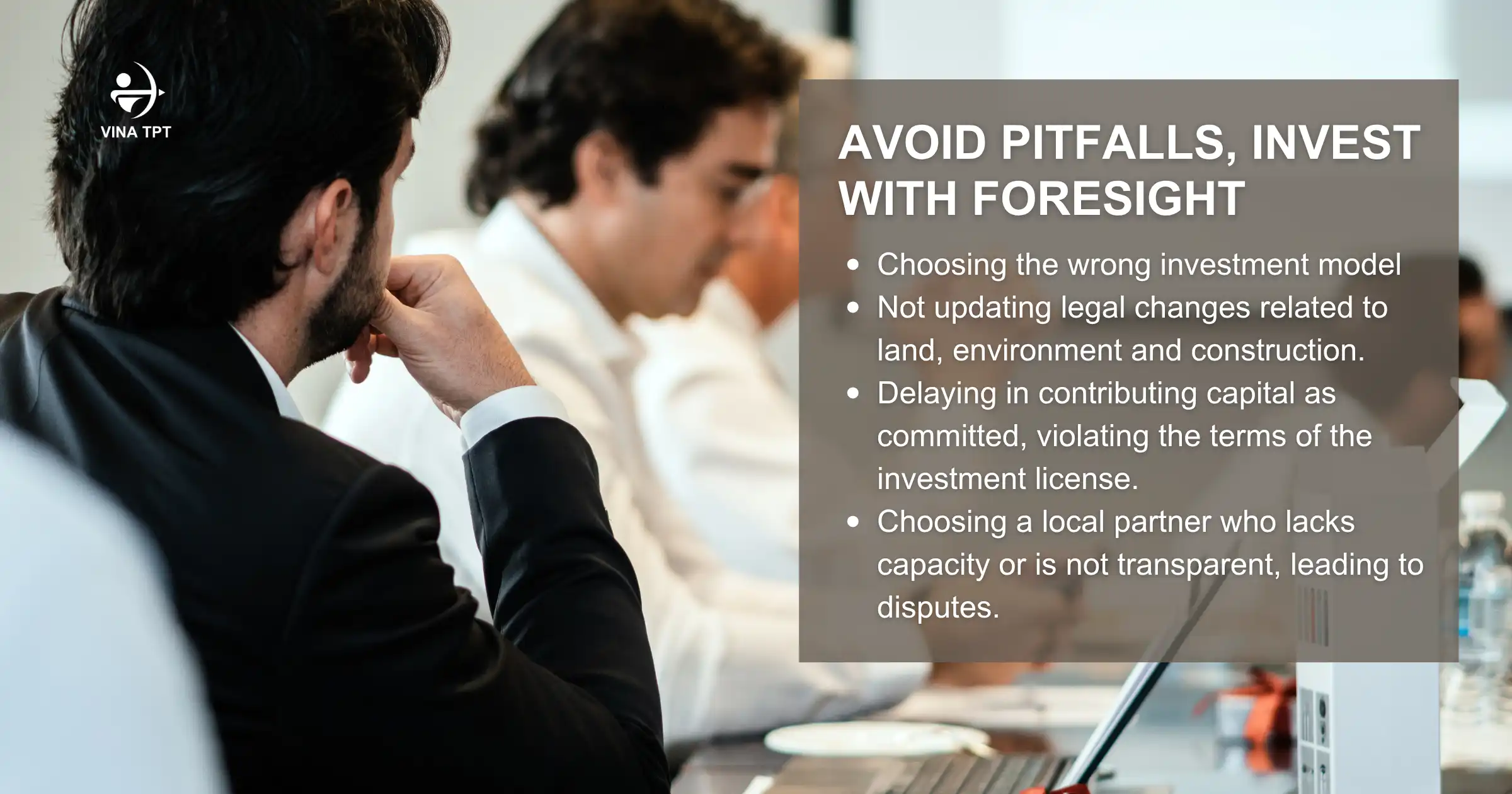
Despite the wide-open opportunities, many foreign investors including large corporations, have encountered trouble when investing in Vietnamese real estate due to common mistakes. Some typical mistakes include:

  • Choosing the wrong investment model (for example, registering a trading company instead of a project development company, leading to restrictions on land use).
  • Not updating legal changes related to land, environment and construction.
  • Delaying in contributing capital as committed, violating the terms of the investment license.
  • Choosing a local partner who lacks capacity or is not transparent, leading to disputes.

An excellent business advisory service will help investors avoid these mistakes right from the start, thanks to legal review, partner assessment and risk control throughout the investment process. 

Business advisory for Singaporean investors establishing real estate businesses in Vietnam

6. Why Partnering with Vina TPT Business Advisory Makes a Difference 

With over 15 years of experience in advising companies, Vina TPT Business Advisory Service’s team of legal, accounting and tax experts has worked with hundreds of international enterprises in the real estate, infrastructure and manufacturing sectors.

We provide end-to-end solutions, from developing investment strategies, applying for IRC/ERC licenses, advising on tax structures, to compliance management and post-investment operational accounting. Vina TPT’s strength lies in combining a deep understanding of Vietnamese law with international operational standards, helping Singaporean investors ensure compliance while optimizing profits.

If you are looking for a business consulting partner with market knowledge and the ability to handle everything from legal to tax, Vina TPT Business Advisory is the reliable bridge between Singapore and Vietnam.

BOOK A FREE CONSULTATION

business-advisory-services

How Singapore Investors Can Smoothly Establish Business in Vietnam

establish business in Vietnam with vtpt

establish business in Vietnam with vtpt

1. Why Singapore Investors Choose to Establish Business in Vietnam  

Vietnam is becoming an attractive investment destination for Singapore investors in Vietnam thanks to its strategic geographical location in Southeast Asia, competitive labor and operating costs, and free trade agreements (FTAs) that facilitate exports and trade.

For small and medium-sized enterprises from Singapore, establishing a business in Vietnam opens up opportunities to access a large consumer market, taking advantage of lower operating costs compared to other saturated markets. In addition, the preferential policies of the Vietnamese Government for a number of industries such as technology, manufacturing, education and renewable energy also increase the attractiveness, helping Singapore investors to expand their scale sustainably.

2. Key Legal Requirements for Singapore Companies

To ensure a smooth business establishment in Vietnam, Singapore investors need to understand the legal requirements. Choosing the type of business such as Limited Liability Company (LLC), Joint Stock Company (JSC) or Representative Office will determine the ownership structure, charter capital and management rights.

Investors need to determine the investment capital, business lines and licensing conditions. Some specific business lines may require additional licenses or pre-investment approval from state agencies. Basic legal documents include the company charter, list of shareholders/members, legal documents of the investor, legal head office address, and capital contribution plan.

For FDI projects, Singapore investors need to apply for an Investment Registration Certificate (IRC) to get investment approval, then apply for an Enterprise Registration Certificate (ERC) – the official business license and tax code of the enterprise. Compliance with these legal requirements is a prerequisite for legal and effective business operations.

3. Prepare Documents and Apply for Business License (IRC & ERC)

For Singapore investors in Vietnam, establishing a business in Vietnam cannot be separated from the steps of preparing documents and applying for licenses. This is an important stage, especially for FDI projects, because complete and accurate documents determine the progress of granting Investment Registration Certificate (IRC) and Enterprise Registration Certificate (ERC) – two mandatory licenses for businesses to operate legally.

3.1 Investment Registration Certificate (IRC) – For FDI

For projects with foreign investment capital, IRC is the first license, allowing investors to implement projects in Vietnam. The documents usually include:

  • Application for implementing investment projects and Investment Plan, clearly stating the objectives, scale, location, capital and progress of the project.
  • Evidence of the investor’s financial capacity, such as bank statements, credit contracts or mortgaged assets.
  • Legal documents of the investor: individuals submit notarized and consularized passports; legal entities submit notarized and consularized business registration certificates.
  • Project location, including lease contract or land/office use right certificate.

3.2 Enterprise Registration Certificate (ERC) – Operating License

After the IRC is issued (or for 100% domestic-owned enterprises), the investor submits an application for an ERC – which is an official license for the enterprise to operate and also a tax code. The ERC dossier includes:

  • Business registration application.
  • Company Charter, which stipulates the organizational structure, member/shareholder rights, capital contribution ratio and management method.
  • List of shareholders/members and legal representatives, clearly stating information, ownership ratio and voting rights.
  • Appointment decision and authorization letter (if any).
  • Capital contribution plan & proof of financial capacity, especially important for large capital projects.

3.3 General requirements and important notes

  • Notarization, consular legalization & translation into Vietnamese: all documents of foreign investors must be completed before submission. This is a step that often causes delays if the dossier has many shareholders or is complicated.
  • Legal head office address: do not use apartments or collective houses.
  • Unified information: company name, address, capital, and business lines must be consistent on all dossiers.
  • Choosing the right business line: ensure that investment conditions are met to avoid multiple amendments.

3.4 Time to prepare and submit documents

  • Document preparation: 1-2 weeks, depending on the volume and complexity of legalization.
  • IRC appraisal: about 20-45 working days.
  • ERC issuance: 10-20 days after IRC approval.

Due to the complicated process of preparing documents and applying for ERC/IRC, Singapore investors should hire outsourcing with professional services such as Vina TPT start-up business license service. This not only saves time, limits legal errors but also ensures that the licensing process is quick, transparent and safe.


GET EXPERT HELP WITH IRC & ERC REGISTRATION

4. Common Challenges and How to Overcome Them

Singaporean investors often face difficulties due to differences in laws, taxes, and administrative procedures between Vietnam and Singapore. Language barriers and incomplete understanding of regulations also hinder the preparation of documents and communication with authorities.

Common problems include delays in IRC or ERC approval, inconsistent information in documents, and additional licensing requirements for specific industries. Working with a business setup consultant Vietnam helps to minimize these risks through legal advice, accurate document preparation, and direct dealing with government agencies, allowing investors to focus on business planning and strategic operations.

establish business in Vietnam with vtpt

5. Role of a Business Setup Consultant in Vietnam

Using a business setup consultant Vietnam is an important strategy for Singapore investors to optimize the company registration process. Consultants help identify the appropriate type of business, review and prepare all legal documents, and ensure compliance with Vietnamese regulations.

In addition, consultants also provide strategic advice on capital allocation, investment approval, and application for specific industry licenses, helping investors avoid legal errors and shorten the time to complete documents. As a result, Singaporean businesses save costs, time, and feel more secure in long-term development in Vietnam.

6. Vina TPT Company Registration Service for Singapore Investors

Vina TPT company registration offers a complete solution for Singapore investors in Vietnam, with outstanding advantages:

  • Comprehensive support: From initial consultation, document preparation, document submission, to post-registration support.
  • Legal compliance: Ensure documents are valid for both IRC and ERC.
  • Industry expertise: Guidance on applying for additional licenses for regulated fields such as education, fintech, manufacturing.
  • Multilingual service: Bilingual support in Vietnamese and English, ensuring accurate and easy-to-understand information for investors.
  • Save time and costs: Help shorten the registration process, limit errors and reduce operating costs.

Singapore investors can rest assured when choosing Vina TPT company registration to establish business in Vietnam quickly, legally and effectively.

Contact Vina TPT today for advice and quick implementation of business registration in Vietnam!

BOOK A FREE CONSULTATION

Laywer-Establish-business-Vietnam-VinaTPT

Avoiding Accounting Errors in FDI Companies: A Practical Guide for Vietnam

accounting errors

accounting errors

1. Why Accounting Errors Are Risky for FDI Companies

Foreign Direct Investment (FDI) enterprises operating in Vietnam face a unique regulatory and business environment. While global companies may already be familiar with International Financial Reporting Standards (IFRS), compliance with Vietnamese Accounting Standards (VAS) introduces an additional layer of complexity. Small errors in accounting can escalate into serious consequences, such as tax penalties, reputational damage, and even restrictions on business activities.

For example, the Vietnam Ministry of Finance (MOF) has emphasized in its guidelines that misreporting revenue or late submission of tax returns can lead to administrative fines and limit access to future incentives. This is why proper accounting practices are not just about bookkeeping but are vital to protecting long-term business success in Vietnam.

2. Misclassifying Expenses and Revenues

2.1 Common misclassifications

A frequent error in FDI operations is the misclassification of expenses and revenues. Under VAS, certain costs such as staff training, marketing, or research may need to be classified differently compared to IFRS. Multinational managers often apply their global practices directly, only to discover later that these classifications conflict with local rules.

2.2 Consequences

Such mistakes can distort profit and loss statements, affect taxable income, and trigger audits by the General Department of Taxation (GDT). Incorrect expense recognition may either inflate profit – leading to higher taxes – or reduce profit – attracting suspicion from regulators.

2.3 Correction approach

Correcting these errors requires both retrospective adjustment and updated policies for future transactions. Companies must train their internal teams on VAS guidelines and, where needed, consult an expert like Vina TPT Accounting Service to review compliance.

3. Inaccurate Foreign Currency Conversions

3.1 Complexity of multi-currency

Many FDI enterprises in Vietnam transact in multiple currencies, especially USD, EUR, and JPY. VAS requires specific rules for translating foreign currency into VND. Failure to apply the correct exchange rate – spot, average, or official – can lead to serious inconsistencies in financial reports.

3.2 Risks and penalties

A World Bank report highlights that emerging markets face elevated risk of misreporting due to currency volatility. In Vietnam, regulators may impose penalties for discrepancies that result from inaccurate conversion, particularly if these errors understate taxable income.

3.3 Best practice

Companies must ensure that exchange rates are updated from official sources and applied consistently. Automated accounting systems can help, but human oversight remains crucial. External reviews by service providers such as Vina TPT guarantee that conversion practices remain compliant with both VAS and investor expectations.

accounting errors

4. Delayed or Missing Compliance Reports

4.1 Regulatory reporting challenges

FDI businesses in Vietnam are required to submit various reports: annual financial statements, quarterly tax declarations, and occasional disclosures for foreign investment registration. Delays or missing reports are among the most visible accounting errors.

4.2 Impact on business

Non-compliance does not only result in fines; it can also block access to tax incentives and financial support programs designed for FDI companies. In some cases, failure to report on time has led to suspension of investment licenses.

4.3 How to address

Creating an internal compliance calendar, supported by technology, is critical. Backed by more than 20 years of experience supporting FDI companies, we know that adopting automated compliance tools helps businesses cut reporting errors by as much as 40%. Partnering with local experts ensures that reports are not only timely but also accurate and aligned with both Vietnamese and international standards.

SCHEDULE A FINANCIAL HEALTH CHECK

5. Weak Internal Controls and Data Inconsistencies

5.1 Gaps in internal control

FDI firms often rely on global accounting systems that may not be fully adapted to Vietnam’s regulatory requirements. Weak internal controls, such as lack of segregation of duties or inadequate audit trails, increase the likelihood of data inconsistencies.

5.2 Risks of weak systems

Without strong internal audits, discrepancies may go unnoticed until an external review or tax inspection. These lapses not only create compliance risks but also undermine investor trust. The OECD stresses the importance of robust internal audit functions in supporting sustainable FDI operations.

5.3 Solutions

Strengthening internal controls requires training, technology upgrades, and independent reviews. Regular internal audits, aligned with VAS, help ensure that accounting data remains reliable. This is an area where Vina TPT’s professional services add measurable value.

6. How Vina TPT Accounting Service Helps FDI Companies Correct and Prevent Errors

Vina TPT Accounting Service offers comprehensive solutions tailored for FDI enterprises in Vietnam. The firm goes beyond bookkeeping by providing proactive troubleshooting, corrections, and preventive strategies.

By integrating knowledge of VAS with international best practices, Vina TPT helps companies:

  • Identify and correct misclassified expenses and revenues.
  • Implement accurate foreign currency conversion processes.
  • Establish compliance calendars to avoid reporting delays.
  • Strengthen internal audit and control systems.

Clients benefit from a smoother relationship with regulators, improved investor confidence, and reduced financial risk. For more details, explore Vina TPT Accounting Service.

Explore Vina TPT’s professional accounting and compliance services to keep your FDI company on the right track in Vietnam.

BOOK A FREE CONSULTATION

accounting skills

Work Permit in Vietnam 2025 | Step-by-Step Guide & Requirements

work permit step by step guidance

Work permit in vietnam 1

Work permit in Vietnam is a mandatory requirement for foreigners to legally work in the country. This article provides detailed information on the latest requirements, documents, and procedures for obtaining a work permit, while also covering exemption cases and relevant penalties. 

1/ What is a Work Permit in Vietnam?  

The work permit is an official legal document issued by a competent Vietnamese authority, allowing foreign nationals to work legally in Vietnam. It is a compulsory requirement for most foreigners employed in the country. 

The work permit in Vietnam is issued by the Ministry of Home Affairs (MOHA) or Department of Home Affairs at the provincial or municipal level. The permit contains key details such as the employee’s full name, nationality, job position, and the validity period. 

2/ Why do foreigners need a work permit in Vietnam?  

Holding a work permit offers several benefits and is a legal requirement:  

  • Compliance with Vietnamese law: This is a legal regulation. Working without a work permit is considered a violation of labor laws.  
  • Avoiding legal risks: Both the employee and the employer can avoid legal risks, including administrative penalties or deportation.  
  • Protection of legal rights: A work permit helps protect the foreign worker’s legal rights, including those related to salary, insurance, and other benefits.  

The current legal documents governing work permits in Vietnam include:  

3/ Eligible individuals and conditions for being granted a work permit in Vietnam  

To be granted a work permit, foreigners must meet specific conditions.  

Eligible for a work permit

Eligible individuals for a work permit: 

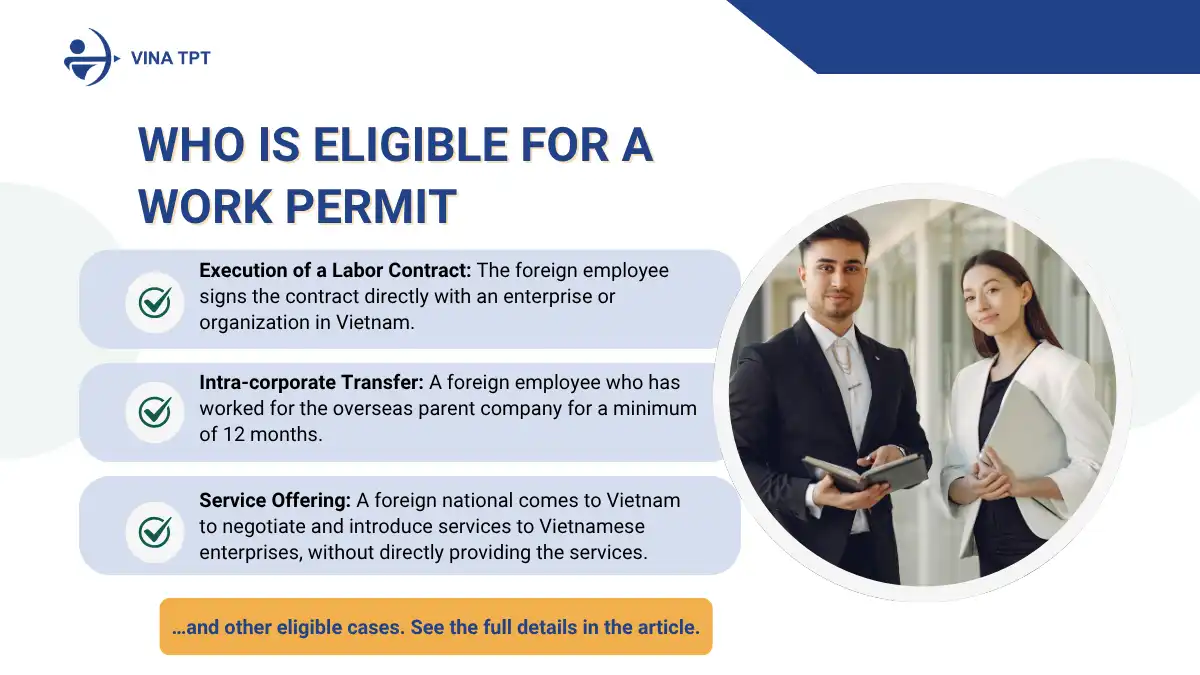
The individuals eligible for a work permit in Vietnam are clearly defined in Article 2 of Decree No. 152/2020/ND-CP (as amended by Decree No. 70/2023/ND-CP). Specifically, these are foreigners entering Vietnam to work under the following forms: 

Performing a labor contract: 

  • The foreign national signs a direct labor contract with a company or organization in Vietnam. 
  • They hold positions such as expert, technician, manager, or executive director.  

Intra-corporate transferee 

  • The foreign worker has been employed by the overseas parent company for at least 12 months.  
  • They are transferred to work at a branch or representative office of the same group/company in Vietnam.  

Executing contracts or agreements between Vietnamese enterprises and foreign organizations 

These may involve fields such as economics, trade, finance, banking, insurance, science and technology, culture, sports, education, healthcare, etc.  

Contract-based service provider 

The foreigner comes to Vietnam to fulfill obligations under a service contract signed between a foreign entity and a Vietnamese one. They do not have a commercial presence in Vietnam.  

Service sales representative 

The foreigner visits Vietnam to negotiate or introduce services to Vietnamese businesses but does not directly deliver the services.  

Foreign volunteer 

They must have an assignment letter from a licensed non-governmental or international organization operating in Vietnam.  

Person responsible for establishing a commercial presence 

They represent a foreign organization in setting up a representative office in Vietnam.  

Other cases 

As defined by regulations or international agreements to which Vietnam is a signatory (e.g., WTO, CPTPP commitments).  

General conditions for work permit Viet Nam:  

Foreign workers must meet the following general conditions to be have work permit in Vietnam: 

  • Possess full civil act capacity.  
  • Be in good health suitable for the job. A valid health certificate is required.  
  • Be a manager, executive director, expert, or technical worker.  
  • Not have a criminal record or be under criminal prosecution.  
  • Obtain a written approval for the job position using a foreign worker. This document must be issued by a competent authority.  

Specific requirements for each category  

Each category has specific requirements in terms of qualifications and experience:  

  • Expert: Must hold a university degree or equivalent, and have at least 3 years of relevant work experience.  
  • Technical worker: Must have received at least 1 year of specialized training and have at least 3 years of experience in the trained field.  
  • Manager or executive director: Must have managerial experience. Supporting documents such as appointment decisions are required.  
  • Intra-corporate transferees: Must be assigned by the foreign enterprise. An appointment decision and proof of experience with the parent company are required.  

View more about service for Expats in Vietnam

4/ Application dossier for a new work permit in Vietnam  

Preparing a complete and accurate dossier is crucial. Required documents include: 

  • Health certificate valid for 12 months.   
  • Criminal record certificate issued within the last 6 months.   
  • Certificates, diplomas, or professional qualification documents.   
  • Document confirming work experience or a previous work permit.   
  • Two 4×6 cm photos with white background, taken within the last 6 months.   
  • Approval letter for the need to employ foreign workers.   
  • Certified copy of a valid passport.   
  • Additional documents depending on the specific case (e.g., contract, assignment letter, etc.).   
  • Foreign documents must be consular legalized and notarized translated.  

5/ VIETNAM WORK PERMIT PROCESS 

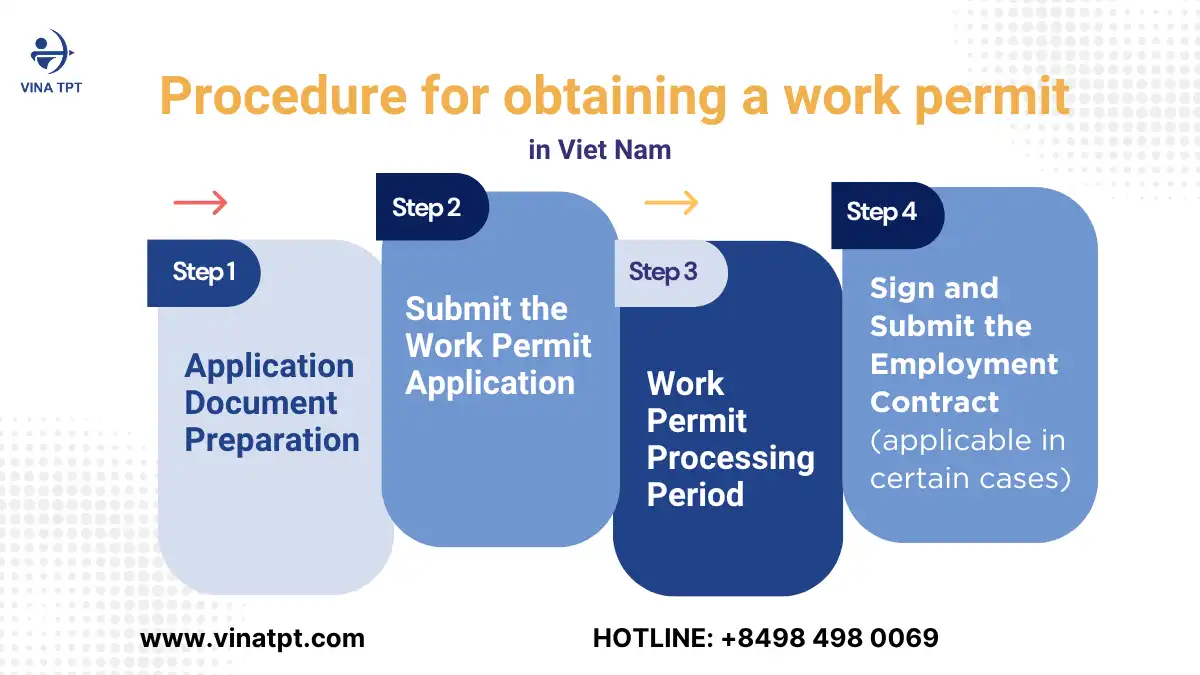
The process for obtaining a work permit includes the following steps:  

Step 1: Submit the application for a work permit in Vietnam 

Submission deadline: At least 15 days before the foreign worker is expected to start working in Vietnam. 

Receiving authority:   

  • Ministry of Home Affairs (for cases under its jurisdiction), 
  • Or Department of Home Affairs, where the foreigner is expected to work. 

Applicants:   

  • Employer: Applies to foreign workers working under labor contracts, intra-corporate transfers, execution of agreements, service providers, service sellers, or other applicable cases.  
  • Vietnamese or foreign entities operating in Vietnam: Applies when foreign workers are working under specific contracts or agreements.  
  • Foreign worker: Applies to those entering Vietnam to offer services or to establish a commercial presence.  

Step 2: Wait for the work permit issuance   

  1. Processing time: Within 5 working days from the date of receiving a complete and valid application. 
  1. Issuing authority: Ministry/ Department of Home Affairs where the foreigner will work.  
  1. Result:  If the application is valid and eligible, the foreign worker will be granted a work permit using Form No. 12/PLI – Appendix I of the Decree. của Nghị định.  

If not granted: The competent authority will issue a written response stating the reason for rejection.  

Step 3: Sign and submit the labor contract (applies to certain cases)   

Applicable to: Foreign workers working under labor contracts.  

Requirement: After the foreign worker is issued a work permit, the employer and the worker must sign a written labor contract in accordance with Vietnamese labor law. This must be done before the worker’s official start date. 

Employer’s obligation: The signed labor contract (original or certified copy) must be submitted to the authority that issued the work permit. 

Produre for abtaining a work permit in vietnam
Procedure for abtaining a work permit in viet nam

6/ Work Permit Fee in Vietnam 

The fee for obtaining a work permit is generally regulated by the Ministry of Finance. According to Circular No. 250/2016/TT-BTC, the fee for a new work permit is 400,000 VND per permit. However, this amount may vary slightly across provinces depending on local People’s Council regulations. 

Work Permit Validity: : The maximum validity period of a work permit is 2 years. 

7/ Exemptions from Work Permit Requirement  

In certain cases, foreigners working in Vietnam are not required to obtain a work permit:  

  • Being the owner or capital-contributing member of a company with contributed capital of at least VND 3 billion.  
  • Being a member of the Board of Directors of a joint-stock company with contributed capital of at least VND 3 billion.  
  • Entering Vietnam for work for less than 30 days and no more than 3 times per year.  
  • Performing duties under international agreements to which Vietnam is a signatory.  
  • Other cases as specified in Article 7 of Decree No. 152/2020/ND-CP (as amended by Decree No. 70/2023/ND-CP).  

You can find more detailed information on exemption work permit on the official Government Portal or in this article.  

8/ Penalty for without work permit in Viet Nam:  

Violations of work permit regulations are strictly penalized.  

In case of working without a permit (penalty for without work permit in Viet Nam)   

  • Foreign worker: May be fined from VND 15,000,000 to VND 25,000,000 and may be subject to deportation.  
  • Employing enterprise: May be fined from VND 30,000,000 to VND 75,000,000 depending on the number of violating workers.  
  • Administrative penalties: Detailed in Decree No. 12/2022/ND-CP on administrative sanctions in labor and social insurance. More information can be found at the Ministry of Home Affairs website: https://moha.gov.vn/ 
  • Other sanctions: : In addition to fines, workers may be deported and employers may face suspension of business activities.  

9/ Conclusion 

Applying for a work permit in Vietnam is a crucial legal procedure. It requires careful preparation and strict compliance with the regulations. To ensure a smooth process, you should: 

  • Prepare your application documents thoroughly and completely.  
  • Seek professional assistance if you are not familiar with the procedures. 
  • Comply with the law to avoid unnecessary legal risks.  

Vina TPT proudly offers full-package consulting and support services for obtaining work permits in Vietnam for foreigners. We assist clients with document preparation, application submission, and process follow-up. 

Our service saves you time and effort, ensuring the process is completed quickly and accurately.   

Contact us for detailed consultation.  

Book a free consultation

Vina TPT Accounting services