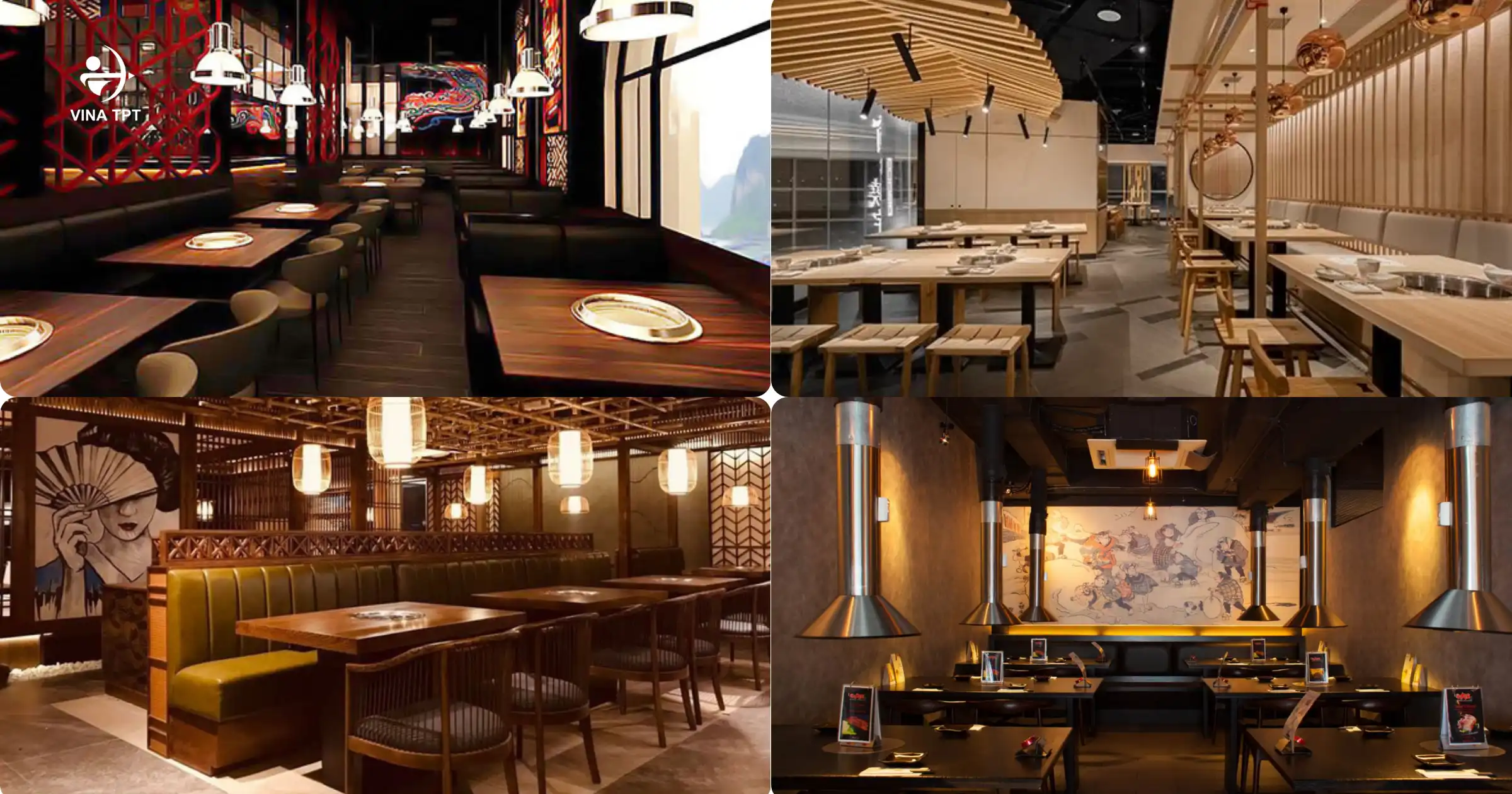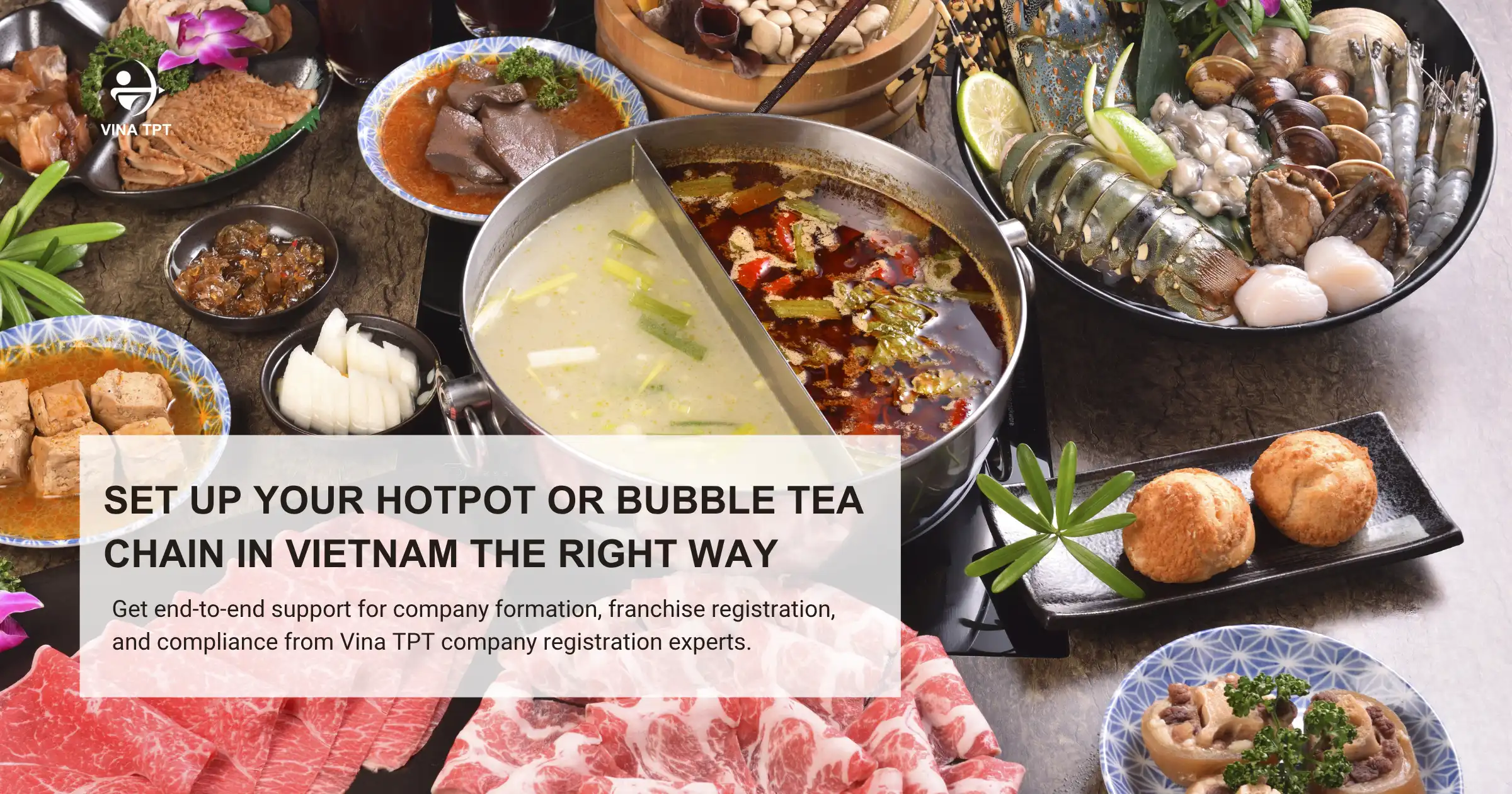
Business setup and operational licensing for Chinese hotpot and bubble tea chains in Vietnam

Business setup and operational licensing for Chinese hotpot and bubble tea chains in Vietnam

Business setup and operational licensing for Chinese hotpot and bubble tea chains in Vietnam

1. Why Chinese Hotpot and Bubble Tea Chains Are Eyeing Vietnam Now

In recent years, Vietnam has become a top attractive destination to register a company in the fields of hotpot and bubble tea chains from China. This attraction comes from the impressive growth rate of the F&B market, the strong expansion of the middle class, and the experiential consumption trend of Gen Z in large cities such as Ho Chi Minh City, Hanoi and Da Nang.

According to a report by Vietnam Briefing (2024), the scale of the food service industry in Vietnam has reached 688.8 trillion VND, equivalent to about 27.3 billion USD, an increase of 16.6% compared to the previous year. Similarly, research by iPOS.vn and Nestlé Professional shows that the Vietnamese F&B industry will maintain a growth rate of about 9.6% per year in the period 2024-2025. Looking further ahead, Mordor Intelligence estimates that the Vietnamese food-service market will reach a size of 41.22 billion USD by 2030, with an average growth rate of 10.7%/year.

These figures clearly reflect the huge potential of the Vietnamese culinary industry, where the demand for dine-out and chain models is growing. With advantages in raw material supply, reasonable premises costs and a young population that loves to experience, Vietnam is becoming a “golden land” for hotpot and bubble tea brands from China.

However, opportunities always go hand in hand with challenges. To be successful, brands not only need to understand the procedures for registering a company or the company formation process, but also need to deeply understand local culinary culture, taste and consumer behavior, key factors that help turn the market boom into a sustainable advantage.

2. The Real Challenge: Localization, Not Just Licensing

Many Chinese brands entering Vietnam face difficulties not in licensing, but in adapting to the market (localization).

Vietnamese people prefer lighter, less spicy, less greasy tastes compared to Chinese cuisine. In addition, rental costs in central areas are increasing rapidly, while requirements for experience space, especially for high-end hotpot models, are increasingly strict.

Human resources to operate a chain of many branches is also a big challenge. Chinese brands inherently have a methodical process, but when applied in Vietnam, they need to standardize training, quality control and service processes to ensure consistency.

Therefore, licensing is just the tip of the iceberg. The bigger problem lies in adapting the operating model to suit the consumer culture and legal environment in Vietnam.
register-a-company

3. Choosing the Right Entry Model: Direct Ownership vs. Master Franchise

Before starting to register a company, investors need to determine the market penetration model. There are two popular strategies:

Direct Ownership (Self-investment and operation)

  • Advantages: Full control over the brand, product quality and customer experience.
  • Disadvantages: High investment costs, longer time to apply for licenses and set up operations.
  • Suitable for: Large brands that want to build a high-end image, create the first flagship store in Vietnam.

Master Franchise (Regional franchising)

  • Advantages: Helps brands expand quickly, reduce financial risks and take advantage of local networks.
  • Disadvantages: Requires a clear mechanism for quality monitoring, training and profit sharing.
  • Suitable for: Bubble tea chains or fast-casual hotpots that want to quickly cover the market.

In fact, many Chinese brands have chosen to combine both models: opening the first store directly to control the image, then franchising to expand to other provinces and cities.

Whichever direction is chosen, investors need to follow the company formation process and comply with the legal regulations on franchise business in Vietnam – including registering the franchise contract with the Ministry of Industry and Trade and periodically declaring taxes.

GET EXPERT GUIDANCE ON ENTRY MODELS

4. Building a Compliant but Scalable Operation

For hotpot or bubble tea chains to expand sustainably in Vietnam, building a legal foundation and licensing right from the beginning is a vital factor. Many international F&B brands have encountered difficulties when developing in Vietnam not because of their products or marketing strategies, but because they have not established a tight legal and operational system from the beginning. When starting a business in Vietnam, F&B businesses need to complete the following procedures:

  • Investment Registration Certificate (IRC) if there is a foreign capital element.
  • Enterprise Registration Certificate (ERC) to legally establish a company in Vietnam.
  • Registering conditional business codes: including food and beverage (5610), food processing (1079), and beverages (4722).

The estimated time for completion is:

  • Document preparation: 1-2 weeks, depending on the volume of documents and the level of complexity.
  • IRC appraisal: 20-45 working days.
  • ERC issuance: 10-20 working days after IRC (or similar if the enterprise is a domestic enterprise).

Applying for “sub-licenses” (operational licenses) including:

  • Food Safety Certificate.
  • Fire prevention and fighting license for each facility.
  • Alcohol sales license (if any).
  • Registering environmental and labor hygiene according to the scale of the restaurant.

These licenses are issued by different agencies (Department of Finance, Department of Food Safety, Fire Police…), so it requires smooth coordination in the documents. 

5. Your Strategic Next Step

As the Vietnamese F&B market is entering a period of fierce competition, having a consulting partner with a good understanding of the local legal and business environment will not only help businesses “open a shop”, but also “build a sustainable brand”. This is the value that Vina TPT company registration brings to F&B chains from China.

With more than 20 years of experience in registering a company and consulting on company formation for foreign businesses, Vina TPT has a deep understanding of each stage that a brand must go through – from the initial market survey, choosing an investment model, to completing legal documents and implementing chain operations.

Vina TPT’s team of experts not only handles administrative procedures, but also accompanies businesses as strategic advisors, helping them:

  • Consulting on suitable legal models: choosing between 100% foreign capital, joint ventures, or franchise business to optimize control and cost advantages.
  • Set up a complete investment profile & business registration package: prepare all IRC, ERC documents, register conditional industry codes for F&B, and apply for operating licenses.
  • Ensure compliance with local regulations: detailed guidance on tax, accounting, human resource management, and standardize operating procedures to meet inspection and testing requirements.

With professional support from Vina TPT company registration, businesses no longer have to worry about legal risks or complicated procedures – instead, they can focus all their efforts on developing their brand, improving customer experience and expanding market share in one of the most dynamic F&B markets in Southeast Asia.

Let Vina TPT become your strategic partner to help you start your business journey in Vietnam legally, effectively and sustainably.

CONTACT YOUR EXPERTS

register-a-company

Starting a Korean BBQ or Café in Vietnam? Here’s a 4-Step Registration Guide

 business-license-in-vietnam

1. Why Korean F&B Brands Are Thriving in Vietnam

Business license in Vietnam is a crucial step for any foreign F&B brand looking to enter the market. In recent years, Vietnam has become one of the fastest growing F&B markets in Southeast Asia, with spending on food and entertainment accounting for more than 35% of young consumers’ total disposable income. The booming middle class, the growing popularity of “eating out”, and the strong influence of Hallyu (Korean Wave) culture have created ideal conditions for Korean food brands to expand their business.

From Korean BBQ chains, Seoul-style cafes, to dessert shops, Vietnamese consumers especially Gen Z and Millennials see enjoying Korean food as a cultural experience rather than just eating. This explains why many Korean brands, from traditional restaurants to franchised coffee chains, are choosing Vietnam as their second strategic move after Korea.

However, behind that attractive potential are a series of legal challenges that foreign investors need to understand. Many Korean brands encounter difficulties when setting up a business in Vietnam (enterprise registration), applying for an F&B business license, or completing food safety and hygiene certifications. Therefore, understanding the correct legal establishment process is the first factor that determines success when establishing a business in Vietnam.

Before going into the licensing process, you can consider a few concepts that are very popular in Vietnam: Korean tabletop BBQ, K-café & dessert, fast-casual K-food (fried chicken, mixed rice), and fusion/comfort food concepts. Each concept will affect the scale, location, and type of license required, so you should determine the concept before starting

 business-license-in-vietnam


2. Step 1 – Understanding Vietnam’s F&B Business License Requirements

To open a restaurant or cafe in Vietnam, Korean investors need the following types of business licenses in Vietnam:

  • Investment Registration Certificate (IRC): certifying that the company legally authorizes an investment project and records its key details
  • Enterprise Registration Certificate (ERC): certifying that the company is legal and allowed to operate in Vietnam.
  • Food Safety and Hygiene Certificate: required for food processing or serving establishments.
  • Fire Safety Certificate: ensures that the location meets fire prevention and fighting standards.
  • Other local permits: such as sign registration, environmental license (if there is a food production scale).

Full preparation of these business license in Vietnam helps companies operate legally, avoiding the risk of being fined or having their business suspended. 

3. Step 2 – Choosing the Right Legal Structure for Korean Investors

When setting up a business in Vietnam, Korean investors can choose one of three popular legal forms:

  • 100% foreign-owned company: Full management, suitable for brands with experience and large capital.
  • Joint Venture: Cooperate with Vietnamese partners, helping to understand the market and process licenses faster.
  • Franchise model: Flexible solution for BBQ or cafe chains that want to expand their brand without directly managing operations.

Each model has its own advantages and disadvantages, depending on the scale, capital, and long-term development strategy of the Korean brand in Vietnam. In addition, at this stage, the most important thing is to determine whether to apply for an Investment Registration Certificate (IRC) or not, as this procedure will affect the entire time and plan of operation later.

According to the Vietnam Investment Law, an IRC is a mandatory license if Korean investors want to:

  • Establish a 100% Korean-owned company in Vietnam (e.g., a company managing a BBQ chain, cafe, bakery, etc.);
  • Contribute more than 51% of capital to a Vietnamese company operating in the F&B sector;
  • Open a branch or restaurant under a Korean parent company.

In this case, the process will include two stages:

  • Apply for IRC: Investment Registration Certificate, issued by the Department of Planning and Investment (DPI).
  • Apply for ERC: Enterprise Registration Certificate (similar to a company establishment license).

The estimated time for completion is:

Document preparation: 1-2 weeks, depending on the volume of documents and the level of complexity.

  • IRC appraisal: 20-45 working days.
  • ERC issuance: 10-20 working days after IRC (or similar if the enterprise is a domestic enterprise).

4. Step 3 – The Registration & Licensing Process Explained

 business-license-in-vietnam

The process of setting up a business license in Vietnam includes the following basic steps:

  1. Preparing legal documents (investor passport, company charter, legal head office address).
  2. Complete the application and apply for IRC, ERC.

If the project has FDI capital, IRC is the first license allowing the investor to implement the project in Vietnam.

The required documents usually include:

  • Application for investment project implementation and Project proposal: stating the objectives, scale, location, investment capital, progress.
  • Proof of the investor’s financial capacity: bank statement, credit contract or collateral.
  • Legal documents of the investor:
    • Individual: Notarized passport, consular legalization.
    • Organization: Business registration certificate or equivalent document, consular legalization.
  • Project location: lease contract or land/office use rights certificate.

After the IRC is granted (or for 100% domestic-owned enterprises), the investor applies for an ERC – an official license for the enterprise to operate, and also the tax code of the company.

The ERC dossier usually includes:

  • Application for enterprise registration.
  • Company Charter: stipulates the organizational structure, powers of members/shareholders, capital ratio and management method.
  • List of members/shareholders and legal representatives: clearly state information, ownership ratio, voting rights.
  • Appointment decision and authorization letter (if any).
  • Capital contribution plan & financial evidence: bank statement or credit contract (especially important for large capital projects).

      3.Register for tax code and electronic invoice.

      4.Open a company bank account and pay charter capital.

      5.Carve the company seal and register the sample seal with the authorities. 

GET EXPERT BUSINESS REGISTRATION SUPPORT

5. Step 4 – Post-License Requirements for F&B Businesses

After obtaining the operating license, the enterprise needs to complete the following post-registration procedures:

  • Renting a business premises in accordance with local planning
  • Signing a labor contract and registering personnel with the labor management agency
  • Registering taxes and social insurance for employees
  • Signing contracts with suppliers of raw materials and operating services
  • Checking and certifying food safety before opening
  • Registering for trademark protection to protect intellectual property rights in Vietnam

These steps help enterprises ensure comprehensive compliance and be ready to operate stably.

6. Simplify Your Market Entry with Vina TPT Company Registration Service

With many years of experience supporting Korean F&B brands in Vietnam, Vina TPT Company Registration Service provides a complete solution including:

  • Consulting on choosing the right type of business
  • Drafting and submitting registration documents to the Department of Planning and Investment
  • Applying for hygiene, fire prevention and trademark licenses
  • Setting up accounting, tax and labor systems according to Vietnamese regulations

Vina TPT acts as a “one-stop service” to help Korean investors shorten time, reduce legal risks and focus on brand development.

7. From Startup to Success: Launching Your Korean BBQ or Café Smoothly

Opening a Korean restaurant or cafe in Vietnam is not only an attractive business opportunity, but also a journey to bring Korean culinary culture closer to Vietnamese customers. With clear instructions and a reliable legal partner like Vina TPT, the business registration process will become simpler, more legal and sustainable than ever.

Contact Vina TPT today for detailed advice on the F&B business license in Vietnam – fast, transparent and legal.

BOOK A FREE CONSULTATION