
Starting a Korean BBQ or Café in Vietnam? Here’s a 4-Step Registration Guide

 business-license-in-vietnam

1. Why Korean F&B Brands Are Thriving in Vietnam

Business license in Vietnam is a crucial step for any foreign F&B brand looking to enter the market. In recent years, Vietnam has become one of the fastest growing F&B markets in Southeast Asia, with spending on food and entertainment accounting for more than 35% of young consumers’ total disposable income. The booming middle class, the growing popularity of “eating out”, and the strong influence of Hallyu (Korean Wave) culture have created ideal conditions for Korean food brands to expand their business.

From Korean BBQ chains, Seoul-style cafes, to dessert shops, Vietnamese consumers especially Gen Z and Millennials see enjoying Korean food as a cultural experience rather than just eating. This explains why many Korean brands, from traditional restaurants to franchised coffee chains, are choosing Vietnam as their second strategic move after Korea.

However, behind that attractive potential are a series of legal challenges that foreign investors need to understand. Many Korean brands encounter difficulties when setting up a business in Vietnam (enterprise registration), applying for an F&B business license, or completing food safety and hygiene certifications. Therefore, understanding the correct legal establishment process is the first factor that determines success when establishing a business in Vietnam.

Before going into the licensing process, you can consider a few concepts that are very popular in Vietnam: Korean tabletop BBQ, K-café & dessert, fast-casual K-food (fried chicken, mixed rice), and fusion/comfort food concepts. Each concept will affect the scale, location, and type of license required, so you should determine the concept before starting

 business-license-in-vietnam


2. Step 1 – Understanding Vietnam’s F&B Business License Requirements

To open a restaurant or cafe in Vietnam, Korean investors need the following types of business licenses in Vietnam:

  • Investment Registration Certificate (IRC): certifying that the company legally authorizes an investment project and records its key details
  • Enterprise Registration Certificate (ERC): certifying that the company is legal and allowed to operate in Vietnam.
  • Food Safety and Hygiene Certificate: required for food processing or serving establishments.
  • Fire Safety Certificate: ensures that the location meets fire prevention and fighting standards.
  • Other local permits: such as sign registration, environmental license (if there is a food production scale).

Full preparation of these business license in Vietnam helps companies operate legally, avoiding the risk of being fined or having their business suspended. 

3. Step 2 – Choosing the Right Legal Structure for Korean Investors

When setting up a business in Vietnam, Korean investors can choose one of three popular legal forms:

  • 100% foreign-owned company: Full management, suitable for brands with experience and large capital.
  • Joint Venture: Cooperate with Vietnamese partners, helping to understand the market and process licenses faster.
  • Franchise model: Flexible solution for BBQ or cafe chains that want to expand their brand without directly managing operations.

Each model has its own advantages and disadvantages, depending on the scale, capital, and long-term development strategy of the Korean brand in Vietnam. In addition, at this stage, the most important thing is to determine whether to apply for an Investment Registration Certificate (IRC) or not, as this procedure will affect the entire time and plan of operation later.

According to the Vietnam Investment Law, an IRC is a mandatory license if Korean investors want to:

  • Establish a 100% Korean-owned company in Vietnam (e.g., a company managing a BBQ chain, cafe, bakery, etc.);
  • Contribute more than 51% of capital to a Vietnamese company operating in the F&B sector;
  • Open a branch or restaurant under a Korean parent company.

In this case, the process will include two stages:

  • Apply for IRC: Investment Registration Certificate, issued by the Department of Planning and Investment (DPI).
  • Apply for ERC: Enterprise Registration Certificate (similar to a company establishment license).

The estimated time for completion is:

Document preparation: 1-2 weeks, depending on the volume of documents and the level of complexity.

  • IRC appraisal: 20-45 working days.
  • ERC issuance: 10-20 working days after IRC (or similar if the enterprise is a domestic enterprise).

4. Step 3 – The Registration & Licensing Process Explained
 business-license-in-vietnam

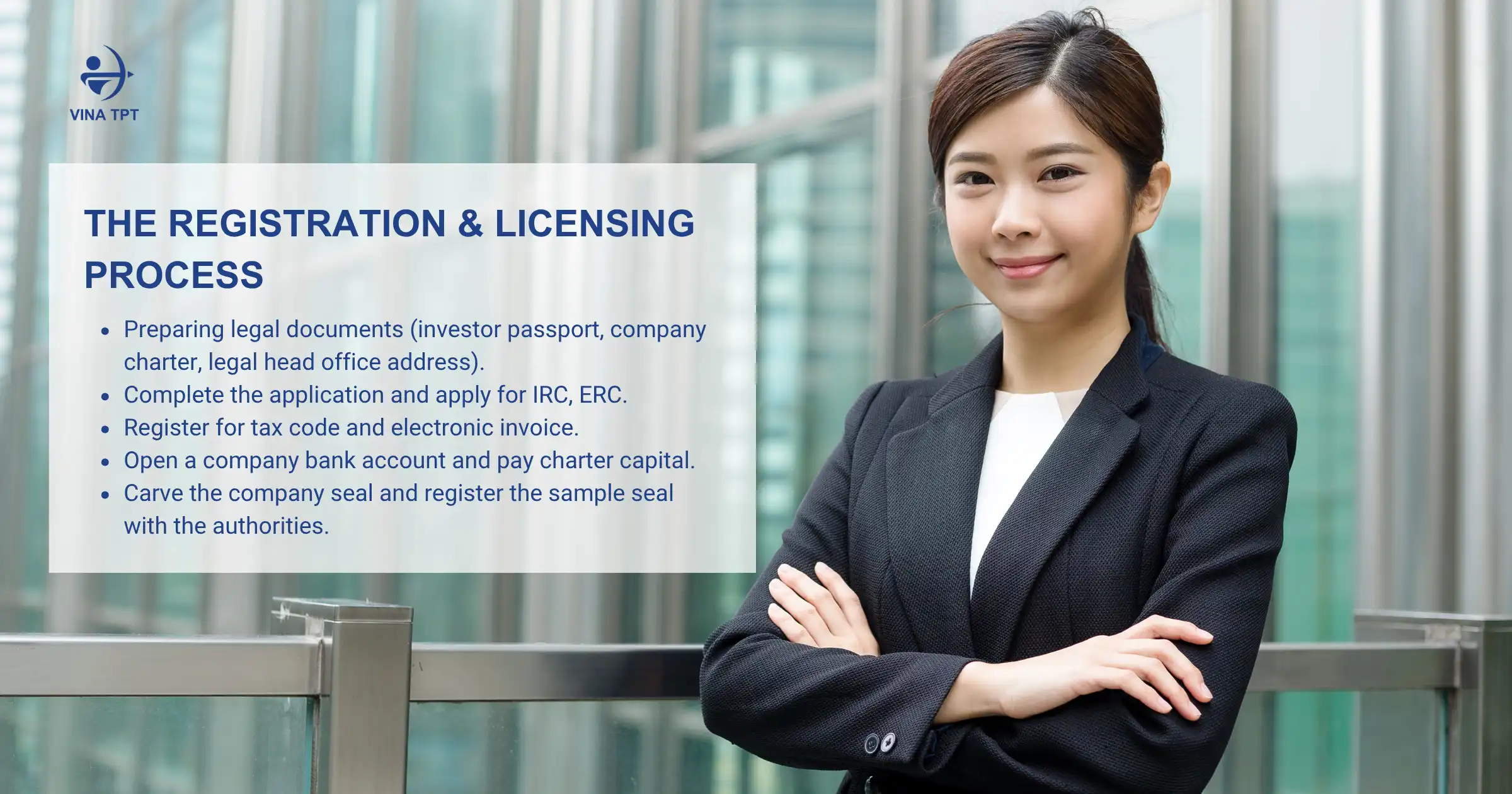
The process of setting up a business license in Vietnam includes the following basic steps:

  1. Preparing legal documents (investor passport, company charter, legal head office address).
  2. Complete the application and apply for IRC, ERC.

If the project has FDI capital, IRC is the first license allowing the investor to implement the project in Vietnam.

The required documents usually include:

  • Application for investment project implementation and Project proposal: stating the objectives, scale, location, investment capital, progress.
  • Proof of the investor’s financial capacity: bank statement, credit contract or collateral.
  • Legal documents of the investor:
    • Individual: Notarized passport, consular legalization.
    • Organization: Business registration certificate or equivalent document, consular legalization.
  • Project location: lease contract or land/office use rights certificate.

After the IRC is granted (or for 100% domestic-owned enterprises), the investor applies for an ERC – an official license for the enterprise to operate, and also the tax code of the company.

The ERC dossier usually includes:

  • Application for enterprise registration.
  • Company Charter: stipulates the organizational structure, powers of members/shareholders, capital ratio and management method.
  • List of members/shareholders and legal representatives: clearly state information, ownership ratio, voting rights.
  • Appointment decision and authorization letter (if any).
  • Capital contribution plan & financial evidence: bank statement or credit contract (especially important for large capital projects).

      3.Register for tax code and electronic invoice.

      4.Open a company bank account and pay charter capital.

      5.Carve the company seal and register the sample seal with the authorities. 

GET EXPERT BUSINESS REGISTRATION SUPPORT

5. Step 4 – Post-License Requirements for F&B Businesses

After obtaining the operating license, the enterprise needs to complete the following post-registration procedures:

  • Renting a business premises in accordance with local planning
  • Signing a labor contract and registering personnel with the labor management agency
  • Registering taxes and social insurance for employees
  • Signing contracts with suppliers of raw materials and operating services
  • Checking and certifying food safety before opening
  • Registering for trademark protection to protect intellectual property rights in Vietnam

These steps help enterprises ensure comprehensive compliance and be ready to operate stably.

6. Simplify Your Market Entry with Vina TPT Company Registration Service

With many years of experience supporting Korean F&B brands in Vietnam, Vina TPT Company Registration Service provides a complete solution including:

  • Consulting on choosing the right type of business
  • Drafting and submitting registration documents to the Department of Planning and Investment
  • Applying for hygiene, fire prevention and trademark licenses
  • Setting up accounting, tax and labor systems according to Vietnamese regulations

Vina TPT acts as a “one-stop service” to help Korean investors shorten time, reduce legal risks and focus on brand development.

7. From Startup to Success: Launching Your Korean BBQ or Café Smoothly

Opening a Korean restaurant or cafe in Vietnam is not only an attractive business opportunity, but also a journey to bring Korean culinary culture closer to Vietnamese customers. With clear instructions and a reliable legal partner like Vina TPT, the business registration process will become simpler, more legal and sustainable than ever.

Contact Vina TPT today for detailed advice on the F&B business license in Vietnam – fast, transparent and legal.

BOOK A FREE CONSULTATION

Tax incentives for Korean electronics factories in Vietnam

Korean electronics factory in Vietnam receiving tax incentives

tax-incentives-in-vietnam

1. Why Korean Electronics Manufacturers Choose Vietnam

Tax incentives in Vietnam have played a major role in making the country a top investment destination for Korean electronics corporations such as Samsung, LG, Hanwha, and SK over the past decade. Factors that make Vietnam stand out include competitive labor costs, political stability, a strategic location near the Asian supply chain, and especially the extensive Free Trade Agreements (FTA) system.

In particular, tax incentives in Vietnam for Korean investors have created a strong motivation for long-term manufacturing expansion, especially in high-tech and electronic component production. These incentives not only reduce the initial investment burden but also help Korean enterprises enhance profitability and competitiveness in the regional and global markets.

In addition, the Vietnamese government is actively attracting investment in the high-tech and electronic component manufacturing sectors – this is a great advantage for Korean factories that want to establish long-term manufacturing operations. Therefore, the tax incentives policy in Vietnam is also designed to provide maximum support to this group of businesses.

2. Overview of Tax Incentives in Vietnam for Foreign Manufacturers

Currently, Vietnam is applying many tax incentives in Vietnam for foreign investors, especially in the fields of manufacturing, high technology and industrial zones. These preferential policies are designed to encourage long-term investment and improve the competitiveness of enterprises:

  • Exemption from corporate income tax (CIT) for the first 2-4 years, 50% reduction for the next 4-9 years, depending on the scale and field of investment.
  • Exemption from import tax on machinery, equipment, components to create fixed assets or serve R&D.
  • Land lease incentives in industrial parks, high-tech parks, helping to significantly reduce initial investment costs.

In addition, Vietnam also implements a special tax holiday policy for high-tech manufacturing projects. These are important advantages that help Vietnam become an attractive destination for foreign investors looking for an efficient and stable production environment in the region.

GET TAX INCENTIVE CONSULTATION

3. Tax Incentives for Korean Factories in Vietnam: Key Benefits for Electronics Manufacturing Projects

Korean electronics factories investing in Vietnam often enjoy many outstanding incentives:

  • Corporate Income Tax (CIT): Preferential tax rate of only 10% for 15 years (compared to the standard rate of 20%), with a long tax exemption and reduction period.
  • Import Duty Exemption: Exemption from import tax on machinery, production lines, and components that cannot be produced domestically.
  • Land Rental Incentive: Exemption or reduction of land rent in industrial zones, especially in Bac Ninh, Thai Nguyen, and Hai Phong, where many Korean factories are concentrated.
  • Value Added Tax (VAT) Refund: For exporting enterprises, input VAT is quickly refunded, helping to improve cash flow.

These incentives help Korean electronics factories shorten the payback period and maximize profits during the expansion phase.

4. Compliance and Documentation Required to Access Tax Incentives in Vietnam

To enjoy tax incentives in Vietnam, businesses need to prepare complete documents according to regulations:

  • Investment Certificate (IRC) and Enterprise Registration Certificate (ERC) clearly stating the eligible business lines.
  • Documents proving that the project is in an incentive sector or area.
  • Financial statements, CIT declarations and annual investment activity reports.
  • Relevant import documents, invoices and contracts (for import tax exemptions).

Due to the strict review process, missing documents or incorrect declarations can cause businesses to lose their right to enjoy incentives or be subject to tax arrears.

5. Strategic Tax Planning with Vietnam Tax Specialists for Long-Term Profitability

To make the most of tax incentives in Vietnam, businesses need to build a long-term tax strategy that both ensures compliance with regulations and optimizes financial efficiency. Tax planning is not simply about compliance with obligations, but also a management tool that helps businesses maintain a competitive advantage and develop sustainably in the Vietnamese market.

Tax specialists play an important role in this process by helping businesses restructure their investment models to suit the locations and preferential fields, thereby maximizing tax benefits. They also support businesses in optimizing depreciation policies, transfer pricing and eligible expenses, helping to significantly reduce corporate income tax (CIT) obligations while still complying with regulations. At the same time, tax experts also periodically monitor tax compliance, detect potential risks early and limit the risk of being inspected or administratively sanctioned.

A well-thought-out tax plan not only provides short-term financial benefits, but also lays a solid foundation for future expansion and reinvestment, helping businesses maintain flexibility and stability in a rapidly changing economic landscape.

Download Vietnam Tax Handbook For Investor

6. Partnering with Vina TPT Tax Service for Comprehensive Tax Support and Incentive Application

Vina TPT Tax Service is a trusted tax consulting partner of hundreds of FDI enterprises, including many Korean electronics factories in Vietnam. Our team of experts includes tax consultants and legal experts with over 15 years of experience, with in-depth knowledge of tax regulations, accounting and investment incentives in Vietnam.

Vina TPT provides comprehensive support from:

  • Evaluating eligibility for tax incentives.
  • Preparing and submitting tax exemption/reduction applications.
  • Tax strategy consulting, risk management and periodic compliance audits.

With Vina TPT Tax Service, Korean electronics factories not only ensure compliance with regulations but also optimize costs and sustainable profits in Vietnam.

Contact Vina TPT Tax Service now to get advice from our tax experts on optimal tax incentives and costs for your business in Vietnam.

BOOK A FREE CONSULTATION

tax-incentives-in-vietnam

Business Established in Vietnam for Korean Electronics Manufacturers

Korean investor receiving business license in Vietnam

setting-up-electronics-business-in-Vietnam

1. Vietnam – The Next Hub for Korean Electronics Manufacturers

As Korean companies continue to look for new growth opportunities across Asia, Vietnam has become one of the most attractive destinations for manufacturing expansion. With a favorable investment climate and a streamlined business license in Vietnam process for foreign enterprises, Vietnam offers Korean electronics manufacturers an ideal entry point to establish long-term operations. Supported by government incentives and a robust supply chain ecosystem, the country is quickly evolving into a major production hub in the region.

Major corporations such as Samsung, LG, and Hanwha have established large-scale production complexes in Bac Ninh, Thai Nguyen, and Hai Phong, regions that are rapidly becoming Vietnam’s key electronics hubs, supported by modern logistics networks, seaports, and government investment incentives.

Moreover, Vietnam’s active participation in free trade agreements such as CPTPP and EVFTA has unlocked significant tariff advantages, enhancing its competitiveness in the global supply chain. A young, skilled workforce combined with the nation’s push for digital transformation positions Vietnam as the “new manufacturing base” for the global electronics industry, much like South Korea’s industrial rise in the 1990s.

For Korean investors, establishing a business in Vietnam not only optimizes production costs but also opens access to ASEAN, China, and India markets. By obtaining the appropriate business license in Vietnam and leveraging professional strategic consulting, Korean electronics enterprises can streamline the enterprise registration process and transform Vietnam into a sustainable hub for manufacturing and innovation in the region.

2. Strategic Considerations Before Enterprise Registration in Vietnam

Before starting the registration process, investors need to carefully consider strategic factors.

Location is key: Northern regions such as Bac Ninh, Hai Phong, Thai Nguyen currently have many Korean electronics factories, convenient for connecting and sharing the supply chain.

Legal form also directly affects the right to operate and tax obligations. Enterprises can choose to establish a 100% foreign-owned company, joint venture with a Vietnamese partner or open a representative office.

In addition, the domestic supply chain in Vietnam is expanding rapidly, providing components and logistics services suitable for electronics production. Understanding these factors helps Korean enterprises optimize costs and limit risks when entering new markets.

Book a Free Consultation on Your Business License

3. Understanding Business License in Vietnam and Compliance for Electronics Companies

After being granted the Investment Registration Certificate (IRC) and Enterprise Registration Certificate (ERC), the electronics enterprise needs to apply for a business license appropriate to the field of operation.

The electronics manufacturing industry has its own requirements on environmental safety, technology standards and fire prevention.

The estimated time for completion is:

Document preparation: 1-2 weeks, depending on the volume of documents and the level of complexity.

  • IRC appraisal: 20-45 working days.
  • ERC issuance: 10-20 working days after IRC (or similar if the enterprise is a domestic enterprise).

In fact, if the enterprise cooperates with a reputable company registration service, it will help the enterprise quickly handle the consular legalization, translation and submission of documents, shortening the time and increasing the possibility of being licensed the first time.

setting-up-electronics-business-in-Vietnam

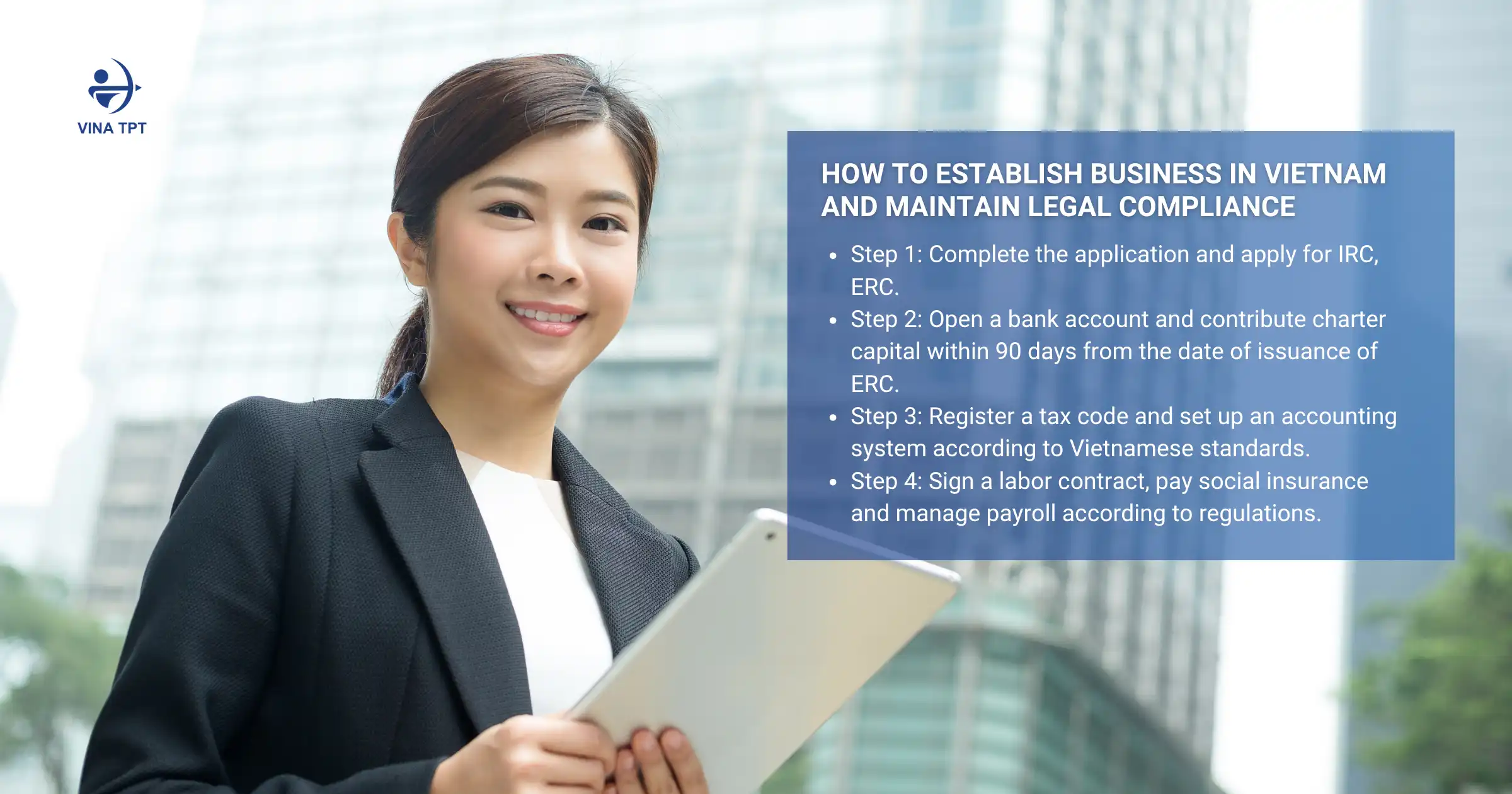
4. How to Establish Business in Vietnam and Maintain Legal Compliance

To successfully establish a business in Vietnam, investors need to take the following important steps:

Step 1: Complete the application and apply for Business License in Vietnam IRC, ERC.

If the project has FDI capital, IRC is the first license allowing the investor to implement the project in Vietnam.

The required documents usually include:

  • Application for investment project implementation and Project proposal: stating the objectives, scale, location, investment capital, progress.
  • Proof of the investor’s financial capacity: bank statement, credit contract or collateral.
  • Legal documents of the investor:
    • Individual: Notarized passport, consular legalization.
    • Organization: Business registration certificate or equivalent document, consular legalization.
  • Project location: lease contract or land/office use rights certificate.

After the IRC is granted (or for 100% domestic-owned enterprises), the investor applies for an ERC – an official license for the enterprise to operate, and also the tax code of the company.

The ERC dossier usually includes:

  • Application for enterprise registration.
  • Company Charter: stipulates the organizational structure, powers of members/shareholders, capital ratio and management method.
  • List of members/shareholders and legal representatives: clearly state information, ownership ratio, voting rights.
  • Appointment decision and authorization letter (if any).
  • Capital contribution plan & financial evidence: bank statement or credit contract (especially important for large capital projects).

Step 2: Open a bank account and contribute charter capital within 90 days from the date of issuance of ERC.

Step 3: Register a tax code and set up an accounting system according to Vietnamese standards.

Step 4: Sign a labor contract, pay social insurance and manage payroll according to regulations.

5. Vina TPT Company Registration – Partnering with Korean Electronics Manufacturers for a Sustainable Setup

With more than a decade of experience in investment consulting and business registration services, Vina TPT has successfully assisted hundreds of FDI enterprises, including a large number of Korean electronics manufacturers in establishing and expanding their operations in Vietnam.

Our comprehensive service scope covers every stage of the process — from investment model consulting and legal documentation, to business license application in Vietnam, business license renewal, and regulatory compliance. This integrated approach ensures a smooth and compliant market entry for Korean investors.

Backed by a team of seasoned professionals with in-depth knowledge of Vietnam’s business, tax, and labor laws, Vina TPT provides end-to-end business license advisory and compliance support, helping investors confidently execute their projects while focusing on production growth and long-term success.

Partnering with Vina TPT Business Advisory and Company Registration means more than saving time and costs. It’s about having a trusted local partner who truly understands how to help Korean investors establish, operate, and sustain successful ventures in Vietnam.

Contact Vina TPT for consultation and support on business registration in Vietnam quickly, legally and at optimal cost.

BOOK A FREE CONSULTATION

setting-up-electronics-business-in-Vietnam