Business Established in Vietnam for Korean Electronics Manufacturers

Korean investor receiving business license in Vietnam

setting-up-electronics-business-in-Vietnam

1. Vietnam – The Next Hub for Korean Electronics Manufacturers

As Korean companies continue to look for new growth opportunities across Asia, Vietnam has become one of the most attractive destinations for manufacturing expansion. With a favorable investment climate and a streamlined business license in Vietnam process for foreign enterprises, Vietnam offers Korean electronics manufacturers an ideal entry point to establish long-term operations. Supported by government incentives and a robust supply chain ecosystem, the country is quickly evolving into a major production hub in the region.

Major corporations such as Samsung, LG, and Hanwha have established large-scale production complexes in Bac Ninh, Thai Nguyen, and Hai Phong, regions that are rapidly becoming Vietnam’s key electronics hubs, supported by modern logistics networks, seaports, and government investment incentives.

Moreover, Vietnam’s active participation in free trade agreements such as CPTPP and EVFTA has unlocked significant tariff advantages, enhancing its competitiveness in the global supply chain. A young, skilled workforce combined with the nation’s push for digital transformation positions Vietnam as the “new manufacturing base” for the global electronics industry, much like South Korea’s industrial rise in the 1990s.

For Korean investors, establishing a business in Vietnam not only optimizes production costs but also opens access to ASEAN, China, and India markets. By obtaining the appropriate business license in Vietnam and leveraging professional strategic consulting, Korean electronics enterprises can streamline the enterprise registration process and transform Vietnam into a sustainable hub for manufacturing and innovation in the region.

2. Strategic Considerations Before Enterprise Registration in Vietnam

Before starting the registration process, investors need to carefully consider strategic factors.

Location is key: Northern regions such as Bac Ninh, Hai Phong, Thai Nguyen currently have many Korean electronics factories, convenient for connecting and sharing the supply chain.

Legal form also directly affects the right to operate and tax obligations. Enterprises can choose to establish a 100% foreign-owned company, joint venture with a Vietnamese partner or open a representative office.

In addition, the domestic supply chain in Vietnam is expanding rapidly, providing components and logistics services suitable for electronics production. Understanding these factors helps Korean enterprises optimize costs and limit risks when entering new markets.

Book a Free Consultation on Your Business License

3. Understanding Business License in Vietnam and Compliance for Electronics Companies

After being granted the Investment Registration Certificate (IRC) and Enterprise Registration Certificate (ERC), the electronics enterprise needs to apply for a business license appropriate to the field of operation.

The electronics manufacturing industry has its own requirements on environmental safety, technology standards and fire prevention.

The estimated time for completion is:

Document preparation: 1-2 weeks, depending on the volume of documents and the level of complexity.

  • IRC appraisal: 20-45 working days.
  • ERC issuance: 10-20 working days after IRC (or similar if the enterprise is a domestic enterprise).

In fact, if the enterprise cooperates with a reputable company registration service, it will help the enterprise quickly handle the consular legalization, translation and submission of documents, shortening the time and increasing the possibility of being licensed the first time.
setting-up-electronics-business-in-Vietnam

4. How to Establish Business in Vietnam and Maintain Legal Compliance

To successfully establish a business in Vietnam, investors need to take the following important steps:

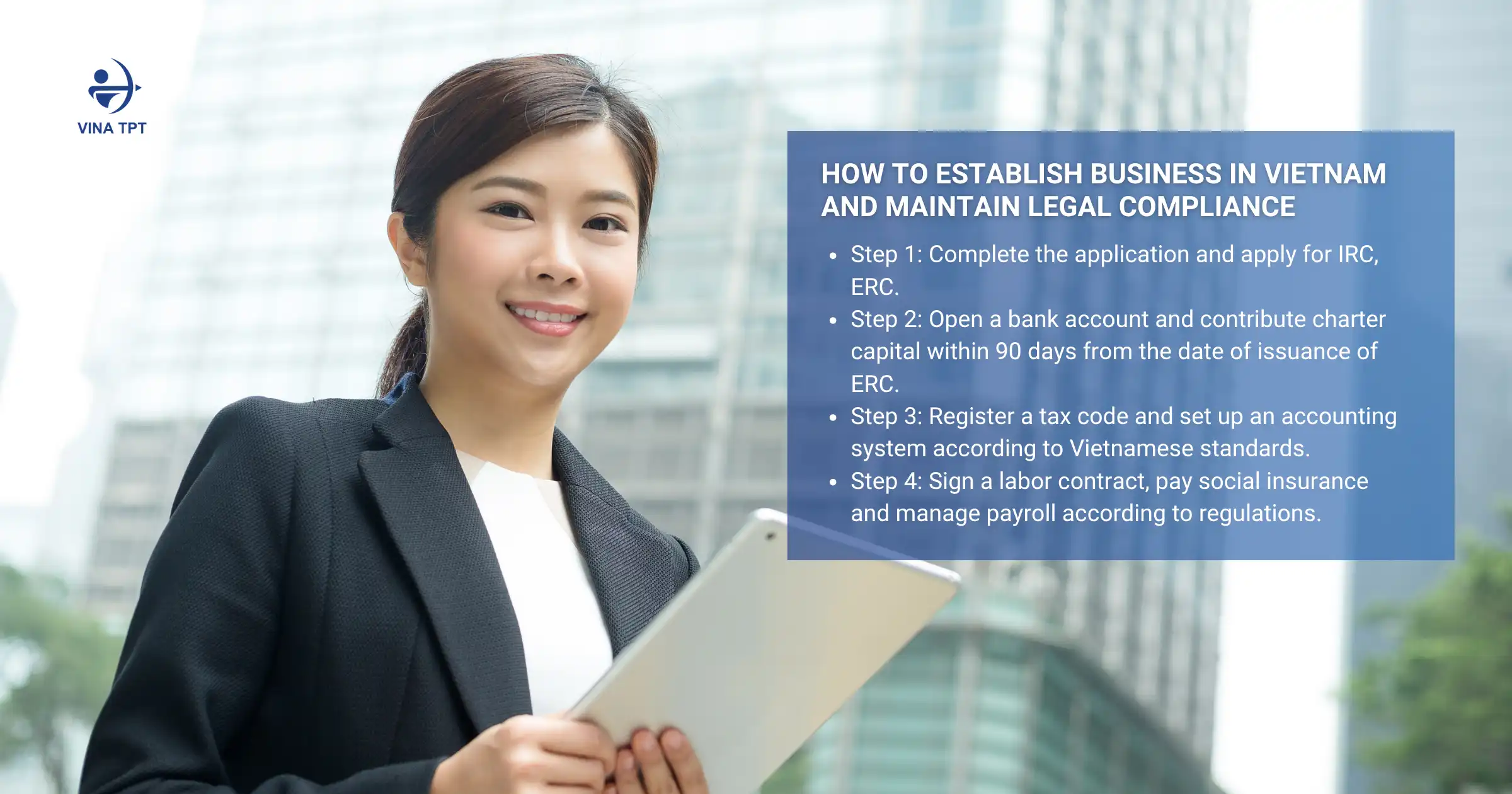
Step 1: Complete the application and apply for Business License in Vietnam IRC, ERC.

If the project has FDI capital, IRC is the first license allowing the investor to implement the project in Vietnam.

The required documents usually include:

  • Application for investment project implementation and Project proposal: stating the objectives, scale, location, investment capital, progress.
  • Proof of the investor’s financial capacity: bank statement, credit contract or collateral.
  • Legal documents of the investor:
    • Individual: Notarized passport, consular legalization.
    • Organization: Business registration certificate or equivalent document, consular legalization.
  • Project location: lease contract or land/office use rights certificate.

After the IRC is granted (or for 100% domestic-owned enterprises), the investor applies for an ERC – an official license for the enterprise to operate, and also the tax code of the company.

The ERC dossier usually includes:

  • Application for enterprise registration.
  • Company Charter: stipulates the organizational structure, powers of members/shareholders, capital ratio and management method.
  • List of members/shareholders and legal representatives: clearly state information, ownership ratio, voting rights.
  • Appointment decision and authorization letter (if any).
  • Capital contribution plan & financial evidence: bank statement or credit contract (especially important for large capital projects).

Step 2: Open a bank account and contribute charter capital within 90 days from the date of issuance of ERC.

Step 3: Register a tax code and set up an accounting system according to Vietnamese standards.

Step 4: Sign a labor contract, pay social insurance and manage payroll according to regulations.

5. Vina TPT Company Registration – Partnering with Korean Electronics Manufacturers for a Sustainable Setup

With more than a decade of experience in investment consulting and business registration services, Vina TPT has successfully assisted hundreds of FDI enterprises, including a large number of Korean electronics manufacturers in establishing and expanding their operations in Vietnam.

Our comprehensive service scope covers every stage of the process — from investment model consulting and legal documentation, to business license application in Vietnam, business license renewal, and regulatory compliance. This integrated approach ensures a smooth and compliant market entry for Korean investors.

Backed by a team of seasoned professionals with in-depth knowledge of Vietnam’s business, tax, and labor laws, Vina TPT provides end-to-end business license advisory and compliance support, helping investors confidently execute their projects while focusing on production growth and long-term success.

Partnering with Vina TPT Business Advisory and Company Registration means more than saving time and costs. It’s about having a trusted local partner who truly understands how to help Korean investors establish, operate, and sustain successful ventures in Vietnam.

Contact Vina TPT for consultation and support on business registration in Vietnam quickly, legally and at optimal cost.

BOOK A FREE CONSULTATION

setting-up-electronics-business-in-Vietnam

Business advisory for Singaporean investors establishing real estate businesses in Vietnam

alt="Business advisory services for Singaporean investors entering Vietnam’s real estate market"

business-advisory-services

1. Vietnam Real Estate: The Next Strategic Move for Singapore Investors

Over the past decade, Vietnam has become one of the most dynamic real estate markets in Asia, with rapid urbanization, high housing demand and a boom in industrial zones. In particular, Singapore is a leading financial, investment and business advisory center in the region, is considering Vietnam as a new “profit drop point” in its strategy to expand in Southeast Asia.

Singaporean investors see in Vietnam not only high profit potential, but also an opportunity to participate in a market that is changing strongly in terms of infrastructure, urban planning and Foreign Direct Investment attraction policies. Vietnam, with its affordable land prices, youthful workforce, and fast-growing transport infrastructure including airports, seaports, and metro lines, is emerging as a promising mirror of Singapore in its early development phase.

However, to realize the opportunity, investors need to clearly understand Vietnam’s legal framework, licensing process and tax mechanism – factors that can directly impact the profitability and safety of the project.

2. Before you invest: Understanding Vietnam’s Real Estate Landscape

Real estate in Vietnam is divided into many different types, including: industrial park development, housing projects, offices, resorts, trade – services and logistics. However, not all segments are open to foreign investors.

According to current regulations, investors can:

  • Contribute capital or buy shares in Vietnamese enterprises with existing real estate projects.
  • Establish a 100% foreign-owned company to develop projects if granted appropriate investment licenses.
  • Lease or sublease land in industrial parks, export processing zones, high-tech zones.

However, direct ownership of land in Vietnam is not allowed, because land is owned by the entire people and managed by the State. Investors can only use land through leasing or joint ventures with domestic partners.

In addition, the tax and regulatory systems related to real estate (VAT, CIT, transfer tax, land fees) also have significant differences compared to Singapore. Lack of understanding or misapplication of investment structures can lead to legal risks or reduced profit efficiency.

At this stage, partnering with a professional business advisory firm becomes essential. A qualified advisory team can help Singaporean investors navigate Vietnam’s complex real estate regulations, review investment structures, and ensure full compliance with local laws. With expert guidance on legal, financial, and tax aspects, investors can make informed decisions and minimize potential risks from the very beginning. Business Advisory

Business advisory for Singaporean investors establishing real estate businesses in Vietnam

3. From Licensing to Launch: Key Steps in Establishing a Real Estate Business

The process of setting up a real estate business in Vietnam usually includes four main stages, requiring close coordination between investors, lawyers and management agencies:

Stage 1: Investment strategy consulting: Business Advisory

Investors need to clearly define their goals (developing new projects, acquiring, cooperating or operating), assess the legal feasibility of the model and choose a locality with appropriate policies.

Stage 2: Applying for an Investment Registration Certificate (IRC):

This is the first license that allows foreign-invested enterprises to carry out projects in Vietnam.

Documents typically required for IRC application include:

  • Application for investment project implementation & Project proposal: Stating objectives, scope, scale, investment capital, location, and implementation schedule.
  • Proof of investor’s financial capacity: Bank statements, audited financial reports, credit contracts, or collateral documents.
  • Legal documents of the investor:
  • For individuals: Notarized passport, consular legalization.
  • For organizations: Business Registration Certificate or equivalent, consular legalization.
  • Evidence of project location: Office/land lease agreement or land use rights certificate.
  • Power of attorney/authorization letter (if the investor appoints a third party to handle procedures).

Stage 3: Enterprise Establishment (ERC):

After having IRC, investors register to establish an enterprise, determine the type of company (LLC, joint stock or joint venture). Choosing the right model will greatly affect the capital mechanism, voting rights and profit distribution.

Stage 4: Compliance and project implementation:

Enterprises must complete tax, insurance, financial and environmental procedures before officially starting operations. This is also the stage where business advisory services become especially important to ensure that all activities are legal and effective.

All foreign documents must be consular legalized and officially translated into Vietnamese before submission. This step often prolongs the preparation process, so it is recommended that investors cooperate with a reliable company registration service to ensure accuracy and save time.

4. Tax Business Advisory: Maximizing Profitability through Smart Structuring

In real estate investment, tax optimization and smart business structure are decisive factors for net profit. Vietnam applies corporate income tax (CIT) at 20%, but there are tax incentives for investment projects in industrial parks, economic zones or investment-encouraged sectors (logistics, infrastructure, social housing, etc.).

In addition, if investors know how to structure capital flows and divide profits reasonably, they can avoid double taxation between Vietnam and Singapore thanks to the Double Taxation Avoidance Agreement (DTA) signed by the two countries. This is a great advantage, but it can only be maximized when there is a business tax advisory team that understands both tax systems.

Vina TPT experts often advise Singaporean investors about business advisory on multi-level legal entity structure strategies, cash flow allocation and legal profit transfer, to ensure optimal profits while still strictly complying with regulations in Vietnam.

OPTIMIZE YOUR TAX STRUCTURE NOW

5. Common Mistakes Foreign Real Estate Investors Should Avoid

Despite the wide-open opportunities, many foreign investors including large corporations, have encountered trouble when investing in Vietnamese real estate due to common mistakes. Some typical mistakes include:

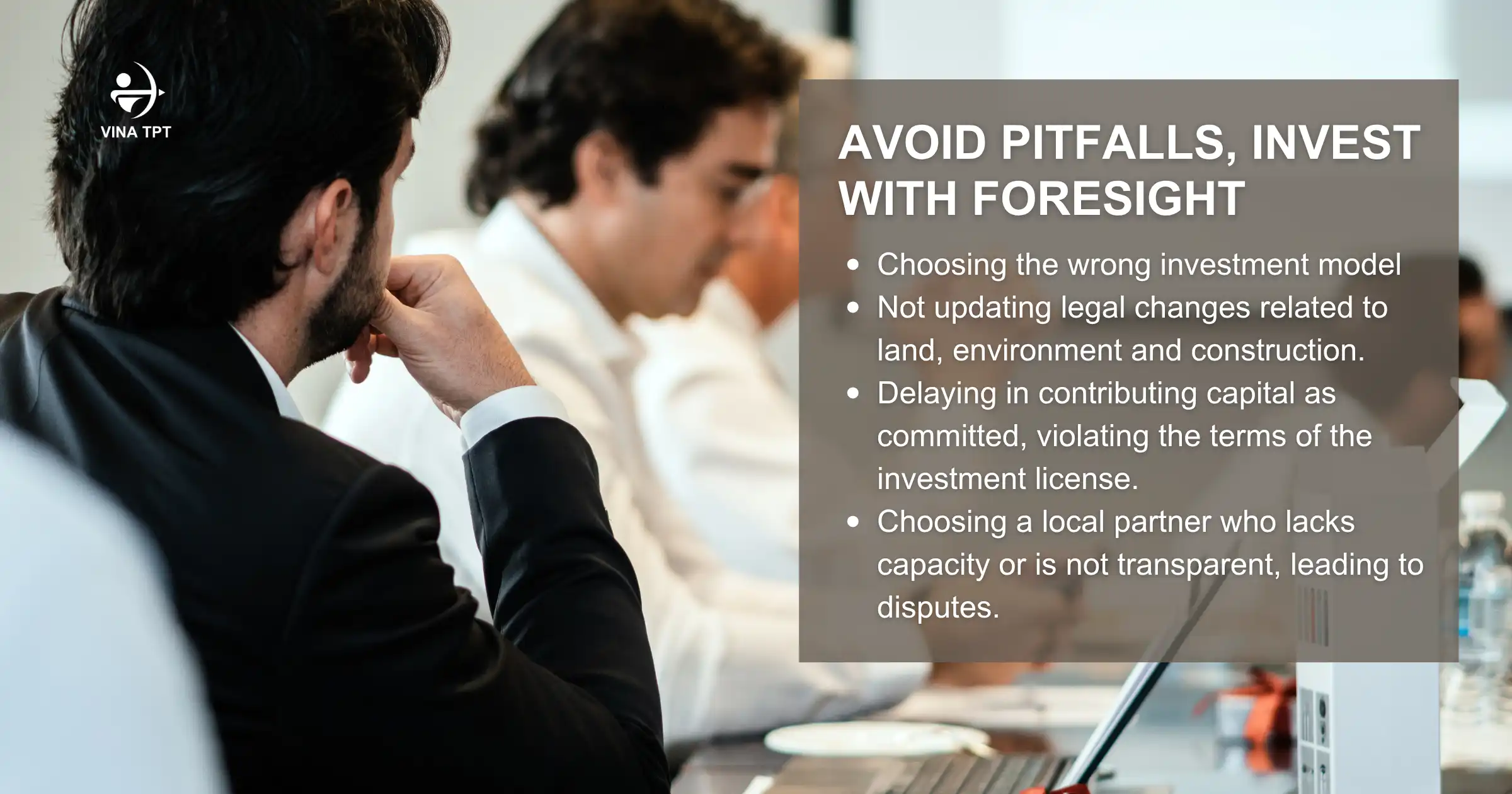
  • Choosing the wrong investment model (for example, registering a trading company instead of a project development company, leading to restrictions on land use).
  • Not updating legal changes related to land, environment and construction.
  • Delaying in contributing capital as committed, violating the terms of the investment license.
  • Choosing a local partner who lacks capacity or is not transparent, leading to disputes.

An excellent business advisory service will help investors avoid these mistakes right from the start, thanks to legal review, partner assessment and risk control throughout the investment process. 

Business advisory for Singaporean investors establishing real estate businesses in Vietnam

6. Why Partnering with Vina TPT Business Advisory Makes a Difference 

With over 15 years of experience in advising companies, Vina TPT Business Advisory Service’s team of legal, accounting and tax experts has worked with hundreds of international enterprises in the real estate, infrastructure and manufacturing sectors.

We provide end-to-end solutions, from developing investment strategies, applying for IRC/ERC licenses, advising on tax structures, to compliance management and post-investment operational accounting. Vina TPT’s strength lies in combining a deep understanding of Vietnamese law with international operational standards, helping Singaporean investors ensure compliance while optimizing profits.

If you are looking for a business consulting partner with market knowledge and the ability to handle everything from legal to tax, Vina TPT Business Advisory is the reliable bridge between Singapore and Vietnam.

BOOK A FREE CONSULTATION

business-advisory-services