Business advisory for Singaporean investors establishing real estate businesses in Vietnam

alt="Business advisory services for Singaporean investors entering Vietnam’s real estate market"

business-advisory-services

1. Vietnam Real Estate: The Next Strategic Move for Singapore Investors

Over the past decade, Vietnam has become one of the most dynamic real estate markets in Asia, with rapid urbanization, high housing demand and a boom in industrial zones. In particular, Singapore is a leading financial, investment and business advisory center in the region, is considering Vietnam as a new “profit drop point” in its strategy to expand in Southeast Asia.

Singaporean investors see in Vietnam not only high profit potential, but also an opportunity to participate in a market that is changing strongly in terms of infrastructure, urban planning and Foreign Direct Investment attraction policies. Vietnam, with its affordable land prices, youthful workforce, and fast-growing transport infrastructure including airports, seaports, and metro lines, is emerging as a promising mirror of Singapore in its early development phase.

However, to realize the opportunity, investors need to clearly understand Vietnam’s legal framework, licensing process and tax mechanism – factors that can directly impact the profitability and safety of the project.

2. Before you invest: Understanding Vietnam’s Real Estate Landscape

Real estate in Vietnam is divided into many different types, including: industrial park development, housing projects, offices, resorts, trade – services and logistics. However, not all segments are open to foreign investors.

According to current regulations, investors can:

  • Contribute capital or buy shares in Vietnamese enterprises with existing real estate projects.
  • Establish a 100% foreign-owned company to develop projects if granted appropriate investment licenses.
  • Lease or sublease land in industrial parks, export processing zones, high-tech zones.

However, direct ownership of land in Vietnam is not allowed, because land is owned by the entire people and managed by the State. Investors can only use land through leasing or joint ventures with domestic partners.

In addition, the tax and regulatory systems related to real estate (VAT, CIT, transfer tax, land fees) also have significant differences compared to Singapore. Lack of understanding or misapplication of investment structures can lead to legal risks or reduced profit efficiency.

At this stage, partnering with a professional business advisory firm becomes essential. A qualified advisory team can help Singaporean investors navigate Vietnam’s complex real estate regulations, review investment structures, and ensure full compliance with local laws. With expert guidance on legal, financial, and tax aspects, investors can make informed decisions and minimize potential risks from the very beginning. Business Advisory
Business advisory for Singaporean investors establishing real estate businesses in Vietnam

3. From Licensing to Launch: Key Steps in Establishing a Real Estate Business

The process of setting up a real estate business in Vietnam usually includes four main stages, requiring close coordination between investors, lawyers and management agencies:

Stage 1: Investment strategy consulting: Business Advisory

Investors need to clearly define their goals (developing new projects, acquiring, cooperating or operating), assess the legal feasibility of the model and choose a locality with appropriate policies.

Stage 2: Applying for an Investment Registration Certificate (IRC):

This is the first license that allows foreign-invested enterprises to carry out projects in Vietnam.

Documents typically required for IRC application include:

  • Application for investment project implementation & Project proposal: Stating objectives, scope, scale, investment capital, location, and implementation schedule.
  • Proof of investor’s financial capacity: Bank statements, audited financial reports, credit contracts, or collateral documents.
  • Legal documents of the investor:
  • For individuals: Notarized passport, consular legalization.
  • For organizations: Business Registration Certificate or equivalent, consular legalization.
  • Evidence of project location: Office/land lease agreement or land use rights certificate.
  • Power of attorney/authorization letter (if the investor appoints a third party to handle procedures).

Stage 3: Enterprise Establishment (ERC):

After having IRC, investors register to establish an enterprise, determine the type of company (LLC, joint stock or joint venture). Choosing the right model will greatly affect the capital mechanism, voting rights and profit distribution.

Stage 4: Compliance and project implementation:

Enterprises must complete tax, insurance, financial and environmental procedures before officially starting operations. This is also the stage where business advisory services become especially important to ensure that all activities are legal and effective.

All foreign documents must be consular legalized and officially translated into Vietnamese before submission. This step often prolongs the preparation process, so it is recommended that investors cooperate with a reliable company registration service to ensure accuracy and save time.

4. Tax Business Advisory: Maximizing Profitability through Smart Structuring

In real estate investment, tax optimization and smart business structure are decisive factors for net profit. Vietnam applies corporate income tax (CIT) at 20%, but there are tax incentives for investment projects in industrial parks, economic zones or investment-encouraged sectors (logistics, infrastructure, social housing, etc.).

In addition, if investors know how to structure capital flows and divide profits reasonably, they can avoid double taxation between Vietnam and Singapore thanks to the Double Taxation Avoidance Agreement (DTA) signed by the two countries. This is a great advantage, but it can only be maximized when there is a business tax advisory team that understands both tax systems.

Vina TPT experts often advise Singaporean investors about business advisory on multi-level legal entity structure strategies, cash flow allocation and legal profit transfer, to ensure optimal profits while still strictly complying with regulations in Vietnam.

OPTIMIZE YOUR TAX STRUCTURE NOW

5. Common Mistakes Foreign Real Estate Investors Should Avoid

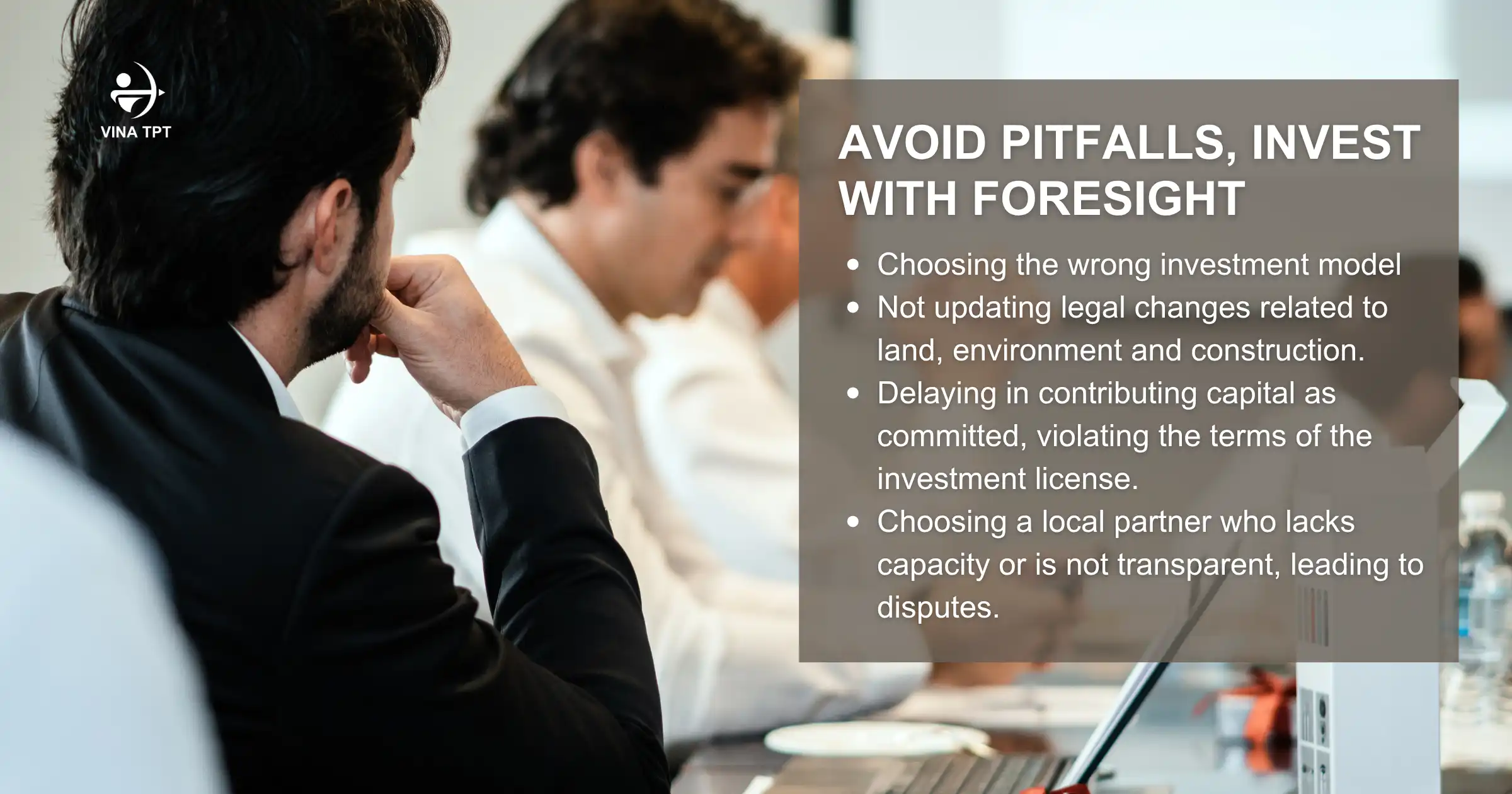
Despite the wide-open opportunities, many foreign investors including large corporations, have encountered trouble when investing in Vietnamese real estate due to common mistakes. Some typical mistakes include:

  • Choosing the wrong investment model (for example, registering a trading company instead of a project development company, leading to restrictions on land use).
  • Not updating legal changes related to land, environment and construction.
  • Delaying in contributing capital as committed, violating the terms of the investment license.
  • Choosing a local partner who lacks capacity or is not transparent, leading to disputes.

An excellent business advisory service will help investors avoid these mistakes right from the start, thanks to legal review, partner assessment and risk control throughout the investment process. 
Business advisory for Singaporean investors establishing real estate businesses in Vietnam

6. Why Partnering with Vina TPT Business Advisory Makes a Difference 

With over 15 years of experience in advising companies, Vina TPT Business Advisory Service’s team of legal, accounting and tax experts has worked with hundreds of international enterprises in the real estate, infrastructure and manufacturing sectors.

We provide end-to-end solutions, from developing investment strategies, applying for IRC/ERC licenses, advising on tax structures, to compliance management and post-investment operational accounting. Vina TPT’s strength lies in combining a deep understanding of Vietnamese law with international operational standards, helping Singaporean investors ensure compliance while optimizing profits.
If you are looking for a business consulting partner with market knowledge and the ability to handle everything from legal to tax, Vina TPT Business Advisory is the reliable bridge between Singapore and Vietnam.

BOOK A FREE CONSULTATION

business-advisory-services

How Singapore Investors Can Smoothly Establish Business in Vietnam

establish business in Vietnam with vtpt

establish business in Vietnam with vtpt

1. Why Singapore Investors Choose to Establish Business in Vietnam  

Vietnam is becoming an attractive investment destination for Singapore investors in Vietnam thanks to its strategic geographical location in Southeast Asia, competitive labor and operating costs, and free trade agreements (FTAs) that facilitate exports and trade.

For small and medium-sized enterprises from Singapore, establishing a business in Vietnam opens up opportunities to access a large consumer market, taking advantage of lower operating costs compared to other saturated markets. In addition, the preferential policies of the Vietnamese Government for a number of industries such as technology, manufacturing, education and renewable energy also increase the attractiveness, helping Singapore investors to expand their scale sustainably.

2. Key Legal Requirements for Singapore Companies

To ensure a smooth business establishment in Vietnam, Singapore investors need to understand the legal requirements. Choosing the type of business such as Limited Liability Company (LLC), Joint Stock Company (JSC) or Representative Office will determine the ownership structure, charter capital and management rights.

Investors need to determine the investment capital, business lines and licensing conditions. Some specific business lines may require additional licenses or pre-investment approval from state agencies. Basic legal documents include the company charter, list of shareholders/members, legal documents of the investor, legal head office address, and capital contribution plan.

For FDI projects, Singapore investors need to apply for an Investment Registration Certificate (IRC) to get investment approval, then apply for an Enterprise Registration Certificate (ERC) – the official business license and tax code of the enterprise. Compliance with these legal requirements is a prerequisite for legal and effective business operations.

3. Prepare Documents and Apply for Business License (IRC & ERC)

For Singapore investors in Vietnam, establishing a business in Vietnam cannot be separated from the steps of preparing documents and applying for licenses. This is an important stage, especially for FDI projects, because complete and accurate documents determine the progress of granting Investment Registration Certificate (IRC) and Enterprise Registration Certificate (ERC) – two mandatory licenses for businesses to operate legally.

3.1 Investment Registration Certificate (IRC) – For FDI

For projects with foreign investment capital, IRC is the first license, allowing investors to implement projects in Vietnam. The documents usually include:

  • Application for implementing investment projects and Investment Plan, clearly stating the objectives, scale, location, capital and progress of the project.
  • Evidence of the investor’s financial capacity, such as bank statements, credit contracts or mortgaged assets.
  • Legal documents of the investor: individuals submit notarized and consularized passports; legal entities submit notarized and consularized business registration certificates.
  • Project location, including lease contract or land/office use right certificate.

3.2 Enterprise Registration Certificate (ERC) – Operating License

After the IRC is issued (or for 100% domestic-owned enterprises), the investor submits an application for an ERC – which is an official license for the enterprise to operate and also a tax code. The ERC dossier includes:

  • Business registration application.
  • Company Charter, which stipulates the organizational structure, member/shareholder rights, capital contribution ratio and management method.
  • List of shareholders/members and legal representatives, clearly stating information, ownership ratio and voting rights.
  • Appointment decision and authorization letter (if any).
  • Capital contribution plan & proof of financial capacity, especially important for large capital projects.

3.3 General requirements and important notes

  • Notarization, consular legalization & translation into Vietnamese: all documents of foreign investors must be completed before submission. This is a step that often causes delays if the dossier has many shareholders or is complicated.
  • Legal head office address: do not use apartments or collective houses.
  • Unified information: company name, address, capital, and business lines must be consistent on all dossiers.
  • Choosing the right business line: ensure that investment conditions are met to avoid multiple amendments.

3.4 Time to prepare and submit documents

  • Document preparation: 1-2 weeks, depending on the volume and complexity of legalization.
  • IRC appraisal: about 20-45 working days.
  • ERC issuance: 10-20 days after IRC approval.

Due to the complicated process of preparing documents and applying for ERC/IRC, Singapore investors should hire outsourcing with professional services such as Vina TPT start-up business license service. This not only saves time, limits legal errors but also ensures that the licensing process is quick, transparent and safe.


GET EXPERT HELP WITH IRC & ERC REGISTRATION

4. Common Challenges and How to Overcome Them

Singaporean investors often face difficulties due to differences in laws, taxes, and administrative procedures between Vietnam and Singapore. Language barriers and incomplete understanding of regulations also hinder the preparation of documents and communication with authorities.

Common problems include delays in IRC or ERC approval, inconsistent information in documents, and additional licensing requirements for specific industries. Working with a business setup consultant Vietnam helps to minimize these risks through legal advice, accurate document preparation, and direct dealing with government agencies, allowing investors to focus on business planning and strategic operations.

establish business in Vietnam with vtpt

5. Role of a Business Setup Consultant in Vietnam

Using a business setup consultant Vietnam is an important strategy for Singapore investors to optimize the company registration process. Consultants help identify the appropriate type of business, review and prepare all legal documents, and ensure compliance with Vietnamese regulations.

In addition, consultants also provide strategic advice on capital allocation, investment approval, and application for specific industry licenses, helping investors avoid legal errors and shorten the time to complete documents. As a result, Singaporean businesses save costs, time, and feel more secure in long-term development in Vietnam.

6. Vina TPT Company Registration Service for Singapore Investors

Vina TPT company registration offers a complete solution for Singapore investors in Vietnam, with outstanding advantages:

  • Comprehensive support: From initial consultation, document preparation, document submission, to post-registration support.
  • Legal compliance: Ensure documents are valid for both IRC and ERC.
  • Industry expertise: Guidance on applying for additional licenses for regulated fields such as education, fintech, manufacturing.
  • Multilingual service: Bilingual support in Vietnamese and English, ensuring accurate and easy-to-understand information for investors.
  • Save time and costs: Help shorten the registration process, limit errors and reduce operating costs.

Singapore investors can rest assured when choosing Vina TPT company registration to establish business in Vietnam quickly, legally and effectively.

Contact Vina TPT today for advice and quick implementation of business registration in Vietnam!

BOOK A FREE CONSULTATION

Laywer-Establish-business-Vietnam-VinaTPT