Setting Up a Representative Office in Vietnam: Step-by-Step Guide for Foreigners 2026

As Vietnam continues to attract foreign direct investment (FDI) with robust economic growth in 2025-2026, many international businesses choose to establish a Representative Office (RO) as their initial market entry strategy. An RO allows foreign companies to build a legal presence, conduct market research, and liaise with local partners without engaging in direct profit-generating activities.

With over 20 years of experience supporting more than 200 foreign clients, Vina TPT specializes in guiding investors through this process efficiently and compliantly. This ultimate guide provides a step-by-step overview for setting up a representative office in Vietnam in 2025, based on the latest regulations under Commercial Law 2005 and Decree 07/2016/ND-CP (with minor procedural updates).

1. What is a Representative Office in Vietnam?

A representative office is a dependent unit of an enterprise that is established in a different province or country for the purpose of supporting the operations of its parent company. ts main activities typically include:

  • Promoting and marketing products or services
  • Collecting and analyzing market information
  • Identifying customer demands and industry trends
  • Providing customer consultation and support
  • Developing and maintaining relationships with partners
  • Assisting with administrative and procedural matters

Key limitations: Representative Offices cannot generate revenue, issue invoices, or conduct direct trading. If your goal involves commercial operations, consider a full foreign-invested enterprise instead.

Representative Office

Foreign-Invested Company

Legal Status Dependent unit; extension of the parent company Independent legal entity; registered in Vietnam.
Business Activities Non-profit; no direct revenue-generating activities. Full operations; allowed to trade, manufacture, and earn profits.
Primary Purpose Market research, brand promotion, and liaison activities. Executing full business operations and commercial contracts.
Suitability Ideal for testing the market and building local relationships. Best for long-term investment and generating local revenue.


2. Eligibility Requirements for Foreign Companies

To qualify for an RO in Vietnam:

  • The parent company must operate legally in its home country for at least 1 year.
  • Business activities must align with Vietnam’s WTO commitments.
  • No minimum capital is required, making it a low-risk option for SMEs and startups.

3. Setting Up a Representative Office: Step-by-Step Process

The process typically takes 4 – 6 weeks months in 2026, handled by the Department of Industry and Trade (DOIT).

Step 1: Prepare Documents

In order to facilitate a seamless and efficient licensing process for a Vietnam-based representative office, foreign entities should assemble the following essential documentation:

  • Application form for RO establishment
  • Parent company’s Business Registration Certificate (legalized)
  • Audited financial statements (latest year)
  • Appointment letter for Chief Representative
  • Lease agreement for office premises (physical address required)
  • Passport/ID of Chief Representative

Note: All foreign documents need consular legalization and Vietnamese translation.

Step 2: Submit Application

After finalizing the necessary paperwork, the investor submits it to the Business Registration Office under the Department of Planning and Investment where the representative office will be located.

Under normal circumstances, the licensing authority will review and issue a result within a timeframe of 10 to 15 business days.

Step 3: Obtain RO License

Upon the successful evaluation of the application, the competent authority will formally issue the Representative Office Establishment License.

To ensure full regulatory compliance, the entity must immediately proceed with post-licensing compliance tasks, such as: 

  • Engrave seal and register specimen
  • Open bank account (for expenses only)
  • Registering for tax if any expenses are incurred
  • Apply for work permits/TRC for foreign staff (if needed)

At VINA TPT, we support clients throughout every step—tracking the progress, handling all paperwork, and collecting the license as soon as the application is approved.

setting-up-a-representative-office-in-vietnam

4. Common Challenges and Tips

To ensure your 2026 application is processed without delays, please consider these essential points:

  • Legalization: Start document legalization early to avoid common administrative bottlenecks.
  • Office Lease: Ensure a valid lease agreement is signed before submitting your dossier.

Work Permits: Foreign Chief Representatives may require a work permit to stay compliant.

5. Ready to Establish Your Representative Office in Vietnam?

Establishing a representative office is a strategic move for foreign companies to expand and engage with the Vietnamese market. However, success requires deep legal insight and meticulous preparation. To overcome language barriers and administrative complexities, partnering with a professional service is the most effective solution.

With over 20 years of expertise, VINA TPT is proud to be the trusted partner for international businesses entering Vietnam. With Vina TPT’s one-stop support, foreign investors can navigate this process seamlessly, ensuring 100% data protection and transparent costs. Contact us today for expert consultation and a seamless start to your investment journey.


BOOK A FREE CONSULTATION

start a business in vietnam with vina tpt

Good Business Ideas to Start in Vietnam: Company Setup & Profitable Opportunities

Good-Business-Ideas-to-Start-in-Vietnam_-Company-Setup-Profitable-Opportunities-Vina-TPT

 Good-Business-Ideas-to-Start-in-Vietnam_-Company-Setup-Profitable-Opportunities-Vina-TPT

1. Current Market Trends Shaping Business Opportunities

Vietnam is becoming an attractive destination for setting up a company in vietnam thanks to its stable economic growth, young population and dynamic workforce. Consumer demand is growing, especially in the technology, services and retail sectors. The booming online market also opens up opportunities for e-commerce and logistics models, while the F&B and tourism industries continue to recover strongly after the pandemic.

In addition, the interest in health, education and high technology also creates many new opportunities. Businesses that exploit this trend can take advantage of rapid growth and sustainable profits in the long term.

2. Emerging Business Models for New Entrepreneurs

The emerging business models in Vietnam today are diverse, suitable for many types of entrepreneurs:

  1. Retail & E-commerce: online sales, e-commerce platforms, dropshipping models.
  2. Logistics services: transportation, warehousing, fulfillment for e-commerce.
  3. Edu-tech: online learning platforms, skills training, specialized education.
  4. High-tech & Startups: AI, IoT, blockchain, enterprise software applications.
  5. Creative F&B: cafes, concept restaurants, organic food.
  6. Production: agricultural processing, processing, industrial equipment manufacturing.
  7. Tourism & Hospitality: experiential tourism, homestay, travel services.
  8. Healthcare & Wellness: clinics, health care, fitness, spa.

These models are growing rapidly thanks to changing consumer needs and the acceptance of new technology in life.

START YOUR BUSINESS JOURNEY

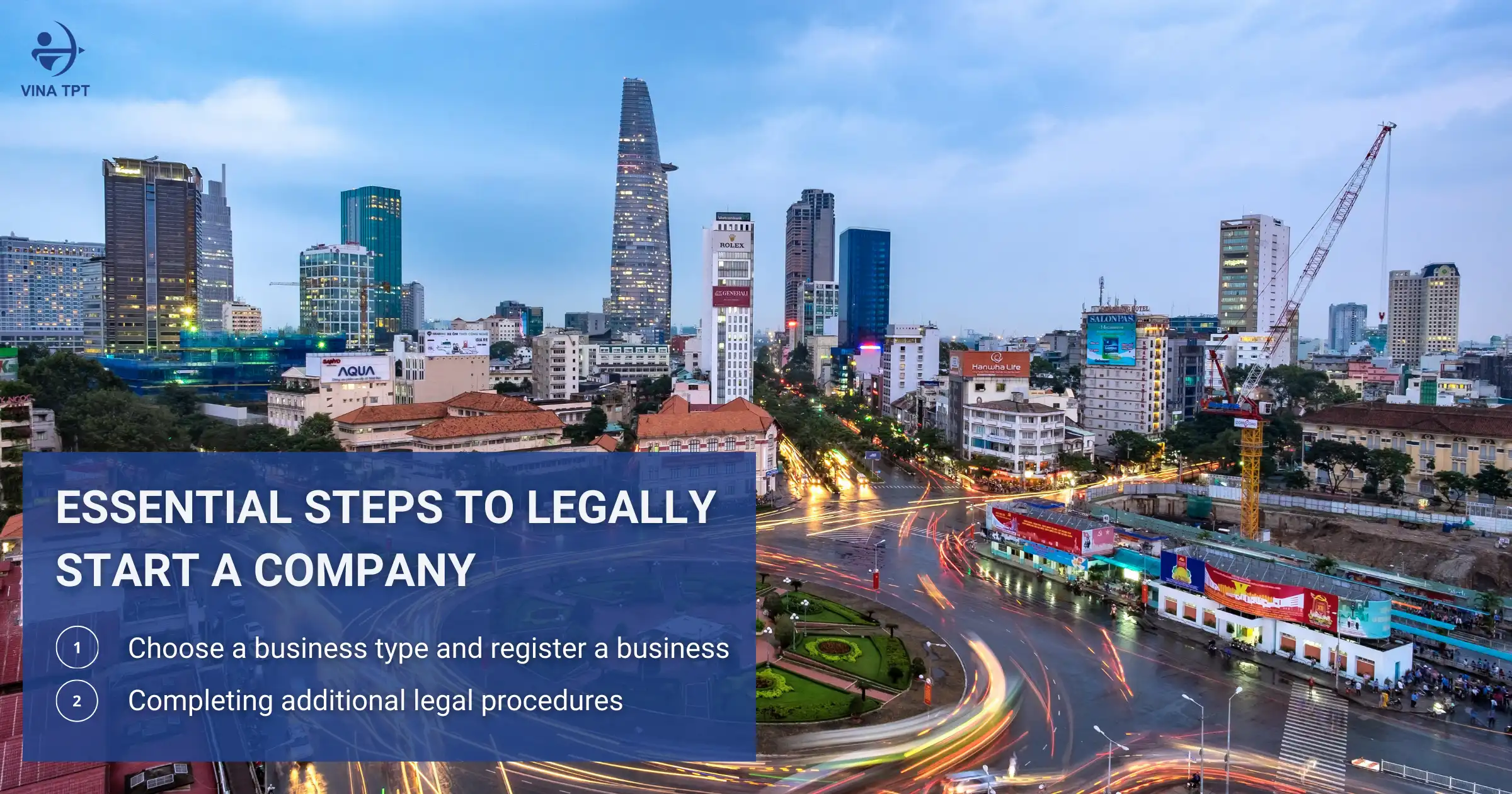
3. Essential Steps to Legally Start a Company

To start a business in Vietnam legally, entrepreneurs need to fully comply with basic legal procedures. Doing it right from the beginning helps avoid legal risks, ensures smooth business operations and easy expansion later.

 Good-Business-Ideas-to-Start-in-Vietnam_-Company-Setup-Profitable-Opportunities-Vina-TPT

3.1 Choose a business type and register a business

The first step is to determine the type of business that is suitable for the business goals:

  • Single-member LLC: suitable for individual business owners or sole investors; limited liability, simple management.
  • Two-member LLC or more: from 2-50 members, limited liability, suitable for small investor groups.
  • Joint Stock Company (JSC): suitable for businesses that want to raise capital from many shareholders; suitable for startups or large projects.
  • Private enterprise: easy to establish, but the business owner has unlimited liability.

After choosing the type, the business needs to name the company uniquely and submit the business registration application to the Department of Planning & Investment. The company name must not be the same as that of registered businesses and must accurately reflect the field of operation.

3.2 Completing additional legal procedures

After registering a business, the enterprise needs to perform the following steps:

  1. Registering a tax code (MST):
    • Required for declaring VAT, CIT and PIT if there are employees.
    • MST is the legal basis for conducting all tax transactions with the management agency.
  2. Applying for necessary business licenses:
    • Depending on the industry, some fields require sub-licenses such as F&B, logistics, education, and healthcare.
    • The license dossier includes conditions on facilities, expertise, and related documents.
  3. Opening a corporate bank account:
    • Needed for financial transactions, obtaining charter capital and managing cash flow.
  4. Complete other procedures:
    • Hanging company signs, registering digital signatures, submitting initial tax reports.
    • Ensuring that businesses fully comply with legal regulations from the beginning.

Fully implementing 3.1 and 3.2 helps businesses operate legally, reduce risks and easily develop long-term in the Vietnamese market.

4. Vina TPT as a Strategic Partner for New Businesses

Starting a business in Vietnam can be complicated, so working with a strategic partner like Vina TPT gives entrepreneurs peace of mind. Vina TPT provides a comprehensive solution from strategic consulting to company registration, including:

  • Choosing the right type of business.
  • Submitting business registration documents to the Department of Planning & Investment.
  • Applying for necessary sub-licenses according to the industry.
  • Instructions on tax management and proper declaration.

Starting a business in Vietnam becomes easier and safer with Vina TPT, a strategic partner providing comprehensive solutions. 

BOOK A FREE CONSULTATION

setting-up-a-company-in-vietnam

Business setup and operational licensing for Chinese hotpot and bubble tea chains in Vietnam

Business setup and operational licensing for Chinese hotpot and bubble tea chains in Vietnam

Business setup and operational licensing for Chinese hotpot and bubble tea chains in Vietnam

1. Why Chinese Hotpot and Bubble Tea Chains Are Eyeing Vietnam Now

In recent years, Vietnam has become a top attractive destination to register a company in the fields of hotpot and bubble tea chains from China. This attraction comes from the impressive growth rate of the F&B market, the strong expansion of the middle class, and the experiential consumption trend of Gen Z in large cities such as Ho Chi Minh City, Hanoi and Da Nang.

According to a report by Vietnam Briefing (2024), the scale of the food service industry in Vietnam has reached 688.8 trillion VND, equivalent to about 27.3 billion USD, an increase of 16.6% compared to the previous year. Similarly, research by iPOS.vn and Nestlé Professional shows that the Vietnamese F&B industry will maintain a growth rate of about 9.6% per year in the period 2024-2025. Looking further ahead, Mordor Intelligence estimates that the Vietnamese food-service market will reach a size of 41.22 billion USD by 2030, with an average growth rate of 10.7%/year.

These figures clearly reflect the huge potential of the Vietnamese culinary industry, where the demand for dine-out and chain models is growing. With advantages in raw material supply, reasonable premises costs and a young population that loves to experience, Vietnam is becoming a “golden land” for hotpot and bubble tea brands from China.

However, opportunities always go hand in hand with challenges. To be successful, brands not only need to understand the procedures for registering a company or the company formation process, but also need to deeply understand local culinary culture, taste and consumer behavior, key factors that help turn the market boom into a sustainable advantage.

2. The Real Challenge: Localization, Not Just Licensing

Many Chinese brands entering Vietnam face difficulties not in licensing, but in adapting to the market (localization).

Vietnamese people prefer lighter, less spicy, less greasy tastes compared to Chinese cuisine. In addition, rental costs in central areas are increasing rapidly, while requirements for experience space, especially for high-end hotpot models, are increasingly strict.

Human resources to operate a chain of many branches is also a big challenge. Chinese brands inherently have a methodical process, but when applied in Vietnam, they need to standardize training, quality control and service processes to ensure consistency.

Therefore, licensing is just the tip of the iceberg. The bigger problem lies in adapting the operating model to suit the consumer culture and legal environment in Vietnam.

register-a-company

3. Choosing the Right Entry Model: Direct Ownership vs. Master Franchise

Before starting to register a company, investors need to determine the market penetration model. There are two popular strategies:

Direct Ownership (Self-investment and operation)

  • Advantages: Full control over the brand, product quality and customer experience.
  • Disadvantages: High investment costs, longer time to apply for licenses and set up operations.
  • Suitable for: Large brands that want to build a high-end image, create the first flagship store in Vietnam.

Master Franchise (Regional franchising)

  • Advantages: Helps brands expand quickly, reduce financial risks and take advantage of local networks.
  • Disadvantages: Requires a clear mechanism for quality monitoring, training and profit sharing.
  • Suitable for: Bubble tea chains or fast-casual hotpots that want to quickly cover the market.

In fact, many Chinese brands have chosen to combine both models: opening the first store directly to control the image, then franchising to expand to other provinces and cities.

Whichever direction is chosen, investors need to follow the company formation process and comply with the legal regulations on franchise business in Vietnam – including registering the franchise contract with the Ministry of Industry and Trade and periodically declaring taxes.

GET EXPERT GUIDANCE ON ENTRY MODELS

4. Building a Compliant but Scalable Operation

For hotpot or bubble tea chains to expand sustainably in Vietnam, building a legal foundation and licensing right from the beginning is a vital factor. Many international F&B brands have encountered difficulties when developing in Vietnam not because of their products or marketing strategies, but because they have not established a tight legal and operational system from the beginning. When starting a business in Vietnam, F&B businesses need to complete the following procedures:

  • Investment Registration Certificate (IRC) if there is a foreign capital element.
  • Enterprise Registration Certificate (ERC) to legally establish a company in Vietnam.
  • Registering conditional business codes: including food and beverage (5610), food processing (1079), and beverages (4722).

The estimated time for completion is:

  • Document preparation: 1-2 weeks, depending on the volume of documents and the level of complexity.
  • IRC appraisal: 20-45 working days.
  • ERC issuance: 10-20 working days after IRC (or similar if the enterprise is a domestic enterprise).

Applying for “sub-licenses” (operational licenses) including:

  • Food Safety Certificate.
  • Fire prevention and fighting license for each facility.
  • Alcohol sales license (if any).
  • Registering environmental and labor hygiene according to the scale of the restaurant.

These licenses are issued by different agencies (Department of Finance, Department of Food Safety, Fire Police…), so it requires smooth coordination in the documents. 

5. Your Strategic Next Step

As the Vietnamese F&B market is entering a period of fierce competition, having a consulting partner with a good understanding of the local legal and business environment will not only help businesses “open a shop”, but also “build a sustainable brand”. This is the value that Vina TPT company registration brings to F&B chains from China.

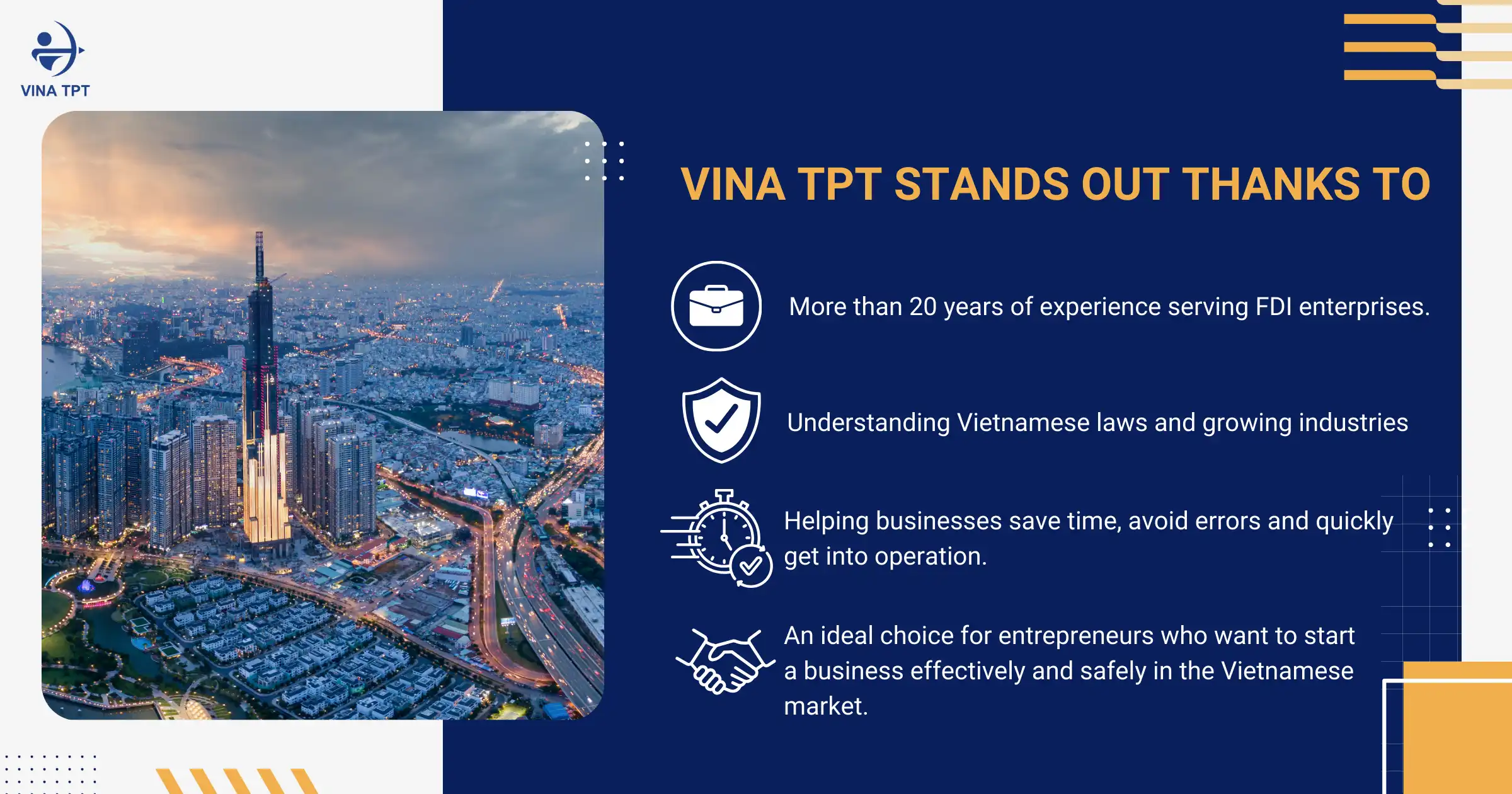
With more than 20 years of experience in registering a company and consulting on company formation for foreign businesses, Vina TPT has a deep understanding of each stage that a brand must go through – from the initial market survey, choosing an investment model, to completing legal documents and implementing chain operations.

Vina TPT’s team of experts not only handles administrative procedures, but also accompanies businesses as strategic advisors, helping them:

  • Consulting on suitable legal models: choosing between 100% foreign capital, joint ventures, or franchise business to optimize control and cost advantages.
  • Set up a complete investment profile & business registration package: prepare all IRC, ERC documents, register conditional industry codes for F&B, and apply for operating licenses.
  • Ensure compliance with local regulations: detailed guidance on tax, accounting, human resource management, and standardize operating procedures to meet inspection and testing requirements.

With professional support from Vina TPT company registration, businesses no longer have to worry about legal risks or complicated procedures – instead, they can focus all their efforts on developing their brand, improving customer experience and expanding market share in one of the most dynamic F&B markets in Southeast Asia.

Let Vina TPT become your strategic partner to help you start your business journey in Vietnam legally, effectively and sustainably.

CONTACT YOUR EXPERTS

register-a-company

Business Established in Vietnam for Korean Electronics Manufacturers

Korean investor receiving business license in Vietnam

setting-up-electronics-business-in-Vietnam

1. Vietnam – The Next Hub for Korean Electronics Manufacturers

As Korean companies continue to look for new growth opportunities across Asia, Vietnam has become one of the most attractive destinations for manufacturing expansion. With a favorable investment climate and a streamlined business license in Vietnam process for foreign enterprises, Vietnam offers Korean electronics manufacturers an ideal entry point to establish long-term operations. Supported by government incentives and a robust supply chain ecosystem, the country is quickly evolving into a major production hub in the region.

Major corporations such as Samsung, LG, and Hanwha have established large-scale production complexes in Bac Ninh, Thai Nguyen, and Hai Phong, regions that are rapidly becoming Vietnam’s key electronics hubs, supported by modern logistics networks, seaports, and government investment incentives.

Moreover, Vietnam’s active participation in free trade agreements such as CPTPP and EVFTA has unlocked significant tariff advantages, enhancing its competitiveness in the global supply chain. A young, skilled workforce combined with the nation’s push for digital transformation positions Vietnam as the “new manufacturing base” for the global electronics industry, much like South Korea’s industrial rise in the 1990s.

For Korean investors, establishing a business in Vietnam not only optimizes production costs but also opens access to ASEAN, China, and India markets. By obtaining the appropriate business license in Vietnam and leveraging professional strategic consulting, Korean electronics enterprises can streamline the enterprise registration process and transform Vietnam into a sustainable hub for manufacturing and innovation in the region.

2. Strategic Considerations Before Enterprise Registration in Vietnam

Before starting the registration process, investors need to carefully consider strategic factors.

Location is key: Northern regions such as Bac Ninh, Hai Phong, Thai Nguyen currently have many Korean electronics factories, convenient for connecting and sharing the supply chain.

Legal form also directly affects the right to operate and tax obligations. Enterprises can choose to establish a 100% foreign-owned company, joint venture with a Vietnamese partner or open a representative office.

In addition, the domestic supply chain in Vietnam is expanding rapidly, providing components and logistics services suitable for electronics production. Understanding these factors helps Korean enterprises optimize costs and limit risks when entering new markets.

Book a Free Consultation on Your Business License

3. Understanding Business License in Vietnam and Compliance for Electronics Companies

After being granted the Investment Registration Certificate (IRC) and Enterprise Registration Certificate (ERC), the electronics enterprise needs to apply for a business license appropriate to the field of operation.

The electronics manufacturing industry has its own requirements on environmental safety, technology standards and fire prevention.

The estimated time for completion is:

Document preparation: 1-2 weeks, depending on the volume of documents and the level of complexity.

  • IRC appraisal: 20-45 working days.
  • ERC issuance: 10-20 working days after IRC (or similar if the enterprise is a domestic enterprise).

In fact, if the enterprise cooperates with a reputable company registration service, it will help the enterprise quickly handle the consular legalization, translation and submission of documents, shortening the time and increasing the possibility of being licensed the first time.

setting-up-electronics-business-in-Vietnam

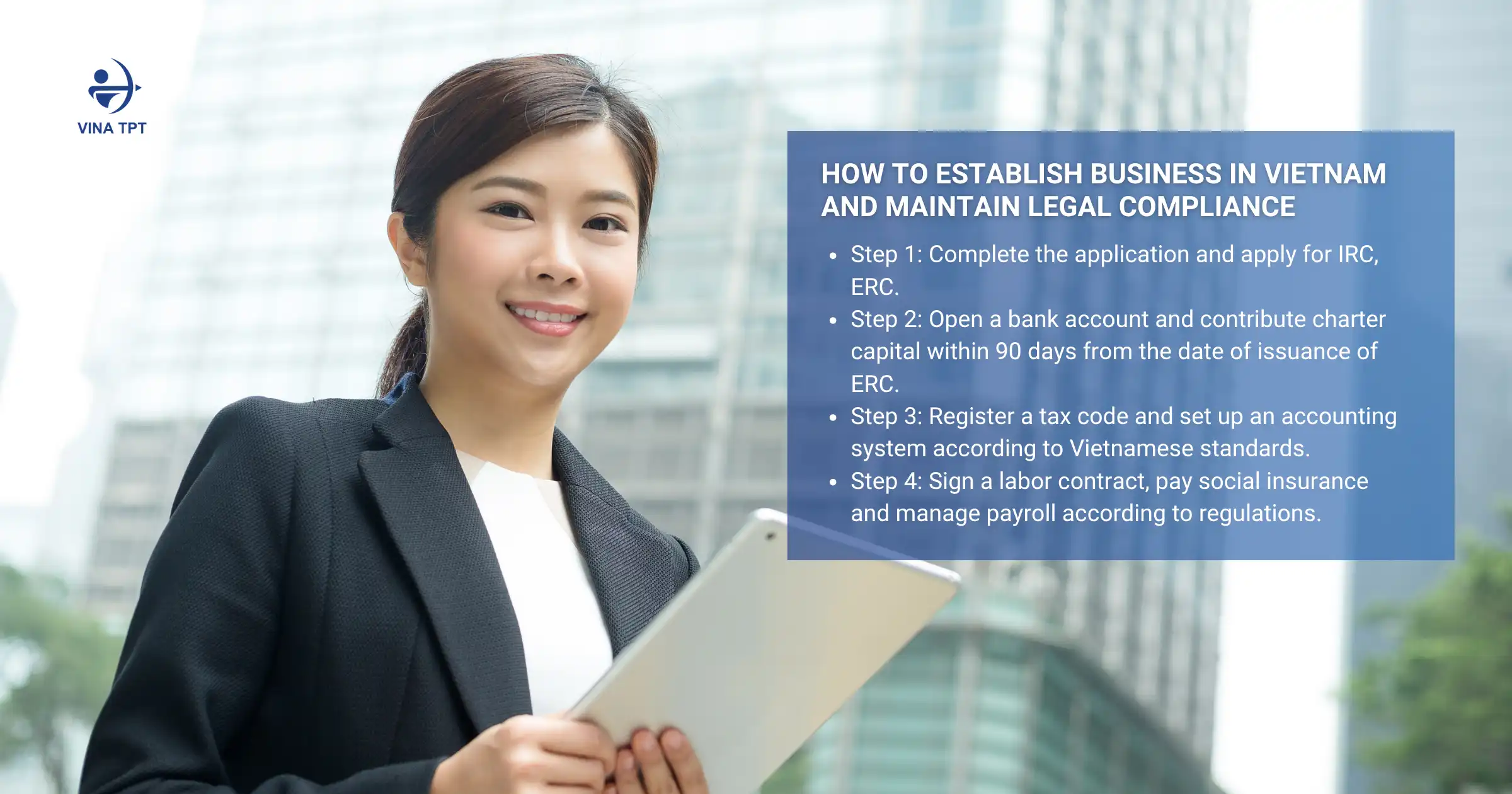
4. How to Establish Business in Vietnam and Maintain Legal Compliance

To successfully establish a business in Vietnam, investors need to take the following important steps:

Step 1: Complete the application and apply for Business License in Vietnam IRC, ERC.

If the project has FDI capital, IRC is the first license allowing the investor to implement the project in Vietnam.

The required documents usually include:

  • Application for investment project implementation and Project proposal: stating the objectives, scale, location, investment capital, progress.
  • Proof of the investor’s financial capacity: bank statement, credit contract or collateral.
  • Legal documents of the investor:
    • Individual: Notarized passport, consular legalization.
    • Organization: Business registration certificate or equivalent document, consular legalization.
  • Project location: lease contract or land/office use rights certificate.

After the IRC is granted (or for 100% domestic-owned enterprises), the investor applies for an ERC – an official license for the enterprise to operate, and also the tax code of the company.

The ERC dossier usually includes:

  • Application for enterprise registration.
  • Company Charter: stipulates the organizational structure, powers of members/shareholders, capital ratio and management method.
  • List of members/shareholders and legal representatives: clearly state information, ownership ratio, voting rights.
  • Appointment decision and authorization letter (if any).
  • Capital contribution plan & financial evidence: bank statement or credit contract (especially important for large capital projects).

Step 2: Open a bank account and contribute charter capital within 90 days from the date of issuance of ERC.

Step 3: Register a tax code and set up an accounting system according to Vietnamese standards.

Step 4: Sign a labor contract, pay social insurance and manage payroll according to regulations.

5. Vina TPT Company Registration – Partnering with Korean Electronics Manufacturers for a Sustainable Setup

With more than a decade of experience in investment consulting and business registration services, Vina TPT has successfully assisted hundreds of FDI enterprises, including a large number of Korean electronics manufacturers in establishing and expanding their operations in Vietnam.

Our comprehensive service scope covers every stage of the process — from investment model consulting and legal documentation, to business license application in Vietnam, business license renewal, and regulatory compliance. This integrated approach ensures a smooth and compliant market entry for Korean investors.

Backed by a team of seasoned professionals with in-depth knowledge of Vietnam’s business, tax, and labor laws, Vina TPT provides end-to-end business license advisory and compliance support, helping investors confidently execute their projects while focusing on production growth and long-term success.

Partnering with Vina TPT Business Advisory and Company Registration means more than saving time and costs. It’s about having a trusted local partner who truly understands how to help Korean investors establish, operate, and sustain successful ventures in Vietnam.

Contact Vina TPT for consultation and support on business registration in Vietnam quickly, legally and at optimal cost.

BOOK A FREE CONSULTATION

setting-up-electronics-business-in-Vietnam

How Singapore Investors Can Smoothly Establish Business in Vietnam

establish business in Vietnam with vtpt

establish business in Vietnam with vtpt

1. Why Singapore Investors Choose to Establish Business in Vietnam  

Vietnam is becoming an attractive investment destination for Singapore investors in Vietnam thanks to its strategic geographical location in Southeast Asia, competitive labor and operating costs, and free trade agreements (FTAs) that facilitate exports and trade.

For small and medium-sized enterprises from Singapore, establishing a business in Vietnam opens up opportunities to access a large consumer market, taking advantage of lower operating costs compared to other saturated markets. In addition, the preferential policies of the Vietnamese Government for a number of industries such as technology, manufacturing, education and renewable energy also increase the attractiveness, helping Singapore investors to expand their scale sustainably.

2. Key Legal Requirements for Singapore Companies

To ensure a smooth business establishment in Vietnam, Singapore investors need to understand the legal requirements. Choosing the type of business such as Limited Liability Company (LLC), Joint Stock Company (JSC) or Representative Office will determine the ownership structure, charter capital and management rights.

Investors need to determine the investment capital, business lines and licensing conditions. Some specific business lines may require additional licenses or pre-investment approval from state agencies. Basic legal documents include the company charter, list of shareholders/members, legal documents of the investor, legal head office address, and capital contribution plan.

For FDI projects, Singapore investors need to apply for an Investment Registration Certificate (IRC) to get investment approval, then apply for an Enterprise Registration Certificate (ERC) – the official business license and tax code of the enterprise. Compliance with these legal requirements is a prerequisite for legal and effective business operations.

3. Prepare Documents and Apply for Business License (IRC & ERC)

For Singapore investors in Vietnam, establishing a business in Vietnam cannot be separated from the steps of preparing documents and applying for licenses. This is an important stage, especially for FDI projects, because complete and accurate documents determine the progress of granting Investment Registration Certificate (IRC) and Enterprise Registration Certificate (ERC) – two mandatory licenses for businesses to operate legally.

3.1 Investment Registration Certificate (IRC) – For FDI

For projects with foreign investment capital, IRC is the first license, allowing investors to implement projects in Vietnam. The documents usually include:

  • Application for implementing investment projects and Investment Plan, clearly stating the objectives, scale, location, capital and progress of the project.
  • Evidence of the investor’s financial capacity, such as bank statements, credit contracts or mortgaged assets.
  • Legal documents of the investor: individuals submit notarized and consularized passports; legal entities submit notarized and consularized business registration certificates.
  • Project location, including lease contract or land/office use right certificate.

3.2 Enterprise Registration Certificate (ERC) – Operating License

After the IRC is issued (or for 100% domestic-owned enterprises), the investor submits an application for an ERC – which is an official license for the enterprise to operate and also a tax code. The ERC dossier includes:

  • Business registration application.
  • Company Charter, which stipulates the organizational structure, member/shareholder rights, capital contribution ratio and management method.
  • List of shareholders/members and legal representatives, clearly stating information, ownership ratio and voting rights.
  • Appointment decision and authorization letter (if any).
  • Capital contribution plan & proof of financial capacity, especially important for large capital projects.

3.3 General requirements and important notes

  • Notarization, consular legalization & translation into Vietnamese: all documents of foreign investors must be completed before submission. This is a step that often causes delays if the dossier has many shareholders or is complicated.
  • Legal head office address: do not use apartments or collective houses.
  • Unified information: company name, address, capital, and business lines must be consistent on all dossiers.
  • Choosing the right business line: ensure that investment conditions are met to avoid multiple amendments.

3.4 Time to prepare and submit documents

  • Document preparation: 1-2 weeks, depending on the volume and complexity of legalization.
  • IRC appraisal: about 20-45 working days.
  • ERC issuance: 10-20 days after IRC approval.

Due to the complicated process of preparing documents and applying for ERC/IRC, Singapore investors should hire outsourcing with professional services such as Vina TPT start-up business license service. This not only saves time, limits legal errors but also ensures that the licensing process is quick, transparent and safe.


GET EXPERT HELP WITH IRC & ERC REGISTRATION

4. Common Challenges and How to Overcome Them

Singaporean investors often face difficulties due to differences in laws, taxes, and administrative procedures between Vietnam and Singapore. Language barriers and incomplete understanding of regulations also hinder the preparation of documents and communication with authorities.

Common problems include delays in IRC or ERC approval, inconsistent information in documents, and additional licensing requirements for specific industries. Working with a business setup consultant Vietnam helps to minimize these risks through legal advice, accurate document preparation, and direct dealing with government agencies, allowing investors to focus on business planning and strategic operations.

establish business in Vietnam with vtpt

5. Role of a Business Setup Consultant in Vietnam

Using a business setup consultant Vietnam is an important strategy for Singapore investors to optimize the company registration process. Consultants help identify the appropriate type of business, review and prepare all legal documents, and ensure compliance with Vietnamese regulations.

In addition, consultants also provide strategic advice on capital allocation, investment approval, and application for specific industry licenses, helping investors avoid legal errors and shorten the time to complete documents. As a result, Singaporean businesses save costs, time, and feel more secure in long-term development in Vietnam.

6. Vina TPT Company Registration Service for Singapore Investors

Vina TPT company registration offers a complete solution for Singapore investors in Vietnam, with outstanding advantages:

  • Comprehensive support: From initial consultation, document preparation, document submission, to post-registration support.
  • Legal compliance: Ensure documents are valid for both IRC and ERC.
  • Industry expertise: Guidance on applying for additional licenses for regulated fields such as education, fintech, manufacturing.
  • Multilingual service: Bilingual support in Vietnamese and English, ensuring accurate and easy-to-understand information for investors.
  • Save time and costs: Help shorten the registration process, limit errors and reduce operating costs.

Singapore investors can rest assured when choosing Vina TPT company registration to establish business in Vietnam quickly, legally and effectively.

Contact Vina TPT today for advice and quick implementation of business registration in Vietnam!

BOOK A FREE CONSULTATION

Laywer-Establish-business-Vietnam-VinaTPT