Outsourcing Accounting Services for Small Business in Vietnam

vina tpt outsourcing accounting services for small business

vina tpt outsourcing accounting services for small business

A Step-by-Step Guide to Outsourcing Accounting Services for Small Business in Vietnam

Entering the vibrant Vietnamese market offers immense opportunities for global expansion, driven by a stable economy and a pro-business regulatory environment. However, this potential is accompanied by a sophisticated web of legal frameworks, evolving tax circulars, and strict administrative requirements that can be daunting for newcomers.

For Foreign Direct Investment (FDI) Small and Medium Enterprises (SMEs), outsourcing accounting services for small businesses is no longer just a simple cost-cutting measure or a tactical convenience. In the rapidly changing landscape of 2026, it has evolved into a high-level strategic move designed to mitigate regional risks, ensure absolute compliance with local authorities, and build a foundation for sustainable, long-term operations in Vietnam. By leveraging expert external support, business owners can navigate the complexities of local standards while keeping their internal resources focused entirely on core growth and market penetration.

1. Why Outsourcing Accounting Services for Small Business is Essential for FDI Entities

New FDI businesses in Vietnam often navigate a “maze” of operational hurdles:

  • E-invoicing Pressure & Strict Deadlines: The mandatory adoption of e-invoices and rigid monthly/quarterly tax filing deadlines can lead to heavy administrative fines without a dedicated professional team.
  • The VAS vs. IFRS Gap: Discrepancies between Vietnamese Accounting Standards (VAS) and International Financial Reporting Standards (IFRS) make consolidating reports for headquarters difficult, often delaying audits and profit repatriations.
  • Language Barriers & Talent Turnover: Finding accountants fluent in English or Japanese is difficult. High turnover rates and hidden labor costs (insurance, benefits, training) can destabilize a company’s management system.

2. Strategic Benefits of Outsourcing Accounting Services for Small Business

Instead of maintaining a bulky internal department, utilizing professional accounting services allows SMEs to focus entirely on their core business growth.

Comprehensive Legal Compliance through Bookkeeping Services

Professional firms provide end-to-end solutions, from bookkeeping services to tax filing, keeping your business “safe” from tax authorities:

  • Tax Filings: Handling Value Added Tax (VAT), Corporate Income Tax (CIT), Personal Income Tax (PIT), and Foreign Contractor Tax (FCT).
  • Mandatory FDI Reports: Preparing periodic investment project implementation reports as required by the Ministry of Planning and Investment (MPI).

Cost and Management Optimization

  • Global Standard Reporting: Providing English-language reports and mapping VAS data to IFRS formats for seamless parent company oversight.
  • Budget Efficiency: Outsourcing costs are significantly lower than hiring full-time internal staff, eliminating expenses for office space, infrastructure, and specialized accounting software.

3. Our Workflow for Outsourcing Accounting Services for Small Business at Vina TPT

vina tpt outsourcing accounting services for small business

At Vina TPT, we utilize a transparent, professional workflow specifically designed to meet the rigorous standards of international investors:

  • Consultancy & Collection: We advise on the required documentation based on your specific industry and collect original vouchers monthly.
  • Data Processing: All transactions are entered into specialized accounting software, ensuring data systematicity and easy retrieval.
  • Integrity Review: We perform a meticulous analysis of all accounts to ensure data is complete, accurate, and valid under Vietnamese law.
  • VAS Reporting: Monthly and annual financial statements are prepared according to VAS standards, with optional IFRS conversion for auditing purposes.
  • Managerial Insights: We provide ad-hoc managerial reports tailored to the Board of Directors’ needs, offering a clear view of the company’s financial health.
  • Professional Advice: Acting as your dedicated accounting and tax consultant, we provide real-time updates on new tax policies to help you adapt and optimize tax obligations.

4. Why Vina TPT is the Ideal Partner for SMEs in Vietnam?

We understand the anxieties of business owners in a new market. Vina TPT offers exclusive advantages:

  • “Pay-as-you-grow” Model: Flexible service fees based on actual document volume, starting from just $120 USD/month. This is the perfect solution for SMEs to preserve working capital during the early stages.
  • No Language Barrier: Our experts communicate directly in English or Japanese, ensuring transparency without the need for third-party interpreters.
  • From Compliance to Strategy: We go beyond filing taxes; we provide deep Financial Insights to help you make data-driven business decisions.
  • Confidentiality & Transparency: We guarantee absolute security for all cash flow and accounting data, building a foundation of trust for your operations in Vietnam.

Ready to Optimize Your Accounting Operations in Vietnam with Vina TPT?

Don’t let complex administrative hurdles, shifting tax regulations, or language barriers slow your business progress and market entry. Navigating the Vietnamese regulatory landscape requires precision, and even a small oversight in compliance can lead to costly delays.

Contact our expert team at Vina TPT today for a comprehensive 1-on-1 intensive consultation. We will provide you with a tailored roadmap for outsourcing accounting services for small business, ensuring your financial system is robust, transparent, and fully compliant from day one. Let us handle the complexities of the local system so you can focus entirely on scaling your business and achieving your strategic goals in Vietnam.

Get Your Free 30-Minute Consultation

Strategic Benefits of Outsourcing Accounting Services for Small Business

VAT and import tax solutions for e-commerce businesses

Vina TPT Tax Service - professional tax preparation services for e-commerce businesses in Vietnam

Vina TPT Tax Service - professional tax preparation service for e-commerce businesses in Vietnam

1. Navigating Complex Tax Requirements in Vietnam’s E-commerce Market

A professional tax preparation services is essential as the boom of e-commerce in Vietnam brings great growth opportunities, but also makes the tax system more complicated than ever. Online businesses, especially those doing business across borders, have to deal with declaring, paying, and refunding value added tax (VAT), and handling import duties when goods are imported into Vietnam.

In this context, the need for tax services is increasing, not only to comply with regulations, but also to optimize costs, avoid administrative fines and ensure transparent financial operations. Understanding the current e-commerce tax policy is the first step for businesses to develop sustainably on the digital platform.

2. Understanding VAT Obligations for Online Sellers

According to the Law on Value Added Tax, all organizations and individuals doing business in Vietnam, including through e-commerce platforms must declare and pay value added tax (VAT).

For domestic enterprises, the common VAT rate is 10% on revenue, except for some goods and services that enjoy preferential tax rates of 0% or 5%. Enterprises must issue electronic invoices for each transaction, including online orders. For e-commerce platforms or international sales platforms, tax authorities require registration and VAT declaration on behalf of foreign sellers when transactions arise in Vietnam.

E-commerce businesses also need to note: determining the location of tax generation, the time of revenue recognition, and the deduction method are important factors for accurate declaration, avoiding late payment or incorrect declaration of value added tobligations. This is one of the reasons why e-commerce companies should use a tax consultant specializing in VAT for guidance on declaration and risk control.

3. Managing Import Duty for Cross-Border E-commerce

For businesses importing goods for online sales, import duty is an indispensable financial obligation. The tax rate depends on the HS code of the product, the origin of the goods, and the trade agreement that Vietnam has signed (such as CPTPP, RCEP, or AJCEP).

Goods imported into Vietnam are not only subject to import duty, but also have to pay value added tax calculated on the total value of imported goods (CIF price + import tax). In addition, some items may also be subject to special consumption tax or environmental fees if they are on the controlled list.

For e-commerce businesses with a cross-border logistics model, managing customs documents, declared goods value, and tax refund procedures when returning or exchanging goods is very important. Small errors in import declarations can lead to tax arrears, late payment penalties, or delays at the port. Therefore, cooperating with a Vietnam tax consultant with experience in the field of import duty will help businesses minimize risks and control costs better.

GET EXPERT IMPORT DUTY SUPPORT

4. Common Tax Challenges for E-commerce Companies

E-commerce activities have high transaction speeds, large order volumes and many different sources of goods, leading to common tax errors. Some common problems include:

  • Incorrect declaration of HS code, leading to incorrect calculation of import tax rates.
  • Incorrect customs declaration value, changing the tax basis and being collected after inspection.
  • Incorrect VAT declaration, causing businesses to be fined for late payment or not eligible for deductions.
  • Lack of customs documents or electronic invoices, making it difficult to prove valid expenses and tax refunds.

These errors not only affect reputation but also increase operating costs. Using tax services helps e-commerce businesses review the entire tax process, minimize risks and optimize financial obligations.

5. Smart Tax Preparation & Compliance Solutions from Vina TPT

Vina TPT Tax Service provides professional solutions specifically for e-commerce businesses in Vietnam. With a team of experts with more than 20 years of experience in the field of tax consulting, accounting and compliance, Vina TPT provides comprehensive tax preparation including:

  • Consulting and declaring value added tax (VAT) in accordance with legal regulations.
  • Checking and confirming import duty for imported goods, optimizing valid HS codes.
  • Reviewing the system of accounting and customs documents, ensuring the validity of tax refunds and VAT deductions.
  • Building an e-commerce tax management strategy suitable for the scale and business model.

Vina TPT’s experts are not only knowledgeable about Vietnamese regulations but also proficient in international standards, helping Japanese, Korean, Singaporean or European businesses operating in the e-commerce field easily adapt to the Vietnamese tax system.

6. Why Professional Tax Consultants Make a Difference

Working with an experienced Vietnam tax consultant like Vina TPT helps businesses save a significant amount of time and compliance costs. Businesses no longer have to worry about periodic tax audits, newly issued regulations or incorrect Tax declarations. In addition, a professional tax consultant helps optimize cash flow, accurately determine deductible expenses, and support businesses in quick tax refund procedures. This allows the management team to focus resources on core activities such as developing online platforms, products and business strategies.

Contact Vina TPT Tax Service now to receive free consultation from our team of experts on tax services for e-commerce businesses.

Contact vina tpt tax service

accounting service Vietnam for FDI company vtpt

Entering Vietnam’s Clothing Market: A Practical Guide for Chinese Manufacturers

Vina TPT company registration service supporting Chinese clothing investors in Vietnam

business-license-in-vietnam-for-chinese-manufacturer

1. Why Vietnam Is the Next Stop for China’s Clothing Giants

Vietnam is emerging as one of the most dynamic consumer markets in Southeast Asia, especially in the fashion and retail sectors. The middle class is growing rapidly, average incomes are rising, and young people’s shopping trends are gradually shifting towards brands with unique styles and reasonable prices.

For foreign investors and Chinese fashion brands, obtaining a business license in Vietnam is the first important step to legally enter this fast-growing market. With proper licensing and strategic market entry, businesses can take full advantage of Vietnam’s expanding retail opportunities and rising consumer demand.

Vietnamese consumers, especially Gen Z and Millennials, prefer modern fashion that quickly updates global trends while maintaining high practicality. This creates a great advantage for Chinese businesses, which have the ability to produce quickly, flexibly, and at competitive costs.

Not only does Vietnam have great purchasing power, it is also a politically stable market, transparent in investment, and benefits from many free trade agreements (CPTPP, RCEP, EVFTA). In addition, obtaining a business license in Vietnam for fashion or retail activities has become increasingly streamlined, making importing, distributing, or opening Chinese fashion brands in Vietnam easier and more compliant than ever. business license in vietnam

2. Choosing the Right Market Entry Strategy

Chinese businesses can choose one of three popular models when expanding into the Vietnamese market:

  • Establishing a 100% foreign-owned company (WFOE): Suitable for brands that want to control the entire import-distribution-retail process. This model allows for opening physical stores or doing business online after obtaining the required business license in Vietnam.
  • Cooperating with local distributors: helps save costs, quickly access the market, and take advantage of the existing retail network.
  • Joint Venture: Cooperating with Vietnamese businesses to combine local knowledge with goods sources and management capacity from China.

Each form has its own advantages in terms of control level, cost and risk, so it is necessary to consult carefully before choosing.

3. Beyond Paperwork: Setting the Foundation for Operations

To open a business in Vietnam, businesses need to carry out some important legal procedures to have business license in Vietnam:

Investment Registration Certificate (IRC) if there is foreign capital. IRC is the first license allowing the investor to implement the project in Vietnam.

The required documents usually include:

  • Application for investment project implementation and Project proposal: stating the objectives, scale, location, investment capital, progress.
  • Proof of the investor’s financial capacity: bank statement, credit contract or collateral.
  • Legal documents of the investor:
    • Individual: Notarized passport, consular legalization.
    • Organization: Business registration certificate or equivalent document, consular legalization.
  • Project location: lease contract or land/office use rights certificate.

After the IRC is granted (or for 100% domestic-owned enterprises), the investor applies for an ERC – an official license for the enterprise to operate, and also the tax code of the company.

Enterprise Registration Certificate (ERC) at the Department of Planning & Investment. The ERC dossier usually includes:

  • Application for enterprise registration.
  • Company Charter: stipulates the organizational structure, powers of members/shareholders, capital ratio and management method.
  • List of members/shareholders and legal representatives: clearly state information, ownership ratio, voting rights.
  • Appointment decision and authorization letter (if any).
  • Capital contribution plan & financial evidence: bank statement or credit contract (especially important for large capital projects).

Register appropriate business lines, for example:

  • Wholesale and retail of garments and fashion accessories.
  • Import and export of fashion goods.
  • E-commerce business (if selling online).

The good news is that the fashion trade and distribution industry does not require any special sub-licenses, so the establishment procedure is quite simple and the processing time is fast.

After obtaining the business license in Vietnam, the business needs to register a tax code, open a bank account, issue electronic invoices and declare taxes periodically to operate legally.

CONSULT ON BUSINESS LICENSE IN VIETNAM

4. Workforce and Culture Integration

The Vietnamese market is diverse and can be divided into 3 key areas:

  • Ho Chi Minh City: a vibrant commercial center, suitable for young, dynamic fashion.
  • Hanoi: a traditional market, favoring brands with reliability and elegant designs.
  • Da Nang, Can Tho: emerging markets, low cost, easy to test retail models.

In addition to choosing a strategic business location, businesses need to:

  • Cooperate with logistics units to optimize shipping costs from China to Vietnam.
  • Build a localized marketing strategy, combining platforms such as TikTok, Shopee, Lazada and Facebook, which currently account for the majority of online fashion sales channels in Vietnam.
  • Understand Vietnamese fashion tastes: prioritize light, airy, easy-to-match and highly applicable products.

5. Local Compliance and Ethical Manufacturing

When operating in Vietnam, recruiting and managing local human resources is an important factor.

Chinese enterprises need to clearly understand the regulations on labor contracts, social insurance, and personal income tax (PIT) to avoid violations.

In addition, cultural differences should also be noted:

  • Vietnamese people value respect, gentleness, and collaboration in the working environment.
  • A team of dedicated employees, paid on time and transparently will help operations run smoothly, especially in the retail and customer care sectors.

Many foreign enterprises choose to outsource payroll and HR services to ensure compliance, optimize costs, and reduce administrative risks. In addition, working with a professional consulting partner also helps businesses handle legal procedures such as applying for a business license in Vietnam, registering employees, and setting up a compliant payroll system, ensuring smooth and lawful operations from the start.

6. How Vina TPT Helps You Scale Smoothly

Vina TPT Company Registration is a consulting and implementation unit for comprehensive services for foreign investors in Vietnam, especially Chinese enterprises in the fields of fashion, trade and light manufacturing.

We provide:

  • Investment consulting & legal structure according to the desired business model.
  • Business registration services (ERC, IRC), opening bank accounts, tax codes and electronic invoices.
  • Accounting, tax, payroll, periodic compliance management, ensuring transparent and legal operations.
  • Bilingual support in English – Vietnamese, helping businesses easily exchange and process documents.

With a team of experts with more than 2015 years of experience in the fields of foreign investment, finance and law, Vina TPT has accompanied hundreds of Chinese FDI companies to successfully expand in Vietnam – from establishment to stable operation.

7. From Setup to Growth: Building a Sustainable Clothing Brand in Vietnam

Vietnam is not only a “production hub” but also a booming consumer market with long-term potential.

Chinese businesses can take advantage of this market to build their brands, develop distribution channels, and expand into Southeast Asia.

With a deep understanding of Vietnam’s legal framework, tax regulations, and consumer market, Vina TPT helps you take every step with confidence – from setting up a legal entity and applying for business licenses in Vietnam, to managing finances and ensuring smooth operations.

Want to bring a Chinese fashion brand to Vietnam quickly and legally? 

Let Vina TPT accompany you through the entire process of company registration, compliance and tax accounting, helping you focus on developing your brand.

BOOK A FREE CONSULTATION

business-license-in-vietnam-for-chinese-manufacturer

Bridging VAS and J-GAAP: Accounting Outsourcing Solutions for Japanese Companies in Vietnam

Accounting and financial reporting for Japanese companies in Vietnam under VAS and J-GAAP standards

accounting-outsourcing-services-for-japanese

1. Japanese Firms Face Complex Financial Localization in Vietnam

Japanese corporations are known for their strict financial and accounting processes and high standards of transparency. However, when expanding operations to Vietnam, they face significant differences between Vietnamese accounting standards (VAS) and Japanese accounting standards (J-GAAP). This difference lies not only in the way revenue and expenses are recorded, but also affects the way financial statements are presented and reconciled between the parent company in Japan and its branch in Vietnam.

Many Japanese enterprises share that ensuring compliance with VAS as required by Vietnamese tax authorities while maintaining the internal reporting format according to J-GAAP is a complex problem. To handle these challenges efficiently, many turn to accounting outsourcing services provided by a professional accounting services company in Vietnam. These services not only ensure accurate reconciliation between the two systems but also support the preparation of bilingual reports and bank statements in Japanese, helping Japanese corporations maintain compliance, transparency, and efficiency across borders.

2. Challenges in Reconciling VAS and Japanese GAAP

What makes Japanese companies difficult is not only the difference in accounting regulations, but also in the actual operation process. The way revenue is recognized between the two systems can be different: VAS is based on the time of completion of the delivery obligation, while J-GAAP can record according to the contract conditions.

Another problem is the difference in exchange rates: VAS uses actual or average exchange rates, while J-GAAP may require re-recording at the end-of-period exchange rate, leading to discrepancies in consolidated reports. In addition, preparing bank statements in Japanese or bilingual financial statements to send to the parent company is also a significant challenge, requiring accounting personnel who are both knowledgeable in the field and fluent in the language.

In many cases, Japanese companies have to maintain two separate sets of accounting systems or spend a lot of time adjusting data. This not only increases operating costs but also prolongs the auditing process, reducing the effectiveness of internal financial management.

GET JAPAN-VIETNAM ACCOUNTING SUPPORT

3. Why Accounting Outsourcing Services Is the Optimal Solution

Accounting outsourcing services is becoming an inevitable trend in the Japanese business community in Vietnam. Instead of building a large internal team, businesses can cooperate with a professional unit – both understanding Vietnamese tax regulations and the J-GAAP system.

This solution helps businesses significantly save on personnel costs, minimize the risk of errors in declarations, and maintain standard bilingual financial reports (English – Japanese – Vietnamese), meeting the requirements of both tax authorities and parent companies. In particular, professional accounting service companies can build a data standardization process, ensuring that reports can be directly integrated into the group’s management system in Japan.

Accounting outsourcing services also helps businesses be more flexible – easily expanding or reducing the scale of accounting when there are changes in the project, without affecting the continuity of financial operations.

4. How Vina TPT Simplifies Accounting for Japanese Companies

Vina TPT Accounting Service is the leading accounting services company providing accounting and financial solutions for Japanese enterprises in Vietnam. We deeply understand the differences between VAS and J-GAAP and have built a specialized process to help Japanese clients localize their financial systems while maintaining the transparency standards of the parent corporation.

Vina TPT’s team of experts includes Japanese – English bilingual accountants and tax consultants, who are intensively trained in Japanese accounting standards, Vietnamese taxes, and specialized communication skills in Japanese. 

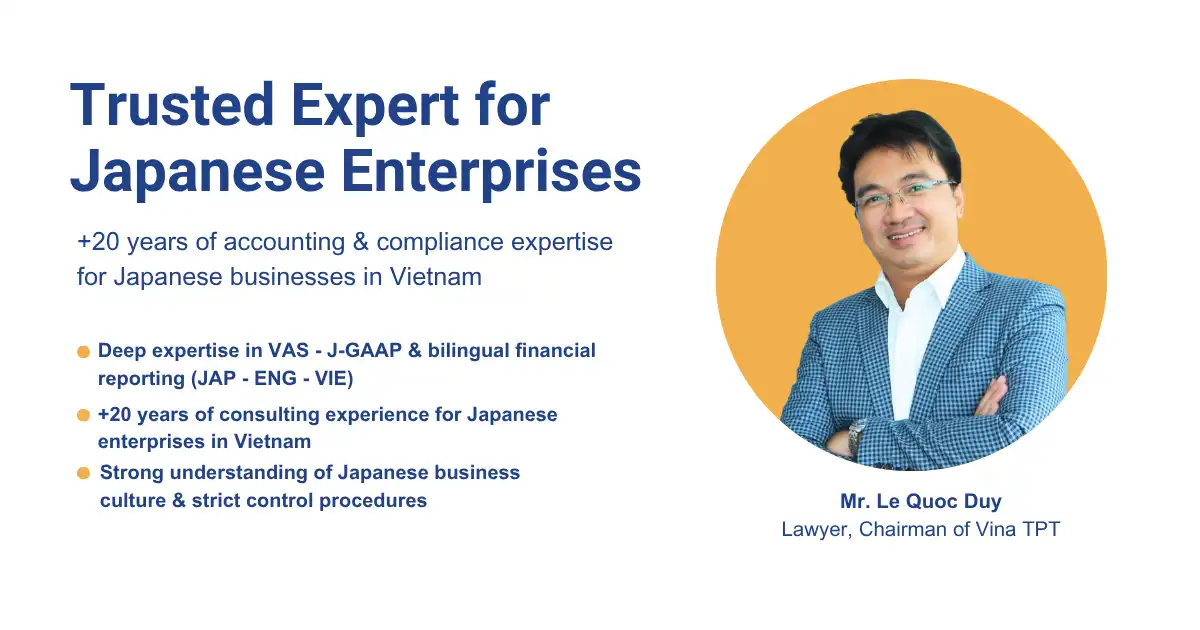
In particular, Mr. Le Quoc Duy, the chief expert in charge of Japanese customers, has more than 2015 years of experience working with large corporations in the fields of manufacturing, finance, and logistics of Japan in Vietnam.

accounting-outsourcing-services-for-japanese

We support businesses in the entire process:

  • Standardizing data and preparing bank statements in Japanese
  • Reconciling and converting reports from VAS to J-GAAP
  • Review documents before sending to HQ
  • And provide regular advice to ensure accuracy and compliance in the long term.

5. Build Transparent, Compliant and Cross-Cultural Financial Systems

With specialized accounting outsourcing services, Japanese enterprises in Vietnam not only solve compliance issues, but also create a transparent, reliable and cross-culturally compatible financial system. Standardized and bilingual financial data helps strengthen trust between the Vietnamese branch and the Japanese parent company, and facilitates smoother group audits.

In the long term, maintaining a transparent accounting and financial system not only helps companies control costs and optimize profits, but also demonstrates a standard operating philosophy that is consistent with Japanese business culture: accuracy – discipline – reliability.

Contact Vina TPT Accounting Service today for advice on outsourcing accounting solutions and bilingual financial reporting in accordance with J-GAAP standards. We help Japanese businesses in Vietnam operate more easily – accurately, compliantly and sustainably.

BOOK A FREE CONSULTATION

Accounting-and-financial-reporting-for-Japanese-companies-in-Vietnam

Tax incentives for Korean electronics factories in Vietnam

Korean electronics factory in Vietnam receiving tax incentives

tax-incentives-in-vietnam

1. Why Korean Electronics Manufacturers Choose Vietnam

Tax incentives in Vietnam have played a major role in making the country a top investment destination for Korean electronics corporations such as Samsung, LG, Hanwha, and SK over the past decade. Factors that make Vietnam stand out include competitive labor costs, political stability, a strategic location near the Asian supply chain, and especially the extensive Free Trade Agreements (FTA) system.

In particular, tax incentives in Vietnam for Korean investors have created a strong motivation for long-term manufacturing expansion, especially in high-tech and electronic component production. These incentives not only reduce the initial investment burden but also help Korean enterprises enhance profitability and competitiveness in the regional and global markets.

In addition, the Vietnamese government is actively attracting investment in the high-tech and electronic component manufacturing sectors – this is a great advantage for Korean factories that want to establish long-term manufacturing operations. Therefore, the tax incentives policy in Vietnam is also designed to provide maximum support to this group of businesses.

2. Overview of Tax Incentives in Vietnam for Foreign Manufacturers

Currently, Vietnam is applying many tax incentives in Vietnam for foreign investors, especially in the fields of manufacturing, high technology and industrial zones. These preferential policies are designed to encourage long-term investment and improve the competitiveness of enterprises:

  • Exemption from corporate income tax (CIT) for the first 2-4 years, 50% reduction for the next 4-9 years, depending on the scale and field of investment.
  • Exemption from import tax on machinery, equipment, components to create fixed assets or serve R&D.
  • Land lease incentives in industrial parks, high-tech parks, helping to significantly reduce initial investment costs.

In addition, Vietnam also implements a special tax holiday policy for high-tech manufacturing projects. These are important advantages that help Vietnam become an attractive destination for foreign investors looking for an efficient and stable production environment in the region.

GET TAX INCENTIVE CONSULTATION

3. Tax Incentives for Korean Factories in Vietnam: Key Benefits for Electronics Manufacturing Projects

Korean electronics factories investing in Vietnam often enjoy many outstanding incentives:

  • Corporate Income Tax (CIT): Preferential tax rate of only 10% for 15 years (compared to the standard rate of 20%), with a long tax exemption and reduction period.
  • Import Duty Exemption: Exemption from import tax on machinery, production lines, and components that cannot be produced domestically.
  • Land Rental Incentive: Exemption or reduction of land rent in industrial zones, especially in Bac Ninh, Thai Nguyen, and Hai Phong, where many Korean factories are concentrated.
  • Value Added Tax (VAT) Refund: For exporting enterprises, input VAT is quickly refunded, helping to improve cash flow.

These incentives help Korean electronics factories shorten the payback period and maximize profits during the expansion phase.

4. Compliance and Documentation Required to Access Tax Incentives in Vietnam

To enjoy tax incentives in Vietnam, businesses need to prepare complete documents according to regulations:

  • Investment Certificate (IRC) and Enterprise Registration Certificate (ERC) clearly stating the eligible business lines.
  • Documents proving that the project is in an incentive sector or area.
  • Financial statements, CIT declarations and annual investment activity reports.
  • Relevant import documents, invoices and contracts (for import tax exemptions).

Due to the strict review process, missing documents or incorrect declarations can cause businesses to lose their right to enjoy incentives or be subject to tax arrears.

5. Strategic Tax Planning with Vietnam Tax Specialists for Long-Term Profitability

To make the most of tax incentives in Vietnam, businesses need to build a long-term tax strategy that both ensures compliance with regulations and optimizes financial efficiency. Tax planning is not simply about compliance with obligations, but also a management tool that helps businesses maintain a competitive advantage and develop sustainably in the Vietnamese market.

Tax specialists play an important role in this process by helping businesses restructure their investment models to suit the locations and preferential fields, thereby maximizing tax benefits. They also support businesses in optimizing depreciation policies, transfer pricing and eligible expenses, helping to significantly reduce corporate income tax (CIT) obligations while still complying with regulations. At the same time, tax experts also periodically monitor tax compliance, detect potential risks early and limit the risk of being inspected or administratively sanctioned.

A well-thought-out tax plan not only provides short-term financial benefits, but also lays a solid foundation for future expansion and reinvestment, helping businesses maintain flexibility and stability in a rapidly changing economic landscape.

Download Vietnam Tax Handbook For Investor

6. Partnering with Vina TPT Tax Service for Comprehensive Tax Support and Incentive Application

Vina TPT Tax Service is a trusted tax consulting partner of hundreds of FDI enterprises, including many Korean electronics factories in Vietnam. Our team of experts includes tax consultants and legal experts with over 15 years of experience, with in-depth knowledge of tax regulations, accounting and investment incentives in Vietnam.

Vina TPT provides comprehensive support from:

  • Evaluating eligibility for tax incentives.
  • Preparing and submitting tax exemption/reduction applications.
  • Tax strategy consulting, risk management and periodic compliance audits.

With Vina TPT Tax Service, Korean electronics factories not only ensure compliance with regulations but also optimize costs and sustainable profits in Vietnam.

Contact Vina TPT Tax Service now to get advice from our tax experts on optimal tax incentives and costs for your business in Vietnam.

BOOK A FREE CONSULTATION

tax-incentives-in-vietnam

Business Established in Vietnam for Korean Electronics Manufacturers

Korean investor receiving business license in Vietnam

setting-up-electronics-business-in-Vietnam

1. Vietnam – The Next Hub for Korean Electronics Manufacturers

As Korean companies continue to look for new growth opportunities across Asia, Vietnam has become one of the most attractive destinations for manufacturing expansion. With a favorable investment climate and a streamlined business license in Vietnam process for foreign enterprises, Vietnam offers Korean electronics manufacturers an ideal entry point to establish long-term operations. Supported by government incentives and a robust supply chain ecosystem, the country is quickly evolving into a major production hub in the region.

Major corporations such as Samsung, LG, and Hanwha have established large-scale production complexes in Bac Ninh, Thai Nguyen, and Hai Phong, regions that are rapidly becoming Vietnam’s key electronics hubs, supported by modern logistics networks, seaports, and government investment incentives.

Moreover, Vietnam’s active participation in free trade agreements such as CPTPP and EVFTA has unlocked significant tariff advantages, enhancing its competitiveness in the global supply chain. A young, skilled workforce combined with the nation’s push for digital transformation positions Vietnam as the “new manufacturing base” for the global electronics industry, much like South Korea’s industrial rise in the 1990s.

For Korean investors, establishing a business in Vietnam not only optimizes production costs but also opens access to ASEAN, China, and India markets. By obtaining the appropriate business license in Vietnam and leveraging professional strategic consulting, Korean electronics enterprises can streamline the enterprise registration process and transform Vietnam into a sustainable hub for manufacturing and innovation in the region.

2. Strategic Considerations Before Enterprise Registration in Vietnam

Before starting the registration process, investors need to carefully consider strategic factors.

Location is key: Northern regions such as Bac Ninh, Hai Phong, Thai Nguyen currently have many Korean electronics factories, convenient for connecting and sharing the supply chain.

Legal form also directly affects the right to operate and tax obligations. Enterprises can choose to establish a 100% foreign-owned company, joint venture with a Vietnamese partner or open a representative office.

In addition, the domestic supply chain in Vietnam is expanding rapidly, providing components and logistics services suitable for electronics production. Understanding these factors helps Korean enterprises optimize costs and limit risks when entering new markets.

Book a Free Consultation on Your Business License

3. Understanding Business License in Vietnam and Compliance for Electronics Companies

After being granted the Investment Registration Certificate (IRC) and Enterprise Registration Certificate (ERC), the electronics enterprise needs to apply for a business license appropriate to the field of operation.

The electronics manufacturing industry has its own requirements on environmental safety, technology standards and fire prevention.

The estimated time for completion is:

Document preparation: 1-2 weeks, depending on the volume of documents and the level of complexity.

  • IRC appraisal: 20-45 working days.
  • ERC issuance: 10-20 working days after IRC (or similar if the enterprise is a domestic enterprise).

In fact, if the enterprise cooperates with a reputable company registration service, it will help the enterprise quickly handle the consular legalization, translation and submission of documents, shortening the time and increasing the possibility of being licensed the first time.

setting-up-electronics-business-in-Vietnam

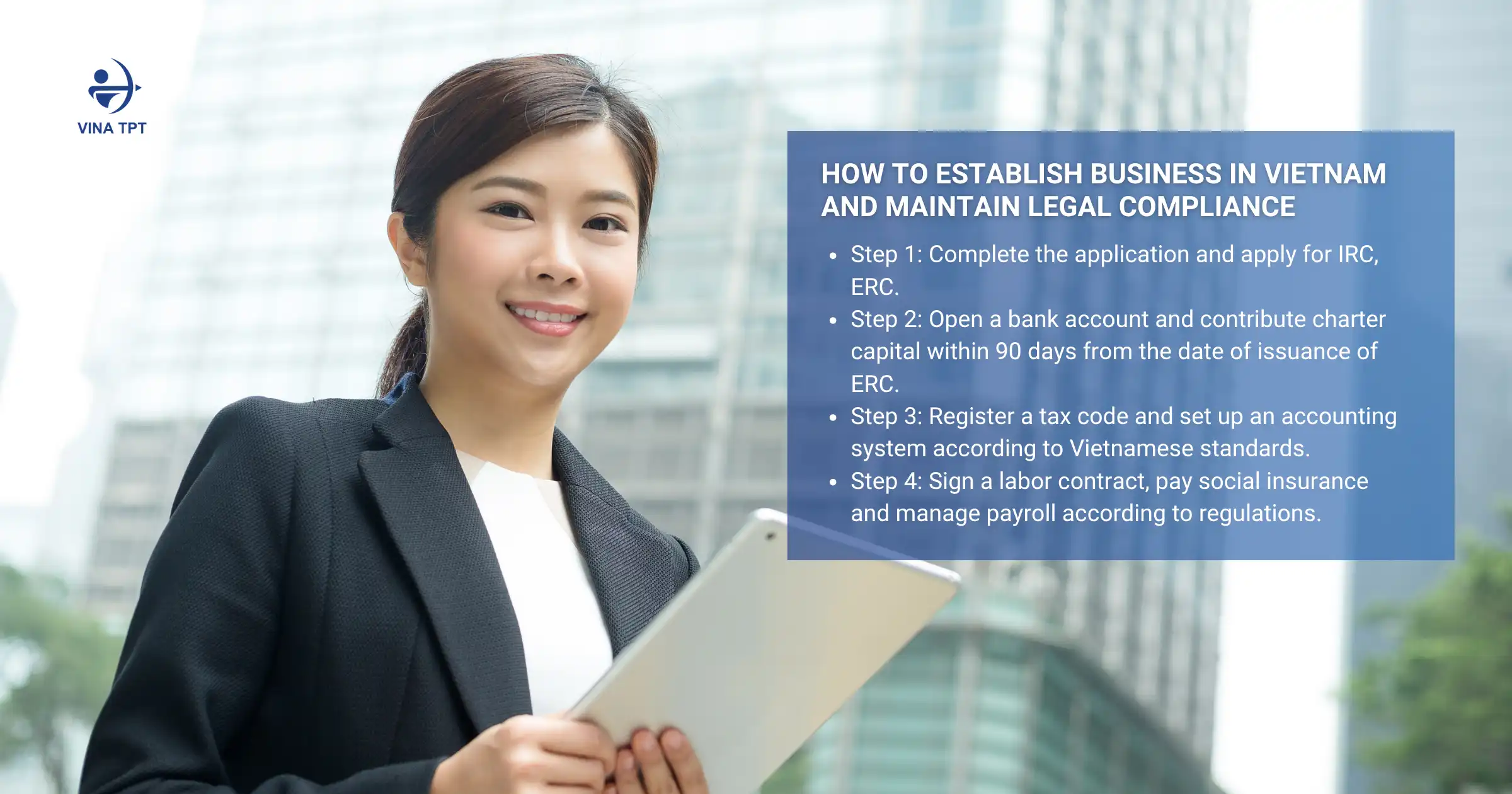
4. How to Establish Business in Vietnam and Maintain Legal Compliance

To successfully establish a business in Vietnam, investors need to take the following important steps:

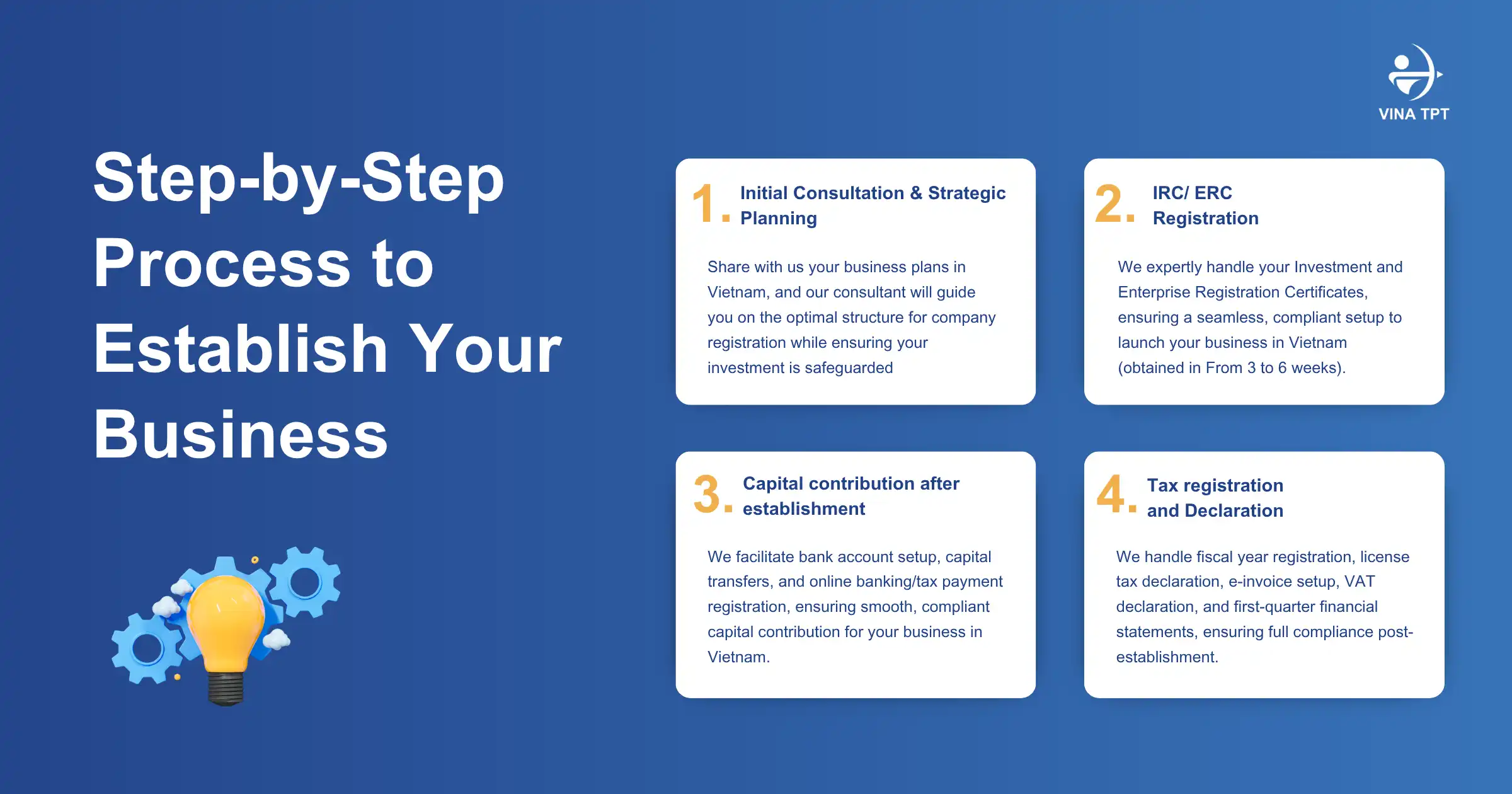
Step 1: Complete the application and apply for Business License in Vietnam IRC, ERC.

If the project has FDI capital, IRC is the first license allowing the investor to implement the project in Vietnam.

The required documents usually include:

  • Application for investment project implementation and Project proposal: stating the objectives, scale, location, investment capital, progress.
  • Proof of the investor’s financial capacity: bank statement, credit contract or collateral.
  • Legal documents of the investor:
    • Individual: Notarized passport, consular legalization.
    • Organization: Business registration certificate or equivalent document, consular legalization.
  • Project location: lease contract or land/office use rights certificate.

After the IRC is granted (or for 100% domestic-owned enterprises), the investor applies for an ERC – an official license for the enterprise to operate, and also the tax code of the company.

The ERC dossier usually includes:

  • Application for enterprise registration.
  • Company Charter: stipulates the organizational structure, powers of members/shareholders, capital ratio and management method.
  • List of members/shareholders and legal representatives: clearly state information, ownership ratio, voting rights.
  • Appointment decision and authorization letter (if any).
  • Capital contribution plan & financial evidence: bank statement or credit contract (especially important for large capital projects).

Step 2: Open a bank account and contribute charter capital within 90 days from the date of issuance of ERC.

Step 3: Register a tax code and set up an accounting system according to Vietnamese standards.

Step 4: Sign a labor contract, pay social insurance and manage payroll according to regulations.

5. Vina TPT Company Registration – Partnering with Korean Electronics Manufacturers for a Sustainable Setup

With more than a decade of experience in investment consulting and business registration services, Vina TPT has successfully assisted hundreds of FDI enterprises, including a large number of Korean electronics manufacturers in establishing and expanding their operations in Vietnam.

Our comprehensive service scope covers every stage of the process — from investment model consulting and legal documentation, to business license application in Vietnam, business license renewal, and regulatory compliance. This integrated approach ensures a smooth and compliant market entry for Korean investors.

Backed by a team of seasoned professionals with in-depth knowledge of Vietnam’s business, tax, and labor laws, Vina TPT provides end-to-end business license advisory and compliance support, helping investors confidently execute their projects while focusing on production growth and long-term success.

Partnering with Vina TPT Business Advisory and Company Registration means more than saving time and costs. It’s about having a trusted local partner who truly understands how to help Korean investors establish, operate, and sustain successful ventures in Vietnam.

Contact Vina TPT for consultation and support on business registration in Vietnam quickly, legally and at optimal cost.

BOOK A FREE CONSULTATION

setting-up-electronics-business-in-Vietnam

VAT Refund in Vietnam 2025: Updated Conditions and Eligible Cases Explained

VAT Refund in Vietnam 2025 Updated Conditions and Eligible Cases Explained-VTPT

VAT Refund in Vietnam 2025_ Updated Conditions and Eligible Cases Explained - VTPT

1.What is a VAT Refund and When is a Business Entitled to it?

Value-Added Tax (VAT) refund refers to the process by which the State reimburses the amount of VAT that a business has either paid into the State budget or has not yet been deducted. When a business meets specific VAT refund conditions, it will be entitled to receive back the paid tax amount. The purpose of this policy is to prevent double taxation and to support businesses in investment or export activities.

Businesses are eligible for VAT refunds when they fall under the cases stipulated by law and meet the specific refund conditions applicable to their business type. Detailed information will be provided by Vina TPT in this article.

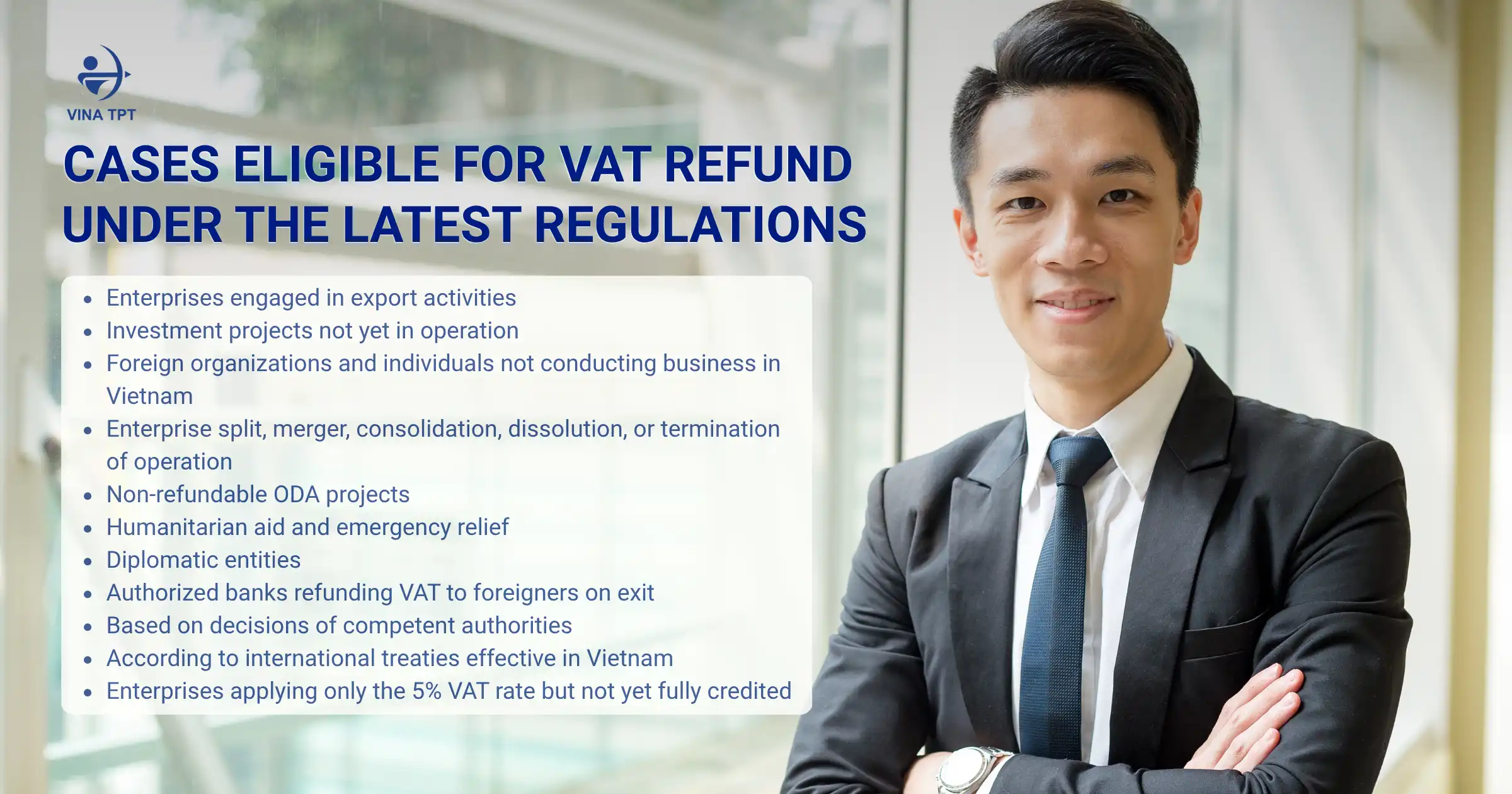
2.Cases Eligible for VAT Refund Under the Latest Regulations

VAT Refund in Vietnam 2025_ Updated Conditions and Eligible Cases Explained - VTPT

No.  Case eligible for VAT refund  Main conditions  Legal basis 
1  Enterprises engaged in export activities  Exported goods and services are subject to a 0% VAT rateInput VAT not yet credited is ≥ VND 300 million

Must have valid customs documents and bank payment records 

Article 13, VAT Law 2024 
2  Investment projects not yet in operation  The investment project has been duly registeredNo revenue has been generated

Input VAT not yet credited is ≥ VND 300 million 

Article 13, VAT Law 2024 
3  Enterprise split, merger, consolidation, dissolution, or termination of operation  The enterprise no longer operates to deduct input VATRemaining input VAT has not yet been credited  Article 13, Amended VAT Law 2008 
4  Foreign organizations and individuals not conducting business in Vietnam  Possess valid tax payment documentsDo not conduct regular business activities in Vietnam  Circular 219/2013/TT-BTC, Article 18 
5  Non-refundable ODA projects  Not using the state budget to pay VATPossess valid confirmation from the donor  VAT Law 2024, Circular 219 
6  Humanitarian aid and emergency relief  Must have a decision approving the receipt of aidMust provide valid documents related to goods and input invoices  Circular 219/2013/TT-BTC 
7  Đối tượng ngoại giao (miễn trừ)  Must have confirmation from the State Protocol DepartmentApplied under international treaties  Decree 134/2016/NĐ-CP 
8  Authorized banks refunding VAT to foreigners on exit  Must have a goods management systemMust prepare a tax refund list according to the prescribed form  Circular 92/2019/TT-BTC 
9  Based on decisions of competent authorities  Must have an official document/decision on tax refundApplied in special cases, subject to post-refund inspection  Decree 49/2022/NĐ-CP 
10  According to international treaties effective in Vietnam  Must fall under subjects clearly stated in the treatyMust provide complete dossiers and supporting documents  Law on International Treaties, Law on VAT 
11  Enterprises applying only the 5% VAT rate but not yet fully credited  Input VAT not yet credited ≥ 300 million VNDAfter 12 months or 4 consecutive quarters – applicable from 01/07/2025  Amended VAT Law 2024

 VAT 2025 Update:The 2024 Value Added Tax (VAT) Law will officially take effect from July 1, 2025.

3. Conditions for VAT refund

Depending on the type of enterprise, the conditions for VAT refund may vary

3.1. For domestic enterprises 

  • Undeducted input VAT of at least VND 300 million
  • Có Valid e-invoices andnon-cash payments for invoices from VND 20 million
  • Not under tax enforcement measures or committing tax violations
  • Proper and timely tax declaration 

3.2. For exporting enterprises 

  • Export contracts, customs declarations, and bank payment documents 
  • Continuous undeducted VAT for 3 periods or at least VND 300 million in one period
  • Exported goods must be cleared through customs
  • No fraudulent invoice transactions 

Note: From 2025, under the amended VAT Law, exporters with undeducted VAT over VND 100 million in a period may apply for refund earlier, reducing waiting time.

3.3. For investment projects 

  • Must have an Investment Registration Certificate 
  • No revenue generated, but large undeducted VAT incurred 
  • Separate bank account for the project 
  • Separate accounting for project expenses 

3.4. For foreign organizations/individuals 

  • Valid proof of VAT paid in Vietnam 
  • Non-regular business activities 
  • Full compliance with tax declaration and refund procedures 

Explore Our Tax Services

 4. Cases Not Eligible for VAT Refund

(According to Circular 219/2013/TT-BTC, amended by Circular 130/2016/TT-BTC)

  • Investment projects with insufficient charter capital contribution
    If, by the time of filing the VAT refund application (from July 1, 2016 onwards), the enterprise has not contributed the full registered charter capital it will not be eligible for refund. Instead, the uncredited input VAT will only be carried forward to the next CIT period.
  • Conditional investment sectors not meeting requirements under the Law on Investment
    This includes cases where the enterprise has not obtained the necessary license, certificate of eligibility, or written approval from the competent authority.  
  • Violation of conditions during project implementation
    If, during the implementation, the project has its license or certificate revoked, or is found no longer to meet conditional business requirements, VAT refund will be suspended from that point onward.  
  • Projects involving natural resource/mineral exploitation or production with ≥ 51% cost structure derived from natural resources
    Applicable to projects licensed from July 1, 2016. The determination of the resource ratio is guided under Clause 23, Article 4 of Circular 219.  
  • Imported goods for export but not exported through the prescribed customs area
    VAT refund is not eligible if export procedures are not carried out at the designated customs office.  
  • Exported goods not completing customs procedures at the customs-controlled area
    In this case, VAT refund is also not eligible. 

5. Key Notes on VAT Refund for Businesses

  • Do not consolidate VAT refund applications across multiple periods unless specifically guided by regulations. 
  • Carefully check the payment timeline and payment conditions of each invoice. 
  • For exporting enterprises, clearly keep records of customs declarations, bills of lading, and payment documents.
  • Always review the validity of input invoices – especially those from new suppliers. 

6. Simplify Your VAT Refund with Vina TPT’s Professional Support

Navigating the VAT refund process in Vietnam can be complex, especially with changing tax regulations and documentation requirements. Vina TPT offers professional support to help businesses simplify every step, from eligibility assessment to refund application and follow-up with tax authorities. With deep expertise in Vietnamese tax law, our team ensures accuracy, compliance, and maximum refund value for your company. Partnering with Vina TPT means saving time, avoiding costly errors, and gaining peace of mind knowing your VAT refund is handled by trusted professionals. Let Vina TPT streamline your refund process efficiently and transparently.

Contact Vina TPT today to simplify your VAT refund process!

Discuss Your Case with Our Specialists

accounting skills

Business Setup Consultant Vietnam: Start Your Small Foreign Business Smoothly

alt="Foreign investors establish business in Vietnam with professional setup consultant support"

alt="Foreign investors establish business in Vietnam with professional setup consultant support"

1. Why Small Foreign Investors Choose to Establish Business in Vietnam

Vietnam is becoming an ideal destination for small investors thanks to its low operating costs, young workforce and large consumer market. Compared to many other countries in the region, establishing a business in Vietnam brings clear advantages in terms of rental costs, labor and customer access. In addition, the Vietnamese Government is increasingly issuing many preferential policies to attract FDI capital, especially in the fields of technology, education, trade services and clean agriculture.

Some small business sectors that are attracting the attention of foreign investors include:

  • International style restaurants and cafes
  • Foreign language and skills training centers
  • Small-scale e-commerce startups
  • Consulting and creative design services
  • Beauty & wellness services
  • Fashion and lifestyle boutiques
  • Cosmetics and personal care retail. These sectors are particularly attractive to investors from Japan, South Korea, the United States, and China, where consumer demand and business expansion opportunities in Vietnam are seen as highly promising.

With strong growth potential, opening a small-scale company is not only suitable for market exploration but also a foundation for future business expansion.

DISCOVER HOW BUSINESS SETUP CONSULTANT VIETNAM CAN HELP YOU 

2. Legal Basics for Small-Scale Foreign Businesses

To establish a business in Vietnam, small investors need to understand the basic legal regulations. The good news is that small-scale projects often require low investment capital and simpler procedures than large enterprises.

Some important legal factors include:

  • Minimum investment capital: depending on the field, many industries do not require high statutory capital, making it easy for investors to start.
  • Registered industries: need to choose industries that are allowed according to Vietnamese law and the WTO.
  • Business license: for conditional fields such as education, logistics services, or restaurants – cafes, businesses need to apply for additional specialized licenses.
  • Business type: the most popular for small investors is a Limited Liability Company (LLC) or Representative Office.

Understanding these conditions will help the business registration process go smoothly and legally from the beginning.

3. Step-by-Step Guide to Setting Up a Small Business

When small foreign investors plan to establish business in Vietnam, understanding the step-by-step process is essential to avoid unnecessary delays and legal risks. Setting up a business may sound complex, but with the right guidance, it can be smooth and straightforward.

Step 1: Prepare the investment documents – This includes drafting the investment proposal, choosing the right business structure (LLC, joint venture, or representative office), and identifying the scope of activities. Investors need to ensure that their chosen industry is open for foreign participation under Vietnamese law.

Step 2: Apply for the Investment Registration Certificate (IRC) – For most foreign-owned companies, this is the first legal approval. It confirms the investor’s right to operate in Vietnam and outlines essential project details such as charter capital, investment scale, location, and business scope. Without the IRC, foreign investors cannot proceed to the next step of enterprise registration.

Documents typically required for IRC application include:

  • Application for investment project implementation & Project proposal: Stating objectives, scope, scale, investment capital, location, and implementation schedule.
  • Proof of investor’s financial capacity: Bank statements, audited financial reports, credit contracts, or collateral documents.
  • Legal documents of the investor:
  • For individuals: Notarized passport, consular legalization.
  • For organizations: Business Registration Certificate or equivalent, consular legalization.
  • Evidence of project location: Office/land lease agreement or land use rights certificate.
  • Power of attorney/authorization letter (if the investor appoints a third party to handle procedures).

All foreign documents must be consular legalized and officially translated into Vietnamese before submission. This step often prolongs the preparation process, so it is recommended that investors cooperate with a reliable company registration service to ensure accuracy and save time.

Step 3: Obtain the Enterprise Registration Certificate (ERC) – Once the IRC is granted, the next step is to register the business entity officially. This is comparable to a company registration service and provides the legal identity of the enterprise.

Step 4: Open a bank account and contribute charter capital. After receiving the Enterprise Registration Certificate (ERC), investors are required to open a capital account at a licensed commercial bank in Vietnam. This account will be used exclusively for injecting charter capital and handling transactions related to foreign investment.

Capital contribution timeline: The owner/members/shareholders must fully contribute the registered charter capital within 90 days from the issuance date of the ERC. Failure to meet this deadline may result in administrative penalties or forced adjustment of charter capital in the company’s registration.

Contributing capital on time is not only a compliance requirement but also strengthens the company’s credibility when applying for future business licenses, work permits, or expanding operations in Vietnam.

Step 5: Register for tax and post-licensing procedures – This includes obtaining tax codes, registering for VAT, and fulfilling labor and insurance obligations if hiring employees.

Step 6: Apply for additional sector-specific licenses (if required) – For industries such as F&B, education, or e-commerce, further permits may be necessary.

By working with a trusted business setup consultant Vietnam, small investors can streamline the above steps, reduce administrative burdens, and ensure full compliance with local regulations. Firms like Vina TPT company registration provide end-to-end assistance, helping investors save time and resources while minimizing costly mistakes.

I If you want to establish business in Vietnam without unnecessary delays, consider working with a reliable company registration service like Vina TPT. Our business setup consultant Vietnam team is ready to guide you through every step smoothly. With a team of seasoned lawyers and tax experts possessing 10–20 years of experience and having worked with more than 200 FDI enterprises, we are well-equipped to anticipate regulatory hurdles, streamline documentation, and ensure full compliance with local laws.

alt="Foreign investors establish business in Vietnam with professional setup consultant support"

4. Cost-Saving Tips for Small Investors

For small investors establishing a business in Vietnam, saving costs is an important factor in maintaining capital flow for business operations. One of the most effective ways is to choose a business type that is suitable for the scale and development goals, such as a limited liability company instead of a joint stock company. In addition, optimizing charter capital also helps reduce initial financial pressure while still ensuring compliance with legal requirements. Instead of handling all the complicated procedures themselves, investors should use a professional company registration service. This not only helps minimize the risk of errors, but also saves time and costs arising from delayed procedures or having to supplement them many times.

5. Working with a Business Setup Consultant

Working with a business setup consultant Vietnam brings great advantages to foreign investors, especially small businesses that are new to the market. With a deep understanding of the legal system, licensing conditions and administrative procedures, consultants will help the entire procedure take place quickly and legally. Moreover, they also play the role of strategic advisors, providing cost-optimized solutions, choosing feasible business lines and supporting the handling of problems arising during the business operation process. This helps investors not only shorten the time to set up a business but also focus on core business activities from the very first days.

To turn investment plans into reality quickly and economically, many small investors have chosen to accompany Vina TPT with a complete company registration service, ensuring legal and transparent procedures right from the first step.

6. Vina TPT Company Registration Service for Small Investors

With experience supporting hundreds of foreign investors, Vina TPT company registration service offers a complete solution specifically for small businesses.

Vina TPT’s strengths:

  • Advising on costs and reasonable capital structures for small startups.
  • Preparing complete and correct business registration documents.
  • Representing and monitoring the progress with state agencies.
  • Supporting post-registration procedures: seal engraving, account opening, tax declaration.

alt="Foreign investors establish business in Vietnam with professional setup consultant support"

Thanks to professional services and a team of legal experts, Vina TPT helps small investors establish businesses in Vietnam easily, quickly and legally.

Contact Vina TPT now to use the Business setup consultant Vietnam service to start your business journey in Vietnam with optimal costs and transparent procedures.

BOOK A FREE CONSULTATION

Laywer-Establish-business-Vietnam-VinaTPT


Comprehensive Tax and Compliance Services for Businesses in Vietnam

Business consultant providing corporate tax service and compliance support

Business consultant providing corporate tax service and compliance support

1. Vietnam Tax & Compliance Overview

The tax environment and legal system in Vietnam are currently in a dynamic phase of updates, covering areas such as value added tax (VAT), corporate income tax (CIT), personal income tax (PIT), financial reporting standards, and electronic filing procedures. These ongoing changes make maintaining tax compliance a significant challenge for all businesses, especially FDI companies and newly established startups. Even minor mistakes in tax declaration or late payments can result in administrative fines, tax arrears, or surprise inspections by regulatory authorities.

For FDI enterprises, the documentation requirements are often more complex, as they must comply simultaneously with Vietnamese accounting standards (VAS) and international standards (IFRS), while also fulfilling regulations related to reporting foreign investment capital. Meanwhile, startups often face limited resources, lack specialized accounting teams, or have incomplete internal control processes. Managing taxes, preparing financial statements, and performing electronic tax filings without professional support can easily lead to common errors such as reporting incorrect indicators, omitting valid expenses, or calculating tax amounts incorrectly.

Using tax services, tax compliance services or full-package services such as accounting & tax services is the optimal solution to help businesses minimize risks and ensure full compliance with Vietnamese tax laws. A professional unit will support from tax code registration, monthly/quarterly tax reporting, implementing tax filing service Vietnam, to checking and periodically comparing books. In addition, tax compliance services also help businesses promptly update changes in tax policies, optimize reasonable CIT costs, prepare annual tax settlement documents and provide transparent data for audits.

2. Key Business Taxes & Compliance Requirements

2.1 Corporate & Operational Taxes

The main taxes that businesses in Vietnam must comply with include:

  • Corporate Income Tax (CIT): Corporate income tax with a common tax rate of 20%, requiring quarterly or annual declaration and payment.
  • Value- Added Tax (VAT): Value added tax applied to most goods and services, requiring electronic invoices and periodic reporting.
  • Foreign Contractor Tax (FCT): Applied to transactions with foreign contractors, requiring complex calculation and declaration processes.

And some other types of taxes depending on the industry and business activities, for example: import and export dutiestax,Natural Resources Tax resource tax, special consumption tax Land and Water Surface Rental, Transfer Pricing Taxation,…

A reputable tax compliance service will assist businesses in reviewing documents, preparing declarations and submitting them on time, avoiding the risk of being fined or collected.

2.2 Employee-Related Taxes

In addition to operating taxes, businesses must also manage:

  • Personal Income Tax (PIT): Personal income tax for employees, requiring monthly or quarterly deductions and declarations.
  • Social Insurance, Health Insurance, Unemployment Insurance: Obligation to pay compulsory social insurance and health insurance according to the provisions of the Labor Law.

Combining tax compliance service with the human resource management system – payroll helps businesses control tax and insurance deductions accurately, limiting risks of periodic inspections.

Download Vietnam Tax Handbook - Japanese Edition

3. Tax Compliance & Tax Filing Service

To operate legally and avoid the risks of late payment penalties or tax arrears, all businesses in Vietnam – from startups, SMEs to FDI companies – must fully comply with tax compliance and tax filing service Vietnam in accordance with the regulations of the tax authorities. This compliance includes many important obligations such as registering for a tax code, preparing and submitting monthly/quarterly tax declarations, annual financial statements, finalizing corporate income tax (CIT) and personal income tax (PIT), as well as paying social insurance, health insurance and union fees.

In reality, the tax declaration and payment process in Vietnam is quite complicated and requires absolute accuracy. Businesses need to clearly understand the deadlines for submitting each type of tax: VAT and PIT declarations are usually submitted monthly or quarterly, CIT reports and financial statements must be completed by the end of the fiscal year, while specific taxes such as Foreign Contractor Tax (FCT) can arise suddenly depending on business activities. Just a small error in tax calculation, reporting targets or late submission of documents can also lead to administrative fines, penalty interest or being subject to tax inspection.

Using a professional tax service or tax compliance service helps businesses significantly reduce this pressure. A reputable service provider will support from the stage of preparing documents, reviewing documents, to implementing tax filing service Vietnam on time on the electronic system of the General Department of Taxation. At the same time, accounting & tax service also acts as an internal control solution, helping businesses promptly update changes in tax laws, optimize deductions, and minimize the risk of being overcharged during settlement periods.

For FDI companies, combining tax compliance services with specialized consulting services like Vina TPT tax service is especially important because it must ensure both Vietnamese accounting standards (VAS) and international standards (IFRS). Vina TPT not only declares and pays taxes on time but also advises on long-term tax strategies, helps businesses optimize CIT, manage PIT for foreign employees, and prepare documents ready for audit or inspection. This is the foundation for businesses to maintain financial transparency and develop sustainably in Vietnam’s increasingly strict legal environment.

OPTIMIZE YOUR TAX STRATEGY

4. Integrated Accounting & Tax Service for Sustainable Growth

To achieve sustainable growth in a competitive and constantly changing business environment, businesses need an integrated accounting & tax service solution – a close combination of accounting service Vietnam and tax compliance service. This service not only ensures the preparation of financial statements according to Vietnamese Accounting Standards (VAS) or International Financial Reporting Standards (IFRS), but also includes in-depth analysis of cash flow management, cost optimization and preparation of documents for independent audit or tax inspection.

The synchronization between accounting and tax helps businesses:

  • Reduce the burden of legal compliance: All financial reports, tax declarations, corporate income tax (CIT) and personal income tax (PIT) finalizations are performed accurately and on time, avoiding the risk of late payment penalties or arrears.
  • Increase financial transparency: Consistent accounting and tax data support the management in making decisions based on actual data, thereby building long-term business plans and effective investment strategies.
  • Optimize operating costs and taxes: Experts can advise on appropriate deductions, cost control, cash flow allocation, and take advantage of tax incentives allowed by Vietnamese law.

Especially for FDI companies or startups, integrated accounting and tax solutions bring outstanding advantages when it comes to cross-border reporting for parent corporations, preparing consolidated financial statements, or handling transactions related to transfer pricing. With extensive experience, Vina TPT accounting & tax service not only performs accurate operations but also provides strategic advisory to help businesses maintain compliance, protect reputation, and develop sustainably in the Vietnamese market.

5. How Vina TPT Delivers Smarter Tax Compliance Service

Vina TPT tax service provides a comprehensive solution, helping businesses handle all procedures from tax code registration, declaration, preparation of periodic reports to representing work with tax authorities. The team of experts regularly updates the latest tax laws, advises on optimal CIT, VAT and PIT roadmaps suitable for each industry.

The strengths of Vina TPT tax compliance service lie in:

  • Experience in implementing for both domestic and FDI enterprises.
  • Multilingual service (English – Vietnamese – Japanese) suitable for international investors.
  • Transparent electronic processes, timely reporting help businesses easily control costs and risks.

Don’t let tax mistakes affect your business. 

Contact Vina TPT today for advice on a complete accounting & tax service solution and start declaring taxes in Vietnam quickly – accurately – legally.

BOOK A FREE CONSULTATION

Vina TPT Accounting services

Transfer Pricing Regulations and Guidelines for FDI Companies in Vietnam

Transfer pricing regulations and guidelines for FDI companies in Vietnam

Transfer pricing regulations and guidelines for FDI companies in Vietnam

1. Why Transfer Pricing Matters for FDI Companies in Vietnam

Transfer pricing is considered a key factor for Foreign-invested enterprises to plan tax strategies and ensure compliance with Vietnamese law. In fact, these rules greatly affects the way profits are allocated among related parties in many countries around the world. Therefore, if these companies do not strictly manage transfer pricing, this activity will lead to suspicions about profit transfer. This will lead to consequences that make businesses closely monitored by tax authorities. 

In Vietnam, pricing regulations is extremely strictly controlled because it directly affects tax revenue and economic fairness. If Overseas-invested companies do not comply, they will certainly face high risks such as administrative fines, prolonged inspections, and impacts on reputation and relationships with state agencies. Therefore, it can be seen that if those companies comply with good regulations, it will help reduce risks and build reputation and trust with investors and management agencies.

2. When do companies need to prepare

Transfer pricing documents are required when Foreign-capital enterprises conduct related transactions. Related transactions are known as transactions between companies in Vietnam and parent companies, other subsidiaries, or foreign affiliates. Typical examples for a clearer understanding are cross-border sales of goods, provision of internal services within the group, transfer of intellectual property rights, or internal lending.

According to regulations in Vietnam, operating enterprises are required to fully retain the pricing framework documents annually when exceeding the prescribed revenue and transaction value thresholds. This document is evidence proving that transactions comply with the arm’s length principle – that is, transactions are conducted at market prices, as between independent parties. The document plays an extremely important role, because if missing, enterprises will be subject to additional taxes and heavy penalties.

BOOK A TRANSFER PRICING CONSULTATION

3. Key Legal Rules that Every Company Must Know

In Vietnam, transfer pricing activities are regulated by Decree 132/2020/ND-CP and related guiding documents of the Ministry of Finance. This is the legal framework that stipulates the principles of determining related transaction prices, the requirement to prepare transfer pricing documents, and the method of comparison with market prices (arm’s length principle).

Some key points that FDI companies need to pay special attention to include:

  • Revenue & transaction value threshold: Enterprises with total revenue of VND 50 billion or total related transaction value of VND 30 billion or more are required to prepare and store transfer pricing records annually.
  • Required records: Includes 3 levels according to international standards – Local file, Master file and Country by Country Report (CbCR).
  • Submission and storage deadline: The documents must be prepared at the same time as the financial statements and tax declarations, and be ready to be provided when requested by the tax authorities.

Understanding and complying with these regulations not only helps businesses comply with the law but also avoids risks of late payment penalties, tax arrears and in-depth audits from the authorities.

4. How to Prepare for a Transfer Pricing Documents?

To create a complete and accurate transfer pricing document, FDI companies need to implement a process consisting of 4 basic steps:

4.1 Collect related transaction data for Transfer Pricing Documents

Synthesize all contracts, accounting documents, financial reports related to related transactions such as internal goods and services, technology licensing, internal loans, etc.

4.2 Analyze functions and risks 

Determine the role of each party in the transaction (service provider, distributor, R&D, brand management, etc.) to demonstrate reasonable profit margins.

4.3 Compare market prices 

Apply accepted methods (CUP, TNMM, RPM, CPM) to demonstrate that the transaction complies with the arm’s length principle.

4.4 Draft and archive documents 

The documents must clearly show business information, pricing methods, analysis results and reference documents. The storage must be made available upon request from tax authorities or during tax audits.

5. Practical Tips to Stay Compliant Without Penalties

To minimize risks and avoid being overcharged, enterprises need to proactively review internal transactions periodically, ideally quarterly or semi-annually, in order to make timely adjustments before the reporting period. At the same time, data synchronization between departments such as accounting, finance and legal plays a key role in ensuring that all information and related-party transaction contracts are updated accurately and consistently. 

In addition, cooperating with consulting units with knowledge of Vietnamese law and international standards such as Vina TPT helps enterprises prepare complete documents and receive in-depth consultation before determining the transfer price. 

This proactive approach not only helps enterprises maintain compliance, avoid administrative fines but also strengthens the image of transparency and reputation with management agencies.

6. Partnering with Vina TPT for Smooth Management

With more than 10 years of experience supporting Foreign Direct Investment Companies in Vietnam, Vina TPT tax audit support provides consulting services and prepares documents according to international standards, and supports businesses during tax audits.

Outstanding benefits when cooperating with Vina TPT:

  • Consulting on optimal transfer pricing strategies, minimizing tax risks.
  • Preparing a complete set of transfer pricing documents (Local file, Master file, CbCR) in accordance with regulations and on time.
  • Representing businesses in meetings with tax authorities, helping the inspection and examination process take place quickly and transparently.

Accompanying Vina TPT, every company can focus on business activities with peace of mind, while ensuring compliance with legal regulations in Vietnam.

BOOK A FREE CONSULTATION

Vina TPT Accounting services