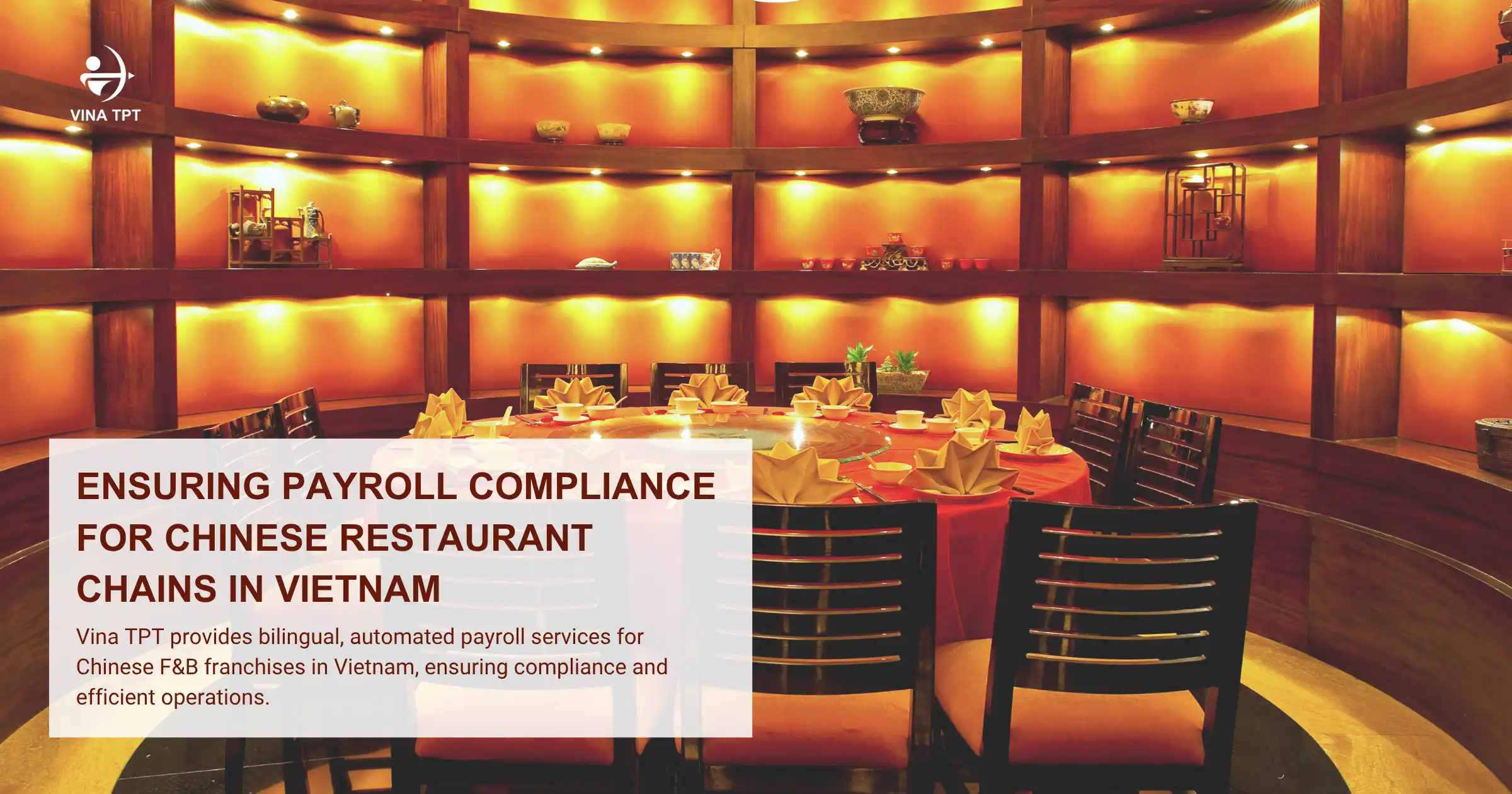
Ensuring Payroll Compliance for Chinese Restaurant Chains in Vietnam

Ensuring Payroll Compliance for Chinese Restaurant Chains in Vietnam-VTPT

payroll-services

1. Payroll Compliance: The Hidden Challenge in Chinese F&B Expansion

In recent years, a series of well-known Chinese F&B brands  such as Haidilao, Mixue, Heytea, and Luckin Coffee have rapidly expanded their restaurant chains across Vietnam. The country’s young population, strong consumer demand, and appetite for new dining experiences have made Vietnam one of the most attractive markets in Southeast Asia.

However, this fast-paced expansion also brings a less visible but serious challenge: payroll compliance. Many Chinese franchises face difficulties in managing payroll due to the large number of part-time and shift-based employees, frequent staff turnover, and the involvement of foreign managers who are unfamiliar with Vietnamese labor and tax regulations. As a result, even successful brands risk payroll miscalculations, delayed payments, or non-compliance penalties if they lack localized HR and payroll systems.

Many businesses are at risk because they do not fully understand the regulations on salary payment, social insurance, personal income tax (PIT) and labor contracts. Small errors in the payroll calculation process can lead to big consequences: administrative fines, damage to brand reputation, or even suspension of business licenses.

2. Payroll Management in the F&B Industry: What Makes It Complex

Unlike the manufacturing or office sector, the F&B industry operates with shift-based schedules, part-time employees, and a high turnover rate. Manual timekeeping or payroll calculated by hours or daily revenue often leads to data inconsistencies and payment errors.

In addition, social insurance and personal income tax (PIT) management are much more complex in this sector. Restaurants must frequently update employee records, process insurance contributions for both full-time and part-time staff, and ensure accurate PIT declarations.

When foreign employees or managers are involved, payroll compliance becomes even more complex, that requiring accurate handling of work permits, foreign income tax, and insurance policies aligned with Vietnamese regulations.

As the business expands from one store to ten or twenty branches, the volume of payroll and HR data multiplies significantly. In such cases, outsourced payroll processing services become the optimal choice, helping F&B chains automate payroll calculations, minimize manual errors, and ensure that all tax and insurance obligations are completed accurately and on time.

With Vina TPT’s payroll processing services, all these tasks from payroll calculation to social insurance management and PIT filing, are handled in an integrated, compliant, and transparent process, allowing F&B businesses to focus on operations rather than administrative burdens.

BOOK A FREE PAYROLL CONSULTATION

3. Key Compliance Requirements for F&B Businesses in Vietnam

Operating a food & beverage franchise in Vietnam involves navigating a complex framework of local labor laws and tax regulations. To ensure compliance, Chinese F&B chains must pay close attention to several core areas:

  • Employment contracts:

Every staff member, including part-time and probationary workers must have a legally valid labor contract that clearly defines salary structure, working hours, and overtime policies. Failure to issue proper contracts can result in penalties or disputes with labor authorities.

  • Social insurance (SI), health insurance (HI), and unemployment insurance (UI):

Vietnamese law requires employers to contribute to all three funds, based on each employee’s monthly income. Missing or under-reporting contributions can lead to back payments and administrative fines.

  • Personal income tax (PIT):

PIT must be calculated and reported monthly or quarterly, depending on the business size. For F&B franchises with multiple branches, this process becomes even more complex, especially when handling part-time employees with fluctuating income.

  • Overtime and minimum wage compliance:

Restaurants and beverage chains often rely on shift-based operations, so adhering to Vietnam’s overtime limits and regional minimum wage levels is crucial. Incorrect application of wage rates or unpaid overtime can trigger employee complaints and damage brand reputation.

  • Data management and reporting:

Accurate timekeeping, record-keeping, and digital reporting are required for labor audits. Many F&B chains still use manual or paper-based systems, which increases the risk of miscalculation and compliance violations.

4. How Payroll  Solves These Compliance Issues

Outsourcing payroll to a professional service provider offers F&B franchises a reliable and cost-efficient solution to handle these complexities.

Instead of maintaining an internal HR and accounting team, Chinese franchises can delegate payroll management to specialized experts who ensure accurate, on-time, and legally compliant processing. This includes everything from automated payroll calculation by shift to real-time integration with timekeeping systems.

payroll-services

Key advantages of payroll processing services:

  • Automation reduces human error: Manual calculation of working hours, tips, and overtime can easily lead to mistakes. Automated systems minimize these risks while maintaining consistency across multiple outlets.
  • Compliance assurance: Payroll service providers stay updated with Vietnam’s labor laws, tax regulations, and insurance policies ensuring your franchise avoids costly penalties.
  • Tax filing and reporting made easy: Outsourced services handle PIT declarations, Social Insurance/ Health Insurance/ Union contributions, and e-invoices on behalf of your business, freeing up internal resources.
  • Scalability for franchise growth: Whether operating one restaurant or ten, outsourced payroll systems can quickly scale to support expansion without disrupting operations.
  • Cost savings: Compared to hiring full-time accountants and HR staff, outsourcing can reduce administrative expenses by up to 30%, as reported by F&B clients who switched to external payroll management.
  • Transparency and bilingual reporting: With bilingual payslips and compliance reports (English, Vietnamese, Chinese), both local managers and overseas investors can clearly track salary data and performance metrics.

payroll-services

5. Payroll Compliance as Part of Franchise Reputation

In the service industry, paying salaries correctly, adequately and transparently is not only a legal obligation but also an important touchpoint of the brand. A professional payroll system helps businesses retain employees, reduce turnover and improve team morale.

At the same time, stable compliance creates trust for investors and franchise partners, that the Chinese brand is operating transparently, professionally and respecting regulations in Vietnam.

6. Why Chinese F&B Brands Choose Vina TPT Payroll Services

Vina TPT is one of the most reputable payroll services providers in Vietnam for restaurant chains, milk tea shops and F&B brands from China.

With a bilingual consulting team in Chinese – English – Vietnamese and many years of experience in the fields of accounting, human resources and law, Vina TPT helps businesses ensure compliance with Vietnamese labor regulations while maintaining flexible operating processes.

Unlike conventional accounting firms, Vina TPT designs a customized payroll processing services according to each chain’s model – from shift organization, hourly salary calculation, to integration with the brand’s existing ERP or POS system.

Thanks to that, businesses can rest assured about accuracy, transparency and synchronous management across the entire chain of stores.

7. Vina TPT Payroll Services

Vina TPT provides a complete payroll processing services, specifically designed for the F&B industry, including:

  • Automating the process of calculating salary by shift and integrating timekeeping data
  • Declaring and paying personal income tax (PIT) monthly/quarterly
  • Managing labor contracts, social insurance and legal compliance according to Vietnamese regulations
  • Issuing electronic payroll (online payslip) and periodic tax reports
  • Storing and securing employee data on a cloud computing platform, easy to access and check at any time.

All services are deployed on a highly secure system, supporting multiple languages ​​and ensuring absolute transparency in each transaction – helping businesses operate effectively, reduce administrative processes and focus on business development.

Talk to our experts at Vina TPT to build a compliant and efficient payroll system for your F&B business in Vietnam.

BOOK A FREE CONSULTATION

HR Manager Vina TPT Payroll services in Vietnam


Entering Vietnam’s Clothing Market: A Practical Guide for Chinese Manufacturers

Vina TPT company registration service supporting Chinese clothing investors in Vietnam

business-license-in-vietnam-for-chinese-manufacturer

1. Why Vietnam Is the Next Stop for China’s Clothing Giants

Vietnam is emerging as one of the most dynamic consumer markets in Southeast Asia, especially in the fashion and retail sectors. The middle class is growing rapidly, average incomes are rising, and young people’s shopping trends are gradually shifting towards brands with unique styles and reasonable prices.

For foreign investors and Chinese fashion brands, obtaining a business license in Vietnam is the first important step to legally enter this fast-growing market. With proper licensing and strategic market entry, businesses can take full advantage of Vietnam’s expanding retail opportunities and rising consumer demand.

Vietnamese consumers, especially Gen Z and Millennials, prefer modern fashion that quickly updates global trends while maintaining high practicality. This creates a great advantage for Chinese businesses, which have the ability to produce quickly, flexibly, and at competitive costs.

Not only does Vietnam have great purchasing power, it is also a politically stable market, transparent in investment, and benefits from many free trade agreements (CPTPP, RCEP, EVFTA). In addition, obtaining a business license in Vietnam for fashion or retail activities has become increasingly streamlined, making importing, distributing, or opening Chinese fashion brands in Vietnam easier and more compliant than ever. business license in vietnam

2. Choosing the Right Market Entry Strategy

Chinese businesses can choose one of three popular models when expanding into the Vietnamese market:

  • Establishing a 100% foreign-owned company (WFOE): Suitable for brands that want to control the entire import-distribution-retail process. This model allows for opening physical stores or doing business online after obtaining the required business license in Vietnam.
  • Cooperating with local distributors: helps save costs, quickly access the market, and take advantage of the existing retail network.
  • Joint Venture: Cooperating with Vietnamese businesses to combine local knowledge with goods sources and management capacity from China.

Each form has its own advantages in terms of control level, cost and risk, so it is necessary to consult carefully before choosing.

3. Beyond Paperwork: Setting the Foundation for Operations

To open a business in Vietnam, businesses need to carry out some important legal procedures to have business license in Vietnam:

Investment Registration Certificate (IRC) if there is foreign capital. IRC is the first license allowing the investor to implement the project in Vietnam.

The required documents usually include:

  • Application for investment project implementation and Project proposal: stating the objectives, scale, location, investment capital, progress.
  • Proof of the investor’s financial capacity: bank statement, credit contract or collateral.
  • Legal documents of the investor:
    • Individual: Notarized passport, consular legalization.
    • Organization: Business registration certificate or equivalent document, consular legalization.
  • Project location: lease contract or land/office use rights certificate.

After the IRC is granted (or for 100% domestic-owned enterprises), the investor applies for an ERC – an official license for the enterprise to operate, and also the tax code of the company.

Enterprise Registration Certificate (ERC) at the Department of Planning & Investment. The ERC dossier usually includes:

  • Application for enterprise registration.
  • Company Charter: stipulates the organizational structure, powers of members/shareholders, capital ratio and management method.
  • List of members/shareholders and legal representatives: clearly state information, ownership ratio, voting rights.
  • Appointment decision and authorization letter (if any).
  • Capital contribution plan & financial evidence: bank statement or credit contract (especially important for large capital projects).

Register appropriate business lines, for example:

  • Wholesale and retail of garments and fashion accessories.
  • Import and export of fashion goods.
  • E-commerce business (if selling online).

The good news is that the fashion trade and distribution industry does not require any special sub-licenses, so the establishment procedure is quite simple and the processing time is fast.

After obtaining the business license in Vietnam, the business needs to register a tax code, open a bank account, issue electronic invoices and declare taxes periodically to operate legally.

CONSULT ON BUSINESS LICENSE IN VIETNAM

4. Workforce and Culture Integration

The Vietnamese market is diverse and can be divided into 3 key areas:

  • Ho Chi Minh City: a vibrant commercial center, suitable for young, dynamic fashion.
  • Hanoi: a traditional market, favoring brands with reliability and elegant designs.
  • Da Nang, Can Tho: emerging markets, low cost, easy to test retail models.

In addition to choosing a strategic business location, businesses need to:

  • Cooperate with logistics units to optimize shipping costs from China to Vietnam.
  • Build a localized marketing strategy, combining platforms such as TikTok, Shopee, Lazada and Facebook, which currently account for the majority of online fashion sales channels in Vietnam.
  • Understand Vietnamese fashion tastes: prioritize light, airy, easy-to-match and highly applicable products.

5. Local Compliance and Ethical Manufacturing

When operating in Vietnam, recruiting and managing local human resources is an important factor.

Chinese enterprises need to clearly understand the regulations on labor contracts, social insurance, and personal income tax (PIT) to avoid violations.

In addition, cultural differences should also be noted:

  • Vietnamese people value respect, gentleness, and collaboration in the working environment.
  • A team of dedicated employees, paid on time and transparently will help operations run smoothly, especially in the retail and customer care sectors.

Many foreign enterprises choose to outsource payroll and HR services to ensure compliance, optimize costs, and reduce administrative risks. In addition, working with a professional consulting partner also helps businesses handle legal procedures such as applying for a business license in Vietnam, registering employees, and setting up a compliant payroll system, ensuring smooth and lawful operations from the start.

6. How Vina TPT Helps You Scale Smoothly

Vina TPT Company Registration is a consulting and implementation unit for comprehensive services for foreign investors in Vietnam, especially Chinese enterprises in the fields of fashion, trade and light manufacturing.

We provide:

  • Investment consulting & legal structure according to the desired business model.
  • Business registration services (ERC, IRC), opening bank accounts, tax codes and electronic invoices.
  • Accounting, tax, payroll, periodic compliance management, ensuring transparent and legal operations.
  • Bilingual support in English – Vietnamese, helping businesses easily exchange and process documents.

With a team of experts with more than 2015 years of experience in the fields of foreign investment, finance and law, Vina TPT has accompanied hundreds of Chinese FDI companies to successfully expand in Vietnam – from establishment to stable operation.

7. From Setup to Growth: Building a Sustainable Clothing Brand in Vietnam

Vietnam is not only a “production hub” but also a booming consumer market with long-term potential.

Chinese businesses can take advantage of this market to build their brands, develop distribution channels, and expand into Southeast Asia.

With a deep understanding of Vietnam’s legal framework, tax regulations, and consumer market, Vina TPT helps you take every step with confidence – from setting up a legal entity and applying for business licenses in Vietnam, to managing finances and ensuring smooth operations.

Want to bring a Chinese fashion brand to Vietnam quickly and legally? 

Let Vina TPT accompany you through the entire process of company registration, compliance and tax accounting, helping you focus on developing your brand.

BOOK A FREE CONSULTATION

business-license-in-vietnam-for-chinese-manufacturer

Payroll & workforce management for Chinese electronics companies

Vina TPT Payroll Service consulting outsource payroll for Chinese companies

payroll-workforce-management-for-chinese-electronics-companies

1. Growing Presence of Chinese Electronics Companies in Vietnam

As global supply chains restructure, Vietnam has become a top destination for Chinese electronics manufacturers – offering both large-scale manufacturing capacity and tax advantages and a young workforce. As manufacturing costs in China continue to rise, many Chinese electronics corporations and businesses have chosen Vietnam as their next destination to expand their factories and optimize their supply chains. Vietnam not only has a strategic geographical location, close to China, but also possesses a young workforce, competitive labor costs and many attractive free trade agreements (FTAs). 

However, this rapid expansion also brings with it many challenges in human resource management and payroll processing. Electronic businesses need professional payroll services and workforce management systems to ensure legal compliance, maintain productivity and manage costs effectively. This is what makes the demand for payroll partners in Vietnam increasingly strong in the Chinese business community.

2. Payroll Challenges for Foreign Manufacturing Businesses in Vietnam

Vietnam has a complex legal and labor tax system, especially for foreign enterprises. Requirements for personal income tax (PIT), social insurance (SI), health insurance (HI) declarations and periodic labor reports make payroll management a multi-layered process. Even small errors in tax declarations or insurance payments can lead to administrative violations and audit risks.

In addition to legal factors, the operation of a non-synchronous payroll system between departments or factories makes it difficult for many enterprises to ensure accuracy, transparency and data security. In this context, professional payroll processing services become an inevitable choice that help Chinese enterprises minimize errors, save resources and focus on production goals.

TALK TO A PAYROLL EXPERT IN VIETNAM

3. Why Outsourced Payroll Services is the Smart Move for Chinese Manufacturers

Outsourcing payroll brings clear benefits to Chinese electronics manufacturers in Vietnam. Instead of setting up a complex human resource accounting department, businesses can entrust the entire process of calculating salaries, deducting taxes, and preparing reports to a specialized unit. This not only helps save fixed costs but also eliminates the risk of legal violations when Vietnam’s regulations change frequently.

Moreover, outsourcing payroll services helps businesses be more flexible when expanding production. As the number of employees increases rapidly in each stage, the service provider can adjust the management process accordingly, ensuring accuracy and timeliness. As a result, businesses do not need to invest in additional software infrastructure or internal personnel, while still maintaining consistency in salary and benefits management.

payroll-services-for-Chinese-companies

4. Key Features of Professional Payroll Processing Services in Vietnam

An effective payroll services needs to ensure that the entire process chain is operated accurately and transparently:

  • Collect and process timekeeping data from different departments and shifts.
  • Calculate salaries, allowances and bonuses according to each level, position and performance.
  • Deduct and declare personal income tax (PIT), along with social insurance (SI) according to regulations.
  • Issue payroll and transfer automatically on time, ensuring confidentiality.
  • Prepare periodic human resource and financial reports, serving internal auditing and management.

All these steps are performed on a secure, automated software platform and have the ability to flexibly integrate with the enterprise’s existing human resource management system.

In addition, professional service providers also:

  • Support timely tax declaration and payment, timely update of new regulations from tax authorities.
  • Labor policy and benefits consulting for Vietnamese employees and foreign workers.
  • Help Chinese electronics enterprises reduce administrative burden, while ensuring all human resources activities run smoothly and legally.

Once the payroll process is automated and transparent, the next step is to optimize the entire HR management system to operate more efficiently.

5. Integrating Workforce Management with Payroll Services for Smooth Operations

When a business implements workforce management integrated with payroll services, the entire internal operating system is connected into a seamless chain:  from timekeeping, shift assignment, performance tracking to payroll and HR reporting. Synchronizing data between departments not only helps managers accurately track productivity, turnover rates or HR costs, but also supports the leadership team in making strategic decisions quickly and based on real data.

In addition, an integrated HR management system also contributes to improving the employee experience. When factors such as salary, bonus, allowances, benefits or insurance are processed transparently, accurately and on time, employees will feel secure, thereby increasing engagement and reducing turnover.

Especially for large-scale Chinese electronics factories with many rotating shifts, applying payroll solutions combined with modern human resource management technology helps standardize operating processes, limit manual errors and ensure strict compliance with labor regulations in Vietnam. This is the foundation for businesses to operate stably, optimize costs and build a sustainable workforce in the long term.

6. Partnering with Vina TPT Payroll Service for Chinese Companies in Vietnam

Vina TPT Payroll Service is a leading partner in the field of payroll services and workforce management for foreign enterprises in Vietnam, especially Chinese electronics companies. With more than 15 years of experience working with large-scale manufacturing corporations, Vina TPT has built a team of experts including human resources specialists, tax accountants and corporate lawyers with in-depth expertise and understanding of the Vietnamese legal system.

Vina TPT experts not only support salary calculation, tax and insurance declaration but also advise on human resource management strategies, build a system of salary and welfare policies suitable for Chinese corporate culture. Thanks to the combination of consulting capacity and modern management technology, Vina TPT helps businesses operate effectively, minimize costs and ensure compliance with Vietnamese laws throughout the operation process.

Contact Vina TPT Payroll Service now to get advice on payroll outsourcing solutions in Vietnam that are suitable for your electronics factory model!

BOOK A FREE CONSULTATION

payroll-services-for-Chinese-companies