Vietnam to Implement Mandatory Electronic Employment Contracts from July 1, 2026

Vietnam to Implement Mandatory Electronic Employment Contracts from July 1, 2026

vietnam-electronic-employment-contracts-vinatpt

1- Overview of Decree 337/2025/ND-CP (Electronic Employment Contracts)

Decree 337/2025/ND-CP, issued by the Government of Vietnam on December 24, 2025, marks an important milestone in the digitalization of labor relations. This Decree focuses on providing detailed regulations on electronic employment contracts, aiming to promote digital transformation in human resources and labor management.

Although the Decree takes effect on January 1, 2026, the specific regulations on the conclusion and implementation of electronic employment contracts will be fully applied from July 1, 2026, coinciding with the official operation of the National Electronic Employment Contract Platform.

The Decree consists of 5 chapters and 30 articles, developed based on the 2019 Labor Code and the 2023 Law on Electronic Transactions. Its main contents focus on the following aspects:

Definition and legal validity 

An electronic employment contract is defined as an employment contract concluded in the form of electronic data messages and has the same legal validity as a traditional paper-based employment contract. This ensures that electronic employment contracts are fully legally enforceable, provided that they comply with regulations on digital signatures, trusted timestamps, and data security
(Source: Decree 337/2025/ND-CP, Article 4).

Principles of application 

The parties involved must strictly comply with laws on labor, electronic transactions, cybersecurity, personal data protection, and electronic data storage. The Decree emphasizes voluntariness, equality, and protection of employees’ rights, while encouraging the use of electronic employment contracts to gradually replace traditional paper-based contracts, thereby reducing administrative burdens.

National platform 

Developed and managed by the Ministry of Home Affairs, the national platform will assign a unique identification code (ID) to each electronic employment contract, enabling state authorities to easily search, manage, and supervise employment relationships. This not only enhances transparency but also supports enterprises in periodic labor reporting
(Source: Government News Portal).

Scope of application 

The Decree applies to all enterprises, employers, and employees in Vietnam, including foreign employees working in Vietnam. It also clearly regulates the conversion of paper-based employment contracts into electronic form, requiring digital signatures to confirm the accuracy and authenticity.

2- How does this impact businesses? 

The issuance of Decree 337/2025/ND-CP will bring significant changes to businesses in Vietnam, especially in the context of accelerating digital transformation. Electronic employment contracts are not only a modernization tool but also offer substantial practical benefits, while also posing certain challenges that businesses must address. 

2.1 Key benefits for businesses 

  • Cost and time savings:
    Instead of printing, storing, and physically transferring documents, businesses can conclude electronic employment contracts remotely via digital platforms. For example, a multi-branch company can sign contracts with employees in different provinces without face-to-face meetings, potentially reducing administrative costs by up to 50%, according to HR experts.
  • Greater flexibility and management efficiency:
    With identification codes assigned on the national platform, businesses can easily search, update, and report employment data. This is particularly beneficial for large companies managing thousands of employment contracts. In addition, electronic employment contracts can be integrated with internal HR systems, helping to automate recruitment, payroll, and attendance processes. 
  • Enhanced transparency and legal compliance:
    Electronic contracts protected by digital signatures and trusted timestamps reduce the risk of forgery or document loss. Businesses can easily demonstrate compliance with the Labor Code during inspections by state authorities while protecting the rights and interests of both parties. 
  • Competitive advantage:
    Enterprises that adopt electronic employment contracts early are more attractive to young, tech-savvy talent and are better aligned with modern remote-working trends. 

2.2 Challenges and potential risks 

  • High technical requirements:
    Businesses must invest in digital signatures, security systems, and connectivity with the national platform. Without timely preparation, companies may face difficulties from July 1, 2026, leading to delays in signing new employment contracts. 
  • Data security risks:
    Electronic storage increases the risk of personal data breaches if cybersecurity measures are inadequate. Although the Decree requires compliance with the 2018 Cybersecurity Law, many small businesses may lack sufficient resources. 
  • Transition from existing contracts:
    Existing paper-based employment contracts need to be converted into electronic form in oder to be integrated into the national platform, requiring time and costs for digital signature authentication. 
  • Impact on employees:
    Some older employees or workers in remote areas may not be familiar with digital tools, requiring additional training and support from employers. 

Overall, Decree 337/2025/ND-CP promotes deeper integration of Vietnamese businesses into the digital economy but requires careful preparation to maximize benefits while minimizing risks. 
Decree-3372025ND-CP-Electronic-Employment-Contracts-VinaTPT

3 – What should businesses prepare for electronic employment contracts before 01 July 2026? 

To comply with Decree 337/2025/ND-CP and effectively implement electronic employment contracts, businesses should develop a detailed preparation plan as early as possible. The following practical steps are recommended: 

  • Build technical infrastructure:
    Register digital signatures for legal representatives and HR staff with licensed public certification authorities (CAs) such as Viettel CA or VNPT CA. Ensure that internal systems support secure digital signing and data storage, in compliance with ISO 27001 standards. 
  • Select an eContract service provider:
    Choose reputable providers licensed to authenticate electronic data messages, such as FPT, Viettel, or VNPT. Providers must meet 13 technical requirements stipulated in the Decree, including API connectivity with the national platform and robust data security measures. 
  • Prepare digital identification documents:
    Collect electronic citizen IDs, business registration certificates, and Level-2 electronic identification accounts for both individuals and enterprises. Employees should be encouraged to use biometric authentication (fingerprints or facial recognition) to enhance security. 
  • Training and internal process updates:
    Organize training sessions for HR teams on electronic employment contract workflows, including sending and receiving contracts, dispute handling, and reporting via the national platform. Update internal HR manuals to incorporate the new regulations. 

To support businesses in implementation, companies such as Vina TPT—a professional provider of HR, payroll, and labor compliance services in Vietnam—can serve as an ideal partner. With extensive experience in payroll outsourcing, Vina TPT helps enterprises integrate electronic employment contracts effectively and in compliance with regulations. 

Decree 337/2025/ND-CP is not only a legal requirement but also an opportunity for Vietnamese businesses to modernize HR management. Early preparation will help minimize risks and maximize the benefits of electronic employment contracts.

If you need advice tailored to your company’s specific situation, please contact Vina TPT for prompt and professional support. 

EXPLORE OUR HR SERVICES

How Korean IoT Startups Streamline Payroll Management in Vietnam

Vina TPT Payroll service streamlining outsource payroll for korean IoT startups

payroll-processing-companies

1. Payroll Challenges Faced by Korean IoT Startups in Vietnam

When Korean startups expand into Vietnam to develop IoT (Internet of Things) products, they often take advantage of the highly skilled and affordable Vietnamese engineering team. However, a major challenge arises right from the beginning: managing payroll and complying with Vietnamese labor regulations – an area where professional payroll processing companies play a crucial role in ensuring accuracy, compliance, and efficiency.

Many startups have to handle complex contracts, including full-time employees, part-time engineers, and freelancers. Calculating salaries, social insurance, personal income tax, and labor declarations are often done manually, leading to errors and legal violations.

That is why more and more Korean businesses choose to outsource payroll to local experts.

2. Why Payroll Outsourcing Is the Smart Choice for Tech Startups

For small tech companies or Korean IoT startups in Vietnam, maintaining an in-house accounting and human resources department is often costly and ineffective. Outsourcing payroll processing services is a smart choice to help them cut operating costs while still ensuring accuracy and legal compliance. When cooperating with payroll processing companies, businesses can automate the entire process of calculating salaries, deducting taxes and issuing electronic payslips, instead of having to manually process them using Excel spreadsheets.

This solution not only saves time but also limits the risk of errors and violations of labor regulations. Instead of spending hours checking data, startups can focus on product research, technology development and market expansion. Meanwhile, all issues related to payroll, taxes and insurance are handled quickly and transparently by a professional team – making outsourcing payroll the optimal choice for startups that want to develop sustainably in Vietnam.

3. Core Components of Payroll Processing Services

A comprehensive employee payroll service typically includes:

  • Collecting and validating timekeeping data.
  • Calculating salaries, bonuses, allowances, and deducting insurance and personal income tax.
  • Preparing periodic reports to tax and insurance authorities.
  • Issuing electronic payslips and storing personnel records.
  • Automatically updating when there are changes in minimum wages or new regulations.

As a result, businesses can save dozens of hours each month on repetitive administrative tasks.

GET PROFESSIONAL PAYROLL SUPPORT

4. Local Compliance for Foreign-Run Startups

When expanding operations to Vietnam, Korean IoT startups need to focus not only on technology development but also on ensuring compliance with all labor and tax regulations for foreign-invested enterprises. In Vietnam, all forms of salary payments, whether for Vietnamese or foreign employees, must be transparently declared and in accordance with regulations on labor contracts, personal income tax (PIT) and social insurance (SI).

What makes it difficult for many Korean startups is the difference in the legal systems between the two countries. For example, a Korean engineer working in Vietnam may have to pay taxes under two double taxation agreements (DTAs), or require a work permit and legal residence declaration. Meanwhile, Vietnamese employees are subject to different regulations regarding fixed-term contracts, overtime hours and compulsory insurance premiums.

Handling these discrepancies without expertise can easily lead to mistakes, such as underpaying insurance, miscalculating taxes, or creating contracts with incorrect formats. Therefore, Korean startups often choose payroll outsourcing services to ensure that the entire payroll and tax reporting process is carried out legally, on time, and always ready for audit. With support from experts who understand Vietnamese law, businesses can avoid legal risks and strengthen their reputation with regulators and investors.

5. How Payroll Outsourcing Integrates with IoT Business Operations

In the IoT industry, human resources often include short-term contract engineers, foreign experts, and R&D partners.

Managing payroll for this diverse group of human resources requires flexibility that conventional Excel spreadsheets cannot provide.

Cloud-based online payroll processing allows startups to:

  • Manage human resources data by project.
  • Track labor costs for each product group.
  • Generate quick reports for investors or headquarters in Korea.

In addition, when there are foreign employees working in Vietnam, the payroll system needs to ensure compliance with tax regulations for foreigners, that something that Vina TPT Payroll Service fully supports.

6. Why Korean Companies Choose Vina TPT Payroll Service

Vina TPT is one of the prestigious payroll processing companies in Vietnam, chosen by many Korean startups thanks to its experience in supporting technology businesses.

Highlights of Vina TPT Payroll Service include:

  • Bilingual interface and reports in English – Vietnamese.
  • Support for many types of contracts (full-time, part-time, freelancer).
  • Integration with the startup’s existing accounting system.
  • Ensuring the security and transparency of salary data.
  • Continuous compliance consulting, helping businesses develop with peace of mind.

With a standardized process, Vina TPT helps Korean startups save time, reduce legal risks and maintain trust with Vietnamese employees.

7. From Payroll Stability to Growth Readiness

A stable payroll system not only helps businesses operate smoothly, but also serves as a foundation for expansion and attracting investment capital.

With the administrative burden removed, Korean IoT startups can focus on their core strengths which are developing technology, expanding products and conquering the Southeast Asian market.

With Vina TPT Payroll Service, payroll is no longer a complicated problem but a stepping stone for sustainable growth in Vietnam.

BOOK A FREE CONSULTATION

payroll-processing-companies

Payroll & workforce management for Chinese electronics companies

Vina TPT Payroll Service consulting outsource payroll for Chinese companies

payroll-workforce-management-for-chinese-electronics-companies

1. Growing Presence of Chinese Electronics Companies in Vietnam

As global supply chains restructure, Vietnam has become a top destination for Chinese electronics manufacturers – offering both large-scale manufacturing capacity and tax advantages and a young workforce. As manufacturing costs in China continue to rise, many Chinese electronics corporations and businesses have chosen Vietnam as their next destination to expand their factories and optimize their supply chains. Vietnam not only has a strategic geographical location, close to China, but also possesses a young workforce, competitive labor costs and many attractive free trade agreements (FTAs). 

However, this rapid expansion also brings with it many challenges in human resource management and payroll processing. Electronic businesses need professional payroll services and workforce management systems to ensure legal compliance, maintain productivity and manage costs effectively. This is what makes the demand for payroll partners in Vietnam increasingly strong in the Chinese business community.

2. Payroll Challenges for Foreign Manufacturing Businesses in Vietnam

Vietnam has a complex legal and labor tax system, especially for foreign enterprises. Requirements for personal income tax (PIT), social insurance (SI), health insurance (HI) declarations and periodic labor reports make payroll management a multi-layered process. Even small errors in tax declarations or insurance payments can lead to administrative violations and audit risks.

In addition to legal factors, the operation of a non-synchronous payroll system between departments or factories makes it difficult for many enterprises to ensure accuracy, transparency and data security. In this context, professional payroll processing services become an inevitable choice that help Chinese enterprises minimize errors, save resources and focus on production goals.

TALK TO A PAYROLL EXPERT IN VIETNAM

3. Why Outsourced Payroll Services is the Smart Move for Chinese Manufacturers

Outsourcing payroll brings clear benefits to Chinese electronics manufacturers in Vietnam. Instead of setting up a complex human resource accounting department, businesses can entrust the entire process of calculating salaries, deducting taxes, and preparing reports to a specialized unit. This not only helps save fixed costs but also eliminates the risk of legal violations when Vietnam’s regulations change frequently.

Moreover, outsourcing payroll services helps businesses be more flexible when expanding production. As the number of employees increases rapidly in each stage, the service provider can adjust the management process accordingly, ensuring accuracy and timeliness. As a result, businesses do not need to invest in additional software infrastructure or internal personnel, while still maintaining consistency in salary and benefits management.

payroll-services-for-Chinese-companies

4. Key Features of Professional Payroll Processing Services in Vietnam

An effective payroll services needs to ensure that the entire process chain is operated accurately and transparently:

  • Collect and process timekeeping data from different departments and shifts.
  • Calculate salaries, allowances and bonuses according to each level, position and performance.
  • Deduct and declare personal income tax (PIT), along with social insurance (SI) according to regulations.
  • Issue payroll and transfer automatically on time, ensuring confidentiality.
  • Prepare periodic human resource and financial reports, serving internal auditing and management.

All these steps are performed on a secure, automated software platform and have the ability to flexibly integrate with the enterprise’s existing human resource management system.

In addition, professional service providers also:

  • Support timely tax declaration and payment, timely update of new regulations from tax authorities.
  • Labor policy and benefits consulting for Vietnamese employees and foreign workers.
  • Help Chinese electronics enterprises reduce administrative burden, while ensuring all human resources activities run smoothly and legally.

Once the payroll process is automated and transparent, the next step is to optimize the entire HR management system to operate more efficiently.

5. Integrating Workforce Management with Payroll Services for Smooth Operations

When a business implements workforce management integrated with payroll services, the entire internal operating system is connected into a seamless chain:  from timekeeping, shift assignment, performance tracking to payroll and HR reporting. Synchronizing data between departments not only helps managers accurately track productivity, turnover rates or HR costs, but also supports the leadership team in making strategic decisions quickly and based on real data.

In addition, an integrated HR management system also contributes to improving the employee experience. When factors such as salary, bonus, allowances, benefits or insurance are processed transparently, accurately and on time, employees will feel secure, thereby increasing engagement and reducing turnover.

Especially for large-scale Chinese electronics factories with many rotating shifts, applying payroll solutions combined with modern human resource management technology helps standardize operating processes, limit manual errors and ensure strict compliance with labor regulations in Vietnam. This is the foundation for businesses to operate stably, optimize costs and build a sustainable workforce in the long term.

6. Partnering with Vina TPT Payroll Service for Chinese Companies in Vietnam

Vina TPT Payroll Service is a leading partner in the field of payroll services and workforce management for foreign enterprises in Vietnam, especially Chinese electronics companies. With more than 15 years of experience working with large-scale manufacturing corporations, Vina TPT has built a team of experts including human resources specialists, tax accountants and corporate lawyers with in-depth expertise and understanding of the Vietnamese legal system.

Vina TPT experts not only support salary calculation, tax and insurance declaration but also advise on human resource management strategies, build a system of salary and welfare policies suitable for Chinese corporate culture. Thanks to the combination of consulting capacity and modern management technology, Vina TPT helps businesses operate effectively, minimize costs and ensure compliance with Vietnamese laws throughout the operation process.

Contact Vina TPT Payroll Service now to get advice on payroll outsourcing solutions in Vietnam that are suitable for your electronics factory model!

BOOK A FREE CONSULTATION

payroll-services-for-Chinese-companies

Cost Comparison: In-House HR vs Outsourced Payroll for FDI in Vietnam

Vina TPT HR outsourcing Vietnam solution for foreign businesses

hr-outsourcing-vietnam-consultant-service

1. HR Management Challenges for FDI Companies in Vietnam

As FDI companies expand their operations and investments in Vietnam, HR Outsourcing Vietnam becomes an increasingly relevant solution as one of the biggest challenges is hiring employees and building an internal HR department. The labor system in Vietnam has many specific regulations such as social insurance, health insurance, personal income tax law and regulations on labor contracts. For newly established businesses in Vietnam, understanding this entire legal framework often takes a lot of time, resources and is prone to errors. 

In addition, cultural differences and language barriers also create additional pressure when businesses want to recruit the right people, manage benefits and set up Human Resources Management Challenges for FDI Companies in Vietnam

As FDI companies expand their operations and investments in Vietnam, HR Outsourcing Vietnam becomes an increasingly relevant solution as one of the biggest challenges is hiring employees and building an internal Human Resources department. The labor system in Vietnam has many specific regulations such as social insurance, health insurance, personal income tax law and regulations on labor contracts. For newly established businesses in Vietnam, understanding this entire legal framework often takes a lot of time, resources and is prone to errors. 


In addition, cultural differences and language barriers also create additional pressure when businesses want to recruit the right people, manage benefits and set up Hiring Relation systems. This is the reason why more and more FDI companies choose HR & payroll service as a safer, more economical and effective solution than building an in-house HR team from the beginning.

2. Understanding In-House HR Costs

When maintaining an in-house HR department, FDI enterprises must consider many hidden and fixed costs. First is the recruitment cost, including advertising, headhunter fees, interviews, and training. Next is the salary and benefits for the Human Resources team, which are often higher due to the demand for personnel with legal knowledge and bilingual skills. Moreover, for every in-house employee, enterprises must also pay compulsory social insurance, health insurance, and unemployment insurance, which together amount to approximately 20.5% of the employee’s monthly salary.

In addition, enterprises need to invest in HR & payroll software systems, employee records management, timekeeping, and payroll calculation. Operating costs such as office space, equipment, and the management time required from the board of directors also cannot be overlooked. Particularly for businesses in Vietnam during the early stages, this total cost structure can easily exceed the planned budget, creating financial pressure and reducing operational flexibility. 

Therefore, outsourcing or applying HR & payroll service is becoming a more effective alternative, helping FDI enterprises balance finances and focus on business development.

DISCOVER HR OUTSOURCING VIETNAM BENEFITS

3. Breakdown of Outsourced HR & Payroll Service Expenses

When choosing HR & payroll service, businesses only need to pay service fee based on the number of employees, instead of bearing the entire fixed cost of in-house HR. HR outsourcing service usually includes many items: drafting labor contracts, registering for social insurance, managing employee records, processing monthly payroll, declaring and paying personal income tax. Some advanced packages also support legal advice, updating changes in labor laws, and providing periodic human resources reports. Compared to maintaining an entire HR department, outsourcing allows businesses to predict and control costs more clearly. Especially for companies that have just opened a business in Vietnam, Vina TPT Hiring Employees Service brings advantages thanks to its flexible model, all-inclusive services, and transparent costs, ensuring that businesses only pay for what is necessary without incurring unexpected fees.

4. Key Factors Beyond Cost

Although cost is an important factor, when comparing in-house HR and outsourced service, FDI enterprises need to consider more long-term values. One of them is compliance with Vietnamese labor laws, a factor that helps avoid legal risks and protect brand reputation. Next is flexibility, allowing enterprises to easily expand or reduce the size of their staff without having to recruit or fire them complicatedly. In addition, outsourcing also brings operational efficiency, helping the management focus resources on business development strategies in Vietnam instead of handling administrative procedures. 

With HR & payroll service, enterprises have access to experts who understand the market, laws and local HR processes. This is a factor that Vina TPT Hiring Employees Service is providing outstandingly, bringing peace of mind to FDI when managing human resources in Vietnam.

5. Cost-Benefit Analysis: In-House vs Outsourcing

If analyzed as a whole, we can see a clear difference between maintaining an in-house HR department and using HR outsourcing combined with HR & payroll service:

HR in-house:

  • Enterprises have the ability to directly control their human resources and internal processes.
  • However, the costs of recruitment, training, salaries, benefits and maintaining the management system are very high.
  • The risk of errors in compliance with labor laws and tax regulations often occurs, especially for FDI enterprises that have just started doing business in Vietnam.

Outsourced HR & payroll service:

  • Provides a cost-saving solution, easily scalable according to the size of the workforce.
  • Reduces costs by 30–50% compared to maintaining in-house HR while still ensuring transparency and effective management.
  • Minimizes legal and administrative risks, while ensuring compliance with labor and tax regulations in Vietnam.
  • Creating transparent human resource data, supporting businesses in long-term development planning.

Looking at both costs and benefits, outsourcing HR is not only a short-term option but also an optimal strategy for FDI companies that want to develop sustainably in Vietnam.

6. Vina TPT Hiring Employees Service Advantage

Vina TPT Hiring Employees Service is specially designed for FDI enterprises that want to build and operate their business in Vietnam effectively. With a team of experts knowledgeable in labor, insurance and tax laws, Vina TPT provides a complete HR & payroll service solution including: recruitment, contract drafting, salary and bonus management, social insurance, and personal income tax declaration. The big difference of Vina TPT is the ability to advise on human resource strategies in parallel with legal compliance, ensuring that businesses both save costs and operate transparently. Instead of spending months building in-house HR, businesses can quickly deploy an optimal HR system in just a few days. This is the advantage that helps FDI companies confidently expand their scale, flexibly manage human resources and develop sustainably in the Vietnamese market.

Vina TPT’s HR & payroll service helps businesses save costs, reduce risks and focus on business development in Vietnam. Contact now!

BOOK A FREE CONSULTATION

Payroll-HR-Manager-Vietnam-VinaTPT

HR Outsourcing Vietnam: Payroll Compliance & Benefits for Businesses

HR outsourcing Vietnam and payroll services for businesses

HR outsourcing Vietnam and payroll services for businesses

1. Why HR & Payroll Management Is a Challenge in Vietnam

Managing HR outsourcing Vietnam and payroll services in Vietnam requires businesses to understand and comply with a series of complex regulations. From Labor Law, Social Insurance Law, to regulations on personal income tax (PIT) – all are constantly updated, making it difficult for many businesses to keep up. Just a small mistake such as late payment of social insurance or under-declaration of PIT can lead to arrears, administrative fines or being placed on the list of high-risk inspections.

For FDI companies, the pressure is even greater when having to both comply with Vietnamese regulations and standardize the process to report to the parent company according to international standards. SMEs are not easier, because maintaining a competent internal HR and payroll department is both costly and difficult to expand when the scale of human resources increases rapidly.

2. What HR Outsourcing Vietnam Really Offers Beyond Cost Savings

Many businesses turn to  with the initial goal of reducing costs, but the true value of this service goes far beyond financial benefits. When cooperating with a professional partner, businesses have access to a team of professional HR services that are familiar with Vietnamese law and international standards, and at the same time own a standardized and automated management system.

That means businesses not only reduce administrative tasks such as file management, timekeeping, and payroll, but also receive strategic advice on human resource structure, benefits, and tax optimization. In particular, FDI companies using Vina TPT’s services are also supported with bilingual reporting (Vietnamese-English) to meet strict requirements from the parent company – something that internal HR departments often find difficult to do perfectly.

3. Key Benefits of Payroll Outsourcing for SMEs and Larger Enterprises

Payroll services Vietnam brings many practical values, from cost savings, increased accuracy to ensuring compliance. For SMEs, payroll outsourcing helps free up resources, reduce the burden on HR and accounting departments. For large corporations, this service supports data synchronization, ensuring a transparent and secure payroll process.

A professional payroll outsourcing package usually includes:

  • Setting up human resources information & timekeeping: Collecting employee data (labor contracts, allowances, bank information), managing working hours, shifts, leave, overtime.
  • Calculating monthly salaries: Calculating basic salaries, allowances, bonuses, commissions; deducting social insurance, health insurance, unemployment insurance, personal income tax; processing advances and adjusting timekeeping.
  • Preparing and issuing payslips: Creating detailed payroll, sending secure payslips, supporting timely bank transfers.
  • Tax/Social Insurance declaration and payment: Prepare monthly/quarterly personal income tax filings, submit periodic social insurance reports and adjust the increase/decrease of employees.
  • Management reporting and data storage: Provide consolidated payroll reports, store secure records for audits or inspections.

Thanks to this professional process, businesses not only minimize errors but also ensure compliance with complex Vietnamese regulations, while creating transparency and trust for employees.


SEE HOW PAYROLL OUTSOURCING SAVES COSTS

4. Ensuring Compliance with Labor Laws and Tax Regulations in Vietnam

In Vietnam, labor laws and taxes related to human resources are constantly being updated. For example, the adjustment of minimum wages, social insurance contribution rates or labor contract regulations alone has changed many times in recent years. If businesses do not promptly grasp them, they can easily fall into a state of violation, even unintentionally.

HR outsourcing Vietnam and payroll services Vietnam help businesses completely minimize this risk. Professional service providers always monitor, update new regulations and automatically apply them to the process of calculating salaries, declaring taxes and paying insurance. In addition to submitting documents on time, they also support reviewing related transactions to ensure compliance with both tax and labor authorities, helping businesses avoid fines, arrears or being classified in high-risk groups during inspections.

5. How HR Outsourcing Improves Employee Satisfaction and Retention

A professional HR and payroll system not only serves the business, but also directly impacts employee satisfaction. Accurate and timely salary payment, transparent payslips, clear benefits – all create a trustworthy working environment, minimize disputes and increase work motivation.

In particular, professional HR service providers today often integrate technology such as employee self-service portals, allowing employees to look up their own payslips, leave schedules, insurance, etc. This not only saves time for the HR department but also helps employees feel proactive, transparent and respected. For FDI enterprises, maintaining a positive employee experience also contributes to strengthening the recruitment brand, attracting and retaining talent in a fiercely competitive environment.

6. Why Vina TPT Is the Trusted Partner for HR Outsourcing in Vietnam

Vina TPT has become a reputable choice for many FDI and SMEs thanks to its team of HR experts with more than 15 years of experience. Vina TPT provides full-service accounting combined with HR outsourcing solutions, helping businesses comply with labor laws and optimize financial management. Vina TPT’s services stand out with:

  • A team of experts updating the law: Understanding the latest regulations on labor, social insurance, taxes and international standards.
  • Bilingual Vietnamese – English – Japanese reports: Support FDI enterprises to report transparently to both parent companies and management agencies in Vietnam.
  • Integrated solutions: Closely connecting HR, payroll and accounting, helping to synchronize data, minimize errors and save time.

Thanks to Vina TPT HR outsourcing solutions, businesses can focus on core business activities, while the entire HR and payroll process is managed professionally, accurately and transparently. This is the key for businesses to not only ensure compliance, but also build a professional image in the eyes of employees and international investors.

Discover how Vina TPT HR outsourcing solutions and payroll services Vietnam can simplify compliance and boost efficiency for your business today.

BOOK A FREE CONSULTATION

HR Manager Vina TPT Accounting services in vietnam

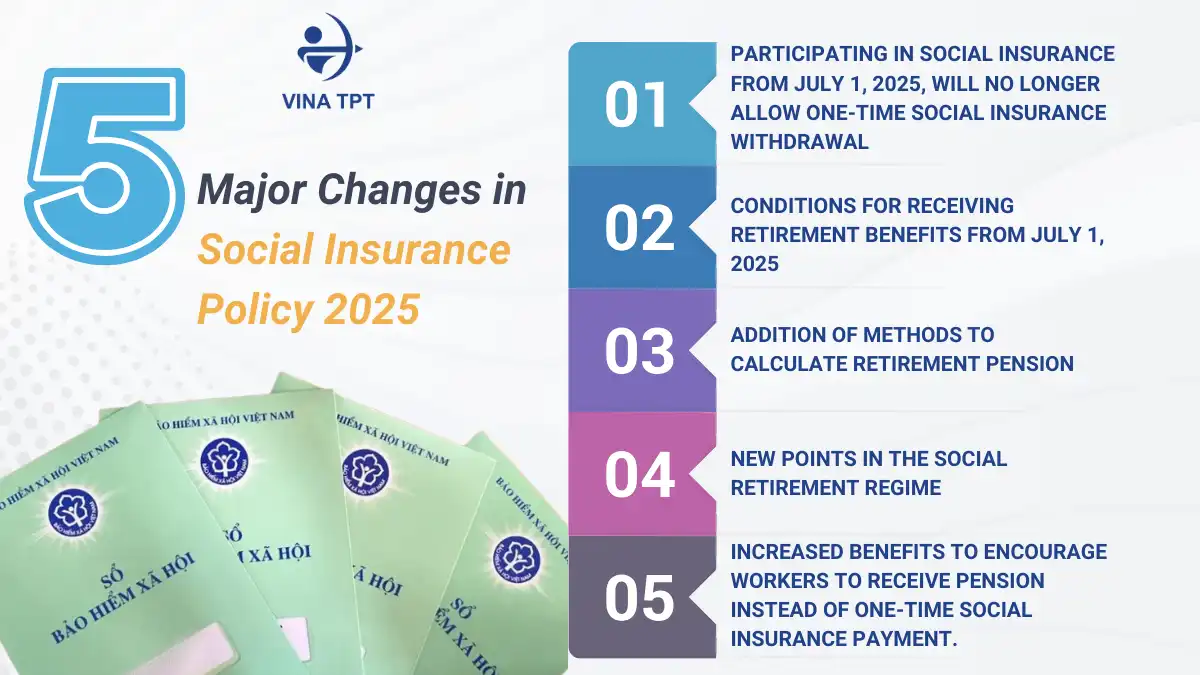
LATEST SOCIAL INSURANCE POLICY 2025 – 5 CHANGES TO NOTE

Infographic showing key changes in social insurance policy 2025 and compliance tips for employers

Infographic showing key changes in social insurance policy 2025 and compliance tips for employers

Participation in Social Insurance from July 1, 2025, Will Not Allow One-Time Withdrawal under the social insurance policy 2025. 

According to the 2025 social insurance policy, employees starting to participate in social insurance from July 1, 2025, will not be allowed to withdraw social insurance in one lump sum. except in the following cases:  

  • Reaching retirement age but having less than 15 years of social insurance contributions.  
  • Emigrating abroad for permanent residence.  
  • Suffering from life-threatening diseases such as cancer, paralysis, decompensated cirrhosis, severe tuberculosis, or AIDS.  
  • Employees who contributed to social insurance before July 1, 2025, and after 12 months are no longer subject to mandatory social insurance or voluntary social insurance, with less than 20 years of contributions.  

This aims to limit one-time social insurance withdrawals, encouraging employees to maintain participation for long-term pension benefits.  

Conditions for Receiving a Pension from July 1, 2025 as regulated by the social insurance policy 2025. 

According to the latest social insurance policy, effective from July 1, 2025, the conditions for employees to receive a monthly pension have been adjusted as follows:  

  • Minimum social insurance contribution period: Reduced from 20 years to 15 years. 
  • Retirement age: Employees must reach the retirement age as stipulated in Clause 2, Article 169 of the Labor Code, specifically as follows: From 2025, under normal working conditions, the retirement age is 61 years and 3 months for male employees and 56 years and 8 months for female employees; thereafter, it increases by 3 months for males and 4 months for females each year. 

This provision aims to enable those who join social insurance late or irregularly to accumulate at least 15 years of contributions to receive a monthly pension, instead of a one-time withdrawal. 

Additionally, employees who reach retirement age and have contributed to social insurance for 15 years or more will receive a free health insurance card for healthcare throughout their pension period. 

2025 Social Insurance Policy Supplements Pension Benefit Calculation Method in the latest social insurance policy 2025. 

Based on Clause b, Paragraph 1, Article 66 of the 2024 Social Insurance Law (effective from July 1, 2025), a new method for calculating pension benefits has been added for male employees with a social insurance contribution period of 15 to under 20 years. 

Infographic showing key changes in social insurance policy 2025 and compliance tips for employers

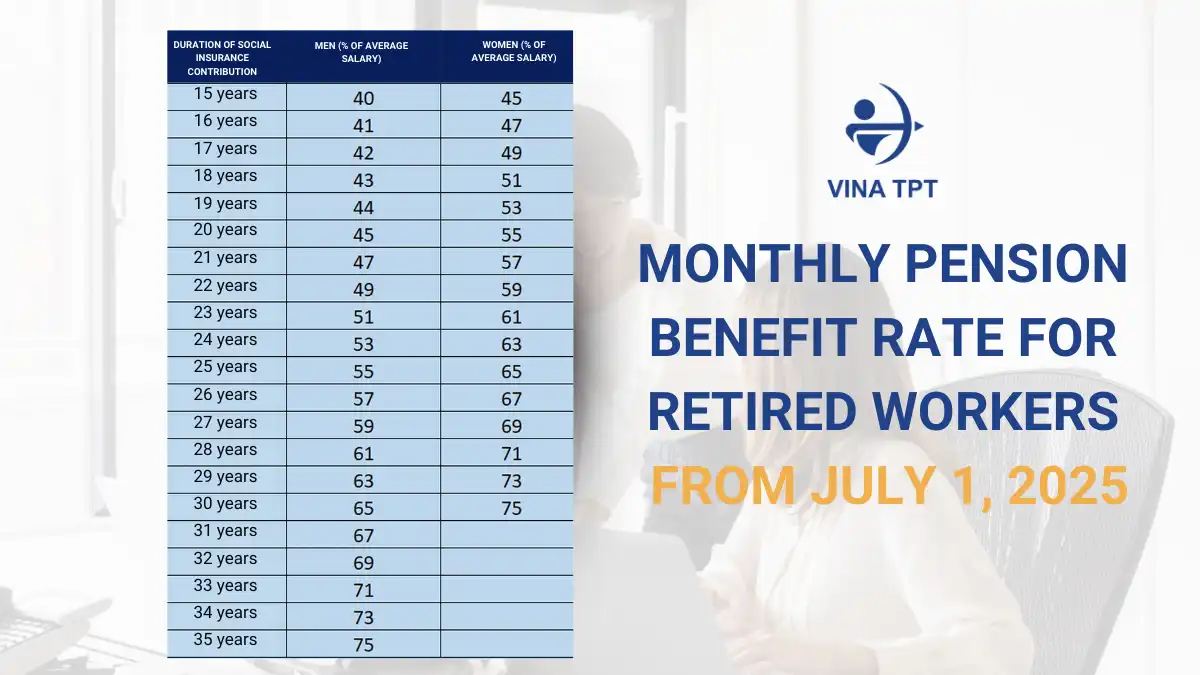
Accordingly, the monthly pension benefit from July 1, 2025, is stipulated as follows:  

Male employees:   

Contributing 20 years of social insurance entitles them to 45%.  

– Thereafter, an additional 2% is added for each additional year.  

– The maximum benefit rate is 75%.  

– For male employees with a contribution period of 15 to under 20 years, they receive 40%, with an additional 1% for each additional year.  

Female employees:  

– Contributing 15 years of social insurance entitles them to 45%.  

– Thereafter, an additional 2% is added for each additional year.  

– The maximum benefit rate is 75%.  

Case of early retirement due to reduced working capacity:   

– A 2% reduction for each year of early retirement before the stipulated age.  

– If the early retirement period is less than 6 months, there is no reduction in the pension benefit percentage; if it is from 6 months to under 12 months, a 1% reduction applies.  

New Aspects in the Social Pension Scheme introduced by the social insurance policy 2025. 

Infographic showing key changes in social insurance policy 2025 and compliance tips for employers

Addition of Social Pension Benefits for Those Without Pensions  

Under the 2025 social insurance policy, the state will provide a monthly social pension to elderly individuals without a pension or those ineligible for social insurance benefits, provided they meet the following conditions:  

(i) Aged 75 or older. 

(ii) Not receiving a pension or monthly social insurance benefits, except as otherwise stipulated by the government. 

(iii) Submitting a written request for social pension benefits. 

Note: Vietnamese citizens aged 70 to under 75 from poor or near-poor households, meeting the conditions in clauses (ii) and (iii) above, are eligible for social pension benefits. 

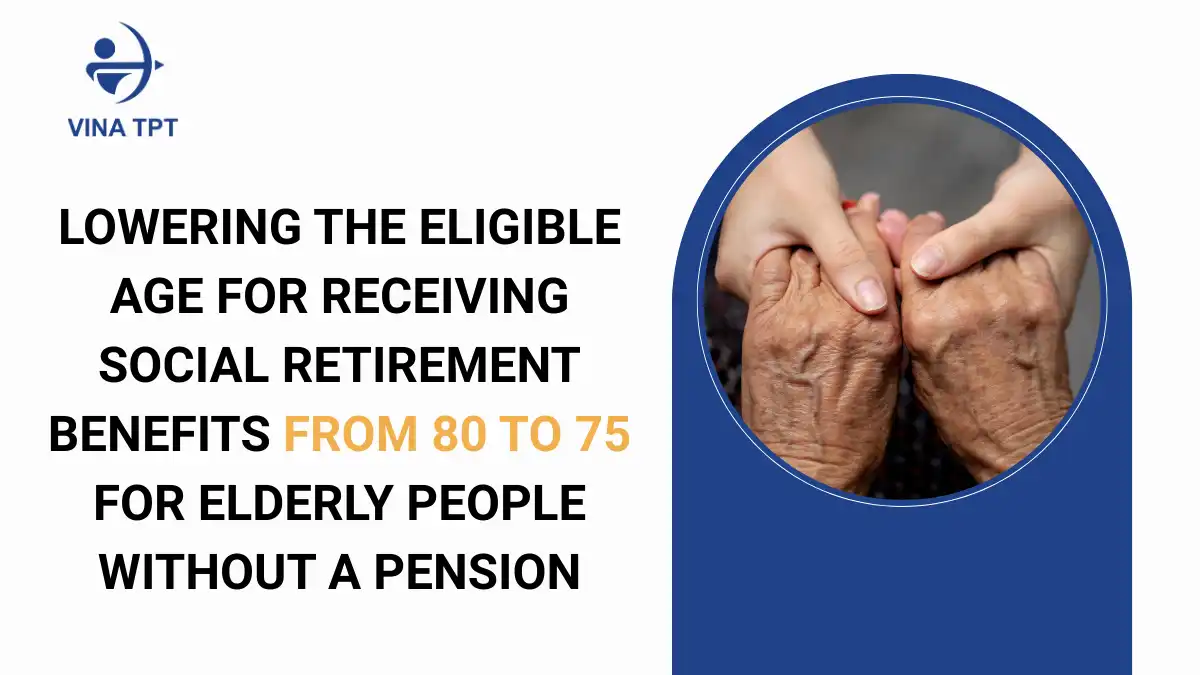
Reduction in the Age for Receiving Social Pension Benefits  

The 2025 social insurance policy (2024 Social Insurance Law) stipulates a reduction in the age for receiving social pension benefits from 80 to 75 years for elderly individuals without pensions. Additionally, those aged 70 or older from poor or near-poor households will also be considered for this benefit.  

2025 Social Insurance Policy Increases Benefits to Encourage Employees to Receive Pensions Instead of One-Time Withdrawals 

To encourage employees to maintain participation in social insurance for pension benefits, the 2025 social insurance policy introduces additional benefits. 

In cases where employees have ceased participating in social insurance, do not opt for a one-time withdrawal, and preserve their contribution period to continue participation, they have the opportunity to enjoy higher benefits such as: 

  • Receiving higher benefits for various schemes calculated based on contribution time (sickness, work accidents, occupational diseases, etc.) upon continued participation; 
  • Eligible for a pension under more favorable conditions; 
  • During the pension period, the social insurance fund covers health insurance; 
  • Eligible for a monthly allowance if not meeting pension conditions and not yet at the age for social pension benefits; 
  • During the monthly allowance period, the state budget covers health insurance. 

CONCLUSION  

The changes in the 2025 social insurance policy have a significant impact on the rights of employees and businesses. Timely awareness and understanding of the new regulations will help you and your business proactively plan finances and ensure social security benefits. 

If you need further information or support regarding social insurance issues, please CONTACT us for timely and accurate advice.  

Contact VINA TPT for Support

📞 (+84) 984 980 069
📧infor@vinatpt.com
🌐 https://vinatpt.com
🏢 5th Floor, More Building, 83B Hoang Sa, Da Kao Ward, District 1, HCMC 

Vina TPT Tax Consultant Vietnam

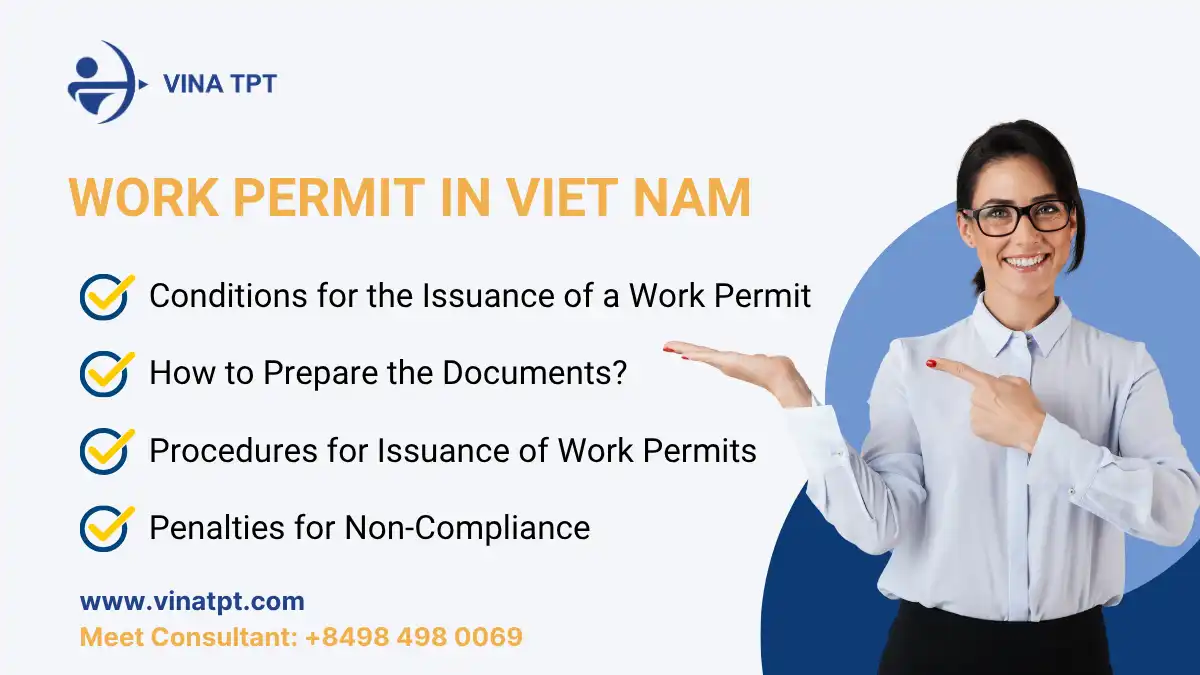
Work Permit in Vietnam 2025 | Step-by-Step Guide & Requirements

work permit step by step guidance

Work permit in vietnam 1

Work permit in Vietnam is a mandatory requirement for foreigners to legally work in the country. This article provides detailed information on the latest requirements, documents, and procedures for obtaining a work permit, while also covering exemption cases and relevant penalties. 

1/ What is a Work Permit in Vietnam?  

The work permit is an official legal document issued by a competent Vietnamese authority, allowing foreign nationals to work legally in Vietnam. It is a compulsory requirement for most foreigners employed in the country. 

The work permit in Vietnam is issued by the Ministry of Home Affairs (MOHA) or Department of Home Affairs at the provincial or municipal level. The permit contains key details such as the employee’s full name, nationality, job position, and the validity period. 

2/ Why do foreigners need a work permit in Vietnam?  

Holding a work permit offers several benefits and is a legal requirement:  

  • Compliance with Vietnamese law: This is a legal regulation. Working without a work permit is considered a violation of labor laws.  
  • Avoiding legal risks: Both the employee and the employer can avoid legal risks, including administrative penalties or deportation.  
  • Protection of legal rights: A work permit helps protect the foreign worker’s legal rights, including those related to salary, insurance, and other benefits.  

The current legal documents governing work permits in Vietnam include:  

3/ Eligible individuals and conditions for being granted a work permit in Vietnam  

To be granted a work permit, foreigners must meet specific conditions.  

Eligible for a work permit

Eligible individuals for a work permit: 

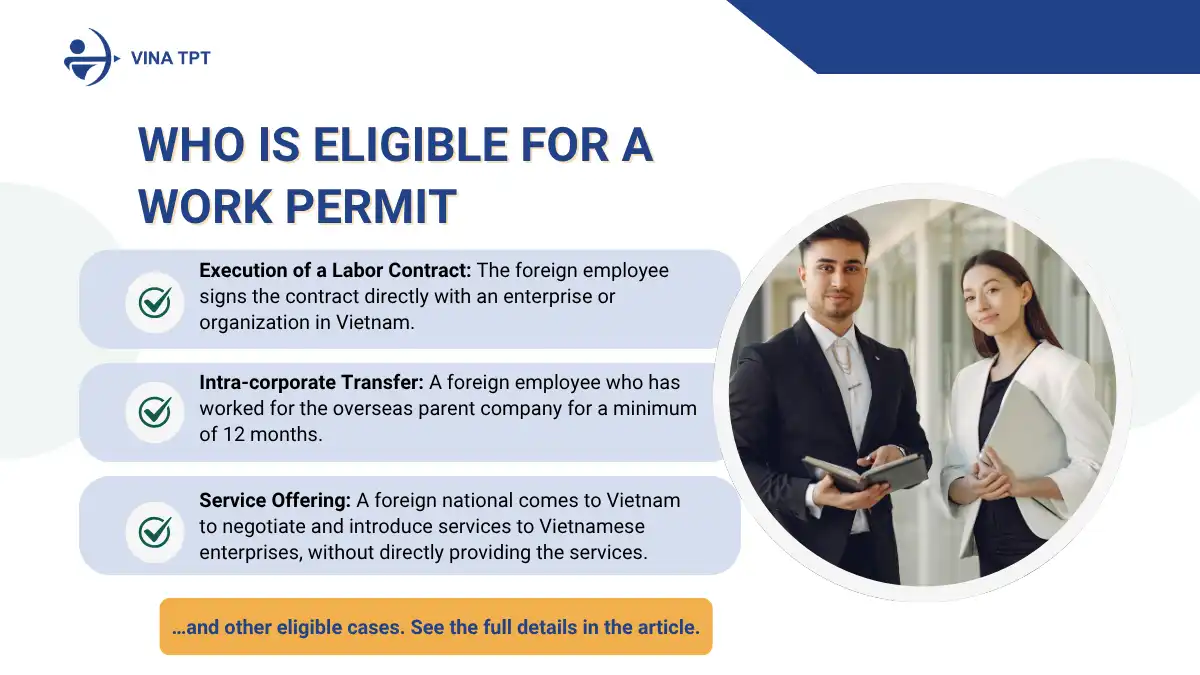
The individuals eligible for a work permit in Vietnam are clearly defined in Article 2 of Decree No. 152/2020/ND-CP (as amended by Decree No. 70/2023/ND-CP). Specifically, these are foreigners entering Vietnam to work under the following forms: 

Performing a labor contract: 

  • The foreign national signs a direct labor contract with a company or organization in Vietnam. 
  • They hold positions such as expert, technician, manager, or executive director.  

Intra-corporate transferee 

  • The foreign worker has been employed by the overseas parent company for at least 12 months.  
  • They are transferred to work at a branch or representative office of the same group/company in Vietnam.  

Executing contracts or agreements between Vietnamese enterprises and foreign organizations 

These may involve fields such as economics, trade, finance, banking, insurance, science and technology, culture, sports, education, healthcare, etc.  

Contract-based service provider 

The foreigner comes to Vietnam to fulfill obligations under a service contract signed between a foreign entity and a Vietnamese one. They do not have a commercial presence in Vietnam.  

Service sales representative 

The foreigner visits Vietnam to negotiate or introduce services to Vietnamese businesses but does not directly deliver the services.  

Foreign volunteer 

They must have an assignment letter from a licensed non-governmental or international organization operating in Vietnam.  

Person responsible for establishing a commercial presence 

They represent a foreign organization in setting up a representative office in Vietnam.  

Other cases 

As defined by regulations or international agreements to which Vietnam is a signatory (e.g., WTO, CPTPP commitments).  

General conditions for work permit Viet Nam:  

Foreign workers must meet the following general conditions to be have work permit in Vietnam: 

  • Possess full civil act capacity.  
  • Be in good health suitable for the job. A valid health certificate is required.  
  • Be a manager, executive director, expert, or technical worker.  
  • Not have a criminal record or be under criminal prosecution.  
  • Obtain a written approval for the job position using a foreign worker. This document must be issued by a competent authority.  

Specific requirements for each category  

Each category has specific requirements in terms of qualifications and experience:  

  • Expert: Must hold a university degree or equivalent, and have at least 3 years of relevant work experience.  
  • Technical worker: Must have received at least 1 year of specialized training and have at least 3 years of experience in the trained field.  
  • Manager or executive director: Must have managerial experience. Supporting documents such as appointment decisions are required.  
  • Intra-corporate transferees: Must be assigned by the foreign enterprise. An appointment decision and proof of experience with the parent company are required.  

View more about service for Expats in Vietnam

4/ Application dossier for a new work permit in Vietnam  

Preparing a complete and accurate dossier is crucial. Required documents include: 

  • Health certificate valid for 12 months.   
  • Criminal record certificate issued within the last 6 months.   
  • Certificates, diplomas, or professional qualification documents.   
  • Document confirming work experience or a previous work permit.   
  • Two 4×6 cm photos with white background, taken within the last 6 months.   
  • Approval letter for the need to employ foreign workers.   
  • Certified copy of a valid passport.   
  • Additional documents depending on the specific case (e.g., contract, assignment letter, etc.).   
  • Foreign documents must be consular legalized and notarized translated.  

5/ VIETNAM WORK PERMIT PROCESS 

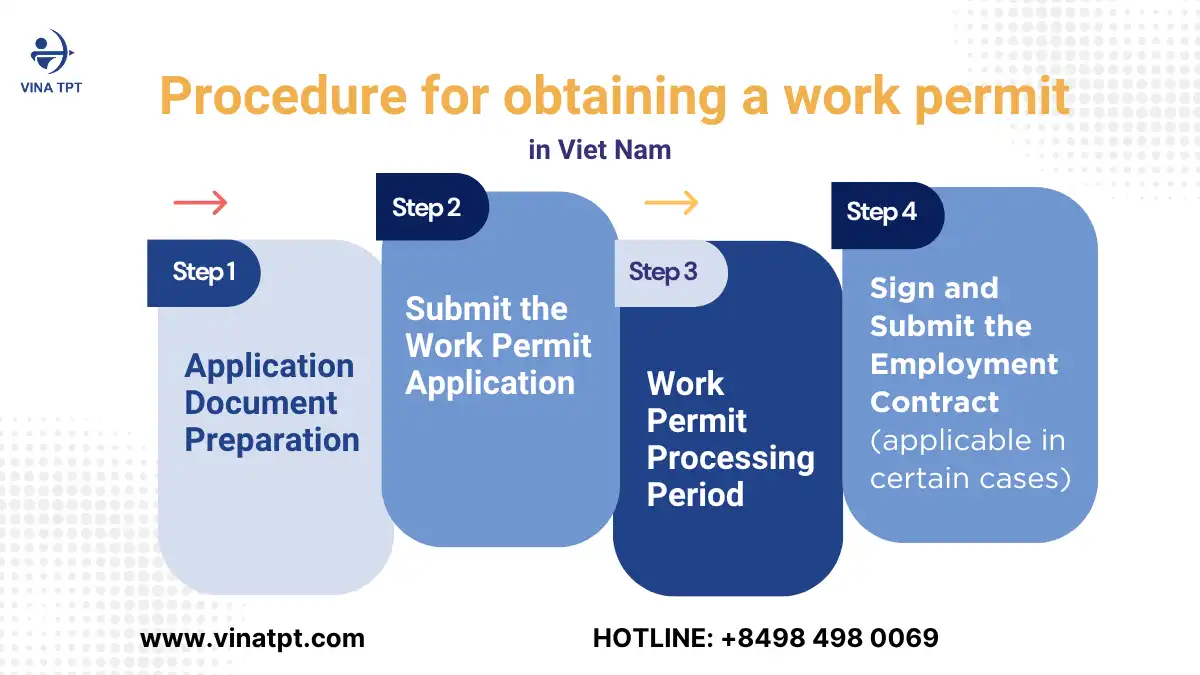
The process for obtaining a work permit includes the following steps:  

Step 1: Submit the application for a work permit in Vietnam 

Submission deadline: At least 15 days before the foreign worker is expected to start working in Vietnam. 

Receiving authority:   

  • Ministry of Home Affairs (for cases under its jurisdiction), 
  • Or Department of Home Affairs, where the foreigner is expected to work. 

Applicants:   

  • Employer: Applies to foreign workers working under labor contracts, intra-corporate transfers, execution of agreements, service providers, service sellers, or other applicable cases.  
  • Vietnamese or foreign entities operating in Vietnam: Applies when foreign workers are working under specific contracts or agreements.  
  • Foreign worker: Applies to those entering Vietnam to offer services or to establish a commercial presence.  

Step 2: Wait for the work permit issuance   

  1. Processing time: Within 5 working days from the date of receiving a complete and valid application. 
  1. Issuing authority: Ministry/ Department of Home Affairs where the foreigner will work.  
  1. Result:  If the application is valid and eligible, the foreign worker will be granted a work permit using Form No. 12/PLI – Appendix I of the Decree. của Nghị định.  

If not granted: The competent authority will issue a written response stating the reason for rejection.  

Step 3: Sign and submit the labor contract (applies to certain cases)   

Applicable to: Foreign workers working under labor contracts.  

Requirement: After the foreign worker is issued a work permit, the employer and the worker must sign a written labor contract in accordance with Vietnamese labor law. This must be done before the worker’s official start date. 

Employer’s obligation: The signed labor contract (original or certified copy) must be submitted to the authority that issued the work permit. 

Produre for abtaining a work permit in vietnam
Procedure for abtaining a work permit in viet nam

6/ Work Permit Fee in Vietnam 

The fee for obtaining a work permit is generally regulated by the Ministry of Finance. According to Circular No. 250/2016/TT-BTC, the fee for a new work permit is 400,000 VND per permit. However, this amount may vary slightly across provinces depending on local People’s Council regulations. 

Work Permit Validity: : The maximum validity period of a work permit is 2 years. 

7/ Exemptions from Work Permit Requirement  

In certain cases, foreigners working in Vietnam are not required to obtain a work permit:  

  • Being the owner or capital-contributing member of a company with contributed capital of at least VND 3 billion.  
  • Being a member of the Board of Directors of a joint-stock company with contributed capital of at least VND 3 billion.  
  • Entering Vietnam for work for less than 30 days and no more than 3 times per year.  
  • Performing duties under international agreements to which Vietnam is a signatory.  
  • Other cases as specified in Article 7 of Decree No. 152/2020/ND-CP (as amended by Decree No. 70/2023/ND-CP).  

You can find more detailed information on exemption work permit on the official Government Portal or in this article.  

8/ Penalty for without work permit in Viet Nam:  

Violations of work permit regulations are strictly penalized.  

In case of working without a permit (penalty for without work permit in Viet Nam)   

  • Foreign worker: May be fined from VND 15,000,000 to VND 25,000,000 and may be subject to deportation.  
  • Employing enterprise: May be fined from VND 30,000,000 to VND 75,000,000 depending on the number of violating workers.  
  • Administrative penalties: Detailed in Decree No. 12/2022/ND-CP on administrative sanctions in labor and social insurance. More information can be found at the Ministry of Home Affairs website: https://moha.gov.vn/ 
  • Other sanctions: : In addition to fines, workers may be deported and employers may face suspension of business activities.  

9/ Conclusion 

Applying for a work permit in Vietnam is a crucial legal procedure. It requires careful preparation and strict compliance with the regulations. To ensure a smooth process, you should: 

  • Prepare your application documents thoroughly and completely.  
  • Seek professional assistance if you are not familiar with the procedures. 
  • Comply with the law to avoid unnecessary legal risks.  

Vina TPT proudly offers full-package consulting and support services for obtaining work permits in Vietnam for foreigners. We assist clients with document preparation, application submission, and process follow-up. 

Our service saves you time and effort, ensuring the process is completed quickly and accurately.   

Contact us for detailed consultation.  

Book a free consultation

Vina TPT Accounting services