How to Calculate Personal Income Tax 2026 in Vietnam

how-to-calculate-personal-income-tax-2026-vinatpt

Vietnam’s Personal Income Tax 2026 law was amended Law No. 109/2025/QH15 and officially takes effect from July 1, 2026. Key rules for salary, wages, and business income, however, apply right from January 1, 2026. These updates significantly reduce the tax burden for employees and business owners amid rising living costs. 

This guide explains exactly how to calculate PIT in 2026, highlights the major changes (increased family deductions, simplified progressive rates, expanded exemptions), and provides clear, real-world examples so you can compute your tax accurately and stay fully compliant. 

1. Major Changes to Personal Income Tax from 2026 

2026 introduces the biggest PIT reforms since 2012, driven by the amended PIT Law 2025 and Resolution 110/2025/UBTVQH15. The goal is to ease pressure on middle-income earners, support digital businesses, and attract high-tech investment while keeping pace with economic growth and inflation. 

Change  Main Benefit 
Increased family deductions  Lower tax for individuals and families 
Simplified progressive brackets  Easier calculation, reduced tax for average incomes 
Expanded exemptions  Support for high-tech, agriculture, and green sectors 

These reforms make the tax system more modern, transparent, and easier to comply with. 

1.1 Increased Family Deductions Effective January 1, 2026 

From January 1, 2026, family circumstance deductions are raised to better match higher living costs, helping millions of taxpayers pay less personal income tax The personal deduction increases from VND 11 million to VND 15.5 million per month (VND 186 million per year), and the deduction per dependent rises from VND 4.4 million to VND 6.2 million per month. 

Type of Deduction  2025 Amount  2026 Amount 
Personal deduction  11 million/month  15.5 million/month 
Per dependent  4.4 million/month  6.2 million/month 

Who qualifies as a dependent? 

  • Children: Under 18; over 18 if disabled and unable to work; full-time students (university, college, vocational) under 22 with low or no income. 
  • Spouse: Unable to work or with very low/no income. 
  • Parents, grandparents, siblings: Elderly or disabled individuals with insufficient income, directly supported by the taxpayer. 

Key conditions 

  • Each dependent can be claimed by only one taxpayer. 
  • Proof is required (birth certificate, household registration, disability certificate, school enrollment, support commitment letter). 
  • Register with your employer or tax office (usually via Form 20-ĐK-TNCN) before tax is calculated. 

1.2 New Progressive Personal Income Tax 2026 Rates – Reduced from 7 to 5 Brackets 

Effective January 1, 2026, the progressive tax scale is simplified from 7 brackets to 5, with wider income ranges to reduce the effective tax rate for middle earners. The top rate remains 35%, now applying only to monthly taxable income over VND 100 million (previously VND 80 million). 

Bracket  Monthly Taxable Income (VND million)  Annual Taxable Income (VND million)  Tax Rate (%) 
1  Up to 10  Up to 120  5 
2  Over 10 to 30  Over 120 to 360  10 
3  Over 30 to 50  Over 360 to 600  20 
4  Over 50 to 100  Over 600 to 1,200  30 
5  Over 100  Over 1,200  35 

Old vs. new comparison The old 7-bracket system had narrower bands, pushing many middle-income earners into higher rates. The new structure is simpler and saves 5–15% in tax for most employees, while encouraging extra work without jumping brackets quickly. 

1.3 Expanded Exemptions, Reductions & Special Incentives 

The updated law adds 21 new exempt income categories starting in 2026, focusing on education, healthcare, green projects, and high-tech sectors. Additional benefits include a 50% reduction on certain investment income and a 5-year exemption for high-tech professionals. 

  • New exempt items: Certain overtime pay, scholarships, income from green bonds, organic agriculture, gifts under VND 10 million, disaster relief support. 
  • Special incentives: 5-year PIT exemption for experts in AI, semiconductors, and R&D; 50% reduction on income from investments in tech startups. 
Incentive Type  Condition  Duration 
Scholarship exemption  Full-time formal education  Indefinite 
5-year high-tech exemption  Experts in AI, semiconductors, R&D  5 years from 2026 
50% investment reduction  Green/technology startups  Applies to 2026+ income 

Proof (contracts, certificates) is required, often from the Ministry of Science and Technology. 

personal-incom-tax-2026-vina-tpt

2. How to Calculate Personal Income Tax in 2026 – Step-by-Step Guide 

Core formula Tax payable = Taxable income × Progressive tax rate Taxable income = Total income – Exempt items – Deductions (family + mandatory insurance + charity + eligible medical/education expenses) 

This applies to tax residents. Non-residents pay a flat 20% on Vietnam-sourced income. 

Step 1: Determine Your Tax Residency Status 

Start by confirming whether you are a tax resident or non-resident, as this determines what income is taxable. 

Under Vietnam’s PIT law: 

  • Tax resident: Present in Vietnam ≥183 days in the calendar year, or maintaining a permanent residence (owned home or long-term rental with registered address). 
  • Non-resident: Taxed only on income sourced from Vietnam. 

Tax implications 

  • Residents: Taxed on worldwide income using the 5-bracket progressive scale (5%–35%). 
  • Non-residents: Flat 20% on Vietnam-sourced salary and wages (other rates apply to specific types). 

Step 2: Calculate Taxable Income 

Basic formula: Taxable income = Total income – Exempt items – Deductions 

  1. Total income includes salary, bonuses, taxable allowances, business profits, investment returns, etc. 
  2. Exempt items include scholarships, certain overtime pay, small gifts, etc. 
  3. Deductions include: 
  • Family deduction (VND 15.5 million/month personal + VND 6.2 million/month per dependent) 
  • Mandatory social, health, unemployment insurance (BHXH, BHYT, BHTN) 
  • Charitable donations (with receipts) 
  • Medical & education expenses (new in 2026, up to VND 10 million/year – detailed guidance pending) 

Example In January 2026, Mr. A receives: 

  • Salary: VND 70,000,000 
  • Meal allowance (per company policy): VND 1,000,000 
  • Sales commission: VND 2,000,000 

No charitable contributions. Mr. A has one registered dependent (child under 18). 

Calculation: 

  • Total income: 70,000,000 + 1,000,000 + 2,000,000 = VND 73,000,000
  • Exempt: VND 1,000,000 (meal allowance) 
  • Deductions: 15,500,000 (personal) + 6,200,000 (dependent) + 4,200,000 (mandatory insurance) = VND 24,850,000
  • Taxable income = 73,000,000  – 1,000,000 – 24,850,000 = VND 47,150,000 per month 

Step 3: Apply the 2026 Progressive Rates

new-progressive-personal-income-tax-rates-vina-tpt

Apply the 5-bracket scale to taxable income, calculating tax portion by portion and adding them up. 

Continuing Mr. A’s example (monthly taxable income: VND 47,150,000): 

  • Bracket 1: VND 10,000,000 × 5% = VND 500,000 
  • Bracket 2: (30,000,000 – 10,000,000) × 10% = VND 2,000,000 
  • Bracket 3: (47,150,000 – 30,000,000) × 20% = VND 3,430,000 

Total PIT payable: 500,000 + 2,000,000 + 3,430,000 = VND 5,930,000 

Net take-home pay: 73M – 4.2M (insurance) – 5.93M (PIT) = VND 62,870,000 

3. Special Rules for Foreigners and Expatriates in Vietnam 

Foreign nationals (expats) and overseas workers follow specific PIT rules in 2026. 

  • Non-residents: Flat 20% on Vietnam-sourced income, withheld at source. 
  • Residents: Subject to the same progressive rates as Vietnamese citizens. 

Double Taxation Agreements (DTAs) Vietnam has over 80 DTAs (with the US, EU countries, Japan, Singapore, etc.). To claim relief: 

  • Submit Form NT5/TNCN 
  • Provide proof of tax residency in your home country 
  • Claim credit for taxes already paid abroad 

Example: A non-resident expat earning VND 50 million/month pays VND 10 million (20%) PIT. With a DTA, the rate may drop to 10–15%. 

These rules, plus the 5-year exemption for high-tech experts, make Vietnam attractive for skilled international professionals. 

4. Filing and Finalizing Personal Income Tax in Vietnam 

PIT filing and finalization are fully online via the General Department of Taxation portal (thuedientu.gdt.gov.vn) or eTax Mobile app. 

General deadlines (apply every year): 

  • Employer finalization (for authorized employees): By the last day of the 3rd month after year-end (usually March 31). 
  • Individual self-finalization: By the last day of the 4th month after year-end (usually April 30). → If the deadline falls on a holiday or weekend, it shifts to the next working day. 

Who must self-file? Individuals with income from two or more sources who do not meet authorization conditions, or those seeking refunds or adjustments. 

5. Vina TPT – Your 2026 PIT Solution for Expats & Businesses in Vietnam 

Vina TPT is a leading tax advisory firm in Vietnam specializing in Personal Income Tax services for expatriates and foreign-invested companies. Our experienced team provides full support, from 2026 PIT forecasting and calculation to DTA claims and maximum deduction optimization. 

Why choose Vina TPT? 

  • Free initial consultation with clear guidance 
  • Fast, accurate filing and deadline reminders 
  • Full compliance with 2026 regulations to minimize risks 

Key services 

  • PIT finalization for expats with multi-source income 
  • Assistance with high-tech and investment incentives 
  • HR training on payroll updates and withholding 

Need help with your 2026 Personal Income Tax in Vietnam? Contact Vina TPT today for expert, hassle-free support.

BOOK A FREE CONSULTATION

Personal income tax: Comprehensive Guide for Residents and Expats

what is personal income tax in vietnam

PERSONAL INCOME TAX IN VIETNAM FOR EXPATS


Personal Income Tax in Vietnam, governed by the Law on Personal Income Tax No. 04/2007/QH12 and its amendments (latest in 2025), is a critical obligation for individuals earning income in Vietnam. Whether you’re a local resident, an expat, or a digital nomad, understanding PIT ensures compliance and optimizes your financial planning. This guide covers tax rates, deductions, filing procedures, and more to address your needs—whether you’re seeking rates (informational), filing steps (transactional), or official resources (navigational).  

Why does PIT matter? With Vietnam’s economy growing and stricter tax enforcement in 2025, knowing your obligations prevents penalties and maximizes deductions. Ready to navigate Vietnam’s tax system? 

1/ Determining Your Tax Residency Status 

Your tax obligations hinge on your residency status. Under Vietnam’s tax law, you’re a tax resident if you meet one of these criteria: 

  • Stay in Vietnam for 183 days or more in a calendar year or 12 consecutive months. 
  • Hold a permanent residence card or have a leased property in Vietnam for 183+ days. 
  • Otherwise, you’re a non-resident, taxed only on Vietnam-sourced income. 

Special cases: Digital nomads or expats in Vietnam may unintentionally become tax residents if they overstay the 183-day threshold. To avoid this, maintain proof of residency elsewhere (e.g., tax certificates from another country).  

Tax residency status

Comparison: Tax Residents vs. Non-Residents 

Criteria  Tax Resident  Non-Resident 
Taxable Income Scope  Global income  Vietnam-sourced income only 
Tax Rates  Progressive (5%-35%)  Flat 20% (employment); 0.1%-20% (others) 
Filing Obligations  Annual finalization, monthly/quarterly  Pay-at-source or annual declaration 

This table highlights why residency status is critical for tax planning. 

2/ Types of Taxable Income 

Personal income tax applies to various income types, including: 

  • Employment income: Salaries, wages, bonuses, allowances, and fringe benefits. 
  • Non-employment income: Business profits, dividends, capital gains, real estate transfers, royalties, inheritances, gifts, and prizes (e.g., lottery winnings). 
  • Foreign currency income: Converted to VND using the State Bank of Vietnam exchange rate at the transaction date. 
  • Emerging categories: Income from digital services (e.g., content creation, online consulting) and remote work is increasingly scrutinized in 2025. 

income streams

3/ Personal Income Tax Rates 2025 

Vietnam uses progressive tax rates for residents and flat rates for non-residents: 

  • Residents: Taxed from 5% (up to 5 million VND/month) to 35% (over 80 million VND/month). 
  • Non-residents: 20% on employment income; other incomes (e.g., real estate, capital gains) range from 0.1%-20%. 

Personal Income Tax Rate Tables 

Monthly Taxable Income (VND)  Tax Rate  Tax Amount (VND)  Approx. USD 
Up to 5 million  5%  0-250,000  $0-10 
5-10 million  10%  250,000-750,000  $10-30 
10-18 million  15%  750,000-1,650,000  $30-65 
18-32 million  20%  1,650,000-3,650,000  $65-144 
32-52 million  25%  3,650,000-6,650,000  $144-262 
52-80 million  30%  6,650,000-11,250,000  $262-444 
Over 80 million  35%  11,250,000+  $444+ 

Note: Non-residents pay a flat 20% on employment income, converted to ~$800/month for a $4,000 salary. 

4/ Deductions and Allowances 

Reduce your taxable income with these deductions: 

  • Personal deduction: 11 million VND/month (~$434 USD). 
  • Dependent deduction: 4.4 million VND/month per dependent (e.g., children under 18, disabled spouses, low-income parents). Register with a Tax Identification Number (TIN) and documents (birth certificates, income proofs). 
  • Other deductions: Compulsory insurances (social, health, unemployment), charitable donations, voluntary pension contributions. 

Checklist for claiming deductions: 

  • Register dependents with tax authorities. 
  • Submit proof of income for dependents earning below the threshold. 
  • Keep records of charitable donations (receipts, bank transfers). 

See Our Full Range of Tax Solutions

5/ Tax-Exempt Income and Benefits 

Certain incomes and benefits are exempt from PIT: 

  • Exempt incomes: Bank interest, insurance compensations, retirement pensions, family property transfers, scholarships, certain agricultural incomes. 

Non-taxable benefits:  

  • One annual round-trip airfare for expats. 
  • School fees for expat children (direct employer payments). 
  • Mid-shift meals (capped at regional minimum wage). 
  • Housing (up to 15% of total income), uniforms (up to 5 million VND/year if cash). 

Example: An expat’s employer pays $2,000 for their child’s school fees directly—fully exempt from PIT. 

6/ How to Calculate Your Personal Income Tax in Vietnam 

Follow these steps to calculate your PIT: 

  1. Determine residency status: Resident or non-resident. 
  1. Calculate taxable income: Gross income minus exemptions. 
  1. Apply deductions: Personal, dependent, and insurance deductions. 
  1. Apply tax rates: Use progressive rates (residents) or flat rates (non-residents). 

Example: A resident expat earns 50 million VND/month with two dependents: 

  • Taxable income: 50.000.000 – 11.000.000 (personal) – 8.800.000 (dependents) = 30.200.000 VND. 
  • Tax: (10.000.000 × 5%) + (8.000.000× 10%) + (12.200.000 × 15%) = 500.000 + 800.000+ 1.830.000 = 3.130.000 VND (~$123 USD). 

Tool: Use the e-portal calculator https://luatvietnam.vn/tinh-thue-thu-nhap-ca-nhan.html  for accuracy. 

7/ Filing and Payment Procedures 

Vietnam’s tax year runs from January 1 to December 31. Key procedures: 

  • Withholding: Employers deduct PIT monthly/quarterly. Self-declare for multiple income sources. 

Deadlines: 

  • Monthly: 20th of the next month. 
  • Quarterly: End of the first month post-quarter. 
  • Annual finalization: March 31 (employers), April 30 (individuals). 

Methods: File via GDT e-portal https://canhan.gdt.gov.vn/ICanhan, local tax offices, or authorized agents. Payments via bank transfer or State Treasury. 

Leaving Vietnam: Finalize taxes 45 days before departure to avoid immigration issues. 

Checklist for filing: 

  • Obtain a Tax Identification Number (TIN). 
  • Prepare income statements, deduction proofs. 
  • Verify filing status on the GDT portal. 

8/ Double Taxation Agreements (DTAs) 

Vietnam has DTAs with over 80 countries (e.g., US, UK, Singapore) to prevent double taxation. Benefits include exemptions or credits for taxes paid abroad. 

How to claim relief: 

  • Notify tax authorities 15 days before payment. 
  • Submit foreign tax payment proofs (e.g., tax certificates). 
  • Example: A US expat pays 10% tax in Vietnam on dividends, then claims a credit in the US. 

Are you leveraging DTAs to avoid double taxation? 

9/ Special Considerations for Expats and Foreigners 

Expats face unique PIT challenges: 

  • US expats: Report global income to the IRS (via FBAR, FEIE, FTC) while complying with Vietnam’s residency rules. 
  • Short-term assignments: “Economic employer” rules may apply, requiring payroll withholding. 
  • Digital nomads: Risk being taxed as residents if staying 183+ days; global income becomes taxable. 
  • 2025 updates: The General Department of Taxation (GDT) uses AI to monitor digital transactions, enforcing taxes on crypto gains and online services. 

Example: A digital nomad staying 200 days in Vietnam may owe PIT on worldwide income unless proving non-residency.

10/ Common Mistakes, Penalties, and Tips for Compliance

Common mistakes:

  • Underreporting benefits: Expats often overlook taxable benefits like housing allowances or cash-based uniform payments, leading to incorrect tax filings.

  • Missing dependent registration deadlines: Failing to register dependents (e.g., children, spouses) by the deadline (typically March 31) forfeits deductions of 4.4 million VND/month per dependent.

  • Ignoring Double Taxation Agreements (DTAs): Not claiming DTA benefits with over 80 countries (e.g., US, UK) results in unnecessary double taxation.

Penalties:

  • Late filing: A 0.05% daily interest penalty applies to overdue tax submissions, accumulating quickly.

  • Underpayment: Fines range from 10%-20% of the underpaid amount, with potential legal action for significant violations.

Tips for expats in Vietnam compliance:

  • Engage professional tax agents: Complex cases, such as multi-source incomes or DTA applications, benefit from expert guidance. Vina TPT, with over a decade of experience, offers tailored PIT solutions, including tax filing, deduction optimization, and multilingual reporting for expats and FDI businesses.

  • Track days in Vietnam: Monitor your stay to confirm tax residency status (183+ days triggers global income taxation). Use calendar apps or consult professionals to avoid unintended residency.

  • Reconcile income records annually: Cross-check payslips, contracts, and bank statements to ensure accurate declarations.

  • Leverage expert support: As an expat, I’ve relied on Vina TPT to navigate Vietnam’s PIT complexities. Their expertise in tax compliance, work permits, and payroll management saved me time and ensured no penalties, allowing me to focus on my work

Comparison: Vietnam’s PIT rates (5%-35%) are competitive with Thailand’s (0%-35%) but higher than Singapore’s flat 0%-22% for residents. Partnering with a service like Vina TPT ensures you optimize deductions and comply with local laws, avoiding costly errors.

10/ Simplifying Tax Procedures with Vina TPT’s PIT Services for Foreigners

Navigating Vietnam’s Personal Income Tax system can be complex, especially for foreigners unfamiliar with local regulations, language barriers, and intricate filing requirements. Vina TPT PIT Services offers a comprehensive PIT service tailored for expatriates and non-residents, streamlining every aspect of tax compliance. With over a decade of experience, Vina TPT provides:

  • End-to-end tax filing: From obtaining a Tax Identification Number (TIN) to submitting accurate declarations via the GDT e-portal, ensuring timely compliance with monthly, quarterly, and annual deadlines.

  • Deduction optimization: Expert guidance to maximize personal and dependent deductions, as well as leveraging Double Taxation Agreements (DTAs) with over 80 countries to minimize tax liabilities.

  • Multilingual support: Clear communication in English and other languages to assist expats with residency status determination, income reporting, and penalty avoidance.

  • Payroll and compliance solutions: For expats on short-term assignments or digital nomads, Vina TPT handles payroll withholding, work permits, and monitors the 183-day residency threshold to prevent unintended tax obligations.

  • AI-driven accuracy: Using advanced tools to track digital transactions (e.g., crypto gains, online services), ensuring compliance with 2025’s stricter tax enforcement.

Let’s Find the Best Tax Solution for You

11/ FAQ on Personal Income Tax in Vietnam 

  • What is the threshold for PIT filing in Vietnam? 

Residents with taxable income above 11 million VND/month or non-residents with any Vietnam-sourced income must file. 

  • How do I register for a Tax Identification Number (TIN)? 

Apply via the GDT e-portal or local tax offices with ID/passport and proof of residency. 

  • Are overseas remittances taxable? 

No, unless used for taxable activities (e.g., investments). 

  • What happens if I overpay PIT? 

Request a refund via the GDT portal with proof of overpayment. 

  • Can I deduct home office expenses as a remote worker? 

No, unless registered as a business expense with proper invoices. 

Why choose Vina TPT?

Their expertise eliminates the stress of navigating Vietnam’s tax system, saving you time and preventing costly errors. Whether you’re a digital nomad, a corporate expat, or managing multiple income sources, Vina TPT ensures seamless compliance and financial peace of mind.

Book a Consultation with Our Expert

Payroll-HR-Manager-Vietnam-VinaTPT

Work Permit in Vietnam 2025 | Step-by-Step Guide & Requirements

work permit step by step guidance

Work permit in vietnam 1

Work permit in Vietnam is a mandatory requirement for foreigners to legally work in the country. This article provides detailed information on the latest requirements, documents, and procedures for obtaining a work permit, while also covering exemption cases and relevant penalties. 

1/ What is a Work Permit in Vietnam?  

The work permit is an official legal document issued by a competent Vietnamese authority, allowing foreign nationals to work legally in Vietnam. It is a compulsory requirement for most foreigners employed in the country. 

The work permit in Vietnam is issued by the Ministry of Home Affairs (MOHA) or Department of Home Affairs at the provincial or municipal level. The permit contains key details such as the employee’s full name, nationality, job position, and the validity period. 

2/ Why do foreigners need a work permit in Vietnam?  

Holding a work permit offers several benefits and is a legal requirement:  

  • Compliance with Vietnamese law: This is a legal regulation. Working without a work permit is considered a violation of labor laws.  
  • Avoiding legal risks: Both the employee and the employer can avoid legal risks, including administrative penalties or deportation.  
  • Protection of legal rights: A work permit helps protect the foreign worker’s legal rights, including those related to salary, insurance, and other benefits.  

The current legal documents governing work permits in Vietnam include:  

3/ Eligible individuals and conditions for being granted a work permit in Vietnam  

To be granted a work permit, foreigners must meet specific conditions.  

Eligible for a work permit

Eligible individuals for a work permit: 

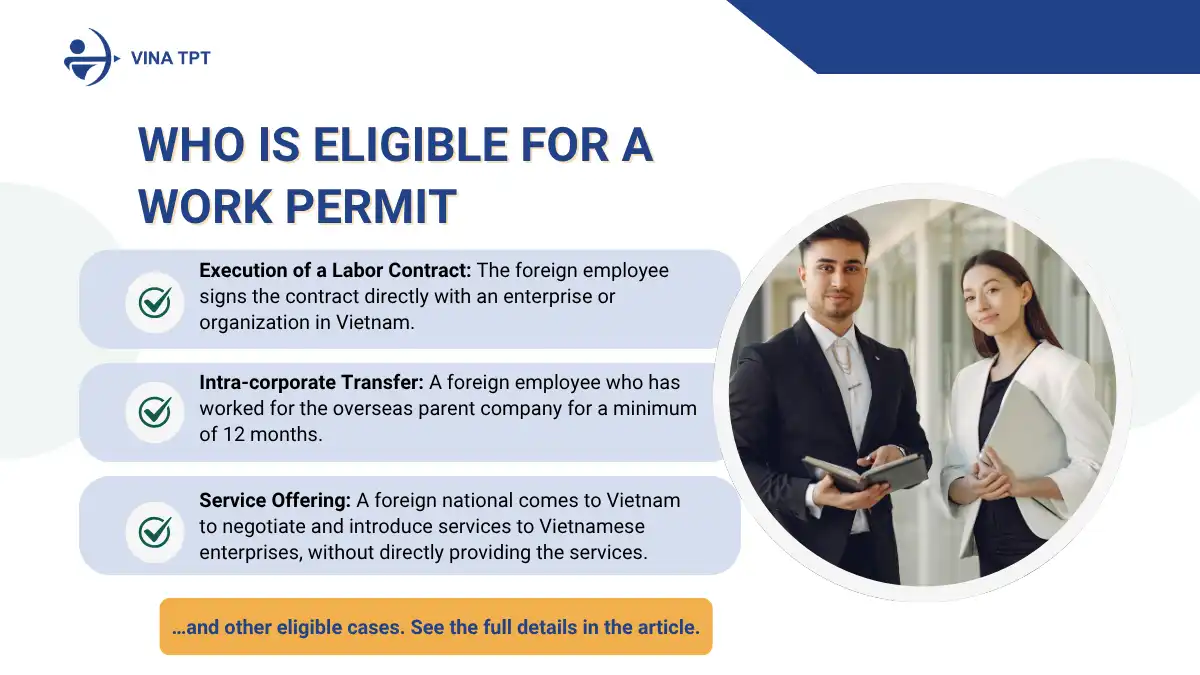
The individuals eligible for a work permit in Vietnam are clearly defined in Article 2 of Decree No. 152/2020/ND-CP (as amended by Decree No. 70/2023/ND-CP). Specifically, these are foreigners entering Vietnam to work under the following forms: 

Performing a labor contract: 

  • The foreign national signs a direct labor contract with a company or organization in Vietnam. 
  • They hold positions such as expert, technician, manager, or executive director.  

Intra-corporate transferee 

  • The foreign worker has been employed by the overseas parent company for at least 12 months.  
  • They are transferred to work at a branch or representative office of the same group/company in Vietnam.  

Executing contracts or agreements between Vietnamese enterprises and foreign organizations 

These may involve fields such as economics, trade, finance, banking, insurance, science and technology, culture, sports, education, healthcare, etc.  

Contract-based service provider 

The foreigner comes to Vietnam to fulfill obligations under a service contract signed between a foreign entity and a Vietnamese one. They do not have a commercial presence in Vietnam.  

Service sales representative 

The foreigner visits Vietnam to negotiate or introduce services to Vietnamese businesses but does not directly deliver the services.  

Foreign volunteer 

They must have an assignment letter from a licensed non-governmental or international organization operating in Vietnam.  

Person responsible for establishing a commercial presence 

They represent a foreign organization in setting up a representative office in Vietnam.  

Other cases 

As defined by regulations or international agreements to which Vietnam is a signatory (e.g., WTO, CPTPP commitments).  

General conditions for work permit Viet Nam:  

Foreign workers must meet the following general conditions to be have work permit in Vietnam: 

  • Possess full civil act capacity.  
  • Be in good health suitable for the job. A valid health certificate is required.  
  • Be a manager, executive director, expert, or technical worker.  
  • Not have a criminal record or be under criminal prosecution.  
  • Obtain a written approval for the job position using a foreign worker. This document must be issued by a competent authority.  

Specific requirements for each category  

Each category has specific requirements in terms of qualifications and experience:  

  • Expert: Must hold a university degree or equivalent, and have at least 3 years of relevant work experience.  
  • Technical worker: Must have received at least 1 year of specialized training and have at least 3 years of experience in the trained field.  
  • Manager or executive director: Must have managerial experience. Supporting documents such as appointment decisions are required.  
  • Intra-corporate transferees: Must be assigned by the foreign enterprise. An appointment decision and proof of experience with the parent company are required.  

View more about service for Expats in Vietnam

4/ Application dossier for a new work permit in Vietnam  

Preparing a complete and accurate dossier is crucial. Required documents include: 

  • Health certificate valid for 12 months.   
  • Criminal record certificate issued within the last 6 months.   
  • Certificates, diplomas, or professional qualification documents.   
  • Document confirming work experience or a previous work permit.   
  • Two 4×6 cm photos with white background, taken within the last 6 months.   
  • Approval letter for the need to employ foreign workers.   
  • Certified copy of a valid passport.   
  • Additional documents depending on the specific case (e.g., contract, assignment letter, etc.).   
  • Foreign documents must be consular legalized and notarized translated.  

5/ VIETNAM WORK PERMIT PROCESS 

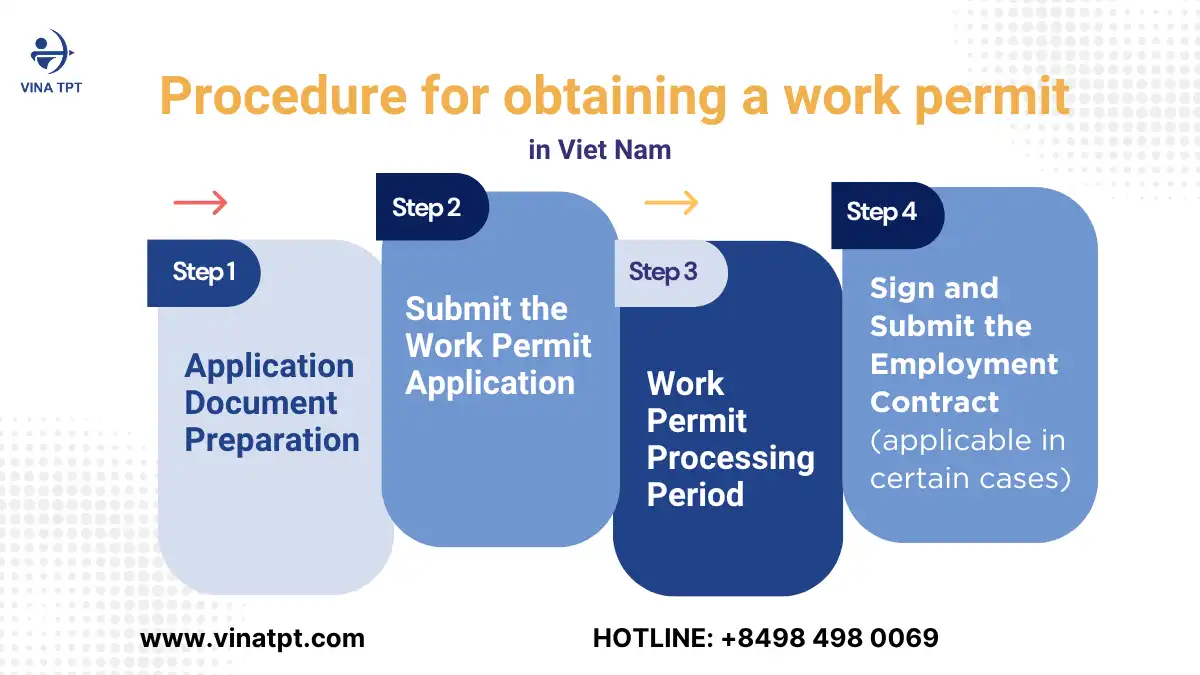
The process for obtaining a work permit includes the following steps:  

Step 1: Submit the application for a work permit in Vietnam 

Submission deadline: At least 15 days before the foreign worker is expected to start working in Vietnam. 

Receiving authority:   

  • Ministry of Home Affairs (for cases under its jurisdiction), 
  • Or Department of Home Affairs, where the foreigner is expected to work. 

Applicants:   

  • Employer: Applies to foreign workers working under labor contracts, intra-corporate transfers, execution of agreements, service providers, service sellers, or other applicable cases.  
  • Vietnamese or foreign entities operating in Vietnam: Applies when foreign workers are working under specific contracts or agreements.  
  • Foreign worker: Applies to those entering Vietnam to offer services or to establish a commercial presence.  

Step 2: Wait for the work permit issuance   

  1. Processing time: Within 5 working days from the date of receiving a complete and valid application. 
  1. Issuing authority: Ministry/ Department of Home Affairs where the foreigner will work.  
  1. Result:  If the application is valid and eligible, the foreign worker will be granted a work permit using Form No. 12/PLI – Appendix I of the Decree. của Nghị định.  

If not granted: The competent authority will issue a written response stating the reason for rejection.  

Step 3: Sign and submit the labor contract (applies to certain cases)   

Applicable to: Foreign workers working under labor contracts.  

Requirement: After the foreign worker is issued a work permit, the employer and the worker must sign a written labor contract in accordance with Vietnamese labor law. This must be done before the worker’s official start date. 

Employer’s obligation: The signed labor contract (original or certified copy) must be submitted to the authority that issued the work permit. 

Produre for abtaining a work permit in vietnam
Procedure for abtaining a work permit in viet nam

6/ Work Permit Fee in Vietnam 

The fee for obtaining a work permit is generally regulated by the Ministry of Finance. According to Circular No. 250/2016/TT-BTC, the fee for a new work permit is 400,000 VND per permit. However, this amount may vary slightly across provinces depending on local People’s Council regulations. 

Work Permit Validity: : The maximum validity period of a work permit is 2 years. 

7/ Exemptions from Work Permit Requirement  

In certain cases, foreigners working in Vietnam are not required to obtain a work permit:  

  • Being the owner or capital-contributing member of a company with contributed capital of at least VND 3 billion.  
  • Being a member of the Board of Directors of a joint-stock company with contributed capital of at least VND 3 billion.  
  • Entering Vietnam for work for less than 30 days and no more than 3 times per year.  
  • Performing duties under international agreements to which Vietnam is a signatory.  
  • Other cases as specified in Article 7 of Decree No. 152/2020/ND-CP (as amended by Decree No. 70/2023/ND-CP).  

You can find more detailed information on exemption work permit on the official Government Portal or in this article.  

8/ Penalty for without work permit in Viet Nam:  

Violations of work permit regulations are strictly penalized.  

In case of working without a permit (penalty for without work permit in Viet Nam)   

  • Foreign worker: May be fined from VND 15,000,000 to VND 25,000,000 and may be subject to deportation.  
  • Employing enterprise: May be fined from VND 30,000,000 to VND 75,000,000 depending on the number of violating workers.  
  • Administrative penalties: Detailed in Decree No. 12/2022/ND-CP on administrative sanctions in labor and social insurance. More information can be found at the Ministry of Home Affairs website: https://moha.gov.vn/ 
  • Other sanctions: : In addition to fines, workers may be deported and employers may face suspension of business activities.  

9/ Conclusion 

Applying for a work permit in Vietnam is a crucial legal procedure. It requires careful preparation and strict compliance with the regulations. To ensure a smooth process, you should: 

  • Prepare your application documents thoroughly and completely.  
  • Seek professional assistance if you are not familiar with the procedures. 
  • Comply with the law to avoid unnecessary legal risks.  

Vina TPT proudly offers full-package consulting and support services for obtaining work permits in Vietnam for foreigners. We assist clients with document preparation, application submission, and process follow-up. 

Our service saves you time and effort, ensuring the process is completed quickly and accurately.   

Contact us for detailed consultation.  

Book a free consultation

Vina TPT Accounting services