How to Calculate Personal Income Tax 2026 in Vietnam

how-to-calculate-personal-income-tax-2026-vinatpt

Vietnam’s Personal Income Tax 2026 law was amended Law No. 109/2025/QH15 and officially takes effect from July 1, 2026. Key rules for salary, wages, and business income, however, apply right from January 1, 2026. These updates significantly reduce the tax burden for employees and business owners amid rising living costs. 

This guide explains exactly how to calculate PIT in 2026, highlights the major changes (increased family deductions, simplified progressive rates, expanded exemptions), and provides clear, real-world examples so you can compute your tax accurately and stay fully compliant. 

1. Major Changes to Personal Income Tax from 2026 

2026 introduces the biggest PIT reforms since 2012, driven by the amended PIT Law 2025 and Resolution 110/2025/UBTVQH15. The goal is to ease pressure on middle-income earners, support digital businesses, and attract high-tech investment while keeping pace with economic growth and inflation. 

Change  Main Benefit 
Increased family deductions  Lower tax for individuals and families 
Simplified progressive brackets  Easier calculation, reduced tax for average incomes 
Expanded exemptions  Support for high-tech, agriculture, and green sectors 

These reforms make the tax system more modern, transparent, and easier to comply with. 

1.1 Increased Family Deductions Effective January 1, 2026 

From January 1, 2026, family circumstance deductions are raised to better match higher living costs, helping millions of taxpayers pay less personal income tax The personal deduction increases from VND 11 million to VND 15.5 million per month (VND 186 million per year), and the deduction per dependent rises from VND 4.4 million to VND 6.2 million per month. 

Type of Deduction  2025 Amount  2026 Amount 
Personal deduction  11 million/month  15.5 million/month 
Per dependent  4.4 million/month  6.2 million/month 

Who qualifies as a dependent? 

  • Children: Under 18; over 18 if disabled and unable to work; full-time students (university, college, vocational) under 22 with low or no income. 
  • Spouse: Unable to work or with very low/no income. 
  • Parents, grandparents, siblings: Elderly or disabled individuals with insufficient income, directly supported by the taxpayer. 

Key conditions 

  • Each dependent can be claimed by only one taxpayer. 
  • Proof is required (birth certificate, household registration, disability certificate, school enrollment, support commitment letter). 
  • Register with your employer or tax office (usually via Form 20-ĐK-TNCN) before tax is calculated. 

1.2 New Progressive Personal Income Tax 2026 Rates – Reduced from 7 to 5 Brackets 

Effective January 1, 2026, the progressive tax scale is simplified from 7 brackets to 5, with wider income ranges to reduce the effective tax rate for middle earners. The top rate remains 35%, now applying only to monthly taxable income over VND 100 million (previously VND 80 million). 

Bracket  Monthly Taxable Income (VND million)  Annual Taxable Income (VND million)  Tax Rate (%) 
1  Up to 10  Up to 120  5 
2  Over 10 to 30  Over 120 to 360  10 
3  Over 30 to 50  Over 360 to 600  20 
4  Over 50 to 100  Over 600 to 1,200  30 
5  Over 100  Over 1,200  35 

Old vs. new comparison The old 7-bracket system had narrower bands, pushing many middle-income earners into higher rates. The new structure is simpler and saves 5–15% in tax for most employees, while encouraging extra work without jumping brackets quickly. 

1.3 Expanded Exemptions, Reductions & Special Incentives 

The updated law adds 21 new exempt income categories starting in 2026, focusing on education, healthcare, green projects, and high-tech sectors. Additional benefits include a 50% reduction on certain investment income and a 5-year exemption for high-tech professionals. 

  • New exempt items: Certain overtime pay, scholarships, income from green bonds, organic agriculture, gifts under VND 10 million, disaster relief support. 
  • Special incentives: 5-year PIT exemption for experts in AI, semiconductors, and R&D; 50% reduction on income from investments in tech startups. 
Incentive Type  Condition  Duration 
Scholarship exemption  Full-time formal education  Indefinite 
5-year high-tech exemption  Experts in AI, semiconductors, R&D  5 years from 2026 
50% investment reduction  Green/technology startups  Applies to 2026+ income 

Proof (contracts, certificates) is required, often from the Ministry of Science and Technology. 

personal-incom-tax-2026-vina-tpt

2. How to Calculate Personal Income Tax in 2026 – Step-by-Step Guide 

Core formula Tax payable = Taxable income × Progressive tax rate Taxable income = Total income – Exempt items – Deductions (family + mandatory insurance + charity + eligible medical/education expenses) 

This applies to tax residents. Non-residents pay a flat 20% on Vietnam-sourced income. 

Step 1: Determine Your Tax Residency Status 

Start by confirming whether you are a tax resident or non-resident, as this determines what income is taxable. 

Under Vietnam’s PIT law: 

  • Tax resident: Present in Vietnam ≥183 days in the calendar year, or maintaining a permanent residence (owned home or long-term rental with registered address). 
  • Non-resident: Taxed only on income sourced from Vietnam. 

Tax implications 

  • Residents: Taxed on worldwide income using the 5-bracket progressive scale (5%–35%). 
  • Non-residents: Flat 20% on Vietnam-sourced salary and wages (other rates apply to specific types). 

Step 2: Calculate Taxable Income 

Basic formula: Taxable income = Total income – Exempt items – Deductions 

  1. Total income includes salary, bonuses, taxable allowances, business profits, investment returns, etc. 
  2. Exempt items include scholarships, certain overtime pay, small gifts, etc. 
  3. Deductions include: 
  • Family deduction (VND 15.5 million/month personal + VND 6.2 million/month per dependent) 
  • Mandatory social, health, unemployment insurance (BHXH, BHYT, BHTN) 
  • Charitable donations (with receipts) 
  • Medical & education expenses (new in 2026, up to VND 10 million/year – detailed guidance pending) 

Example In January 2026, Mr. A receives: 

  • Salary: VND 70,000,000 
  • Meal allowance (per company policy): VND 1,000,000 
  • Sales commission: VND 2,000,000 

No charitable contributions. Mr. A has one registered dependent (child under 18). 

Calculation: 

  • Total income: 70,000,000 + 1,000,000 + 2,000,000 = VND 73,000,000
  • Exempt: VND 1,000,000 (meal allowance) 
  • Deductions: 15,500,000 (personal) + 6,200,000 (dependent) + 4,200,000 (mandatory insurance) = VND 24,850,000
  • Taxable income = 73,000,000  – 1,000,000 – 24,850,000 = VND 47,150,000 per month 

Step 3: Apply the 2026 Progressive Rates

new-progressive-personal-income-tax-rates-vina-tpt

Apply the 5-bracket scale to taxable income, calculating tax portion by portion and adding them up. 

Continuing Mr. A’s example (monthly taxable income: VND 47,150,000): 

  • Bracket 1: VND 10,000,000 × 5% = VND 500,000 
  • Bracket 2: (30,000,000 – 10,000,000) × 10% = VND 2,000,000 
  • Bracket 3: (47,150,000 – 30,000,000) × 20% = VND 3,430,000 

Total PIT payable: 500,000 + 2,000,000 + 3,430,000 = VND 5,930,000 

Net take-home pay: 73M – 4.2M (insurance) – 5.93M (PIT) = VND 62,870,000 

3. Special Rules for Foreigners and Expatriates in Vietnam 

Foreign nationals (expats) and overseas workers follow specific PIT rules in 2026. 

  • Non-residents: Flat 20% on Vietnam-sourced income, withheld at source. 
  • Residents: Subject to the same progressive rates as Vietnamese citizens. 

Double Taxation Agreements (DTAs) Vietnam has over 80 DTAs (with the US, EU countries, Japan, Singapore, etc.). To claim relief: 

  • Submit Form NT5/TNCN 
  • Provide proof of tax residency in your home country 
  • Claim credit for taxes already paid abroad 

Example: A non-resident expat earning VND 50 million/month pays VND 10 million (20%) PIT. With a DTA, the rate may drop to 10–15%. 

These rules, plus the 5-year exemption for high-tech experts, make Vietnam attractive for skilled international professionals. 

4. Filing and Finalizing Personal Income Tax in Vietnam 

PIT filing and finalization are fully online via the General Department of Taxation portal (thuedientu.gdt.gov.vn) or eTax Mobile app. 

General deadlines (apply every year): 

  • Employer finalization (for authorized employees): By the last day of the 3rd month after year-end (usually March 31). 
  • Individual self-finalization: By the last day of the 4th month after year-end (usually April 30). → If the deadline falls on a holiday or weekend, it shifts to the next working day. 

Who must self-file? Individuals with income from two or more sources who do not meet authorization conditions, or those seeking refunds or adjustments. 

5. Vina TPT – Your 2026 PIT Solution for Expats & Businesses in Vietnam 

Vina TPT is a leading tax advisory firm in Vietnam specializing in Personal Income Tax services for expatriates and foreign-invested companies. Our experienced team provides full support, from 2026 PIT forecasting and calculation to DTA claims and maximum deduction optimization. 

Why choose Vina TPT? 

  • Free initial consultation with clear guidance 
  • Fast, accurate filing and deadline reminders 
  • Full compliance with 2026 regulations to minimize risks 

Key services 

  • PIT finalization for expats with multi-source income 
  • Assistance with high-tech and investment incentives 
  • HR training on payroll updates and withholding 

Need help with your 2026 Personal Income Tax in Vietnam? Contact Vina TPT today for expert, hassle-free support.


BOOK A FREE CONSULTATION

Vietnam to Implement Mandatory Electronic Employment Contracts from July 1, 2026

Vietnam to Implement Mandatory Electronic Employment Contracts from July 1, 2026

vietnam-electronic-employment-contracts-vinatpt

1- Overview of Decree 337/2025/ND-CP (Electronic Employment Contracts)

Decree 337/2025/ND-CP, issued by the Government of Vietnam on December 24, 2025, marks an important milestone in the digitalization of labor relations. This Decree focuses on providing detailed regulations on electronic employment contracts, aiming to promote digital transformation in human resources and labor management.

Although the Decree takes effect on January 1, 2026, the specific regulations on the conclusion and implementation of electronic employment contracts will be fully applied from July 1, 2026, coinciding with the official operation of the National Electronic Employment Contract Platform.

The Decree consists of 5 chapters and 30 articles, developed based on the 2019 Labor Code and the 2023 Law on Electronic Transactions. Its main contents focus on the following aspects:

Definition and legal validity 

An electronic employment contract is defined as an employment contract concluded in the form of electronic data messages and has the same legal validity as a traditional paper-based employment contract. This ensures that electronic employment contracts are fully legally enforceable, provided that they comply with regulations on digital signatures, trusted timestamps, and data security
(Source: Decree 337/2025/ND-CP, Article 4).

Principles of application 

The parties involved must strictly comply with laws on labor, electronic transactions, cybersecurity, personal data protection, and electronic data storage. The Decree emphasizes voluntariness, equality, and protection of employees’ rights, while encouraging the use of electronic employment contracts to gradually replace traditional paper-based contracts, thereby reducing administrative burdens.

National platform 

Developed and managed by the Ministry of Home Affairs, the national platform will assign a unique identification code (ID) to each electronic employment contract, enabling state authorities to easily search, manage, and supervise employment relationships. This not only enhances transparency but also supports enterprises in periodic labor reporting
(Source: Government News Portal).

Scope of application 

The Decree applies to all enterprises, employers, and employees in Vietnam, including foreign employees working in Vietnam. It also clearly regulates the conversion of paper-based employment contracts into electronic form, requiring digital signatures to confirm the accuracy and authenticity.

2- How does this impact businesses? 

The issuance of Decree 337/2025/ND-CP will bring significant changes to businesses in Vietnam, especially in the context of accelerating digital transformation. Electronic employment contracts are not only a modernization tool but also offer substantial practical benefits, while also posing certain challenges that businesses must address. 

2.1 Key benefits for businesses 

  • Cost and time savings:
    Instead of printing, storing, and physically transferring documents, businesses can conclude electronic employment contracts remotely via digital platforms. For example, a multi-branch company can sign contracts with employees in different provinces without face-to-face meetings, potentially reducing administrative costs by up to 50%, according to HR experts.
  • Greater flexibility and management efficiency:
    With identification codes assigned on the national platform, businesses can easily search, update, and report employment data. This is particularly beneficial for large companies managing thousands of employment contracts. In addition, electronic employment contracts can be integrated with internal HR systems, helping to automate recruitment, payroll, and attendance processes. 
  • Enhanced transparency and legal compliance:
    Electronic contracts protected by digital signatures and trusted timestamps reduce the risk of forgery or document loss. Businesses can easily demonstrate compliance with the Labor Code during inspections by state authorities while protecting the rights and interests of both parties. 
  • Competitive advantage:
    Enterprises that adopt electronic employment contracts early are more attractive to young, tech-savvy talent and are better aligned with modern remote-working trends. 

2.2 Challenges and potential risks 

  • High technical requirements:
    Businesses must invest in digital signatures, security systems, and connectivity with the national platform. Without timely preparation, companies may face difficulties from July 1, 2026, leading to delays in signing new employment contracts. 
  • Data security risks:
    Electronic storage increases the risk of personal data breaches if cybersecurity measures are inadequate. Although the Decree requires compliance with the 2018 Cybersecurity Law, many small businesses may lack sufficient resources. 
  • Transition from existing contracts:
    Existing paper-based employment contracts need to be converted into electronic form in oder to be integrated into the national platform, requiring time and costs for digital signature authentication. 
  • Impact on employees:
    Some older employees or workers in remote areas may not be familiar with digital tools, requiring additional training and support from employers. 

Overall, Decree 337/2025/ND-CP promotes deeper integration of Vietnamese businesses into the digital economy but requires careful preparation to maximize benefits while minimizing risks. 

Decree-3372025ND-CP-Electronic-Employment-Contracts-VinaTPT

3 – What should businesses prepare for electronic employment contracts before 01 July 2026? 

To comply with Decree 337/2025/ND-CP and effectively implement electronic employment contracts, businesses should develop a detailed preparation plan as early as possible. The following practical steps are recommended: 

  • Build technical infrastructure:
    Register digital signatures for legal representatives and HR staff with licensed public certification authorities (CAs) such as Viettel CA or VNPT CA. Ensure that internal systems support secure digital signing and data storage, in compliance with ISO 27001 standards. 
  • Select an eContract service provider:
    Choose reputable providers licensed to authenticate electronic data messages, such as FPT, Viettel, or VNPT. Providers must meet 13 technical requirements stipulated in the Decree, including API connectivity with the national platform and robust data security measures. 
  • Prepare digital identification documents:
    Collect electronic citizen IDs, business registration certificates, and Level-2 electronic identification accounts for both individuals and enterprises. Employees should be encouraged to use biometric authentication (fingerprints or facial recognition) to enhance security. 
  • Training and internal process updates:
    Organize training sessions for HR teams on electronic employment contract workflows, including sending and receiving contracts, dispute handling, and reporting via the national platform. Update internal HR manuals to incorporate the new regulations. 

To support businesses in implementation, companies such as Vina TPT—a professional provider of HR, payroll, and labor compliance services in Vietnam—can serve as an ideal partner. With extensive experience in payroll outsourcing, Vina TPT helps enterprises integrate electronic employment contracts effectively and in compliance with regulations. 

Decree 337/2025/ND-CP is not only a legal requirement but also an opportunity for Vietnamese businesses to modernize HR management. Early preparation will help minimize risks and maximize the benefits of electronic employment contracts.

If you need advice tailored to your company’s specific situation, please contact Vina TPT for prompt and professional support. 

EXPLORE OUR HR SERVICES

VNeID for Foreigners in Vietnam | Step by step to Register

VNeID for Foreigners in Vietnam

VNeID for Foreigners in Vietnam

As Vietnam continues to digitize public services, understanding how to use VNeID for foreigners in Vietnam has become essential for long-term residents, travelers, and expatriates. VNeID, the official electronic identification app issued by the Ministry of Public Security, allows users to access various government services, prove identity, and travel more conveniently within the country. For foreigners, registering and activating VNeID can simplify daily activities such as checking into accommodations, accessing healthcare, or handling administrative procedures. The following article explains step-by-step process of obtaining and using VNeID for foreigners in Vietnam.

1. Are Foreigners in Vietnam Eligible for Electronic Identification (VNeID)? 

Based on Article 11 of Decree 59/2022/NĐ-CP, foreigners aged 14 and above entering Vietnam are eligible for a VNeID account. In cases where foreigners are under 14 or under guardianship, registration will be linked to the VNeID account of their parent or guardian. 

2. Why is VNeID Important to Foreigners in Vietnam?

VNeID for foreigners in Vietnam is increasingly important as Vietnam shifts toward digital governance and paperless identification. For foreigners living, working, or traveling in Vietnam, VNeID provides a secure and official way to verify identity, reducing the need to carry physical documents like passports or residence cards. The app is used for checking into hotels, booking domestic flights, accessing public services, and even during police checks or administrative procedures.

Also, VNeID integrates personal information such as visa status, address, and legal records, making interactions with Vietnamese authorities more efficient. As more services transition to digital platforms, having a VNeID becomes not just convenient but often required. Without VNeID, foreigners in Vietnam may get in troubles when accessing essential services. Overall, VNeID for foreigners in Vietnam plays a vital role in helping individuals stay compliant, access services easily, and navigate life with confidence.

3. How to Register for VNeID for Foreigners in Vietnam?

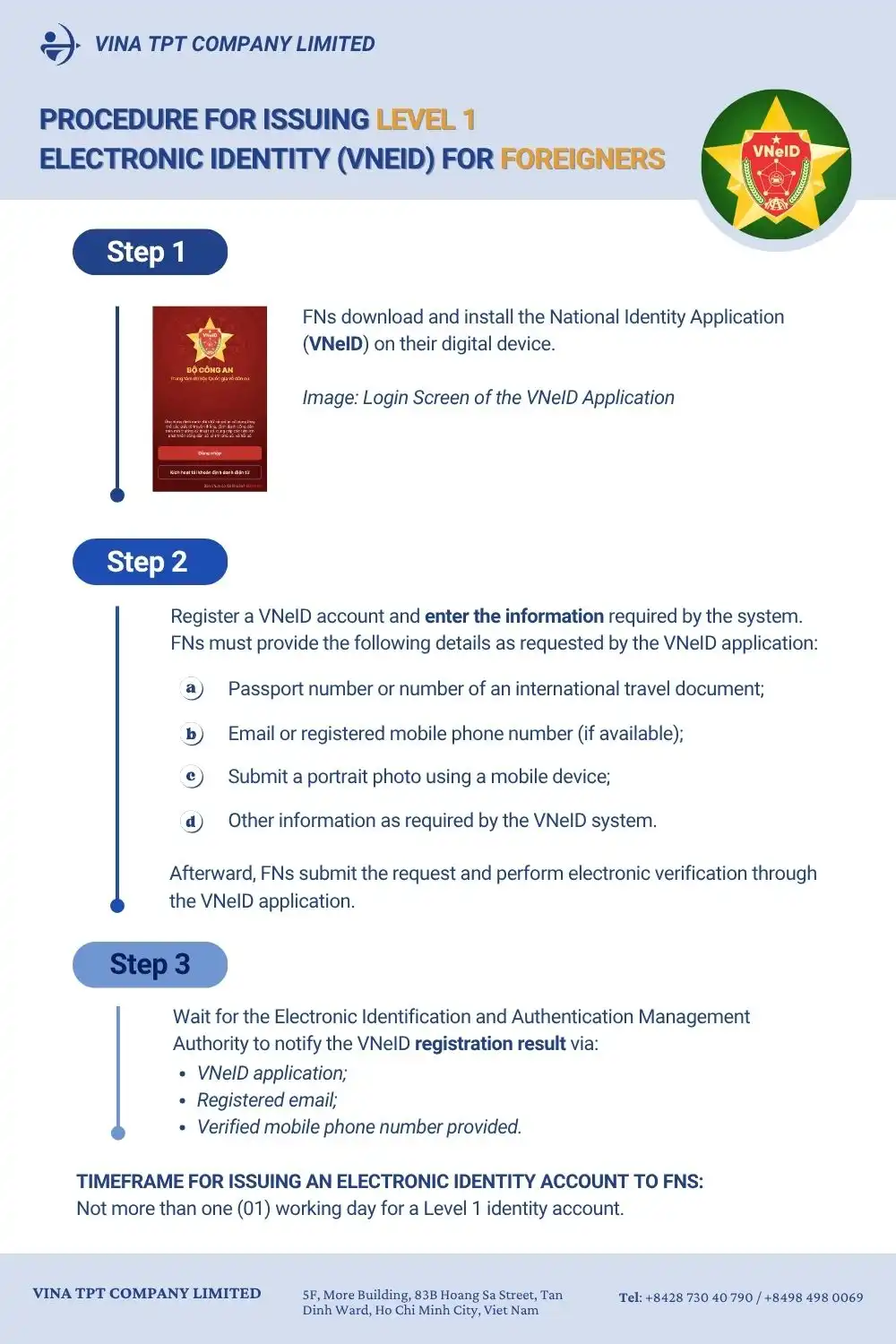
3.1 Procedure for Issuing Level 1 VNeID for Foreigners in Vietnam

VNeID Level 1

Step 1

Foreigners in Vietnam need to download and install the VNeID application on a digital device

Step 2

Select “Register for VNeID account” and fill in all the required information as prompted by the system.

The VNeID registration will require the following information:

  • Passport number or valid international travel document number
  • Registered email or phone number (if available)
  • Provide a portrait photo using a mobile device
  • Other information as required by the VNeID system

Following that, foreigners submit the request and verifies electronically via the VNeID application.

Step 3

Wait for the Electronic Identification and Authentication Management Authority to notify the VNeID registration result via:

  • VNeID application
  • Registered email
  • Verified phone number provided

Timeframe for issuing an Electronic Identity account to foreigners: Not more than one (01) working day for a level 1 identity account.

Explore Our Services For Foreigner

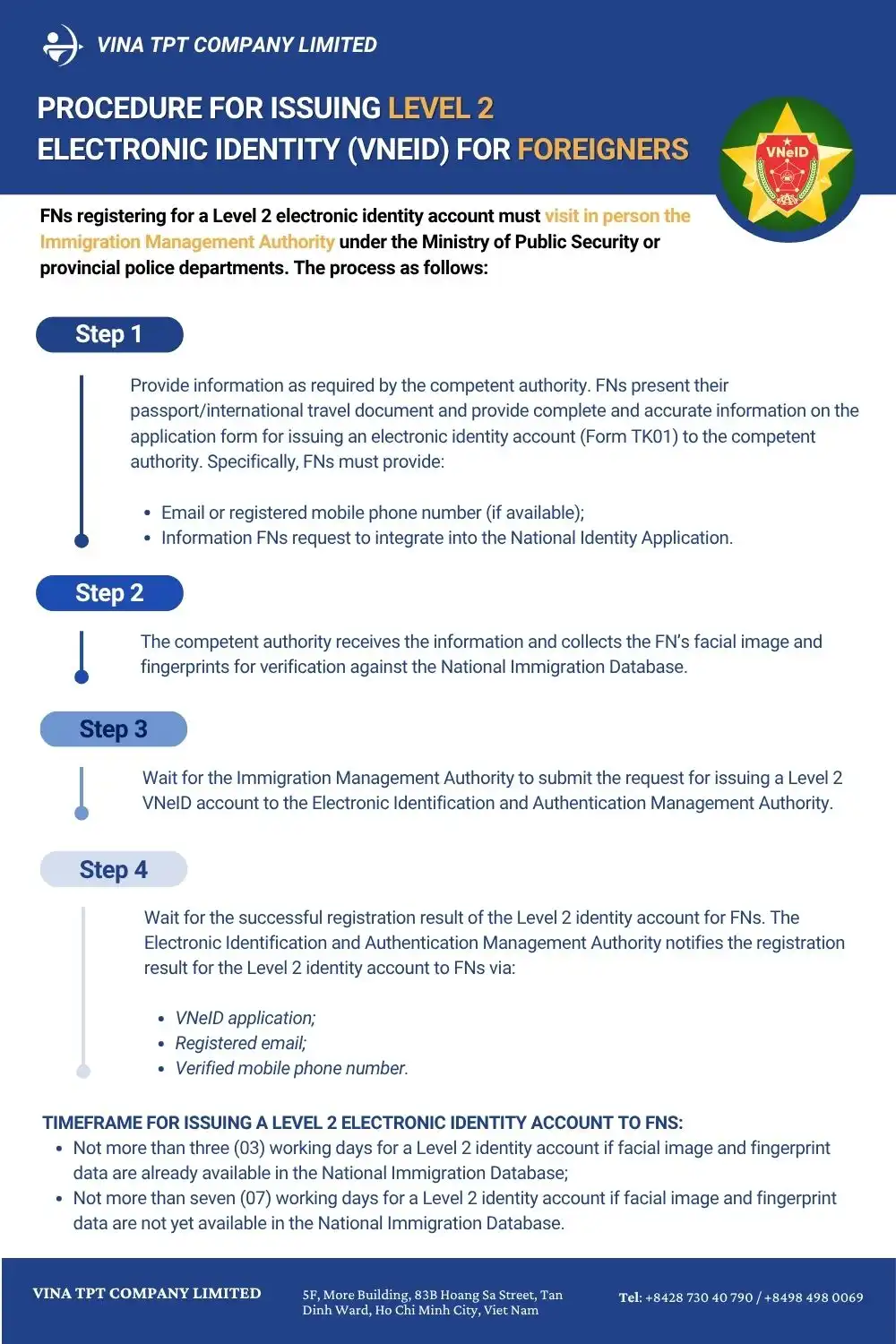
3.2 Procedure for Issuing Level 2 VNeID for Foreigners in Vietnam

VNeID Level 2

Foreigners registering for a Level 2 VNeID account must visit in person the Immigration Management Authority under the Ministry of Public Security or provincial police departments. The process as follows:

Step 1

Provide information as required by the competent authority. Foreigners need to present their passport/international travel documents and provide accurate information on the VNeID account request form (Form TK01 – below) to the competent authority. Specifically, Foreigners must provide:

  • Email/phone number registered for subscriber information (if available)
  • Information foreigners request to integrate into the national VNeID application

Step 2

The competent authority collects foreigner’s facial photo and fingerprints for verification against the national immigration database.

Step 3

Wait for the Immigration Management Authority to submit the request for issuing a Level 2 VNeID account to the Electronic Identification and Authentication Management Authority.

Step 4

Wait for the successful registration result of the Level 2 identity account for FNs. The Electronic Identification and Authentication Management Authority notifies the registration result for the Level 2 identity account to FNs via:

  • VNeID application
  • Registered email
  • Verified mobile phone number

Timeframe for issuing a Level 2 VNeID account to foreigners:

  • Not more than three (03) working days for a Level 2 identity account if facial image and fingerprint data are already available in the National Immigration Database
  • Not more than seven (07) working days for a Level 2 identity account if facial image and fingerprint data are not yet available in the National Immigration Database

4. Conclusion

In summary, obtaining a VNeID for foreigners in Vietnam is now an essential step in complying with local regulations and accessing key services. From travel and accommodation to public administration, this digital ID plays a vital role.

Vina TPT Expat HR Services offers comprehensive consulting and support services for obtaining electronic identification (VNeID) for foreigners in Vietnam. From document preparation to application submission and process monitoring, our team ensure every step is handled with accuracy and efficiency.

BOOK A FREE CONSULTATION

Payroll-HR-Manager-Vietnam-VinaTPT