
Regional Minimum Wage 2026 in Vietnam: Latest Updates and Key Changes

Regional-Minimum-Wage-2026-in-Vietnam_-Latest-Updates-and-Key-Changes-Vina-TPT

Regional-Minimum-Wage-2026-in-Vietnam_-Latest-Updates-and-Key-Changes-Vina-TPT

1. Entities Subject to the 2026 Regional Minimum Wage Adjustment

According to Article 2 of Decree No. 293/2025/ND-CP, the scope of entities subject to the application of the regional minimum wage has been clearly defined and expanded to include the following groups: 

  • Employees working under labor contracts in accordance with the current Labor Code of Vietnam. 
  • Employers as stipulated under the Labor Code, including: 
  • Enterprises established and operating in compliance with the Law on Enterprises; 
  • Agencies, organizations, cooperatives, households, and individuals that employ workers under lawful labor agreements. 
  • Other relevant agencies, organizations, and individuals involved in the implementation and application of the regional minimum wage in accordance with Decree No. 293/2025/ND-CP. 

2. Application of the New Regional Minimum Wage from January 1, 2026

On November 10, 2025, the Government issued Decree No. 293/2025/ND-CP regulating the regional minimum wage applicable to employees working under labor contracts. This adjustment represents a significant policy update aimed at safeguarding employees’ livelihoods while remaining aligned with Vietnam’s economic growth and productivity trends. 

Regional Minimum Wage Rates on a Monthly Basis 

According to Decree No. 293/2025/ND-CP, the monthly regional minimum wage levels have been revised upward by region as follows: 


 Minimum Wage Rates by Month 

(Unit: VND/month) 

Region 

2025    2026 

Region I 

4.960.000  5.310.000 

Region II 

4.410.000 

4.730.000 

Region III  3.860.000 

4.140.000 

Region IV  3.450.000 

3.700.000 

The regional minimum wage has been adjusted upward by approximately 7.2% compared to 2025, contributing to higher income levels and stronger social security for employees, particularly in the manufacturing and service sectors. 

Regional Minimum Wage Table by Hour 


Minimum Wage Rate by Hour 

(Unit: VND/hour) 

Region 

2025  2026  

Region I 

23.800  25.500 

Region II 

21.200 

22.700 

Region III  18.600 

20.000 

Region IV  16.600 

17.800 

The adjustment of the hourly minimum wage enhances flexibility for seasonal and part-time employment arrangements, while ensuring the protection of workers’ rights in an increasingly diverse labor market.

3. Regulations on the Application of the Minimum Wage

According to the Decree, the monthly minimum wage represents the lowest level used as the basis for wage agreements between employers and employees. Specifically: 

  • Employees who work full standard working hours and fulfill their assigned duties must be paid no less than the applicable regional minimum wage. 
  • For employees paid on an hourly basis, the hourly wage must not be lower than the minimum hourly wage applicable to the corresponding region. 
  • In cases where wages are paid by day, week, output, or lump-sum basis, the converted monthly or hourly wage must ensure compliance with at least the regional minimum wage level. 

Wage Conversion Methods: 

  • Monthly wage = (Weekly wage × 52) / 12, or Daily wage × Number of normal working days in the month 
  • Hourly wage = Weekly wage (or daily wage) / Number of normal working hours in the week (or day)

Regional-Minimum-Wage-2026-in-Vietnam_-Latest-Updates-and-Key-Changes-Vina-TPT

4. Employer Responsibilities When Applying the Minimum Wage

According to Clause 4, Article 5 of Decree No. 293/2025/NĐ-CP on effectiveness and implementation responsibilities, employers are required to fulfill the following obligations when applying the minimum wage to employees: 

  • Employers must review and adjust the provisions in labor contracts, collective labor agreements, and internal regulations to ensure compliance with the new regulations. At the same time, they are not permitted to abolish or reduce employees’ lawful wage and benefit entitlements, including overtime pay, night-shift pay, in-kind allowances, and other benefits prescribed under labor laws. 
  • For agreements that are more favorable to employees and were previously established (for example, wage levels higher than the minimum wage for trained workers or those working in hazardous, arduous, or dangerous conditions), enterprises are required to continue implementing such agreements, unless otherwise mutually agreed by the parties involved.

5. Why Vina TPT Is the Trusted Partner for HR Outsourcing in Vietnam?

Vina TPT is a trusted partner for many FDI enterprises and SMEs, delivering professional HR outsourcing and payroll services supported by a team of experts with over 15 years of experience. Vina TPT helps businesses effectively manage human resources, ensure accurate payroll processing, and maintain full compliance with Vietnam’s labor and employment regulations. 

Vina TPT’s HR & Payroll services stand out through: 

  • Experienced legal and HR specialists with up-to-date regulatory knowledge: Our experts stay continuously updated on the latest regulations regarding labor law, wages, social insurance, personal income tax, and international standards, helping businesses minimize compliance risks. 
  • Accurate and transparent payroll processing: We manage payroll calculations, tax withholdings, social insurance contributions, and employee benefits with precision, confidentiality, and on-time execution. 
  • Bilingual Vietnamese – English – Japanese reporting: Designed to meet the governance and reporting requirements of FDI enterprises, supporting communication with parent companies and regulatory authorities in Vietnam. 
  • Integrated end-to-end solutions: By synchronizing HR, payroll, and financial data, Vina TPT reduces errors, saves time, and optimizes operating costs for businesses. 

With Vina TPT’s HR outsourcing and payroll solutions, enterprises can focus on their core business activities while all HR and payroll processes are handled professionally, accurately, and transparently. This is a key factor in ensuring legal compliance and building a strong, professional image with employees and international investors. 

Reach out to Vina TPT for professional HR outsourcing and payroll solutions that help your business optimize human resource management, payroll administration, and overall operational efficiency.

BOOK A FREE CONSULTATION

start a business in vietnam with vina tpt

How to Start a Business in Vietnam: 2026 Guide for Investors 

start a business in vietnam with vina tpt

start a business in vietnam with vina tpt

How to Start a Business in Vietnam as a Foreigner: A Comprehensive 2026 Guide 

Choosing to start a business in Vietnam has become a strategic move for international investors, thanks to the country’s consistent economic growth and increasingly transparent regulatory environment. This guide provides a precise roadmap to help you optimize the setup process and ensure full legal compliance from day one.

1. Strategic Reasons to Start a Business in Vietnam in 2026

2026 marks a pivotal year as Vietnam solidifies its position as Asia’s “new tiger.” For entrepreneurs, deciding to start a business in Vietnam is not just about tapping into a market of 100 million people, it is about leveraging several macro advantages:

  • Robust Economic Growth & Sustainable FDI: Foreign Direct Investment (FDI) continues to flow into high-tech sectors, green manufacturing, and specialized services.
  • 100% Foreign Ownership: In most manufacturing and trading sectors, investors can own 100% of the equity (with a few exceptions in restricted sectors).
  • ASEAN Competitive Edge: Compared to regional peers, Vietnam offers optimized operating costs, a young and technically skilled workforce, and an extensive network of Free Trade Agreements (FTAs).

2. Selecting the Ideal Structure to Start a Business in Vietnam

Selecting the correct legal entity is a critical step when learning how to start a business in Vietnam. Below are the primary options for foreign investors:

Structure  Best For  Key Characteristic 
Limited Liability Company (LLC)  Startups and SMEs  Simple governance; clear separation of personal and corporate assets. 
Joint-Stock Company (JSC)  Large-scale projects  Suitable for raising capital or future IPOs; requires at least 3 shareholders. 
Branch Office  Specific projects  Allows foreign companies to conduct commercial activities without a full subsidiary. 
Representative Office  Market research  Ideal for brand presence and networking; cannot engage in direct profit-generating activities. 
Joint Venture  Restricted sectors  Collaboration with a local partner to navigate specific regulatory requirements. 

3. The 5-Step Process to Establish a Company in Vietnam (2026 Update)

To successfully start a business in Vietnam, investors must follow this standardized five-step procedure:

Step 1: Define Business Lines & Check Conditions

Verify if your industry falls under “conditional business lines” which may require minimum legal capital, specific professional certificates, or sub-licenses.

Step 2: Obtain the Investment Registration Certificate (IRC)

The IRC is the official approval of your investment project by the authorities, confirming the legitimacy of your capital source and business objectives.

Step 3: Obtain the Enterprise Registration Certificate (ERC)

Once the IRC is issued, you apply for the ERC. This grants your company a tax identification number and official legal status.

Step 4: Post-Incorporation Requirements

After receiving the ERC, you must complete these administrative tasks to become fully operational:

  • Open a Direct Investment Capital Account (DICA): This is mandatory for FDI companies. All capital injections, profit repatriations, and foreign loan repayments must flow through this specific account.
  • Company Seal Carving: Under current Enterprise Law, companies have the autonomy to decide the form and content of their seal. However, consistency is vital for banking and tax transactions.
  • Digital Signature (Token/Smart-OTP): Required for electronic tax filing, Social Insurance (SHUI) declarations, and using the National Single Window portal.
  • Tax Activation & E-Invoicing: You must register your initial tax status and purchase E-invoicing software to issue legal invoices to customers.

Step 5: E-ID Onboarding & Digital Compliance (New for 2026)

The 2026 regulatory framework requires the integration of Electronic Identification (e-ID) for the Legal Representative to manage online filings and administrative procedures seamlessly.

start a business in vietnam with vina tpt

4. Key Post-Setup Compliance Regulations

Once you start a business in Vietnam, you must adhere to strict legal obligations to avoid penalties or suspension:

  • Capital Contribution: The total charter capital must be fully paid into the DICA within 90 days from the ERC issuance date.
  • Mandatory Annual Audit: Unlike local companies, 100% of FDI enterprises in Vietnam must have their annual financial statements audited by an independent auditing firm.
  • Investment Reporting: You are required to submit periodic reports (quarterly/annually) via the National Foreign Investment Information System.
  • Labor & Insurance (SHUI): Register for Social, Health, and Unemployment Insurance (SHUI), sign labor contracts, and fulfill monthly contribution requirements.
  • Tax Compliance: Ensure timely filing for:
    (1) Value Added Tax (VAT) – Monthly or Quarterly.
    (2) Corporate Income Tax (CIT) – Provisional quarterly payments.
    (3) Personal Income Tax (PIT) – For employees, filed monthly or quarterly.
    (4) Foreign Contractor Tax (FCT) – If engaging in transactions with overseas entities.

5. Vina TPT: Your Strategic Partner for the Vietnamese Market

Navigating administrative procedures can be challenging due to language barriers and evolving regulations. Vina TPT is a professional consultancy dedicated to helping you start a business in Vietnam smoothly:

  • End-to-End Solutions: From choosing the right structure and drafting IRC/ERC dossiers to full operational setup.
  • Expert Financial Management: We handle your accounting, tax finalization, and mandatory audit coordination.
  • Multilingual Support (EN/JP/VN): We bridge the communication gap between your global headquarters and local authorities.
  • Proactive Advisory: Vina TPT provides early warnings on policy changes, helping you avoid licensing delays or industry misclassifications.

Vina TPT provides the peace of mind you need to focus entirely on growing your business in Vietnam.

Planning to launch or expand your business in Vietnam?

Contact the Vina TPT expert team today for a detailed roadmap and a comprehensive quote for our all-in-one company incorporation services.

Get a Free Consultation

start a business in vietnam with vina tpt

Outsourcing Accounting Services for Small Business in Vietnam

vina tpt outsourcing accounting services for small business

vina tpt outsourcing accounting services for small business

A Step-by-Step Guide to Outsourcing Accounting Services for Small Business in Vietnam

Entering the vibrant Vietnamese market offers immense opportunities for global expansion, driven by a stable economy and a pro-business regulatory environment. However, this potential is accompanied by a sophisticated web of legal frameworks, evolving tax circulars, and strict administrative requirements that can be daunting for newcomers.

For Foreign Direct Investment (FDI) Small and Medium Enterprises (SMEs), outsourcing accounting services for small businesses is no longer just a simple cost-cutting measure or a tactical convenience. In the rapidly changing landscape of 2026, it has evolved into a high-level strategic move designed to mitigate regional risks, ensure absolute compliance with local authorities, and build a foundation for sustainable, long-term operations in Vietnam. By leveraging expert external support, business owners can navigate the complexities of local standards while keeping their internal resources focused entirely on core growth and market penetration.

1. Why Outsourcing Accounting Services for Small Business is Essential for FDI Entities

New FDI businesses in Vietnam often navigate a “maze” of operational hurdles:

  • E-invoicing Pressure & Strict Deadlines: The mandatory adoption of e-invoices and rigid monthly/quarterly tax filing deadlines can lead to heavy administrative fines without a dedicated professional team.
  • The VAS vs. IFRS Gap: Discrepancies between Vietnamese Accounting Standards (VAS) and International Financial Reporting Standards (IFRS) make consolidating reports for headquarters difficult, often delaying audits and profit repatriations.
  • Language Barriers & Talent Turnover: Finding accountants fluent in English or Japanese is difficult. High turnover rates and hidden labor costs (insurance, benefits, training) can destabilize a company’s management system.

2. Strategic Benefits of Outsourcing Accounting Services for Small Business

Instead of maintaining a bulky internal department, utilizing professional accounting services allows SMEs to focus entirely on their core business growth.

Comprehensive Legal Compliance through Bookkeeping Services

Professional firms provide end-to-end solutions, from bookkeeping services to tax filing, keeping your business “safe” from tax authorities:

  • Tax Filings: Handling Value Added Tax (VAT), Corporate Income Tax (CIT), Personal Income Tax (PIT), and Foreign Contractor Tax (FCT).
  • Mandatory FDI Reports: Preparing periodic investment project implementation reports as required by the Ministry of Planning and Investment (MPI).

Cost and Management Optimization

  • Global Standard Reporting: Providing English-language reports and mapping VAS data to IFRS formats for seamless parent company oversight.
  • Budget Efficiency: Outsourcing costs are significantly lower than hiring full-time internal staff, eliminating expenses for office space, infrastructure, and specialized accounting software.

3. Our Workflow for Outsourcing Accounting Services for Small Business at Vina TPT

vina tpt outsourcing accounting services for small business

At Vina TPT, we utilize a transparent, professional workflow specifically designed to meet the rigorous standards of international investors:

  • Consultancy & Collection: We advise on the required documentation based on your specific industry and collect original vouchers monthly.
  • Data Processing: All transactions are entered into specialized accounting software, ensuring data systematicity and easy retrieval.
  • Integrity Review: We perform a meticulous analysis of all accounts to ensure data is complete, accurate, and valid under Vietnamese law.
  • VAS Reporting: Monthly and annual financial statements are prepared according to VAS standards, with optional IFRS conversion for auditing purposes.
  • Managerial Insights: We provide ad-hoc managerial reports tailored to the Board of Directors’ needs, offering a clear view of the company’s financial health.
  • Professional Advice: Acting as your dedicated accounting and tax consultant, we provide real-time updates on new tax policies to help you adapt and optimize tax obligations.

4. Why Vina TPT is the Ideal Partner for SMEs in Vietnam?

We understand the anxieties of business owners in a new market. Vina TPT offers exclusive advantages:

  • “Pay-as-you-grow” Model: Flexible service fees based on actual document volume, starting from just $120 USD/month. This is the perfect solution for SMEs to preserve working capital during the early stages.
  • No Language Barrier: Our experts communicate directly in English or Japanese, ensuring transparency without the need for third-party interpreters.
  • From Compliance to Strategy: We go beyond filing taxes; we provide deep Financial Insights to help you make data-driven business decisions.
  • Confidentiality & Transparency: We guarantee absolute security for all cash flow and accounting data, building a foundation of trust for your operations in Vietnam.

Ready to Optimize Your Accounting Operations in Vietnam with Vina TPT?

Don’t let complex administrative hurdles, shifting tax regulations, or language barriers slow your business progress and market entry. Navigating the Vietnamese regulatory landscape requires precision, and even a small oversight in compliance can lead to costly delays.

Contact our expert team at Vina TPT today for a comprehensive 1-on-1 intensive consultation. We will provide you with a tailored roadmap for outsourcing accounting services for small business, ensuring your financial system is robust, transparent, and fully compliant from day one. Let us handle the complexities of the local system so you can focus entirely on scaling your business and achieving your strategic goals in Vietnam.

Get Your Free 30-Minute Consultation

Strategic Benefits of Outsourcing Accounting Services for Small Business

Key Changes to Vietnam Personal Allowances in 2026: Family Deduction Explained

Vietnam Personal Allowances 2026_ Family Deductions Explained-Vina TPT

Vietnam Personal Allowances 2026_ Family Deductions Explained-Vina TPT

1. Overview of Personal Income Tax Thresholds in Vietnam from 2026

The official policy to increase personal allowances to VND 15.5 million per month from 2026 represents a significant adjustment to Vietnam’s personal income tax system, aiming to ease the tax burden and better reflect current living costs. Under this policy, the personal allowance for taxpayers rises from VND 11 million to VND 15.5 million per month, while the allowance for each dependent increases to VND 6.2 million per month.

This change raises the taxable income threshold, providing meaningful support to middle-income earners, especially those with children or other dependents. Effective from the 2026 tax year, the new regulation not only helps reduce financial pressure on salaried individuals but also enables taxpayers to plan their personal finances more proactively in line with economic conditions and cost of living changes.

2. Family Deduction Levels Applicable from 2026

According to the Resolution, starting from the 2026 tax assessment period, personal income applied in personal allowance applied in personal income tax (PIT) calculation will be significantly increased. Specifically:

  • Personal allowance for the taxpayer will be raised to VND 15.5 million per month (equivalent to VND 186 million per year).

  • The dependent allowance will be set at VND 6.2 million per month for each eligible dependent.

Example 1: Individual With No Dependents

  • Monthly income: VND 18,000,000

  • Personal allowance: VND 15,500,000

After applying the personal allowance, only VND 2,500,000 remains subject to personal income tax. If mandatory insurance contributions are further deducted, this individual may not incur any PIT liability.

Example 2: Individual With One Eligible Dependent

  • Monthly income: VND 25,000,000

  • Personal allowance: VND 15,500,000

  • Dependent allowance (1 dependent): VND 6,200,000

Taxable income calculation: 25,000,000 − 15,500,000 − 6,200,000 = VND 3,300,000

This taxable income falls within the lowest PIT bracket under Vietnam’s progressive tax rate system. 

3. Who Qualifies as a Dependent for Family Deduction Purposes?

Pursuant to Point d, Clause 1, Article 9 of Circular No. 111/2013/TT-BTC, dependents eligible for family deductions when calculating personal income tax (PIT) include the following categories:

3.1. Children of the Taxpayer

  • Children under 18 years of age (calculated on a monthly basis).

  • Children aged 18 or older who are disabled and unable to work.

  • Children who are studying in Vietnam or overseas at universities, colleges, professional secondary schools, or vocational institutions, including children aged 18 or older who are still attending high school (including the period from June to September of Grade 12 while awaiting university entrance exam results), with no income or with an average monthly income not exceeding VND 1 million.

3.2. Spouse of the Taxpayer

  • Of working age: must be disabled, unable to work, and have no income or an average monthly income not exceeding VND 1 million.

  • Beyond working age: must have no income or an average monthly income not exceeding VND 1 million.

Specifically, according to Clause 1, Article 4 of Decree No. 135/2020/NĐ-CP, the statutory retirement age in 2025 is:

  • Male employees: 61 years and 3 months

  • Female employees: 56 years and 8 months

3.3. Parents and Parents-in-law

This category includes biological parents, parents-in-law, step-parents, and legally adopted parents:

  • Of working age: must be disabled, unable to work, and have no income or an average monthly income not exceeding VND 1 million.

  • Beyond working age: must have no income or an average monthly income not exceeding VND 1 million.

3.4. Other Individuals Directly Supported by the Taxpayer

  • Biological brothers and sisters.

  • Paternal and maternal grandparents.

  • Aunts, uncles (paternal or maternal).

  • Nieces and nephews (children of biological siblings).

  • Other individuals without means of support, as prescribed by law.

Note: Individuals under this category are only considered eligible dependents if they have no means of support, are directly supported by the taxpayer, and meet the statutory conditions regarding income level and working capacity in accordance with Point đ, Clause 1, Article 9 of Circular No. 111/2013/TT-BTC.

Vietnam Personal Allowances 2026_ Family Deductions Explained-Vina TPT

4. How to Determine Family Deduction When Calculating PIT from 2026

4.1. Step 1: Determine Total Taxable Income for the Period

Total income includes all salary, wages, and salary-like allowances arising during the relevant tax assessment period.

4.2. Step 2: Apply Deductions For The Taxpayer And Eligible Dependents

The personal allowance is deducted directly at VND 15.5 million per month. For each eligible and duly registered dependent, an additional VND 6.2 million per month may be deducted.

Total family deduction = Personal allowance + Dependent allowances.

Accordingly, from 2026, individuals without dependents will only incur personal income tax (PIT) when their income exceeds VND 15.5 million per month, while individuals with one eligible dependent will begin to pay PIT when their income exceeds VND 21.7 million per month. These guidelines enable employees to more easily estimate their taxable income and PIT liabilities, thereby proactively planning their personal finances once the new policy takes effect.

4.3. Illustrative Example

Mr. C is a salaried employee who has registered two eligible dependents.

Monthly income: VND 30,000,000

Personal allowance: VND 15,500,000 per month

Dependent allowances: VND 6,200,000 × 2 = VND 12,400,000 per month

Taxable income: 30,000,000 − 15,500,000 − 12,400,000 = VND 2,100,000 per month

Under the progressive PIT tariff, taxable income of VND 2.1 million per month falls within Bracket 1, subject to a 5% tax rate.

PIT payable: 2,100,000 × 5% = VND 105,000 per month

This example demonstrates that, under the new family deduction thresholds effective from 2026, taxpayers with multiple dependents benefit significantly, as their PIT liabilities are substantially reduced and their net take-home income is improved.

5How Vina TPT Supports Foreigners with Personal Income Tax Finalization in Vietnam 

Vina TPT offers comprehensive Personal Income Tax (PIT) support for foreign employees in Vietnam, ensuring full compliance with local regulations while simplifying the process for businesses:

  • Record Review: Carefully review labor contracts, payroll records, tax deduction documents, foreign-sourced income records, and related invoices to ensure all data is accurate and complete.
  • Tax Calculation: Calculate taxable income, apply family and dependent deductions, and ensure proper application of Double Taxation Agreements (DTA) to avoid double taxation.
  • Declaration Preparation & Submission: Prepare PIT finalization dossiers and submit them via the e-tax system or on behalf of the business, providing bilingual Vietnamese-English reports for easy monitoring.
  • Tax Refund Support: Assist with preparing and monitoring tax refund dossiers, liaising with tax authorities to secure timely and transparent refunds.
  • Ongoing Consultation: Represent the business in the event of tax audits, additional document requests, or inquiries, helping to manage administrative requirements efficiently.

Contact Vina TPT today for comprehensive consultation and end-to-end support on personal income tax matters in Vietnam.

BOOK A FREE CONSULTATION

setting up company in Vietnam

FDI Company Setup in Vietnam: Business License & Complete 2026 Guide

setting up company in Vietnam

setting up company in Vietnam

Why Setting up Company in Vietnam is the Strategic Choice for 2026?

The year 2026 marks a pivotal turning point for foreign investors in Vietnam. With significant reforms in the Law on Investment and a roadmap to reduce conditional business lines, the process for setting up a company in Vietnam is becoming more transparent and streamlined than ever.

However, to operate legally in specialized sectors such as retail, distribution, or logistics, investors must follow a structured path from obtaining an IRC and ERC to securing a specific business license.

1. Why Foreign Investors Need a Clear Roadmap in 2026

Starting a business in Vietnam as a foreigner offers immense potential, but understanding the 2026 regulatory landscape is crucial to avoiding delays or rejected applications.

a. FDI Opportunities in 2026

Vietnam maintains its position as Southeast Asia’s “global factory” based on four key pillars:

  • Extensive FTA Network: Leverage tariff incentives from the CPTPP, EVFTA, and RCEP.
  • New Incentive Policies: Strong focus on high-tech projects, circular economy, and renewable energy.
  • Flexible Ownership Structures: 100% foreign ownership is permitted in most sectors, including manufacturing, IT, consulting, and trading.
  • Digitalized Procedures: Significant reduction in waiting times through the National Business Registration Portal.

b. When is a Business License (Trading License) Mandatory?

While many sectors are open, a Business License (Trading License or Retail Distribution License) is still mandatory for foreign investors in “conditional” sectors under WTO commitments and Vietnamese Law.

Even with eased regulations, a separate Business License is required after company formation for:

  • Retail Sales: Directly providing goods to end consumers.
  • Distribution & Import: Applied to restricted or specialized commodity groups.
  • Specialized Services: Logistics, education, healthcare, and F&B.
  • Important Note: By July 1, 2026, sectors like accounting and insurance brokerage will see further liberalization. However, for Retail & Distribution, investors must still seek approval from the Ministry/Department of Industry and Trade.

c. Distinguishing IRC vs. ERC vs. Business License

Understanding these three acronyms is vital for any foreigner setting up a company in Vietnam:

Permit Type Issuing Authority Primary Role
IRC (Investment Registration Certificate) Department of Planning and Investment (DPI) Approves the investment project (capital, objectives, location).
ERC (Enterprise Registration Certificate) Business Registration Office Creates the legal entity and issues the Tax ID.
Business License Relevant Ministry or Department Grants permission to operate in conditional sectors (Retail, etc.).

The Standard Sequence: IRC (Project Approval) → ERC (Company Formation) → Business License (For specific sectors).

2. 5-Step Process for Setting Up Company in Vietnam in 2026

The average timeline for completion ranges from 1 to 2 months, depending on the complexity of your business lines.

Step 1: Choose a Legal Structure & Check Ownership Limits

The most common choice is a Limited Liability Company (LLC) due to its flexibility and limited liability protection. Foreigners must verify if their specific sector requires a Joint Venture (JV) with a Vietnamese partner.

Step 2: Obtain the Investment Registration Certificate (IRC)

Investors submit the application to the DPI. Key documents include:

  • Detailed Investment Project Proposal.
  • Proof of Financial Capacity (Bank statements or audited reports).
  • Office Lease Agreement or Memorandum of Understanding (MOU).
  • Timeline: 15 – 35 working days.

Step 3: Obtain the Enterprise Registration Certificate (ERC)

Once the IRC is issued, the ERC application is typically processed within 3 – 7 working days. This step officially grants your business its legal status.

Step 4: Post-Registration Procedures (Operational Compliance)

Obtaining the ERC is only the beginning. Within 90 days, investors must fulfill these mandatory obligations:

  • Open a Direct Investment Capital Account (DICA): This is the most critical step. All capital contributions, profit repatriations, and share transfers must flow through this account.
  • Capital Contribution: Ensure the total committed capital is transferred into the DICA within 90 days of ERC issuance.
  • Online Investment Reporting: Businesses must report project progress quarterly and annually on the National Investment Information System. Missing these deadlines can lead to heavy administrative fines.
  • Initial Tax & Accounting Setup: Register digital signatures, set up e-invoice templates, and pay Business License Tax (License Fees). Appointing a Chief Accountant or an outsourced accounting representative is a legal requirement for signing financial statements.

Step 5: Specialized Business License (If applicable)

For retail and distribution entities, authorities will assess the application based on local planning and socio-economic impact. Note the Economic Needs Test (ENT) requirement if you plan to open a second retail outlet or more.

setting up company in Vietnam

Get a free 30-minutes consultation

3. Required Documents & Checklist

All foreign documents must be Consularly Legalized, translated into Vietnamese, and notarized.

  • Individual Investors: Notarized passport + Bank balance confirmation.
  • Corporate Investors: Parent company’s Certificate of Incorporation + Audited financial statements (last 2 years) + Resolution appointing the authorized representative.
  • Project Documents: Detailed Business Plan and proof of right to use the business location.

4. Vina TPT: Your Trusted Partner for FDI Success in Vietnam

Establishing a legal entity is just the start. To thrive in the Vietnamese market, businesses need a solid foundation in Accounting, Tax, and HR from day one.

Vina TPT is proud to be a strategic partner, helping foreign investors remove language barriers and navigate local legal complexities:

  • Expert Consulting: From initial setup to tax structure optimization. We keep you updated on the latest regulations, including Global Minimum Tax and 2026 tax incentives.
  • Payroll & HR Management: We handle labor contracts, Social Health & Unemployment Insurance (SHUI), and Personal Income Tax (PIT) finalization for both expats and locals, ensuring absolute confidentiality.
  • Lifecycle Partnership: With over 20 years of experience, Vina TPT provides an “All-in-one” ecosystem. You focus on growth; we handle the administration.
  • No Language Barrier: Our trilingual team (English – Japanese – Vietnamese) ensures transparent communication and seamless management reporting.

Optimize your resources and minimize legal risks with Vina TPT. Contact us today for a 1-on-1 specialized consultation for your 2026 project.

Start your journey in vietnam

setting up company in Vietnam

Updated List of Foreign Contractors Registered for Tax in Vietnam 2024-2025

List of foreign contractors registered for tax in Vietnam including Google, Meta and Microsoft

Official list of foreign contractors registered for tax in Vietnam under Circular 80

1. Comprehensive List of Foreign Contractors Registered for Tax in Vietnam

In recent years, the General Department of Taxation (GDT) of Vietnam has revolutionized the tax landscape for digital services. By launching a dedicated e-tax portal Vietnam (etaxvn.gdt.gov.vn), the GDT now allows foreign information providers and non-resident contractors to register, declare, and pay taxes directly. This shift significantly impacts how local businesses manage their Foreign Contractor Tax (FCT) obligations, moving the compliance burden from the local buyer to the international seller. Understanding the current list of foreign contractors registered for tax in Vietnam is the first step for any business to ensure they are applying the correct tax treatment for cross-border transactions.

2. Why You Need to Track This List

For Vietnamese accountants and business owners, regularly monitoring the list of foreign contractors registered for tax in Vietnam is crucial for navigating FCT compliance because:

  • Direct Tax Compliance: It determines whether the Vietnamese buyer must withhold tax or if the foreign information providers on the list of foreign contractors registered for tax in Vietnam handle it directly via the e-tax portal Vietnam.

  • Expense Validation: Ensuring the FCT tax codes (MST) provided on digital receipts matches the official list of foreign contractors registered for tax in Vietnam is vital for valid Corporate Income Tax (CIT) deductions.

  • Avoiding Double Taxation: By referring to the list of foreign contractors registered for tax in Vietnam, businesses can accurately apply rules for cross-border digital services under Circular 80/2021/TT-BTC without risk of overpayment.

3. Featured List of Foreign Contractors Registered for Tax in Vietnam

Below is the directory of major entities that have successfully registered their FCT tax codes as shown in the official list of foreign contractors registered for tax in Vietnam.

NO TAX CODE TAXPAYER’S NAME TC ISSUE DATE
1 9000001017 Addons Studio LLC 07/05/2024 14:40:41
2 9000001169 Lemon Squeezy LLC 02/05/2024 08:07:32
3 9000001151 Replay 02/05/2024 08:06:36
4 9000001144 SEMRUSH INC. 23/04/2024 17:50:45
5 9000001137 PMMAX Technology Limited 23/04/2024 17:50:38
6 9000001112 Elsevier B.V. 22/04/2024 08:42:25
7 9000001105 Elsevier Inc. 22/04/2024 08:42:09
8 9000001095 Elsevier Limited 22/04/2024 08:35:37
9 9000001088 Nanyang Technological University 22/04/2024 08:34:41
10 9000001070 Clearword Ltd 13/04/2024 15:33:34
11 9000001063 With Reach UK Ltd 09/04/2024 16:15:14
12 9000001056 Association Of Chartered Certified Accountants 25/03/2024 11:27:18
13 9000001049 Predibase 21/02/2024 08:45:09
14 9000001031 Posit Software PBC 16/02/2024 08:57:58
15 9000001024 CYBERGHOST S.R.L. 16/02/2024 08:53:01
16 9000000990 upvpn LLC 29/01/2024 18:07:05
17 9000000983 Ahrefs Pte. Ltd. 29/01/2024 18:06:29
18 9000000976 Brainfish Pty Ltd 17/01/2024 11:11:45
19 9000000969 Codecademy LLC 09/01/2024 19:35:40
20 9000000951 YX ECOMMERCE SUPPLY (HONG KONG) LIMITED 09/01/2024 19:32:28
21 9000000944 Surfshark B.V. 09/01/2024 19:23:55
22 9000000937 PIA Private Internet Access, Inc 15/12/2023 14:01:32
23 9000000912 Express Technologies Limited 08/12/2023 11:20:12
24 9000000905 FREEPIK COMPANY, S.L 26/10/2023 09:12:02
25 9000000895 Aptoide S.A. 26/10/2023 09:11:51
26 9000000888 Nintendo Co., Ltd. 24/10/2023 11:37:26
27 9000000870 Olea Global Pte. Ltd. 23/10/2023 14:47:48
28 9000000863 Metis.AI UG (haftungsbeschränkt) 07/10/2023 17:28:06
29 9000000856 VERICANT INTERNATIONAL HOLDINGS LIMITED 29/09/2023 16:31:27
30 9000000849 TRIP.COM TRAVEL SINGAPORE PTE. LTD. 17/09/2023 20:11:41
31 9000000831 Upwork Global Inc. 14/09/2023 11:06:50
32 9000000824 VELOTRADE MANAGEMENT LIMITED 13/09/2023 13:02:42
33 9000000817 Match Group, LLC. 05/09/2023 09:59:04
34 9000000782 Localization Academy Inc. 05/09/2023 09:58:13
35 9000000775 INDEFINITE 03/08/2023 08:40:28
36 9000000768 AMAZON ASIA-PACIFIC HOLDINGS PRIVATE LIMITED 03/08/2023 08:36:31
37 9000000750 HONG KONG EXPRESS AIRWAYS LIMITED 01/08/2023 17:05:16
38 9000000736 Blinks Labs GmbH 27/07/2023 10:54:38
39 9000000743 Epic Games Commerce GmbH 21/07/2023 14:46:26
40 9000000729 Sandbox Interactive GmbH 22/06/2023 16:11:48
41 9000000711 Epic Games Entertainment International GmbH 22/06/2023 16:11:16
42 9000000704 Foxit Software Incorporated 17/06/2023 12:28:16
43 9000000694 Ganjingworld Corporation 09/05/2023 09:16:02
44 9000000687 nordvpn S.A. 27/04/2023 10:14:53
45 9000000662 GARMIN (EUROPE) LIMITED 25/04/2023 10:27:45
46 9000000655 BYTEDANCE PTE. LTD. 21/04/2023 14:17:01
47 9000000648 POLIGON PTE. LTD. 21/04/2023 14:16:54
48 9000000630 MySchool Ltd 13/03/2023 15:23:57
49 9000000623 Udemy, Inc. 03/03/2023 10:02:33
50 9000000616 TENCENT MUSIC ENTERTAINMENT HONG KONG LIMITED 27/02/2023 08:58:33
51 9000000599 Bitrix, Inc. 06/02/2023 11:17:13
52 9000000581 Galactic Entertainment NFTs Limited 19/01/2023 14:53:33
53 9000000574 University of London 19/01/2023 11:03:26
54 9000000567 ZOOM VIDEO COMMUNICATIONS INC 10/01/2023 17:00:46
55 9000000542 TRADINGVIEW, INC. 25/11/2022 10:01:25
56 9000000535 Trinity College London Press Limited 23/11/2022 10:08:41
57 9000000528 NBA Digital Services International, Inc. 23/11/2022 10:02:24
58 9000000510 The Chancellor, Masters, and Scholars of the University of Cambridge 14/11/2022 10:21:00
59 9000000503 Shen Yun Zuo Pin, Inc. 09/11/2022 16:05:09
60 9000000422 Fenix International Limited 18/10/2022 10:59:50
61 9000000493 DialogEdu, LLC 10/10/2022 17:22:23
62 9000000486 Apple Distribution International Limited 29/09/2022 08:22:44
63 9000000479 Verifone Payments B.V. 21/09/2022 08:21:52
64 9000000461 ETSY IRELAND 13/09/2022 16:41:16
65 9000000454 Bloomberg Finance Singapore L.P. 13/09/2022 16:38:35
66 9000000447 PADDLE.COM MARKET LIMITED 05/09/2022 11:18:10
67 9000000415 Google Asia Pacific Pte Ltd 15/08/2022 14:54:14
68 9000000408 TOKGISTIC PTE. LTD. 11/08/2022 16:54:48
69 9000000398 University of Auckland 29/07/2022 17:24:35
70 9000000380 MORRIS SHIPPING INTERNATIONAL LIMITED 20/07/2022 08:46:30
71 9000000373 Bloomberg L.P. 11/07/2022 11:32:09
72 9000000366 eBay Marketplaces GmbH 28/06/2022 20:52:39
73 9000000359 Canva Pty Ltd 23/06/2022 18:37:44
74 9000000341 MCAFEE IRELAND LIMITED 01/06/2022 14:30:09
75 9000000334 CGTrader UAB 30/05/2022 10:39:47
76 9000000327 META PLATFORMS IRELAND LIMITED 27/05/2022 10:23:13
77 9000000302 Hostinger PTE Ltd. 27/05/2022 10:23:08
78 9000000292 META PLATFORMS TECHNOLOGIES IRELAND LIMITED 27/05/2022 10:22:58
79 9000000285 FACEBOOK PAYMENTS INTERNATIONAL LIMITED 27/05/2022 10:22:52
80 9000000278 2C2P PTE.LTD 24/05/2022 18:27:49
81 9000000260 PIPO (HK) Limited 20/05/2022 11:41:10
82 9000000207 Cricut Inc 06/05/2022 18:07:24
83 9000000197 Spotify AB 05/05/2022 14:30:46
84 9000000172 TRAVELOKA SERVICES PTE.LTD. 30/04/2022 08:47:53
85 9000000165 Huawei Services (Hong Kong) Co., Limited 29/04/2022 16:48:55
86 9000000158 IMAGE FUTURE INVESTMENT (HK) LIMITED 28/04/2022 15:52:35
87 9000000140 KLOOK TRAVEL TECHNOLOGY LIMITED 27/04/2022 17:03:21
88 9000000133 Samsung Electronics Co., Ltd. 27/04/2022 14:30:26
89 9000000126 LinkedIn Singapore Pte. Ltd. 18/04/2022 08:41:35
90 9000000119 EZVIZ INTERNATIONAL LIMITED 18/04/2022 08:41:25
91 9000000101 Educational Testing Service 13/04/2022 16:21:51
92 9000000091 Blizzard Entertainment Inc 06/04/2022 14:41:27
93 9000000084 TIKTOK PTE. LTD. 04/04/2022 11:07:49
94 9000000077 Netflix Pte. Ltd. 31/03/2022 15:39:17
95 9000000052 iHerb, LLC 30/03/2022 10:50:20
96 9000000045 Microsoft Regional Sales Pte Ltd 24/03/2022 15:56:01

How to Search for Foreign Tax IDs (MST) Online

To verify if a specific foreign partner is registered, follow these steps:

  1. Visit the Official Portal for Foreign Suppliers

  2. Navigate to the “Taxpayer Information” or “Look up Information” section.

  3. Enter the entity name or the 10-digit Tax ID to check their current status.

4. Key Considerations for FCT Compliance

  • Direct Registration: If a provider is found on the list of foreign contractors registered for tax in Vietnam, the local buyer is generally relieved from declaring and paying FCT on their behalf.

  • Invoicing & Verification: Always verify that the digital invoice includes a 10-digit FCT tax code that matches the list of foreign contractors registered for tax in Vietnam.

  • E-tax Portal Verification: Use the e-tax portal Vietnam to look up any new foreign information providers that might have joined the list of foreign contractors registered for tax in Vietnam mid-quarter.

5. Conclusion

Staying updated with the list of foreign contractors registered for tax in Vietnam is no longer just a recommendation—it is a critical requirement for maintaining financial transparency and FCT compliance. Referring to the official list of foreign contractors registered for tax in Vietnam ensures your business adheres to Circular 80/2021/TT-BTC guidelines.

For businesses, verifying the tax status of foreign information providers through this list of foreign contractors registered for tax in Vietnam is the most effective way to mitigate risks during tax audits. By confirming that a provider has registered their FCT tax code on the list of foreign contractors registered for tax in Vietnam, you can confidently manage your international payments and ensure that all expense claims remain valid under current laws.

6. How Vina TPT Supports Your FCT Compliance

Vina TPT Accounting Service provides specialized support for businesses dealing with foreign information providers and the list of foreign contractors registered for tax in Vietnam:

  • Tax Compliance Review: Verifying partners against the latest list of foreign contractors registered for tax in Vietnam.
  • Circular 80/2021/TT-BTC Advisory: Managing filings for providers not yet on the list of foreign contractors registered for tax in Vietnam.
  • FCT Tax Code Verification: Ensuring your receipts from the list of foreign contractors registered for tax in Vietnam are 100% tax-deductible.
  • E-tax Portal Management: Assisting with documentation and reporting via the e-tax portal Vietnam.

Contact Vina TPT today for a free consultation. Let us help you navigate the list of foreign contractors registered for tax in Vietnam and stay legally secure.

CONTACT YOUR EXPERT

[Newsletter] Vietnam Tax Policy Updates November 2025 – VAT, PIT and Labor

Vietnam-Tax-Policy-Updates-November-2025-VAT-PIT-and-Labor-Vina-TPT

Vietnam-Tax-Policy-Updates-November-2025-VAT-PIT-and-Labor-Vina-TPT

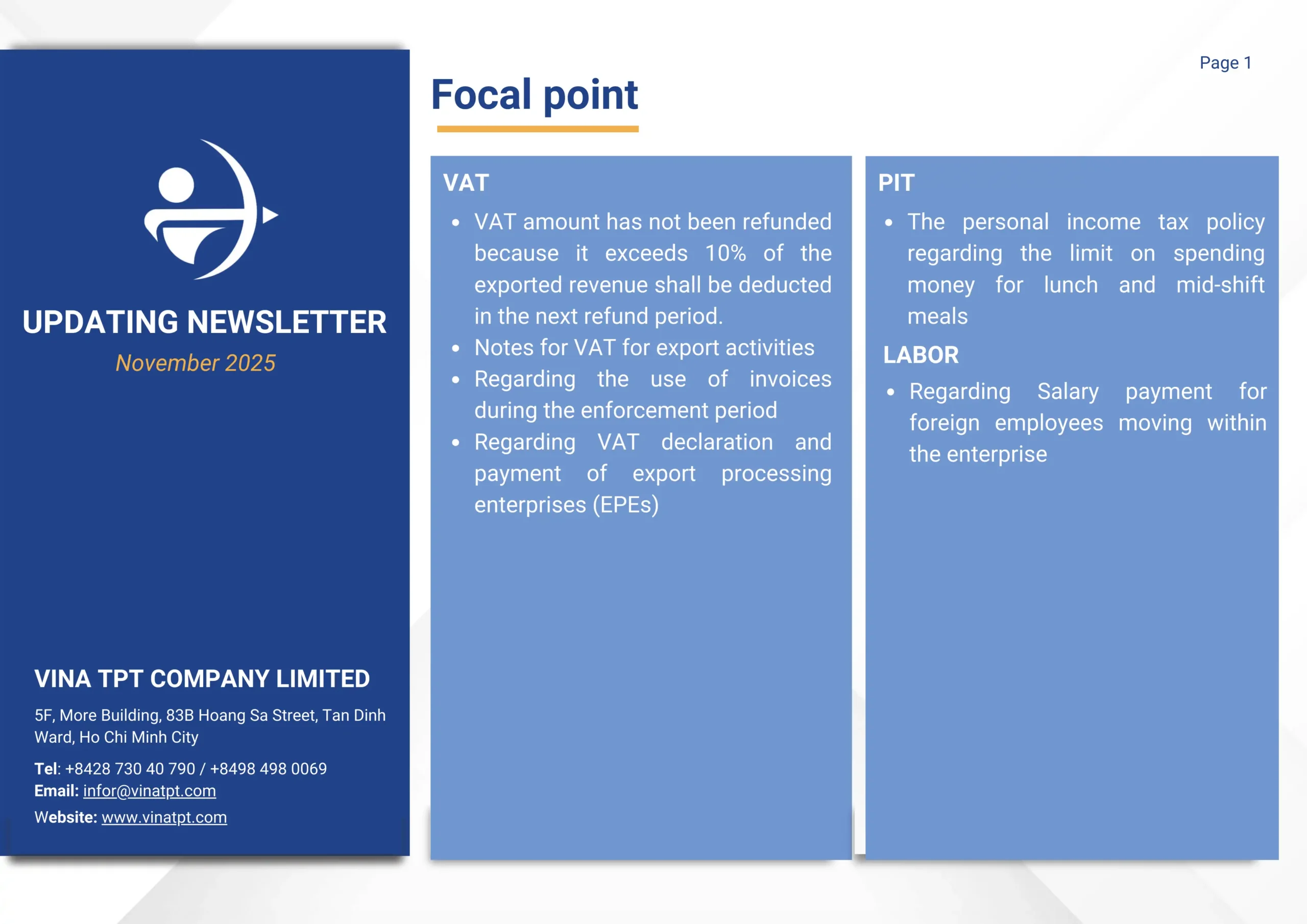
The November 2025 newsletter highlights key Vietnam tax policy updates that businesses need to closely monitor. The focus is on important VAT regulations related to export activities, VAT refund mechanisms, invoice usage during enforcement periods, and compliance requirements for export processing enterprises (EPEs). In addition, the update addresses notable Personal Income Tax (PIT) changes, particularly policies on employee meal allowances, as well as labor regulations governing salary payments for foreign employees transferring within an enterprise. These developments have significant implications for business compliance, operations, and tax planning in Vietnam.

1. VALUE ADDED TAX (VAT)

1.1. VAT amount has not been refunded because it exceeds 10% of the exported revenue shall be deducted in the next refund period.

Official dispatch No. 5094/CT-CS dated November 11, 2025 of the Tax Department on Notes on VAT refund policy for exported goods
Regulations related to VAT refunds for exported goods and services were previously stated in Article 2 of Circular 25/2018/TT-BTC (amending and supplementing Clause 4, Article 18 of Circular 219/2013/TT-BTC) and are now applied according to the provisions of Clause 1, Article 15 of VAT Law No. 48/2024/QH15, Clause 2, Article 29 of Decree 181/2025/ND-CP and Appendix II of Circular No. 69/2025/TT-BTC.
According to Vietnam tax policy updates, in case a business establishment exports goods and services in a month or quarter, if the input VAT amount that has not been fully deducted is 300 million VND or more, it will be entitled to a VAT refund on a monthly or quarterly basis. However, the maximum refunded input VAT amount of exported goods and services must not exceed 10% of the revenue of exported goods and services in the tax refund period.
For the input VAT amount of exported goods and services that has not been refunded because it exceeds 10% of the revenue of exported goods and services of the previous tax refund period, the enterprise is allowed to deduct it in the next tax period to determine the VAT amount to be refunded for exported goods and services of the next tax refund period.
1.2. Notes for VAT for export activities:

Official dispatch No. 5489/CT-CS dated November 25, 2025 of the Tax Department on value added tax policy.

According to the Tax Department’s note, the principle of input VAT deduction for goods and services used for production and trading of goods and services subject to VAT is to be fully deducted (Article 14 of the Law on VAT No. 48/2024/QH15, Clause 1, Article 23 of Decree No.181/2025/ND-CP, Clause 4, Article 24 of Decree No. 181/2025/ND-CP).

In case an enterprise has both export and domestic consumption activities, it is necessary to separately account for input VAT for export activities (Clause 1, Article 15 of VAT Law No.48/2024/QH15, Clause 2, Article 29 of Decree No. 181/2025/ND-CP). If it is not possible to account separately, the input VAT for exported goods will be determined according to the ratio of export revenue to total taxable revenue (Appendix II of Circular No. 69/2025/TT-BTC).

1.3. Regarding the use of invoices during the enforcement period

According to Official dispatch No. 5282/CT-CS dated November 18, 2025 of the Tax Department on the conditions for allowing invoice issuance during the period of enforcement, Tax Department has based on the provisions of Article 4, Article 13 of Decree 123/2020/ND-CP (amended in Clause 3, Clause 10, Article 1 of Decree 70/2025/ND-CP) and Article 34 of Decree 126/2020/ND-CP to respond as follows:

  • Under the latest Vietnam tax policy updates, in cases where an enterprise is subject to compulsory measures to stop using invoices but submits a written request to continue invoice usage and falls under situations where the tax authority issues invoices on a per-occurrence basis, the enterprise will be issued electronic invoices with codes from the tax authority for each occurrence. The enterprise bears full responsibility for the accuracy of all information stated on these electronic invoices. The issuance and declaration of related tax obligations for invoices issued per occurrence by the tax authority must be carried out in accordance with Clause 10, Article 1 of Decree No. 70/2025/ND-CP.
  • In case an enterprise is being forced to stop using invoices and has a written request to use invoices to have a source of payment for workers’ salaries and expenses to ensure continuous production and business, the tax authority will continue to allow the enterprise to use invoices each time they arise, on the condition that the enterprise must immediately pay at least 18% of the revenue on the used invoices to the state budget according to the provisions of Point d, Clause 4, Article 34 of Decree No. 126/2020/ND-CP mentioned above.

1.4. Regarding VAT declaration and payment of export processing enterprises (EPEs)

Official dispatch No. 3905/HYE-QLDN3 dated October 31, 2025 of Hung Yen Provincial Tax Department has provided the instructions regarding VAT declaration and payment of export processing enterprises (EPEs) as below:

  1. VAT payers:
  • The enterprise is not a VAT payer for production activities for export (export processing activities) and is not required to declare VAT for this activity.
  • Export processing enterprises must pay VAT if they carry out business activities other than export processing activities, for example:

-Purchase domestic goods for export (exercise export rights).

-Import goods for domestic sale (exercise import rights).

  1. Conditions for declaring and paying VAT (for business activities other than manufacturing activities):
  • Separate accounting: Export processing enterprises must separately account for transactions of buying and selling goods that are not part of export processing activities (for example, import-export activities).
  • Tax registration: The enterprise needs to register for tax with the domestic tax authority to declare and pay VAT separately for these other business activities.
  • Arrangement of separate areas: The arrangement of the storage area for goods serving processing activities must ensure separation from the storage area for goods serving other production and business activities.
  1. VAT declaration period:
  • Monthly declaration: According to the provisions of Point a, Clause 1, Article 8 of Decree No. 126/2020/ND-CP, the enterprise shall declare VAT monthly.
  • Quarterly declaration: If the enterprise meets the criteria specified in Point a, Clause 1, Article 9 of Decree No.126/2020/ND-CP (total revenue from sales of goods and provision of services of the previous year is 50 billion VND or less), the enterprise can choose to declare VAT quarterly.
  1. Using invoices:
  • If the enterprise declares VAT using the deduction method, use VAT invoices.
  • If the enterprise declares VAT using the direct method, use sales invoices.
  • When selling goods and providing services domestically and when selling goods and providing services between organizations and individuals in duty-free zones, exporting goods and providing services abroad, the invoice must clearly state “For organizations and individuals in duty-free zones”.

In short, under the latest Vietnam tax policy updates, export processing enterprises are only required to declare and pay VAT for business activities other than export processing activities (production of export goods). These enterprises must separately account for such activities and register for tax to declare and pay VAT in accordance with regulations. The VAT declaration period may be monthly or quarterly, depending on the revenue of the previous year.

Vietnam-Tax-Policy-Updates-November-2025-VAT-PIT-and-Labor-Vina-TPT

2. PERSONAL INCOME TAX (PIT)

2.1. The Personal income tax policy regarding the limit on spending money for lunch and mid-shift meals

As part of the Vietnam tax policy updates, Official Dispatch No. 5106/CT-CS dated November 12, 2025, issued by the Tax Department, provides guidance on personal income tax policy regarding the limits on lunch and mid-shift meal expenses used as a basis for determining personal income tax. In this dispatch, the Tax Department cites the following regulations and instructions for reference:

  • Article 103 of the Labor Code No. 45/2019/QH14 stipulates that “The regime of salary increase, promotion, allowances, subsidies and incentives for employees is agreed upon in the labor contract, collective labor agreement or regulations of the employer”.
  • Clause 1, Article 33, Clause 9, Article 34 of Decree No. 44/2025/ND-CP on salary and bonus regimes in state-owned enterprises stipulates: “This Decree takes effect from April 15, 2025 and the regimes in this Decree are implemented from January 1, 2025”. “The mid-shift meal regime or fixed-quantity meal regime for employees, Executive Board, Board Members, and Supervisors is implemented according to the agreement in the collective labor agreement or the internal rules and regulations of the enterprise according to the provisions of the Labor Code”.
  • Article 10 of Decree No. 248/2025/ND-CP on salary and bonus regimes in state-owned enterprises stipulates: “This Decree takes effect from September 15, 2025 and the regimes in this Decree are implemented from August 1, 2025. Decree No. 44/2025/ND-CP is abolished”.
  • Section g.5, Clause 2, Article 2 of Circular No. 111/2013/TT-BTC stipulates: “In case the employer does not organize mid-shift meals or lunch but pays for the employee, it is not included in the taxable income of the individual if the level of expenditure is in accordance with the guidance of the Ministry of Labor – Invalids and Social Affairs. In case the level of expenditure is higher than the guidance of the Ministry of Labor – Invalids and Social Affairs, the excess expenditure must be included in the taxable income of the individual. The specific expenditure level applicable to state-owned enterprises… shall not exceed the guidance of the Ministry of Labor – Invalids and Social Affairs. For non-state-owned enterprises… the expenditure level shall be decided by the head of the unit in agreement with the chairman of the trade union but shall not exceed the level applicable to state-owned enterprises”.
  • In Vietnam tax policy updates: Official Dispatch No. 1387/CTL&BHXH-TLSXKD dated September 29, 2025 of the Ministry of Home Affairs, it is instructed: “According to the provisions of Article 103 of the Labor Code, incentive regimes for employees are agreed upon in the labor contract, collective labor agreement or regulations of the employer. The mid shift meal regime for employees, Executive Board, Council members, and Controllers in state-owned enterprises from January 1, 2025 to July 31, 2025 is implemented according to the provisions of Clause 9, Article 34 of Decree No. 44/2025/ND-CP on salary and bonus regimes in state-owned enterprises; from August 1, 2025, it is implemented according to the provisions of the Labor Code”.

According to Vietnam tax policy updates, the current allowance of VND 730,000 per month for mid-shift meals has been abolished. Instead, enterprises may determine a reasonable allowance level based on the agreements in the collective labor agreement or in the company’s internal rules and regulations. In the case where the Company incurs expenses for mid-shift meals for employees working at the company, if this allowance is specifically stipulated regarding eligibility conditions and allowance levels in the labor contract, the collective labor agreement, or the company’s internal rules and regulations, it shall not be included in taxable personal income (PIT). If the allowance exceeds the stipulated level, the excess amount will be included in taxable PIT income.

Vietnam-Tax-Policy-Updates-November-2025-VAT-PIT-and-Labor-Vina-TPT

3. LABOR 

3.1. Regarding Salary payment for foreign employees moving within the enterprise

Official dispatch No. 10861/BNV-CVL dated November 19, 2025 of the Ministry of Home Affairs on domestic salary payment for foreign employees moving within the enterprise.

The Ministry of Home Affairs notes that, in the case of “foreign workers being paid (in Vietnam)”, before the expected working date, the enterprise employing the foreign worker must request a work permit and sign a labor contract as prescribed (Clause 1, Article 13, Point d, Clause 1, Article 21 of the Labor Code No. 45/2019/QH14 and Point a, Clause 1, Article 2, Clause 4, Article 22 of Decree 219/2025/ND-CP), and must also participate in compulsory social insurance in Vietnam for this person as prescribed (Point a, Clause 2, Article 2 of the Law on Social Insurance No. 41/2024/QH15).

The case of “foreign employees being paid in Vietnam” (performing procedures to request a work permit) and the case of “foreign employees transferring within the enterprise” (performing procedures to request a certificate of not being subject to a work permit under Article 8 of Decree 219/2025/ND-CP) are two different cases according to the provisions of the Labor Code No. 45/2019/QH14 and guiding documents on foreign employees working in Vietnam.

BOOK A FREE CONSULTATION

Vina TPT Accounting services


Financial Reporting and Tax Finalization Services 2025 in Vietnam

Financial Reporting and Tax Finalization Services 2025 in Vietnam

Choose Vina TPT for consistent, professional accounting support

1. Overview of Financial Reporting & Tax Finalization in Vietnam 2025

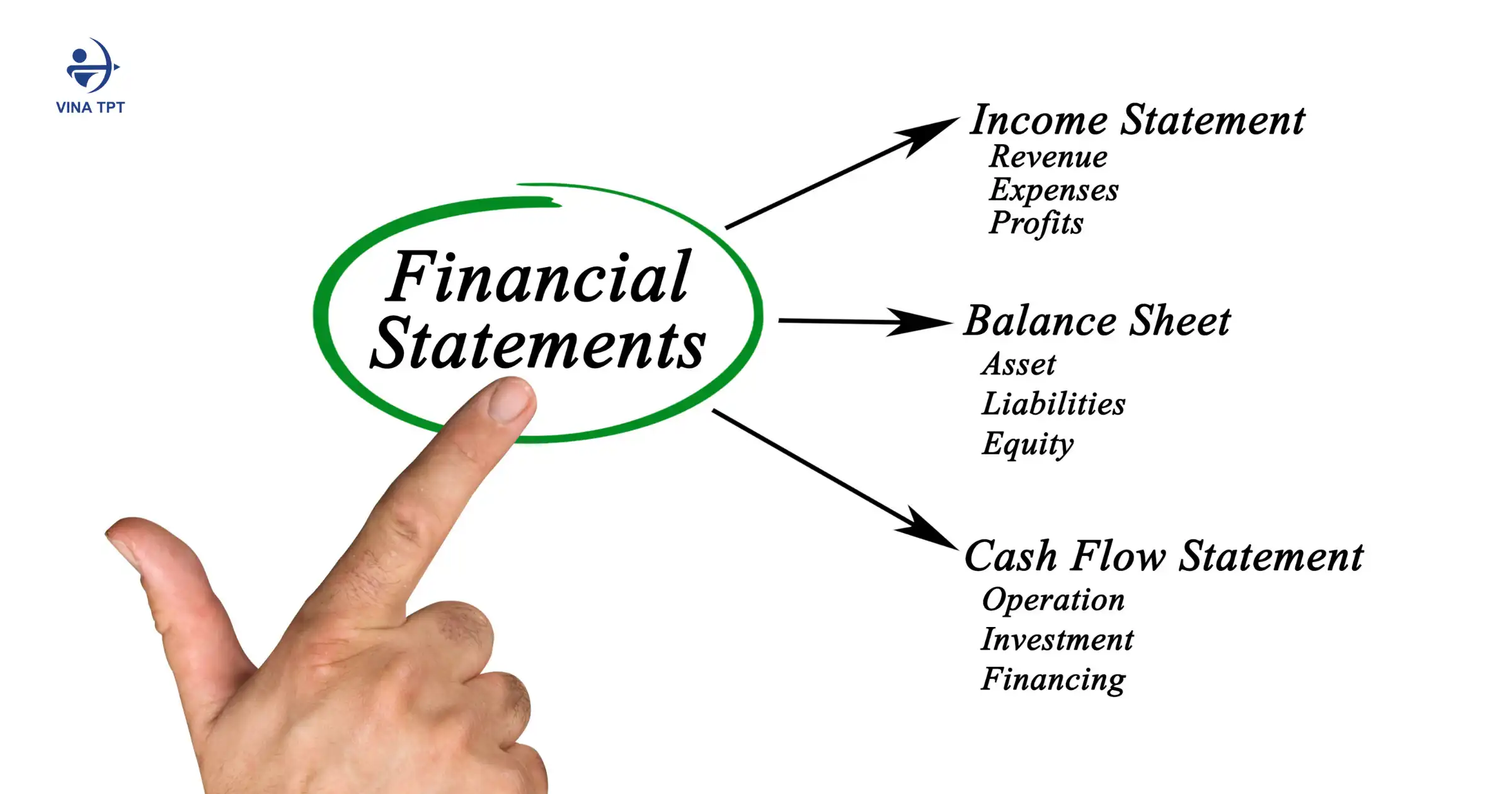
In 2025, FDI enterprises and domestic enterprises in Vietnam must fully comply with financial reporting and tax settlement obligations as prescribed. The annual financial statements include the Balance Sheet, Income Statement, Cash Flow Statement and Notes to the Financial Statements, all of which must be prepared in accordance with Vietnamese Accounting Standards (VAS).

In parallel with preparing the Financial Statements, enterprises must make corporate income tax and personal income tax settlements within 90 days from the end of the fiscal year. The increase in the frequency of reviews and inspections by tax authorities requires enterprises to have accurate data, a synchronous accounting system and complete records to avoid the risk of being penalized.

2. Vina TPT’s Financial Statement Services

Vina TPT provides in-depth financial reporting services, helping businesses prepare accurate, transparent and fully VAS-compliant reports. Not only synthesizing data, we also provide a clear view of the financial situation and ensure readiness for audits or tax inspections.

Vina TPT’s financial reporting services include:

  • Preparing Balance Sheets, Income Statements, Cash Flow Statements and Financial Statement Notes
  • Reconciling general ledgers, detailed ledgers, accounting documents
  • Reviewing and adjusting prepaid expenses, fixed asset depreciation, provisions
  • Checking compliance with VAS and tax regulations
  • Detecting and handling data discrepancies before closing the books
  • Providing bilingual reports (Vietnamese, English, Japanese)

Explore Our Services

3. Corporate Income Tax (CIT) Finalization Services

Vina TPT provides in-depth corporate income tax settlement services, helping businesses control data, comply with regulations and limit errors in the context of many important adjustments to tax policies and the Enterprise Law from October 1, 2025.

3.1 Review expenses and determine taxable profits

Vina TPT checks all expenses to determine which are deductible and which are not deductible in accordance with the Corporate Income Tax Law; reviews depreciation of fixed assets, interest expenses, provisions and expenses that are easily excluded during tax inspections. At the same time, the team compares data between financial statements and tax declarations to accurately calculate taxable profits, ensuring that there are no difficult-to-explain differences.

3.2 Prepare corporate income tax settlement declarations and in-depth risk assessment

The service includes full preparation of declarations, loss transfer appendices, tax incentives, cost analysis tables and explanation documents according to tax inspection standards. Vina TPT also analyzes risks by group such as costs without sufficient documents, incorrect revenue-expense periods, discrepancies in electronic invoice data, or lack of linked transaction records. From there, it proposes solutions to reduce the risk of collection and fines.

3.3 Tax optimization consulting and notes on new regulations from October 1, 2025

Vina TPT supports businesses in applying tax incentives to the right subjects, implementing valid loss transfers, and optimizing tax obligations based on legal mechanisms. In particular, changes effective from October 1, 2025 related to electronic records management, tightening cost control, and expanding explanation requirements make the settlement process more stringent; businesses need to carefully compare data, contracts, and documents to avoid risks when tax authorities inspect.

4. Personal Income Tax (PIT) Finalization for Employees & Foreigners

Personal income tax settlement is a major challenge for businesses with large staff numbers, diverse income structures or foreign employees. Vina TPT provides a complete PIT solution, helping businesses process quickly, correctly and fully comply with new regulations.

4.1 Review PIT data and prepare settlement documents

Vina TPT checks tax data of each employee monthly (income, exemptions, deductions, working days, taxes paid) to ensure consistent data before making settlement. At the same time, collect and check all documents: labor contracts, payroll, residence papers, entry/exit history of foreign experts… to help businesses have accurate data from the beginning of the year.

4.2 Preparation and submission of PIT settlement dossiers and tax refund support

Services include preparing PIT settlement declarations for businesses and individuals, correctly classifying residents and non-residents, applying double taxation agreements (DTA) if any, and submitting dossiers on time. Vina TPT also carries out tax refund procedures for employees and foreign experts, monitors the processing process and works with tax authorities to ensure that dossiers are processed quickly.

4.3 Representing and working with tax authorities and providing in-depth advice for foreign workers

Vina TPT represents businesses when requested by tax authorities, helping to reduce the workload for HR and accounting departments. At the same time, it provides in-depth advice on tax residency, applying DTA, handling business trips to multiple countries, income arising outside of Vietnam, or common international risks. This is especially important for businesses that employ many foreign experts and need to comply with cross-border tax standards.

SOLVE YOUR TAX CHALLENGES

Vina TPT’s Financial Statement Services

5. Common Pain Points & Why Businesses Need Professional Support

At the end of each year, many businesses face difficulties due to:

  • Incorrect data or inconsistent recording
  • Lack of documents or incomplete records
  • Internal accounting systems and reporting to parent companies are not synchronized
  • Late submission deadlines due to limited staff
  • Risks of fines and additional collection when tax authorities inspect
  • Lack of expertise in VAS and complex tax regulations

Professional services from Vina TPT help businesses avoid these risks and ensure the tax filing process runs smoothly.

6. Why Choose Vina TPT for Reporting & Tax Services

Values:

  • Vina TPT helps businesses maintain a transparent accounting system, accurate reporting and minimize tax risks in the context of increasingly strict inspections.

Professional capacity:

  • A team of accountants & tax experts with many years of experience in FDI enterprises
  • Deep understanding of VAS and financial reporting according to international standards
  • Bilingual support in Vietnamese – English – Japanese

Service commitment:

  • Clear process, fast processing time
  • Data security and absolute compliance with legal regulations
  • Optimal cost according to scale and workload

7. Comprehensive Service Package for FDI Enterprises

Vina TPT provides One-Stop Tax & Accounting Solution, including:

  • Annual Financial Report
  • Corporate Income Tax Finalization
  • Personal Income Tax Finalization
  • Accounting & Bookkeeping Services
  • Payroll, Labor Report
  • Support for Foreign Labor Compliance
  • Support for Working with Tax Authorities, Inspections & Audits

Consistency

  • All services are deployed synchronously according to one system, avoiding data discrepancies between departments and reducing risks during audits.

Long-term Benefits

  • A suitable solution for FDI enterprises that need stability, transparency and long-term support in a volatile legal environment.

Start with Vina TPT to complete financial reports and tax settlement 2025 quickly!

Talk to Our Experts

accounting service Vietnam for FDI company vtpt

Top Companies Providing the Best Outsourced Accounting Services in Ho Chi Minh City

Top Companies Providing the Best Outsourced Accounting Services in hO CHI MINH CITY

Top Companies Providing the Best Outsourced Accounting Services in hO CHI MINH CITY

1. Why Businesses Look for The Best outsourced accounting services in Ho Chi Minh City

Ho Chi Minh City is the largest economic center in Vietnam, accounting for more than 23% of the country’s total GDP and attracting over 40% of new FDI projects annually (according to data from the Ministry of Planning and Investment). FDI enterprises and small and medium-sized enterprises in Ho Chi Minh City have to handle a dense volume of reports: monthly tax declarations, quarterly reports, annual financial reports according to VAS standards, along with obligations such as corporate income tax/personal income tax settlement and labor reports. The level of inspection and audit in Ho Chi Minh City is also higher than in many other provinces and cities, making the requirements for accuracy and compliance more stringent.

In that context, businesses seek accounting firms not only to “make reports”, but also to have a partner who has a deep understanding of Vietnamese Accounting Standards (VAS), and at the same time meets the need to prepare parallel reports for headquarters in Japan, Korea, the EU or the US. FDI enterprises often have to reconcile data between VAS and IFRS/J-GAAP/K-GAAP, so they need a team capable of handling exchange rate differences, classifying fixed assets, and recording prepaid expenses according to international standards. A suitable accounting firm helps enterprises reduce errors, limit tax penalty risks, optimize cash flow, and significantly reduce the administrative burden for internal departments.

GET EXPERT ACCOUNTING SUPPORT

2. Types of Accounting Firms Commonly Chosen in Ho Chi Minh City

The accounting services market in Ho Chi Minh City is diverse, serving more than 330,000 active businesses, from SMEs to large FDI corporations. Depending on the size, budget and complexity of the reports, businesses often choose between three main groups of providers, each with distinct advantages and disadvantages.

Criteria International Firms (Big 4 & Global) Mid-Tier Firms Boutique / Professional Firms
Ideal Clients Large FDI corporations, multinational groups, IFRS reporting, mandatory audits Mid-sized FDI companies, Vietnamese firms with complex transactions SMEs, FDI startups, businesses needing flexible and cost-effective services
Representative Firms Deloitte, PwC, EY, KPMG Grant Thornton, RSM Vietnam, A&C BDO Vietnam, boutique/non-Big firms (e.g., small approved audit firms)
Expertise Strong in IFRS/J-GAAP/K-GAAP, globally standardized processes Solid VAS + IFRS capability, strong in consolidated reporting and advisory Industry-focused, strong practical accounting capabilities
Response Speed Fast but structured; larger teams with layered review Fast, more flexible client communication, good customer care Fastest, direct work with senior team members, highly adaptable
FDI Handling Capability Excellent, best fit for large global or regional FDI operations (high cost) Very good for mid-sized FDI companies with structured operations Suitable for new or simple FDI setups
Key Strengths Global credibility, standardized reporting, highest reliability Good balance of cost, quality, service Flexible, cost-effective, highly personalized service
Notes on Representative Firms Deloitte – strong in large FDI audits 

PwC – comprehensive service line 

EY – long-established, strong advisory 

KPMG – wide presence (HN/HCMC/Da Nang)

Grant Thornton – flexible, strong advisory 

RSM – strong in outsourcing & mid-FDI audit 

A&C – top non-Big option for VN firms + mid-FDI

BDO Vietnam – part of BDO global network, ideal for SMEs 

Other boutique firms – suitable for startups, small FDI, custom service needs


3. Why Vina TPT Is a Trusted Choice for International Companies

Vina TPT has become a preferred partner for many FDI enterprises in Ho Chi Minh City by offering a practical balance between local compliance expertise and the reporting expectations of overseas headquarters. As foreign-invested companies navigate increasingly strict tax regulations, frequent monthly and quarterly reporting cycles, and complex cross-border coordination, they need an accounting provider that is both technically reliable and agile enough to support their day-to-day operations. Vina TPT fits this need exceptionally well, especially for Japanese, Korean, Singaporean, and European investors establishing or expanding their presence in Vietnam.

Vina TPT stands out thanks to:

  • Deep knowledge of VAS and international reporting standards
  • Bilingual support in English and Japanese for smooth communication
  • Flexible and comprehensive services covering bookkeeping, tax, payroll, and compliance
  • An optimized cost structure specifically designed for FDI companies

Choose Vina TPT for consistent, professional accounting support

4. Factors to Consider When Choosing an Accounting Firm in HCM

When selecting an accounting partner, businesses should evaluate:

  • FDI experience and understanding of foreign-invested business operations
  • Accuracy and timeliness of reports
  • Multilingual support and clear communication
  • Transparency of service scope and fees
  • Responsiveness and reliability

Choosing the best outsourced accounting services in HCM ensures accurate reporting, full compliance, and peace of mind for your business operations.

Contact Vina TPT today to receive a complete accounting solution, optimize costs and ensure compliance for your business in Ho Chi Minh City!

Get Your Accounting Solution

accounting service Vietnam for FDI company vtpt

Capital Contribution and Business Setup for Foreign Investment in Vietnam

Capital-Contribution-and-Business-Setup-for-Foreign-Investment-in-Vietnam-Vina-TPT

Capital-Contribution-and-Business-Setup-for-Foreign-Investment-in-Vietnam-Vina-TPT

1. Understanding Capital Contribution Requirements for Foreign investment in vietnam

Capital contribution is the most important step when establishing an FDI enterprise. According to Vietnamese law, foreign investors should note:

  • Minimum capital: Vietnam does not require a general legal capital level, but the charter capital must be appropriate and demonstrate the ability to implement the business model. Some specific industries (education, real estate, e-commerce, etc.) have higher capital requirements.
  • Form of capital contribution: Investors can contribute capital in cash, machinery and equipment, assets, intellectual property rights, or other legal assets.
  • Capital contribution period: Usually must be completed within 90 days from the date of issuance of the Certificate of Business Registration (or according to the period stated in the Investment Registration Certificate).

Determining capital accurately from the beginning helps reduce legal risks and limit capital adjustments later.

2. Types of Foreign Investment in Vietnam

When choosing a form of investment in Vietnam, investors need to consider their business objectives, project scale, level of control and desired scope of operations. Vietnam allows for a variety of flexible legal models, from establishing a new business to opening a branch or representative office. Each form carries different levels of risk, costs and compliance obligations, so choosing the right one at the outset will have a big impact on investment performance and long-term strategy.

Below are the most common forms of FDI in Vietnam:

Type Suitable for Advantages Disadvantages
Limited Liability Company (LLC) Small & medium enterprises

Investors needing strong control

Simple structure

Easy to operate

High control

Fast setup

Hard to raise capital

Extra procedures to convert to JSC

Joint Stock Company (JSC) Businesses expanding strongly

Companies seeking fundraising

Easy capital raising Fit for large/multinational projects

Flexible share transfer

Good for future IPO

Complex governance

More management bodies required

Higher compliance cost

Branch of Foreign Traders Foreign companies in eligible sectors Can conduct profit-making activities

No new legal entity required

Operate under parent company

Limited to specific industries

Dependent on parent company

Hard to scale like an independent entity

Representative Office (RO) Market research stage

Building partner networks

Simple setup

Low cost

No CIT applied

Cannot generate revenue

Cannot sign commercial contracts

Not suitable for long-term investment

Choosing the appropriate form of FDI helps investors optimize costs, reduce legal risks and ensure that their business strategy in Vietnam is effectively implemented. For small and medium-sized projects, LLC is often the optimal choice; for strong expansion plans or many shareholders, JSC is more suitable. Meanwhile, branches and representative offices serve the purpose of market presence without the need to establish a new legal entity.

3. Steps to Set Up a Company with Capital Contribution

When setting up a Foreign investment in Vietnam, investors need to take the following main steps:

Step 1: Prepare investment documents

  • Investor information
  • Financial capacity report
  • Business plan
  • Headquarters lease contract, company charter

Step 2: Apply for Investment Registration Certificate (IRC): Confirm investment project and capital structure. Processing time: 15-30 days.

Step 3: Apply for Enterprise Registration Certificate (ERC): Officially establish the enterprise. Time: 3-5 days.

Step 4: Open an investment capital account: Required for FDI enterprises, used to receive capital from abroad.

Step 5: Make capital contribution: Investors transfer capital on time and complete the report.

Step 6: Post-establishment procedures

  • Tax registration
  • Digital signature
  • Corporate seal
  • Labor and insurance registration (if required)

Capital-Contribution-and-Business-Setup-for-Foreign-Investment-in-Vietnam-Vina-TPT

4. Compliance and Reporting Obligations

Foreign investment in Vietnam must ensure full compliance with the following regulations:

  • Capital contribution progress report
  • Accounting and bookkeeping according to VAS standards
  • Periodic tax declaration (VAT, CIT, PIT)
  • Annual financial report
  • Notification of changes in capital, headquarters, and representative

Non-compliance may result in administrative fines, restrictions on operations, or capital adjustment requirements.

AVOID COSTLY COMPLIANCE RISKS

5. Benefits of Proper Capital Contribution Management

Managing and implementing capital contribution in accordance with regulations is not only a legal requirement but also brings many practical values ​​to FDI enterprises in Vietnam:

Avoid legal risks and penalties

  • Contributing capital on time helps avoid administrative penalties.
  • Avoid being required to reduce charter capital or adjust the Investment Certificate.
  • Limit risks when checking, inspecting or working with banks.

Protecting investors’ ownership rights and capital contribution ratios

  • Clearly record the ownership ratio, voting rights and interests of each shareholder.
  • Avoid internal disputes, especially with investors from many different countries.
  • Increase transparency when planning to transfer shares or raise capital.

Increase the level of trust with banks, partners and management agencies

  • Adequate charter capital is an important factor in expanding credit limits.
  • Demonstrate the financial capacity and long-term commitment of investors in Vietnam.
  • Help partners and suppliers feel secure when signing contracts.

Optimize taxes and cash flow

  • A reasonable capital structure helps reduce the risk of transfer pricing adjustments and avoid tax disputes.
  • Easily control cash flow in and out through investment capital accounts.
  • Increase the ability to plan finances and operating budgets.

Create a solid foundation for expansion

  • Easy to add capital, open more branches or change the scope of the project.
  • Convenient when upgrading the type of business or expanding to a new industry.
  • Support the process of calling for more investors or strategic cooperation.

Increase long-term enterprise value

  • Enterprises with a transparent history of capital contribution are often highly appreciated when evaluating M&A.
  • Increase attractiveness to investment funds and global partners.
  • Create a competitive advantage when negotiating large contracts.

Minimize risks during divestment

  • Easily determine the value of the capital contribution when the investor wants to withdraw capital.
  • Reduce disputes due to the difference between actual capital contribution and registered capital.
  • Optimize tax benefits when transferring capital.

6. How Vina TPT Supports FDI Company Formation

Vina TPT Company Formation provides a complete package of support for the process of establishing and operating FDI enterprises:

  • Consulting on conditions for capital contribution and business lines
  • Preparing and submitting IRC & ERC documents
  • Shareholding structure, ownership ratio, charter
  • Support for opening investment capital accounts, guidance on capital contribution
  • Accounting – tax services – compliance with Vietnamese regulations
  • Consulting throughout for investors in operations and expansion

With experience working with international enterprises, Vina TPT ensures that the investment process in Vietnam becomes clear, safe and effective.

BOOK A FREE CONSULTATION

Laywer-Establish-business-Vietnam-VinaTPT