Outsourcing Accounting Services for Small Business in Vietnam

vina tpt outsourcing accounting services for small business

vina tpt outsourcing accounting services for small business

A Step-by-Step Guide to Outsourcing Accounting Services for Small Business in Vietnam

Entering the vibrant Vietnamese market offers immense opportunities for global expansion, driven by a stable economy and a pro-business regulatory environment. However, this potential is accompanied by a sophisticated web of legal frameworks, evolving tax circulars, and strict administrative requirements that can be daunting for newcomers.

For Foreign Direct Investment (FDI) Small and Medium Enterprises (SMEs), outsourcing accounting services for small businesses is no longer just a simple cost-cutting measure or a tactical convenience. In the rapidly changing landscape of 2026, it has evolved into a high-level strategic move designed to mitigate regional risks, ensure absolute compliance with local authorities, and build a foundation for sustainable, long-term operations in Vietnam. By leveraging expert external support, business owners can navigate the complexities of local standards while keeping their internal resources focused entirely on core growth and market penetration.

1. Why Outsourcing Accounting Services for Small Business is Essential for FDI Entities

New FDI businesses in Vietnam often navigate a “maze” of operational hurdles:

  • E-invoicing Pressure & Strict Deadlines: The mandatory adoption of e-invoices and rigid monthly/quarterly tax filing deadlines can lead to heavy administrative fines without a dedicated professional team.
  • The VAS vs. IFRS Gap: Discrepancies between Vietnamese Accounting Standards (VAS) and International Financial Reporting Standards (IFRS) make consolidating reports for headquarters difficult, often delaying audits and profit repatriations.
  • Language Barriers & Talent Turnover: Finding accountants fluent in English or Japanese is difficult. High turnover rates and hidden labor costs (insurance, benefits, training) can destabilize a company’s management system.

2. Strategic Benefits of Outsourcing Accounting Services for Small Business

Instead of maintaining a bulky internal department, utilizing professional accounting services allows SMEs to focus entirely on their core business growth.

Comprehensive Legal Compliance through Bookkeeping Services

Professional firms provide end-to-end solutions, from bookkeeping services to tax filing, keeping your business “safe” from tax authorities:

  • Tax Filings: Handling Value Added Tax (VAT), Corporate Income Tax (CIT), Personal Income Tax (PIT), and Foreign Contractor Tax (FCT).
  • Mandatory FDI Reports: Preparing periodic investment project implementation reports as required by the Ministry of Planning and Investment (MPI).

Cost and Management Optimization

  • Global Standard Reporting: Providing English-language reports and mapping VAS data to IFRS formats for seamless parent company oversight.
  • Budget Efficiency: Outsourcing costs are significantly lower than hiring full-time internal staff, eliminating expenses for office space, infrastructure, and specialized accounting software.

3. Our Workflow for Outsourcing Accounting Services for Small Business at Vina TPT

vina tpt outsourcing accounting services for small business

At Vina TPT, we utilize a transparent, professional workflow specifically designed to meet the rigorous standards of international investors:

  • Consultancy & Collection: We advise on the required documentation based on your specific industry and collect original vouchers monthly.
  • Data Processing: All transactions are entered into specialized accounting software, ensuring data systematicity and easy retrieval.
  • Integrity Review: We perform a meticulous analysis of all accounts to ensure data is complete, accurate, and valid under Vietnamese law.
  • VAS Reporting: Monthly and annual financial statements are prepared according to VAS standards, with optional IFRS conversion for auditing purposes.
  • Managerial Insights: We provide ad-hoc managerial reports tailored to the Board of Directors’ needs, offering a clear view of the company’s financial health.
  • Professional Advice: Acting as your dedicated accounting and tax consultant, we provide real-time updates on new tax policies to help you adapt and optimize tax obligations.

4. Why Vina TPT is the Ideal Partner for SMEs in Vietnam?

We understand the anxieties of business owners in a new market. Vina TPT offers exclusive advantages:

  • “Pay-as-you-grow” Model: Flexible service fees based on actual document volume, starting from just $120 USD/month. This is the perfect solution for SMEs to preserve working capital during the early stages.
  • No Language Barrier: Our experts communicate directly in English or Japanese, ensuring transparency without the need for third-party interpreters.
  • From Compliance to Strategy: We go beyond filing taxes; we provide deep Financial Insights to help you make data-driven business decisions.
  • Confidentiality & Transparency: We guarantee absolute security for all cash flow and accounting data, building a foundation of trust for your operations in Vietnam.

Ready to Optimize Your Accounting Operations in Vietnam with Vina TPT?

Don’t let complex administrative hurdles, shifting tax regulations, or language barriers slow your business progress and market entry. Navigating the Vietnamese regulatory landscape requires precision, and even a small oversight in compliance can lead to costly delays.

Contact our expert team at Vina TPT today for a comprehensive 1-on-1 intensive consultation. We will provide you with a tailored roadmap for outsourcing accounting services for small business, ensuring your financial system is robust, transparent, and fully compliant from day one. Let us handle the complexities of the local system so you can focus entirely on scaling your business and achieving your strategic goals in Vietnam.

Get Your Free 30-Minute Consultation

Strategic Benefits of Outsourcing Accounting Services for Small Business

Bridging VAS and J-GAAP: Accounting Outsourcing Solutions for Japanese Companies in Vietnam

Accounting and financial reporting for Japanese companies in Vietnam under VAS and J-GAAP standards

accounting-outsourcing-services-for-japanese

1. Japanese Firms Face Complex Financial Localization in Vietnam

Japanese corporations are known for their strict financial and accounting processes and high standards of transparency. However, when expanding operations to Vietnam, they face significant differences between Vietnamese accounting standards (VAS) and Japanese accounting standards (J-GAAP). This difference lies not only in the way revenue and expenses are recorded, but also affects the way financial statements are presented and reconciled between the parent company in Japan and its branch in Vietnam.

Many Japanese enterprises share that ensuring compliance with VAS as required by Vietnamese tax authorities while maintaining the internal reporting format according to J-GAAP is a complex problem. To handle these challenges efficiently, many turn to accounting outsourcing services provided by a professional accounting services company in Vietnam. These services not only ensure accurate reconciliation between the two systems but also support the preparation of bilingual reports and bank statements in Japanese, helping Japanese corporations maintain compliance, transparency, and efficiency across borders.

2. Challenges in Reconciling VAS and Japanese GAAP

What makes Japanese companies difficult is not only the difference in accounting regulations, but also in the actual operation process. The way revenue is recognized between the two systems can be different: VAS is based on the time of completion of the delivery obligation, while J-GAAP can record according to the contract conditions.

Another problem is the difference in exchange rates: VAS uses actual or average exchange rates, while J-GAAP may require re-recording at the end-of-period exchange rate, leading to discrepancies in consolidated reports. In addition, preparing bank statements in Japanese or bilingual financial statements to send to the parent company is also a significant challenge, requiring accounting personnel who are both knowledgeable in the field and fluent in the language.

In many cases, Japanese companies have to maintain two separate sets of accounting systems or spend a lot of time adjusting data. This not only increases operating costs but also prolongs the auditing process, reducing the effectiveness of internal financial management.

GET JAPAN-VIETNAM ACCOUNTING SUPPORT

3. Why Accounting Outsourcing Services Is the Optimal Solution

Accounting outsourcing services is becoming an inevitable trend in the Japanese business community in Vietnam. Instead of building a large internal team, businesses can cooperate with a professional unit – both understanding Vietnamese tax regulations and the J-GAAP system.

This solution helps businesses significantly save on personnel costs, minimize the risk of errors in declarations, and maintain standard bilingual financial reports (English – Japanese – Vietnamese), meeting the requirements of both tax authorities and parent companies. In particular, professional accounting service companies can build a data standardization process, ensuring that reports can be directly integrated into the group’s management system in Japan.

Accounting outsourcing services also helps businesses be more flexible – easily expanding or reducing the scale of accounting when there are changes in the project, without affecting the continuity of financial operations.

4. How Vina TPT Simplifies Accounting for Japanese Companies

Vina TPT Accounting Service is the leading accounting services company providing accounting and financial solutions for Japanese enterprises in Vietnam. We deeply understand the differences between VAS and J-GAAP and have built a specialized process to help Japanese clients localize their financial systems while maintaining the transparency standards of the parent corporation.

Vina TPT’s team of experts includes Japanese – English bilingual accountants and tax consultants, who are intensively trained in Japanese accounting standards, Vietnamese taxes, and specialized communication skills in Japanese. 

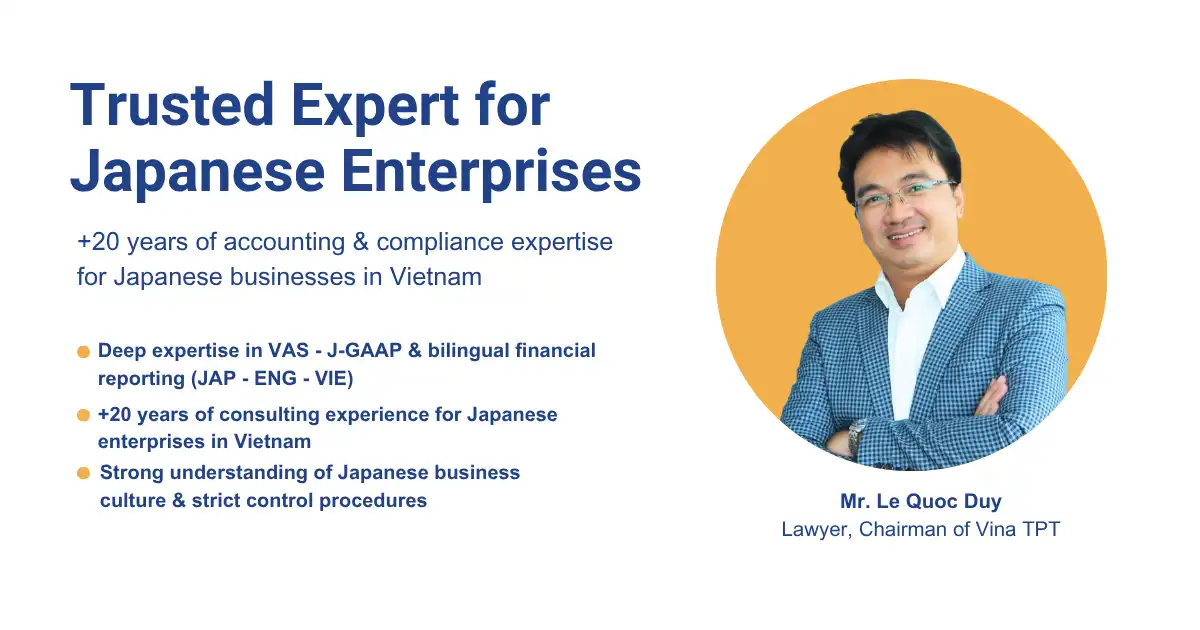
In particular, Mr. Le Quoc Duy, the chief expert in charge of Japanese customers, has more than 2015 years of experience working with large corporations in the fields of manufacturing, finance, and logistics of Japan in Vietnam.

accounting-outsourcing-services-for-japanese

We support businesses in the entire process:

  • Standardizing data and preparing bank statements in Japanese
  • Reconciling and converting reports from VAS to J-GAAP
  • Review documents before sending to HQ
  • And provide regular advice to ensure accuracy and compliance in the long term.

5. Build Transparent, Compliant and Cross-Cultural Financial Systems

With specialized accounting outsourcing services, Japanese enterprises in Vietnam not only solve compliance issues, but also create a transparent, reliable and cross-culturally compatible financial system. Standardized and bilingual financial data helps strengthen trust between the Vietnamese branch and the Japanese parent company, and facilitates smoother group audits.

In the long term, maintaining a transparent accounting and financial system not only helps companies control costs and optimize profits, but also demonstrates a standard operating philosophy that is consistent with Japanese business culture: accuracy – discipline – reliability.

Contact Vina TPT Accounting Service today for advice on outsourcing accounting solutions and bilingual financial reporting in accordance with J-GAAP standards. We help Japanese businesses in Vietnam operate more easily – accurately, compliantly and sustainably.

BOOK A FREE CONSULTATION

Accounting-and-financial-reporting-for-Japanese-companies-in-Vietnam

Invoices under 20 million VND must be paid via bank transfer starting from July 1, 2025

Invoices under 20 million VND paid by bank transfer requirement from July 1, 2025

Invoices under 20 million VND paid by bank transfer

Starting July 1, 2025, invoices under 20 million VND paid by bank transfer will be a mandatory requirement for businesses to qualify for VAT deduction. This means that any transaction involving goods or services with an invoice value below 20 million VND must be paid through bank transfer or other recognized cashless payment methods. Cash payments for such invoices will no longer qualify for VAT deduction, even though they may still be legally allowed for the transaction.

This new regulation is part of a broader effort by the Vietnamese government to improve transparency and accountability in financial transactions, reduce tax evasion, and promote digital payments in the business environment.

1. Why Is This Regulation Important?

The requirement for invoices under 20 million VND paid by bank transfer aims to address several key issues:

  • Reduce Tax Evasion: Cash payments are harder to trace and can be used to conceal taxable income. By enforcing invoices under 20 million VND paid by bank transfer and other cashless payments, tax authorities can more easily verify transactions.
  • Increase Transparency: Electronic payment trails created by invoices under 20 million VND paid by bank transfer make it simpler to audit businesses and ensure compliance with tax laws.
  • Facilitate VAT Management: Ensuring payments through bank transfers streamlines VAT deduction claims and reduces fraudulent refund claims related to VAT.

Businesses that fail to comply with the requirement for invoices under 20 million VND paid by bank transfer risk having their expenses disallowed for VAT deduction, resulting in higher tax liabilities.

2. What Does the 2024 VAT Law Say?

According to the amended 2024 Value Added Tax Law, effective from July 1, 2025, all invoices—including those under 20 million VND—must be accompanied by proof of cashless payment to be eligible for VAT deduction. This applies across all business sectors involved in selling goods and services within Vietnam.

The law also enforces strict penalties and prohibits acts such as issuing fake invoices, failing to submit electronic invoice data, and manipulating invoice information. Compliance with the rule on invoices under 20 million VND paid by bank transfer is essential to avoid legal consequences and maintain proper VAT benefits.

3. Are Cash Payments Still Allowed for Invoices Under 20 Million VND?

Yes, cash payments for invoices below 20 million VND remain legally permitted for settling transactions. However, under the new regulation, if payment is made in cash, the invoice will not qualify for VAT deduction. To ensure compliance with the rule on invoices under 20 million VND paid by bank transfer, businesses are encouraged to switch from cash payments to cashless payment methods such as bank transfers, mobile wallets, or other electronic payment options. Adopting invoices under 20 million VND paid by bank transfer helps maintain tax benefits and avoid potential penalties.

4. 8 Prohibited Acts in VAT Deduction and Refund – Pay Attention to Invoices Under 20 Million VND

The 2024 VAT Law defines eight prohibited acts related to VAT deduction and refund that businesses must avoid:

  1. Illegal purchase, exchange, or brokerage of invoices.
  2. Issuing invoices for fictitious or illegal transactions.
  3. Issuing invoices during business suspension, except for contracts signed before suspension.
  4. Use of illegal invoices or documents as regulated by the government.
  5. Failure to timely transfer electronic invoice data to tax authorities.
  6. Altering, misusing, unauthorized access, or destruction of invoice data systems.
  7. Bribery or collusion to fraudulently obtain tax deductions or refunds.
  8. Collusion between tax authorities and businesses to evade VAT.
  9. Understanding and complying with these rules is essential to avoid penalties.

Understanding and strictly complying with these regulations protects businesses from penalties and ensures smooth tax operations.

5. How Should Businesses Prepare?

To fully comply with the requirement of invoices under 20 million VND paid by bank transfer, businesses should:

  • Adopt and encourage payment via bank transfers, e-wallets, or other official cashless payment methods.
  • Avoid cash payments for invoices intended for VAT deduction.
  • Train finance and accounting teams about the new regulations and record-keeping requirements.
  • Maintain thorough documentation of all transactions and corresponding cashless payment proofs.
  • Regularly update themselves on tax policies and legal changes to avoid unexpected penalties.
  • Consult with tax experts or service providers like VINA TPT for guidance and support.

Summary

The regulation requiring invoices under 20 million VND paid by bank transfer starting July 1, 2025, marks a significant shift in Vietnam’s tax and payment landscape. Businesses must adapt by transitioning to cashless payment methods to ensure their VAT deductions are valid and to avoid legal risks. Proper preparation and compliance will help enterprises operate smoothly and benefit from tax incentives. If you need support in reviewing documents or ensuring compliance with this regulation, Vina TPT is ready to help.

Vina TPT Accounting services

Step-by-Step Accounting Procedures for FDI Enterprises in Vietnam

Accounting Procedures for FDI company in Vietnam

Accounting Procedures for FDI company in Vietnam

1/ Challenges of Accounting Procedures for FDI Vietnam

Foreign direct investment has become a cornerstone of Vietnam’s economic growth, attracting multinational corporations and small enterprises alike. However, the journey for FDI Vietnam operations is not without obstacles. One of the most pressing issues is compliance with accounting procedures that are both complex and highly regulated.  

Unlike some jurisdictions where accounting systems are more flexible, Vietnamese accounting follows strict rules set by the Ministry of Finance. FDI companies frequently encounter barriers in understanding these procedures because the framework is rooted in local law, written in Vietnamese, and subject to regular amendments. The language barrier is significant, since all accounting documents and reports must be prepared in Vietnamese. This requirement often results in additional administrative costs and reliance on professional translation or advisory services.  

Another common challenge is the fast-changing regulatory environment. Tax regulations, reporting requirements, and compliance obligations are updated frequently, sometimes annually. Without a reliable accounting guide, FDI companies may struggle to stay up to date, leading to errors and compliance risks. Moreover, differences in cultural and business practices can cause misunderstandings in financial communication between local partners and foreign headquarters. 

Get Advisory Support

2/ What Are Accounting Procedures for FDI Operations? 

When discussing accounting procedures in Vietnam, it is essential to understand that they go far beyond basic bookkeeping. For FDI enterprises, accounting procedures encompass the entire framework of recording, classifying, summarizing, and reporting financial transactions in line with Vietnamese accounting standards (VAS).  

This includes maintaining accurate ledgers, preparing quarterly and annual financial statements, and fulfilling tax obligations such as value-added tax (VAT), corporate income tax (CIT), and personal income tax (PIT) for employees. Each of these tasks must follow regulations set by the Ministry of Finance and the General Department of Taxation. For example, financial statements must be prepared in Vietnamese dong (VND), regardless of whether the parent company reports in US dollars, euros, or another foreign currency.  

In addition, all reports must be filed within strict deadlines. Late submission or inaccurate reporting can result in penalties or even suspension of business licenses. This is why FDI Vietnam businesses cannot treat accounting as a secondary matter. Instead, they must approach it as a core compliance function that directly impacts operational success and investor confidence. 

3/ Key Differences Between Vietnamese Accounting (VAS) and International Standards (IFRS) 

One of the most challenging aspects for FDI enterprises is reconciling Vietnamese accounting practices with international standards such as International Financial Reporting Standards (IFRS). The differences between the two systems are not merely technical but often affect how companies strategize their operations in Vietnam.  

For instance, VAS is highly compliance-driven and closely tied to tax regulations, while IFRS prioritizes transparency and comparability for investors. This means that under VAS, companies may need to record expenses and revenues in ways that differ from international expectations. Furthermore, the language requirement poses additional complexity, as all accounting records must be maintained in Vietnamese, regardless of the company’s internal systems.  

Currency is another significant difference. While multinational corporations often operate in USD or EUR, Vietnamese regulations require financial reporting in VND. This necessitates frequent foreign exchange translations, which may create discrepancies between local and global reports.  

These differences are not insurmountable but require careful planning and professional support. Companies often rely on advisory services such as Vina TPT Accounting Service to ensure smooth reconciliation between VAS and IFRS. This allows them to satisfy both local authorities and international stakeholders. 

Get Expert Accounting Support

4/ Risks of Non-Compliance with Vietnamese Accounting Regulations 

The consequences of failing to follow accounting procedures in Vietnam can be severe. Financial penalties are the most immediate risk, as the tax authorities impose fines for late submissions, missing documents, or incorrect financial statements. However, the risks extend beyond monetary loss.  

Non-compliance can damage a company’s reputation, eroding trust with local partners, regulators, and even investors abroad. For multinational corporations, reputational harm in one jurisdiction can quickly spread across global markets. Moreover, persistent violations may lead to stricter audits, sanctions, or even suspension of licenses.  

There is also the risk of operational delays. For example, companies that fail to comply with accounting regulations may face challenges when applying for tax refunds, investment incentives, or expansion licenses. This creates unnecessary bottlenecks in growth strategies. According to the Ministry of Finance of Vietnam, maintaining compliance with financial reporting standards is a prerequisite for building credibility in the local market. 

IFRS

5/ How an Accounting Guide Helps FDI Companies in Vietnam 

An effective accounting guide acts as a roadmap for FDI Vietnam businesses. Rather than reacting to compliance issues after they arise, companies can proactively manage their obligations through structured guidance. A comprehensive guide explains in detail how to maintain ledgers, prepare financial statements, and align reporting with both VAS and international standards.  

The benefits of using an accounting guide are significant. It reduces the likelihood of errors in tax filings, ensures timely submission of reports, and provides clarity on the differences between local and international standards. For new entrants into the Vietnamese market, an accounting guide can shorten the learning curve and prevent costly mistakes.  

Beyond compliance, such guides also help companies design internal processes that optimize efficiency. For instance, knowing how to structure payroll systems according to Vietnamese tax laws can save both time and resources. Access to reliable information from trusted sources such as Google Scholar further reinforces decision-making and ensures that companies rely on accurate, up-to-date knowledge. 

6/ Vina TPT Accounting Service – Professional Solutions for FDI Enterprises 

At Vina TPT Accounting Service, we recognize the difficulties foreign investors encounter when dealing with Vietnamese accounting regulations. Our mission is to provide professional, reliable, and customized solutions that help FDI enterprises thrive in Vietnam.  

We offer comprehensive bookkeeping services tailored to the needs of foreign companies, ensuring all transactions comply with VAS. Our tax compliance support minimizes the risks of penalties and audits, giving businesses peace of mind. We also provide consulting services on IFRS-VAS reconciliation, helping companies deliver consistent and transparent reports to both local authorities and international headquarters.  

What sets Vina TPT Accounting Service apart is our commitment to clarity. We develop customized accounting guides for each client, simplifying complex regulations into practical, easy-to-follow steps. This empowers foreign enterprises to focus on what matters most: growing their business in one of Asia’s most dynamic economies.  

If your enterprise is seeking a reliable partner to navigate accounting procedures in Vietnam, Vina TPT is here to help. Visit our official service page for more details or contact us directly for a consultation.  

Let Vina TPT Accounting Service be your trusted partner in Vietnam. Reach out today to secure compliance and accelerate your business success. 

Book a free consultation

vina tpt accounting & tax firm


Accounting Services in Vietnam for FDI Compliance. 

What service do FDI company need to stay compliant in vietnam

Accounting services in Vietnam

As Vietnam’s economy thrives with a surge in foreign direct investment (FDI), the demand for accounting services in Vietnam has become critical for businesses to comply with local regulations and optimize operations. This comprehensive guide explores accounting solutions, from compliance to outsourcing, empowering you to make informed decisions. Discover how VINA TPT Company Limited, a leading provider, can support your business needs. 

What Are Accounting Services in Vietnam? 

Accounting services in Vietnam encompass professional solutions that help businesses manage finances, adhere to legal requirements, and produce accurate reports. Distinguished by local standards like Vietnamese Accounting Standards (VAS) and the transition to International Financial Reporting Standards (IFRS), these services are vital in an open economic landscape. 

  • Daily bookkeeping, including bank transactions and asset management. 
  • Preparation of financial statements compliant with VAS/IFRS, tailored for FDI companies. 
  • Tax advisory and lawful cost optimization. 
  • Audit support and financial due diligence. 

The growth of the accounting sector in Vietnam is closely tied to the rise of foreign enterprises, necessitating specialized solutions. For instance, a Japanese company in Ho Chi Minh City might require bilingual accounting services to meet internal and legal demands. 

Benefits of Outsourcing Accounting Services in Vietnam 

Outsourcing accounting services in Vietnam offers tangible benefits, especially for small and medium enterprises (SMEs) and FDI companies. Compared to in-house management, this approach saves costs, time, and reduces legal risks. 

  • Cost savings: Avoid investing in expensive staff and software, paying only for service packages as needed. 
  • Access to local expertise: Teams with deep knowledge of Vietnamese tax laws minimize penalty risks. 
  • Focus on core business: Free up resources to focus on strategic growth rather than bookkeeping. 
  • Rapid regulatory updates: Providers like VINA TPT stay updated with the latest regulations. 

For example, a U.S. company in Da Nang cut administrative costs by 30% by outsourcing to VINA TPT while ensuring timely VAT compliance. This highlights the practical value of outsourcing amid Vietnam’s growing international investment climate. 

Key Types of Accounting Services Available in Vietnam

1/ Bookkeeping and Financial Reporting 

Bookkeeping and financial reporting form the backbone of accounting services in Vietnam, ensuring transparent business operations. 

  • Record daily transactions, reconcile bank accounts, and manage assets. 
  • Prepare financial statements per VAS, with IFRS conversion support when required. 
  • Utilize accounting software like MISA or Fast for enhanced efficiency. 

A small business in Ho Chi Minh City improved report accuracy to 95% by adopting this process with expert assistance. 

2/ Tax Compliance and Advisory 

Tax compliance is mandatory, and accounting services in Vietnam help businesses optimize financial obligations. 

Tax Type  Rate (%)  Filing Period 
VAT  0, 5, 8, 10  Monthly/Quarterly 
CIT  15-17-20  Annually 
PIT  5-35  Quarterly 
  • File and submit VAT, CIT, and PIT taxes on time. 
  • Offer tax optimization, VAT refund assistance, and dispute resolution. 
  • Provide expertise in transfer pricing and Global Minimum Tax (Pillar Two). 

Download Vietnam Tax Handbook For Investor

3/ Payroll and HR Services 

Payroll and human resource management are crucial, particularly for foreign workers in Vietnam. 

  • Calculate salaries, contribute to social and health insurance. 
  • Assist with work permits and visas for foreign employees. 
  • Draft labor contracts and manage personnel records. 

Outsourcing saves 20% of administrative time compared to in-house management, especially in Ho Chi Minh City and Da Nang. 

4/ Chief Accountant Appointment 

Under Vietnamese law, companies must appoint a chief accountant, a need this service addresses. 

  • Register a chief accountant with tax authorities. 
  • Ensure compliance with related legal requirements. 
  • Reduce internal management burdens for small businesses. 

Outsourcing this role with VINA TPT helps new companies avoid violations. 

5/ Audit Assistance and Due Diligence 

Audit support and financial due diligence are essential for large enterprises. 

  • Prepare documents for annual audits. 
  • Conduct financial due diligence for M&A, adhering to Vietnamese standards. 
  • Assist in explanations to regulatory bodies. 

How to Choose the Right Accounting Service Provider in Vietnam 

How do you select the ideal accounting services in Vietnam provider? Consider these key factors. 

  • Experience: Teams with over 10 years in the field. 
  • Certifications: Chief accountant and tax advisory credentials from the Ministry of Finance. 
  • Bilingual support: Essential for FDI companies. 
Factor  In-house  Outsourced 
Cost  High (salaries, software)  Low (package-based) 
Expertise  Limited  High (specialists) 

VINA TPT offers bilingual (Vietnamese/English/Japanese) services and international certifications, surpassing many competitors. 

Top Accounting Firms and Providers in Vietnam 

Leading accounting services in Vietnam providers include: 

Company  Strength  Contact 
Acclime  Comprehensive FDI support  www.acclime.com 
TMF Group  Global services  www.tmf-group.com 
VINA TPT  Holistic solutions, expert team  www.vinatpt.com 

VINA TPT stands out with over 20 years of experience, offices in Ho Chi Minh City and Da Nang, and a team led by Mr. Lê Quốc Duy—a renowned consultant for Japanese and international firms, contributing to Mizuho Asia Report and Japanese journals.

Top accounting services in vietnam

Frequently Asked Questions (FAQs) 

  • What are the main taxes for foreign companies in Vietnam? VAT, CIT, and PIT with specific rates per regulation. 
  • How much do accounting services cost in Vietnam? Ranges from $85-800/month depending on the package; contact VINA TPT for a quote. 
  • Is outsourcing compliant with Vietnamese law? Yes, when using reputable providers like VINA TPT. 
  • What documents are needed for tax filings? Invoices, financial statements, and labor contracts. 
  • How to process a VAT refund? Reach out to VINA TPT for step-by-step assistance. 


EXPLORE OUR ACCOUNTING SERVICE