VAT Refund in Vietnam 2025: Updated Conditions and Eligible Cases Explained

VAT Refund in Vietnam 2025 Updated Conditions and Eligible Cases Explained-VTPT

VAT Refund in Vietnam 2025_ Updated Conditions and Eligible Cases Explained - VTPT

1.What is a VAT Refund and When is a Business Entitled to it?

Value-Added Tax (VAT) refund refers to the process by which the State reimburses the amount of VAT that a business has either paid into the State budget or has not yet been deducted. When a business meets specific VAT refund conditions, it will be entitled to receive back the paid tax amount. The purpose of this policy is to prevent double taxation and to support businesses in investment or export activities.

Businesses are eligible for VAT refunds when they fall under the cases stipulated by law and meet the specific refund conditions applicable to their business type. Detailed information will be provided by Vina TPT in this article.

2.Cases Eligible for VAT Refund Under the Latest Regulations
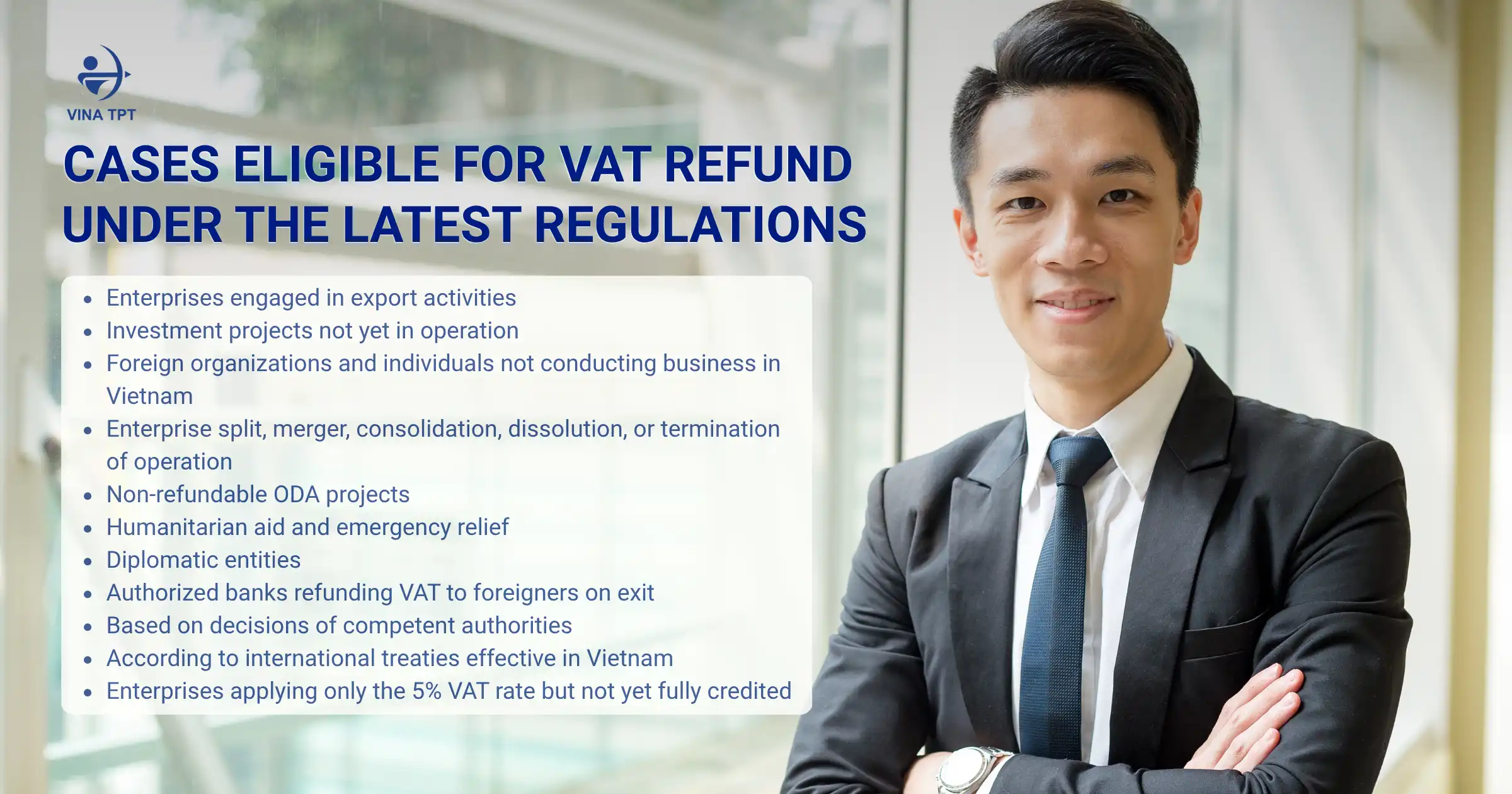
VAT Refund in Vietnam 2025_ Updated Conditions and Eligible Cases Explained - VTPT

No.  Case eligible for VAT refund  Main conditions  Legal basis 
1  Enterprises engaged in export activities  Exported goods and services are subject to a 0% VAT rateInput VAT not yet credited is ≥ VND 300 million

Must have valid customs documents and bank payment records 

Article 13, VAT Law 2024 
2  Investment projects not yet in operation  The investment project has been duly registeredNo revenue has been generated

Input VAT not yet credited is ≥ VND 300 million 

Article 13, VAT Law 2024 
3  Enterprise split, merger, consolidation, dissolution, or termination of operation  The enterprise no longer operates to deduct input VATRemaining input VAT has not yet been credited  Article 13, Amended VAT Law 2008 
4  Foreign organizations and individuals not conducting business in Vietnam  Possess valid tax payment documentsDo not conduct regular business activities in Vietnam  Circular 219/2013/TT-BTC, Article 18 
5  Non-refundable ODA projects  Not using the state budget to pay VATPossess valid confirmation from the donor  VAT Law 2024, Circular 219 
6  Humanitarian aid and emergency relief  Must have a decision approving the receipt of aidMust provide valid documents related to goods and input invoices  Circular 219/2013/TT-BTC 
7  Đối tượng ngoại giao (miễn trừ)  Must have confirmation from the State Protocol DepartmentApplied under international treaties  Decree 134/2016/NĐ-CP 
8  Authorized banks refunding VAT to foreigners on exit  Must have a goods management systemMust prepare a tax refund list according to the prescribed form  Circular 92/2019/TT-BTC 
9  Based on decisions of competent authorities  Must have an official document/decision on tax refundApplied in special cases, subject to post-refund inspection  Decree 49/2022/NĐ-CP 
10  According to international treaties effective in Vietnam  Must fall under subjects clearly stated in the treatyMust provide complete dossiers and supporting documents  Law on International Treaties, Law on VAT 
11  Enterprises applying only the 5% VAT rate but not yet fully credited  Input VAT not yet credited ≥ 300 million VNDAfter 12 months or 4 consecutive quarters – applicable from 01/07/2025  Amended VAT Law 2024

 VAT 2025 Update:The 2024 Value Added Tax (VAT) Law will officially take effect from July 1, 2025.

3. Conditions for VAT refund

Depending on the type of enterprise, the conditions for VAT refund may vary

3.1. For domestic enterprises 

  • Undeducted input VAT of at least VND 300 million
  • Có Valid e-invoices andnon-cash payments for invoices from VND 20 million
  • Not under tax enforcement measures or committing tax violations
  • Proper and timely tax declaration 

3.2. For exporting enterprises 

  • Export contracts, customs declarations, and bank payment documents 
  • Continuous undeducted VAT for 3 periods or at least VND 300 million in one period
  • Exported goods must be cleared through customs
  • No fraudulent invoice transactions 

Note: From 2025, under the amended VAT Law, exporters with undeducted VAT over VND 100 million in a period may apply for refund earlier, reducing waiting time.

3.3. For investment projects 

  • Must have an Investment Registration Certificate 
  • No revenue generated, but large undeducted VAT incurred 
  • Separate bank account for the project 
  • Separate accounting for project expenses 

3.4. For foreign organizations/individuals 

  • Valid proof of VAT paid in Vietnam 
  • Non-regular business activities 
  • Full compliance with tax declaration and refund procedures 

Explore Our Tax Services

 4. Cases Not Eligible for VAT Refund

(According to Circular 219/2013/TT-BTC, amended by Circular 130/2016/TT-BTC)

  • Investment projects with insufficient charter capital contribution
    If, by the time of filing the VAT refund application (from July 1, 2016 onwards), the enterprise has not contributed the full registered charter capital it will not be eligible for refund. Instead, the uncredited input VAT will only be carried forward to the next CIT period.
  • Conditional investment sectors not meeting requirements under the Law on Investment
    This includes cases where the enterprise has not obtained the necessary license, certificate of eligibility, or written approval from the competent authority.  
  • Violation of conditions during project implementation
    If, during the implementation, the project has its license or certificate revoked, or is found no longer to meet conditional business requirements, VAT refund will be suspended from that point onward.  
  • Projects involving natural resource/mineral exploitation or production with ≥ 51% cost structure derived from natural resources
    Applicable to projects licensed from July 1, 2016. The determination of the resource ratio is guided under Clause 23, Article 4 of Circular 219.  
  • Imported goods for export but not exported through the prescribed customs area
    VAT refund is not eligible if export procedures are not carried out at the designated customs office.  
  • Exported goods not completing customs procedures at the customs-controlled area
    In this case, VAT refund is also not eligible. 

5. Key Notes on VAT Refund for Businesses

  • Do not consolidate VAT refund applications across multiple periods unless specifically guided by regulations. 
  • Carefully check the payment timeline and payment conditions of each invoice. 
  • For exporting enterprises, clearly keep records of customs declarations, bills of lading, and payment documents.
  • Always review the validity of input invoices – especially those from new suppliers. 

6. Simplify Your VAT Refund with Vina TPT’s Professional Support

Navigating the VAT refund process in Vietnam can be complex, especially with changing tax regulations and documentation requirements. Vina TPT offers professional support to help businesses simplify every step, from eligibility assessment to refund application and follow-up with tax authorities. With deep expertise in Vietnamese tax law, our team ensures accuracy, compliance, and maximum refund value for your company. Partnering with Vina TPT means saving time, avoiding costly errors, and gaining peace of mind knowing your VAT refund is handled by trusted professionals. Let Vina TPT streamline your refund process efficiently and transparently.

Contact Vina TPT today to simplify your VAT refund process!

Discuss Your Case with Our Specialists

accounting skills

Step-by-Step Accounting Procedures for FDI Enterprises in Vietnam

Accounting Procedures for FDI company in Vietnam

Accounting Procedures for FDI company in Vietnam

1/ Challenges of Accounting Procedures for FDI Vietnam

Foreign direct investment has become a cornerstone of Vietnam’s economic growth, attracting multinational corporations and small enterprises alike. However, the journey for FDI Vietnam operations is not without obstacles. One of the most pressing issues is compliance with accounting procedures that are both complex and highly regulated.  

Unlike some jurisdictions where accounting systems are more flexible, Vietnamese accounting follows strict rules set by the Ministry of Finance. FDI companies frequently encounter barriers in understanding these procedures because the framework is rooted in local law, written in Vietnamese, and subject to regular amendments. The language barrier is significant, since all accounting documents and reports must be prepared in Vietnamese. This requirement often results in additional administrative costs and reliance on professional translation or advisory services.  

Another common challenge is the fast-changing regulatory environment. Tax regulations, reporting requirements, and compliance obligations are updated frequently, sometimes annually. Without a reliable accounting guide, FDI companies may struggle to stay up to date, leading to errors and compliance risks. Moreover, differences in cultural and business practices can cause misunderstandings in financial communication between local partners and foreign headquarters. 

Get Advisory Support

2/ What Are Accounting Procedures for FDI Operations? 

When discussing accounting procedures in Vietnam, it is essential to understand that they go far beyond basic bookkeeping. For FDI enterprises, accounting procedures encompass the entire framework of recording, classifying, summarizing, and reporting financial transactions in line with Vietnamese accounting standards (VAS).  

This includes maintaining accurate ledgers, preparing quarterly and annual financial statements, and fulfilling tax obligations such as value-added tax (VAT), corporate income tax (CIT), and personal income tax (PIT) for employees. Each of these tasks must follow regulations set by the Ministry of Finance and the General Department of Taxation. For example, financial statements must be prepared in Vietnamese dong (VND), regardless of whether the parent company reports in US dollars, euros, or another foreign currency.  

In addition, all reports must be filed within strict deadlines. Late submission or inaccurate reporting can result in penalties or even suspension of business licenses. This is why FDI Vietnam businesses cannot treat accounting as a secondary matter. Instead, they must approach it as a core compliance function that directly impacts operational success and investor confidence. 

3/ Key Differences Between Vietnamese Accounting (VAS) and International Standards (IFRS) 

One of the most challenging aspects for FDI enterprises is reconciling Vietnamese accounting practices with international standards such as International Financial Reporting Standards (IFRS). The differences between the two systems are not merely technical but often affect how companies strategize their operations in Vietnam.  

For instance, VAS is highly compliance-driven and closely tied to tax regulations, while IFRS prioritizes transparency and comparability for investors. This means that under VAS, companies may need to record expenses and revenues in ways that differ from international expectations. Furthermore, the language requirement poses additional complexity, as all accounting records must be maintained in Vietnamese, regardless of the company’s internal systems.  

Currency is another significant difference. While multinational corporations often operate in USD or EUR, Vietnamese regulations require financial reporting in VND. This necessitates frequent foreign exchange translations, which may create discrepancies between local and global reports.  

These differences are not insurmountable but require careful planning and professional support. Companies often rely on advisory services such as Vina TPT Accounting Service to ensure smooth reconciliation between VAS and IFRS. This allows them to satisfy both local authorities and international stakeholders. 

Get Expert Accounting Support

4/ Risks of Non-Compliance with Vietnamese Accounting Regulations 

The consequences of failing to follow accounting procedures in Vietnam can be severe. Financial penalties are the most immediate risk, as the tax authorities impose fines for late submissions, missing documents, or incorrect financial statements. However, the risks extend beyond monetary loss.  

Non-compliance can damage a company’s reputation, eroding trust with local partners, regulators, and even investors abroad. For multinational corporations, reputational harm in one jurisdiction can quickly spread across global markets. Moreover, persistent violations may lead to stricter audits, sanctions, or even suspension of licenses.  

There is also the risk of operational delays. For example, companies that fail to comply with accounting regulations may face challenges when applying for tax refunds, investment incentives, or expansion licenses. This creates unnecessary bottlenecks in growth strategies. According to the Ministry of Finance of Vietnam, maintaining compliance with financial reporting standards is a prerequisite for building credibility in the local market. 

IFRS

5/ How an Accounting Guide Helps FDI Companies in Vietnam 

An effective accounting guide acts as a roadmap for FDI Vietnam businesses. Rather than reacting to compliance issues after they arise, companies can proactively manage their obligations through structured guidance. A comprehensive guide explains in detail how to maintain ledgers, prepare financial statements, and align reporting with both VAS and international standards.  

The benefits of using an accounting guide are significant. It reduces the likelihood of errors in tax filings, ensures timely submission of reports, and provides clarity on the differences between local and international standards. For new entrants into the Vietnamese market, an accounting guide can shorten the learning curve and prevent costly mistakes.  

Beyond compliance, such guides also help companies design internal processes that optimize efficiency. For instance, knowing how to structure payroll systems according to Vietnamese tax laws can save both time and resources. Access to reliable information from trusted sources such as Google Scholar further reinforces decision-making and ensures that companies rely on accurate, up-to-date knowledge. 

6/ Vina TPT Accounting Service – Professional Solutions for FDI Enterprises 

At Vina TPT Accounting Service, we recognize the difficulties foreign investors encounter when dealing with Vietnamese accounting regulations. Our mission is to provide professional, reliable, and customized solutions that help FDI enterprises thrive in Vietnam.  

We offer comprehensive bookkeeping services tailored to the needs of foreign companies, ensuring all transactions comply with VAS. Our tax compliance support minimizes the risks of penalties and audits, giving businesses peace of mind. We also provide consulting services on IFRS-VAS reconciliation, helping companies deliver consistent and transparent reports to both local authorities and international headquarters.  

What sets Vina TPT Accounting Service apart is our commitment to clarity. We develop customized accounting guides for each client, simplifying complex regulations into practical, easy-to-follow steps. This empowers foreign enterprises to focus on what matters most: growing their business in one of Asia’s most dynamic economies.  

If your enterprise is seeking a reliable partner to navigate accounting procedures in Vietnam, Vina TPT is here to help. Visit our official service page for more details or contact us directly for a consultation.  

Let Vina TPT Accounting Service be your trusted partner in Vietnam. Reach out today to secure compliance and accelerate your business success. 

Book a free consultation

vina tpt accounting & tax firm


Vietnam Foreign Contractor Tax: Ultimate Guide for 2025 

vietnam foreign contractor tax

vietnam foreign contractor tax

Vietnam Foreign Contractor Tax (FCT), also known as Foreign Contractor Withholding Tax (FCWT), is a crucial withholding tax regime in Vietnam that applies to non-resident entities earning income from goods, services, or other activities sourced in the country. Governed primarily by Circular 103/2014/TT-BTC and updated through recent decrees like Decree 181/2025/ND-CP and Circular 69/2025/TT-BTC, FCT combines Value-Added Tax (VAT) and Corporate Income Tax (CIT) or Personal Income Tax (PIT) components to ensure foreign businesses comply with local tax obligations. This tax is particularly important for foreign contractors, suppliers, and digital service providers operating in Vietnam without a permanent establishment (PE), as non-compliance can lead to penalties, audits, and barriers to market entry. 

For quick assessment: Is FCT applicable to your business? 

1/ Checklist for Vietnam Foreign Contractor Tax Applicability: 

  • Are you a non-resident entity providing goods/services in Vietnam? (Yes/No) 
  • Does the transaction involve Vietnam-sourced income? (Yes/No) 
  • No permanent establishment in Vietnam? (Yes/No) 
  • If mostly “Yes,” FCT likely applies—consult a tax expert. 
Component  Description  Basic Rates (2025) 
VAT  Tax on added value in transactions  2-5% (with 2% reduction extended to Dec 2025) 
CIT  Income tax on profits  0.1-10% depending on activity 
PIT  For individuals  Up to 10% on gross income 

This overview sets the context: We’ll dive deeper into who pays, how to calculate, and tips for 2025 compliance, ensuring a logical flow from basics to advanced scenarios. 

2/ What is Vietnam Foreign Contractor Tax (FCT)? 

Foreign Contractor Tax (FCT) is a withholding tax imposed on payments made to foreign entities (non-residents) for income derived from Vietnam, regardless of where the contract is signed or services performed. It’s not a separate tax but a hybrid mechanism combining VAT and CIT (or PIT for individuals), withheld by the Vietnamese payer to simplify collection from non-residents. Introduced under Circular 103/2014/TT-BTC, FCT ensures foreign contractors contribute to Vietnam’s tax base without needing full residency. 

In 2025, updates via Circular 69/2025/TT-BTC emphasize stricter enforcement on e-commerce, aligning with global digital tax trends. Unlike standard withholding taxes (e.g., on dividends), FCT applies broadly to service-inclusive transactions, preventing tax evasion in cross-border deals. 

  • Key Components of FCT: 
  • VAT Portion: Covers value added, creditable for Vietnamese parties. 
  • CIT/PIT Portion: Taxes deemed profits. 
  • Hybrid Nature: Allows flexibility in calculation methods. 

For example, a foreign software firm licensing tech to a Vietnamese company pays FCT on royalties, contrasting with pure export taxes which might be exempt. This definition builds a foundation, leading to who it affects next. 

3/ Who is Subject to FCT? 

FCT targets non-resident foreign entities and individuals earning Vietnam-sourced income without a PE. This includes overseas contractors, subcontractors, suppliers, and digital platforms, as per updates in Official Letter 2200/CT-CS and 2025 regulations. 

Main Subjects: 

  • Foreign organizations providing services/goods in Vietnam. 
  • Non-resident individuals (e.g., consultants) without 183-day presence. 
  • E-suppliers like online marketplaces under new 2025 rules. 
Type of Subject  Conditions for Applicability  Examples 
Organizations  No PE; Vietnam-sourced income  Foreign engineering firms, SaaS providers 
Individuals  Non-residents earning fees  Expat freelancers, licensors 
E-Suppliers  Digital services to VN users  Streaming platforms, ad networks 

Checklist to Determine Liability: 

  • Income from VN contract? (Yes → Likely liable) 
  • Services performed in VN or goods with installation? (Yes → Liable) 
  • Treaty relief available? (Check DTAs) 
  • If unsure, register for clarification to avoid penalties. 

This section flows from definition to identification, highlighting 2025 e-supplier expansions for comprehensive coverage. 

Get to tax expert

Transactions Subject to FCT 

FCT applies to a wide range of cross-border transactions generating Vietnam-sourced income, including those with service elements. In 2025, this extends to digital distributions and royalties under tightened rules. 

Categories of Transactions: 

  • Goods sales bundled with services (e.g., equipment + installation). 
  • Pure services (e.g., consulting, training). 
  • Other income (e.g., interest, royalties, asset transfers). 
Transaction Type  Description  Examples  B2B vs. B2C Comparison 
Goods + Services  Sales with VN-linked support  Machinery import with setup  B2B: Higher scrutiny; B2C: Rare but taxable if services involved 
Services  Performed for VN entities  IT consulting  B2B: Standard FCT; B2C: E-commerce focus in 2025 
Other Income  Royalties, leases  Software licensing  Similar rates, but B2C digital often via platforms 

Risks include misclassifying pure goods as taxable—contextual examples like SaaS vs. physical sales add depth, transitioning to exemptions. 

Exemptions from FCT 

Certain transactions escape FCT if they meet strict criteria, reducing burdens for pure trade.  

  • Key Exemptions: 
  • Pure goods supply without VN services. 
  • Services wholly performed outside Vietnam. 
  • Reinsurance, international transport (partial). 
Exempt Scenario  Taxable Scenario  Reason 
Goods delivered at border  Goods + VN installation  No service element 
Offshore consulting  On-site training  Location of performance 
DTA-covered royalties  Non-treaty interest  Treaty provisions 

Always verify via DTAs; this hierarchy from common to specific ensures logical progression to calculations. 

Get expert support today

4/ Vietnam Foreign Contractor Tax Calculation Methods 

Foreign contractors can choose from three methods for FCT computation, each suiting different operational setups. Selection depends on eligibility and records, with 2025 updates favoring deduction for compliant firms. 

Method  Conditions  Pros/Cons 
Direct (Withholding)  No PE; simple records  Pros: Easy; Cons: Higher effective tax 
Deduction (VAS)  PE or 183+ days; full accounting  Pros: Lower on net; Cons: Audit-heavy 
Hybrid  Similar to Deduction; partial records  Pros: Flexible; Cons: Complex application 
  • Overview: Start with eligibility check, then apply rates—detailed sub-sections follow for hierarchy. 

4.1/ Direct Method (Withholding Method) 

The simplest approach: Tax is withheld on gross revenue using deemed rates. 

  • Steps: 
  • Identify gross turnover. 
  • Apply VAT (2-5%) + CIT (0.1-10%). 
  • Vietnamese party withholds within 10 days post-payment. 

Example: $100,000 service contract → VAT 5% ($5,000) + CIT 5% ($5,000) = $10,000 FCT. 

Revenue Gross  Rate  Tax Due 
$100,000  VAT 5% + CIT 5%  $10,000 

Flow: From formula to deadlines, ensuring practical application. 

4.2/ Deduction Method

Applicable Subjects:

Foreign contractors and foreign subcontractors are subject to tax when they meet all of the following conditions:

  • They have a permanent establishment in Vietnam or are identified as residents in Vietnam;
  • The duration of business operations in Vietnam under the contractor or subcontractor contract is 183 days or more, calculated from the effective date of the contract;
  • They comply with Vietnamese accounting regulations, register for tax, and are issued a tax identification number by the tax authority.
Methods of calculating VAT and Corporate Income Tax:
The declaration and determination of VAT and Corporate Income Tax are carried out according to the provisions of the VAT Law, the Corporate Income Tax Law, and related guiding documents.

4.3/ Hybrid Method 

Applicable Subjects:
Foreign contractors and foreign subcontractors, upon meeting the conditions for applying the declaration method or the direct method, and simultaneously implementing accounting procedures as prescribed by law on accounting and guidance from the Ministry of Finance, must register with the tax authorities to declare and pay taxes. Accordingly, VAT is applied using the deduction method and corporate income tax is calculated as a percentage of taxable revenue.
VAT for foreign contractors:
The determination and calculation of VAT are carried out according to the VAT Law and related guiding documents.
CIT for foreign contractors:
CIT is calculated using the direct method as prescribed by current regulations.

5/ FCT Rates 

Tax rates vary depending on the activity, with VAT at 2-5% (note that the 2% VAT reduction policy has been extended until the end of 2025 for certain industry groups) and corporate income tax from 1 -10%. Personal income tax (PIT) is governed by the law on PIT.

Activity  VAT Rate  CIT Rate  Examples 
Construction  3%  2%  Building projects 
Royalties  5%  10%  IP licensing 
Services  5%  5%  Consulting 


Get Free Consultation on Foreign Contractor Tax

6/ Declaration and Payment Procedures 

Steps: 

  • Register tax code (5 days before first transaction). 
  • Declare quarterly via GDT portal. 
  • Pay online within deadlines. 

Text Flowchart: Registration → Declaration (quarterly) → Payment (10 days post) → Audit if needed. 

7/ Frequently Asked Questions (FAQs) 

  1. What is the difference between FCT and standard withholding tax? FCT is broader, combining VAT/CIT for contractors, while standard applies to dividends/interest. 
  2. Is FCT applicable to e-commerce in 2025? Yes, with platforms withholding from July 1. 
  3. What if I have a PE? Switch to standard CIT; FCT may not apply. 
  4. Can I get a refund for overpaid FCT? Yes, via audit and claim within 5 years. 
  5. How to calculate FCT for hybrids? VAT on net, CIT on gross—consult for specifics. 
  6. Are there penalties for non-compliance? Up to 20% fines plus interest. 

If you need expert assistance with Foreign Contractor Tax (FCT) in Vietnam.

VINA TPT Tax Consultancy specializes in providing optimal solutions for Foreign Contractor Tax (FCT) for foreign businesses and partners in Vietnam. We help you understand and comply with the latest 2025 regulations, ensuring:

With a team of experts boasting over 20 years of experience and deep expertise in international taxation, VINA TPT is committed to supporting your business, from registration and declaration to crafting tax strategies tailored to your business model.

Book a Free Consultation with Our Expert

vina tpt accounting & tax firm