[Newsletter] Vietnam Tax Policy Updates November 2025 – VAT, PIT and Labor

Vietnam-Tax-Policy-Updates-November-2025-VAT-PIT-and-Labor-Vina-TPT

Vietnam-Tax-Policy-Updates-November-2025-VAT-PIT-and-Labor-Vina-TPT

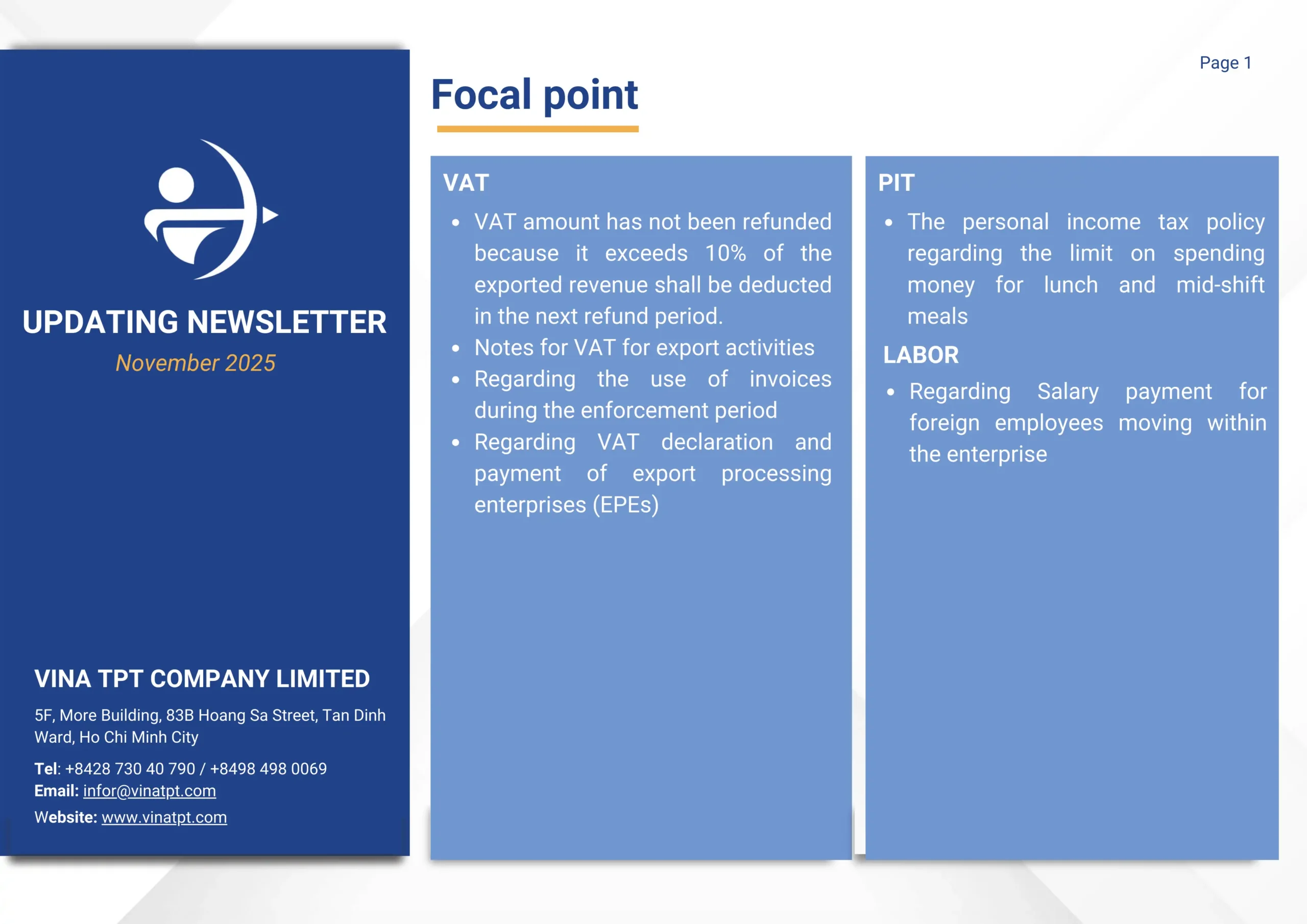
The November 2025 newsletter highlights key Vietnam tax policy updates that businesses need to closely monitor. The focus is on important VAT regulations related to export activities, VAT refund mechanisms, invoice usage during enforcement periods, and compliance requirements for export processing enterprises (EPEs). In addition, the update addresses notable Personal Income Tax (PIT) changes, particularly policies on employee meal allowances, as well as labor regulations governing salary payments for foreign employees transferring within an enterprise. These developments have significant implications for business compliance, operations, and tax planning in Vietnam.

1. VALUE ADDED TAX (VAT)

1.1. VAT amount has not been refunded because it exceeds 10% of the exported revenue shall be deducted in the next refund period.

Official dispatch No. 5094/CT-CS dated November 11, 2025 of the Tax Department on Notes on VAT refund policy for exported goods
Regulations related to VAT refunds for exported goods and services were previously stated in Article 2 of Circular 25/2018/TT-BTC (amending and supplementing Clause 4, Article 18 of Circular 219/2013/TT-BTC) and are now applied according to the provisions of Clause 1, Article 15 of VAT Law No. 48/2024/QH15, Clause 2, Article 29 of Decree 181/2025/ND-CP and Appendix II of Circular No. 69/2025/TT-BTC.
According to Vietnam tax policy updates, in case a business establishment exports goods and services in a month or quarter, if the input VAT amount that has not been fully deducted is 300 million VND or more, it will be entitled to a VAT refund on a monthly or quarterly basis. However, the maximum refunded input VAT amount of exported goods and services must not exceed 10% of the revenue of exported goods and services in the tax refund period.
For the input VAT amount of exported goods and services that has not been refunded because it exceeds 10% of the revenue of exported goods and services of the previous tax refund period, the enterprise is allowed to deduct it in the next tax period to determine the VAT amount to be refunded for exported goods and services of the next tax refund period.
1.2. Notes for VAT for export activities:

Official dispatch No. 5489/CT-CS dated November 25, 2025 of the Tax Department on value added tax policy.

According to the Tax Department’s note, the principle of input VAT deduction for goods and services used for production and trading of goods and services subject to VAT is to be fully deducted (Article 14 of the Law on VAT No. 48/2024/QH15, Clause 1, Article 23 of Decree No.181/2025/ND-CP, Clause 4, Article 24 of Decree No. 181/2025/ND-CP).

In case an enterprise has both export and domestic consumption activities, it is necessary to separately account for input VAT for export activities (Clause 1, Article 15 of VAT Law No.48/2024/QH15, Clause 2, Article 29 of Decree No. 181/2025/ND-CP). If it is not possible to account separately, the input VAT for exported goods will be determined according to the ratio of export revenue to total taxable revenue (Appendix II of Circular No. 69/2025/TT-BTC).

1.3. Regarding the use of invoices during the enforcement period

According to Official dispatch No. 5282/CT-CS dated November 18, 2025 of the Tax Department on the conditions for allowing invoice issuance during the period of enforcement, Tax Department has based on the provisions of Article 4, Article 13 of Decree 123/2020/ND-CP (amended in Clause 3, Clause 10, Article 1 of Decree 70/2025/ND-CP) and Article 34 of Decree 126/2020/ND-CP to respond as follows:

  • Under the latest Vietnam tax policy updates, in cases where an enterprise is subject to compulsory measures to stop using invoices but submits a written request to continue invoice usage and falls under situations where the tax authority issues invoices on a per-occurrence basis, the enterprise will be issued electronic invoices with codes from the tax authority for each occurrence. The enterprise bears full responsibility for the accuracy of all information stated on these electronic invoices. The issuance and declaration of related tax obligations for invoices issued per occurrence by the tax authority must be carried out in accordance with Clause 10, Article 1 of Decree No. 70/2025/ND-CP.
  • In case an enterprise is being forced to stop using invoices and has a written request to use invoices to have a source of payment for workers’ salaries and expenses to ensure continuous production and business, the tax authority will continue to allow the enterprise to use invoices each time they arise, on the condition that the enterprise must immediately pay at least 18% of the revenue on the used invoices to the state budget according to the provisions of Point d, Clause 4, Article 34 of Decree No. 126/2020/ND-CP mentioned above.

1.4. Regarding VAT declaration and payment of export processing enterprises (EPEs)

Official dispatch No. 3905/HYE-QLDN3 dated October 31, 2025 of Hung Yen Provincial Tax Department has provided the instructions regarding VAT declaration and payment of export processing enterprises (EPEs) as below:

  1. VAT payers:
  • The enterprise is not a VAT payer for production activities for export (export processing activities) and is not required to declare VAT for this activity.
  • Export processing enterprises must pay VAT if they carry out business activities other than export processing activities, for example:

-Purchase domestic goods for export (exercise export rights).

-Import goods for domestic sale (exercise import rights).

  1. Conditions for declaring and paying VAT (for business activities other than manufacturing activities):
  • Separate accounting: Export processing enterprises must separately account for transactions of buying and selling goods that are not part of export processing activities (for example, import-export activities).
  • Tax registration: The enterprise needs to register for tax with the domestic tax authority to declare and pay VAT separately for these other business activities.
  • Arrangement of separate areas: The arrangement of the storage area for goods serving processing activities must ensure separation from the storage area for goods serving other production and business activities.
  1. VAT declaration period:
  • Monthly declaration: According to the provisions of Point a, Clause 1, Article 8 of Decree No. 126/2020/ND-CP, the enterprise shall declare VAT monthly.
  • Quarterly declaration: If the enterprise meets the criteria specified in Point a, Clause 1, Article 9 of Decree No.126/2020/ND-CP (total revenue from sales of goods and provision of services of the previous year is 50 billion VND or less), the enterprise can choose to declare VAT quarterly.
  1. Using invoices:
  • If the enterprise declares VAT using the deduction method, use VAT invoices.
  • If the enterprise declares VAT using the direct method, use sales invoices.
  • When selling goods and providing services domestically and when selling goods and providing services between organizations and individuals in duty-free zones, exporting goods and providing services abroad, the invoice must clearly state “For organizations and individuals in duty-free zones”.

In short, under the latest Vietnam tax policy updates, export processing enterprises are only required to declare and pay VAT for business activities other than export processing activities (production of export goods). These enterprises must separately account for such activities and register for tax to declare and pay VAT in accordance with regulations. The VAT declaration period may be monthly or quarterly, depending on the revenue of the previous year.
Vietnam-Tax-Policy-Updates-November-2025-VAT-PIT-and-Labor-Vina-TPT

2. PERSONAL INCOME TAX (PIT)

2.1. The Personal income tax policy regarding the limit on spending money for lunch and mid-shift meals

As part of the Vietnam tax policy updates, Official Dispatch No. 5106/CT-CS dated November 12, 2025, issued by the Tax Department, provides guidance on personal income tax policy regarding the limits on lunch and mid-shift meal expenses used as a basis for determining personal income tax. In this dispatch, the Tax Department cites the following regulations and instructions for reference:

  • Article 103 of the Labor Code No. 45/2019/QH14 stipulates that “The regime of salary increase, promotion, allowances, subsidies and incentives for employees is agreed upon in the labor contract, collective labor agreement or regulations of the employer”.
  • Clause 1, Article 33, Clause 9, Article 34 of Decree No. 44/2025/ND-CP on salary and bonus regimes in state-owned enterprises stipulates: “This Decree takes effect from April 15, 2025 and the regimes in this Decree are implemented from January 1, 2025”. “The mid-shift meal regime or fixed-quantity meal regime for employees, Executive Board, Board Members, and Supervisors is implemented according to the agreement in the collective labor agreement or the internal rules and regulations of the enterprise according to the provisions of the Labor Code”.
  • Article 10 of Decree No. 248/2025/ND-CP on salary and bonus regimes in state-owned enterprises stipulates: “This Decree takes effect from September 15, 2025 and the regimes in this Decree are implemented from August 1, 2025. Decree No. 44/2025/ND-CP is abolished”.
  • Section g.5, Clause 2, Article 2 of Circular No. 111/2013/TT-BTC stipulates: “In case the employer does not organize mid-shift meals or lunch but pays for the employee, it is not included in the taxable income of the individual if the level of expenditure is in accordance with the guidance of the Ministry of Labor – Invalids and Social Affairs. In case the level of expenditure is higher than the guidance of the Ministry of Labor – Invalids and Social Affairs, the excess expenditure must be included in the taxable income of the individual. The specific expenditure level applicable to state-owned enterprises… shall not exceed the guidance of the Ministry of Labor – Invalids and Social Affairs. For non-state-owned enterprises… the expenditure level shall be decided by the head of the unit in agreement with the chairman of the trade union but shall not exceed the level applicable to state-owned enterprises”.
  • In Vietnam tax policy updates: Official Dispatch No. 1387/CTL&BHXH-TLSXKD dated September 29, 2025 of the Ministry of Home Affairs, it is instructed: “According to the provisions of Article 103 of the Labor Code, incentive regimes for employees are agreed upon in the labor contract, collective labor agreement or regulations of the employer. The mid shift meal regime for employees, Executive Board, Council members, and Controllers in state-owned enterprises from January 1, 2025 to July 31, 2025 is implemented according to the provisions of Clause 9, Article 34 of Decree No. 44/2025/ND-CP on salary and bonus regimes in state-owned enterprises; from August 1, 2025, it is implemented according to the provisions of the Labor Code”.

According to Vietnam tax policy updates, the current allowance of VND 730,000 per month for mid-shift meals has been abolished. Instead, enterprises may determine a reasonable allowance level based on the agreements in the collective labor agreement or in the company’s internal rules and regulations. In the case where the Company incurs expenses for mid-shift meals for employees working at the company, if this allowance is specifically stipulated regarding eligibility conditions and allowance levels in the labor contract, the collective labor agreement, or the company’s internal rules and regulations, it shall not be included in taxable personal income (PIT). If the allowance exceeds the stipulated level, the excess amount will be included in taxable PIT income.
Vietnam-Tax-Policy-Updates-November-2025-VAT-PIT-and-Labor-Vina-TPT

3. LABOR 

3.1. Regarding Salary payment for foreign employees moving within the enterprise

Official dispatch No. 10861/BNV-CVL dated November 19, 2025 of the Ministry of Home Affairs on domestic salary payment for foreign employees moving within the enterprise.

The Ministry of Home Affairs notes that, in the case of “foreign workers being paid (in Vietnam)”, before the expected working date, the enterprise employing the foreign worker must request a work permit and sign a labor contract as prescribed (Clause 1, Article 13, Point d, Clause 1, Article 21 of the Labor Code No. 45/2019/QH14 and Point a, Clause 1, Article 2, Clause 4, Article 22 of Decree 219/2025/ND-CP), and must also participate in compulsory social insurance in Vietnam for this person as prescribed (Point a, Clause 2, Article 2 of the Law on Social Insurance No. 41/2024/QH15).

The case of “foreign employees being paid in Vietnam” (performing procedures to request a work permit) and the case of “foreign employees transferring within the enterprise” (performing procedures to request a certificate of not being subject to a work permit under Article 8 of Decree 219/2025/ND-CP) are two different cases according to the provisions of the Labor Code No. 45/2019/QH14 and guiding documents on foreign employees working in Vietnam.

BOOK A FREE CONSULTATION

Vina TPT Accounting services


VAT Refund in Vietnam 2025: Updated Conditions and Eligible Cases Explained

VAT Refund in Vietnam 2025 Updated Conditions and Eligible Cases Explained-VTPT

VAT Refund in Vietnam 2025_ Updated Conditions and Eligible Cases Explained - VTPT

1.What is a VAT Refund and When is a Business Entitled to it?

Value-Added Tax (VAT) refund refers to the process by which the State reimburses the amount of VAT that a business has either paid into the State budget or has not yet been deducted. When a business meets specific VAT refund conditions, it will be entitled to receive back the paid tax amount. The purpose of this policy is to prevent double taxation and to support businesses in investment or export activities.

Businesses are eligible for VAT refunds when they fall under the cases stipulated by law and meet the specific refund conditions applicable to their business type. Detailed information will be provided by Vina TPT in this article.

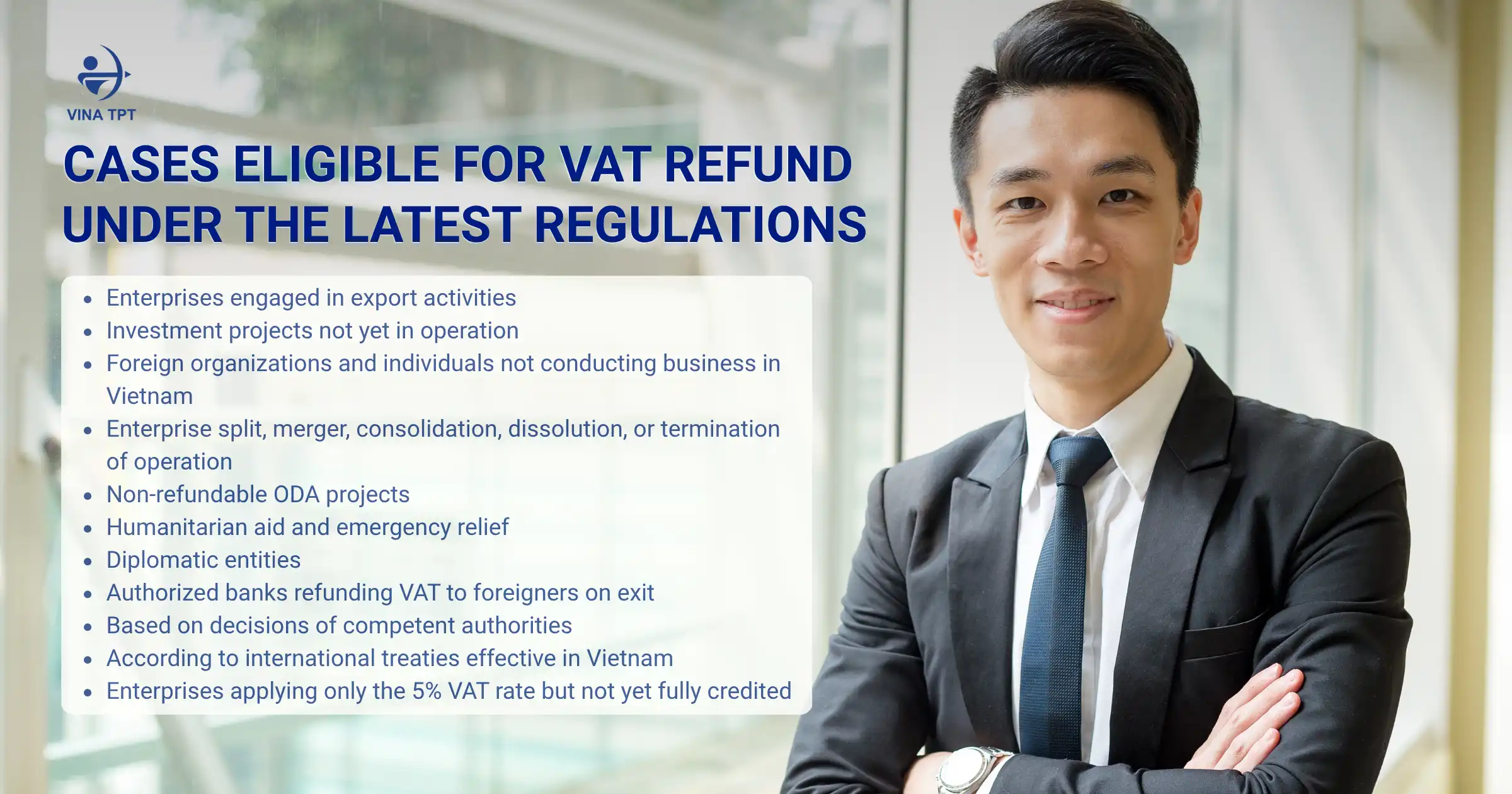
2.Cases Eligible for VAT Refund Under the Latest Regulations

VAT Refund in Vietnam 2025_ Updated Conditions and Eligible Cases Explained - VTPT

No.  Case eligible for VAT refund  Main conditions  Legal basis 
1  Enterprises engaged in export activities  Exported goods and services are subject to a 0% VAT rateInput VAT not yet credited is ≥ VND 300 million

Must have valid customs documents and bank payment records 

Article 13, VAT Law 2024 
2  Investment projects not yet in operation  The investment project has been duly registeredNo revenue has been generated

Input VAT not yet credited is ≥ VND 300 million 

Article 13, VAT Law 2024 
3  Enterprise split, merger, consolidation, dissolution, or termination of operation  The enterprise no longer operates to deduct input VATRemaining input VAT has not yet been credited  Article 13, Amended VAT Law 2008 
4  Foreign organizations and individuals not conducting business in Vietnam  Possess valid tax payment documentsDo not conduct regular business activities in Vietnam  Circular 219/2013/TT-BTC, Article 18 
5  Non-refundable ODA projects  Not using the state budget to pay VATPossess valid confirmation from the donor  VAT Law 2024, Circular 219 
6  Humanitarian aid and emergency relief  Must have a decision approving the receipt of aidMust provide valid documents related to goods and input invoices  Circular 219/2013/TT-BTC 
7  Đối tượng ngoại giao (miễn trừ)  Must have confirmation from the State Protocol DepartmentApplied under international treaties  Decree 134/2016/NĐ-CP 
8  Authorized banks refunding VAT to foreigners on exit  Must have a goods management systemMust prepare a tax refund list according to the prescribed form  Circular 92/2019/TT-BTC 
9  Based on decisions of competent authorities  Must have an official document/decision on tax refundApplied in special cases, subject to post-refund inspection  Decree 49/2022/NĐ-CP 
10  According to international treaties effective in Vietnam  Must fall under subjects clearly stated in the treatyMust provide complete dossiers and supporting documents  Law on International Treaties, Law on VAT 
11  Enterprises applying only the 5% VAT rate but not yet fully credited  Input VAT not yet credited ≥ 300 million VNDAfter 12 months or 4 consecutive quarters – applicable from 01/07/2025  Amended VAT Law 2024

 VAT 2025 Update:The 2024 Value Added Tax (VAT) Law will officially take effect from July 1, 2025.

3. Conditions for VAT refund

Depending on the type of enterprise, the conditions for VAT refund may vary

3.1. For domestic enterprises 

  • Undeducted input VAT of at least VND 300 million
  • Có Valid e-invoices andnon-cash payments for invoices from VND 20 million
  • Not under tax enforcement measures or committing tax violations
  • Proper and timely tax declaration 

3.2. For exporting enterprises 

  • Export contracts, customs declarations, and bank payment documents 
  • Continuous undeducted VAT for 3 periods or at least VND 300 million in one period
  • Exported goods must be cleared through customs
  • No fraudulent invoice transactions 

Note: From 2025, under the amended VAT Law, exporters with undeducted VAT over VND 100 million in a period may apply for refund earlier, reducing waiting time.

3.3. For investment projects 

  • Must have an Investment Registration Certificate 
  • No revenue generated, but large undeducted VAT incurred 
  • Separate bank account for the project 
  • Separate accounting for project expenses 

3.4. For foreign organizations/individuals 

  • Valid proof of VAT paid in Vietnam 
  • Non-regular business activities 
  • Full compliance with tax declaration and refund procedures 

Explore Our Tax Services

 4. Cases Not Eligible for VAT Refund

(According to Circular 219/2013/TT-BTC, amended by Circular 130/2016/TT-BTC)

  • Investment projects with insufficient charter capital contribution
    If, by the time of filing the VAT refund application (from July 1, 2016 onwards), the enterprise has not contributed the full registered charter capital it will not be eligible for refund. Instead, the uncredited input VAT will only be carried forward to the next CIT period.
  • Conditional investment sectors not meeting requirements under the Law on Investment
    This includes cases where the enterprise has not obtained the necessary license, certificate of eligibility, or written approval from the competent authority.  
  • Violation of conditions during project implementation
    If, during the implementation, the project has its license or certificate revoked, or is found no longer to meet conditional business requirements, VAT refund will be suspended from that point onward.  
  • Projects involving natural resource/mineral exploitation or production with ≥ 51% cost structure derived from natural resources
    Applicable to projects licensed from July 1, 2016. The determination of the resource ratio is guided under Clause 23, Article 4 of Circular 219.  
  • Imported goods for export but not exported through the prescribed customs area
    VAT refund is not eligible if export procedures are not carried out at the designated customs office.  
  • Exported goods not completing customs procedures at the customs-controlled area
    In this case, VAT refund is also not eligible. 

5. Key Notes on VAT Refund for Businesses

  • Do not consolidate VAT refund applications across multiple periods unless specifically guided by regulations. 
  • Carefully check the payment timeline and payment conditions of each invoice. 
  • For exporting enterprises, clearly keep records of customs declarations, bills of lading, and payment documents.
  • Always review the validity of input invoices – especially those from new suppliers. 

6. Simplify Your VAT Refund with Vina TPT’s Professional Support

Navigating the VAT refund process in Vietnam can be complex, especially with changing tax regulations and documentation requirements. Vina TPT offers professional support to help businesses simplify every step, from eligibility assessment to refund application and follow-up with tax authorities. With deep expertise in Vietnamese tax law, our team ensures accuracy, compliance, and maximum refund value for your company. Partnering with Vina TPT means saving time, avoiding costly errors, and gaining peace of mind knowing your VAT refund is handled by trusted professionals. Let Vina TPT streamline your refund process efficiently and transparently.

Contact Vina TPT today to simplify your VAT refund process!

Discuss Your Case with Our Specialists

accounting skills