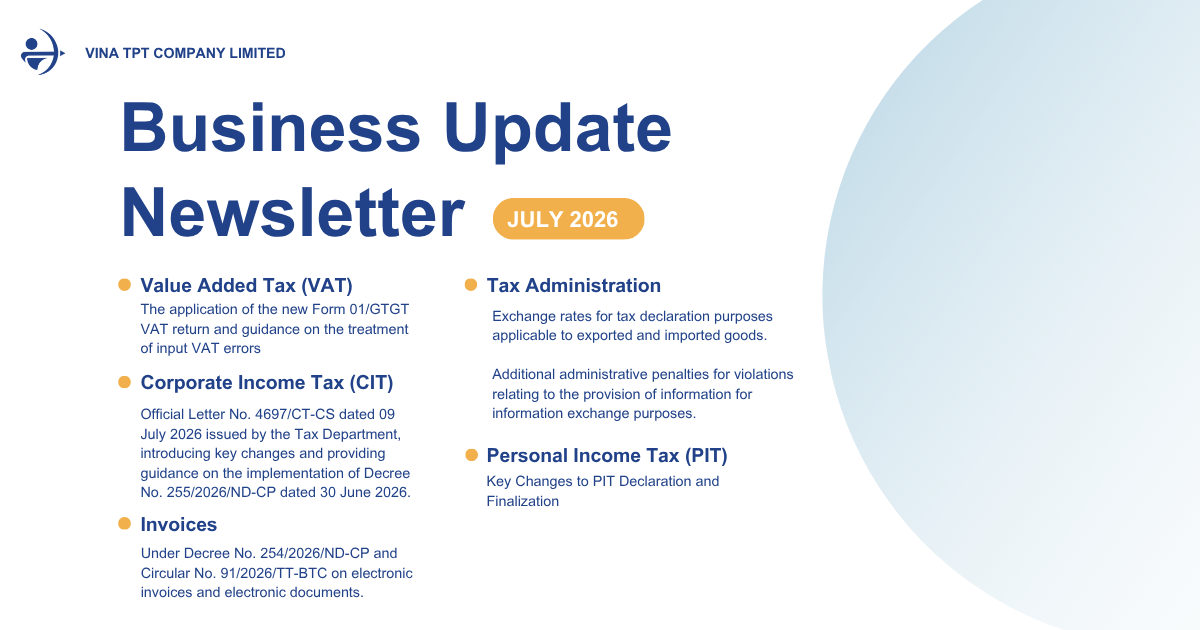
[Newsletter] Vietnam Tax Policy Updates November 2025 – VAT, PIT and Labor

Vietnam-Tax-Policy-Updates-November-2025-VAT-PIT-and-Labor-Vina-TPT

Vietnam-Tax-Policy-Updates-November-2025-VAT-PIT-and-Labor-Vina-TPT

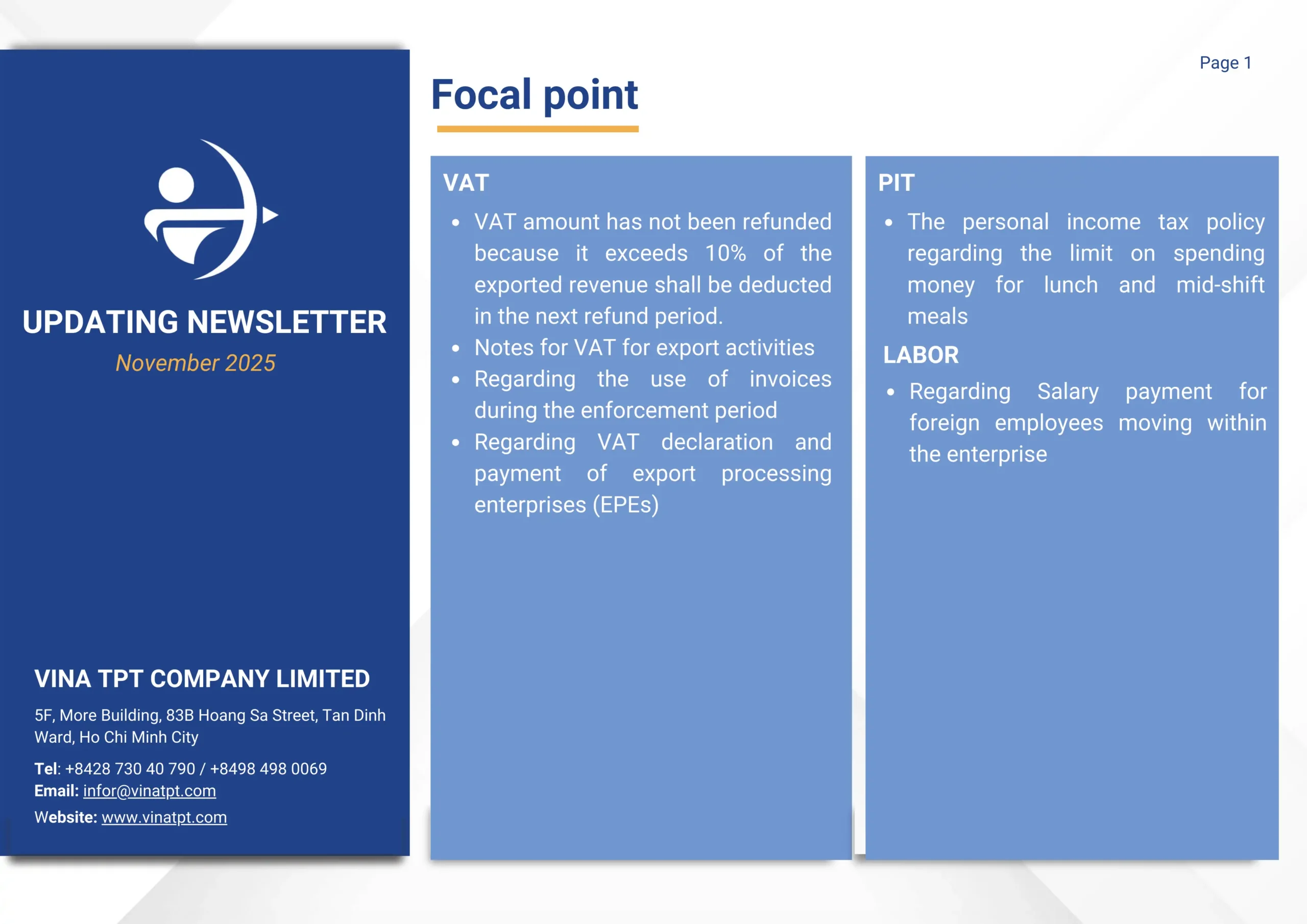
The November 2025 newsletter highlights key Vietnam tax policy updates that businesses need to closely monitor. The focus is on important VAT regulations related to export activities, VAT refund mechanisms, invoice usage during enforcement periods, and compliance requirements for export processing enterprises (EPEs). In addition, the update addresses notable Personal Income Tax (PIT) changes, particularly policies on employee meal allowances, as well as labor regulations governing salary payments for foreign employees transferring within an enterprise. These developments have significant implications for business compliance, operations, and tax planning in Vietnam.

1. VALUE ADDED TAX (VAT)

1.1. VAT amount has not been refunded because it exceeds 10% of the exported revenue shall be deducted in the next refund period.

Official dispatch No. 5094/CT-CS dated November 11, 2025 of the Tax Department on Notes on VAT refund policy for exported goods
Regulations related to VAT refunds for exported goods and services were previously stated in Article 2 of Circular 25/2018/TT-BTC (amending and supplementing Clause 4, Article 18 of Circular 219/2013/TT-BTC) and are now applied according to the provisions of Clause 1, Article 15 of VAT Law No. 48/2024/QH15, Clause 2, Article 29 of Decree 181/2025/ND-CP and Appendix II of Circular No. 69/2025/TT-BTC.
According to Vietnam tax policy updates, in case a business establishment exports goods and services in a month or quarter, if the input VAT amount that has not been fully deducted is 300 million VND or more, it will be entitled to a VAT refund on a monthly or quarterly basis. However, the maximum refunded input VAT amount of exported goods and services must not exceed 10% of the revenue of exported goods and services in the tax refund period.
For the input VAT amount of exported goods and services that has not been refunded because it exceeds 10% of the revenue of exported goods and services of the previous tax refund period, the enterprise is allowed to deduct it in the next tax period to determine the VAT amount to be refunded for exported goods and services of the next tax refund period.
1.2. Notes for VAT for export activities:

Official dispatch No. 5489/CT-CS dated November 25, 2025 of the Tax Department on value added tax policy.

According to the Tax Department’s note, the principle of input VAT deduction for goods and services used for production and trading of goods and services subject to VAT is to be fully deducted (Article 14 of the Law on VAT No. 48/2024/QH15, Clause 1, Article 23 of Decree No.181/2025/ND-CP, Clause 4, Article 24 of Decree No. 181/2025/ND-CP).

In case an enterprise has both export and domestic consumption activities, it is necessary to separately account for input VAT for export activities (Clause 1, Article 15 of VAT Law No.48/2024/QH15, Clause 2, Article 29 of Decree No. 181/2025/ND-CP). If it is not possible to account separately, the input VAT for exported goods will be determined according to the ratio of export revenue to total taxable revenue (Appendix II of Circular No. 69/2025/TT-BTC).

1.3. Regarding the use of invoices during the enforcement period

According to Official dispatch No. 5282/CT-CS dated November 18, 2025 of the Tax Department on the conditions for allowing invoice issuance during the period of enforcement, Tax Department has based on the provisions of Article 4, Article 13 of Decree 123/2020/ND-CP (amended in Clause 3, Clause 10, Article 1 of Decree 70/2025/ND-CP) and Article 34 of Decree 126/2020/ND-CP to respond as follows:

  • Under the latest Vietnam tax policy updates, in cases where an enterprise is subject to compulsory measures to stop using invoices but submits a written request to continue invoice usage and falls under situations where the tax authority issues invoices on a per-occurrence basis, the enterprise will be issued electronic invoices with codes from the tax authority for each occurrence. The enterprise bears full responsibility for the accuracy of all information stated on these electronic invoices. The issuance and declaration of related tax obligations for invoices issued per occurrence by the tax authority must be carried out in accordance with Clause 10, Article 1 of Decree No. 70/2025/ND-CP.
  • In case an enterprise is being forced to stop using invoices and has a written request to use invoices to have a source of payment for workers’ salaries and expenses to ensure continuous production and business, the tax authority will continue to allow the enterprise to use invoices each time they arise, on the condition that the enterprise must immediately pay at least 18% of the revenue on the used invoices to the state budget according to the provisions of Point d, Clause 4, Article 34 of Decree No. 126/2020/ND-CP mentioned above.

1.4. Regarding VAT declaration and payment of export processing enterprises (EPEs)

Official dispatch No. 3905/HYE-QLDN3 dated October 31, 2025 of Hung Yen Provincial Tax Department has provided the instructions regarding VAT declaration and payment of export processing enterprises (EPEs) as below:

  1. VAT payers:
  • The enterprise is not a VAT payer for production activities for export (export processing activities) and is not required to declare VAT for this activity.
  • Export processing enterprises must pay VAT if they carry out business activities other than export processing activities, for example:

-Purchase domestic goods for export (exercise export rights).

-Import goods for domestic sale (exercise import rights).

  1. Conditions for declaring and paying VAT (for business activities other than manufacturing activities):
  • Separate accounting: Export processing enterprises must separately account for transactions of buying and selling goods that are not part of export processing activities (for example, import-export activities).
  • Tax registration: The enterprise needs to register for tax with the domestic tax authority to declare and pay VAT separately for these other business activities.
  • Arrangement of separate areas: The arrangement of the storage area for goods serving processing activities must ensure separation from the storage area for goods serving other production and business activities.
  1. VAT declaration period:
  • Monthly declaration: According to the provisions of Point a, Clause 1, Article 8 of Decree No. 126/2020/ND-CP, the enterprise shall declare VAT monthly.
  • Quarterly declaration: If the enterprise meets the criteria specified in Point a, Clause 1, Article 9 of Decree No.126/2020/ND-CP (total revenue from sales of goods and provision of services of the previous year is 50 billion VND or less), the enterprise can choose to declare VAT quarterly.
  1. Using invoices:
  • If the enterprise declares VAT using the deduction method, use VAT invoices.
  • If the enterprise declares VAT using the direct method, use sales invoices.
  • When selling goods and providing services domestically and when selling goods and providing services between organizations and individuals in duty-free zones, exporting goods and providing services abroad, the invoice must clearly state “For organizations and individuals in duty-free zones”.

In short, under the latest Vietnam tax policy updates, export processing enterprises are only required to declare and pay VAT for business activities other than export processing activities (production of export goods). These enterprises must separately account for such activities and register for tax to declare and pay VAT in accordance with regulations. The VAT declaration period may be monthly or quarterly, depending on the revenue of the previous year.

Vietnam-Tax-Policy-Updates-November-2025-VAT-PIT-and-Labor-Vina-TPT

2. PERSONAL INCOME TAX (PIT)

2.1. The Personal income tax policy regarding the limit on spending money for lunch and mid-shift meals

As part of the Vietnam tax policy updates, Official Dispatch No. 5106/CT-CS dated November 12, 2025, issued by the Tax Department, provides guidance on personal income tax policy regarding the limits on lunch and mid-shift meal expenses used as a basis for determining personal income tax. In this dispatch, the Tax Department cites the following regulations and instructions for reference:

  • Article 103 of the Labor Code No. 45/2019/QH14 stipulates that “The regime of salary increase, promotion, allowances, subsidies and incentives for employees is agreed upon in the labor contract, collective labor agreement or regulations of the employer”.
  • Clause 1, Article 33, Clause 9, Article 34 of Decree No. 44/2025/ND-CP on salary and bonus regimes in state-owned enterprises stipulates: “This Decree takes effect from April 15, 2025 and the regimes in this Decree are implemented from January 1, 2025”. “The mid-shift meal regime or fixed-quantity meal regime for employees, Executive Board, Board Members, and Supervisors is implemented according to the agreement in the collective labor agreement or the internal rules and regulations of the enterprise according to the provisions of the Labor Code”.
  • Article 10 of Decree No. 248/2025/ND-CP on salary and bonus regimes in state-owned enterprises stipulates: “This Decree takes effect from September 15, 2025 and the regimes in this Decree are implemented from August 1, 2025. Decree No. 44/2025/ND-CP is abolished”.
  • Section g.5, Clause 2, Article 2 of Circular No. 111/2013/TT-BTC stipulates: “In case the employer does not organize mid-shift meals or lunch but pays for the employee, it is not included in the taxable income of the individual if the level of expenditure is in accordance with the guidance of the Ministry of Labor – Invalids and Social Affairs. In case the level of expenditure is higher than the guidance of the Ministry of Labor – Invalids and Social Affairs, the excess expenditure must be included in the taxable income of the individual. The specific expenditure level applicable to state-owned enterprises… shall not exceed the guidance of the Ministry of Labor – Invalids and Social Affairs. For non-state-owned enterprises… the expenditure level shall be decided by the head of the unit in agreement with the chairman of the trade union but shall not exceed the level applicable to state-owned enterprises”.
  • In Vietnam tax policy updates: Official Dispatch No. 1387/CTL&BHXH-TLSXKD dated September 29, 2025 of the Ministry of Home Affairs, it is instructed: “According to the provisions of Article 103 of the Labor Code, incentive regimes for employees are agreed upon in the labor contract, collective labor agreement or regulations of the employer. The mid shift meal regime for employees, Executive Board, Council members, and Controllers in state-owned enterprises from January 1, 2025 to July 31, 2025 is implemented according to the provisions of Clause 9, Article 34 of Decree No. 44/2025/ND-CP on salary and bonus regimes in state-owned enterprises; from August 1, 2025, it is implemented according to the provisions of the Labor Code”.

According to Vietnam tax policy updates, the current allowance of VND 730,000 per month for mid-shift meals has been abolished. Instead, enterprises may determine a reasonable allowance level based on the agreements in the collective labor agreement or in the company’s internal rules and regulations. In the case where the Company incurs expenses for mid-shift meals for employees working at the company, if this allowance is specifically stipulated regarding eligibility conditions and allowance levels in the labor contract, the collective labor agreement, or the company’s internal rules and regulations, it shall not be included in taxable personal income (PIT). If the allowance exceeds the stipulated level, the excess amount will be included in taxable PIT income.

Vietnam-Tax-Policy-Updates-November-2025-VAT-PIT-and-Labor-Vina-TPT

3. LABOR 

3.1. Regarding Salary payment for foreign employees moving within the enterprise

Official dispatch No. 10861/BNV-CVL dated November 19, 2025 of the Ministry of Home Affairs on domestic salary payment for foreign employees moving within the enterprise.

The Ministry of Home Affairs notes that, in the case of “foreign workers being paid (in Vietnam)”, before the expected working date, the enterprise employing the foreign worker must request a work permit and sign a labor contract as prescribed (Clause 1, Article 13, Point d, Clause 1, Article 21 of the Labor Code No. 45/2019/QH14 and Point a, Clause 1, Article 2, Clause 4, Article 22 of Decree 219/2025/ND-CP), and must also participate in compulsory social insurance in Vietnam for this person as prescribed (Point a, Clause 2, Article 2 of the Law on Social Insurance No. 41/2024/QH15).

The case of “foreign employees being paid in Vietnam” (performing procedures to request a work permit) and the case of “foreign employees transferring within the enterprise” (performing procedures to request a certificate of not being subject to a work permit under Article 8 of Decree 219/2025/ND-CP) are two different cases according to the provisions of the Labor Code No. 45/2019/QH14 and guiding documents on foreign employees working in Vietnam.

BOOK A FREE CONSULTATION

Vina TPT Accounting services


[Newsletter] Vietnam Tax Policy Updates October 2025- CIT, VAT, PIT and Social Insurance

October-2025-Newsletter-CIT-VAT-PIT-and-Social-Insurance-Vina-TPT

Newsletter-October-2025-Vina-TPT

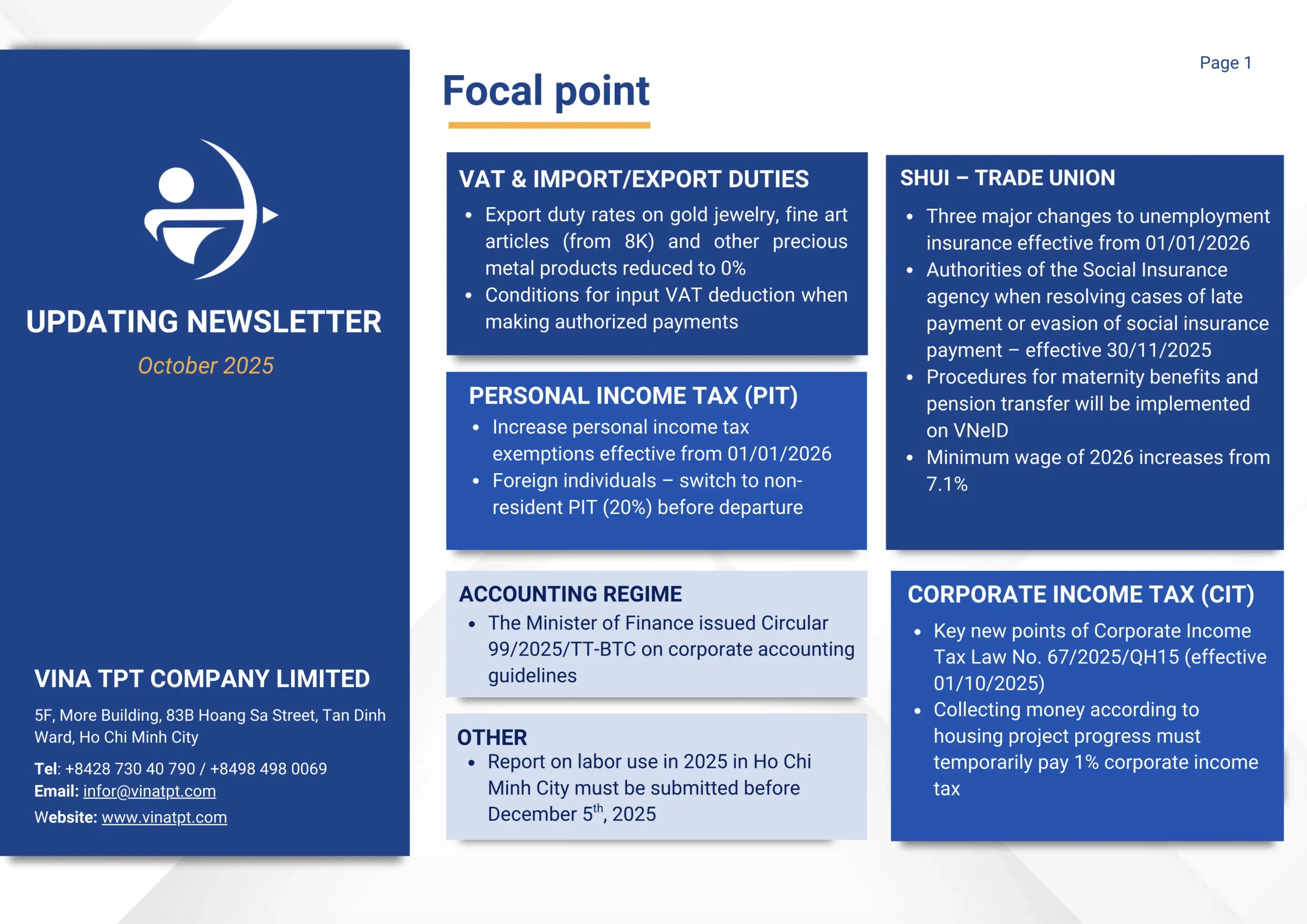
Vietnam is implementing a series of new tax, accounting, insurance, and labour regulations effective from October 2025. Notable updates include reduced export duty rates, clarified rules for input VAT deduction, higher PIT family circumstance deductions, a shift to non-resident taxation for certain foreign individuals, new CIT rates and deductible expense rules, and stricter sanctions on late or unpaid insurance contributions. These updates will reshape compliance requirements and influence core business operations, particularly in finance, payroll, and reporting functions.

This article outlines the essential policy changes businesses need to prepare for to ensure smooth compliance and operational continuity.

1. VAT & IMPORT/EXPORT DUTIES 

1.a. Export duty on gold jewellery, fine art articles (from 8K) and other precious metal products reduced to 0%  

Decree No. 260/2025/NĐ-CP dated 10/10/2025 of the Government amends the export duty rates for certain commodity lines under groups 71.13, 71.14 and 71.15 in the Export Tariff Schedule issued together with Decree No. 26/2023/NĐ-CP dated 31/05/2023. 

The Decree reduces the export duty rate from 1% to 0% for the following items: 

  • Jewellery and parts thereof, of other precious metal, whether or not plated or clad with precious metal (HS codes 7113.19.10 and 7113.19.90); 
  • Articles of goldsmiths’ or silversmiths’ wares and parts thereof, of other precious metal, whether or not plated or clad with precious metal (HS code 7114.19.00); 
  • Other articles of gold or silver (HS code 7115.90.10). 

Products that are currently subject to the 0% export duty rate will continue to enjoy the existing 0% rate. 

1.b. Input VAT deduction when payment is made via third-party authorisation  

Official Letter No. 4850/DON-QLDN1 dated 15/10/2025 of Đồng Nai Provincial Tax Department provides guidance on the deduction of input VAT in cases where non-cash payment is made through authorisation to a third party. 

According to the regulations, for the enterprise to be eligible for input VAT deduction, it must fully satisfy the general conditions prescribed in Clause 2, Article 14 of Law No. 48/2024/QH15: 

  • Possession of a VAT invoice for the purchase of goods and services or VAT payment document. 
  • Availability of non-cash payment evidence. 
  • For exported goods and services, additional documents are required: contract, invoice, non-cash payment evidence, customs declaration, and other related documents. 

In addition, when making payment through authorisation to a third party, the enterprise must comply with the further conditions stipulated in Decree No. 181/2025/NĐ-CP: 

  • The authorisation for payment to the third party must be specifically stipulated in a written contract. 
  • The third party must be an organisation or individual lawfully operating. 

If the company fully satisfies all the above conditions and other relevant legal provisions, it will be entitled to deduct the input VAT. 

2. PERSONAL INCOME TAX (PIT)

2.a. Increase in family circumstance deductions effective from 01/01/2026  

On 17 October 2025, the Standing Committee of the National Assembly issued Resolution No. 110/2025/UBTVQH15 adjusting the family circumstance deductions for personal income tax. This Resolution takes effect from 01 January 2026 and applies to the 2026 tax period. 

  • The deduction for the taxpayer himself/herself is increased from VND 11 million to VND 15.5 million per month (VND 186 million per year) (Article 1, point a). This means the taxpayer may deduct this amount when calculating taxable income, thereby reducing the tax payable. 
  • The deduction for each dependant is increased from VND 4.4 million to VND 6.2 million per month (Article 1, point b). Accordingly, taxpayers with dependants will enjoy an additional deduction corresponding to the number of dependants, further easing the tax burden. 

2.b. Foreign individuals – switch to non-resident PIT (20%) before departure  

On 03 October 2025, the Tax Department issued Official Letter No. 4221/CT-CS providing guidance on PIT for foreign individuals working in Vietnam for less than 183 days and required to finalise their tax obligations before leaving the country. Specifically, where a foreign individual has previously been subject to resident PIT withholding and has self-declared PIT on overseas-paid income arising from work performed in Vietnam, but the actual number of days present in Vietnam is less than 183 days, such individual must re-determine their PIT obligations under the non-resident regime. 

  • PIT is calculated at 20% on total Vietnam-sourced income, irrespective of where the income is paid or received. 
  • Tax finalisation must be completed prior to departure from Vietnam.

3. CORPORATE INCOME TAX (CIT) 

3.a. Key new points of Corporate Income Tax Law No. 67/2025/QH15 (effective 01/10/2025)  

Official Letter No. 2244/QNG-NVDTPC dated 13 October 2025 of Quảng Ngãi Provincial Tax Department introduces the key new points of the Corporate Income Tax Law No. 67/2025/QH15 (effective from 01 October 2025). The main changes are as follows: 

  1. Expanded scope of taxpayers:  

Addition of foreign enterprises that do not have a permanent establishment in Vietnam (including those engaged in e-commerce and digital platforms). 

      2. Taxable income:  

Additional provision stipulating that taxable income arising in Vietnam for foreign enterprises is income derived from Vietnam, regardless of where the business activities are conducted. 

      3.New CIT rates based on revenue: 

  • Standard rate: 20% 
  • Enterprises with total annual revenue not exceeding VND 3 billion: 15% 
  • Enterprises with total annual revenue exceeding VND 3 billion but not exceeding VND 50 billion: 17% 
  • Oil and gas exploration and production activities: 25% – 50% depending on the project. 

      4.Determination of taxable income: 

  • Taxable income from business activities is the total income from all business activities. 
  • Loss carry-forward is allowed between activities, except for real estate transfer activities, investment projects, and participation rights in investment projects when the entity is enjoying tax incentives. 
  • Income from the transfer of mineral exploration, extraction, and processing projects must be accounted for separately and may not be offset against other activities. 

       5.Tax exemption and reduction: 

  • Public-service entities providing public services in socio-economically disadvantaged areas are entitled to a 50% reduction of CIT payable. 
  • Enterprises converted from household businesses are exempt from CIT for two consecutive years from the year taxable income first arises. 

       6.Science and technology development fund:  

Maximum contribution rate increased to 20%. 

       7.New tax calculation method:  

Application of CIT as a percentage of revenue for enterprises with annual revenue ≤ VND 3 billion when revenue can be determined but costs and income cannot be determined. 

      8.Additional deductible expenses: 

  • Expenses related to seconded personnel participating in management, administration, and control at credit institutions under special control or commercial banks subject to mandatory transfer. 
  • Certain expenses incurred for business and production purposes but not yet generating corresponding revenue in the period, as stipulated by the Government. 
  • Expenses for supporting the construction of public infrastructure that simultaneously serves business and production activities. 
  • Expenses related to greenhouse gas emission reduction, carbon neutrality, net-zero initiatives, and environmental pollution reduction linked to business and production activities. 
  • Certain contributions to funds established by decision of the Prime Minister or the Government.


3.b. Temporary CIT payment of 1% on progress payments received for housing projects  

Official Letter No. 5129/CT-CS dated 12 November 2025 of the Tax Department on tax policies: 

  • For housing investment projects intended for transfer/sale: If the investor collects advance payments according to progress, it must make provisional quarterly Corporate Income Tax (CIT) payments equal to 1% of the amounts collected, pursuant to Point b, Clause 6, Article 8 of Decree No. 126/2020/NĐ-CP. 
  • Regarding interest expense for enterprises with related-party transactions: Deductible interest expense is subject to the cap under Clause 3, Article 16 of Decree No. 132/2020/NĐ-CP and applies to all enterprises with related-party transactions, irrespective of whether they are domestic or foreign-invested enterprises. 


4. SOCIAL, HEALTH & UNEMPLOYMENT INSURANCE – TRADE UNION 

4.a. Three major changes to unemployment insurance effective from 01/01/2026 (Law on Employment 2025) 

On 16 June 2025, the National Assembly passed the Law on Employment 2025, which officially takes effect from 01 January 2026. Accordingly, unemployment insurance policies will undergo significant changes, with the following three key updates to unemployment insurance effective from 01/01/2026: 

(1) No entitlement to unemployment benefits upon eligibility for pension 

From 01/01/2026, under point a, clause 1, Article 39 of the Law on Employment 2025, employees who terminate employment or end their labour contract upon reaching eligibility for pension benefits will not be entitled to unemployment benefits. Thus, effective from 01/01/2026, unemployment benefits will not be payable to individuals who meet pension eligibility criteria, regardless of whether pension procedures have been initiated. 

(2) Faster receipt of unemployment benefits with reduced waiting period to 10 days 

From 2025, pursuant to clause 3, Article 39 of the Law on Employment 2025, the commencement date for unemployment benefits effective from 01/01/2026 will be the 11th working day following the submission of a complete application dossier for unemployment benefits. This represents a reduction of 5 days from the current regulation, under which benefits commence from the 16th day after dossier submission. 

(3) Maximum level of unemployment benefits 

Pursuant to clause 1, Article 39 of the Law on Employment 2025, the maximum monthly unemployment benefit for all employees shall not exceed 5 times the regional minimum wage at the time of contract termination. 

4.b. Penalties for late or evaded compulsory social/health/unemployment insurance contributions – effective 30/11/2025  

On 16 October 2025, the Government issued Decree No. 274/2025/NĐ-CP detailing certain provisions of the Social Insurance Law regarding late payment, evasion of compulsory social insurance and unemployment insurance contributions; complaints and denunciations related to social insurance. This Decree takes effect from 30 November 2025. 

  • Late payment interest rate: 0.03% per day calculated on the amount and number of days of late or evaded payment (Article 3, Clause 1, Point d; Article 7, Clause 2). 
  • Conversion period to evasion: An act of late payment shall be converted to an act of evasion after 60 days from the expiry of the latest payment deadline, provided that the Social Insurance Agency has issued a written reminder (Article 6, Clause 1, Point c). 
  • Evasion by understating salary: The act of registering a salary base for social insurance contributions lower than prescribed under the Social Insurance Law shall be deemed evasion (Article 6, Clause 1, Point b). 
  • Exemption from evasion classification (force majeure): Specific enumeration of 4 force majeure cases not to be considered as evasion (such as storms, floods, dangerous epidemics, emergency situations) as announced by competent authorities (Article 4).


5. ACCOUNTING REGIME 

5.a. Circular 99/2025/TT-BTC guiding the accounting regime for enterprises  

On 27 October 2025, the Ministry of Finance issued Circular No. 99/2025/TT-BTC regulating the accounting regime for enterprises, replacing Circular No. 200/2014/TT-BTC dated 22 December 2014. Circular No. 99/2025/TT-BTC takes effect from 01 January 2026 and applies to financial years beginning on or after 01 January 2026. Pursuant to the regulations, Circular No. 99/2025/TT-BTC simultaneously repeals and replaces the following documents: 

  • Circular No. 200/2014/TT-BTC guiding the accounting regime for enterprises; 
  • Circular No. 75/2015/TT-BTC (amending Article 128 of Circular 200); 
  • Circular No. 53/2016/TT-BTC (amending and supplementing certain provisions of Circular 200); 
  • Circular No. 195/2012/TT-BTC dated 15 November 2012 guiding accounting for main investors. 

However, certain provisions related to the accounting for the equitisation of State-owned enterprises under Circular 200 shall continue to apply until the Ministry of Finance issues a new replacement document. 

Below are some key differences between Circular No. 99/2025/TT-BTC and Circular No. 200/2014/TT-BTC regarding the accounting regime for enterprises: 

Method of converting financial statements prepared in foreign currency to Vietnamese Dong: 

  • Assets and liabilities shall be converted to Vietnamese Dong at the average transfer buying/selling exchange rate of the commercial bank where the enterprise regularly conducts transactions as at the end of the accounting period; 
  • Owner’s equity (owner’s contributed capital, capital surplus, other capital, convertible bond options) shall be converted to Vietnamese Dong at the actual transaction exchange rate on the date of capital contribution; 
  • Revaluation differences of assets shall be converted to Vietnamese Dong at the actual transaction exchange rate on the revaluation date; ….. 

Chart of accounts: Reduced to 71 level-1 accounts, abolishing 6 accounts, including 4 accounts related to non-business funding sources, capital construction investments, and 2 accounts (611 and 631). 

Addition of accounts: Renaming of accounts and addition of new accounts (e.g., Account 215 – Biological assets, etc.). Abolition of certain accounts: 621 – Purchase costs, 631 – Production costs, etc. 

Accounting forms and financial statement templates: Enterprises may also design additional or amend and supplement accounting forms and financial statement templates compared to those guided under this Circular to suit the characteristics of production and business activities and management requirements. Renaming of the “Balance Sheet” template to “Statement of Financial Position”. 


6. OTHER 

6.a. 2025 Labour Utilisation Report for Ho Chi Minh City – Must be submitted before 05 December 2025 

Official Letter No. 9002/SNV-VLATLĐ dated 13 November 2025 of the Ho Chi Minh City Department of Home Affairs on the implementation of Article 4 of Decree No. 145/2020/NĐ-CP regarding labour utilisation reporting. 

The Ho Chi Minh City Department of Home Affairs provides the following guidance on the submission of the 2025 labour utilisation report by establishments within the territory of Ho Chi Minh City: 

  1. Entities required to submit the report: 
  • Agencies, organisations, enterprises, cooperatives, households, and individuals that hire, employ, or utilise labour. 
  • Those with headquarters or places of operation within the territory of Ho Chi Minh City. 

      2. Content of the report: 

  • To be completed in accordance with Form No. 01/PLI in Appendix I issued together with Decree No. 145/2020/NĐ-CP. 

      3. Method of submission (select one of the two options): 

  • Submission via the National Public Service Portal: Perform the “Integrated procedure for registering adjustments to compulsory social insurance, health insurance, unemployment insurance contributions and labour utilisation reporting”: https://dichvucong.gov.vn/. 

      4. Submission deadline: To be completed before 05 December 2025. 

      5. Important notes: 

  • After the prescribed deadline, the Department of Home Affairs will not accept any reports. 
  • The Department of Home Affairs will compile the implementation status as a basis for confirming compliance with legal regulations upon request from relevant agencies. 
  • Failure to submit the report on time may result in administrative violations under Clause 2, Article 8 of Decree No. 12/2022/NĐ-CP. 


CONTACT US FOR SUPPORT

Expert-Vietnam-VinaTPT

Comprehensive Tax and Compliance Services for Businesses in Vietnam

Business consultant providing corporate tax service and compliance support

Business consultant providing corporate tax service and compliance support

1. Vietnam Tax & Compliance Overview

The tax environment and legal system in Vietnam are currently in a dynamic phase of updates, covering areas such as value added tax (VAT), corporate income tax (CIT), personal income tax (PIT), financial reporting standards, and electronic filing procedures. These ongoing changes make maintaining tax compliance a significant challenge for all businesses, especially FDI companies and newly established startups. Even minor mistakes in tax declaration or late payments can result in administrative fines, tax arrears, or surprise inspections by regulatory authorities.

For FDI enterprises, the documentation requirements are often more complex, as they must comply simultaneously with Vietnamese accounting standards (VAS) and international standards (IFRS), while also fulfilling regulations related to reporting foreign investment capital. Meanwhile, startups often face limited resources, lack specialized accounting teams, or have incomplete internal control processes. Managing taxes, preparing financial statements, and performing electronic tax filings without professional support can easily lead to common errors such as reporting incorrect indicators, omitting valid expenses, or calculating tax amounts incorrectly.

Using tax services, tax compliance services or full-package services such as accounting & tax services is the optimal solution to help businesses minimize risks and ensure full compliance with Vietnamese tax laws. A professional unit will support from tax code registration, monthly/quarterly tax reporting, implementing tax filing service Vietnam, to checking and periodically comparing books. In addition, tax compliance services also help businesses promptly update changes in tax policies, optimize reasonable CIT costs, prepare annual tax settlement documents and provide transparent data for audits.

2. Key Business Taxes & Compliance Requirements

2.1 Corporate & Operational Taxes

The main taxes that businesses in Vietnam must comply with include:

  • Corporate Income Tax (CIT): Corporate income tax with a common tax rate of 20%, requiring quarterly or annual declaration and payment.
  • Value- Added Tax (VAT): Value added tax applied to most goods and services, requiring electronic invoices and periodic reporting.
  • Foreign Contractor Tax (FCT): Applied to transactions with foreign contractors, requiring complex calculation and declaration processes.

And some other types of taxes depending on the industry and business activities, for example: import and export dutiestax,Natural Resources Tax resource tax, special consumption tax Land and Water Surface Rental, Transfer Pricing Taxation,…

A reputable tax compliance service will assist businesses in reviewing documents, preparing declarations and submitting them on time, avoiding the risk of being fined or collected.

2.2 Employee-Related Taxes

In addition to operating taxes, businesses must also manage:

  • Personal Income Tax (PIT): Personal income tax for employees, requiring monthly or quarterly deductions and declarations.
  • Social Insurance, Health Insurance, Unemployment Insurance: Obligation to pay compulsory social insurance and health insurance according to the provisions of the Labor Law.

Combining tax compliance service with the human resource management system – payroll helps businesses control tax and insurance deductions accurately, limiting risks of periodic inspections.

Download Vietnam Tax Handbook - Japanese Edition

3. Tax Compliance & Tax Filing Service

To operate legally and avoid the risks of late payment penalties or tax arrears, all businesses in Vietnam – from startups, SMEs to FDI companies – must fully comply with tax compliance and tax filing service Vietnam in accordance with the regulations of the tax authorities. This compliance includes many important obligations such as registering for a tax code, preparing and submitting monthly/quarterly tax declarations, annual financial statements, finalizing corporate income tax (CIT) and personal income tax (PIT), as well as paying social insurance, health insurance and union fees.

In reality, the tax declaration and payment process in Vietnam is quite complicated and requires absolute accuracy. Businesses need to clearly understand the deadlines for submitting each type of tax: VAT and PIT declarations are usually submitted monthly or quarterly, CIT reports and financial statements must be completed by the end of the fiscal year, while specific taxes such as Foreign Contractor Tax (FCT) can arise suddenly depending on business activities. Just a small error in tax calculation, reporting targets or late submission of documents can also lead to administrative fines, penalty interest or being subject to tax inspection.

Using a professional tax service or tax compliance service helps businesses significantly reduce this pressure. A reputable service provider will support from the stage of preparing documents, reviewing documents, to implementing tax filing service Vietnam on time on the electronic system of the General Department of Taxation. At the same time, accounting & tax service also acts as an internal control solution, helping businesses promptly update changes in tax laws, optimize deductions, and minimize the risk of being overcharged during settlement periods.

For FDI companies, combining tax compliance services with specialized consulting services like Vina TPT tax service is especially important because it must ensure both Vietnamese accounting standards (VAS) and international standards (IFRS). Vina TPT not only declares and pays taxes on time but also advises on long-term tax strategies, helps businesses optimize CIT, manage PIT for foreign employees, and prepare documents ready for audit or inspection. This is the foundation for businesses to maintain financial transparency and develop sustainably in Vietnam’s increasingly strict legal environment.

OPTIMIZE YOUR TAX STRATEGY

4. Integrated Accounting & Tax Service for Sustainable Growth

To achieve sustainable growth in a competitive and constantly changing business environment, businesses need an integrated accounting & tax service solution – a close combination of accounting service Vietnam and tax compliance service. This service not only ensures the preparation of financial statements according to Vietnamese Accounting Standards (VAS) or International Financial Reporting Standards (IFRS), but also includes in-depth analysis of cash flow management, cost optimization and preparation of documents for independent audit or tax inspection.

The synchronization between accounting and tax helps businesses:

  • Reduce the burden of legal compliance: All financial reports, tax declarations, corporate income tax (CIT) and personal income tax (PIT) finalizations are performed accurately and on time, avoiding the risk of late payment penalties or arrears.
  • Increase financial transparency: Consistent accounting and tax data support the management in making decisions based on actual data, thereby building long-term business plans and effective investment strategies.
  • Optimize operating costs and taxes: Experts can advise on appropriate deductions, cost control, cash flow allocation, and take advantage of tax incentives allowed by Vietnamese law.

Especially for FDI companies or startups, integrated accounting and tax solutions bring outstanding advantages when it comes to cross-border reporting for parent corporations, preparing consolidated financial statements, or handling transactions related to transfer pricing. With extensive experience, Vina TPT accounting & tax service not only performs accurate operations but also provides strategic advisory to help businesses maintain compliance, protect reputation, and develop sustainably in the Vietnamese market.

5. How Vina TPT Delivers Smarter Tax Compliance Service

Vina TPT tax service provides a comprehensive solution, helping businesses handle all procedures from tax code registration, declaration, preparation of periodic reports to representing work with tax authorities. The team of experts regularly updates the latest tax laws, advises on optimal CIT, VAT and PIT roadmaps suitable for each industry.

The strengths of Vina TPT tax compliance service lie in:

  • Experience in implementing for both domestic and FDI enterprises.
  • Multilingual service (English – Vietnamese – Japanese) suitable for international investors.
  • Transparent electronic processes, timely reporting help businesses easily control costs and risks.

Don’t let tax mistakes affect your business. 

Contact Vina TPT today for advice on a complete accounting & tax service solution and start declaring taxes in Vietnam quickly – accurately – legally.

BOOK A FREE CONSULTATION

Vina TPT Accounting services