Tax Breaks in Vietnam 2025 | Key CIT, VAT & PIT Updates

1/ Overview of Tax Breaks and Their Importance for FDI Businesses 

Tax breaks, also known as tax incentives, are government measures that reduce or exempt taxes to support businesses and individuals. These aim to boost investment, drive economic growth, and ease financial burdens. In Vietnam, tax breaks typically include exemptions, reduced rates, or deductible expenses. They help companies lower operating costs, boost net profits, and expand operations—especially amid post-pandemic recovery and global competition. 

For foreign direct investment (FDI) businesses, tax breaks serve as both financial tools and strategic advantages to attract capital. Under the 2025 Corporate Income Tax Law (No. 67/2025/QH15), these policies align with international commitments like the 15% global minimum tax. This creates competitive edges, encourages reinvestment, and generates jobs in Vietnam. 

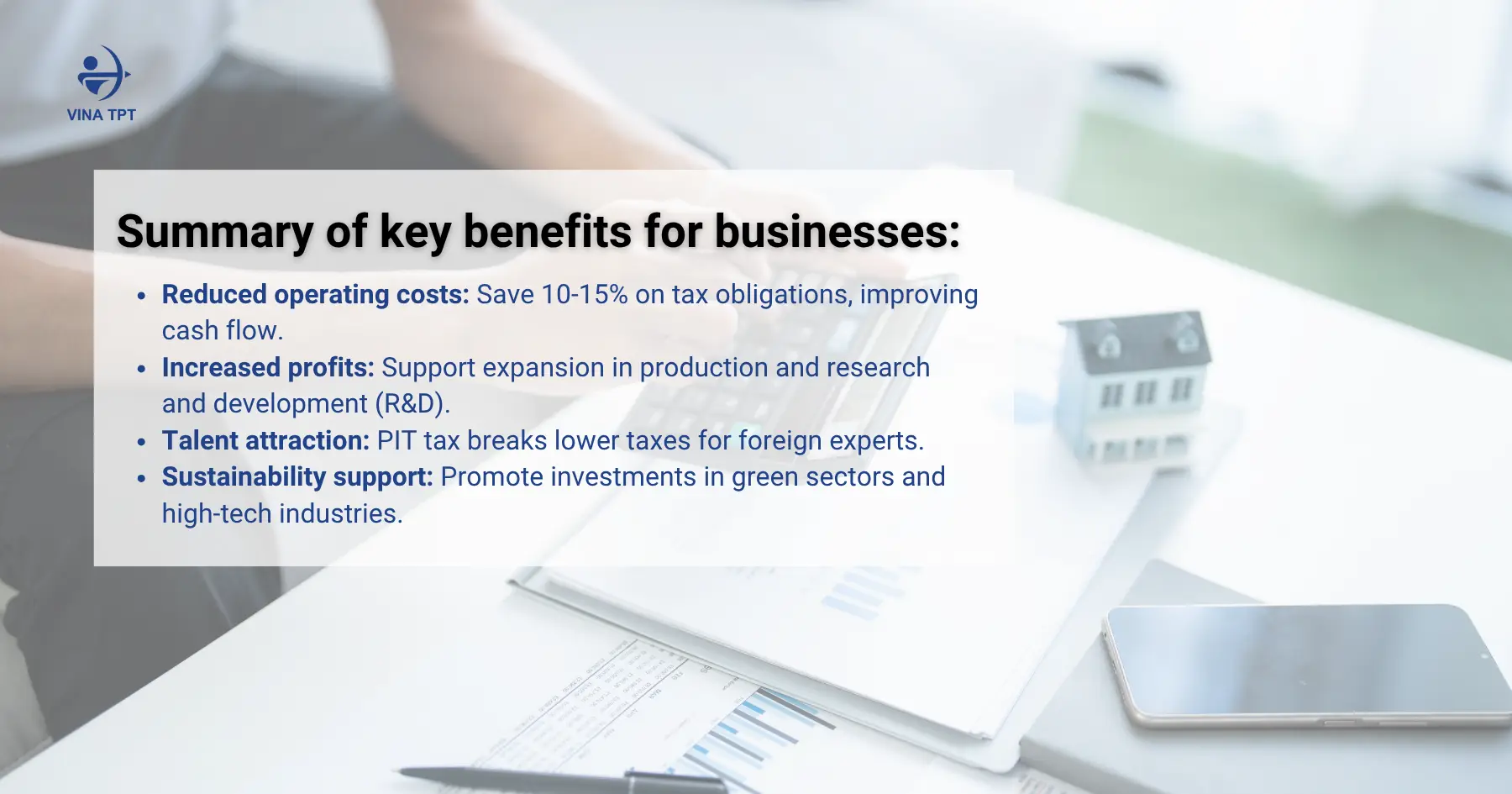
Here’s a summary of key benefits for FDI businesses: 

  • Reduced operating costs: Save 10-15% on tax obligations, improving cash flow. 
  • Increased profits: Support expansion in production and research and development (R&D). 
  • Talent attraction: PIT tax breaks lower taxes for foreign experts. 
  • Sustainability support: Promote investments in green sectors and high-tech industries. 

Explore the common tax breaks available in Vietnam to maximize benefits for your FDI enterprise. 

2/ Common Types of Tax Breaks Currently Available 

Vietnam’s government is refining tax policies to aid businesses during economic recovery, focusing on priority sectors like technology, green manufacturing, and exports. Starting in 2025, incentives apply to key taxes: Corporate Income Tax (CIT), Value-Added Tax (VAT), and Personal Income Tax (PIT). Each targets different groups and goals, helping FDI businesses cut financial loads and enhance competitiveness. Below is a comparison table: 

Tax Type  Main Incentives  Applicable Entities  Duration 
CIT  Exemption for 2-4 years, 50% reduction thereafter  FDI businesses in priority sectors  6-15 years 
VAT  Reduction from 10% to 8%  Goods and services (exclusions apply)  Until December 31, 2026 
PIT  Family deduction of VND 11 million/month (rising to VND 15.5 million/month from 2026)  Individuals and foreign experts as residents  Annual 

2.1 Corporate Income Tax (CIT) Incentives Effective from October 1, 2025 

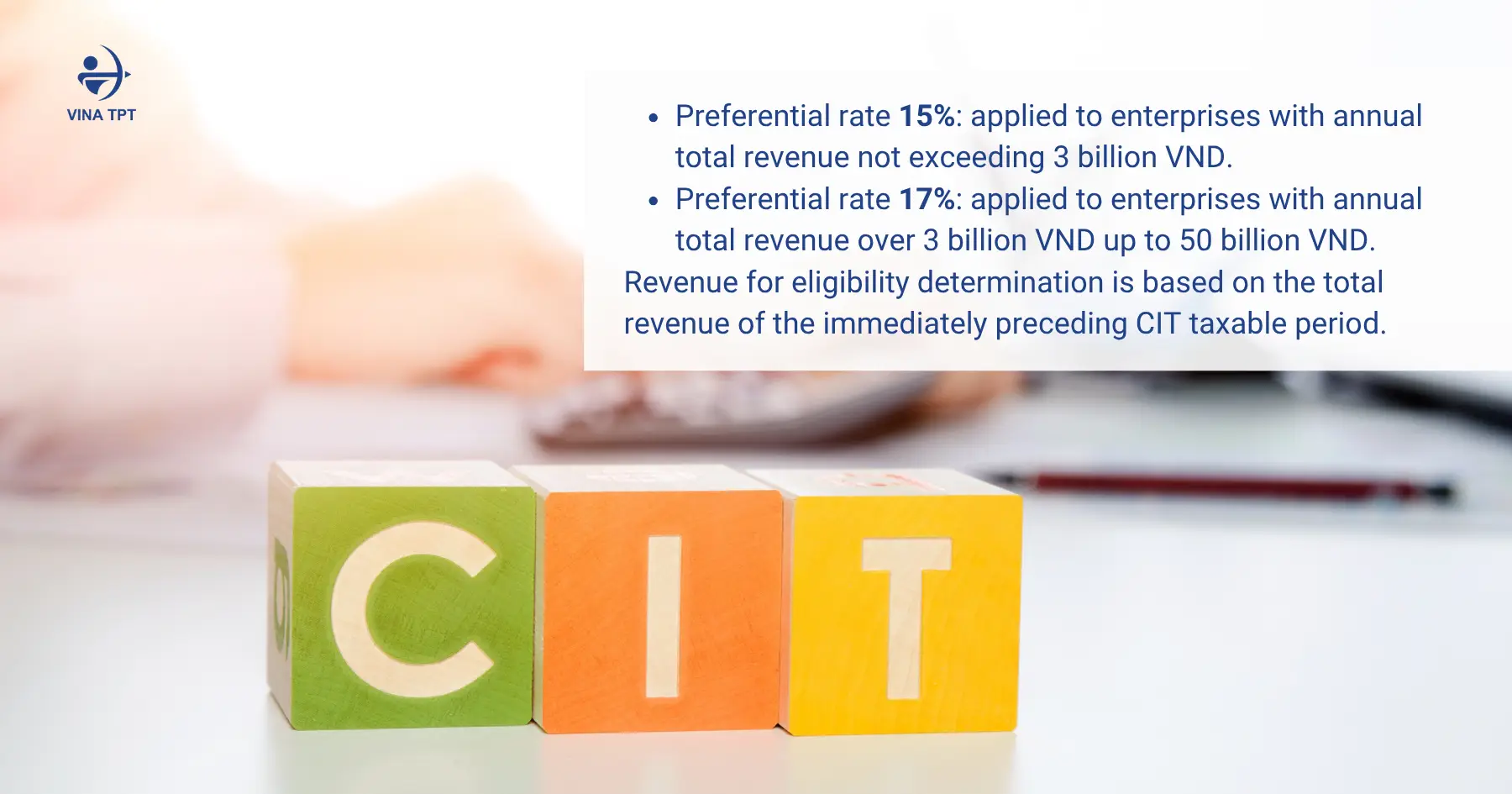
Corporate Income Tax (CIT) directly impacts FDI business profits. From October 1, 2025, the 2025 CIT Law (No. 67/2025/QH15) expands incentives to attract high-quality investments. FDI enterprises starting new projects in high-tech fields, disadvantaged areas, or economic zones qualify for CIT exemptions for 2-4 initial years and a 50% reduction for the next 4-9 years. Preferential rates can drop to 10% for specially prioritized projects, 15% for small and medium enterprises, or 17% for investments in favored locations. 

Incentives are categorized by: 

  • Sector: High-tech, education, healthcare—exemption for 4 years, 50% reduction for 9 years. 
  • Location: Disadvantaged areas—10% rate for 15 years. 
  • Investment scale: Projects over EUR 750 million apply the 15% global minimum tax. 

Summary table: 

Incentive Type  Conditions  Duration  Reduction Level 
Exemption  High-tech projects  4 years  100% 
Rate reduction  Favored locations  15 years  10-17% 
50% reduction  New investment projects  4-9 years  50% 

Impact on FDI businesses: 

  • Cost savings up to 20-30%, boosting net profits and reinvestment. 
  • Encourages production growth and local job creation. 

Example: An FDI company investing USD 100 million in a high-tech zone could save tens of millions in taxes over the first 10 years. 

FDI enterprises should consult tax experts early to ensure proper reporting, legal workforce use, and eligibility maintenance. Compliance from the start avoids audits, penalties, and maximizes legal tax breaks. 
Maximize Your Tax Incentives Today

2.2 Value-Added Tax (VAT) Incentives Effective from July 1, 2025 

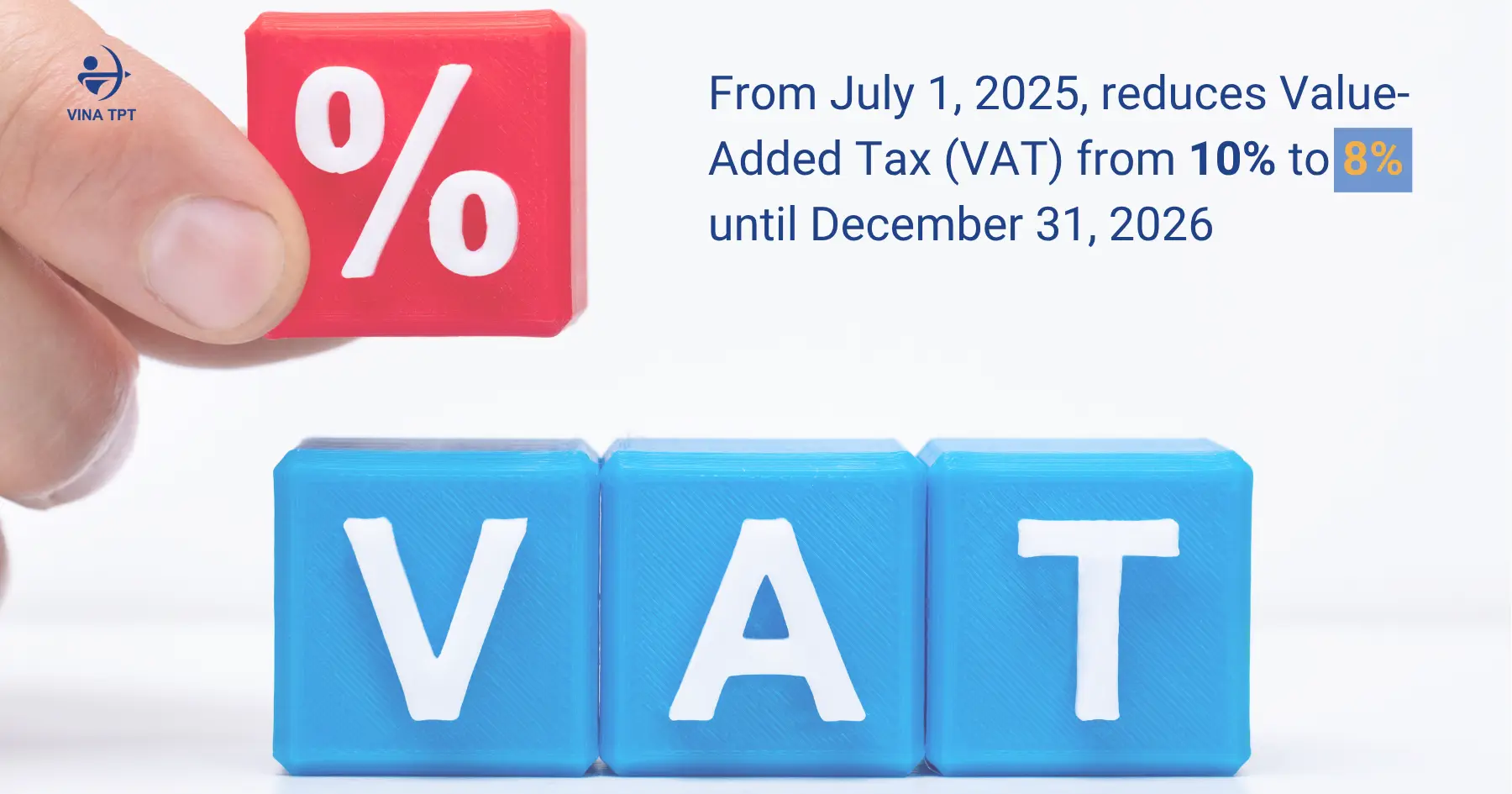
From July 1, 2025, Decree 174/2025/ND-CP reduces Value-Added Tax (VAT) from 10% to 8% until December 31, 2026, to stimulate consumption and support business recovery. This applies to most goods and services, excluding telecommunications, finance, and real estate. For FDI businesses, VAT tax breaks lower input costs, enhance cash flow, and strengthen export competitiveness. 

Specific benefits: 

  • Lower production costs: Imported materials face reduced VAT. 
  • Export support: Exported goods at 0% VAT, plus 8% reduction on related services. 

Example: An FDI firm exporting high-tech software enjoys full VAT exemption, saving 8-10% on costs. 

Key procedures: 

  • Declare VAT using new forms and electronic invoices. 
  • Collect valid documents for deductions or refunds. 
  • Note: Does not apply to specially taxed imports. 
2.3 Personal Income Tax (PIT) Incentives 

Personal Income Tax (PIT) continues to directly impact the income of workers, especially foreign experts in FDI enterprises.
From 2026, the personal allowance has been adjusted upwards to VND 15.5 million/month for the taxpayer themselves and VND 6.2 million/month for each dependent. This increase in allowances helps reduce tax obligations, improve disposable income, and enhance the attractiveness of the Vietnamese labor market.
At the same time, the PIT tax schedule has been simplified, reduced from 7 brackets to 5, with progressive tax rates.

PIT tax breaks for FDI businesses: 

  • Reduced taxes for foreign experts: Residents (present in Vietnam 183+ days/year) get deductions, cutting personnel costs. 
  • Exemptions for certain income: Stock transfers (if qualified) and foreign allowances. 

Notes: 

  • Register dependents electronically with tax authorities. 
  • Update income regularly to prevent back taxes. 

From 2026, updated policies will help FDI firms attract top global talent more easily. 

Download Vietnam Tax Handbook For Investor

3/ Key Benefits: How Tax Breaks Help Save Costs and Expand Business 

Tax breaks directly cut tax liabilities, increasing net profits and providing capital for FDI businesses to reinvest. Experts estimate savings of 10-20% on overall costs, enabling scale-up and global competition. 

Analysis from three angles: 

  • Financial: CIT and VAT reductions improve cash flow and reduce quarterly tax debts. 
  • Strategic: Encourage investments in priority areas like green technology, enhancing brand value. 
  • Human resources: PIT incentives lower salary costs, aiding recruitment of international and local experts. 

In summary, tax breaks not only save costs but also unlock business growth, allowing FDI enterprises to contribute sustainably to Vietnam’s economy. 

4/ Leveraging Tax Breaks with Vina TPT Tax Services 

To fully utilize tax breaks, FDI businesses need professional guidance from firms like Vina TPT—a Vietnam-based expert in tax and accounting. With experience supporting hundreds of FDI clients, Vina TPT identifies suitable incentives, prepares compliant files, and handles timely declarations to avoid audits. 

Standout advantages: 

  • Expertise across industries, from manufacturing to technology. 
  • Team knowledgeable in Vietnamese and international tax laws, with multilingual support. 
  • Transparent reporting and competitive fees for cost optimization. 

Support process: 

  • Assess your business and identify applicable incentives. 
  • Recommend tax plans and prepare registration documents. 
  • Implement declarations and monitor policy updates. 
  • Conduct regular reviews for ongoing compliance. 

Tax breaks are essential for FDI businesses in Vietnam to optimize costs, boost profits, and expand investments—especially with 2025 updates like the 8% VAT reduction and CIT incentives for priority sectors. These changes support economic recovery and position Vietnam as an attractive destination for foreign investment. 

Has your business maximized current tax incentives? Contact Vina TPT Tax Services today for a detailed analysis and tailored tax solutions—ensuring compliance and maximum savings! 

Talk to a Tax Specialist

Vina TPT Accounting services


Comprehensive Tax and Compliance Services for Businesses in Vietnam

Business consultant providing corporate tax service and compliance support

Business consultant providing corporate tax service and compliance support

1. Vietnam Tax & Compliance Overview

The tax environment and legal system in Vietnam are currently in a dynamic phase of updates, covering areas such as value added tax (VAT), corporate income tax (CIT), personal income tax (PIT), financial reporting standards, and electronic filing procedures. These ongoing changes make maintaining tax compliance a significant challenge for all businesses, especially FDI companies and newly established startups. Even minor mistakes in tax declaration or late payments can result in administrative fines, tax arrears, or surprise inspections by regulatory authorities.

For FDI enterprises, the documentation requirements are often more complex, as they must comply simultaneously with Vietnamese accounting standards (VAS) and international standards (IFRS), while also fulfilling regulations related to reporting foreign investment capital. Meanwhile, startups often face limited resources, lack specialized accounting teams, or have incomplete internal control processes. Managing taxes, preparing financial statements, and performing electronic tax filings without professional support can easily lead to common errors such as reporting incorrect indicators, omitting valid expenses, or calculating tax amounts incorrectly.

Using tax services, tax compliance services or full-package services such as accounting & tax services is the optimal solution to help businesses minimize risks and ensure full compliance with Vietnamese tax laws. A professional unit will support from tax code registration, monthly/quarterly tax reporting, implementing tax filing service Vietnam, to checking and periodically comparing books. In addition, tax compliance services also help businesses promptly update changes in tax policies, optimize reasonable CIT costs, prepare annual tax settlement documents and provide transparent data for audits.

2. Key Business Taxes & Compliance Requirements

2.1 Corporate & Operational Taxes

The main taxes that businesses in Vietnam must comply with include:

  • Corporate Income Tax (CIT): Corporate income tax with a common tax rate of 20%, requiring quarterly or annual declaration and payment.
  • Value- Added Tax (VAT): Value added tax applied to most goods and services, requiring electronic invoices and periodic reporting.
  • Foreign Contractor Tax (FCT): Applied to transactions with foreign contractors, requiring complex calculation and declaration processes.

And some other types of taxes depending on the industry and business activities, for example: import and export dutiestax,Natural Resources Tax resource tax, special consumption tax Land and Water Surface Rental, Transfer Pricing Taxation,…

A reputable tax compliance service will assist businesses in reviewing documents, preparing declarations and submitting them on time, avoiding the risk of being fined or collected.

2.2 Employee-Related Taxes

In addition to operating taxes, businesses must also manage:

  • Personal Income Tax (PIT): Personal income tax for employees, requiring monthly or quarterly deductions and declarations.
  • Social Insurance, Health Insurance, Unemployment Insurance: Obligation to pay compulsory social insurance and health insurance according to the provisions of the Labor Law.

Combining tax compliance service with the human resource management system – payroll helps businesses control tax and insurance deductions accurately, limiting risks of periodic inspections.

Download Vietnam Tax Handbook - Japanese Edition

3. Tax Compliance & Tax Filing Service

To operate legally and avoid the risks of late payment penalties or tax arrears, all businesses in Vietnam – from startups, SMEs to FDI companies – must fully comply with tax compliance and tax filing service Vietnam in accordance with the regulations of the tax authorities. This compliance includes many important obligations such as registering for a tax code, preparing and submitting monthly/quarterly tax declarations, annual financial statements, finalizing corporate income tax (CIT) and personal income tax (PIT), as well as paying social insurance, health insurance and union fees.

In reality, the tax declaration and payment process in Vietnam is quite complicated and requires absolute accuracy. Businesses need to clearly understand the deadlines for submitting each type of tax: VAT and PIT declarations are usually submitted monthly or quarterly, CIT reports and financial statements must be completed by the end of the fiscal year, while specific taxes such as Foreign Contractor Tax (FCT) can arise suddenly depending on business activities. Just a small error in tax calculation, reporting targets or late submission of documents can also lead to administrative fines, penalty interest or being subject to tax inspection.

Using a professional tax service or tax compliance service helps businesses significantly reduce this pressure. A reputable service provider will support from the stage of preparing documents, reviewing documents, to implementing tax filing service Vietnam on time on the electronic system of the General Department of Taxation. At the same time, accounting & tax service also acts as an internal control solution, helping businesses promptly update changes in tax laws, optimize deductions, and minimize the risk of being overcharged during settlement periods.

For FDI companies, combining tax compliance services with specialized consulting services like Vina TPT tax service is especially important because it must ensure both Vietnamese accounting standards (VAS) and international standards (IFRS). Vina TPT not only declares and pays taxes on time but also advises on long-term tax strategies, helps businesses optimize CIT, manage PIT for foreign employees, and prepare documents ready for audit or inspection. This is the foundation for businesses to maintain financial transparency and develop sustainably in Vietnam’s increasingly strict legal environment.

OPTIMIZE YOUR TAX STRATEGY

4. Integrated Accounting & Tax Service for Sustainable Growth

To achieve sustainable growth in a competitive and constantly changing business environment, businesses need an integrated accounting & tax service solution – a close combination of accounting service Vietnam and tax compliance service. This service not only ensures the preparation of financial statements according to Vietnamese Accounting Standards (VAS) or International Financial Reporting Standards (IFRS), but also includes in-depth analysis of cash flow management, cost optimization and preparation of documents for independent audit or tax inspection.

The synchronization between accounting and tax helps businesses:

  • Reduce the burden of legal compliance: All financial reports, tax declarations, corporate income tax (CIT) and personal income tax (PIT) finalizations are performed accurately and on time, avoiding the risk of late payment penalties or arrears.
  • Increase financial transparency: Consistent accounting and tax data support the management in making decisions based on actual data, thereby building long-term business plans and effective investment strategies.
  • Optimize operating costs and taxes: Experts can advise on appropriate deductions, cost control, cash flow allocation, and take advantage of tax incentives allowed by Vietnamese law.

Especially for FDI companies or startups, integrated accounting and tax solutions bring outstanding advantages when it comes to cross-border reporting for parent corporations, preparing consolidated financial statements, or handling transactions related to transfer pricing. With extensive experience, Vina TPT accounting & tax service not only performs accurate operations but also provides strategic advisory to help businesses maintain compliance, protect reputation, and develop sustainably in the Vietnamese market.

5. How Vina TPT Delivers Smarter Tax Compliance Service

Vina TPT tax service provides a comprehensive solution, helping businesses handle all procedures from tax code registration, declaration, preparation of periodic reports to representing work with tax authorities. The team of experts regularly updates the latest tax laws, advises on optimal CIT, VAT and PIT roadmaps suitable for each industry.

The strengths of Vina TPT tax compliance service lie in:

  • Experience in implementing for both domestic and FDI enterprises.
  • Multilingual service (English – Vietnamese – Japanese) suitable for international investors.
  • Transparent electronic processes, timely reporting help businesses easily control costs and risks.

Don’t let tax mistakes affect your business. 

Contact Vina TPT today for advice on a complete accounting & tax service solution and start declaring taxes in Vietnam quickly – accurately – legally.

BOOK A FREE CONSULTATION

Vina TPT Accounting services