Key Changes to Vietnam Personal Allowances in 2026: Family Deduction Explained

Vietnam Personal Allowances 2026_ Family Deductions Explained-Vina TPT

Vietnam Personal Allowances 2026_ Family Deductions Explained-Vina TPT

1. Overview of Personal Income Tax Thresholds in Vietnam from 2026

The official policy to increase personal allowances to VND 15.5 million per month from 2026 represents a significant adjustment to Vietnam’s personal income tax system, aiming to ease the tax burden and better reflect current living costs. Under this policy, the personal allowance for taxpayers rises from VND 11 million to VND 15.5 million per month, while the allowance for each dependent increases to VND 6.2 million per month.

This change raises the taxable income threshold, providing meaningful support to middle-income earners, especially those with children or other dependents. Effective from the 2026 tax year, the new regulation not only helps reduce financial pressure on salaried individuals but also enables taxpayers to plan their personal finances more proactively in line with economic conditions and cost of living changes.

2. Family Deduction Levels Applicable from 2026

According to the Resolution, starting from the 2026 tax assessment period, personal income applied in personal allowance applied in personal income tax (PIT) calculation will be significantly increased. Specifically:

  • Personal allowance for the taxpayer will be raised to VND 15.5 million per month (equivalent to VND 186 million per year).

  • The dependent allowance will be set at VND 6.2 million per month for each eligible dependent.

Example 1: Individual With No Dependents

  • Monthly income: VND 18,000,000

  • Personal allowance: VND 15,500,000

After applying the personal allowance, only VND 2,500,000 remains subject to personal income tax. If mandatory insurance contributions are further deducted, this individual may not incur any PIT liability.

Example 2: Individual With One Eligible Dependent

  • Monthly income: VND 25,000,000

  • Personal allowance: VND 15,500,000

  • Dependent allowance (1 dependent): VND 6,200,000

Taxable income calculation: 25,000,000 − 15,500,000 − 6,200,000 = VND 3,300,000

This taxable income falls within the lowest PIT bracket under Vietnam’s progressive tax rate system. 

3. Who Qualifies as a Dependent for Family Deduction Purposes?

Pursuant to Point d, Clause 1, Article 9 of Circular No. 111/2013/TT-BTC, dependents eligible for family deductions when calculating personal income tax (PIT) include the following categories:

3.1. Children of the Taxpayer

  • Children under 18 years of age (calculated on a monthly basis).

  • Children aged 18 or older who are disabled and unable to work.

  • Children who are studying in Vietnam or overseas at universities, colleges, professional secondary schools, or vocational institutions, including children aged 18 or older who are still attending high school (including the period from June to September of Grade 12 while awaiting university entrance exam results), with no income or with an average monthly income not exceeding VND 1 million.

3.2. Spouse of the Taxpayer

  • Of working age: must be disabled, unable to work, and have no income or an average monthly income not exceeding VND 1 million.

  • Beyond working age: must have no income or an average monthly income not exceeding VND 1 million.

Specifically, according to Clause 1, Article 4 of Decree No. 135/2020/NĐ-CP, the statutory retirement age in 2025 is:

  • Male employees: 61 years and 3 months

  • Female employees: 56 years and 8 months

3.3. Parents and Parents-in-law

This category includes biological parents, parents-in-law, step-parents, and legally adopted parents:

  • Of working age: must be disabled, unable to work, and have no income or an average monthly income not exceeding VND 1 million.

  • Beyond working age: must have no income or an average monthly income not exceeding VND 1 million.

3.4. Other Individuals Directly Supported by the Taxpayer

  • Biological brothers and sisters.

  • Paternal and maternal grandparents.

  • Aunts, uncles (paternal or maternal).

  • Nieces and nephews (children of biological siblings).

  • Other individuals without means of support, as prescribed by law.

Note: Individuals under this category are only considered eligible dependents if they have no means of support, are directly supported by the taxpayer, and meet the statutory conditions regarding income level and working capacity in accordance with Point đ, Clause 1, Article 9 of Circular No. 111/2013/TT-BTC.

Vietnam Personal Allowances 2026_ Family Deductions Explained-Vina TPT

4. How to Determine Family Deduction When Calculating PIT from 2026

4.1. Step 1: Determine Total Taxable Income for the Period

Total income includes all salary, wages, and salary-like allowances arising during the relevant tax assessment period.

4.2. Step 2: Apply Deductions For The Taxpayer And Eligible Dependents

The personal allowance is deducted directly at VND 15.5 million per month. For each eligible and duly registered dependent, an additional VND 6.2 million per month may be deducted.

Total family deduction = Personal allowance + Dependent allowances.

Accordingly, from 2026, individuals without dependents will only incur personal income tax (PIT) when their income exceeds VND 15.5 million per month, while individuals with one eligible dependent will begin to pay PIT when their income exceeds VND 21.7 million per month. These guidelines enable employees to more easily estimate their taxable income and PIT liabilities, thereby proactively planning their personal finances once the new policy takes effect.

4.3. Illustrative Example

Mr. C is a salaried employee who has registered two eligible dependents.

Monthly income: VND 30,000,000

Personal allowance: VND 15,500,000 per month

Dependent allowances: VND 6,200,000 × 2 = VND 12,400,000 per month

Taxable income: 30,000,000 − 15,500,000 − 12,400,000 = VND 2,100,000 per month

Under the progressive PIT tariff, taxable income of VND 2.1 million per month falls within Bracket 1, subject to a 5% tax rate.

PIT payable: 2,100,000 × 5% = VND 105,000 per month

This example demonstrates that, under the new family deduction thresholds effective from 2026, taxpayers with multiple dependents benefit significantly, as their PIT liabilities are substantially reduced and their net take-home income is improved.

5How Vina TPT Supports Foreigners with Personal Income Tax Finalization in Vietnam 

Vina TPT offers comprehensive Personal Income Tax (PIT) support for foreign employees in Vietnam, ensuring full compliance with local regulations while simplifying the process for businesses:

  • Record Review: Carefully review labor contracts, payroll records, tax deduction documents, foreign-sourced income records, and related invoices to ensure all data is accurate and complete.
  • Tax Calculation: Calculate taxable income, apply family and dependent deductions, and ensure proper application of Double Taxation Agreements (DTA) to avoid double taxation.
  • Declaration Preparation & Submission: Prepare PIT finalization dossiers and submit them via the e-tax system or on behalf of the business, providing bilingual Vietnamese-English reports for easy monitoring.
  • Tax Refund Support: Assist with preparing and monitoring tax refund dossiers, liaising with tax authorities to secure timely and transparent refunds.
  • Ongoing Consultation: Represent the business in the event of tax audits, additional document requests, or inquiries, helping to manage administrative requirements efficiently.

Contact Vina TPT today for comprehensive consultation and end-to-end support on personal income tax matters in Vietnam.

BOOK A FREE CONSULTATION

setting up company in Vietnam

Updated Rules on VAT Deductibility for Delayed Payments

Updated-Rules-on-VAT-Deductibility-for-Delayed-Payments-Vina-TPT

Updated-Rules-on-VAT-Deductibility-for-Delayed-Payments-Vina-TPT

Tax Breaks in Vietnam 2025 | Key CIT, VAT & PIT Updates

1/ Overview of Tax Breaks and Their Importance for FDI Businesses 

Tax breaks, also known as tax incentives, are government measures that reduce or exempt taxes to support businesses and individuals. These aim to boost investment, drive economic growth, and ease financial burdens. In Vietnam, tax breaks typically include exemptions, reduced rates, or deductible expenses. They help companies lower operating costs, boost net profits, and expand operations—especially amid post-pandemic recovery and global competition. 

For foreign direct investment (FDI) businesses, tax breaks serve as both financial tools and strategic advantages to attract capital. Under the 2025 Corporate Income Tax Law (No. 67/2025/QH15), these policies align with international commitments like the 15% global minimum tax. This creates competitive edges, encourages reinvestment, and generates jobs in Vietnam. 

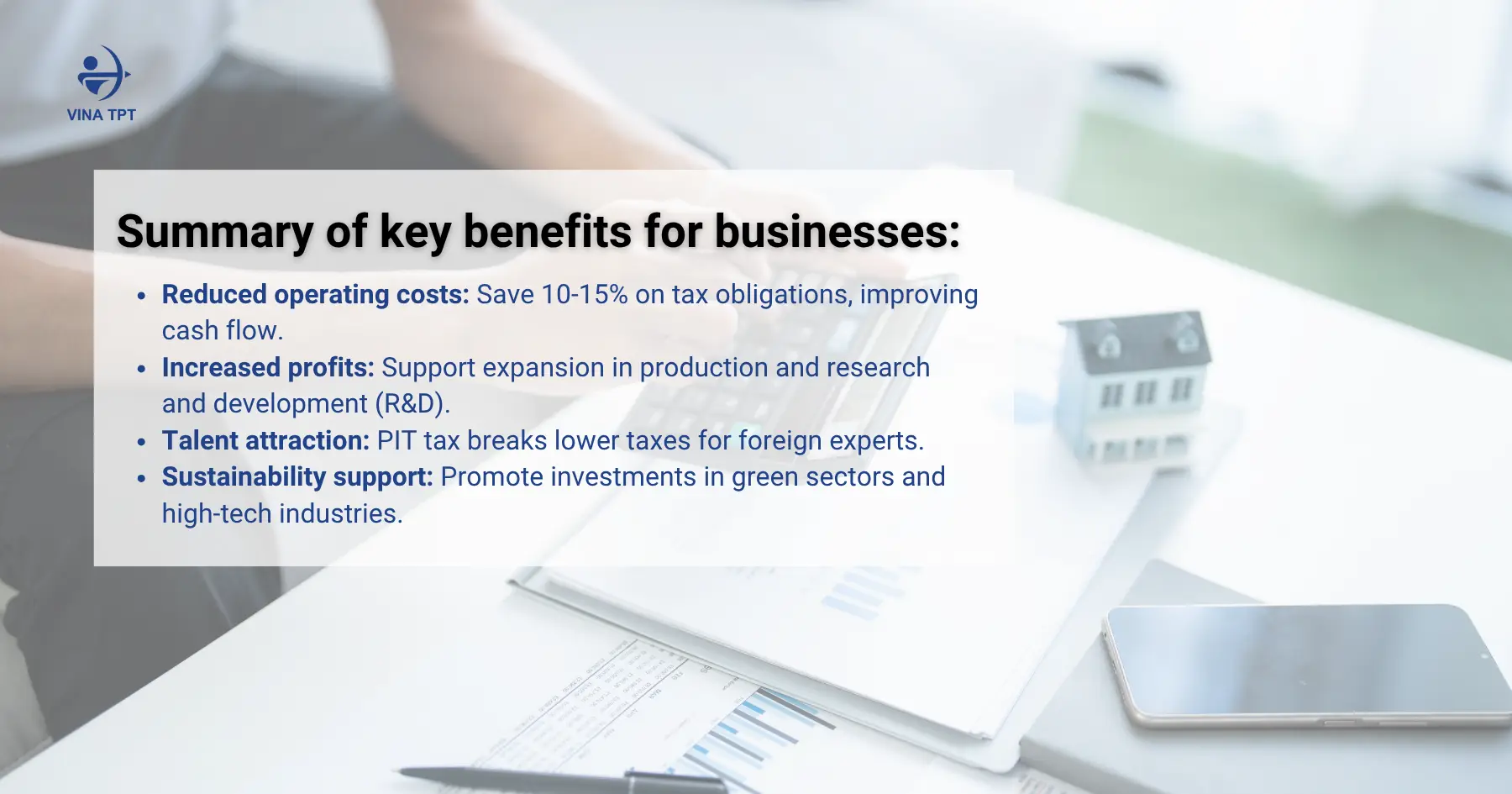
Here’s a summary of key benefits for FDI businesses: 

  • Reduced operating costs: Save 10-15% on tax obligations, improving cash flow. 
  • Increased profits: Support expansion in production and research and development (R&D). 
  • Talent attraction: PIT tax breaks lower taxes for foreign experts. 
  • Sustainability support: Promote investments in green sectors and high-tech industries. 

Explore the common tax breaks available in Vietnam to maximize benefits for your FDI enterprise. 

2/ Common Types of Tax Breaks Currently Available 

Vietnam’s government is refining tax policies to aid businesses during economic recovery, focusing on priority sectors like technology, green manufacturing, and exports. Starting in 2025, incentives apply to key taxes: Corporate Income Tax (CIT), Value-Added Tax (VAT), and Personal Income Tax (PIT). Each targets different groups and goals, helping FDI businesses cut financial loads and enhance competitiveness. Below is a comparison table: 

Tax Type  Main Incentives  Applicable Entities  Duration 
CIT  Exemption for 2-4 years, 50% reduction thereafter  FDI businesses in priority sectors  6-15 years 
VAT  Reduction from 10% to 8%  Goods and services (exclusions apply)  Until December 31, 2026 
PIT  Family deduction of VND 11 million/month (rising to VND 15.5 million/month from 2026)  Individuals and foreign experts as residents  Annual 

2.1 Corporate Income Tax (CIT) Incentives Effective from October 1, 2025 

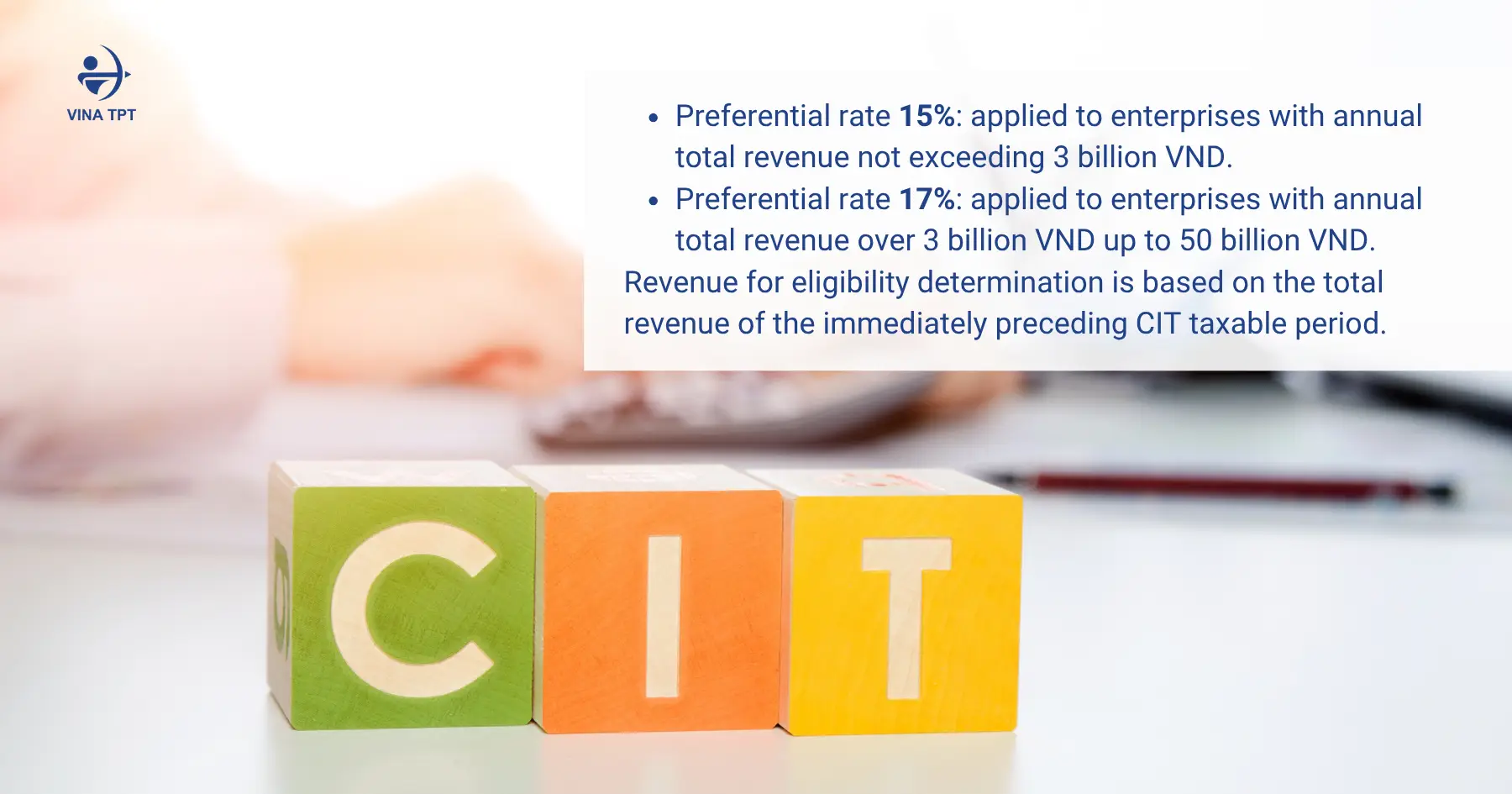
Corporate Income Tax (CIT) directly impacts FDI business profits. From October 1, 2025, the 2025 CIT Law (No. 67/2025/QH15) expands incentives to attract high-quality investments. FDI enterprises starting new projects in high-tech fields, disadvantaged areas, or economic zones qualify for CIT exemptions for 2-4 initial years and a 50% reduction for the next 4-9 years. Preferential rates can drop to 10% for specially prioritized projects, 15% for small and medium enterprises, or 17% for investments in favored locations. 

Incentives are categorized by: 

  • Sector: High-tech, education, healthcare—exemption for 4 years, 50% reduction for 9 years. 
  • Location: Disadvantaged areas—10% rate for 15 years. 
  • Investment scale: Projects over EUR 750 million apply the 15% global minimum tax. 

Summary table: 

Incentive Type  Conditions  Duration  Reduction Level 
Exemption  High-tech projects  4 years  100% 
Rate reduction  Favored locations  15 years  10-17% 
50% reduction  New investment projects  4-9 years  50% 

Impact on FDI businesses: 

  • Cost savings up to 20-30%, boosting net profits and reinvestment. 
  • Encourages production growth and local job creation. 

Example: An FDI company investing USD 100 million in a high-tech zone could save tens of millions in taxes over the first 10 years. 

FDI enterprises should consult tax experts early to ensure proper reporting, legal workforce use, and eligibility maintenance. Compliance from the start avoids audits, penalties, and maximizes legal tax breaks. 

Maximize Your Tax Incentives Today

2.2 Value-Added Tax (VAT) Incentives Effective from July 1, 2025 

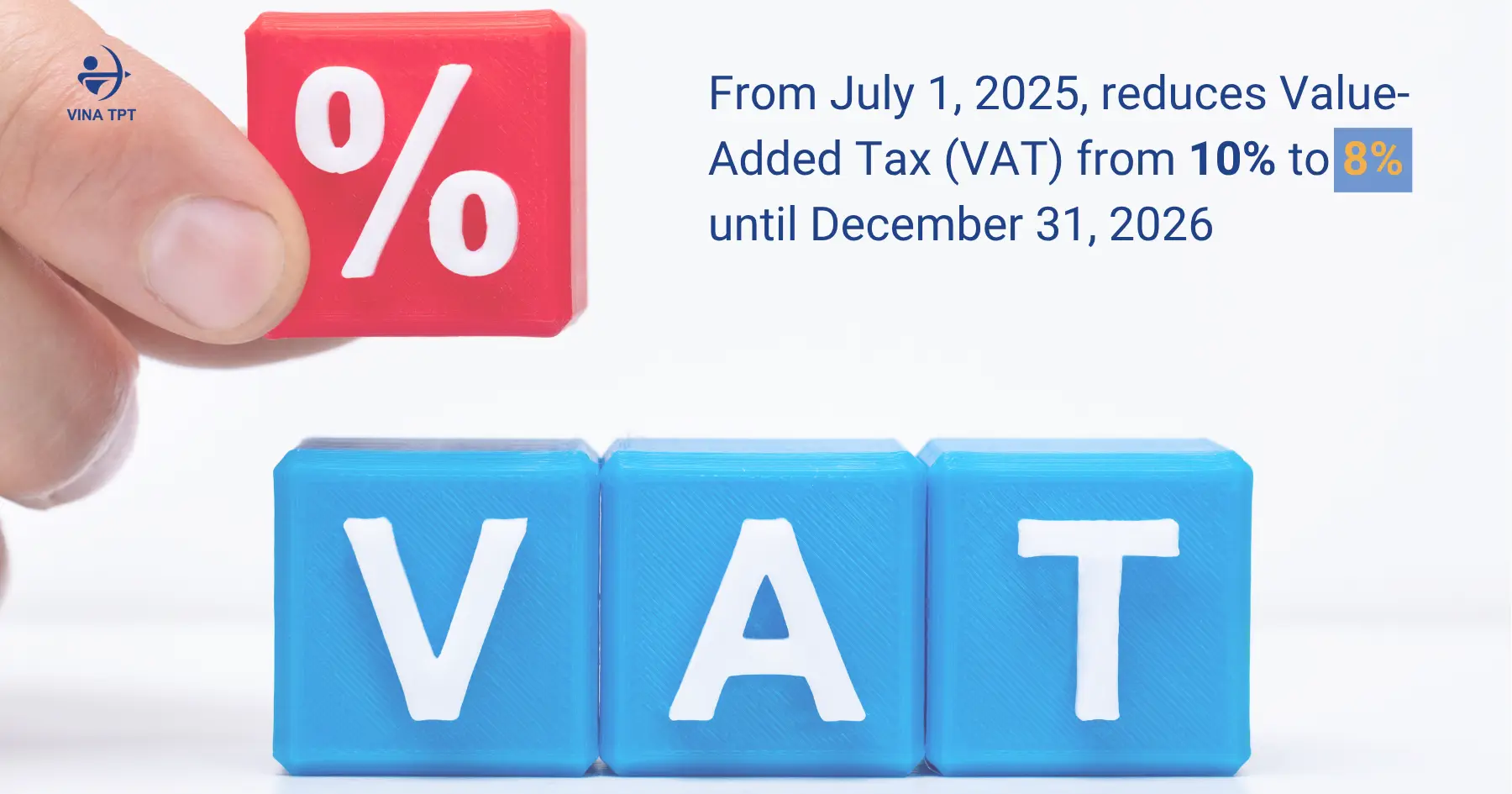
From July 1, 2025, Decree 174/2025/ND-CP reduces Value-Added Tax (VAT) from 10% to 8% until December 31, 2026, to stimulate consumption and support business recovery. This applies to most goods and services, excluding telecommunications, finance, and real estate. For FDI businesses, VAT tax breaks lower input costs, enhance cash flow, and strengthen export competitiveness. 

Specific benefits: 

  • Lower production costs: Imported materials face reduced VAT. 
  • Export support: Exported goods at 0% VAT, plus 8% reduction on related services. 

Example: An FDI firm exporting high-tech software enjoys full VAT exemption, saving 8-10% on costs. 

Key procedures: 

  • Declare VAT using new forms and electronic invoices. 
  • Collect valid documents for deductions or refunds. 
  • Note: Does not apply to specially taxed imports. 

2.3 Personal Income Tax (PIT) Incentives 

Personal Income Tax (PIT) continues to directly impact the income of workers, especially foreign experts in FDI enterprises.
From 2026, the personal allowance has been adjusted upwards to VND 15.5 million/month for the taxpayer themselves and VND 6.2 million/month for each dependent. This increase in allowances helps reduce tax obligations, improve disposable income, and enhance the attractiveness of the Vietnamese labor market.
At the same time, the PIT tax schedule has been simplified, reduced from 7 brackets to 5, with progressive tax rates.

PIT tax breaks for FDI businesses: 

  • Reduced taxes for foreign experts: Residents (present in Vietnam 183+ days/year) get deductions, cutting personnel costs. 
  • Exemptions for certain income: Stock transfers (if qualified) and foreign allowances. 

Notes: 

  • Register dependents electronically with tax authorities. 
  • Update income regularly to prevent back taxes. 

From 2026, updated policies will help FDI firms attract top global talent more easily. 

Download Vietnam Tax Handbook For Investor

3/ Key Benefits: How Tax Breaks Help Save Costs and Expand Business 

Tax breaks directly cut tax liabilities, increasing net profits and providing capital for FDI businesses to reinvest. Experts estimate savings of 10-20% on overall costs, enabling scale-up and global competition. 

Analysis from three angles: 

  • Financial: CIT and VAT reductions improve cash flow and reduce quarterly tax debts. 
  • Strategic: Encourage investments in priority areas like green technology, enhancing brand value. 
  • Human resources: PIT incentives lower salary costs, aiding recruitment of international and local experts. 

In summary, tax breaks not only save costs but also unlock business growth, allowing FDI enterprises to contribute sustainably to Vietnam’s economy. 

4/ Leveraging Tax Breaks with Vina TPT Tax Services 

To fully utilize tax breaks, FDI businesses need professional guidance from firms like Vina TPT—a Vietnam-based expert in tax and accounting. With experience supporting hundreds of FDI clients, Vina TPT identifies suitable incentives, prepares compliant files, and handles timely declarations to avoid audits. 

Standout advantages: 

  • Expertise across industries, from manufacturing to technology. 
  • Team knowledgeable in Vietnamese and international tax laws, with multilingual support. 
  • Transparent reporting and competitive fees for cost optimization. 

Support process: 

  • Assess your business and identify applicable incentives. 
  • Recommend tax plans and prepare registration documents. 
  • Implement declarations and monitor policy updates. 
  • Conduct regular reviews for ongoing compliance. 

Tax breaks are essential for FDI businesses in Vietnam to optimize costs, boost profits, and expand investments—especially with 2025 updates like the 8% VAT reduction and CIT incentives for priority sectors. These changes support economic recovery and position Vietnam as an attractive destination for foreign investment. 

Has your business maximized current tax incentives? Contact Vina TPT Tax Services today for a detailed analysis and tailored tax solutions—ensuring compliance and maximum savings! 

Talk to a Tax Specialist

Vina TPT Accounting services


Maximizing FDI Success in Vietnam: Tax Incentives and Financial Support Explained

tax incentives

tax incentives

1. How Tax Incentives Shape FDI Success in Vietnam

Vietnam has become one of Southeast Asia’s most attractive investment destinations, largely thanks to its tax incentives for FDI Vietnam enterprises. For many foreign investors, tax reductions are not just a way to save costs but also a signal of Vietnam’s commitment to long-term global investment growth.

Key tax incentives include preferential corporate income tax rates, tax holidays, and exemptions for industries such as high technology, renewable energy, and export manufacturing. By lowering the cost of doing business, these incentives directly improve profitability while creating a competitive environment for multinational firms.

According to the Vietnam Ministry of Finance, FDI Vietnam contributed nearly 70% of the country’s exports in 2023. This growth would not have been possible without a consistent and attractive tax policy framework aligned with international accounting standards and global trade norms.

2. Financial Support and Tax Incentives for FDI Vietnam Companies

Beyond tax reductions, Vietnam provides financial support programs for foreign investors. These include:

  • Land rent exemptions and reductions for projects in economic zones or underdeveloped areas.

  • Access to state-supported credit for infrastructure development or green technology.

  • Subsidies and grants for vocational training programs to upgrade local workforce skills.

Such measures complement tax incentives, reducing fixed costs while building sustainable operations. In practice, these support programs help FDI Vietnam enterprises balance early-stage expenses with long-term compliance under both VAS and IFRS accounting norms.

Download Vietnam Tax Handbook For Investor

3. Exploring the Main FDI Benefits Beyond Tax Reductions

While tax breaks are often the first attraction, FDI Vietnam investors also gain long-term strategic advantages. The country offers access to a consumer market of nearly 100 million people, creating opportunities for steady revenue growth. At the same time, Vietnam’s participation in strategic trade agreements such as CPTPP and EVFTA enhances its role as a reliable trade partner. A stable political environment further supports international partnerships, giving foreign investors confidence in long-term commitments.

Beyond these strengths, Vietnam’s deep integration into global supply chains enables foreign companies to use the country not only as a production hub but also as a gateway to regional markets. When combined with global accounting practices and IFRS compliance, these advantages build sustainable transparency and trust with stakeholders, positioning Vietnam as a premier destination for international investment.

4. Challenges of IFRS and Accounting Norms in Vietnam for FDI Enterprises

Despite the opportunities, FDI companies often encounter challenges in interpreting and applying Vietnam’s tax policies. Complex regulations, frequent updates, and differences between Vietnamese accounting standards and international norms can make compliance difficult.

For example, the lack of clarity around transfer pricing rules has led to disputes between tax authorities and multinational firms. Moreover, many foreign investors underestimate the time and resources needed to maintain proper financial reporting under Vietnamese standards.

These challenges can result in penalties, additional audits, and even reputational risks. This is why having a reliable accounting guide and professional local support is crucial for long-term success.

Need help navigating Vietnam’s complex tax rules?

Talk to Vina TPT’s Accounting Experts Today

5. Strategies to Maximize FDI Support Programs Effectively

To fully benefit from Vietnam’s tax incentives and financial support, FDI companies should adopt proactive strategies:

First, they need to perform regular policy reviews to stay updated with changes in tax laws. Second, companies should align their operations with priority sectors – such as high-tech or green energy – where incentives are more favorable. Third, building strong relationships with local partners and government authorities can smoothen administrative processes and reduce delays in obtaining approvals.

Equally important is the adoption of transparent financial management. By maintaining detailed records and ensuring compliance with local standards, companies can position themselves to qualify for maximum support while minimizing risks of disputes with regulators.

6. From Policy to Practice: How Vina TPT Financial Statement Service Helps FDI Companies Leverage Incentives

Turning government policies into real business advantages requires expert support. This is where Vina TPT financial statement service comes in. With deep expertise in Vietnamese accounting regulations and international reporting standards, Vina TPT helps FDI companies navigate the complexities of tax incentives and financial support programs.

Our services ensure that businesses remain compliant while maximizing the benefits available to them. Whether it is preparing accurate financial statements, advising on tax strategies, or assisting with regulatory filings, Vina TPT provides tailored solutions that help foreign investors focus on growth rather than administrative hurdles.

For companies aiming to thrive in Vietnam, partnering with a trusted service provider is not just an option but a necessity. Vina TPT empowers enterprises to move from policy awareness to policy application, turning financial support into sustainable growth.

Ready to grow your investment?Learn how Vina TPT’s tax planning and financial support services can help your FDI business thrive.

BOOK A FREE CONSULTATION

Vina TPT Accounting services