
Checklist Tax Registration Requirements After Your Business Setup Vietnam

checklist-tax-registration-requirements-after-your-business-setup-vietnam

checklist-tax-registration-requirements-after-your-business-setup-vietnam

You already hold the Enterprise Registration Certificate (ERC), so why can you still not issue invoices, open a bank account, or record the first transaction? The legal entity exists, but the tax and payment systems have not been switched on. Without a Chief Accountant, a registered digital signature, a configured e-tax account, or valid e-invoices, the company is not yet legally ready to operate in practice.

Once the business setup Vietnam process is complete, foreign investors must address a series of post-establishment obligations to prepare their companies for operations. This article from Vina TPT walks through the next execution steps in priority order: appointing key positions, completing initial tax registration Vietnam, opening bank accounts and contributing capital, filing the first periodic tax returns, registering e-invoice Vietnam before the first invoice is issued, and registering a social-insurance unit code if you are about to hire staff.

1. Appoint Key Positions, Seal and Digital Signature

One of the first compliance priorities after business setup Vietnam is configuring the company’s tax registration and accounting systems correctly. This establishes the foundation for subsequent tax filings and financial reporting.

The Enterprise Registration Certificate (ERC) already records the Legal Representative. Immediately after that milestone, the investor’s first urgent task is to appoint a Chief Accountant (or the person in charge of accounting) – either an in-house hire or a professional outsourced accounting service. Under Vietnam’s Law on Accounting, this title is mandatory for every FDI company.

In practice, commercial banks require the Chief Accountant appointment decision when the company opens its capital account. Opening that account is the step that lets the investor transfer charter capital within the 90-day deadline after the ERC, or within the longer schedule stated on the IRC. Without the account, the contribution cannot be recorded on time.

The next step is to engrave the company seal so the initial accounting and tax registration dossiers can be completed and legally valid. The company then purchases a digital signature (CA Token). The token is the electronic identity used to log in to the General Department of Taxation portal, register e-invoices and sign periodic tax returns. These tools support the company’s initial tax registration Vietnam procedures and enable electronic submissions through the relevant government portals.

2. Initial Tax Registration

Although the company’s tax code is issued automatically with the ERC, completing the initial tax registration Vietnam requirements remains an important step before the business begins regular tax reporting. The core configuration items include:

  • Accounting regime and financial year: Register the enterprise accounting regime (Circular 200/2014/TT-BTC or Circular 133/2016/TT-BTC) and confirm the financial year (usually the calendar year from 1 January to 31 December).
  • Fixed-asset depreciation method: Declare the depreciation method applied under Ministry of Finance rules.
  • E-tax account and VAT method: Declare the Value-Added Tax calculation method (credit method or direct method) as the basis for setting up VAS books.
  • Digital identity and corporate VNeID: Activate the company’s electronic identity account and link the Legal Representative’s VNeID for two-factor authentication on the National Public Service Portal and the Tax Portal.

Declaring the wrong VAT method or choosing the wrong filing period at this step leads to complex amendment procedures and interrupts the company’s input and output invoice flow.

3. Open the Bank Account and Contribute Capital

After completing business setup Vietnam, foreign investors should arrange the appropriate corporate bank accounts, including a Direct Investment Capital Account (DICA) where required, to facilitate timely capital contributions. The statutory deadline is 90 days from the date the ERC is issued (unless the Investment Registration Certificate (IRC) records a longer, staged contribution schedule).

The bank file for an FDI company typically requires the following documents:

  • Notarized copies of the ERC, IRC, and company charter.
  • A valid visa, Temporary Residence Card (TRC), or passport of the Legal Representative.
  • The decision appointing the Chief Accountant or the person in charge of accounting, plus personal identification.
  • Specimen-signature and seal registration for the account holder and the Chief Accountant.

Besides the DICA, the company also needs a VND current account for day-to-day commercial receipts and payments.

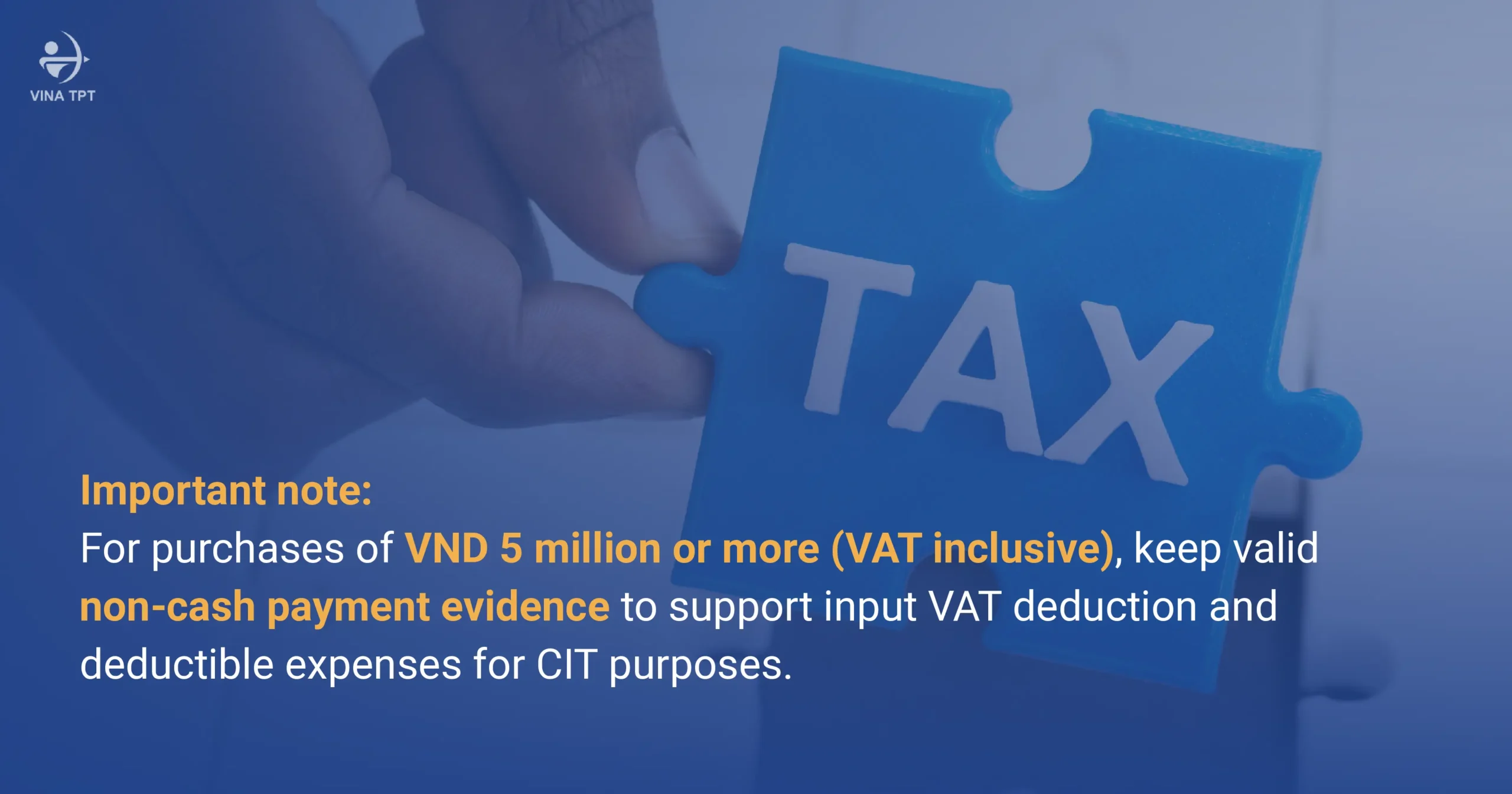
Important note on deductible costs: Under tax-administration rules, every purchase of goods or services of VND 5 million or more (VAT inclusive) must have a non-cash payment voucher (a transfer from the company’s bank account) to qualify for input VAT credit and for a reasonable expense when Corporate Income Tax is determined. Late charter-capital contribution through the DICA triggers administrative fines and can lock the company’s international banking functions.
checklist-tax-registration-requirements-after-your-business-setup-vietnam

Explore Vina TPT’s Company Formation Services

4. File the First Periodic Tax Returns

As soon as the ERC is issued and the tax code is activated, the company has periodic tax-compliance duties under the law — even if it is newly formed and has no revenue, no costs, and no staff.

Initial periodic filing obligations include:

  • VAT return: File monthly or quarterly (newly formed companies are usually quarterly VAT filers). If there are no transactions, the company must still file a nil return (select the “no arising” indicator).
  • PIT return: File quarterly if income was paid to employees in the period.
  • Self-assessed provisional CIT: The company determines quarterly provisional Corporate Income Tax if it has profit. No quarterly CIT return is filed; only the annual finalization is required.
  • Foreign Contractor Tax (FCT): File and pay on each arising payment if the company pays costs to overseas counterparties or service providers (Google, Meta, international software services, and similar).

>>> You may also be interested in: Tax Tips for Small Businesses in Vietnam to Avoid Mistakes

Updated legal note: From 1 January 2026, the business license fee is abolished under the new Government rules. Companies completing business setup Vietnam from 2026 no longer file a business-license-fee return or pay the annual fee.

5. Register E-Invoices Before You Issue the First Invoice

Registering e-invoice Vietnam (tax-authority-coded electronic invoices under Circular 78/2021/TT-BTC) is mandatory before the company records any sale of goods or supply of services. Until e-invoice registration is complete, the company must not issue commercial invoices. Issuing unofficial invoices or recording revenue outside the e-invoice system is a tax-law violation.

The e-invoice registration steps are:

  1. Choose a certified e-invoice solution provider.
  2. File the e-invoice registration form (Form 01/ĐKTĐ-HĐĐT) with the managing tax office, signed with the digital signature.
  3. Wait for the tax office’s approval (usually within one working day).

Every detail on the e-invoice template, company name, tax code, and head-office address, must match the ERC 100%. Even a small character or administrative-place-name discrepancy can lead the tax office to reject the invoice or the buyer to refuse the VAT credit. The company may issue invoices only after the digital signature and the e-invoice template have been confirmed as active on the General Department of Taxation portal.

6. Register Social Insurance If You Will Hire Staff

If the company plans to hire local or foreign staff to work formally right after incorporation, registering a social-insurance unit code is mandatory. Even if the company has only one or two employees on labor contracts, first-time registration for social insurance, health insurance, and unemployment insurance must be completed before the first official payday.

The social-insurance unit code is linked directly to the company’s quarterly Personal Income Tax (PIT) finalization data.

Note for expatriates: If a founder or foreign specialist works in Vietnam, the company must at the same time obtain a Work Permit or a confirmation that the person is exempt from a Work Permit, then register compulsory social insurance under the rules for foreign workers. Without a valid Work Permit, the foreign employee’s salary can be disallowed as a reasonable expense when Corporate Income Tax is calculated.

7. 30-Day Sequence After Business Setup in Vietnam

To help investors see the exact execution path, here is the mandatory 30-day sequence to follow as soon as the Enterprise Registration Certificate (ERC) is in hand:

7.1. Days 1-7 (initial legal setup)

  • Issue the decision appointing the Chief Accountant or the person in charge of accounting.
  • Engrave the company seal (if used) and purchase a company digital signature (CA Token).
  • File initial tax registration with the managing tax office.
  • Activate the Legal Representative’s VNeID digital identity so it connects to the public-service system.

7.2. Days 7-15 (finance and banking)

  • Open the Direct Investment Capital Account (DICA) and the VND current account at a commercial bank.
  • Notify the tax office of the bank accounts (via the digital signature).
  • Prepare funds and transfer charter capital from abroad into the DICA (complete within the 90-day deadline).

7.3. Days 15-30 (activation and periodic compliance)

  • Select an electronic invoicing provider and complete the e-invoice Vietnam registration process before issuing the company’s first invoice.

  • Set up the accounting books under VAS.

  • Register the social-insurance unit code if hiring has started.

  • Get ready for the first VAT and PIT filing period.

Reminder for FDI companies: Besides tax duties, foreign-invested companies must also meet the quarterly project-implementation reporting deadline on the National Foreign Investment Information System – even while the project is still in preparation and has no revenue.

8. How Vina TPT Handles Post-Setup Tax Registration

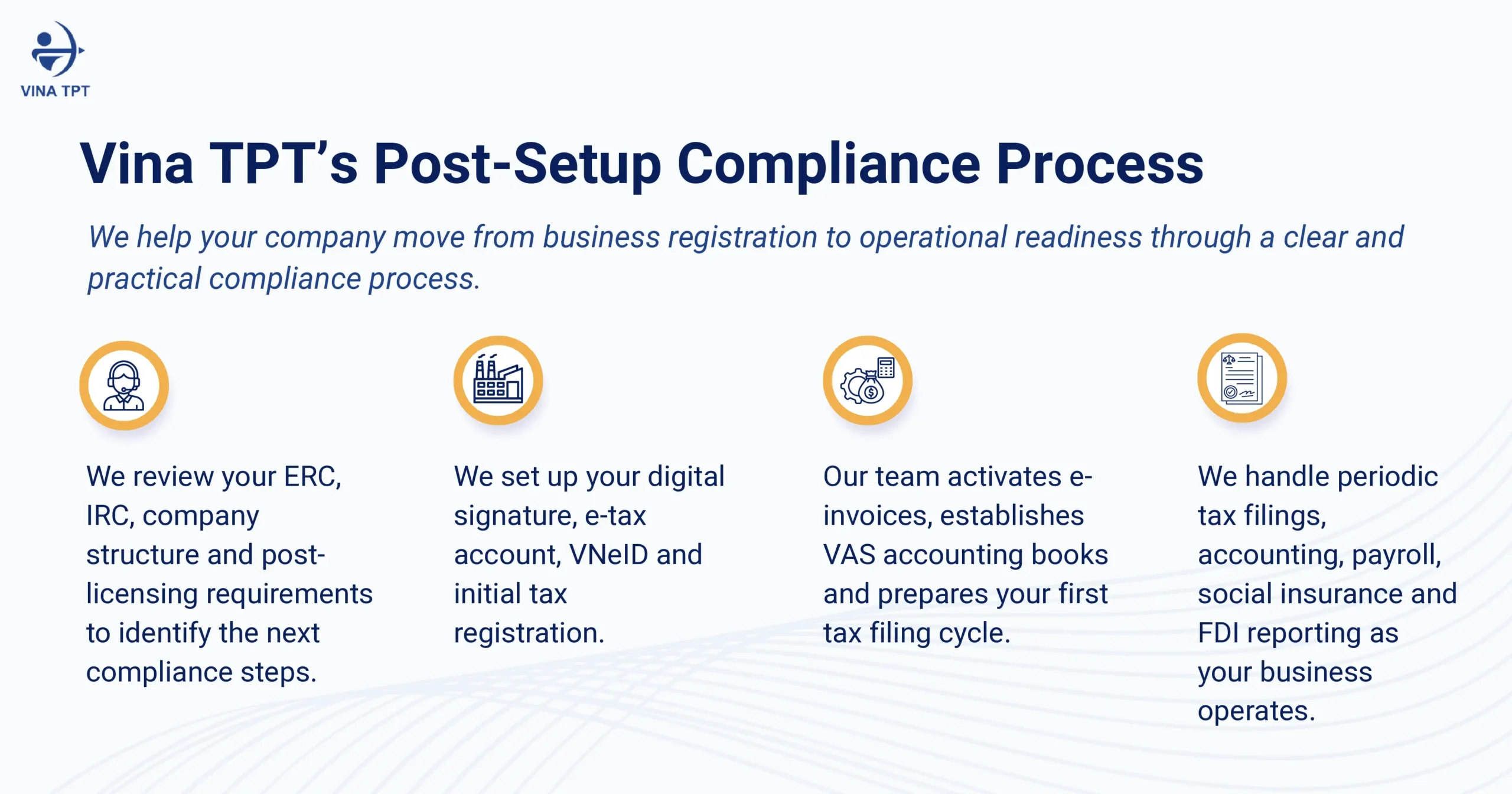
Handling the full tax registration Vietnam chain after incorporation often takes time and creates legal errors for foreign investors who are not yet familiar with Vietnam’s administrative system. Vina TPT provides an end-to-end advisory and implementation package that standardizes the entire post-establishment tax-compliance system:

  • Chief Accountant appointment and initial tax filing: Supplying a practicing-qualified Chief Accountant, registering the digital signature, activating corporate VNeID, and completing the initial tax-registration file accurately.
  • E-invoice configuration and VAS books: Supporting template registration and activation of e-invoice Vietnam, and setting up VAS books that match the industry.
  • Tax and social-insurance filing on the company’s behalf: Full handling of periodic returns (VAT, CIT, PIT, FCT), registration of the social-insurance unit code, and payroll for staff.
  • FDI legal support: Tracking the 90-day charter-capital deadline, filing periodic FDI investment reports, and supporting Work Permit and TRC applications for foreign staff.

Have you just completed business setup Vietnam and are preparing for the first invoice? Contact Vina TPT so our specialists and CPAs with 10-20 years of experience can review and activate the full initial tax checklist for your company.

checklist-tax-registration-requirements-after-your-business-setup-vietnam

BOOK A FREE CONSULTATION

Business advisory for Singaporean investors establishing real estate businesses in Vietnam

alt="Business advisory services for Singaporean investors entering Vietnam’s real estate market"

business-advisory-services

1. Vietnam Real Estate: The Next Strategic Move for Singapore Investors

Over the past decade, Vietnam has become one of the most dynamic real estate markets in Asia, with rapid urbanization, high housing demand and a boom in industrial zones. In particular, Singapore is a leading financial, investment and business advisory center in the region, is considering Vietnam as a new “profit drop point” in its strategy to expand in Southeast Asia.

Singaporean investors see in Vietnam not only high profit potential, but also an opportunity to participate in a market that is changing strongly in terms of infrastructure, urban planning and Foreign Direct Investment attraction policies. Vietnam, with its affordable land prices, youthful workforce, and fast-growing transport infrastructure including airports, seaports, and metro lines, is emerging as a promising mirror of Singapore in its early development phase.

However, to realize the opportunity, investors need to clearly understand Vietnam’s legal framework, licensing process and tax mechanism – factors that can directly impact the profitability and safety of the project.

2. Before you invest: Understanding Vietnam’s Real Estate Landscape

Real estate in Vietnam is divided into many different types, including: industrial park development, housing projects, offices, resorts, trade – services and logistics. However, not all segments are open to foreign investors.

According to current regulations, investors can:

  • Contribute capital or buy shares in Vietnamese enterprises with existing real estate projects.
  • Establish a 100% foreign-owned company to develop projects if granted appropriate investment licenses.
  • Lease or sublease land in industrial parks, export processing zones, high-tech zones.

However, direct ownership of land in Vietnam is not allowed, because land is owned by the entire people and managed by the State. Investors can only use land through leasing or joint ventures with domestic partners.

In addition, the tax and regulatory systems related to real estate (VAT, CIT, transfer tax, land fees) also have significant differences compared to Singapore. Lack of understanding or misapplication of investment structures can lead to legal risks or reduced profit efficiency.

At this stage, partnering with a professional business advisory firm becomes essential. A qualified advisory team can help Singaporean investors navigate Vietnam’s complex real estate regulations, review investment structures, and ensure full compliance with local laws. With expert guidance on legal, financial, and tax aspects, investors can make informed decisions and minimize potential risks from the very beginning. Business Advisory

Business advisory for Singaporean investors establishing real estate businesses in Vietnam

3. From Licensing to Launch: Key Steps in Establishing a Real Estate Business

The process of setting up a real estate business in Vietnam usually includes four main stages, requiring close coordination between investors, lawyers and management agencies:

Stage 1: Investment strategy consulting: Business Advisory

Investors need to clearly define their goals (developing new projects, acquiring, cooperating or operating), assess the legal feasibility of the model and choose a locality with appropriate policies.

Stage 2: Applying for an Investment Registration Certificate (IRC):

This is the first license that allows foreign-invested enterprises to carry out projects in Vietnam.

Documents typically required for IRC application include:

  • Application for investment project implementation & Project proposal: Stating objectives, scope, scale, investment capital, location, and implementation schedule.
  • Proof of investor’s financial capacity: Bank statements, audited financial reports, credit contracts, or collateral documents.
  • Legal documents of the investor:
  • For individuals: Notarized passport, consular legalization.
  • For organizations: Business Registration Certificate or equivalent, consular legalization.
  • Evidence of project location: Office/land lease agreement or land use rights certificate.
  • Power of attorney/authorization letter (if the investor appoints a third party to handle procedures).

Stage 3: Enterprise Establishment (ERC):

After having IRC, investors register to establish an enterprise, determine the type of company (LLC, joint stock or joint venture). Choosing the right model will greatly affect the capital mechanism, voting rights and profit distribution.

Stage 4: Compliance and project implementation:

Enterprises must complete tax, insurance, financial and environmental procedures before officially starting operations. This is also the stage where business advisory services become especially important to ensure that all activities are legal and effective.

All foreign documents must be consular legalized and officially translated into Vietnamese before submission. This step often prolongs the preparation process, so it is recommended that investors cooperate with a reliable company registration service to ensure accuracy and save time.

4. Tax Business Advisory: Maximizing Profitability through Smart Structuring

In real estate investment, tax optimization and smart business structure are decisive factors for net profit. Vietnam applies corporate income tax (CIT) at 20%, but there are tax incentives for investment projects in industrial parks, economic zones or investment-encouraged sectors (logistics, infrastructure, social housing, etc.).

In addition, if investors know how to structure capital flows and divide profits reasonably, they can avoid double taxation between Vietnam and Singapore thanks to the Double Taxation Avoidance Agreement (DTA) signed by the two countries. This is a great advantage, but it can only be maximized when there is a business tax advisory team that understands both tax systems.

Vina TPT experts often advise Singaporean investors about business advisory on multi-level legal entity structure strategies, cash flow allocation and legal profit transfer, to ensure optimal profits while still strictly complying with regulations in Vietnam.

OPTIMIZE YOUR TAX STRUCTURE NOW

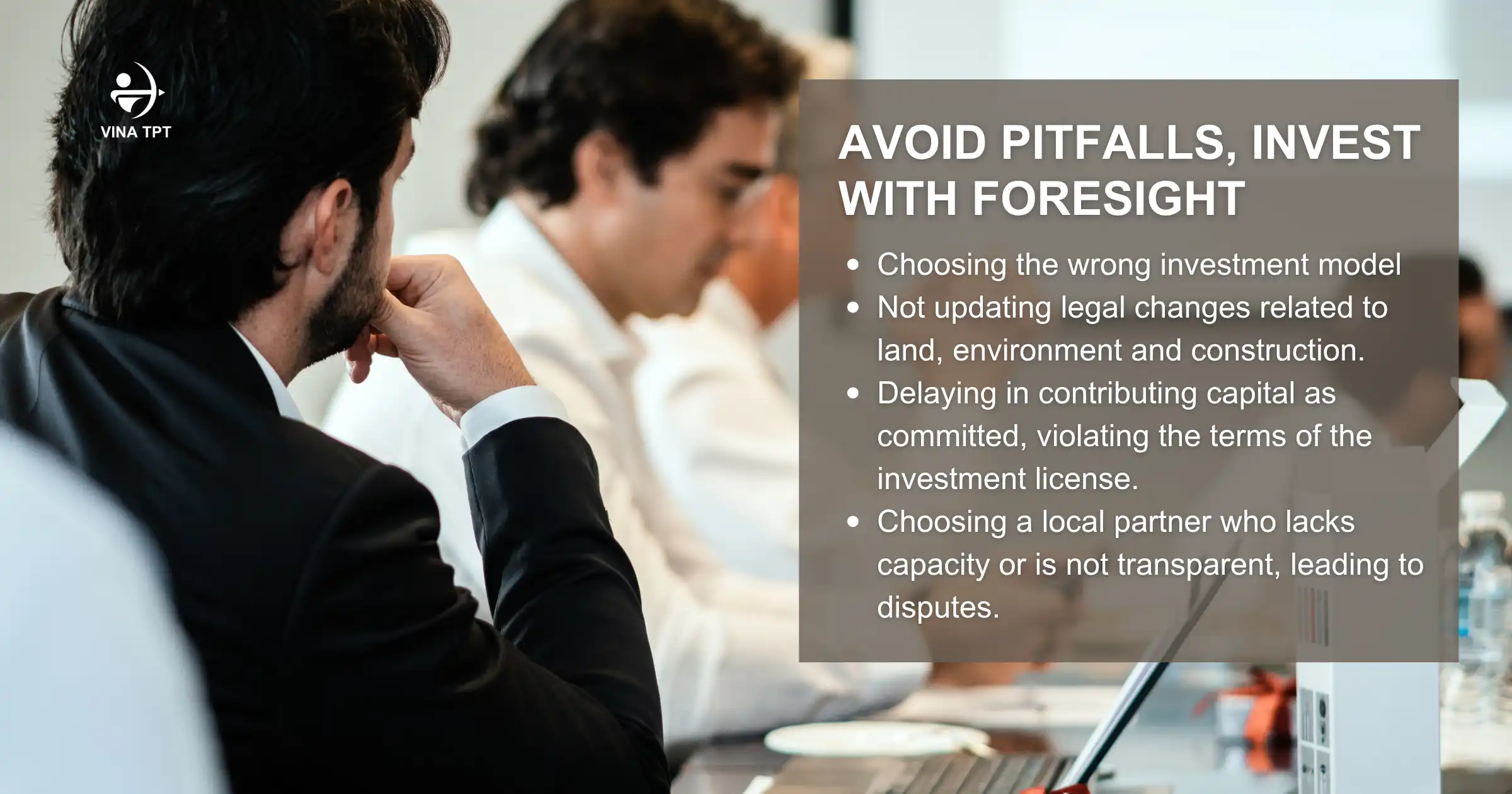
5. Common Mistakes Foreign Real Estate Investors Should Avoid

Despite the wide-open opportunities, many foreign investors including large corporations, have encountered trouble when investing in Vietnamese real estate due to common mistakes. Some typical mistakes include:

  • Choosing the wrong investment model (for example, registering a trading company instead of a project development company, leading to restrictions on land use).
  • Not updating legal changes related to land, environment and construction.
  • Delaying in contributing capital as committed, violating the terms of the investment license.
  • Choosing a local partner who lacks capacity or is not transparent, leading to disputes.

An excellent business advisory service will help investors avoid these mistakes right from the start, thanks to legal review, partner assessment and risk control throughout the investment process. 

Business advisory for Singaporean investors establishing real estate businesses in Vietnam

6. Why Partnering with Vina TPT Business Advisory Makes a Difference 

With over 15 years of experience in advising companies, Vina TPT Business Advisory Service’s team of legal, accounting and tax experts has worked with hundreds of international enterprises in the real estate, infrastructure and manufacturing sectors.

We provide end-to-end solutions, from developing investment strategies, applying for IRC/ERC licenses, advising on tax structures, to compliance management and post-investment operational accounting. Vina TPT’s strength lies in combining a deep understanding of Vietnamese law with international operational standards, helping Singaporean investors ensure compliance while optimizing profits.

If you are looking for a business consulting partner with market knowledge and the ability to handle everything from legal to tax, Vina TPT Business Advisory is the reliable bridge between Singapore and Vietnam.

BOOK A FREE CONSULTATION

business-advisory-services

Maximizing FDI Success in Vietnam: Tax Incentives and Financial Support Explained

tax incentives

tax incentives

1. How Tax Incentives Shape FDI Success in Vietnam

Vietnam has become one of Southeast Asia’s most attractive investment destinations, largely thanks to its tax incentives for FDI Vietnam enterprises. For many foreign investors, tax reductions are not just a way to save costs but also a signal of Vietnam’s commitment to long-term global investment growth.

Key tax incentives include preferential corporate income tax rates, tax holidays, and exemptions for industries such as high technology, renewable energy, and export manufacturing. By lowering the cost of doing business, these incentives directly improve profitability while creating a competitive environment for multinational firms.

According to the Vietnam Ministry of Finance, FDI Vietnam contributed nearly 70% of the country’s exports in 2023. This growth would not have been possible without a consistent and attractive tax policy framework aligned with international accounting standards and global trade norms.

2. Financial Support and Tax Incentives for FDI Vietnam Companies

Beyond tax reductions, Vietnam provides financial support programs for foreign investors. These include:

  • Land rent exemptions and reductions for projects in economic zones or underdeveloped areas.

  • Access to state-supported credit for infrastructure development or green technology.

  • Subsidies and grants for vocational training programs to upgrade local workforce skills.

Such measures complement tax incentives, reducing fixed costs while building sustainable operations. In practice, these support programs help FDI Vietnam enterprises balance early-stage expenses with long-term compliance under both VAS and IFRS accounting norms.

Download Vietnam Tax Handbook For Investor

3. Exploring the Main FDI Benefits Beyond Tax Reductions

While tax breaks are often the first attraction, FDI Vietnam investors also gain long-term strategic advantages. The country offers access to a consumer market of nearly 100 million people, creating opportunities for steady revenue growth. At the same time, Vietnam’s participation in strategic trade agreements such as CPTPP and EVFTA enhances its role as a reliable trade partner. A stable political environment further supports international partnerships, giving foreign investors confidence in long-term commitments.

Beyond these strengths, Vietnam’s deep integration into global supply chains enables foreign companies to use the country not only as a production hub but also as a gateway to regional markets. When combined with global accounting practices and IFRS compliance, these advantages build sustainable transparency and trust with stakeholders, positioning Vietnam as a premier destination for international investment.

4. Challenges of IFRS and Accounting Norms in Vietnam for FDI Enterprises

Despite the opportunities, FDI companies often encounter challenges in interpreting and applying Vietnam’s tax policies. Complex regulations, frequent updates, and differences between Vietnamese accounting standards and international norms can make compliance difficult.

For example, the lack of clarity around transfer pricing rules has led to disputes between tax authorities and multinational firms. Moreover, many foreign investors underestimate the time and resources needed to maintain proper financial reporting under Vietnamese standards.

These challenges can result in penalties, additional audits, and even reputational risks. This is why having a reliable accounting guide and professional local support is crucial for long-term success.

Need help navigating Vietnam’s complex tax rules?

Talk to Vina TPT’s Accounting Experts Today

5. Strategies to Maximize FDI Support Programs Effectively

To fully benefit from Vietnam’s tax incentives and financial support, FDI companies should adopt proactive strategies:

First, they need to perform regular policy reviews to stay updated with changes in tax laws. Second, companies should align their operations with priority sectors – such as high-tech or green energy – where incentives are more favorable. Third, building strong relationships with local partners and government authorities can smoothen administrative processes and reduce delays in obtaining approvals.

Equally important is the adoption of transparent financial management. By maintaining detailed records and ensuring compliance with local standards, companies can position themselves to qualify for maximum support while minimizing risks of disputes with regulators.

6. From Policy to Practice: How Vina TPT Financial Statement Service Helps FDI Companies Leverage Incentives

Turning government policies into real business advantages requires expert support. This is where Vina TPT financial statement service comes in. With deep expertise in Vietnamese accounting regulations and international reporting standards, Vina TPT helps FDI companies navigate the complexities of tax incentives and financial support programs.

Our services ensure that businesses remain compliant while maximizing the benefits available to them. Whether it is preparing accurate financial statements, advising on tax strategies, or assisting with regulatory filings, Vina TPT provides tailored solutions that help foreign investors focus on growth rather than administrative hurdles.

For companies aiming to thrive in Vietnam, partnering with a trusted service provider is not just an option but a necessity. Vina TPT empowers enterprises to move from policy awareness to policy application, turning financial support into sustainable growth.

Ready to grow your investment?Learn how Vina TPT’s tax planning and financial support services can help your FDI business thrive.

BOOK A FREE CONSULTATION

Vina TPT Accounting services