Essential Step For Setting Up a Company in Vietnam| Trading Businesses

setting-up-a-company-in-vietnam-trading-Vina-TPT-Legal

Are you looking for a solution for setting up a company in Vietnam and explore opportunities in one of Asia’s fastest-growing economies? Vietnam, with its strategic geographic location along the South China Sea and borders with China, Laos, and Cambodia, has become a top destination for foreign investors in the trading sector. However, full legal compliance is essential for sustainable success, governed by the Law on Investment 2020 (amended in 2025) and the Law on Enterprises 2020. This comprehensive guide details the essential steps to set up a trading company in Vietnam, from basic concepts to full operations, catering to both informational and transactional search intent. 

  • Key Benefits: Access to FTAs for tariff reductions, excellent logistics positioning, and policies allowing up to 100% foreign ownership in most trading activities. 
  • Challenges to Consider: Administrative procedures can take 1–6 months, and it’s crucial to stay updated on recent changes, such as the 2025 Investment Law amendments permitting company establishment before obtaining the Investment Registration Certificate (IRC). 

By following these steps carefully, you can successfully start a business in Vietnam as a foreigner. 

1/ What is a Trading Company in Vietnam? 

A trading company in Vietnam specializes in buying and selling goods, including import, export, wholesale/retail distribution, and related services, regulated by Decree 09/2018/ND-CP (with a replacement draft under discussion in 2025). Unlike manufacturing companies, which focused on production or service providers offering labor or consulting, trading companies serve as intermediaries in the supply chain, connecting producers with consumers. With Vietnam’s exports surging by 28% in 2025, this sector is booming—especially in electronics, textiles, and agricultural products. According to the Ministry of Industry and Trade, trading contributes 15–20% to GDP, with an average annual growth rate of 9–10% over the past decade, fueled by international integration. 

Key Activities: 

  • Importing goods from abroad for domestic distribution. 
  • Exporting Vietnamese products to global markets. 
  • Wholesale and retail distribution through traditional or online channels. 
  • Logistics, warehousing, and product promotion services. 

Comparison table with other business types: 

Type  Key Characteristics  Example 
Trading  Focuses on buying/selling, no production  Mobile phone importer, apparel distributor 
Manufacturing  Produces goods from raw materials  Textile factory, electronics component maker 
Services  Provides labor or advisory services  Software consulting, management consulting 

2/ Benefits and Challenges of Setting Up Company in Vietnam 

Setting up a trading company in Vietnam offers substantial advantages but also involves challenges. Here is a clear comparison: 

Benefits  Challenges  Illustrative Example 
Young market with 100 million consumers and high demand  Complex and potentially lengthy administrative procedures Textile exports grew by 20% due to young population 
Strategic location near China and major sea routes  A local partner is required hoặc Local partners are required Logistics advantages reduce transport costs by 15% 
FTAs reduce tariffs and open access to EU and US markets  Currency fluctuations and legal risks  EVFTA boosts agricultural exports by 25% 

The benefits clearly outweigh the challenges with proper planning. For example, foreign investors can leverage FTAs to expand markets but must comply with regulatory requirements such as the Economic Needs Test (ENT) for multiple retail outlets. 

3/ Legal Requirements and Foreign Ownership Rules 

Under the Law on Investment 2020 (amended 2025) and the Law on Enterprises 2020, Vietnam permits up to 100% foreign ownership in most trading sectors, except for restricted industries such as pharmaceuticals, oil and gas, and printing. The 2025 amendments (effective from 2026) simplify procedures by allowing company registration before IRC issuance and reducing conditional business lines from 243 to approximately 200. These changes have driven record FDI inflows in 2025. Compliance with Decree 09/2018/ND-CP (a replacement draft pending) remains required for foreign-invested trading operations. 

Key Requirements: 

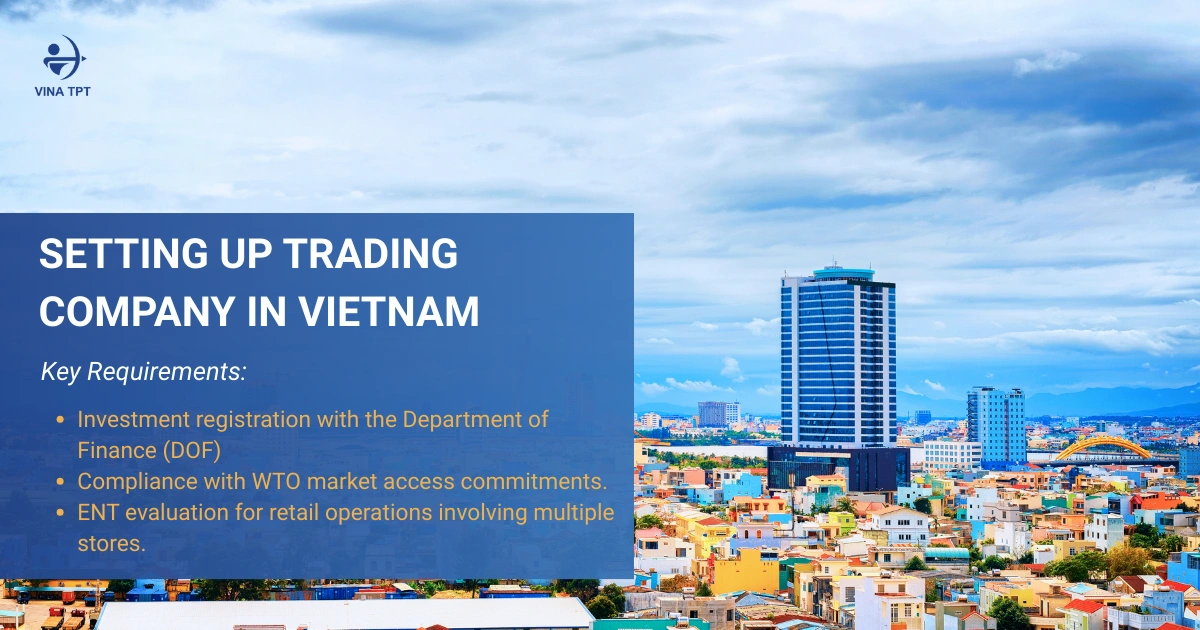
  • Investment registration with the Department of Finance (DOF) 
  • Compliance with WTO market access commitments. 
  • ENT evaluation for retail operations involving multiple stores. 

Restricted Product Categories and Conditional Business Lines 

Certain products are restricted or required special conditions under the Investment Law and Decree 09/2018/ND-CP, such as explosives, printing materials, and pharmaceuticals. 

Summary table: 

Product Category  VSIC Code  Restrictions 
Explosives  2029  Import prohibited except for national defense purpose
Printing Materials  1811  Requires approval from Ministry of Information 
Pharmaceuticals  2100  Foreign ownership limited to 49% 

Verification checklist: 

  • Check the national portal for conditional business lines. 
  • Assess legal risks with a local lawyer. 
  • Monitor the draft replacement of Decree 09 for 2026 updates. 
setting-up-a-company-in-vietnam-trading-Vina-TPT-Tax-Consultant

4/ Choosing the Right Business Structure 

Selecting the right business structure for your trading company depends on its scale and ownership. Under the Law on Enterprises 2020, the two most common forms are the Limited Liability Company (LLC) and the Joint Stock Company (JSC), with the LLC being ideal for smaller businesses due to its simpler procedures. 

  • LLC Pros & Cons: Flexible, liability limited to contributed capital; drawback: harder to raise large capital. 
  • JSC Pros & Cons: Easier to list on stock exchanges; drawback: more complex structure, requires at least 3 shareholders. 

Comparison table: 

Structure  Number of Members  Legal Liability 
LLC  1–50  Limited to contributed capital 
JSC  Minimum 3  Limited to share capital 

For foreign investors with limited capital, an LLC is the best choice for a fast start. 

LLC vs. JSC: Which is Best for Trading? 

Detailed comparison: 

LLC  JSC  Best for Trading 
Simple procedures, flexible capital  More complex, easier expansion  High for small businesses, local distribution 
No board of directors required  Requires diverse shareholders  Lower if needing large capital for exports 

LLC is generally more suitable for trading due to its flexibility. For example, a foreign agricultural trading company often opts for an LLC to quickly begin import operations. 

Consult a Business Setup Expert

5/ Capital Requirements and Financial Planning 

Vietnam imposes no fixed minimum capital for trading companies, but charter capital must be “reasonable” to demonstrate operational capability. A typical recommendation is USD 10,000–50,000, depending on the business plan. Total investment capital includes charter capital and other expenses, with full contribution required within 90 days of registration. 

Financial preparation checklist: 

  • Estimated setup costs: USD 3,000–10,000 for procedures and office. 
  • Reserve for VND/USD exchange rate risks. 
  • Budget for taxes and employee salaries. 

Estimated capital table: 

Recommended Capital  Purpose 
USD 10,000  Basic operations, small-scale distribution 
USD 50,000  Expansion of import/export activities 

6/ Essential Steps to Setting Up a Company in Vietnam as a Foreign Investor 

Setting up a foreign-invested company in Vietnam requires following a clear, structured process to ensure full legal compliance and smooth operations. This step-by-step guide is tailored for foreign-owned trading or commercial entities. 

Step 1: Prepare Your Investment Documentation 

Gather all necessary paperwork for your investment project. This includes defining your business model (e.g., Limited Liability Company – LLC, joint venture, or representative office), choosing the right structure, and outlining main activities. Verify that your industry allows foreign ownership under Vietnamese law. 

Step 2: Submit Application for the Investment Registration Certificate (IRC) 

The IRC is the foundational approval for foreign-invested enterprises. It authorizes your project and details the charter capital, scale, location, and business scope. Without an IRC, you cannot proceed to company registration. 

Required documents: 

  • Application form and a detailed project proposal (objectives, scale, capital, location, and timeline). 
  • Proof of financial capability (bank statements, audited financials, or credit agreements). 
  • Legal documents: notarized passport (individuals) or business registration certificate (organizations), both legalized. 
  • Proof of location (lease agreement or land use rights). 
  • Power of attorney (if using a third-party service). 

Foreign documents require consular legalization and official Vietnamese translation. Partnering with a professional company setup service such as Vina TPT is recommended to avoid delays. 

Step 3: Obtain the Enterprise Registration Certificate (ERC) 

After the IRC issuance, register the company to receive the ERC, which establishes its legal identity in Vietnam. 

Step 4: Open a Corporate Bank Account and Inject Charter Capital 

Open a dedicated capital account at a licensed Vietnamese bank. Contribute the full charter capital within 90 days of ERC issuance to avoid penalties and ensure the credibility for future permits. 

Step 5: Complete Tax Registration and Post-Licensing Formalities 

Register for a tax ID, VAT, and fulfill obligations such as social insurance and labor compliance if hiring staff. 

Step 6: Secure Industry-Specific Licenses (If Applicable) 

Sectors like trading, retail, F&B, education, or e-commerce may require additional permits. 

By following these steps and staying updated on regulations, foreign investors can successfully set up company in Vietnam.

setting-up-a-company-in-vietnam-trading-Vina-TPT

7/ Taxation, Compliance, and Ongoing Operations 

Foreign-invested trading enterprises (FDIs) in Vietnam must strictly comply with tax, labor, and periodic reporting obligations to avoid penalties and maintain legal standing. 

A – Taxes: 

  • Corporate Income Tax (CIT): 20% (15–17% incentives for SMEs from late 2025 if revenue < VND 50 billion); quarterly provisional payments (at least 80% of annual obligation); due by the 30th of the first month of the following quarter; annual declaration within 90 days after the fiscal year-end. 
  • Value Added Tax (VAT): 8–10% (reduced to 8% until 2026); monthly declaration (revenue > VND 50 billion/year) or quarterly declaration; due by the 20th of the following month or the end of the first month of the next quarter; retain invoices for deductions. 
  • Personal Income Tax (PIT): 5–35% (residents) or 20% (non-residents); withholding and declaration monthly/quarterly, aligned with VAT; annual employee declaration. 
  • Other fees (environmental protection, resource tax, land use): Usually annually or on an event basis, with changes required to be reported within 30 days.

B – Laws and Other Compliance: 

  • Labor Law 2019 (amended): Work permits for foreigners; quarterly labor reports; standard contracts; monthly social insurance contributions (pension, health, unemployment insurance). 
  • Intellectual Property: Registration and monitoring (annual review recommended). 
  • Financial Reporting: Annual audited financial statements for FDI, submitted with final CIT. 
  • Transfer Pricing: Local/master file prepared annually, submitted within 90 days after the fiscal year-end if thresholds are met. 

Compliance Checklist: 

Requirement  Details  Frequency  Deadline  Penalties if Violated 
VAT Declaration & Payment  Input/output, deductions (Form 01/GTGT or 04/GTGT)  Monthly (>50B VND) or quarterly  20th of next month or end of first month of next quarter  0.03%/day interest, disallowed deductions, audits 
PIT Withholding & Declaration  Employee withholding (Form 05/KK-TNCN)  Monthly/quarterly  20th or end of the first month of next quarter; annual within 90 days  Daily fines, criminal liability 
Provisional CIT Payment  Estimated profit-based  Quarterly  30th of the first month of next quarter  Interest if below 80% the annual obligation 
Social Insurance  Contributions and reporting  Monthly  Aligned with PIT monthly/quarterly  Late fees, hiring restrictions 
Labor Usage Report  Employee numbers and changes  Quarterly  End of the quarter  Administrative fines, suspension 
FCT Declaration  Payments to foreign contractors  Monthly or per payment  20th of the next month or 10 days after payment  Employer liability, heavy fines 
Transfer Pricing  Local/master file  Annually  90 days the after fiscal year-end  Audits, tax adjustments 
Audited Financial Statements  VAS-compliant with independent audit  Annually  With final CIT (90 days)  Mandatory audits, penalties for errors 

FDI companies should engage professional accounting services and monitor updates such as Decree 132/2025/ND-CP on CIT, ensuring electronic filing with digital signatures. 

8/ Frequently Asked Questions (FAQs) 

  • Can foreigners own 100% of a trading company in Vietnam? 

Yes, foreign investors can own up to 100% in most sectors, including import-export and distribution. Exceptions apply to restricted sectors such as pharmaceuticals, oil and gas, or printing, where ownership may be limited or may require a local partner. 

  • What is the minimum capital required? 

No fixed minimum capital exists for most trading companies. Charter capital must be reasonable to support operations. Authorities often recommend at least USD 10,000 to show financial capability and avoid delays. The exact amount depends on your business plan and scale. 

  • How long does it take to set up? 

Setting up a business in Vietnam as a foreigner typically takes 1–2 months, depending on the complexity and the province. The IRC usually takes 30–45 working days, the ERC follows in 7–14 days. Additional licenses and post-registration steps may extend the timeline. 

  • Do I need a local partner? 

For general trading (import, export, wholesale, and distribution), no local partner is needed—100% foreign ownership is allowed. In restricted or conditional sectors (e.g., multi-outlet retail, pharmaceuticals, and media), a local partner or joint venture may be required. 

  • How to start a business in Vietnam as a foreigner? 

Follow these key steps: obtain the Investment Registration Certificate (IRC), then the Enterprise Registration Certificate (ERC), secure trading or sector-specific licenses, open a corporate bank account, contribute charter capital, and complete tax registration. Using professional services like Vina TPT’s company setup service ensures accuracy and efficiency. 

Vina TPT – Your Trusted Partner for Foreign Businesses in Vietnam 

Vina TPT is one of Vietnam’s leading company formation consultancies, specializing in helping foreign investors to set up companies in Vietnam for trading, manufacturing, and services. With over 20 years of experience, Vina TPT has assisted hundreds of FDI companies from Europe, the US, Japan, Korea, and Singapore in successfully obtaining IRCs, ERC, and required licenses in minimal time. 

  • Multilingual Expert Team: Lawyers, accountants, and registration specialists fluent in English, Japanese, and more for seamless communication. 
  • Fast and Transparent Process: Commitment to completing the IRC in 30–45 working days and the ERC in 7–14 days, with a near-100% success rate. 
  • Full-Service Package: From company registration to capital advisory, bank account opening, tax filing, work permits, social insurance, and transfer pricing support. 
  • Competitive and Transparent Pricing: Clear quotes with no hidden fees, ideal for SMEs. 
  • Long-Term Post-Setup Support: Daily operational guidance and updates on the latest laws (including the 2025 Investment Law changes) to minimize risks and support sustainable growth. 

We go beyond simply setting up a company in Vietnam – we help you build a strong foundation for success. With our commitment to “Fast – Accurate – Cost-Effective” service, Vina TPT saves time, reduces legal risks, and lets you focus on business growth. Hundreds of satisfied clients trust Vina TPT – contact us today for a free consultation and a personalized quote tailored to your needs. 
BOOK A FREE CONSULTATION

Good-Business-Ideas-to-Start-in-Vietnam_-Company-Setup-Profitable-Opportunities-Vina-TPT


Financial Reporting and Tax Finalization Services 2025 in Vietnam

Financial Reporting and Tax Finalization Services 2025 in Vietnam

Choose Vina TPT for consistent, professional accounting support

1. Overview of Financial Reporting & Tax Finalization in Vietnam 2025

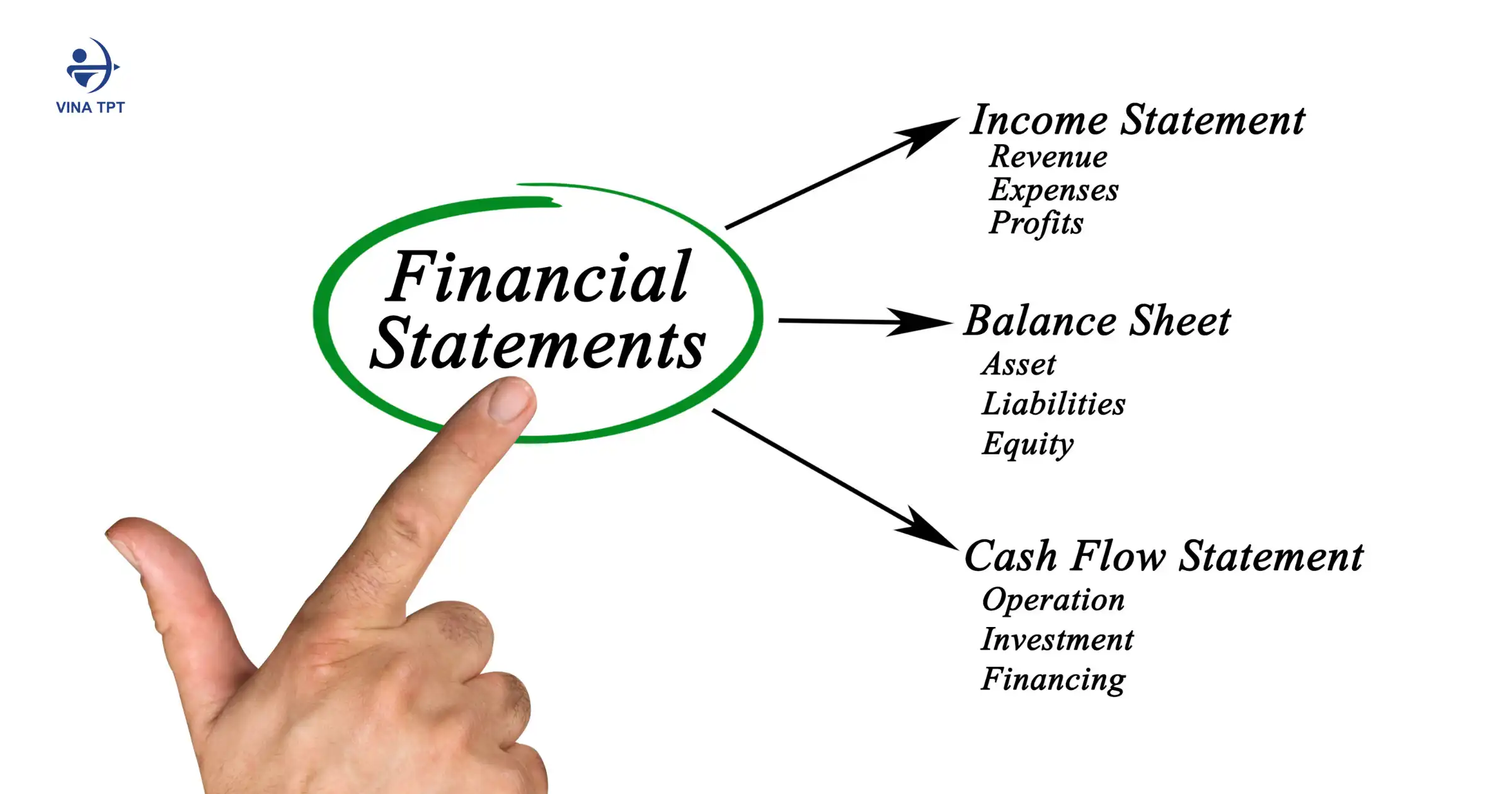
In 2025, FDI enterprises and domestic enterprises in Vietnam must fully comply with financial reporting and tax settlement obligations as prescribed. The annual financial statements include the Balance Sheet, Income Statement, Cash Flow Statement and Notes to the Financial Statements, all of which must be prepared in accordance with Vietnamese Accounting Standards (VAS).

In parallel with preparing the Financial Statements, enterprises must make corporate income tax and personal income tax settlements within 90 days from the end of the fiscal year. The increase in the frequency of reviews and inspections by tax authorities requires enterprises to have accurate data, a synchronous accounting system and complete records to avoid the risk of being penalized.

2. Vina TPT’s Financial Statement Services

Vina TPT provides in-depth financial reporting services, helping businesses prepare accurate, transparent and fully VAS-compliant reports. Not only synthesizing data, we also provide a clear view of the financial situation and ensure readiness for audits or tax inspections.

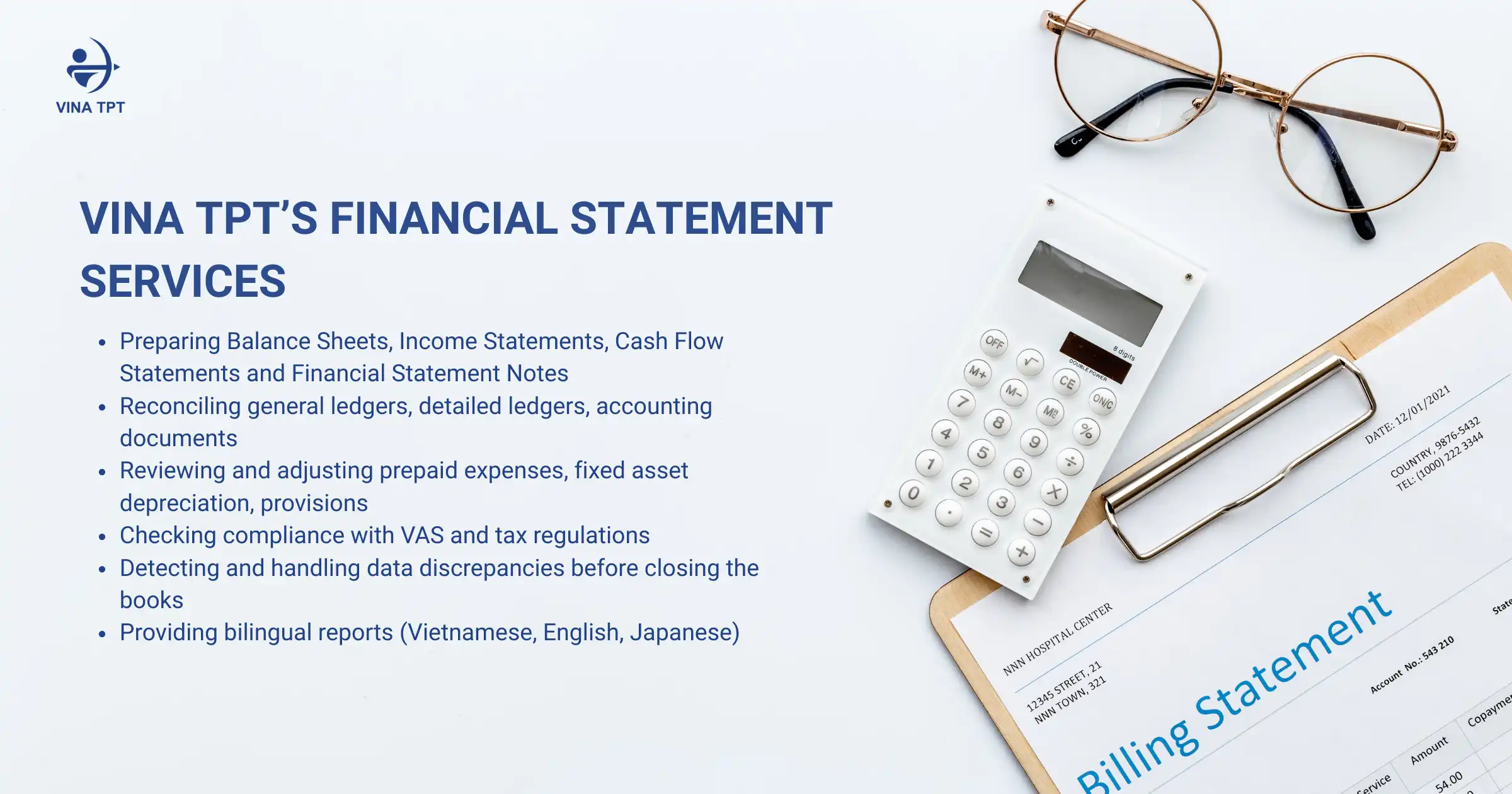
Vina TPT’s financial reporting services include:

  • Preparing Balance Sheets, Income Statements, Cash Flow Statements and Financial Statement Notes
  • Reconciling general ledgers, detailed ledgers, accounting documents
  • Reviewing and adjusting prepaid expenses, fixed asset depreciation, provisions
  • Checking compliance with VAS and tax regulations
  • Detecting and handling data discrepancies before closing the books
  • Providing bilingual reports (Vietnamese, English, Japanese)

Explore Our Services

3. Corporate Income Tax (CIT) Finalization Services

Vina TPT provides in-depth corporate income tax settlement services, helping businesses control data, comply with regulations and limit errors in the context of many important adjustments to tax policies and the Enterprise Law from October 1, 2025.

3.1 Review expenses and determine taxable profits

Vina TPT checks all expenses to determine which are deductible and which are not deductible in accordance with the Corporate Income Tax Law; reviews depreciation of fixed assets, interest expenses, provisions and expenses that are easily excluded during tax inspections. At the same time, the team compares data between financial statements and tax declarations to accurately calculate taxable profits, ensuring that there are no difficult-to-explain differences.

3.2 Prepare corporate income tax settlement declarations and in-depth risk assessment

The service includes full preparation of declarations, loss transfer appendices, tax incentives, cost analysis tables and explanation documents according to tax inspection standards. Vina TPT also analyzes risks by group such as costs without sufficient documents, incorrect revenue-expense periods, discrepancies in electronic invoice data, or lack of linked transaction records. From there, it proposes solutions to reduce the risk of collection and fines.

3.3 Tax optimization consulting and notes on new regulations from October 1, 2025

Vina TPT supports businesses in applying tax incentives to the right subjects, implementing valid loss transfers, and optimizing tax obligations based on legal mechanisms. In particular, changes effective from October 1, 2025 related to electronic records management, tightening cost control, and expanding explanation requirements make the settlement process more stringent; businesses need to carefully compare data, contracts, and documents to avoid risks when tax authorities inspect.

4. Personal Income Tax (PIT) Finalization for Employees & Foreigners

Personal income tax settlement is a major challenge for businesses with large staff numbers, diverse income structures or foreign employees. Vina TPT provides a complete PIT solution, helping businesses process quickly, correctly and fully comply with new regulations.

4.1 Review PIT data and prepare settlement documents

Vina TPT checks tax data of each employee monthly (income, exemptions, deductions, working days, taxes paid) to ensure consistent data before making settlement. At the same time, collect and check all documents: labor contracts, payroll, residence papers, entry/exit history of foreign experts… to help businesses have accurate data from the beginning of the year.

4.2 Preparation and submission of PIT settlement dossiers and tax refund support

Services include preparing PIT settlement declarations for businesses and individuals, correctly classifying residents and non-residents, applying double taxation agreements (DTA) if any, and submitting dossiers on time. Vina TPT also carries out tax refund procedures for employees and foreign experts, monitors the processing process and works with tax authorities to ensure that dossiers are processed quickly.

4.3 Representing and working with tax authorities and providing in-depth advice for foreign workers

Vina TPT represents businesses when requested by tax authorities, helping to reduce the workload for HR and accounting departments. At the same time, it provides in-depth advice on tax residency, applying DTA, handling business trips to multiple countries, income arising outside of Vietnam, or common international risks. This is especially important for businesses that employ many foreign experts and need to comply with cross-border tax standards.

SOLVE YOUR TAX CHALLENGES

Vina TPT’s Financial Statement Services

5. Common Pain Points & Why Businesses Need Professional Support

At the end of each year, many businesses face difficulties due to:

  • Incorrect data or inconsistent recording
  • Lack of documents or incomplete records
  • Internal accounting systems and reporting to parent companies are not synchronized
  • Late submission deadlines due to limited staff
  • Risks of fines and additional collection when tax authorities inspect
  • Lack of expertise in VAS and complex tax regulations

Professional services from Vina TPT help businesses avoid these risks and ensure the tax filing process runs smoothly.

6. Why Choose Vina TPT for Reporting & Tax Services

Values:

  • Vina TPT helps businesses maintain a transparent accounting system, accurate reporting and minimize tax risks in the context of increasingly strict inspections.

Professional capacity:

  • A team of accountants & tax experts with many years of experience in FDI enterprises
  • Deep understanding of VAS and financial reporting according to international standards
  • Bilingual support in Vietnamese – English – Japanese

Service commitment:

  • Clear process, fast processing time
  • Data security and absolute compliance with legal regulations
  • Optimal cost according to scale and workload

7. Comprehensive Service Package for FDI Enterprises

Vina TPT provides One-Stop Tax & Accounting Solution, including:

  • Annual Financial Report
  • Corporate Income Tax Finalization
  • Personal Income Tax Finalization
  • Accounting & Bookkeeping Services
  • Payroll, Labor Report
  • Support for Foreign Labor Compliance
  • Support for Working with Tax Authorities, Inspections & Audits

Consistency

  • All services are deployed synchronously according to one system, avoiding data discrepancies between departments and reducing risks during audits.

Long-term Benefits

  • A suitable solution for FDI enterprises that need stability, transparency and long-term support in a volatile legal environment.

Start with Vina TPT to complete financial reports and tax settlement 2025 quickly!

Talk to Our Experts

accounting service Vietnam for FDI company vtpt

Tax Services for Japanese Manufacturing Companies in Vietnam

Tax Services for Japanese Manufacturing Companies in Vietnam - VTPT

Tax Services for Japanese Manufacturing Companies in Vietnam - VTPT

1. The Precision of Japanese Manufacturing Meets Vietnam’s Tax Reality

Japanese companies are globally renowned for their “Kaizen” spirit – precision and continuous improvement in production. When expanding their investment to Vietnam, especially in the mechanical engineering and machine manufacturing sector, they bring with them strict standards of quality and efficiency.

However, the tax system in Vietnam has its own characteristics. Regulations on import tax, value-added tax (VAT), or corporate income tax (CIT) all have different calculation methods and declaration deadlines than in Japan. This difference makes tax management and compliance a big challenge, especially when businesses have to simultaneously handle contracts for purchasing components, technology transfer, warranty – maintenance, and research and development (R&D) costs.

Therefore, many Japanese companies have sought specialized tax services in Vietnam to ensure that all financial activities are legal, transparent, and cost-optimized.

START YOUR VIETNAM TAX COMPLIANCE SETUP

2. The Tax Landscape for Mechanical Manufacturers

The mechanical engineering and machinery manufacturing industry is directly affected by many different taxes. Each transaction and each contract has potential risks if not handled properly.

First of all, import tax on components is an important factor, especially for factories importing spare parts from Japan. If the HS code (commodity code) is declared incorrectly, the enterprise may be subject to additional tax or administrative fines. In addition, VAT for industrial products has a rather complicated tax refund and deduction mechanism, requiring accurate accounting for each shipment.

In addition, depreciation of machinery and equipment must comply with the time limit and depreciation method prescribed in Vietnamese accounting standards. For mechanical enterprises, the value of fixed assets is often very large; therefore, even a small error in recording depreciation can affect financial statements and corporate income tax.

Technology transfer, maintenance and warranty costs also need to be recorded at the right time and have valid documents. These are areas where tax advisory services with mechanical expertise can save businesses hundreds of thousands of dollars each year.

Download Vietnam Tax Handbook - Japanese Edition

3. Typical Compliance Risks

In fact, many Japanese enterprises in Vietnam face common tax risks that are difficult to detect early. One of the biggest risks is inaccurate transfer pricing. When a Vietnamese branch purchases components, equipment or technical services from its parent company in Japan, incorrect pricing can be considered by tax authorities as an act of transferring profits abroad.

Another risk is invalid maintenance and warranty costs due to a lack of clear contracts or insufficient payment documents. In addition, incorrect recording of fixed assets – for example, including leased machinery in the ownership list – also leads to improper tax deductions.

In addition, VAT deduction errors are common in enterprises with many input and output invoices, especially in import and export transactions. These errors can cause enterprises to be subject to tax arrears, late payment penalties, and even affect their reputation with authorities.

This is why mechanical manufacturing companies need specialized tax advisory services to help them identify risks, review accounting processes and ensure compliance with Vietnamese laws.

Tax Services for Japanese Manufacturing Companies in Vietnam - VTPT

4. International Tax Services: Bridging Japan and Vietnam

One of the biggest challenges for Japanese businesses in Vietnam is the difference between the two accounting systems. Japan applies J-GAAP or IFRS accounting standards, while Vietnam follows VAS (Vietnamese Accounting Standards).

Therefore, international tax services act as a bridge between the two countries. This service not only helps businesses adjust accounting items to comply with regulations in Vietnam, but also supports reviewing internal contracts with parent companies, ensuring that R&D costs, royalties or technical service fees are recorded reasonably and have transparent documents.

A synchronous accounting system helps Japanese businesses report accurately to both markets, avoiding the situation of “one number, two reports” – both tax risks and loss of reputation with partners.

Thanks to international tax services, Japanese companies can operate in Vietnam with peace of mind while maintaining the same accuracy, transparency and efficiency as when operating at home.

5. Vina TPT’s Role in End-to-End Compliance

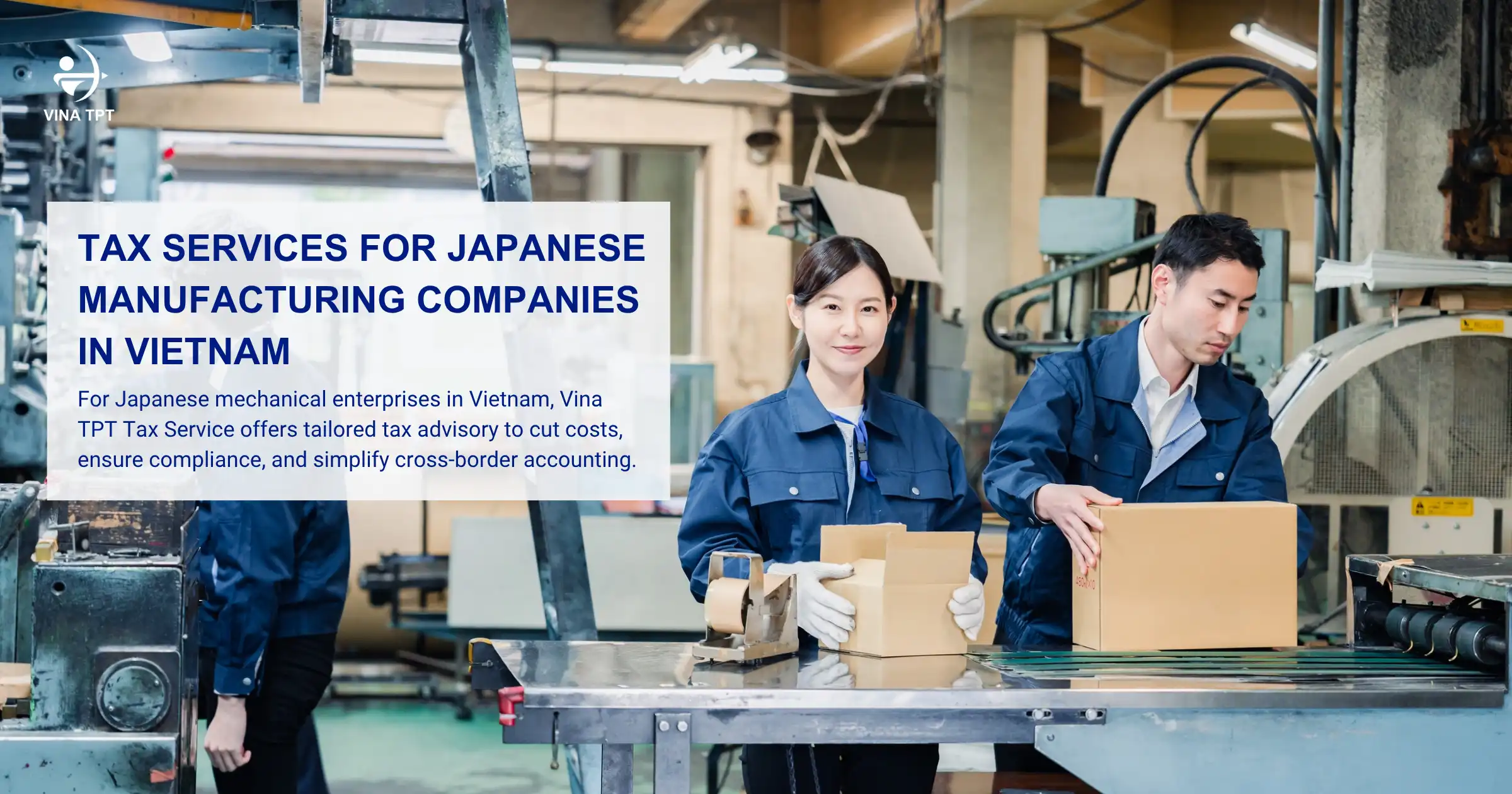
In Vietnam, Vina TPT Tax Service is one of the prestigious partners specializing in providing comprehensive solutions from Vietnam tax accounting to processing periodic reports and tax settlement.

The difference of Vina TPT lies in its deep understanding of the mechanical manufacturing industry and Japanese corporate culture. Their consulting team is not only good at tax expertise but also has a “Kaizen mindset” – a spirit of continuous improvement to help businesses operate more effectively every day.

Vina TPT supports businesses at every stage: from setting up the initial accounting system, preparing VAT and corporate income tax reports, to representing them in working with tax authorities when explanations are needed. The close coordination between the two teams – Japanese and Vietnamese – helps businesses not only comply with regulations but also optimize legal profits.

6. From Compliance to Competitiveness

Tax compliance is not only a legal obligation, but also the foundation of competitiveness. When the accounting and tax systems are managed transparently, businesses can easily calculate actual costs, control profits, and make more accurate investment decisions.

In the long term, a solid tax compliance strategy will help Japanese businesses in Vietnam not only avoid legal risks but also build a trustworthy image in the eyes of partners and management agencies.

With the support of Vina TPT Tax Service, that process becomes easier and more effective than ever.

Contact Vina TPT Tax Service now for free consultation on comprehensive tax management solutions.

BOOK A FREE CONSULTATION

Vina TPT Accounting services

Business advisory for Singaporean investors establishing real estate businesses in Vietnam

alt="Business advisory services for Singaporean investors entering Vietnam’s real estate market"

business-advisory-services

1. Vietnam Real Estate: The Next Strategic Move for Singapore Investors

Over the past decade, Vietnam has become one of the most dynamic real estate markets in Asia, with rapid urbanization, high housing demand and a boom in industrial zones. In particular, Singapore is a leading financial, investment and business advisory center in the region, is considering Vietnam as a new “profit drop point” in its strategy to expand in Southeast Asia.

Singaporean investors see in Vietnam not only high profit potential, but also an opportunity to participate in a market that is changing strongly in terms of infrastructure, urban planning and Foreign Direct Investment attraction policies. Vietnam, with its affordable land prices, youthful workforce, and fast-growing transport infrastructure including airports, seaports, and metro lines, is emerging as a promising mirror of Singapore in its early development phase.

However, to realize the opportunity, investors need to clearly understand Vietnam’s legal framework, licensing process and tax mechanism – factors that can directly impact the profitability and safety of the project.

2. Before you invest: Understanding Vietnam’s Real Estate Landscape

Real estate in Vietnam is divided into many different types, including: industrial park development, housing projects, offices, resorts, trade – services and logistics. However, not all segments are open to foreign investors.

According to current regulations, investors can:

  • Contribute capital or buy shares in Vietnamese enterprises with existing real estate projects.
  • Establish a 100% foreign-owned company to develop projects if granted appropriate investment licenses.
  • Lease or sublease land in industrial parks, export processing zones, high-tech zones.

However, direct ownership of land in Vietnam is not allowed, because land is owned by the entire people and managed by the State. Investors can only use land through leasing or joint ventures with domestic partners.

In addition, the tax and regulatory systems related to real estate (VAT, CIT, transfer tax, land fees) also have significant differences compared to Singapore. Lack of understanding or misapplication of investment structures can lead to legal risks or reduced profit efficiency.

At this stage, partnering with a professional business advisory firm becomes essential. A qualified advisory team can help Singaporean investors navigate Vietnam’s complex real estate regulations, review investment structures, and ensure full compliance with local laws. With expert guidance on legal, financial, and tax aspects, investors can make informed decisions and minimize potential risks from the very beginning. Business Advisory

Business advisory for Singaporean investors establishing real estate businesses in Vietnam

3. From Licensing to Launch: Key Steps in Establishing a Real Estate Business

The process of setting up a real estate business in Vietnam usually includes four main stages, requiring close coordination between investors, lawyers and management agencies:

Stage 1: Investment strategy consulting: Business Advisory

Investors need to clearly define their goals (developing new projects, acquiring, cooperating or operating), assess the legal feasibility of the model and choose a locality with appropriate policies.

Stage 2: Applying for an Investment Registration Certificate (IRC):

This is the first license that allows foreign-invested enterprises to carry out projects in Vietnam.

Documents typically required for IRC application include:

  • Application for investment project implementation & Project proposal: Stating objectives, scope, scale, investment capital, location, and implementation schedule.
  • Proof of investor’s financial capacity: Bank statements, audited financial reports, credit contracts, or collateral documents.
  • Legal documents of the investor:
  • For individuals: Notarized passport, consular legalization.
  • For organizations: Business Registration Certificate or equivalent, consular legalization.
  • Evidence of project location: Office/land lease agreement or land use rights certificate.
  • Power of attorney/authorization letter (if the investor appoints a third party to handle procedures).

Stage 3: Enterprise Establishment (ERC):

After having IRC, investors register to establish an enterprise, determine the type of company (LLC, joint stock or joint venture). Choosing the right model will greatly affect the capital mechanism, voting rights and profit distribution.

Stage 4: Compliance and project implementation:

Enterprises must complete tax, insurance, financial and environmental procedures before officially starting operations. This is also the stage where business advisory services become especially important to ensure that all activities are legal and effective.

All foreign documents must be consular legalized and officially translated into Vietnamese before submission. This step often prolongs the preparation process, so it is recommended that investors cooperate with a reliable company registration service to ensure accuracy and save time.

4. Tax Business Advisory: Maximizing Profitability through Smart Structuring

In real estate investment, tax optimization and smart business structure are decisive factors for net profit. Vietnam applies corporate income tax (CIT) at 20%, but there are tax incentives for investment projects in industrial parks, economic zones or investment-encouraged sectors (logistics, infrastructure, social housing, etc.).

In addition, if investors know how to structure capital flows and divide profits reasonably, they can avoid double taxation between Vietnam and Singapore thanks to the Double Taxation Avoidance Agreement (DTA) signed by the two countries. This is a great advantage, but it can only be maximized when there is a business tax advisory team that understands both tax systems.

Vina TPT experts often advise Singaporean investors about business advisory on multi-level legal entity structure strategies, cash flow allocation and legal profit transfer, to ensure optimal profits while still strictly complying with regulations in Vietnam.

OPTIMIZE YOUR TAX STRUCTURE NOW

5. Common Mistakes Foreign Real Estate Investors Should Avoid

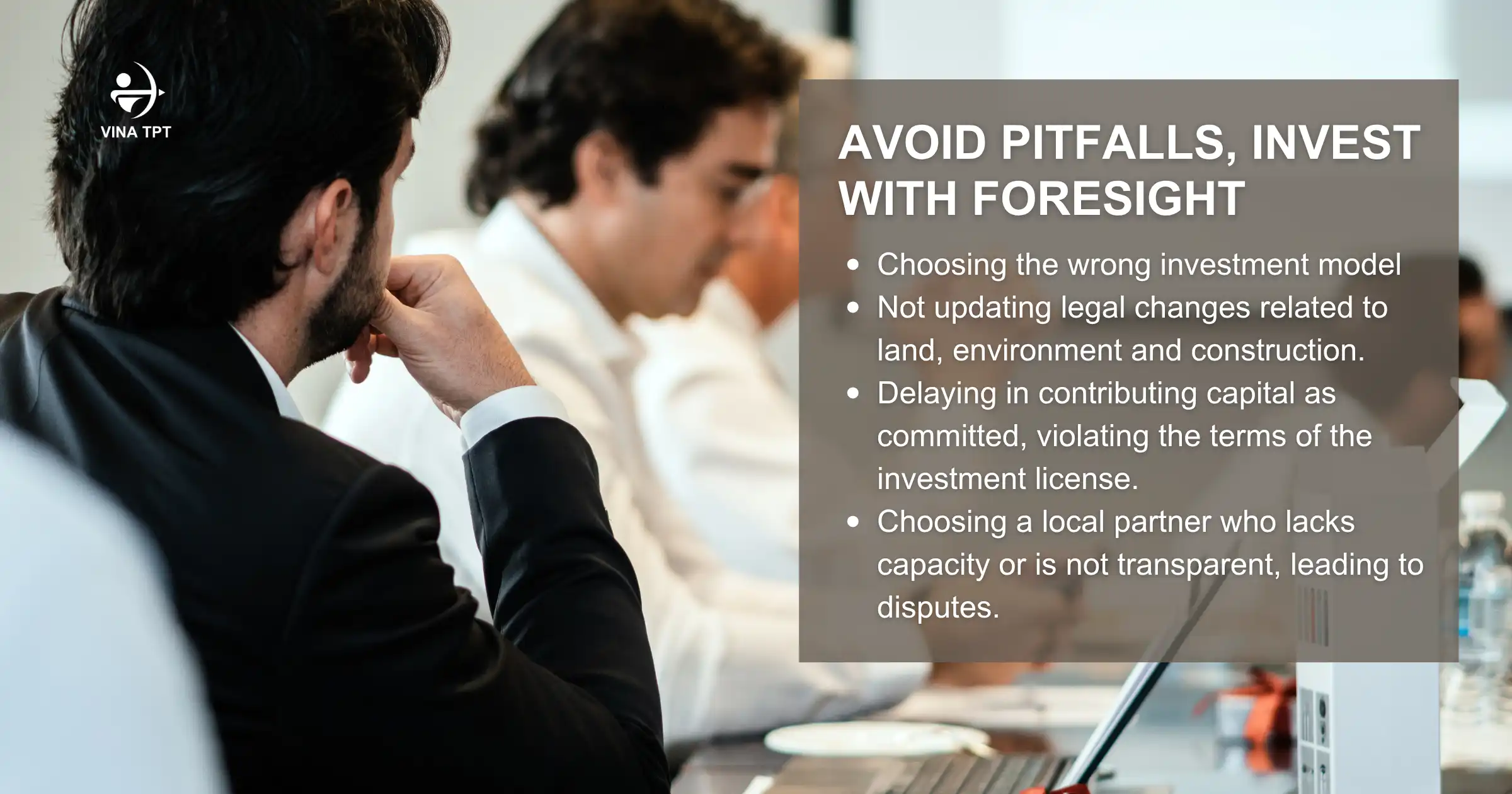
Despite the wide-open opportunities, many foreign investors including large corporations, have encountered trouble when investing in Vietnamese real estate due to common mistakes. Some typical mistakes include:

  • Choosing the wrong investment model (for example, registering a trading company instead of a project development company, leading to restrictions on land use).
  • Not updating legal changes related to land, environment and construction.
  • Delaying in contributing capital as committed, violating the terms of the investment license.
  • Choosing a local partner who lacks capacity or is not transparent, leading to disputes.

An excellent business advisory service will help investors avoid these mistakes right from the start, thanks to legal review, partner assessment and risk control throughout the investment process. 

Business advisory for Singaporean investors establishing real estate businesses in Vietnam

6. Why Partnering with Vina TPT Business Advisory Makes a Difference 

With over 15 years of experience in advising companies, Vina TPT Business Advisory Service’s team of legal, accounting and tax experts has worked with hundreds of international enterprises in the real estate, infrastructure and manufacturing sectors.

We provide end-to-end solutions, from developing investment strategies, applying for IRC/ERC licenses, advising on tax structures, to compliance management and post-investment operational accounting. Vina TPT’s strength lies in combining a deep understanding of Vietnamese law with international operational standards, helping Singaporean investors ensure compliance while optimizing profits.

If you are looking for a business consulting partner with market knowledge and the ability to handle everything from legal to tax, Vina TPT Business Advisory is the reliable bridge between Singapore and Vietnam.

BOOK A FREE CONSULTATION

business-advisory-services