Setting Up a Representative Office in Vietnam: Step-by-Step Guide for Foreigners 2026

As Vietnam continues to attract foreign direct investment (FDI) with robust economic growth in 2025-2026, many international businesses choose to establish a Representative Office (RO) as their initial market entry strategy. An RO allows foreign companies to build a legal presence, conduct market research, and liaise with local partners without engaging in direct profit-generating activities.

With over 20 years of experience supporting more than 200 foreign clients, Vina TPT specializes in guiding investors through this process efficiently and compliantly. This ultimate guide provides a step-by-step overview for setting up a representative office in Vietnam in 2025, based on the latest regulations under Commercial Law 2005 and Decree 07/2016/ND-CP (with minor procedural updates).

1. What is a Representative Office in Vietnam?

A representative office is a dependent unit of an enterprise that is established in a different province or country for the purpose of supporting the operations of its parent company. ts main activities typically include:

  • Promoting and marketing products or services
  • Collecting and analyzing market information
  • Identifying customer demands and industry trends
  • Providing customer consultation and support
  • Developing and maintaining relationships with partners
  • Assisting with administrative and procedural matters

Key limitations: Representative Offices cannot generate revenue, issue invoices, or conduct direct trading. If your goal involves commercial operations, consider a full foreign-invested enterprise instead.

Representative Office

Foreign-Invested Company

Legal Status Dependent unit; extension of the parent company Independent legal entity; registered in Vietnam.
Business Activities Non-profit; no direct revenue-generating activities. Full operations; allowed to trade, manufacture, and earn profits.
Primary Purpose Market research, brand promotion, and liaison activities. Executing full business operations and commercial contracts.
Suitability Ideal for testing the market and building local relationships. Best for long-term investment and generating local revenue.


2. Eligibility Requirements for Foreign Companies

To qualify for an RO in Vietnam:

  • The parent company must operate legally in its home country for at least 1 year.
  • Business activities must align with Vietnam’s WTO commitments.
  • No minimum capital is required, making it a low-risk option for SMEs and startups.

3. Setting Up a Representative Office: Step-by-Step Process

The process typically takes 4 – 6 weeks months in 2026, handled by the Department of Industry and Trade (DOIT).

Step 1: Prepare Documents

In order to facilitate a seamless and efficient licensing process for a Vietnam-based representative office, foreign entities should assemble the following essential documentation:

  • Application form for RO establishment
  • Parent company’s Business Registration Certificate (legalized)
  • Audited financial statements (latest year)
  • Appointment letter for Chief Representative
  • Lease agreement for office premises (physical address required)
  • Passport/ID of Chief Representative

Note: All foreign documents need consular legalization and Vietnamese translation.

Step 2: Submit Application

After finalizing the necessary paperwork, the investor submits it to the Business Registration Office under the Department of Planning and Investment where the representative office will be located.

Under normal circumstances, the licensing authority will review and issue a result within a timeframe of 10 to 15 business days.

Step 3: Obtain RO License

Upon the successful evaluation of the application, the competent authority will formally issue the Representative Office Establishment License.

To ensure full regulatory compliance, the entity must immediately proceed with post-licensing compliance tasks, such as: 

  • Engrave seal and register specimen
  • Open bank account (for expenses only)
  • Registering for tax if any expenses are incurred
  • Apply for work permits/TRC for foreign staff (if needed)

At VINA TPT, we support clients throughout every step—tracking the progress, handling all paperwork, and collecting the license as soon as the application is approved.

setting-up-a-representative-office-in-vietnam

4. Common Challenges and Tips

To ensure your 2026 application is processed without delays, please consider these essential points:

  • Legalization: Start document legalization early to avoid common administrative bottlenecks.
  • Office Lease: Ensure a valid lease agreement is signed before submitting your dossier.

Work Permits: Foreign Chief Representatives may require a work permit to stay compliant.

5. Ready to Establish Your Representative Office in Vietnam?

Establishing a representative office is a strategic move for foreign companies to expand and engage with the Vietnamese market. However, success requires deep legal insight and meticulous preparation. To overcome language barriers and administrative complexities, partnering with a professional service is the most effective solution.

With over 20 years of expertise, VINA TPT is proud to be the trusted partner for international businesses entering Vietnam. With Vina TPT’s one-stop support, foreign investors can navigate this process seamlessly, ensuring 100% data protection and transparent costs. Contact us today for expert consultation and a seamless start to your investment journey.

BOOK A FREE CONSULTATION

start a business in vietnam with vina tpt

FDI Company Setup in Vietnam: Business License & Complete 2026 Guide

setting up company in Vietnam

setting up company in Vietnam

Why Setting up Company in Vietnam is the Strategic Choice for 2026?

The year 2026 marks a pivotal turning point for foreign investors in Vietnam. With significant reforms in the Law on Investment and a roadmap to reduce conditional business lines, the process for setting up a company in Vietnam is becoming more transparent and streamlined than ever.

However, to operate legally in specialized sectors such as retail, distribution, or logistics, investors must follow a structured path from obtaining an IRC and ERC to securing a specific business license.

1. Why Foreign Investors Need a Clear Roadmap in 2026

Starting a business in Vietnam as a foreigner offers immense potential, but understanding the 2026 regulatory landscape is crucial to avoiding delays or rejected applications.

a. FDI Opportunities in 2026

Vietnam maintains its position as Southeast Asia’s “global factory” based on four key pillars:

  • Extensive FTA Network: Leverage tariff incentives from the CPTPP, EVFTA, and RCEP.
  • New Incentive Policies: Strong focus on high-tech projects, circular economy, and renewable energy.
  • Flexible Ownership Structures: 100% foreign ownership is permitted in most sectors, including manufacturing, IT, consulting, and trading.
  • Digitalized Procedures: Significant reduction in waiting times through the National Business Registration Portal.

b. When is a Business License (Trading License) Mandatory?

While many sectors are open, a Business License (Trading License or Retail Distribution License) is still mandatory for foreign investors in “conditional” sectors under WTO commitments and Vietnamese Law.

Even with eased regulations, a separate Business License is required after company formation for:

  • Retail Sales: Directly providing goods to end consumers.
  • Distribution & Import: Applied to restricted or specialized commodity groups.
  • Specialized Services: Logistics, education, healthcare, and F&B.
  • Important Note: By July 1, 2026, sectors like accounting and insurance brokerage will see further liberalization. However, for Retail & Distribution, investors must still seek approval from the Ministry/Department of Industry and Trade.

c. Distinguishing IRC vs. ERC vs. Business License

Understanding these three acronyms is vital for any foreigner setting up a company in Vietnam:

Permit Type Issuing Authority Primary Role
IRC (Investment Registration Certificate) Department of Planning and Investment (DPI) Approves the investment project (capital, objectives, location).
ERC (Enterprise Registration Certificate) Business Registration Office Creates the legal entity and issues the Tax ID.
Business License Relevant Ministry or Department Grants permission to operate in conditional sectors (Retail, etc.).

The Standard Sequence: IRC (Project Approval) → ERC (Company Formation) → Business License (For specific sectors).

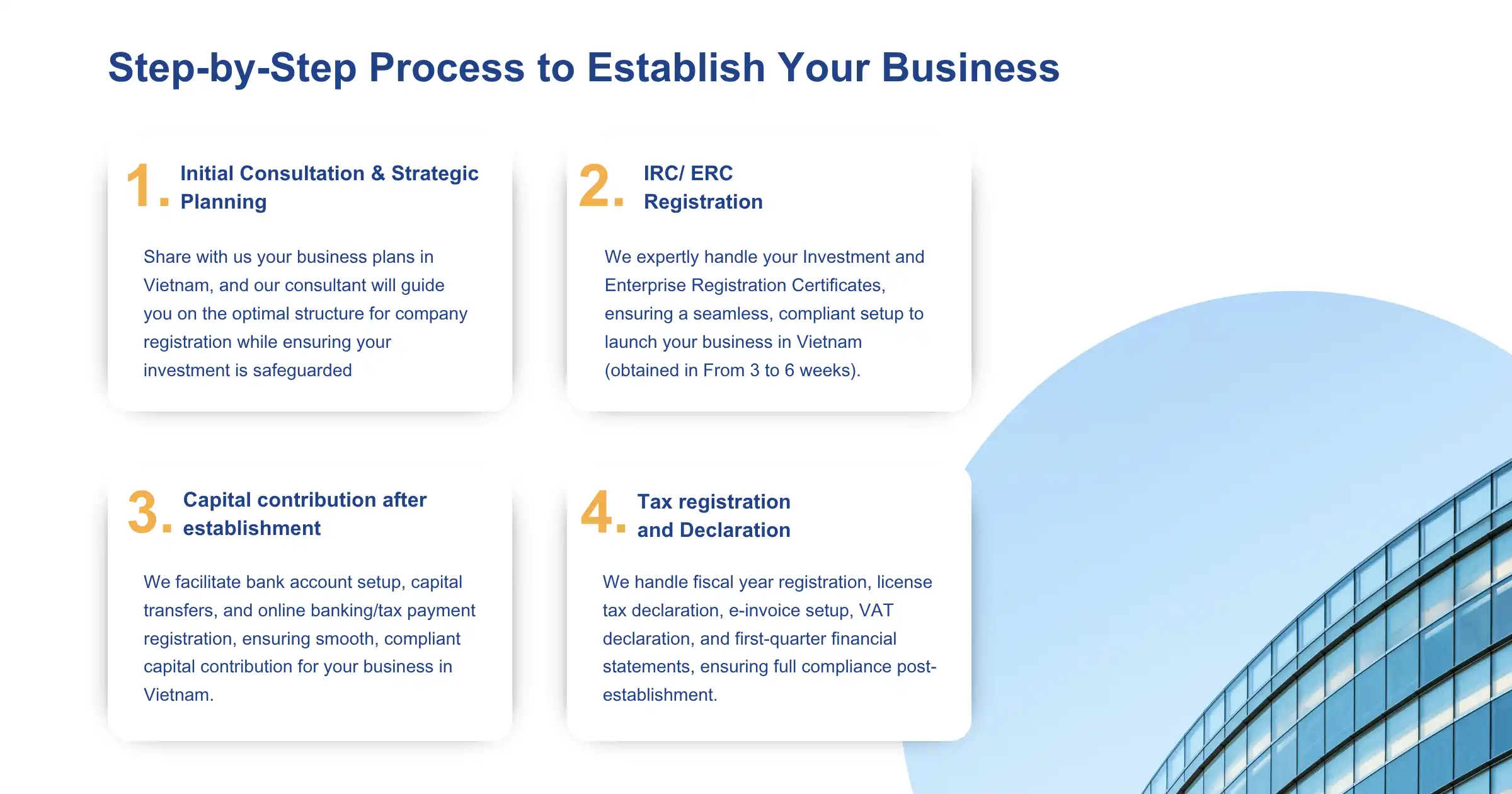
2. 5-Step Process for Setting Up Company in Vietnam in 2026

The average timeline for completion ranges from 1 to 2 months, depending on the complexity of your business lines.

Step 1: Choose a Legal Structure & Check Ownership Limits

The most common choice is a Limited Liability Company (LLC) due to its flexibility and limited liability protection. Foreigners must verify if their specific sector requires a Joint Venture (JV) with a Vietnamese partner.

Step 2: Obtain the Investment Registration Certificate (IRC)

Investors submit the application to the DPI. Key documents include:

  • Detailed Investment Project Proposal.
  • Proof of Financial Capacity (Bank statements or audited reports).
  • Office Lease Agreement or Memorandum of Understanding (MOU).
  • Timeline: 15 – 35 working days.

Step 3: Obtain the Enterprise Registration Certificate (ERC)

Once the IRC is issued, the ERC application is typically processed within 3 – 7 working days. This step officially grants your business its legal status.

Step 4: Post-Registration Procedures (Operational Compliance)

Obtaining the ERC is only the beginning. Within 90 days, investors must fulfill these mandatory obligations:

  • Open a Direct Investment Capital Account (DICA): This is the most critical step. All capital contributions, profit repatriations, and share transfers must flow through this account.
  • Capital Contribution: Ensure the total committed capital is transferred into the DICA within 90 days of ERC issuance.
  • Online Investment Reporting: Businesses must report project progress quarterly and annually on the National Investment Information System. Missing these deadlines can lead to heavy administrative fines.
  • Initial Tax & Accounting Setup: Register digital signatures, set up e-invoice templates, and pay Business License Tax (License Fees). Appointing a Chief Accountant or an outsourced accounting representative is a legal requirement for signing financial statements.

Step 5: Specialized Business License (If applicable)

For retail and distribution entities, authorities will assess the application based on local planning and socio-economic impact. Note the Economic Needs Test (ENT) requirement if you plan to open a second retail outlet or more.

setting up company in Vietnam

Get a free 30-minutes consultation

3. Required Documents & Checklist

All foreign documents must be Consularly Legalized, translated into Vietnamese, and notarized.

  • Individual Investors: Notarized passport + Bank balance confirmation.
  • Corporate Investors: Parent company’s Certificate of Incorporation + Audited financial statements (last 2 years) + Resolution appointing the authorized representative.
  • Project Documents: Detailed Business Plan and proof of right to use the business location.

4. Vina TPT: Your Trusted Partner for FDI Success in Vietnam

Establishing a legal entity is just the start. To thrive in the Vietnamese market, businesses need a solid foundation in Accounting, Tax, and HR from day one.

Vina TPT is proud to be a strategic partner, helping foreign investors remove language barriers and navigate local legal complexities:

  • Expert Consulting: From initial setup to tax structure optimization. We keep you updated on the latest regulations, including Global Minimum Tax and 2026 tax incentives.
  • Payroll & HR Management: We handle labor contracts, Social Health & Unemployment Insurance (SHUI), and Personal Income Tax (PIT) finalization for both expats and locals, ensuring absolute confidentiality.
  • Lifecycle Partnership: With over 20 years of experience, Vina TPT provides an “All-in-one” ecosystem. You focus on growth; we handle the administration.
  • No Language Barrier: Our trilingual team (English – Japanese – Vietnamese) ensures transparent communication and seamless management reporting.

Optimize your resources and minimize legal risks with Vina TPT. Contact us today for a 1-on-1 specialized consultation for your 2026 project.

Start your journey in vietnam

setting up company in Vietnam

Top 10 | Ideas for small business in Vietnam for Foreign Investors

1. Overview of Business Opportunities for Foreigners

If you’re exploring ideas for small business in emerging markets, Vietnam stands out as one of the fastest-growing economies in Southeast Asia, backed by a young population, a dynamic workforce and rising consumer demand. Foreign investors can tap into numerous developing sectors.

The Vietnamese market is particularly attractive due to the growth of the middle class, new consumer habits and high demand for quality services. Large cities such as Hanoi, Ho Chi Minh City, Da Nang are ideal destinations to test small business models and implement innovative ideas.

2. Profitable Ideas for Small Business

Below are ideas for small business suitable for foreign investors in Vietnam, detailed implementation so that customers can evaluate the potential:

F&B (Food & Beverage):

  • Coffee shops, restaurants, milk tea stalls with creative concepts.
  • Delivery services, processing organic food, healthy food.
  • Business in foreign specialties or combining local culinary culture.

Education services:

  • Foreign language centers, skills training, teaching STEM or coding for children.
  • Online classes, edu-tech models combined with offline.

E-commerce:

  • Online retail, dropshipping, or specialized sales platforms.
  • Providing unique imported products, targeting middle-class customers.

Light Manufacturing:

  • Processing agricultural products, packaged foods, manufacturing handmade products.
  • Producing small consumer products, souvenirs or fashion accessories.

Support and logistics:

  • Transportation, warehousing, fulfillment for e-commerce.
  • Business consulting, marketing, or office rental services.

Tourism & Travel:

  • Boutique travel agencies, guided tours, eco-tourism, and adventure trips.
  • Services combining local culture, culinary experiences, and foreign-language support.

Health & Wellness:

  • Fitness studios, yoga centers, spas, wellness retreats.
  • Health coaching, organic/natural product shops, or dietary consultation services.

Tech & Digital Solutions

  • App or software development for small businesses, fintech solutions.
  • Digital marketing agencies, social media management, or website development.

Creative & Arts Services

  • Photography studios, interior design, handmade crafts, or art workshops.
  • Event planning, wedding services, or cultural experience workshops for foreigners.

Green & Sustainable Businesses

  • Eco-friendly products, recycling services, sustainable packaging, or zero-waste shops.
  • Solar energy solutions or small-scale environmental consulting for local businesses.

These ideas for small business are suitable for small and medium investment capital, flexible in implementation and can be tested in big cities or niche markets.

4. Key Considerations for Compliance and Operations

When planning to implement ideas for small business in Vietnam, foreign investors need to understand some basic factors about operations and legal compliance. Although you do not need to go into the details of the law, understanding these points will help avoid future risks and ensure the company operates smoothly.

4.1 Tax compliance and financial reporting

Every business in Vietnam must declare value-added tax (VAT), corporate income tax (CIT) and personal income tax (if it has employees). Preparing accounting books from the beginning will help businesses easily prepare monthly, quarterly and year-end financial reports, and avoid tax arrears or administrative fines.

4.2 Social insurance and employee benefits

If a business hires local workers, paying social insurance, health insurance and unemployment insurance is mandatory. This is an important factor to ensure employee benefits and compliance with Vietnamese labor laws.

4.3 Compliance with basic industry and legal regulations

Some industries, such as F&B, education or logistics, require specific business licenses or sub-licenses. A basic understanding of these requirements will help investors choose the right business model and avoid legal risks.

GET LEGAL SUPPORT

4.4 Manage operations and administrative records

Preparing basic procedures such as registering for a tax code, opening a corporate bank account and keeping complete records will help businesses operate effectively right from the start.

In short, understanding the above notes helps investors plan in advance, minimize risks and focus on implementing business ideas, without having to go too deep into detailed regulations on laws and taxes.

5. How Vina TPT Supports Foreign Investors

Vina TPT provides comprehensive services for foreign investors, including:

  • Company setup & registration at state agencies and corporate bank account opening.
  • Accounting & tax compliance: bookkeeping, financial reports, tax registration, declarations, and handling tax inquiries.
  • Payroll & social insurance: payroll calculation, insurance registration, and labor report submissions.
  • Work permit & visa support for foreign employees.
  • Ongoing legal compliance to ensure smooth operations.

With more than 20 years of experience supporting startups and FDI enterprises in Vietnam, Vina TPT commits to providing fast, transparent and legally compliant services, helping investors feel secure from the company setup step to initial operation, optimizing time and costs, while ensuring the business operates effectively and safely.

Explore business opportunities in Vietnam and start your investment journey with Vina TPT

BOOK A FREE CONSULTATION

Top-20-Sectors-for-Business-Opportunities-in-Vietnam-VTPT

Financial Reporting and Tax Finalization Services 2025 in Vietnam

Financial Reporting and Tax Finalization Services 2025 in Vietnam

Choose Vina TPT for consistent, professional accounting support

1. Overview of Financial Reporting & Tax Finalization in Vietnam 2025

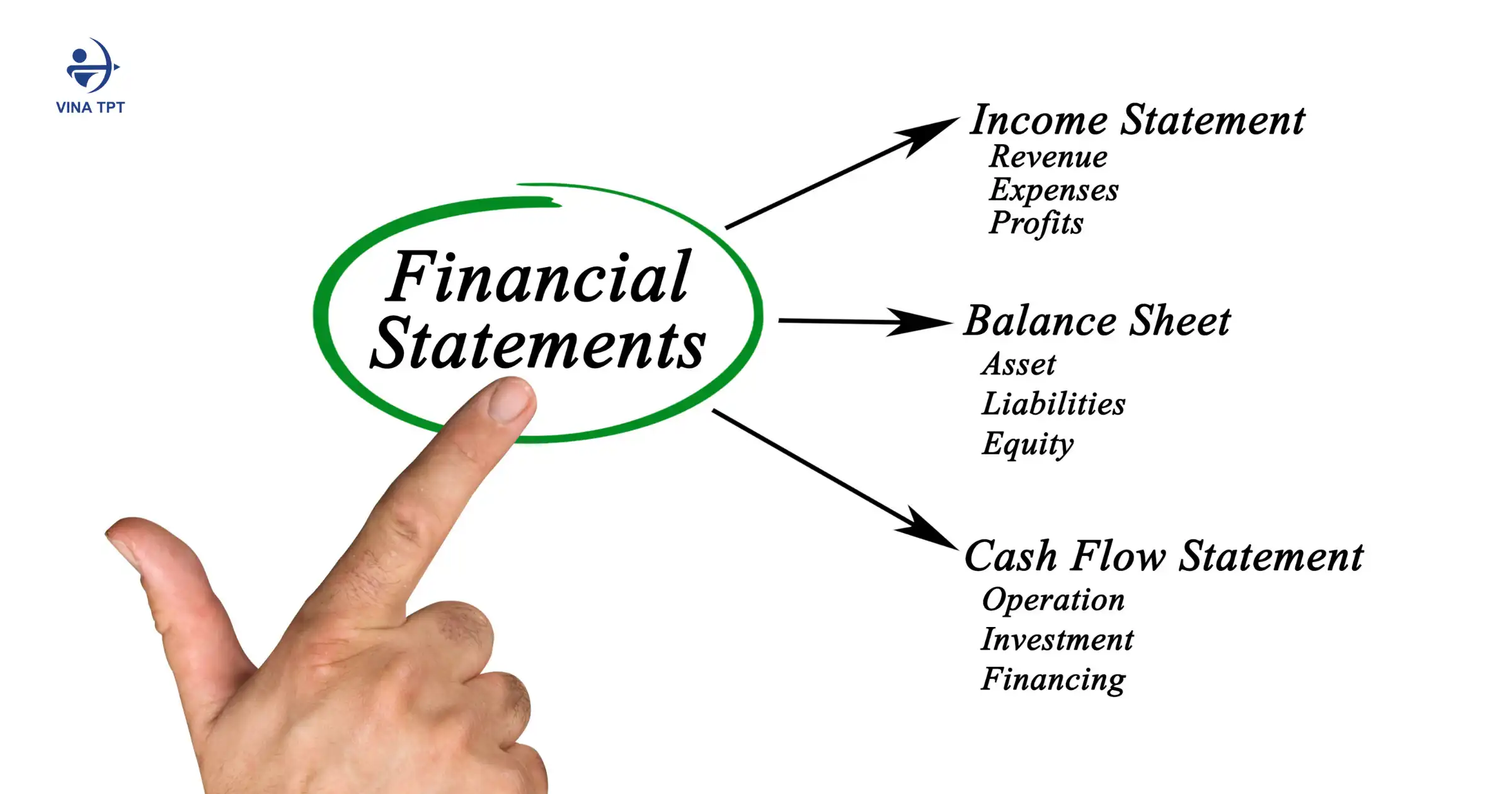
In 2025, FDI enterprises and domestic enterprises in Vietnam must fully comply with financial reporting and tax settlement obligations as prescribed. The annual financial statements include the Balance Sheet, Income Statement, Cash Flow Statement and Notes to the Financial Statements, all of which must be prepared in accordance with Vietnamese Accounting Standards (VAS).

In parallel with preparing the Financial Statements, enterprises must make corporate income tax and personal income tax settlements within 90 days from the end of the fiscal year. The increase in the frequency of reviews and inspections by tax authorities requires enterprises to have accurate data, a synchronous accounting system and complete records to avoid the risk of being penalized.

2. Vina TPT’s Financial Statement Services

Vina TPT provides in-depth financial reporting services, helping businesses prepare accurate, transparent and fully VAS-compliant reports. Not only synthesizing data, we also provide a clear view of the financial situation and ensure readiness for audits or tax inspections.

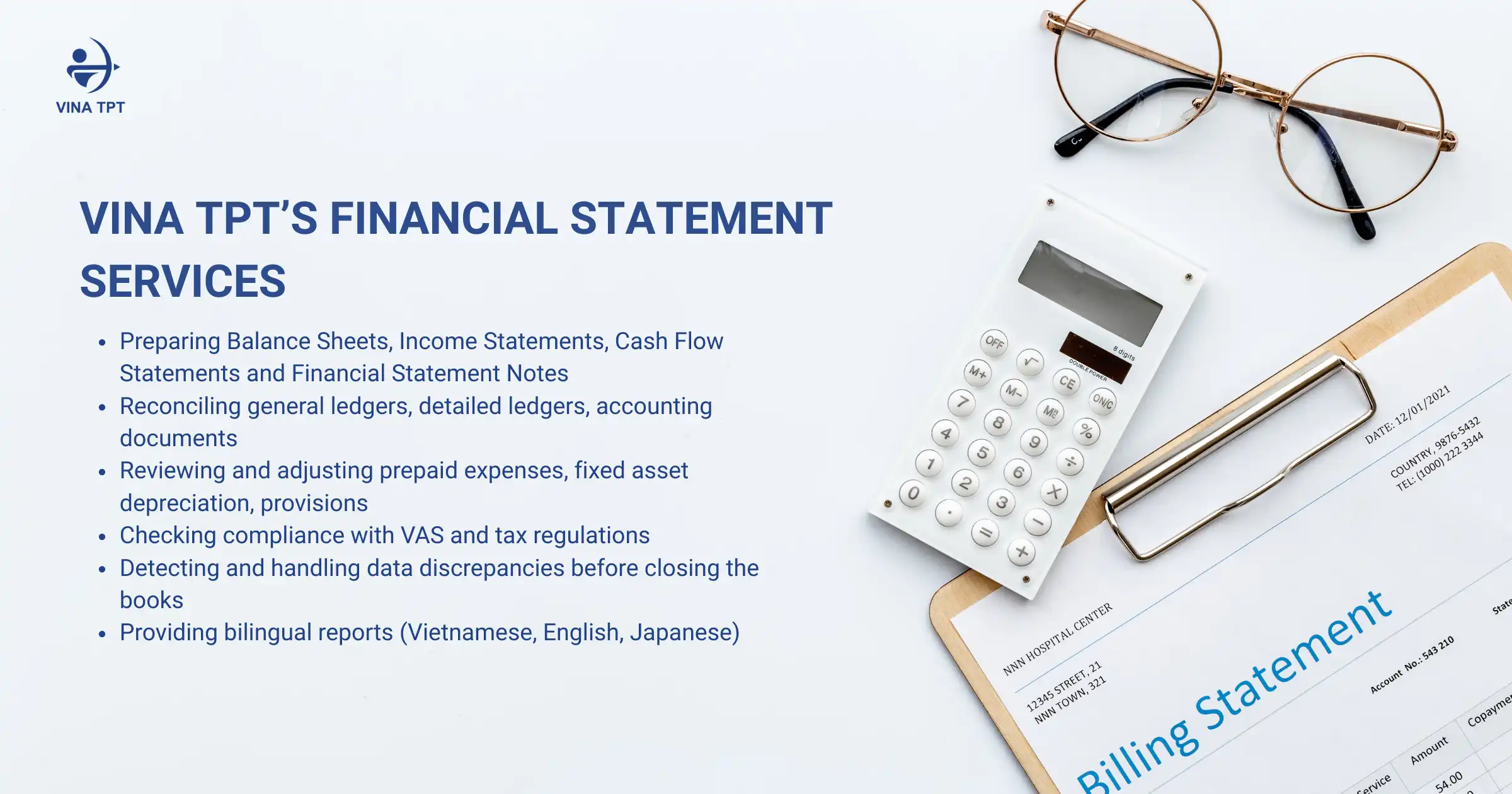
Vina TPT’s financial reporting services include:

  • Preparing Balance Sheets, Income Statements, Cash Flow Statements and Financial Statement Notes
  • Reconciling general ledgers, detailed ledgers, accounting documents
  • Reviewing and adjusting prepaid expenses, fixed asset depreciation, provisions
  • Checking compliance with VAS and tax regulations
  • Detecting and handling data discrepancies before closing the books
  • Providing bilingual reports (Vietnamese, English, Japanese)

Explore Our Services

3. Corporate Income Tax (CIT) Finalization Services

Vina TPT provides in-depth corporate income tax settlement services, helping businesses control data, comply with regulations and limit errors in the context of many important adjustments to tax policies and the Enterprise Law from October 1, 2025.

3.1 Review expenses and determine taxable profits

Vina TPT checks all expenses to determine which are deductible and which are not deductible in accordance with the Corporate Income Tax Law; reviews depreciation of fixed assets, interest expenses, provisions and expenses that are easily excluded during tax inspections. At the same time, the team compares data between financial statements and tax declarations to accurately calculate taxable profits, ensuring that there are no difficult-to-explain differences.

3.2 Prepare corporate income tax settlement declarations and in-depth risk assessment

The service includes full preparation of declarations, loss transfer appendices, tax incentives, cost analysis tables and explanation documents according to tax inspection standards. Vina TPT also analyzes risks by group such as costs without sufficient documents, incorrect revenue-expense periods, discrepancies in electronic invoice data, or lack of linked transaction records. From there, it proposes solutions to reduce the risk of collection and fines.

3.3 Tax optimization consulting and notes on new regulations from October 1, 2025

Vina TPT supports businesses in applying tax incentives to the right subjects, implementing valid loss transfers, and optimizing tax obligations based on legal mechanisms. In particular, changes effective from October 1, 2025 related to electronic records management, tightening cost control, and expanding explanation requirements make the settlement process more stringent; businesses need to carefully compare data, contracts, and documents to avoid risks when tax authorities inspect.

4. Personal Income Tax (PIT) Finalization for Employees & Foreigners

Personal income tax settlement is a major challenge for businesses with large staff numbers, diverse income structures or foreign employees. Vina TPT provides a complete PIT solution, helping businesses process quickly, correctly and fully comply with new regulations.

4.1 Review PIT data and prepare settlement documents

Vina TPT checks tax data of each employee monthly (income, exemptions, deductions, working days, taxes paid) to ensure consistent data before making settlement. At the same time, collect and check all documents: labor contracts, payroll, residence papers, entry/exit history of foreign experts… to help businesses have accurate data from the beginning of the year.

4.2 Preparation and submission of PIT settlement dossiers and tax refund support

Services include preparing PIT settlement declarations for businesses and individuals, correctly classifying residents and non-residents, applying double taxation agreements (DTA) if any, and submitting dossiers on time. Vina TPT also carries out tax refund procedures for employees and foreign experts, monitors the processing process and works with tax authorities to ensure that dossiers are processed quickly.

4.3 Representing and working with tax authorities and providing in-depth advice for foreign workers

Vina TPT represents businesses when requested by tax authorities, helping to reduce the workload for HR and accounting departments. At the same time, it provides in-depth advice on tax residency, applying DTA, handling business trips to multiple countries, income arising outside of Vietnam, or common international risks. This is especially important for businesses that employ many foreign experts and need to comply with cross-border tax standards.

SOLVE YOUR TAX CHALLENGES

Vina TPT’s Financial Statement Services

5. Common Pain Points & Why Businesses Need Professional Support

At the end of each year, many businesses face difficulties due to:

  • Incorrect data or inconsistent recording
  • Lack of documents or incomplete records
  • Internal accounting systems and reporting to parent companies are not synchronized
  • Late submission deadlines due to limited staff
  • Risks of fines and additional collection when tax authorities inspect
  • Lack of expertise in VAS and complex tax regulations

Professional services from Vina TPT help businesses avoid these risks and ensure the tax filing process runs smoothly.

6. Why Choose Vina TPT for Reporting & Tax Services

Values:

  • Vina TPT helps businesses maintain a transparent accounting system, accurate reporting and minimize tax risks in the context of increasingly strict inspections.

Professional capacity:

  • A team of accountants & tax experts with many years of experience in FDI enterprises
  • Deep understanding of VAS and financial reporting according to international standards
  • Bilingual support in Vietnamese – English – Japanese

Service commitment:

  • Clear process, fast processing time
  • Data security and absolute compliance with legal regulations
  • Optimal cost according to scale and workload

7. Comprehensive Service Package for FDI Enterprises

Vina TPT provides One-Stop Tax & Accounting Solution, including:

  • Annual Financial Report
  • Corporate Income Tax Finalization
  • Personal Income Tax Finalization
  • Accounting & Bookkeeping Services
  • Payroll, Labor Report
  • Support for Foreign Labor Compliance
  • Support for Working with Tax Authorities, Inspections & Audits

Consistency

  • All services are deployed synchronously according to one system, avoiding data discrepancies between departments and reducing risks during audits.

Long-term Benefits

  • A suitable solution for FDI enterprises that need stability, transparency and long-term support in a volatile legal environment.

Start with Vina TPT to complete financial reports and tax settlement 2025 quickly!

Talk to Our Experts

accounting service Vietnam for FDI company vtpt

Vietnam Work Permit & Tax Compliance for Foreign Experts

Vietnam Work Permit & Tax Compliance for Foreign Experts-Vina TPT

 Vietnam Work Permit & Tax Compliance for Foreign Experts-Vina TPT

1. Key Compliance Requirements for Foreign Experts in Vietnam

When foreign experts work in Vietnam, they must fully meet three main groups of obligations: Vietnam Work permit legal documents, labor records, and tax and insurance obligations. Compliance is mandatory, and businesses are not allowed to let foreigners work without the appropriate license or visa.

1.1 Required legal documents

  • Work Permit or certificate of license exemption.
  • Vietnam work visa / TRC for the right purpose of work.
  • Labor contract signed after the work permit is approved.

1.2 Required labor records

  • Valid passport, degrees, professional certificates.
  • Confirmation of minimum experience according to job requirements.
  • Health certificate in the correct form.
  • Judicial record (if required by law).
  • All foreign documents must be consularized and notarized.

1.3 Tax and insurance obligations

  • Register for tax code and determine resident/non-resident status.
  • Deduct – declare – pay personal income tax according to Vietnam taxation regulations.
  • Participate in social insurance/health insurance if required.

1.4 Reporting and responsibilities of enterprises

  • Enterprises must explain the need to use foreign labor before applying for Work Permit.
  • Report foreign labor according to the deadline of the management agency.
  • Monitor visa, TRC, Work Permit expiration date to renew on time.

Failure to fully comply with regulations on work permits, work visas and Vietnam taxation can lead to serious consequences for both businesses and foreign experts. Businesses may be subject to high administrative fines, be suspended from employing foreign workers or be subject to increased inspections in subsequent periods. 

Workers are at risk of being denied or having their Work Permit/visa extended, forced to leave the country or restricted from returning to work in Vietnam. 

Therefore, full compliance and proactively updating regulations are of utmost importance for all businesses with foreign experts working in Vietnam.

 Vietnam Work Permit & Tax Compliance for Foreign Experts-Vina TPT

2. Work Permit & Work Visa Requirements 

2.1 Conditions for granting Work Permit

  • Enterprises must have written approval of the need to use foreign labor before submitting the application.
  • Workers must meet the professional standards:
    • Qualifications relevant to the position
    • Working experience according to the number of years specified for each position
  • Have a health certificate according to the form recognized in Vietnam (valid for 12 months).
  • Have a clean criminal record, no criminal record, valid and legalized according to regulations.
  • The labor contract or work agreement must be appropriate to the position applying for a Work Permit.

2.2 Classification of work visas and duration

  • DN Visa: for people who come to work with a business for a short time (not a replacement for a Work Permit).
  • LD Visa / Labor Visa: for people who work long-term and is the basis for applying for a temporary residence card.
  • Temporary Residence Card (TRC): is issued based on a Work Permit and has a corresponding term, up to 2 years.
  • The Work Permit term is according to the contract but not more than 2 years, and can be extended if conditions are met.

2.3 Work Permit Renewal Process

  • Submit your application when your Work Permit is still valid, 5-45 days before the expiry date.
  • The renewal application includes:
    • Current Work Permit
    • Confirmation of continued employment of foreign workers
    • Renewed or renewed employment contract
    • Health certificate, criminal record (if update required)
  • The labor agency reviews the new issuance according to the same procedure.

2.4 Work Permit Exemptions

  • Working in Vietnam for a short period of time according to the number of days allowed by law.
  • Members of diplomatic missions and their dependents who qualify.
  • Experts and lecturers invited or confirmed by state agencies.
  • Volunteers working for non-profit organizations or NGOs.
  • Some special cases according to the current decree, but still have to submit an exemption notification to the labor agency.

2.5 Common mistakes that cause applications to be rejected

  • Lack of notarized documents or using the wrong form according to regulations.
  • Degrees or experience do not demonstrate appropriate expertise.
  • Health certificate or criminal record expired / not legalized.
  • Inconsistent information between passport – contract – application.
  • The enterprise has not been approved to use foreign labor.
  • Using the wrong type of visa during the working period, leading to the application being evaluated as invalid.

REQUEST WORK PERMIT ASSISTANCE

3. Employment Contracts & Payroll Compliance

Foreign experts working in Vietnam must fully comply with tax obligations, focusing on personal income tax (PIT) and determining residency status. Enterprises are responsible for withholding, declaring and paying taxes according to regulations, and ensuring that the labor contract, working time and residency records of experts are properly managed. Determining whether an expert is a resident or non-resident directly affects the tax calculation, tax rate and income range that must be declared.

Important tax obligations to comply with:

  • Register for a personal tax code (MST) as soon as you start working.
  • Determine residency status based on the number of days present in Vietnam (≥183 days are considered residency).
  • Declare and pay PIT monthly or quarterly depending on the enterprise.
  • Annual tax finalization for resident individuals, or upon termination of the contract.
  • Declaring global income for individuals residing in Vietnam, if there is income generated abroad.
  • Store full tax documents for inspection purposes: labor contracts, payroll, deduction documents.

In addition, foreign experts need to ensure that their visas, Work Permits and labor contracts are consistent with the actual working time, to avoid being considered “illegible work”, leading to tax arrears or penalties. When there are changes such as position transfers, salary increases, changes in country of residence or contract termination, businesses must promptly update their tax records to avoid compliance risks and ensure transparency according to Vietnamese regulations.

 Vietnam Work Permit & Tax Compliance for Foreign Experts-Vina TPT

4. Personal Income Tax for Foreign Employees 

Foreign experts working in Vietnam must fully comply with personal income tax (PIT) obligations, including registering for a tax code, determining their residency status, and declaring and paying taxes on time. Residency status (resident or non-resident) directly affects the tax calculation, tax rate, and income range that must be declared. For resident individuals, global income arising from both Vietnam and abroad may be subject to declaration if it meets the prescribed conditions.

Main tax obligations to be performed

  • Register for a personal tax code as soon as you start working.
  • Determine residency status based on the number of days present in Vietnam (≥183 days/year).
  • Deduct, declare, and pay taxes monthly or quarterly through the enterprise.
  • Perform year-end tax settlement or upon termination of the labor contract.
  • Declare global income for resident individuals if they have income from abroad.
  • Keep complete documents to serve tax inspection when needed.

5. Annual Compliance Checklist for Foreign Experts Working in Vietnam

To avoid legal and tax risks, foreign experts and businesses need to comply with a set of annual inspection standards. This checklist helps ensure that Vietnam work Permits, visas, labor contracts, taxes and periodic reports are always updated on time, avoiding common errors such as incorrect visa types, expired documents, or inconsistent tax declarations. Annual Compliance Checklist including: 

  • Check the Vietnam work Permit validity and renew it on time.
  • Review visas / temporary residence cards (TRC) to ensure compliance with the length of stay.
  • Update labor contracts, salaries, and allowances according to reality.
  • Compare residence records with the number of days present in Vietnam.
  • Make personal income tax settlements on time.
  • Confirm compulsory social insurance obligations (if applicable).
  • Submit all foreign worker reports as required by the Department of Labor.
  • Review all documents: contracts, payroll, taxes, visa/Work Permit documents.

6. Vina TPT’s End-to-End Compliance Support for Foreign Experts

Vina TPT provides a comprehensive compliance support solution for foreign experts in Vietnam, including Work Permit, visa, tax and labor records management. The service is optimally designed for FDI enterprises, multinational corporations and experts working under long-term contracts. Thanks to standardized processes and a team of experts, Vina TPT helps businesses reduce legal risks, save time and ensure transparency when using foreign workers. Comprehensive support services include:

  • Vietnam work Permit consultation and submission, WP extension, WP exemption confirmation.
  • Visa processing, temporary residence card (TRC) for experts and relatives.
  • Salary optimization – personal income tax, residence status determination and tax declaration.
  • Labor contract management, foreign worker reporting.
  • Annual compliance review.
  • Representing businesses in meetings with tax and labor authorities.

To ensure foreign experts work legally in Vietnam, contact Vina TPT for full support on Work Permit, visa and tax.

BOOK A FREE CONSULTATION

 Vietnam Work Permit & Tax Compliance for Foreign Experts-Vina TPT

Understanding Vietnam’s licensing requirements for premium F&B concepts from America

Understanding Vietnam’s licensing requirements for premium F&B concepts from America

Company-formation

1. Finding Your Market Fit Before Registering a Company in Vietnam

Vietnam is becoming an attractive destination for international F&B brands, especially high-end models from the US. However, before starting the company formation process, investors need to clearly understand local consumer behavior and culinary trends in major cities such as Ho Chi Minh City, Hanoi, and Da Nang. 

Unlike the US market, Vietnamese customers have a strong differentiation between high-end and mass consumer groups. Therefore, determining brand positioning such as casual dining, premium restaurant, or street concept, plays a decisive role in choosing an investment model. Careful research helps businesses avoid opening in the wrong segment, reducing financial risks when operating the first store.

2. Choosing the Right Business Model for Your F&B Chain

Not all models are suitable for Vietnamese regulations. American brands can choose three main directions:

  • 100% foreign-owned companies: proactively manage the brand, ensure consistent quality, but the legal process is more complicated.
  • Cooperating with local partners: helps shorten the time to penetrate the market, but requires a clear brand and financial control mechanism.
  • Franchising: suitable for brands with a reputation, but requires the franchise contract to be legally registered with the Ministry of Industry and Trade.
  • Mergers & Acquisitions (M&A): For investors seeking a faster route, acquiring an existing Vietnamese F&B company can be highly effective. However, this approach demands thorough due diligence, including legal, financial, and operational assessments to ensure compliance and minimize hidden risks.

The choice of model directly affects the type of legal entity when performing company registration services as well as the tax structure, licenses and initial investment costs.

SELECT THE BEST BUSINESS STRUCTURE IN VIETNAM

3. Company Registration Services That Simplify Expansion

Registering an F&B company in Vietnam requires careful legal preparation. Investors need to complete the investment certificate (IRC) – if there is foreign capital, and enterprise registration certificate (ERC).

The F&B sector in Vietnam belongs to the group of “conditional” industries, which means that after being granted an ERC, businesses cannot operate immediately but need to register additional related industry codes:

  • Code 5610: Restaurant and catering services.
  • Code 5629: Other food and beverage services.
  • Code 4632: Wholesale of food and beverages.
  • Code 4722: Retail sale of food in specialized stores.

Registering the correct industry code helps businesses to conveniently apply for sub-licenses such as Food Safety Certificate, Fire Prevention and Fighting License, Alcohol and Beer Sales License, etc.

To ensure the business establishment process is quick and in compliance with regulations, international F&B brands should cooperate with a professional company registration service provider. This solution helps shorten the multi-step legal process, ensures accurate records and completes procedures on time. 

Vina TPT company registration service helps businesses shorten the time, prepare documents according to FDI standards, and ensure compliance with all licensing regulations in Vietnam.

Company-formation

4. Licensing and Compliance: What F&B Investors Often Miss

Many international F&B brands fail in Vietnam not because of poor products, but because they do not understand the Vietnam F&B market licensing requirements. To operate legally, businesses need:

  • Food Safety License for processing or serving locations.
  • Fire prevention and fighting license for each facility, issued after completing technical acceptance.
  • License to sell wine, beer or alcoholic beverages if they are on the list of conditional businesses.
  • Environmental and labor hygiene license, especially for large-scale processing facilities.

Missing one of these licenses can result in a business being suspended or being fined. Preparing all documents and complying from the beginning helps the inspection, acceptance and licensing process go smoothly, while also building a professional brand image in the eyes of Vietnamese management agencies.

5. Building a Scalable System: HR, Tax & Operations

As the F&B chain expands, the management problem becomes more complicated. Investors need to have a tightly operating human resource (HR), tax and accounting management system. Vietnam requires businesses to declare taxes monthly, finalize taxes annually and comply with regulations on accounting for FDI enterprises.

Setting up an internal ERP system and cooperating with a local consulting unit helps businesses minimize fixed costs, while controlling financial activities, profits, and tax obligations. In addition, good compliance with business license tax and regulations on electronic invoices helps businesses avoid the risk of being subject to surprise inspections.

6. Partnering with Experts Like Vina TPT to Go Further

Instead of handling dozens of administrative procedures and legal regulations themselves, many international F&B brands choose Vina TPT company registration service as their strategic partner in Vietnam.

With a team of experts with numerous experience in the field of business registration, investment consulting and F&B licensing, Vina TPT provides full support from company formation, FDI dossier preparation, operating license to accounting and tax after establishment.

Vina TPT experts not only understand Vietnamese regulations, but also have experience supporting many American and Japanese brands to successfully deploy premium dining models. This helps investors focus on the core, customer experience and brand development, instead of wasting time on administrative procedures.

Start successfully in the Vietnamese market today by contacting Vina TPT now!

BOOK A FREE CONSULTATION

Company-formation