Understanding Vietnam’s licensing requirements for premium F&B concepts from America

Understanding Vietnam’s licensing requirements for premium F&B concepts from America

Company-formation

1. Finding Your Market Fit Before Registering a Company in Vietnam

Vietnam is becoming an attractive destination for international F&B brands, especially high-end models from the US. However, before starting the company formation process, investors need to clearly understand local consumer behavior and culinary trends in major cities such as Ho Chi Minh City, Hanoi, and Da Nang. 

Unlike the US market, Vietnamese customers have a strong differentiation between high-end and mass consumer groups. Therefore, determining brand positioning such as casual dining, premium restaurant, or street concept, plays a decisive role in choosing an investment model. Careful research helps businesses avoid opening in the wrong segment, reducing financial risks when operating the first store.

2. Choosing the Right Business Model for Your F&B Chain

Not all models are suitable for Vietnamese regulations. American brands can choose three main directions:

  • 100% foreign-owned companies: proactively manage the brand, ensure consistent quality, but the legal process is more complicated.
  • Cooperating with local partners: helps shorten the time to penetrate the market, but requires a clear brand and financial control mechanism.
  • Franchising: suitable for brands with a reputation, but requires the franchise contract to be legally registered with the Ministry of Industry and Trade.
  • Mergers & Acquisitions (M&A): For investors seeking a faster route, acquiring an existing Vietnamese F&B company can be highly effective. However, this approach demands thorough due diligence, including legal, financial, and operational assessments to ensure compliance and minimize hidden risks.

The choice of model directly affects the type of legal entity when performing company registration services as well as the tax structure, licenses and initial investment costs.

SELECT THE BEST BUSINESS STRUCTURE IN VIETNAM

3. Company Registration Services That Simplify Expansion

Registering an F&B company in Vietnam requires careful legal preparation. Investors need to complete the investment certificate (IRC) – if there is foreign capital, and enterprise registration certificate (ERC).

The F&B sector in Vietnam belongs to the group of “conditional” industries, which means that after being granted an ERC, businesses cannot operate immediately but need to register additional related industry codes:

  • Code 5610: Restaurant and catering services.
  • Code 5629: Other food and beverage services.
  • Code 4632: Wholesale of food and beverages.
  • Code 4722: Retail sale of food in specialized stores.

Registering the correct industry code helps businesses to conveniently apply for sub-licenses such as Food Safety Certificate, Fire Prevention and Fighting License, Alcohol and Beer Sales License, etc.

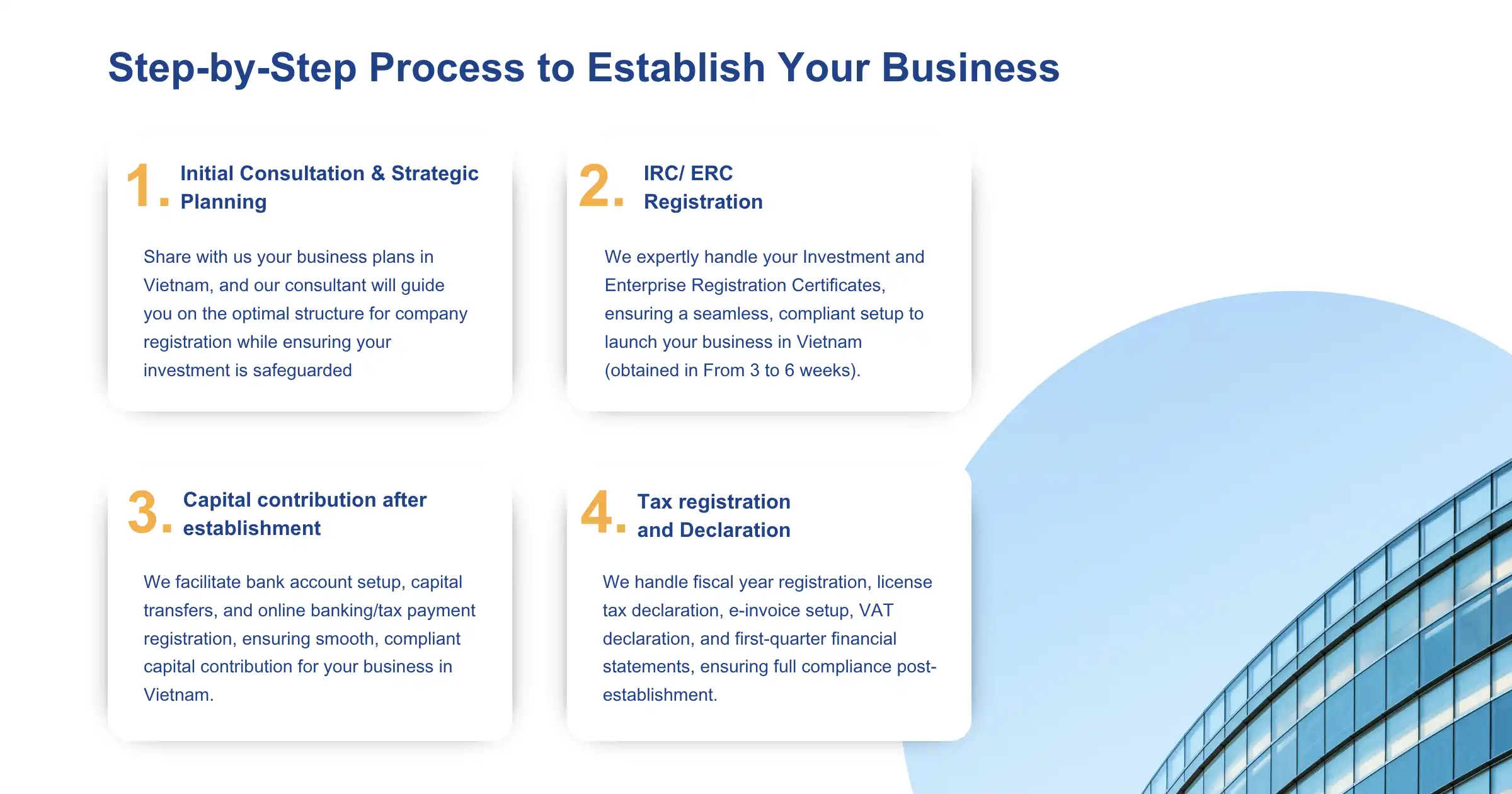
To ensure the business establishment process is quick and in compliance with regulations, international F&B brands should cooperate with a professional company registration service provider. This solution helps shorten the multi-step legal process, ensures accurate records and completes procedures on time. 

Vina TPT company registration service helps businesses shorten the time, prepare documents according to FDI standards, and ensure compliance with all licensing regulations in Vietnam.
Company-formation

4. Licensing and Compliance: What F&B Investors Often Miss

Many international F&B brands fail in Vietnam not because of poor products, but because they do not understand the Vietnam F&B market licensing requirements. To operate legally, businesses need:

  • Food Safety License for processing or serving locations.
  • Fire prevention and fighting license for each facility, issued after completing technical acceptance.
  • License to sell wine, beer or alcoholic beverages if they are on the list of conditional businesses.
  • Environmental and labor hygiene license, especially for large-scale processing facilities.

Missing one of these licenses can result in a business being suspended or being fined. Preparing all documents and complying from the beginning helps the inspection, acceptance and licensing process go smoothly, while also building a professional brand image in the eyes of Vietnamese management agencies.

5. Building a Scalable System: HR, Tax & Operations

As the F&B chain expands, the management problem becomes more complicated. Investors need to have a tightly operating human resource (HR), tax and accounting management system. Vietnam requires businesses to declare taxes monthly, finalize taxes annually and comply with regulations on accounting for FDI enterprises.

Setting up an internal ERP system and cooperating with a local consulting unit helps businesses minimize fixed costs, while controlling financial activities, profits, and tax obligations. In addition, good compliance with business license tax and regulations on electronic invoices helps businesses avoid the risk of being subject to surprise inspections.

6. Partnering with Experts Like Vina TPT to Go Further

Instead of handling dozens of administrative procedures and legal regulations themselves, many international F&B brands choose Vina TPT company registration service as their strategic partner in Vietnam.

With a team of experts with numerous experience in the field of business registration, investment consulting and F&B licensing, Vina TPT provides full support from company formation, FDI dossier preparation, operating license to accounting and tax after establishment.

Vina TPT experts not only understand Vietnamese regulations, but also have experience supporting many American and Japanese brands to successfully deploy premium dining models. This helps investors focus on the core, customer experience and brand development, instead of wasting time on administrative procedures.

Start successfully in the Vietnamese market today by contacting Vina TPT now!

BOOK A FREE CONSULTATION

Company-formation

Company registration service for Japanese mechanical manufacturing

Company-registration-service-for-Japanese-mechanical-manufacturing

register-a-company-service-for-japanese

1. Vietnam – A Strategic Base for Japanese Mechanical Manufacturers

Register a company in Vietnam has become increasingly appealing, as the country has emerged over the past decade as a new manufacturing hub in Asia, particularly attractive to Japanese mechanical engineering companies. The reasons come from reasonable operating costs, highly skilled technical human resources and a favorable geographical location for connecting the regional supply chain. In addition, the Vietnamese government has also implemented many tax incentives and infrastructure support policies to attract FDI, especially in the field of mechanical engineering and supporting industries.

For Japanese enterprises, setting up a business in Vietnam not only helps reduce costs but also expands access to the ASEAN market, while maintaining production quality according to Japanese standards. This is the reason why more and more mechanical corporations choose Vietnam as a strategic production base in Southeast Asia.

2. Legal Requirements to Register a Mechanical Manufacturing Company

To register a mechanical manufacturing company in Vietnam, businesses need to carry out some important legal procedures:

2.1 Investment Registration Certificate (IRC) if there is foreign capital.

IRC is the first license allowing the investor to implement the project in Vietnam.

The required documents usually include:

  • Application for investment project implementation and Project proposal: stating the objectives, scale, location, investment capital, progress.
  • Proof of the investor’s financial capacity: bank statement, credit contract or collateral.
  • Legal documents of the investor:
    • Individual: Notarized passport, consular legalization.
    • Organization: Business registration certificate or equivalent document, consular legalization.
  • Project location: lease contract or land/office use rights certificate.

After the IRC is granted (or for 100% domestic-owned enterprises), the investor applies for an ERC – an official license for the enterprise to operate, and also the tax code of the company.

2.2 Enterprise Registration Certificate (ERC) at the Department of Finance.

The ERC dossier usually includes:

  • Application for enterprise registration.
  • Company Charter: stipulates the organizational structure, powers of members/shareholders, capital ratio and management method.
  • List of members/shareholders and legal representatives: clearly state information, ownership ratio, voting rights.
  • Appointment decision and authorization letter (if any).
  • Capital contribution plan & financial evidence: bank statement or credit contract (especially important for large capital projects).

For the mechanical industry, some activities such as heavy metal processing, precision mechanical equipment manufacturing or industrial machinery assembly may require additional specialized licenses or technical safety certificates.

Using a professional service to register a company helps investors avoid legal errors and ensures that documents are processed in accordance with the regulations of Vietnamese authorities.

REGISTER YOUR COMPANY IN VIETNAM NOW

3. Site Selection and Industrial Licensing for Manufacturing Facilities

Choosing a factory location is one of the most important strategic decisions when Japanese mechanical enterprises register a company in Vietnam. A suitable location not only affects the initial investment cost but also determines production efficiency and future expansion.

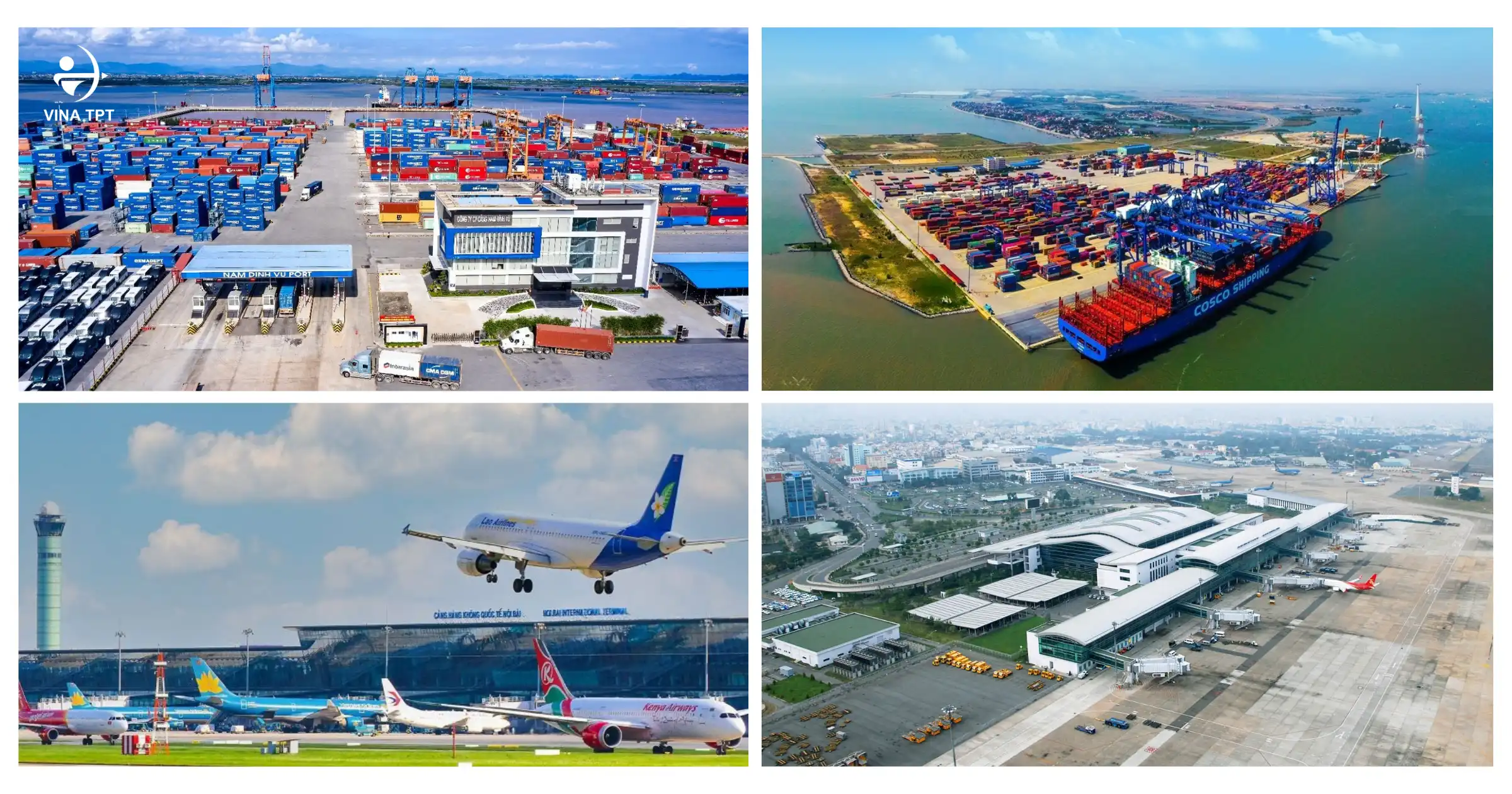
In terms of location, northern regions such as Bac Ninh, Hai Phong, Hung Yen have the advantage of being close to seaports, convenient for exporting to Japan and ASEAN. Meanwhile, southern regions such as Binh Duong, Dong Nai, Long An have good industrial infrastructure and support services, suitable for domestic supply chains. In addition to land rental costs, businesses also need to consider the ability to recruit technical workers – industrial parks near training centers in Hanoi or Ho Chi Minh City help reduce personnel costs.

register-a-company-service-for-japanese

Investment incentives are also a factor worth considering: corporate income tax exemption for the first 2-4 years, 50% reduction in the following years, support for infrastructure costs or land rental. Many localities also have their own promotion programs for Japanese investors.

After selecting a location, businesses must complete the factory operation licenses, including:

  • Construction license according to the approved industrial park planning.
  • Environmental impact assessment (EIA) report according to regulations of the Ministry of Natural Resources and Environment.
  • Certificate of safety of machinery and equipment, especially for imported mechanical lines.
  • Fire safety certification, ensuring safety systems and labor standards.

Completing all these procedures helps businesses operate legally, avoid interruptions in the production process and facilitate future expansion or investment incentives.

4. Understanding Vietnam’s Regulatory Standards for Mechanical Production to Register a Company 

For Japanese mechanical enterprises, establishing a factory in Vietnam involves not only investment and location but also compliance with local technical, safety, and quality standards, a key factor to maintain reputation and meet global requirements.

4.1. Technical Standards System

Vietnam applies two main groups of standards:

  • TCVN (Vietnam National Standards): Recommended standards based on ISO and JIS, used to control quality and production processes.
  • QCVN (Technical Regulations): Mandatory standards on safety, emissions, and energy use. Non-compliance can lead to fines or suspension.

For export-oriented firms, applying ISO 9001, ISO 14001, ISO 45001, and JIS standards ensures product quality equivalent to factories in Japan.

4.2. Equipment Inspection and Product Certification

All imported machinery are CNCs, lathes, welding, or lifting equipment, and must pass technical safety inspections before operation. Products supplied to FDI projects or exports require CR/CQ certificates, and some industries also need IATF 16949 certification.

Proactive inspection and certification reduce technical risks and enhance global competitiveness.

4.3. Environmental and Workplace Safety

Mechanical factories must install air, wastewater, and waste treatment systems meeting national standards. Enterprises also need regular safety training, inspection of lifting equipment and electrical systems, and proper protective gear.

Strict compliance not only fulfills legal requirements but reflects the Japanese values of safety, discipline, and quality.

4.4. Advantages of Japanese Enterprises

By maintaining JIS or Kaizen-5S management models, Japanese enterprises can:

  • Transfer technology easily
  • Build trust with authorities and partners
  • Access programs from JETRO, JBIC, and Vietnam-Japan cooperation projects

This foundation supports stable, long-term investment with optimized costs and minimal legal risk.

5. How Vina TPT Company Registration Service Simplifies the Setup Process

In the context of the increasingly complex Vietnamese legal system, register a company for foreign enterprises, especially in the mechanical field, requires in-depth knowledge of investment, accounting, tax and technical standards. Vina TPT company registration service was established with the mission of supporting foreign investors, especially Japanese enterprises, to set up business operations in Vietnam quickly, legally and effectively.

Vina TPT provides comprehensive solutions for the process of setting up a business in Vietnam, including:

  • Consulting on investment strategies and choosing a business model suitable for the scale of mechanical production.
  • Preparing documents and applying for an Investment Registration Certificate (IRC) and Enterprise Registration Certificate (ERC) according to the provisions of the Investment Law and the Enterprise Law.
  • Consulting on construction permits, environmental permits, equipment safety certificates and mechanical factory operation procedures.

register-a-company-service-for-japanese

Thanks to a closed service system, Vina TPT helps Japanese enterprises save maximum time, reduce legal risks and ensure the factory launch progress on schedule.

The biggest difference of Vina TPT company registration lies in the team of experts with over 20 years of practical experience in the field of corporate law, accounting, tax in Vietnam.

How Vina TPT Supports Japanese Manufacturing Enterprises: 

  • .Proven FDI Experience: Advised many Japanese projects in mechanics, electronics, and supporting industries, fully understanding local licensing and compliance.
  • Cultural Alignment: Operates with Japanese-style precision, transparency, and discipline in all documentation and processes.
  • End-to-End Support: A strategic partner from setup to operation and expansion.
  • Bilingual Team: Fluent Japanese communication ensures smooth coordination and minimized barriers.
  • Focused on Results: Ensures legal compliance, cost efficiency, and sustainable growth for every project.

Contact Vina TPT today for free consultation on the process register a company and setting up a mechanical factory in Vietnam.

CONTACT US NOW

register-a-company-service-for-japanese