Understanding Vietnam’s licensing requirements for premium F&B concepts from America

Understanding Vietnam’s licensing requirements for premium F&B concepts from America

Company-formation

1. Finding Your Market Fit Before Registering a Company in Vietnam

Vietnam is becoming an attractive destination for international F&B brands, especially high-end models from the US. However, before starting the company formation process, investors need to clearly understand local consumer behavior and culinary trends in major cities such as Ho Chi Minh City, Hanoi, and Da Nang. 

Unlike the US market, Vietnamese customers have a strong differentiation between high-end and mass consumer groups. Therefore, determining brand positioning such as casual dining, premium restaurant, or street concept, plays a decisive role in choosing an investment model. Careful research helps businesses avoid opening in the wrong segment, reducing financial risks when operating the first store.

2. Choosing the Right Business Model for Your F&B Chain

Not all models are suitable for Vietnamese regulations. American brands can choose three main directions:

  • 100% foreign-owned companies: proactively manage the brand, ensure consistent quality, but the legal process is more complicated.
  • Cooperating with local partners: helps shorten the time to penetrate the market, but requires a clear brand and financial control mechanism.
  • Franchising: suitable for brands with a reputation, but requires the franchise contract to be legally registered with the Ministry of Industry and Trade.
  • Mergers & Acquisitions (M&A): For investors seeking a faster route, acquiring an existing Vietnamese F&B company can be highly effective. However, this approach demands thorough due diligence, including legal, financial, and operational assessments to ensure compliance and minimize hidden risks.

The choice of model directly affects the type of legal entity when performing company registration services as well as the tax structure, licenses and initial investment costs.

SELECT THE BEST BUSINESS STRUCTURE IN VIETNAM

3. Company Registration Services That Simplify Expansion

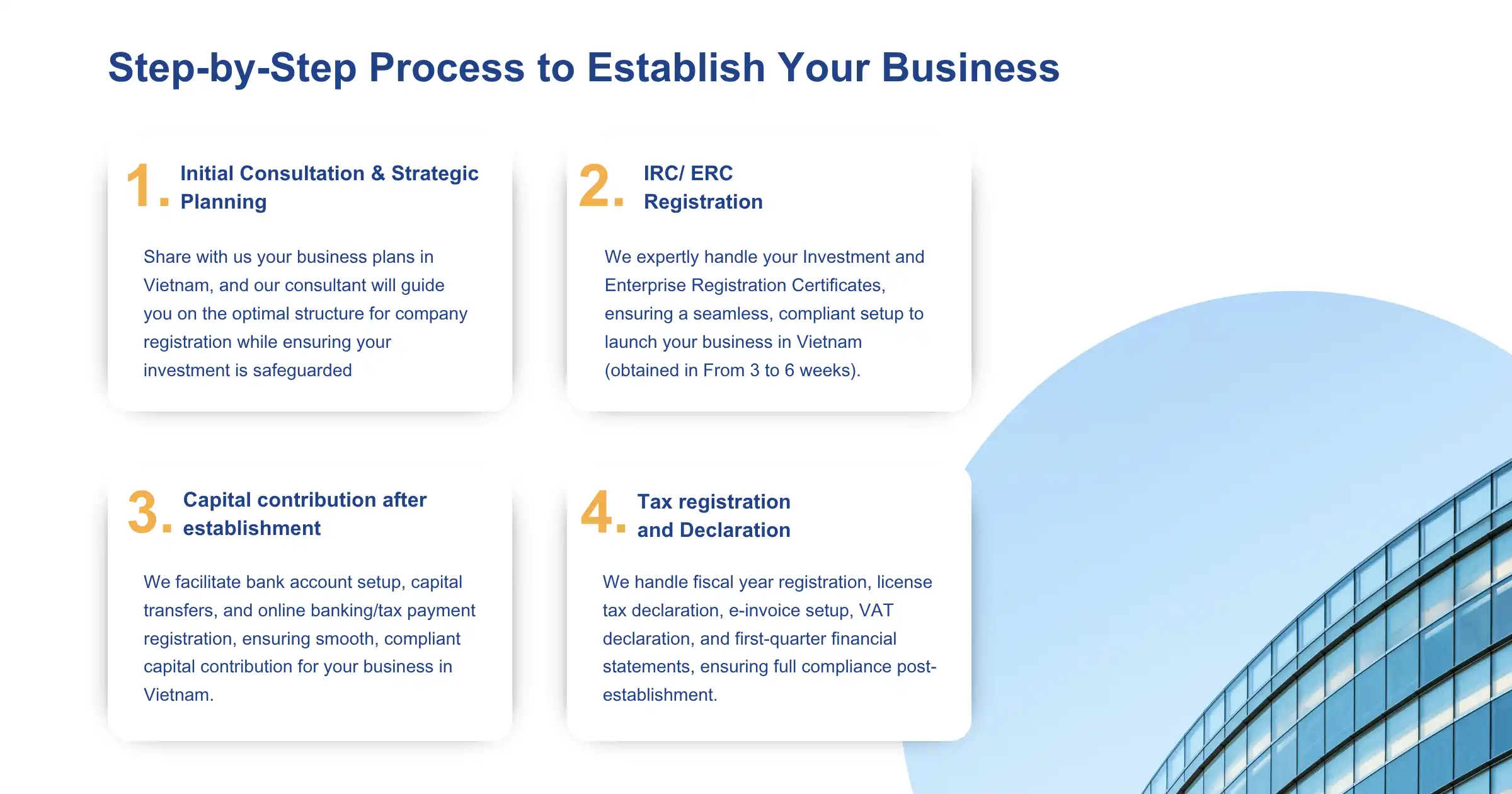
Registering an F&B company in Vietnam requires careful legal preparation. Investors need to complete the investment certificate (IRC) – if there is foreign capital, and enterprise registration certificate (ERC).

The F&B sector in Vietnam belongs to the group of “conditional” industries, which means that after being granted an ERC, businesses cannot operate immediately but need to register additional related industry codes:

  • Code 5610: Restaurant and catering services.
  • Code 5629: Other food and beverage services.
  • Code 4632: Wholesale of food and beverages.
  • Code 4722: Retail sale of food in specialized stores.

Registering the correct industry code helps businesses to conveniently apply for sub-licenses such as Food Safety Certificate, Fire Prevention and Fighting License, Alcohol and Beer Sales License, etc.

To ensure the business establishment process is quick and in compliance with regulations, international F&B brands should cooperate with a professional company registration service provider. This solution helps shorten the multi-step legal process, ensures accurate records and completes procedures on time. 

Vina TPT company registration service helps businesses shorten the time, prepare documents according to FDI standards, and ensure compliance with all licensing regulations in Vietnam.
Company-formation

4. Licensing and Compliance: What F&B Investors Often Miss

Many international F&B brands fail in Vietnam not because of poor products, but because they do not understand the Vietnam F&B market licensing requirements. To operate legally, businesses need:

  • Food Safety License for processing or serving locations.
  • Fire prevention and fighting license for each facility, issued after completing technical acceptance.
  • License to sell wine, beer or alcoholic beverages if they are on the list of conditional businesses.
  • Environmental and labor hygiene license, especially for large-scale processing facilities.

Missing one of these licenses can result in a business being suspended or being fined. Preparing all documents and complying from the beginning helps the inspection, acceptance and licensing process go smoothly, while also building a professional brand image in the eyes of Vietnamese management agencies.

5. Building a Scalable System: HR, Tax & Operations

As the F&B chain expands, the management problem becomes more complicated. Investors need to have a tightly operating human resource (HR), tax and accounting management system. Vietnam requires businesses to declare taxes monthly, finalize taxes annually and comply with regulations on accounting for FDI enterprises.

Setting up an internal ERP system and cooperating with a local consulting unit helps businesses minimize fixed costs, while controlling financial activities, profits, and tax obligations. In addition, good compliance with business license tax and regulations on electronic invoices helps businesses avoid the risk of being subject to surprise inspections.

6. Partnering with Experts Like Vina TPT to Go Further

Instead of handling dozens of administrative procedures and legal regulations themselves, many international F&B brands choose Vina TPT company registration service as their strategic partner in Vietnam.

With a team of experts with numerous experience in the field of business registration, investment consulting and F&B licensing, Vina TPT provides full support from company formation, FDI dossier preparation, operating license to accounting and tax after establishment.

Vina TPT experts not only understand Vietnamese regulations, but also have experience supporting many American and Japanese brands to successfully deploy premium dining models. This helps investors focus on the core, customer experience and brand development, instead of wasting time on administrative procedures.

Start successfully in the Vietnamese market today by contacting Vina TPT now!

BOOK A FREE CONSULTATION

Company-formation

Entering Vietnam’s Clothing Market: A Practical Guide for Chinese Manufacturers

Vina TPT company registration service supporting Chinese clothing investors in Vietnam

business-license-in-vietnam-for-chinese-manufacturer

1. Why Vietnam Is the Next Stop for China’s Clothing Giants

Vietnam is emerging as one of the most dynamic consumer markets in Southeast Asia, especially in the fashion and retail sectors. The middle class is growing rapidly, average incomes are rising, and young people’s shopping trends are gradually shifting towards brands with unique styles and reasonable prices.

For foreign investors and Chinese fashion brands, obtaining a business license in Vietnam is the first important step to legally enter this fast-growing market. With proper licensing and strategic market entry, businesses can take full advantage of Vietnam’s expanding retail opportunities and rising consumer demand.

Vietnamese consumers, especially Gen Z and Millennials, prefer modern fashion that quickly updates global trends while maintaining high practicality. This creates a great advantage for Chinese businesses, which have the ability to produce quickly, flexibly, and at competitive costs.

Not only does Vietnam have great purchasing power, it is also a politically stable market, transparent in investment, and benefits from many free trade agreements (CPTPP, RCEP, EVFTA). In addition, obtaining a business license in Vietnam for fashion or retail activities has become increasingly streamlined, making importing, distributing, or opening Chinese fashion brands in Vietnam easier and more compliant than ever. business license in vietnam

2. Choosing the Right Market Entry Strategy

Chinese businesses can choose one of three popular models when expanding into the Vietnamese market:

  • Establishing a 100% foreign-owned company (WFOE): Suitable for brands that want to control the entire import-distribution-retail process. This model allows for opening physical stores or doing business online after obtaining the required business license in Vietnam.
  • Cooperating with local distributors: helps save costs, quickly access the market, and take advantage of the existing retail network.
  • Joint Venture: Cooperating with Vietnamese businesses to combine local knowledge with goods sources and management capacity from China.

Each form has its own advantages in terms of control level, cost and risk, so it is necessary to consult carefully before choosing.

3. Beyond Paperwork: Setting the Foundation for Operations

To open a business in Vietnam, businesses need to carry out some important legal procedures to have business license in Vietnam:

Investment Registration Certificate (IRC) if there is foreign capital. IRC is the first license allowing the investor to implement the project in Vietnam.

The required documents usually include:

  • Application for investment project implementation and Project proposal: stating the objectives, scale, location, investment capital, progress.
  • Proof of the investor’s financial capacity: bank statement, credit contract or collateral.
  • Legal documents of the investor:
    • Individual: Notarized passport, consular legalization.
    • Organization: Business registration certificate or equivalent document, consular legalization.
  • Project location: lease contract or land/office use rights certificate.

After the IRC is granted (or for 100% domestic-owned enterprises), the investor applies for an ERC – an official license for the enterprise to operate, and also the tax code of the company.

Enterprise Registration Certificate (ERC) at the Department of Planning & Investment. The ERC dossier usually includes:

  • Application for enterprise registration.
  • Company Charter: stipulates the organizational structure, powers of members/shareholders, capital ratio and management method.
  • List of members/shareholders and legal representatives: clearly state information, ownership ratio, voting rights.
  • Appointment decision and authorization letter (if any).
  • Capital contribution plan & financial evidence: bank statement or credit contract (especially important for large capital projects).

Register appropriate business lines, for example:

  • Wholesale and retail of garments and fashion accessories.
  • Import and export of fashion goods.
  • E-commerce business (if selling online).

The good news is that the fashion trade and distribution industry does not require any special sub-licenses, so the establishment procedure is quite simple and the processing time is fast.

After obtaining the business license in Vietnam, the business needs to register a tax code, open a bank account, issue electronic invoices and declare taxes periodically to operate legally.

CONSULT ON BUSINESS LICENSE IN VIETNAM

4. Workforce and Culture Integration

The Vietnamese market is diverse and can be divided into 3 key areas:

  • Ho Chi Minh City: a vibrant commercial center, suitable for young, dynamic fashion.
  • Hanoi: a traditional market, favoring brands with reliability and elegant designs.
  • Da Nang, Can Tho: emerging markets, low cost, easy to test retail models.

In addition to choosing a strategic business location, businesses need to:

  • Cooperate with logistics units to optimize shipping costs from China to Vietnam.
  • Build a localized marketing strategy, combining platforms such as TikTok, Shopee, Lazada and Facebook, which currently account for the majority of online fashion sales channels in Vietnam.
  • Understand Vietnamese fashion tastes: prioritize light, airy, easy-to-match and highly applicable products.

5. Local Compliance and Ethical Manufacturing

When operating in Vietnam, recruiting and managing local human resources is an important factor.

Chinese enterprises need to clearly understand the regulations on labor contracts, social insurance, and personal income tax (PIT) to avoid violations.

In addition, cultural differences should also be noted:

  • Vietnamese people value respect, gentleness, and collaboration in the working environment.
  • A team of dedicated employees, paid on time and transparently will help operations run smoothly, especially in the retail and customer care sectors.

Many foreign enterprises choose to outsource payroll and HR services to ensure compliance, optimize costs, and reduce administrative risks. In addition, working with a professional consulting partner also helps businesses handle legal procedures such as applying for a business license in Vietnam, registering employees, and setting up a compliant payroll system, ensuring smooth and lawful operations from the start.

6. How Vina TPT Helps You Scale Smoothly

Vina TPT Company Registration is a consulting and implementation unit for comprehensive services for foreign investors in Vietnam, especially Chinese enterprises in the fields of fashion, trade and light manufacturing.

We provide:

  • Investment consulting & legal structure according to the desired business model.
  • Business registration services (ERC, IRC), opening bank accounts, tax codes and electronic invoices.
  • Accounting, tax, payroll, periodic compliance management, ensuring transparent and legal operations.
  • Bilingual support in English – Vietnamese, helping businesses easily exchange and process documents.

With a team of experts with more than 2015 years of experience in the fields of foreign investment, finance and law, Vina TPT has accompanied hundreds of Chinese FDI companies to successfully expand in Vietnam – from establishment to stable operation.

7. From Setup to Growth: Building a Sustainable Clothing Brand in Vietnam

Vietnam is not only a “production hub” but also a booming consumer market with long-term potential.

Chinese businesses can take advantage of this market to build their brands, develop distribution channels, and expand into Southeast Asia.

With a deep understanding of Vietnam’s legal framework, tax regulations, and consumer market, Vina TPT helps you take every step with confidence – from setting up a legal entity and applying for business licenses in Vietnam, to managing finances and ensuring smooth operations.

Want to bring a Chinese fashion brand to Vietnam quickly and legally? 

Let Vina TPT accompany you through the entire process of company registration, compliance and tax accounting, helping you focus on developing your brand.

BOOK A FREE CONSULTATION

business-license-in-vietnam-for-chinese-manufacturer