Top 10 | Ideas for small business in Vietnam for Foreign Investors

1. Overview of Business Opportunities for Foreigners

If you’re exploring ideas for small business in emerging markets, Vietnam stands out as one of the fastest-growing economies in Southeast Asia, backed by a young population, a dynamic workforce and rising consumer demand. Foreign investors can tap into numerous developing sectors.

The Vietnamese market is particularly attractive due to the growth of the middle class, new consumer habits and high demand for quality services. Large cities such as Hanoi, Ho Chi Minh City, Da Nang are ideal destinations to test small business models and implement innovative ideas.

2. Profitable Ideas for Small Business

Below are ideas for small business suitable for foreign investors in Vietnam, detailed implementation so that customers can evaluate the potential:

F&B (Food & Beverage):

  • Coffee shops, restaurants, milk tea stalls with creative concepts.
  • Delivery services, processing organic food, healthy food.
  • Business in foreign specialties or combining local culinary culture.

Education services:

  • Foreign language centers, skills training, teaching STEM or coding for children.
  • Online classes, edu-tech models combined with offline.

E-commerce:

  • Online retail, dropshipping, or specialized sales platforms.
  • Providing unique imported products, targeting middle-class customers.

Light Manufacturing:

  • Processing agricultural products, packaged foods, manufacturing handmade products.
  • Producing small consumer products, souvenirs or fashion accessories.

Support and logistics:

  • Transportation, warehousing, fulfillment for e-commerce.
  • Business consulting, marketing, or office rental services.

Tourism & Travel:

  • Boutique travel agencies, guided tours, eco-tourism, and adventure trips.
  • Services combining local culture, culinary experiences, and foreign-language support.

Health & Wellness:

  • Fitness studios, yoga centers, spas, wellness retreats.
  • Health coaching, organic/natural product shops, or dietary consultation services.

Tech & Digital Solutions

  • App or software development for small businesses, fintech solutions.
  • Digital marketing agencies, social media management, or website development.

Creative & Arts Services

  • Photography studios, interior design, handmade crafts, or art workshops.
  • Event planning, wedding services, or cultural experience workshops for foreigners.

Green & Sustainable Businesses

  • Eco-friendly products, recycling services, sustainable packaging, or zero-waste shops.
  • Solar energy solutions or small-scale environmental consulting for local businesses.

These ideas for small business are suitable for small and medium investment capital, flexible in implementation and can be tested in big cities or niche markets.

4. Key Considerations for Compliance and Operations

When planning to implement ideas for small business in Vietnam, foreign investors need to understand some basic factors about operations and legal compliance. Although you do not need to go into the details of the law, understanding these points will help avoid future risks and ensure the company operates smoothly.

4.1 Tax compliance and financial reporting

Every business in Vietnam must declare value-added tax (VAT), corporate income tax (CIT) and personal income tax (if it has employees). Preparing accounting books from the beginning will help businesses easily prepare monthly, quarterly and year-end financial reports, and avoid tax arrears or administrative fines.

4.2 Social insurance and employee benefits

If a business hires local workers, paying social insurance, health insurance and unemployment insurance is mandatory. This is an important factor to ensure employee benefits and compliance with Vietnamese labor laws.

4.3 Compliance with basic industry and legal regulations

Some industries, such as F&B, education or logistics, require specific business licenses or sub-licenses. A basic understanding of these requirements will help investors choose the right business model and avoid legal risks.

GET LEGAL SUPPORT

4.4 Manage operations and administrative records

Preparing basic procedures such as registering for a tax code, opening a corporate bank account and keeping complete records will help businesses operate effectively right from the start.

In short, understanding the above notes helps investors plan in advance, minimize risks and focus on implementing business ideas, without having to go too deep into detailed regulations on laws and taxes.

5. How Vina TPT Supports Foreign Investors

Vina TPT provides comprehensive services for foreign investors, including:

  • Company setup & registration at state agencies and corporate bank account opening.
  • Accounting & tax compliance: bookkeeping, financial reports, tax registration, declarations, and handling tax inquiries.
  • Payroll & social insurance: payroll calculation, insurance registration, and labor report submissions.
  • Work permit & visa support for foreign employees.
  • Ongoing legal compliance to ensure smooth operations.

With more than 20 years of experience supporting startups and FDI enterprises in Vietnam, Vina TPT commits to providing fast, transparent and legally compliant services, helping investors feel secure from the company setup step to initial operation, optimizing time and costs, while ensuring the business operates effectively and safely.

Explore business opportunities in Vietnam and start your investment journey with Vina TPT

BOOK A FREE CONSULTATION

Top-20-Sectors-for-Business-Opportunities-in-Vietnam-VTPT

Capital Contribution and Business Setup for Foreign Investment in Vietnam

Capital-Contribution-and-Business-Setup-for-Foreign-Investment-in-Vietnam-Vina-TPT

Capital-Contribution-and-Business-Setup-for-Foreign-Investment-in-Vietnam-Vina-TPT

1. Understanding Capital Contribution Requirements for Foreign investment in vietnam

Capital contribution is the most important step when establishing an FDI enterprise. According to Vietnamese law, foreign investors should note:

  • Minimum capital: Vietnam does not require a general legal capital level, but the charter capital must be appropriate and demonstrate the ability to implement the business model. Some specific industries (education, real estate, e-commerce, etc.) have higher capital requirements.
  • Form of capital contribution: Investors can contribute capital in cash, machinery and equipment, assets, intellectual property rights, or other legal assets.
  • Capital contribution period: Usually must be completed within 90 days from the date of issuance of the Certificate of Business Registration (or according to the period stated in the Investment Registration Certificate).

Determining capital accurately from the beginning helps reduce legal risks and limit capital adjustments later.

2. Types of Foreign Investment in Vietnam

When choosing a form of investment in Vietnam, investors need to consider their business objectives, project scale, level of control and desired scope of operations. Vietnam allows for a variety of flexible legal models, from establishing a new business to opening a branch or representative office. Each form carries different levels of risk, costs and compliance obligations, so choosing the right one at the outset will have a big impact on investment performance and long-term strategy.

Below are the most common forms of FDI in Vietnam:

Type Suitable for Advantages Disadvantages
Limited Liability Company (LLC) Small & medium enterprises

Investors needing strong control

Simple structure

Easy to operate

High control

Fast setup

Hard to raise capital

Extra procedures to convert to JSC

Joint Stock Company (JSC) Businesses expanding strongly

Companies seeking fundraising

Easy capital raising Fit for large/multinational projects

Flexible share transfer

Good for future IPO

Complex governance

More management bodies required

Higher compliance cost

Branch of Foreign Traders Foreign companies in eligible sectors Can conduct profit-making activities

No new legal entity required

Operate under parent company

Limited to specific industries

Dependent on parent company

Hard to scale like an independent entity

Representative Office (RO) Market research stage

Building partner networks

Simple setup

Low cost

No CIT applied

Cannot generate revenue

Cannot sign commercial contracts

Not suitable for long-term investment

Choosing the appropriate form of FDI helps investors optimize costs, reduce legal risks and ensure that their business strategy in Vietnam is effectively implemented. For small and medium-sized projects, LLC is often the optimal choice; for strong expansion plans or many shareholders, JSC is more suitable. Meanwhile, branches and representative offices serve the purpose of market presence without the need to establish a new legal entity.

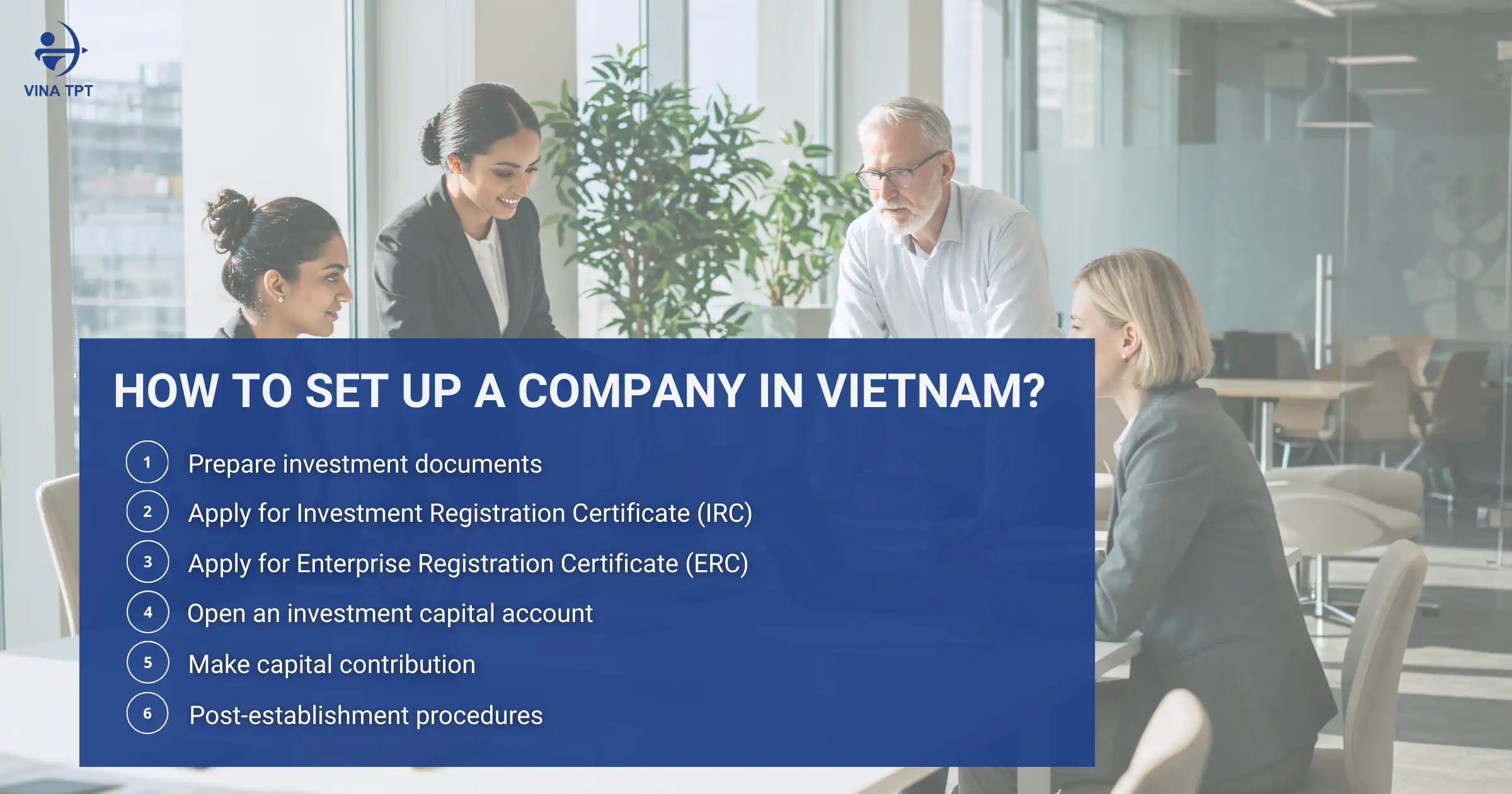
3. Steps to Set Up a Company with Capital Contribution

When setting up a Foreign investment in Vietnam, investors need to take the following main steps:

Step 1: Prepare investment documents

  • Investor information
  • Financial capacity report
  • Business plan
  • Headquarters lease contract, company charter

Step 2: Apply for Investment Registration Certificate (IRC): Confirm investment project and capital structure. Processing time: 15-30 days.

Step 3: Apply for Enterprise Registration Certificate (ERC): Officially establish the enterprise. Time: 3-5 days.

Step 4: Open an investment capital account: Required for FDI enterprises, used to receive capital from abroad.

Step 5: Make capital contribution: Investors transfer capital on time and complete the report.

Step 6: Post-establishment procedures

  • Tax registration
  • Digital signature
  • Corporate seal
  • Labor and insurance registration (if required)

Capital-Contribution-and-Business-Setup-for-Foreign-Investment-in-Vietnam-Vina-TPT

4. Compliance and Reporting Obligations

Foreign investment in Vietnam must ensure full compliance with the following regulations:

  • Capital contribution progress report
  • Accounting and bookkeeping according to VAS standards
  • Periodic tax declaration (VAT, CIT, PIT)
  • Annual financial report
  • Notification of changes in capital, headquarters, and representative

Non-compliance may result in administrative fines, restrictions on operations, or capital adjustment requirements.

AVOID COSTLY COMPLIANCE RISKS

5. Benefits of Proper Capital Contribution Management

Managing and implementing capital contribution in accordance with regulations is not only a legal requirement but also brings many practical values ​​to FDI enterprises in Vietnam:

Avoid legal risks and penalties

  • Contributing capital on time helps avoid administrative penalties.
  • Avoid being required to reduce charter capital or adjust the Investment Certificate.
  • Limit risks when checking, inspecting or working with banks.

Protecting investors’ ownership rights and capital contribution ratios

  • Clearly record the ownership ratio, voting rights and interests of each shareholder.
  • Avoid internal disputes, especially with investors from many different countries.
  • Increase transparency when planning to transfer shares or raise capital.

Increase the level of trust with banks, partners and management agencies

  • Adequate charter capital is an important factor in expanding credit limits.
  • Demonstrate the financial capacity and long-term commitment of investors in Vietnam.
  • Help partners and suppliers feel secure when signing contracts.

Optimize taxes and cash flow

  • A reasonable capital structure helps reduce the risk of transfer pricing adjustments and avoid tax disputes.
  • Easily control cash flow in and out through investment capital accounts.
  • Increase the ability to plan finances and operating budgets.

Create a solid foundation for expansion

  • Easy to add capital, open more branches or change the scope of the project.
  • Convenient when upgrading the type of business or expanding to a new industry.
  • Support the process of calling for more investors or strategic cooperation.

Increase long-term enterprise value

  • Enterprises with a transparent history of capital contribution are often highly appreciated when evaluating M&A.
  • Increase attractiveness to investment funds and global partners.
  • Create a competitive advantage when negotiating large contracts.

Minimize risks during divestment

  • Easily determine the value of the capital contribution when the investor wants to withdraw capital.
  • Reduce disputes due to the difference between actual capital contribution and registered capital.
  • Optimize tax benefits when transferring capital.

6. How Vina TPT Supports FDI Company Formation

Vina TPT Company Formation provides a complete package of support for the process of establishing and operating FDI enterprises:

  • Consulting on conditions for capital contribution and business lines
  • Preparing and submitting IRC & ERC documents
  • Shareholding structure, ownership ratio, charter
  • Support for opening investment capital accounts, guidance on capital contribution
  • Accounting – tax services – compliance with Vietnamese regulations
  • Consulting throughout for investors in operations and expansion

With experience working with international enterprises, Vina TPT ensures that the investment process in Vietnam becomes clear, safe and effective.

BOOK A FREE CONSULTATION

Laywer-Establish-business-Vietnam-VinaTPT

Vietnam Accounting & Tax Services for Japanese Investors

vtpt hire accounting service

vtpt hire accounting service

1. The Need to Hire Accounting Service for Japanese Investors in Vietnam

Vietnam is emerging as one of the top investment destinations in Asia, attracting more and more Japanese businesses looking for new growth opportunities. However, differences in laws, accounting standards and business environments make hiring accounting services a strategic factor to ensure success right from the start.

For Japanese companies, cooperating with a reputable Vietnamese accounting service unit not only helps with daily financial management but also ensures Vietnam accounting compliance for Japanese business, meets the reporting requirements of the parent company and complies with strict regulations in Vietnam. Hiring Vina TPT accounting service helps investors reduce administrative burden, limit errors in tax declarations, and build a transparent accounting system, supporting the long-term business expansion process.

2. Common Financial Challenges for Japanese Businesses

When operating in Vietnam, Japanese businesses often encounter some unique difficulties related to Vietnam accounting compliance for Japanese businesses, including:

  • Different accounting standards: Vietnamese Accounting Standards (VAS) differ significantly from Japanese GAAP and IFRS, requiring accurate and continuous conversion of financial statements.
  • Cash flow and foreign currency management: Exchange rate fluctuations and foreign exchange regulations can affect cash flow, especially for companies that import or transact internationally.
  • Diverse tax requirements: Businesses need to comply with many types of taxes such as Corporate Income Tax (CIT), Value Added Tax (VAT), Foreign Contractor Tax, Personal Income Tax (PIT), as well as social and health insurance.
  • Parallel reporting system: Many companies must simultaneously meet reporting requirements of Vietnam and Japan, resulting in a large amount of accounting and auditing work.

These challenges not only increase the internal workload but also require the support of a highly qualified Vina TPT accounting service partner to help businesses operate financially stably and legally.


BRIDGE JAPAN-VIETNAM ACCOUNTING STANDARDS

3. Essential Services to Hire for Smooth Operations

To overcome barriers and ensure compliance, Japanese investors should hire an accounting service that provides a comprehensive and in-depth service package. Some important services include:

  • Bookkeeping & General Accounting: Standard accounting bookkeeping, invoice management, processing daily transaction documents to ensure accuracy and transparency.
  • Financial Reporting & Conversion: Prepare financial statements according to VAS standards and convert to Japanese GAAP or IFRS for auditing, consolidate reports for parent companies in Japan.
  • Tax Filing & Compliance Service: Support periodic tax declaration, submit CIT, VAT, PIT, social insurance and other tax obligations on time, helping to avoid late payment penalties.
  • Payroll & HR Accounting: Manage payroll, personal income tax and insurance for employees, ensuring compliance with Vietnamese labor laws.
  • Audit Preparation & Internal Control: Establishing an internal control system and preparing documents for independent audits, helping businesses prepare for any financial audit or assessment.

With the above services, Vina TPT accounting service helps Japanese businesses not only comply with Vietnam accounting compliance for Japanese business, but also optimize costs and improve long-term financial management efficiency.

vtpt hire accounting service

4. Ensuring Compliance with Vietnamese Standards and Japanese Reporting Requirements

For Japanese companies operating in Vietnam, dual compliance is not only a legal requirement but also a key factor in maintaining the trust of shareholders and parent companies. Enterprises need to ensure Vietnam accounting compliance for Japanese business, while also meeting international reporting standards such as Japanese GAAP, IFRS or the group’s consolidated standards. This process includes preparing consolidated financial statements, converting reports from VAS (Vietnamese Accounting Standards) to international standards, reconciling internal data, and closely managing multidimensional financial indicators.

Performing these dual requirements yourself requires in-depth knowledge, time and experienced personnel, so hiring a professional accounting service is the optimal solution. A reputable unit like Vina TPT accounting service will provide a complete accounting service Vietnam, support the preparation of bilingual financial reports (Vietnamese – Japanese/English), control input data, and standardize the accounting system to easily serve both the Vietnamese tax authorities and the parent company in Japan.

By combining tax compliance, financial reporting, and business accounting Vietnam in one comprehensive service, Vina TPT helps businesses minimize the risk of errors, optimize the inspection process, and ensure all reports are transparent, accurate, and timely. This is the strategic solution for Japanese businesses in Vietnam to maintain sustainable growth, strengthen their reputation in both markets, and enhance their ability to expand in the future.

5. Vina TPT’s Advantage for Japanese Investors

Vina TPT stands out in the Vietnamese accounting service market thanks to its team of Japanese-Vietnamese bilingual experts and in-depth knowledge of Vietnam accounting compliance for Japanese business. The accompaniment of Lawyer Le Quoc Duy, a legal expert who can communicate directly in Japanese, helps all legal and financial procedures to be implemented quickly, accurately and in accordance with Japanese corporate culture.

Outstanding strengths of Vina TPT accounting service:

  • Bilingual Expertise: Support communication, reporting and financial analysis in both Japanese and Vietnamese.
  • Tailored Accounting Solutions: Provide flexible services from bookkeeping, tax filing to financial advisory, suitable for the needs of each type of investment.
  • Regulatory Insights: Always update Vietnamese tax regulations and accounting standards, helping Japanese enterprises maintain Vietnam accounting compliance for Japanese business in a sustainable way.
  • Strategic Financial Planning: Support financial planning, optimize capital structure and prepare for international audits.

Download Vietnam Tax Handbook - Japanese Edition

6. Steps to Engage the Right Accounting Service in Vietnam

To choose the most suitable and effective hire accounting service, Japanese investors can follow these steps:

  • Determine specific needs: Evaluate business scale, reporting requirements, accounting standard conversion needs and level of support from partners.
  • Evaluate experience and expertise: Choose a partner with professional certification and experience providing accounting services in Vietnam for Japanese businesses.
  • Compare costs and scope of services: Ensure transparent fees, suitable for budget, and include important services such as bookkeeping, tax filing and compliance.
  • Sign the contract and implement the service: Clearly define responsibilities, reporting deadlines and information exchange methods to optimize cooperation efficiency.

With extensive experience and comprehensive services, Vina TPT accounting service is the ideal choice to ensure Vietnam accounting compliance for Japanese business, helping Japanese businesses develop sustainably in Vietnam.

Hire Vina TPT accounting service today to ensure Vietnam accounting compliance for Japanese business and fully meet Japanese reporting requirements.

BOOK A FREE CONSULTATION

Vina TPT Accounting services