Vietnam Company Formation: Complete Guide to Register a Business for Foreign Investors

vietnam-company-formation-complete-guide-to-register-a-business-for-foreign-investors

vietnam-company-formation-complete-guide-to-register-a-business-for-foreign-investors

Vietnam continues to attract strong FDI inflows thanks to stable economic growth, a young workforce, and increasingly clear administrative reforms. The Law on Investment 2025 has made the Vietnam company formation process more convenient for foreign investors.

However, success in how to register a company in Vietnam depends not only on completing the legal paperwork but also on understanding operational realities, market practices, and local business culture. This article provides a detailed step-by-step guide to company registration in Vietnam, along with practical insights to help foreign investors start smoothly.

Step 1 – Prepare the Investment Dossier

The quality and accuracy of the investment dossier directly determine the appraisal time of state authorities. Under the Law on Investment 2025, foreign investors must prepare a complete dossier and submit it to the Department of Finance (or the competent investment registration authority) in the province/city where the head office is planned.

Core documents required:

  • Application for investment project implementation: Official application form as prescribed.
  • Legal status documents:
    • For individual investors: Passport (only a notarized copy is required; consular legalization is not needed).
    • For organizational investors: Enterprise Registration Certificate / Company Charter (must be consularized at the Vietnamese Embassy or Consulate in the home country).
  • Detailed investment project proposal: Explanation of investment objectives, project scale, investment capital and charter capital, location, capital contribution schedule, and socio-economic impact assessment.
  • Documents proving financial capacity:
    • For organizations: Audited financial statements for the most recent two years.
    • For individuals or organizations: Bank account statements or bank balance confirmation letters.
  • Head office location documents: Office/factory lease agreement together with documents proving the lessor’s legal right to lease.
  • Technology explanation: Mandatory form if the project is subject to technology appraisal or consultation under the Law on Technology Transfer.

Practical note from experts: Many foreign investors prepare the capital source explanation and socio-economic impact assessment rather superficially. Authorities usually require thorough justification of cash-flow feasibility. Building an accurate dossier from the start eliminates the risk of repeated requests for amendment and supplementation.

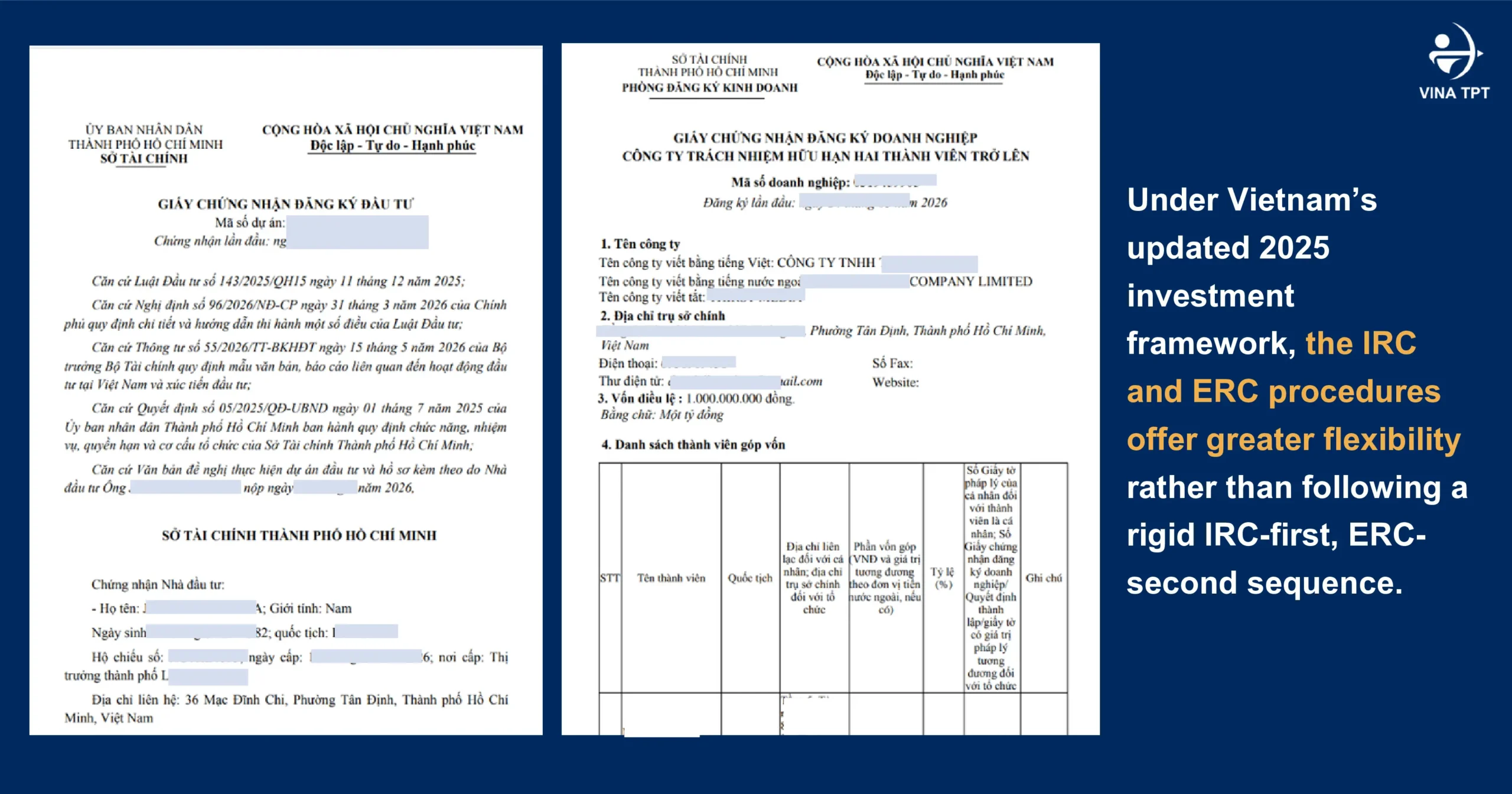
Step 2 – Obtain the Investment Registration Certificate (IRC) and Enterprise Registration Certificate (ERC)

For foreign-invested enterprises (holding from 50% of charter capital), the company registration Vietnam process requires two separate licensing steps:

2.1. Issuance of the Investment Registration Certificate (IRC)

The IRC confirms the legality of the investment project, specifying the business lines, total investment capital, location, and project duration.

  • Processing time: 20-45 working days from receipt of a complete and valid dossier.
  • Appraisal of conditional business lines: Processing time may be longer if the project involves conditional sectors (retail, education, logistics, real estate) or if registered capital is not commensurate with the planned scale. Authorities may seek opinions from relevant ministries.

2.2. Issuance of the Enterprise Registration Certificate (ERC)

After receiving the IRC, the investor submits the dossier for the ERC to formally establish the legal entity (Limited Liability Company or Joint Stock Company) and obtain the Enterprise Code (which also serves as the Tax Code).

  • Processing time: Usually 7-10 working days.

Practical insight: Partnering with a local consulting firm that thoroughly understands the process helps accurately code business lines according to the Vietnam Standard Industrial Classification (VSIC) and WTO commitments, avoiding bottlenecks during appraisal.
vietnam-company-formation-complete-guide-to-register-a-business-for-foreign-investors

Step 3 – Open Bank Accounts and Contribute Charter Capital

Immediately after receiving the ERC, the enterprise must promptly set up its bank account system and strictly comply with the capital contribution schedule.

Mandatory steps:

  • Open a Direct Investment Capital Account (DICA): The legal representative must open a DICA at a commercial bank licensed to operate in Vietnam. All capital contribution, capital transfer, and profit repatriation transactions must go through this account.
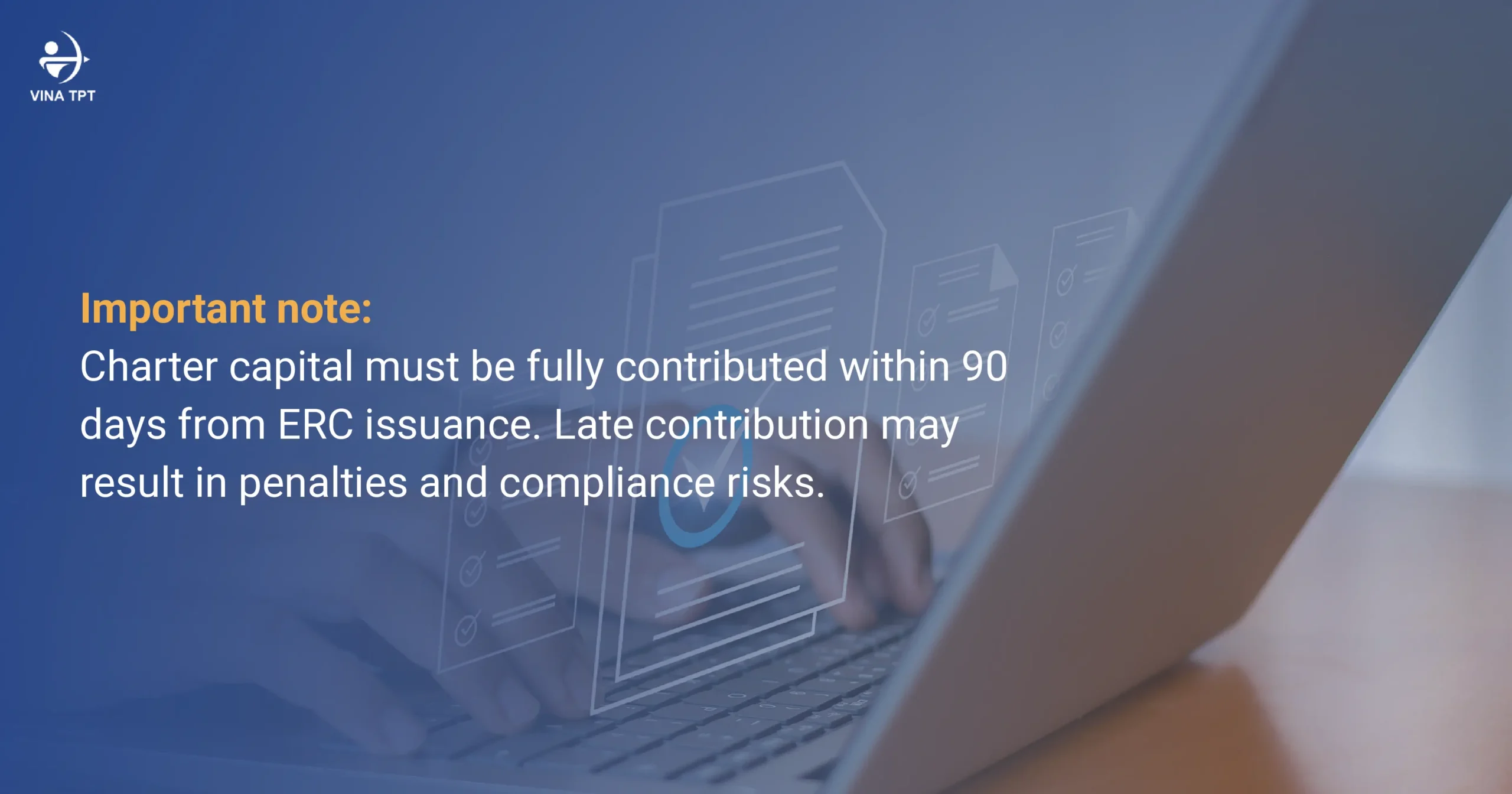
  • 90-day capital contribution deadline: Under the Law on Enterprises, investors must fully contribute 100% of the registered charter capital within 90 days from the date of ERC issuance.
  • Open a VND current account: Open a regular payment account for daily business transactions, salary payments, and tax obligations.

In Vietnam’s business environment, completing capital contribution on time is the first “measure” of an investor’s credibility and serious commitment. Late contribution not only incurs administrative penalties but also directly affects the company’s credit rating with tax authorities and banks.
vietnam-company-formation-complete-guide-to-register-a-business-for-foreign-investors

Step 4 – Complete Tax Registration and Post-Licensing Procedures

Before commencing commercial activities, the FDI enterprise must complete the following mandatory operational procedures:

  • Create company seal & digital signature (Digital CA): Purchase a digital signature device (USB Token or Cloud CA) for tax declaration, social insurance payment, and electronic document signing.
  • Register electronic invoices: Register for electronic invoice use with the managing tax authority under Decree 123/2020/ND-CP (and subsequent amendments).
  • Declare and pay license fee (Môn bài): Submit the license fee declaration and fulfill the first-year obligation (if not exempt).
  • Register labor & social insurance (BHXH): Open social insurance, health insurance, and unemployment insurance codes for employees and register the salary scale with the local labor authority.

Vietnam applies a highly modern electronic tax administration system. However, data accuracy is controlled extremely strictly. Any carelessness in input accounting or failure to synchronize head-office location information can lead to temporary suspension of electronic invoice use.

Step 5 – Obtain Sector-Specific / Sub-Licenses 

The ERC allows the enterprise to exist legally, but to actually operate in certain fields, the company must obtain sector-specific licenses (sub-licenses):

Business Line

Mandatory Sub-License

Issuing Authority

Retail & Distribution Retail business license / Retail outlet establishment license (ENT) Department of Industry and Trade (DOIT)
Restaurant & F&B Food safety certificate Food Safety Department
Education & Training Education operation license / Center establishment approval Department of Education and Training (DOET)
Manufacturing & Warehousing Environmental permit & Fire prevention and fighting certificate Department of Natural Resources and Environment / Fire Police

Real-life example: An FDI restaurant brand completed the ERC and signed a high-value lease in the city center. However, because it did not anticipate the appraisal time for the food safety and fire prevention certificates, the restaurant was delayed by nearly two months, bearing full rent and staff costs without generating revenue. Early identification of required sub-licenses is essential when preparing the financial plan.

Important Cultural & Practical Insights for Foreign Investors

Successful company registration in Vietnam does not end with legal procedures; it also requires flexible adaptation to local business culture:

  • Patience with inter-agency processes: Administrative procedures in Vietnam often require coordination among multiple authorities (Department of Finance, Tax Authority, Fire Police, Labor). Maintaining a cooperative attitude and having a local legal representative closely follow the dossier helps accelerate the process.
  • Understanding consumer psychology: Vietnamese consumers are highly price-sensitive and value-oriented. They prioritize products/services that deliver high practical value, consistent quality, and fast service rather than overly luxurious models with unreasonable costs.
  • Building reputation through compliance: Transparency in financial reporting, timely tax payment, and fair treatment of local employees form the strongest foundation for lasting relationships with authorities and local partners.

How Vina TPT Supports You Throughout the Entire Process

Vina TPT is proud to be a leading strategic partner in company formation and operational management consulting for FDI enterprises in Vietnam. We provide end-to-end solutions including:

  • Investment structure advisory: Feasibility assessment, ownership ratio advice, and tax incentive optimization.
  • Licensing procedures: Preparation of bilingual dossiers and representation of the investor before appraisal authorities to obtain IRC, ERC, and sub-licenses.
  • Financial support – Bank account opening: Guidance on opening the DICA capital account, transferring charter capital, and registering foreign exchange transactions with the State Bank of Vietnam.
  • Full post-licensing services: Initial tax declaration, electronic invoice registration, establishment of VAS/IFRS accounting systems, and monthly payroll management.

Vina TPT’s team of CPA experts and financial lawyers combines international professional capabilities with deep understanding of local business culture, ready to accompany the sustainable development of your enterprise.

Which stage of your Vietnam market expansion plan are you currently in? Contact Vina TPT today for a free consultation and a tailored company formation solution.
BOOK A FREE CONSULTATION

vietnam-company-formation-complete-guide-to-register-a-business-for-foreign-investors

Essential Step For Setting Up a Company in Vietnam| Trading Businesses

setting-up-a-company-in-vietnam-trading-Vina-TPT-Legal

Are you looking for a solution for setting up a company in Vietnam and explore opportunities in one of Asia’s fastest-growing economies? Vietnam, with its strategic geographic location along the South China Sea and borders with China, Laos, and Cambodia, has become a top destination for foreign investors in the trading sector. However, full legal compliance is essential for sustainable success, governed by the Law on Investment 2020 (amended in 2025) and the Law on Enterprises 2020. This comprehensive guide details the essential steps to set up a trading company in Vietnam, from basic concepts to full operations, catering to both informational and transactional search intent. 

  • Key Benefits: Access to FTAs for tariff reductions, excellent logistics positioning, and policies allowing up to 100% foreign ownership in most trading activities. 
  • Challenges to Consider: Administrative procedures can take 1–6 months, and it’s crucial to stay updated on recent changes, such as the 2025 Investment Law amendments permitting company establishment before obtaining the Investment Registration Certificate (IRC). 

By following these steps carefully, you can successfully start a business in Vietnam as a foreigner. 

1/ What is a Trading Company in Vietnam? 

A trading company in Vietnam specializes in buying and selling goods, including import, export, wholesale/retail distribution, and related services, regulated by Decree 09/2018/ND-CP (with a replacement draft under discussion in 2025). Unlike manufacturing companies, which focused on production or service providers offering labor or consulting, trading companies serve as intermediaries in the supply chain, connecting producers with consumers. With Vietnam’s exports surging by 28% in 2025, this sector is booming—especially in electronics, textiles, and agricultural products. According to the Ministry of Industry and Trade, trading contributes 15–20% to GDP, with an average annual growth rate of 9–10% over the past decade, fueled by international integration. 

Key Activities: 

  • Importing goods from abroad for domestic distribution. 
  • Exporting Vietnamese products to global markets. 
  • Wholesale and retail distribution through traditional or online channels. 
  • Logistics, warehousing, and product promotion services. 

Comparison table with other business types: 

Type  Key Characteristics  Example 
Trading  Focuses on buying/selling, no production  Mobile phone importer, apparel distributor 
Manufacturing  Produces goods from raw materials  Textile factory, electronics component maker 
Services  Provides labor or advisory services  Software consulting, management consulting 

2/ Benefits and Challenges of Setting Up Company in Vietnam 

Setting up a trading company in Vietnam offers substantial advantages but also involves challenges. Here is a clear comparison: 

Benefits  Challenges  Illustrative Example 
Young market with 100 million consumers and high demand  Complex and potentially lengthy administrative procedures Textile exports grew by 20% due to young population 
Strategic location near China and major sea routes  A local partner is required hoặc Local partners are required Logistics advantages reduce transport costs by 15% 
FTAs reduce tariffs and open access to EU and US markets  Currency fluctuations and legal risks  EVFTA boosts agricultural exports by 25% 

The benefits clearly outweigh the challenges with proper planning. For example, foreign investors can leverage FTAs to expand markets but must comply with regulatory requirements such as the Economic Needs Test (ENT) for multiple retail outlets. 

3/ Legal Requirements and Foreign Ownership Rules 

Under the Law on Investment 2020 (amended 2025) and the Law on Enterprises 2020, Vietnam permits up to 100% foreign ownership in most trading sectors, except for restricted industries such as pharmaceuticals, oil and gas, and printing. The 2025 amendments (effective from 2026) simplify procedures by allowing company registration before IRC issuance and reducing conditional business lines from 243 to approximately 200. These changes have driven record FDI inflows in 2025. Compliance with Decree 09/2018/ND-CP (a replacement draft pending) remains required for foreign-invested trading operations. 

Key Requirements: 

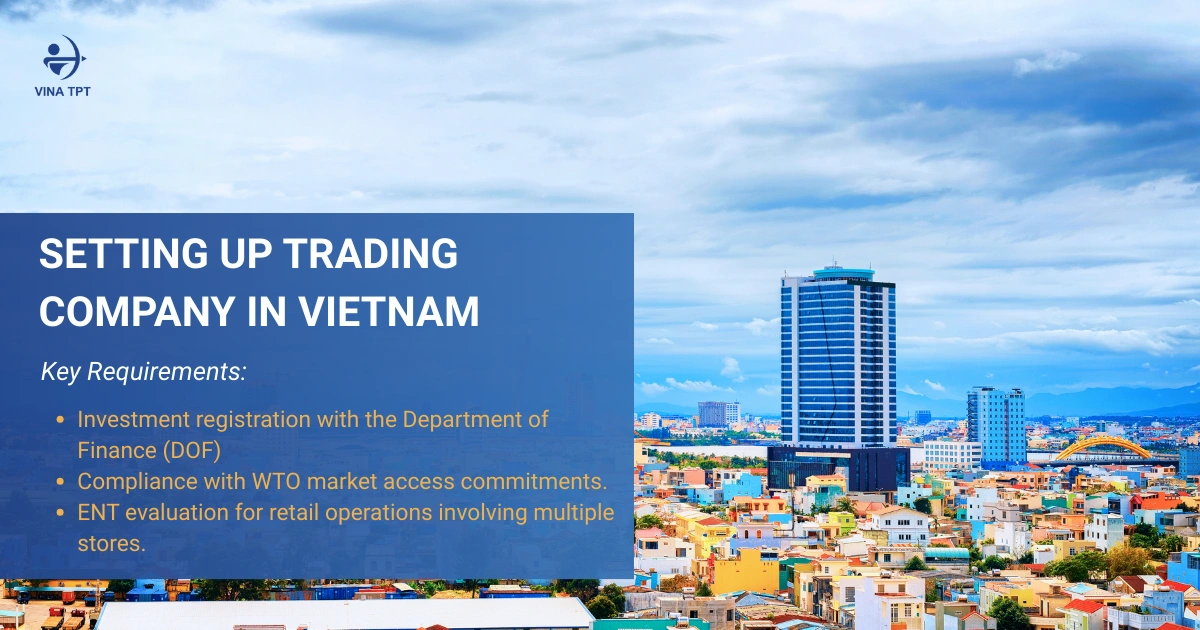
  • Investment registration with the Department of Finance (DOF) 
  • Compliance with WTO market access commitments. 
  • ENT evaluation for retail operations involving multiple stores. 

Restricted Product Categories and Conditional Business Lines 

Certain products are restricted or required special conditions under the Investment Law and Decree 09/2018/ND-CP, such as explosives, printing materials, and pharmaceuticals. 

Summary table: 

Product Category  VSIC Code  Restrictions 
Explosives  2029  Import prohibited except for national defense purpose
Printing Materials  1811  Requires approval from Ministry of Information 
Pharmaceuticals  2100  Foreign ownership limited to 49% 

Verification checklist: 

  • Check the national portal for conditional business lines. 
  • Assess legal risks with a local lawyer. 
  • Monitor the draft replacement of Decree 09 for 2026 updates. 

setting-up-a-company-in-vietnam-trading-Vina-TPT-Tax-Consultant

4/ Choosing the Right Business Structure 

Selecting the right business structure for your trading company depends on its scale and ownership. Under the Law on Enterprises 2020, the two most common forms are the Limited Liability Company (LLC) and the Joint Stock Company (JSC), with the LLC being ideal for smaller businesses due to its simpler procedures. 

  • LLC Pros & Cons: Flexible, liability limited to contributed capital; drawback: harder to raise large capital. 
  • JSC Pros & Cons: Easier to list on stock exchanges; drawback: more complex structure, requires at least 3 shareholders. 

Comparison table: 

Structure  Number of Members  Legal Liability 
LLC  1–50  Limited to contributed capital 
JSC  Minimum 3  Limited to share capital 

For foreign investors with limited capital, an LLC is the best choice for a fast start. 

LLC vs. JSC: Which is Best for Trading? 

Detailed comparison: 

LLC  JSC  Best for Trading 
Simple procedures, flexible capital  More complex, easier expansion  High for small businesses, local distribution 
No board of directors required  Requires diverse shareholders  Lower if needing large capital for exports 

LLC is generally more suitable for trading due to its flexibility. For example, a foreign agricultural trading company often opts for an LLC to quickly begin import operations. 

Consult a Business Setup Expert

5/ Capital Requirements and Financial Planning 

Vietnam imposes no fixed minimum capital for trading companies, but charter capital must be “reasonable” to demonstrate operational capability. A typical recommendation is USD 10,000–50,000, depending on the business plan. Total investment capital includes charter capital and other expenses, with full contribution required within 90 days of registration. 

Financial preparation checklist: 

  • Estimated setup costs: USD 3,000–10,000 for procedures and office. 
  • Reserve for VND/USD exchange rate risks. 
  • Budget for taxes and employee salaries. 

Estimated capital table: 

Recommended Capital  Purpose 
USD 10,000  Basic operations, small-scale distribution 
USD 50,000  Expansion of import/export activities 

6/ Essential Steps to Setting Up a Company in Vietnam as a Foreign Investor 

Setting up a foreign-invested company in Vietnam requires following a clear, structured process to ensure full legal compliance and smooth operations. This step-by-step guide is tailored for foreign-owned trading or commercial entities. 

Step 1: Prepare Your Investment Documentation 

Gather all necessary paperwork for your investment project. This includes defining your business model (e.g., Limited Liability Company – LLC, joint venture, or representative office), choosing the right structure, and outlining main activities. Verify that your industry allows foreign ownership under Vietnamese law. 

Step 2: Submit Application for the Investment Registration Certificate (IRC) 

The IRC is the foundational approval for foreign-invested enterprises. It authorizes your project and details the charter capital, scale, location, and business scope. Without an IRC, you cannot proceed to company registration. 

Required documents: 

  • Application form and a detailed project proposal (objectives, scale, capital, location, and timeline). 
  • Proof of financial capability (bank statements, audited financials, or credit agreements). 
  • Legal documents: notarized passport (individuals) or business registration certificate (organizations), both legalized. 
  • Proof of location (lease agreement or land use rights). 
  • Power of attorney (if using a third-party service). 

Foreign documents require consular legalization and official Vietnamese translation. Partnering with a professional company setup service such as Vina TPT is recommended to avoid delays. 

Step 3: Obtain the Enterprise Registration Certificate (ERC) 

After the IRC issuance, register the company to receive the ERC, which establishes its legal identity in Vietnam. 

Step 4: Open a Corporate Bank Account and Inject Charter Capital 

Open a dedicated capital account at a licensed Vietnamese bank. Contribute the full charter capital within 90 days of ERC issuance to avoid penalties and ensure the credibility for future permits. 

Step 5: Complete Tax Registration and Post-Licensing Formalities 

Register for a tax ID, VAT, and fulfill obligations such as social insurance and labor compliance if hiring staff. 

Step 6: Secure Industry-Specific Licenses (If Applicable) 

Sectors like trading, retail, F&B, education, or e-commerce may require additional permits. 

By following these steps and staying updated on regulations, foreign investors can successfully set up company in Vietnam.

setting-up-a-company-in-vietnam-trading-Vina-TPT

7/ Taxation, Compliance, and Ongoing Operations 

Foreign-invested trading enterprises (FDIs) in Vietnam must strictly comply with tax, labor, and periodic reporting obligations to avoid penalties and maintain legal standing. 

A – Taxes: 

  • Corporate Income Tax (CIT): 20% (15–17% incentives for SMEs from late 2025 if revenue < VND 50 billion); quarterly provisional payments (at least 80% of annual obligation); due by the 30th of the first month of the following quarter; annual declaration within 90 days after the fiscal year-end. 
  • Value Added Tax (VAT): 8–10% (reduced to 8% until 2026); monthly declaration (revenue > VND 50 billion/year) or quarterly declaration; due by the 20th of the following month or the end of the first month of the next quarter; retain invoices for deductions. 
  • Personal Income Tax (PIT): 5–35% (residents) or 20% (non-residents); withholding and declaration monthly/quarterly, aligned with VAT; annual employee declaration. 
  • Other fees (environmental protection, resource tax, land use): Usually annually or on an event basis, with changes required to be reported within 30 days.

B – Laws and Other Compliance: 

  • Labor Law 2019 (amended): Work permits for foreigners; quarterly labor reports; standard contracts; monthly social insurance contributions (pension, health, unemployment insurance). 
  • Intellectual Property: Registration and monitoring (annual review recommended). 
  • Financial Reporting: Annual audited financial statements for FDI, submitted with final CIT. 
  • Transfer Pricing: Local/master file prepared annually, submitted within 90 days after the fiscal year-end if thresholds are met. 

Compliance Checklist: 

Requirement  Details  Frequency  Deadline  Penalties if Violated 
VAT Declaration & Payment  Input/output, deductions (Form 01/GTGT or 04/GTGT)  Monthly (>50B VND) or quarterly  20th of next month or end of first month of next quarter  0.03%/day interest, disallowed deductions, audits 
PIT Withholding & Declaration  Employee withholding (Form 05/KK-TNCN)  Monthly/quarterly  20th or end of the first month of next quarter; annual within 90 days  Daily fines, criminal liability 
Provisional CIT Payment  Estimated profit-based  Quarterly  30th of the first month of next quarter  Interest if below 80% the annual obligation 
Social Insurance  Contributions and reporting  Monthly  Aligned with PIT monthly/quarterly  Late fees, hiring restrictions 
Labor Usage Report  Employee numbers and changes  Quarterly  End of the quarter  Administrative fines, suspension 
FCT Declaration  Payments to foreign contractors  Monthly or per payment  20th of the next month or 10 days after payment  Employer liability, heavy fines 
Transfer Pricing  Local/master file  Annually  90 days the after fiscal year-end  Audits, tax adjustments 
Audited Financial Statements  VAS-compliant with independent audit  Annually  With final CIT (90 days)  Mandatory audits, penalties for errors 

FDI companies should engage professional accounting services and monitor updates such as Decree 132/2025/ND-CP on CIT, ensuring electronic filing with digital signatures. 

8/ Frequently Asked Questions (FAQs) 

  • Can foreigners own 100% of a trading company in Vietnam? 

Yes, foreign investors can own up to 100% in most sectors, including import-export and distribution. Exceptions apply to restricted sectors such as pharmaceuticals, oil and gas, or printing, where ownership may be limited or may require a local partner. 

  • What is the minimum capital required? 

No fixed minimum capital exists for most trading companies. Charter capital must be reasonable to support operations. Authorities often recommend at least USD 10,000 to show financial capability and avoid delays. The exact amount depends on your business plan and scale. 

  • How long does it take to set up? 

Setting up a business in Vietnam as a foreigner typically takes 1–2 months, depending on the complexity and the province. The IRC usually takes 30–45 working days, the ERC follows in 7–14 days. Additional licenses and post-registration steps may extend the timeline. 

  • Do I need a local partner? 

For general trading (import, export, wholesale, and distribution), no local partner is needed—100% foreign ownership is allowed. In restricted or conditional sectors (e.g., multi-outlet retail, pharmaceuticals, and media), a local partner or joint venture may be required. 

  • How to start a business in Vietnam as a foreigner? 

Follow these key steps: obtain the Investment Registration Certificate (IRC), then the Enterprise Registration Certificate (ERC), secure trading or sector-specific licenses, open a corporate bank account, contribute charter capital, and complete tax registration. Using professional services like Vina TPT’s company setup service ensures accuracy and efficiency. 

Vina TPT – Your Trusted Partner for Foreign Businesses in Vietnam 

Vina TPT is one of Vietnam’s leading company formation consultancies, specializing in helping foreign investors to set up companies in Vietnam for trading, manufacturing, and services. With over 20 years of experience, Vina TPT has assisted hundreds of FDI companies from Europe, the US, Japan, Korea, and Singapore in successfully obtaining IRCs, ERC, and required licenses in minimal time. 

  • Multilingual Expert Team: Lawyers, accountants, and registration specialists fluent in English, Japanese, and more for seamless communication. 
  • Fast and Transparent Process: Commitment to completing the IRC in 30–45 working days and the ERC in 7–14 days, with a near-100% success rate. 
  • Full-Service Package: From company registration to capital advisory, bank account opening, tax filing, work permits, social insurance, and transfer pricing support. 
  • Competitive and Transparent Pricing: Clear quotes with no hidden fees, ideal for SMEs. 
  • Long-Term Post-Setup Support: Daily operational guidance and updates on the latest laws (including the 2025 Investment Law changes) to minimize risks and support sustainable growth. 

We go beyond simply setting up a company in Vietnam – we help you build a strong foundation for success. With our commitment to “Fast – Accurate – Cost-Effective” service, Vina TPT saves time, reduces legal risks, and lets you focus on business growth. Hundreds of satisfied clients trust Vina TPT – contact us today for a free consultation and a personalized quote tailored to your needs. 

BOOK A FREE CONSULTATION

Good-Business-Ideas-to-Start-in-Vietnam_-Company-Setup-Profitable-Opportunities-Vina-TPT