Vietnam continues to attract strong FDI inflows thanks to stable economic growth, a young workforce, and increasingly clear administrative reforms. The Law on Investment 2025 has made the Vietnam company formation process more convenient for foreign investors.
However, success in how to register a company in Vietnam depends not only on completing the legal paperwork but also on understanding operational realities, market practices, and local business culture. This article provides a detailed step-by-step guide to company registration in Vietnam, along with practical insights to help foreign investors start smoothly.
Step 1 – Prepare the Investment Dossier
The quality and accuracy of the investment dossier directly determine the appraisal time of state authorities. Under the Law on Investment 2025, foreign investors must prepare a complete dossier and submit it to the Department of Finance (or the competent investment registration authority) in the province/city where the head office is planned.
Core documents required:
- Application for investment project implementation: Official application form as prescribed.
- Legal status documents:
-
- For individual investors: Passport (only a notarized copy is required; consular legalization is not needed).
-
- For organizational investors: Enterprise Registration Certificate / Company Charter (must be consularized at the Vietnamese Embassy or Consulate in the home country).
- Detailed investment project proposal: Explanation of investment objectives, project scale, investment capital and charter capital, location, capital contribution schedule, and socio-economic impact assessment.
- Documents proving financial capacity:
-
- For organizations: Audited financial statements for the most recent two years.
- For individuals or organizations: Bank account statements or bank balance confirmation letters.
- Head office location documents: Office/factory lease agreement together with documents proving the lessor’s legal right to lease.
- Technology explanation: Mandatory form if the project is subject to technology appraisal or consultation under the Law on Technology Transfer.
Practical note from experts: Many foreign investors prepare the capital source explanation and socio-economic impact assessment rather superficially. Authorities usually require thorough justification of cash-flow feasibility. Building an accurate dossier from the start eliminates the risk of repeated requests for amendment and supplementation.
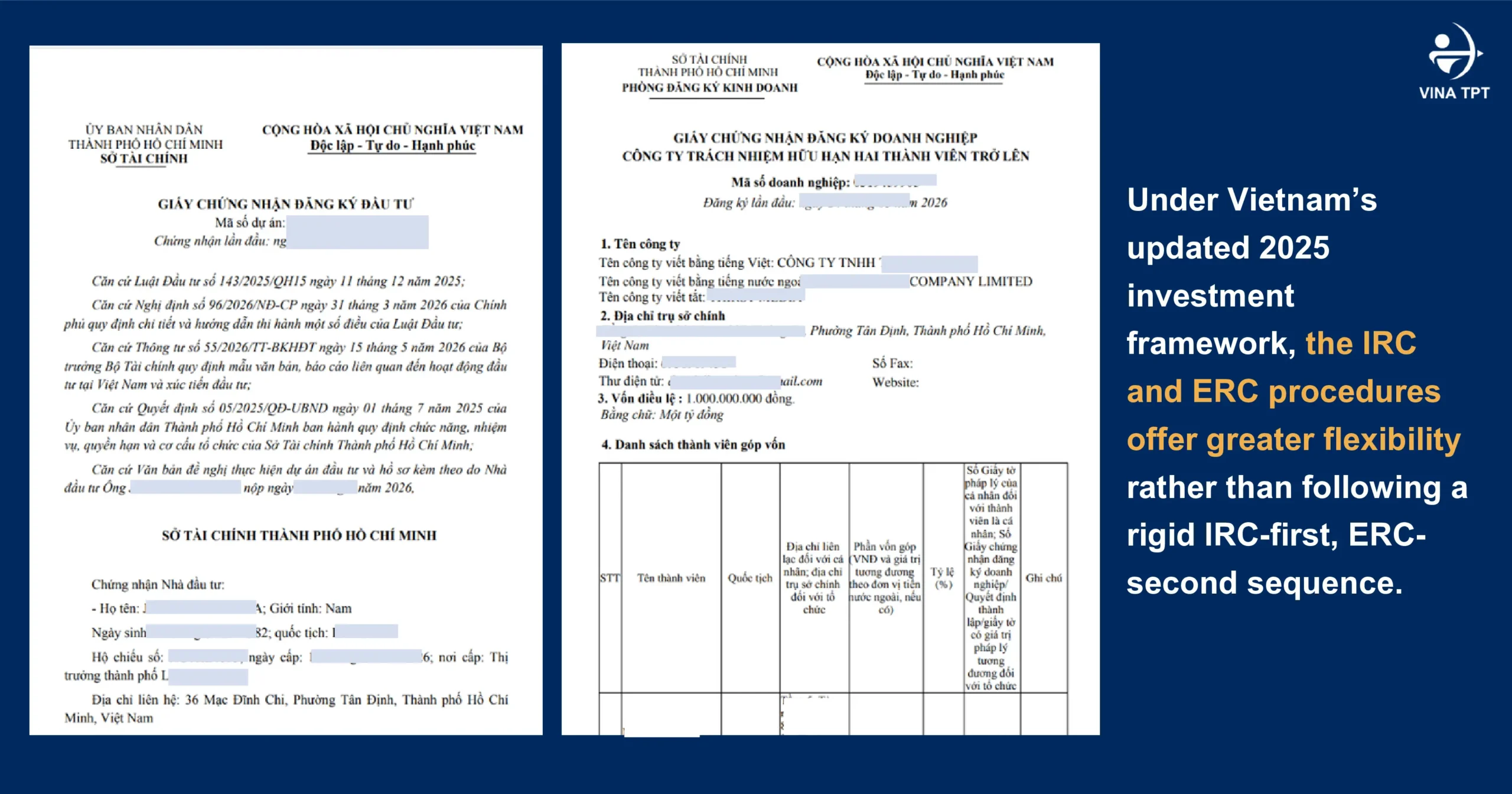
Step 2 – Obtain the Investment Registration Certificate (IRC) and Enterprise Registration Certificate (ERC)
For foreign-invested enterprises (holding from 50% of charter capital), the company registration Vietnam process requires two separate licensing steps:
2.1. Issuance of the Investment Registration Certificate (IRC)
The IRC confirms the legality of the investment project, specifying the business lines, total investment capital, location, and project duration.
- Processing time: 20-45 working days from receipt of a complete and valid dossier.
- Appraisal of conditional business lines: Processing time may be longer if the project involves conditional sectors (retail, education, logistics, real estate) or if registered capital is not commensurate with the planned scale. Authorities may seek opinions from relevant ministries.
2.2. Issuance of the Enterprise Registration Certificate (ERC)
After receiving the IRC, the investor submits the dossier for the ERC to formally establish the legal entity (Limited Liability Company or Joint Stock Company) and obtain the Enterprise Code (which also serves as the Tax Code).
- Processing time: Usually 7-10 working days.
Practical insight: Partnering with a local consulting firm that thoroughly understands the process helps accurately code business lines according to the Vietnam Standard Industrial Classification (VSIC) and WTO commitments, avoiding bottlenecks during appraisal.
Step 3 – Open Bank Accounts and Contribute Charter Capital
Immediately after receiving the ERC, the enterprise must promptly set up its bank account system and strictly comply with the capital contribution schedule.
Mandatory steps:
- Open a Direct Investment Capital Account (DICA): The legal representative must open a DICA at a commercial bank licensed to operate in Vietnam. All capital contribution, capital transfer, and profit repatriation transactions must go through this account.
- 90-day capital contribution deadline: Under the Law on Enterprises, investors must fully contribute 100% of the registered charter capital within 90 days from the date of ERC issuance.
- Open a VND current account: Open a regular payment account for daily business transactions, salary payments, and tax obligations.
In Vietnam’s business environment, completing capital contribution on time is the first “measure” of an investor’s credibility and serious commitment. Late contribution not only incurs administrative penalties but also directly affects the company’s credit rating with tax authorities and banks.
Step 4 – Complete Tax Registration and Post-Licensing Procedures
Before commencing commercial activities, the FDI enterprise must complete the following mandatory operational procedures:
- Create company seal & digital signature (Digital CA): Purchase a digital signature device (USB Token or Cloud CA) for tax declaration, social insurance payment, and electronic document signing.
- Register electronic invoices: Register for electronic invoice use with the managing tax authority under Decree 123/2020/ND-CP (and subsequent amendments).
- Declare and pay license fee (Môn bài): Submit the license fee declaration and fulfill the first-year obligation (if not exempt).
- Register labor & social insurance (BHXH): Open social insurance, health insurance, and unemployment insurance codes for employees and register the salary scale with the local labor authority.
Vietnam applies a highly modern electronic tax administration system. However, data accuracy is controlled extremely strictly. Any carelessness in input accounting or failure to synchronize head-office location information can lead to temporary suspension of electronic invoice use.
Step 5 – Obtain Sector-Specific / Sub-Licenses
The ERC allows the enterprise to exist legally, but to actually operate in certain fields, the company must obtain sector-specific licenses (sub-licenses):
|
Business Line |
Mandatory Sub-License |
Issuing Authority |
| Retail & Distribution | Retail business license / Retail outlet establishment license (ENT) | Department of Industry and Trade (DOIT) |
| Restaurant & F&B | Food safety certificate | Food Safety Department |
| Education & Training | Education operation license / Center establishment approval | Department of Education and Training (DOET) |
| Manufacturing & Warehousing | Environmental permit & Fire prevention and fighting certificate | Department of Natural Resources and Environment / Fire Police |
Real-life example: An FDI restaurant brand completed the ERC and signed a high-value lease in the city center. However, because it did not anticipate the appraisal time for the food safety and fire prevention certificates, the restaurant was delayed by nearly two months, bearing full rent and staff costs without generating revenue. Early identification of required sub-licenses is essential when preparing the financial plan.
Important Cultural & Practical Insights for Foreign Investors
Successful company registration in Vietnam does not end with legal procedures; it also requires flexible adaptation to local business culture:
- Patience with inter-agency processes: Administrative procedures in Vietnam often require coordination among multiple authorities (Department of Finance, Tax Authority, Fire Police, Labor). Maintaining a cooperative attitude and having a local legal representative closely follow the dossier helps accelerate the process.
- Understanding consumer psychology: Vietnamese consumers are highly price-sensitive and value-oriented. They prioritize products/services that deliver high practical value, consistent quality, and fast service rather than overly luxurious models with unreasonable costs.
- Building reputation through compliance: Transparency in financial reporting, timely tax payment, and fair treatment of local employees form the strongest foundation for lasting relationships with authorities and local partners.
How Vina TPT Supports You Throughout the Entire Process
Vina TPT is proud to be a leading strategic partner in company formation and operational management consulting for FDI enterprises in Vietnam. We provide end-to-end solutions including:
- Investment structure advisory: Feasibility assessment, ownership ratio advice, and tax incentive optimization.
- Licensing procedures: Preparation of bilingual dossiers and representation of the investor before appraisal authorities to obtain IRC, ERC, and sub-licenses.
- Financial support – Bank account opening: Guidance on opening the DICA capital account, transferring charter capital, and registering foreign exchange transactions with the State Bank of Vietnam.
- Full post-licensing services: Initial tax declaration, electronic invoice registration, establishment of VAS/IFRS accounting systems, and monthly payroll management.
Vina TPT’s team of CPA experts and financial lawyers combines international professional capabilities with deep understanding of local business culture, ready to accompany the sustainable development of your enterprise.
Which stage of your Vietnam market expansion plan are you currently in? Contact Vina TPT today for a free consultation and a tailored company formation solution.