Vietnam Tax Updates July 2026: Key VAT, PIT, Transfer Pricing and E-Invoice Changes
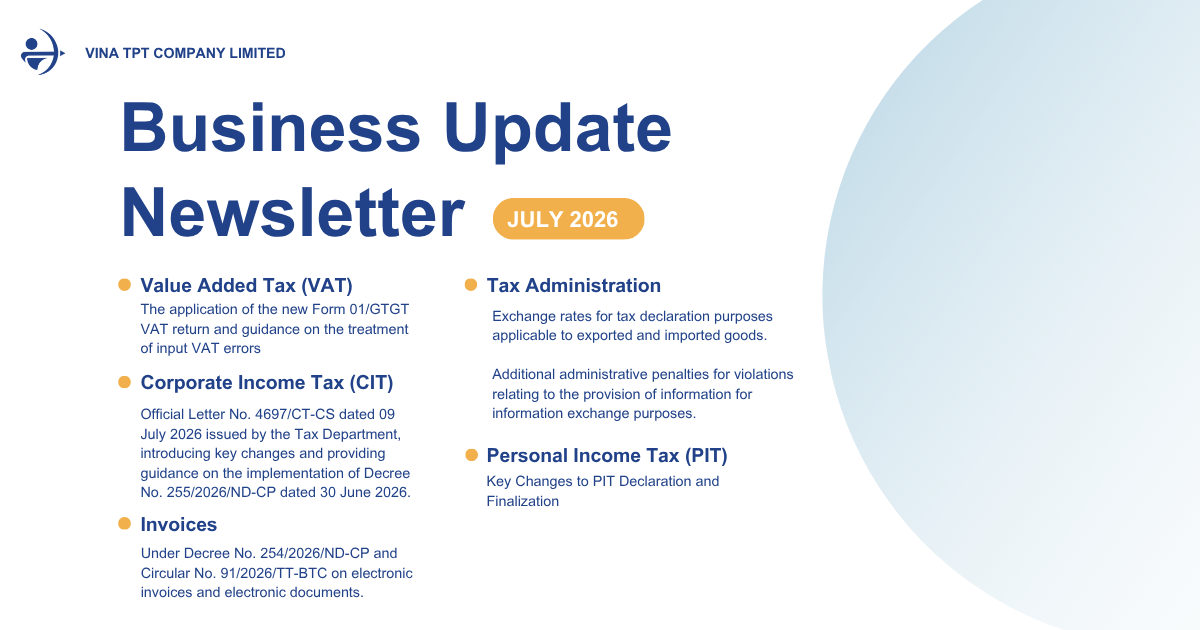
The Vietnam Tax Updates July 2026 introduce several important changes and clarifications affecting VAT declaration, input VAT adjustments, related-party transactions, transfer pricing documentation, Personal Income Tax (PIT), tax exchange rates, tax information disclosure penalties, and electronic invoices.
Businesses should pay close attention to these updates to ensure accurate tax declarations, comply with applicable reporting requirements, and manage their tax obligations effectively.
1. Regarding the application of the new Form 01/GTGT VAT return and guidance on the treatment of input VAT errors under items [37] and [38]:
Circular No. 89/2026/TT-BTC dated 30 June 2026, applicable from the July 2026 tax period or Q3/2026.
1.1 Form 01/GTGT VAT return:
– Addition of item [32b]: Goods and services sold that are not included in the value-added tax taxable price
– Addition of item [34a]: Goods and services sold that are outside the scope of the value-added tax regulations.
1.2 Guidance on the treatment of input VAT errors through items [37] and [38]:
– For goods and services purchased on deferred payment or installment terms with a purchase value of VND 5 million or more, the business shall declare and reduce the deductible input VAT corresponding to the portion of the purchase value for which no non-cash payment supporting document is available in item [37] of the tax period in which the payment obligation arises under the contract or contract appendix, without filing a supplementary tax return. If, after such adjustment, the business obtains a non-cash payment supporting document, it may declare and deduct the input VAT corresponding to the portion of the purchase value supported by the non-cash payment document in item [38] of the tax period in which such document is obtained.
– Where a taxpayer discovers an error or omission in the input VAT previously declared and deducted, the adjustment shall be declared in item [37] or [38] of the month or quarter in which the error or omission is discovered if declaring the adjustment in the month or quarter in which the erroneous input VAT arose would reduce the tax payable or would only increase or decrease the input VAT credit carried forward to the following period, without filing a supplementary tax return.
– Where the buyer receives an adjusted invoice or replacement invoice in the cases prescribed in Clause 5, Article 10 of Circular No. 91/2026/TT-BTC dated 30 June 2026 of the Ministry of Finance, the adjustment shall be declared in item [37] or [38] of the tax period in which the adjusted invoice or replacement invoice is received, without filing a supplementary tax return.
– Where a taxpayer changes its VAT calculation method from the credit method to the direct method based on revenue, the taxpayer shall declare a reduction of any remaining uncredited input VAT in item [37] of the final tax period before changing the VAT calculation method, without filing a supplementary tax return.
2. Regarding related-party transactions
Another important area covered by the Vietnam Tax Updates July 2026 is related-party transactions and transfer pricing.
Official Letter No. 4697/CT-CS dated July 9, 2026, issued by the Tax Department, introduces key changes and provides guidance on the implementation of Decree No. 255/2026/ND-CP dated June 30, 2026.
2.1 Related Party Relationship (Article 5)
A related-party relationship has been expanded to include borrowing and lending arrangements in a manner similar to loan transactions under Point l, Clause 2, Article 5 of the Decree, as follows:
“An enterprise that engages in transactions involving the transfer or receipt of capital contributions representing at least 25% of the owner’s contributed capital during the tax period; or that borrows, lends, receives on loan, or provides on loan an amount equivalent to at least 10% of the owner’s contributed capital at the time the transaction arises during the tax period with an individual who manages or controls the enterprise, or with an individual having a relationship specified in Point g of this Clause.”
2.2 Exemption from preparing Transfer Pricing Documentation (Point c, Clause 2, Article 20)
– The Decree increases the revenue threshold for taxpayers eligible for exemption from preparing Transfer Pricing Documentation to less than VND 500 billion, while removing the requirement that the taxpayer must operate under a “simple functional profile.”
Previously, taxpayers were required to satisfy all four of the following conditions to qualify for the exemption: (i)Conducting business with a simple functional profile; (ii)Not generating revenue from, incurring expenses related to, or utilizing intangible assets; (iii) Having annual revenue below VND 200 billion; (iv) Achieving the prescribed net profit margin applicable to the relevant business sector.
– The increase in the revenue threshold and the removal of the “simple functional profile” criterion are intended to broaden the scope of low tax-risk taxpayers eligible for the exemption, simplify the application requirements, and reduce compliance costs and administrative burdens for taxpayers.
3. Key Changes to PIT Declaration and Finalization.
Circular No. 89/2026/TT-BTC dated June 30, 2026, also introduces changes to Personal Income Tax declaration and finalization.
3.1 Changes to tax declaration forms, notably Form 05/KK-TNCN
– Additional categories of tax-exempt income:
[26] Income from performing scientific, technological, and innovation-related tasks.
[27] Income of experts supporting innovative start-ups in accordance with regulations.
[28] Other tax-exempt income.
– Addition of item [32] Taxable income = [33] + [34].
– Addition of item [35] Personal income tax required to be withheld during the period.
– Addition of item [36] Tax amount exempted during the period.
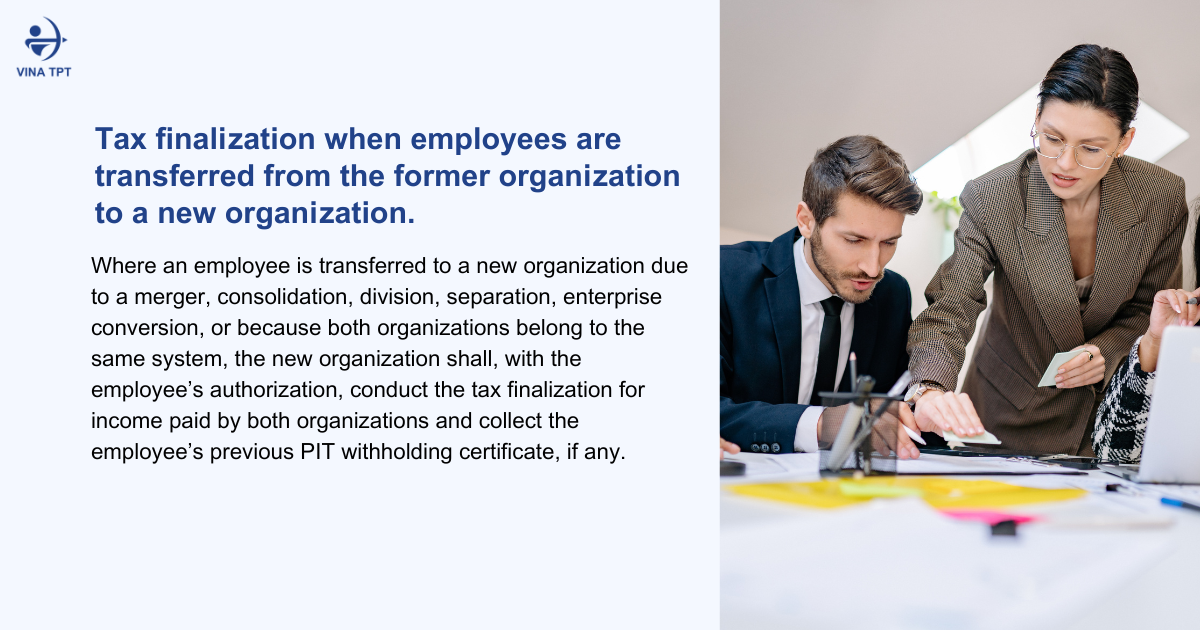
3.2 Tax finalization when employees are transferred from the former organization to a new organization.
– Where an employee is transferred from the former organization to a new organization as a result of a merger, consolidation, division, separation, or conversion of the enterprise type of the former organization, or where the former and new organizations belong to the same system, the new organization shall be responsible for conducting the tax finalization on behalf of the individual, subject to the individual’s authorization, for income paid by both the former and new organizations. The new organization shall also collect the personal income tax withholding certificate previously issued to the employee by the former organization, if any.
4. Exchange rates for tax declaration purposes applicable to exported and imported goods.
Pursuant to Article 14 of Decree No. 252/2026/ND-CP dated June 30, 2026, the exchange rate used for tax calculation for imported and exported goods shall be determined in accordance with customs regulations.
Under the regulations on exchange rates for tax calculation in the customs sector, the applicable exchange rate is the foreign currency buying rate for bank transfers quoted by the Joint Stock Commercial Bank for Foreign Trade of Vietnam (Vietcombank) at the end of Thursday of the immediately preceding week.
If Thursday falls on a public holiday or non-working day, the end-of-day exchange rate of the immediately preceding working day shall be used.
This exchange rate applies to all customs declarations registered during that week.
EXPLORE VINA TPT BUSINESS ADVISORY
5. Additional administrative penalties for violations relating to the provision of information for information exchange purposes.
Decree No. 291/2026/ND-CP dated July 21, 2026, introduces additional administrative penalties for violations relating to the provision of information for information exchange purposes.
- A fine ranging from VND 10,000,000 to VND 30,000,000 shall be imposed for providing information requested by the tax authority for information exchange purposes under Vietnamese law, international treaties, or international tax agreements to which the Socialist Republic of Vietnam is a member or signatory at least 5 days after the prescribed deadline.
- A fine ranging from VND 30,000,000 to VND 50,000,000 shall be imposed for providing inaccurate or incomplete information requested by the tax authority for information exchange purposes under Vietnamese law, international treaties, or international tax agreements to which the Socialist Republic of Vietnam is a member or signatory.
- A fine ranging from VND 50,000,000 to VND 100,000,000 shall be imposed for either of the following violations:
a) Failure to provide information within15 daysafter the expiry of the information provision deadline or the extended information provision deadline, as requested by the tax authority for information exchange purposes under Vietnamese law, international treaties, or international tax agreements to which the Socialist Republic of Vietnam is a member or signatory.
b) Colluding with or shielding taxpayersin order toobstruct the tax authority from collecting or verifying information for information exchange purposes under Vietnamese law, international treaties, or international tax agreements to which the Socialist Republic of Vietnam is a member or signatory.
- Remedial measure: The violating party shall be required to provide complete andaccurateinformation in respect of the violations specified in Clause 2 and Point a, Clause 3 of this Article.
6. Regarding the introduction of new provisions under Decree No. 254/2026/ND-CP and Circular No. 91/2026/TT-BTC on electronic invoices and electronic documents.
The Vietnam Tax Updates July 2026 also include new provisions concerning electronic invoices and electronic documents under Decree No. 254/2026/ND-CP and Circular No. 91/2026/TT-BTC.
Official Letter No. 4831/CT-CS dated July 15, 2026, provides further guidance on the implementation of these regulations.
– An additional case is introduced for handling incorrectly issued electronic invoices: where the incorrect invoice is an electronic invoice generated from a cash register or an electronic invoice for the sale of goods that are assets subject to registration of ownership or usage rights, the seller shall issue a replacement invoice for the incorrect invoice.
– The regulations are amended for cases where an invoice contains errors in information such as the name, address, amount in words, or other details, but there are no errors in the tax identification number, amount stated on the invoice, tax rate, tax amount, or goods stated on the invoice. In such cases, the seller shall notify the buyer of the error in the issued invoice and is not required to reissue the invoice.
Conclusion
The Vietnam Tax Updates July 2026 bring important changes to VAT declarations, input VAT adjustments, related-party transactions, transfer pricing documentation, PIT declaration and finalization, tax exchange rates, information exchange penalties, and electronic invoices.
Businesses should review these changes carefully to determine how they may affect their tax compliance and reporting obligations.
If you need assistance in interpreting these regulations or assessing their impact on your business, contact Vina TPT. Our accounting and tax professionals can provide practical guidance and support your business in maintaining compliance with Vietnam’s latest tax requirements.