Capital Contribution and Business Setup for Foreign Investment in Vietnam

Capital-Contribution-and-Business-Setup-for-Foreign-Investment-in-Vietnam-Vina-TPT

Capital-Contribution-and-Business-Setup-for-Foreign-Investment-in-Vietnam-Vina-TPT

1. Understanding Capital Contribution Requirements for Foreign investment in vietnam

Capital contribution is the most important step when establishing an FDI enterprise. According to Vietnamese law, foreign investors should note:

  • Minimum capital: Vietnam does not require a general legal capital level, but the charter capital must be appropriate and demonstrate the ability to implement the business model. Some specific industries (education, real estate, e-commerce, etc.) have higher capital requirements.
  • Form of capital contribution: Investors can contribute capital in cash, machinery and equipment, assets, intellectual property rights, or other legal assets.
  • Capital contribution period: Usually must be completed within 90 days from the date of issuance of the Certificate of Business Registration (or according to the period stated in the Investment Registration Certificate).

Determining capital accurately from the beginning helps reduce legal risks and limit capital adjustments later.

2. Types of Foreign Investment in Vietnam

When choosing a form of investment in Vietnam, investors need to consider their business objectives, project scale, level of control and desired scope of operations. Vietnam allows for a variety of flexible legal models, from establishing a new business to opening a branch or representative office. Each form carries different levels of risk, costs and compliance obligations, so choosing the right one at the outset will have a big impact on investment performance and long-term strategy.

Below are the most common forms of FDI in Vietnam:

Type Suitable for Advantages Disadvantages
Limited Liability Company (LLC) Small & medium enterprises

Investors needing strong control

Simple structure

Easy to operate

High control

Fast setup

Hard to raise capital

Extra procedures to convert to JSC

Joint Stock Company (JSC) Businesses expanding strongly

Companies seeking fundraising

Easy capital raising Fit for large/multinational projects

Flexible share transfer

Good for future IPO

Complex governance

More management bodies required

Higher compliance cost

Branch of Foreign Traders Foreign companies in eligible sectors Can conduct profit-making activities

No new legal entity required

Operate under parent company

Limited to specific industries

Dependent on parent company

Hard to scale like an independent entity

Representative Office (RO) Market research stage

Building partner networks

Simple setup

Low cost

No CIT applied

Cannot generate revenue

Cannot sign commercial contracts

Not suitable for long-term investment

Choosing the appropriate form of FDI helps investors optimize costs, reduce legal risks and ensure that their business strategy in Vietnam is effectively implemented. For small and medium-sized projects, LLC is often the optimal choice; for strong expansion plans or many shareholders, JSC is more suitable. Meanwhile, branches and representative offices serve the purpose of market presence without the need to establish a new legal entity.

3. Steps to Set Up a Company with Capital Contribution

When setting up a Foreign investment in Vietnam, investors need to take the following main steps:

Step 1: Prepare investment documents

  • Investor information
  • Financial capacity report
  • Business plan
  • Headquarters lease contract, company charter

Step 2: Apply for Investment Registration Certificate (IRC): Confirm investment project and capital structure. Processing time: 15-30 days.

Step 3: Apply for Enterprise Registration Certificate (ERC): Officially establish the enterprise. Time: 3-5 days.

Step 4: Open an investment capital account: Required for FDI enterprises, used to receive capital from abroad.

Step 5: Make capital contribution: Investors transfer capital on time and complete the report.

Step 6: Post-establishment procedures

  • Tax registration
  • Digital signature
  • Corporate seal
  • Labor and insurance registration (if required)

Capital-Contribution-and-Business-Setup-for-Foreign-Investment-in-Vietnam-Vina-TPT

4. Compliance and Reporting Obligations

Foreign investment in Vietnam must ensure full compliance with the following regulations:

  • Capital contribution progress report
  • Accounting and bookkeeping according to VAS standards
  • Periodic tax declaration (VAT, CIT, PIT)
  • Annual financial report
  • Notification of changes in capital, headquarters, and representative

Non-compliance may result in administrative fines, restrictions on operations, or capital adjustment requirements.

AVOID COSTLY COMPLIANCE RISKS

5. Benefits of Proper Capital Contribution Management

Managing and implementing capital contribution in accordance with regulations is not only a legal requirement but also brings many practical values ​​to FDI enterprises in Vietnam:

Avoid legal risks and penalties

  • Contributing capital on time helps avoid administrative penalties.
  • Avoid being required to reduce charter capital or adjust the Investment Certificate.
  • Limit risks when checking, inspecting or working with banks.

Protecting investors’ ownership rights and capital contribution ratios

  • Clearly record the ownership ratio, voting rights and interests of each shareholder.
  • Avoid internal disputes, especially with investors from many different countries.
  • Increase transparency when planning to transfer shares or raise capital.

Increase the level of trust with banks, partners and management agencies

  • Adequate charter capital is an important factor in expanding credit limits.
  • Demonstrate the financial capacity and long-term commitment of investors in Vietnam.
  • Help partners and suppliers feel secure when signing contracts.

Optimize taxes and cash flow

  • A reasonable capital structure helps reduce the risk of transfer pricing adjustments and avoid tax disputes.
  • Easily control cash flow in and out through investment capital accounts.
  • Increase the ability to plan finances and operating budgets.

Create a solid foundation for expansion

  • Easy to add capital, open more branches or change the scope of the project.
  • Convenient when upgrading the type of business or expanding to a new industry.
  • Support the process of calling for more investors or strategic cooperation.

Increase long-term enterprise value

  • Enterprises with a transparent history of capital contribution are often highly appreciated when evaluating M&A.
  • Increase attractiveness to investment funds and global partners.
  • Create a competitive advantage when negotiating large contracts.

Minimize risks during divestment

  • Easily determine the value of the capital contribution when the investor wants to withdraw capital.
  • Reduce disputes due to the difference between actual capital contribution and registered capital.
  • Optimize tax benefits when transferring capital.

6. How Vina TPT Supports FDI Company Formation

Vina TPT Company Formation provides a complete package of support for the process of establishing and operating FDI enterprises:

  • Consulting on conditions for capital contribution and business lines
  • Preparing and submitting IRC & ERC documents
  • Shareholding structure, ownership ratio, charter
  • Support for opening investment capital accounts, guidance on capital contribution
  • Accounting – tax services – compliance with Vietnamese regulations
  • Consulting throughout for investors in operations and expansion

With experience working with international enterprises, Vina TPT ensures that the investment process in Vietnam becomes clear, safe and effective.

BOOK A FREE CONSULTATION

Laywer-Establish-business-Vietnam-VinaTPT

When to Switch Accounting Services in Vietnam: Key Indicators for Businesses

Switch your accounting service, upgrade your operations

1. Key Indicators Bookkeeping Service Should Improve

Businesses should consider improving their accounting services when they notice the following signs:

  • Inaccurate or opaque reporting, making it difficult to assess the financial situation.
  • Delays in preparing monthly/quarterly/annual reports, affecting business decisions and legal compliance.
  • Service costs are too high compared to the quality and scope of service.
  • Lack of financial strategy consulting support, preventing businesses from optimizing cash flow or budget.
  • Expanding business but current services are not meeting the increased volume of books and reports.

These signs are signals to consider finding a more reliable accounting partner.

2. Assessing Your Business Requirements

To decide whether to switch to a new bookkeeping or accounting service, businesses need to conduct a comprehensive assessment of their current needs. A correct assessment will help you choose the right type of service, the right level of support and optimize costs.

2.1 Assess the volume of documents and the complexity of transactions

Businesses need to answer the following questions:

  • Is the number of input and output invoices increasing each month?
  • Are there complex transactions such as: import, export, transfer pricing, authorization, cross-border service contracts?
  • Do the transactions require cost allocation, depreciation, asset capitalization, and exchange rate difference handling?
  • If the volume of documents is increasing or the transactions are complicated, businesses need an accounting unit with in-depth expertise, instead of just simple bookkeeping.

2.2 Assessing Tax Compliance

Vietnam has many taxes with constantly updated regulations: VAT, CIT, PIT, FCT, electronic invoices…

Enterprises need to consider:

  • Are tax reports submitted on time?
  • Have you ever been fined for incorrect declaration or late submission?
  • Does the current unit warn the business of new regulations or tax risks?
  • Does it ensure complete documentation when the tax authority inspects?

If the answer to any question is “No”, the business should consider changing to a unit with stronger tax consulting capacity.

REVIEW YOUR CURRENT SYSTEM

2.3 Reporting frequency and transparency level

Each business has different reporting needs:

  • Internal management reports by month/quarter
  • Reports as required by the parent company (e.g., for Japanese, Korean, Singaporean businesses)
  • Reports analyzing costs, cash flow, and profits by segment

Businesses need to evaluate whether the current unit:

  • Does it provide reports on time and in the required format?
  • Does it explain the data clearly, or does it just send files without consulting?
  • Does it support customizing reports according to management needs?
  • If it does not meet these requirements, the business needs a more professional partner.

Reports matter, clarity matters even more

2.4 Ability to accompany the business when it expands

You need to consider:

  • Does the business plan to open branches, increase capital, or increase staff size in the coming year?
  • Can the current accounting unit meet the increased workload?
  • Do they have experience in handling FDI or large-scale enterprise records?

A small or unsystematic unit often has difficulty keeping up with the growth rate of the enterprise.

2.5 Evaluate the appropriate bookkeeping service model

When assessing the needs, you also need to determine the ideal model:

  • Fully outsource?
  • Specialized service?
  • A combination of internal + outsourced bookkeeping?

Part 3 below will have a comparison table to help you decide exactly which model is most suitable.

3. Comparing Bookkeeping and Accounting Options

Below is a comparison table of popular options: full outsourcing, hiring specialized services, and building an internal accounting team.

Evaluation Criteria Outsourced Bookkeeping / Full Accounting Outsourcing Specialized Accounting Services (Tax, Review, Financial Reporting) Internal Accounting Team
Operating cost Low, fixed monthly fee Medium, depends on the specialized service scope High, includes salary, social insurance, training, and management cost
Professional expertise High, especially with reputable firms such as Vina TPT Very high, suitable for complex financial and tax matters Varies by individual capability, risk of dependency
Tax advisory capability Good, with regular regulation updates Excellent, strong in tax planning and risk management Limited, as internal staff have less exposure to diverse industries
Staff stability Stable due to dedicated service teams Very stable Unstable, employees may resign and require rehiring and retraining
Best suited for SMEs, FDI companies, fast growing businesses Companies needing deep tax expertise, reviews, or complex reporting Large enterprises that require strong internal control
Speed of implementation Fast, can start immediately Depends on scope or project complexity Slow, requires recruitment and training
Data control Good when handover processes are well managed Very strong and detailed Good but depends heavily on internal personnel
Legal compliance risk Low due to expert handling Very low due to constant regulatory updates Higher if the internal team is not updated on tax regulations
Scalability Flexible based on business growth Flexible based on project needs Limited, scaling requires hiring additional staff
Best case to choose this option When businesses want cost savings and on time reports When advanced tax, audit support, or financial management expertise is required When the company is large and needs deep internal control


4. Key Benefits of Switching to a Reliable Bookkeeping Service Partner

When switching to a better service provider, businesses will receive:

  • Significant cost savings: No need to recruit, train, or maintain an internal accounting team.
  • Improve accuracy and transparency: Bookkeeping is standardized, consistent, and in compliance with regulations.
  • Ensure compliance with the law: Tax reporting and financial reporting are done on time and in compliance with regulations, avoiding the risk of being fined.
  • Optimize financial processes: A scientifically organized accounting system supports better decision making for the board of directors.

The Upside of Moving to a Reliable Accounting Service

5. Steps to Seamlessly Transition Bookkeeping Service

Transitioning to a new accounting unit will go smoothly if the business prepares properly. Here are simple but effective steps to reduce risks and avoid reporting disruptions:

Step 1: Assess the current state of bookkeeping services

Businesses need to review the quality of reports, progress of declaration submission, accuracy and coordination ability of the current accounting unit. From there, accurately determine the reason for the transition and specific requirements for the new unit.

Step 2: Prepare documents & data for handover

Including financial reports, books, tax declarations, labor contracts, software accounting data, and related documents. Arranging complete documents will help the new unit to receive quickly and not miss tax obligations.

Step 3: Make a detailed transition plan

Agree with the new accounting unit on the scope of work, start time, responsibilities of each party and method of receiving data. In this step, the business also determines the closing time to avoid duplication.

Step 4: Handover of books & check for completeness

All data is handed over according to the agreed list. The new unit will check for completeness, compare data and detect problems (if any) before official operation.

Step 5: Trial operation & adjustment

In the first 1-2 cycles (month or quarter), the new accounting unit will re-check the accounting, ensuring that tax reports and management reports are prepared correctly. If there are any discrepancies from the old unit, the two parties will immediately adjust to avoid tax risks.

Step 6: Officially switch to stable operation

After testing and comparison, the business can operate stably with the new accounting provider, ensuring a smooth, transparent process and in accordance with management requirements.

6. Why Vina TPT Is the Preferred Choice for Businesses

Vina TPT is considered the best bookkeeping services in Vietnam with many outstanding advantages:

Comprehensive and specialized services: From bookkeeping services, accounting services to complex tax consulting for FDI enterprises.

Ability to receive books at any time: Whether the enterprise transfers accounting services at the beginning, middle or end of the year, Vina TPT still ensures:

  • Review old data
  • Adjust errors
  • Complete unfinished records
  • Continue to record books for the next phase

All are done quickly – transparently – in compliance with the law.

Smooth transition process: Vina TPT has experience in handling interrupted records, incomplete books, or delayed tax reports.

Highly specialized team: Accounting – tax experts with many years of experience, knowledgeable about FDI enterprises and domestic enterprises.

BOOK A FREE CONSULTATION

 bookkeeping-services


How to Check Company Name Availability in Vietnam Before Registration

How to Check Company Name Availability in Vietnam Before Registration

Check Your Company Name with Confidence

1. Importance of Checking Company Name Availability

Before registering a company in Vietnam, business name lookup is the first important step. A name that is identical or too similar to another business can lead to legal risks, rejection of registration applications or trademark disputes later.

Checking the name also helps businesses protect their brand from the beginning, creating a professional impression with customers and partners. This is especially important for startups and companies planning to expand their market.

2. Understanding Vietnam’s Business Name Rules

When choosing a company name in Vietnam, businesses must comply with the following legal requirements:

  • Name structure: must include the business type + a distinct proper name. (Based on ArtHow to Check Company Name Availability in Vietnam Before Registrationicle 37, Law on Enterprises 2020)
  • Prohibited or confusing words: the name must not duplicate or cause confusion with existing businesses, nor contain words related to state agencies or political organizations. (Based on Articles 38 & 39, Law on Enterprises 2020)
  • Language & characters: Vietnamese, foreign languages using Latin letters, numbers, and symbols are permitted. (Based on Article 37(3), Law on Enterprises 2020)
  • Consistency with business lines: the name must not create misunderstanding regarding the registered business field. (Specified in Article 38, Law on Enterprises 2020)

Following these regulations increases the likelihood of name approval on the first submission.

VERIFY YOUR BUSINESS NAME NOW

3. Online Tools and Databases for Name Lookup

Vietnam provides several official online systems that help business name lookup availability and avoid conflicts before registration.

3.1 National Business Registration Portal 

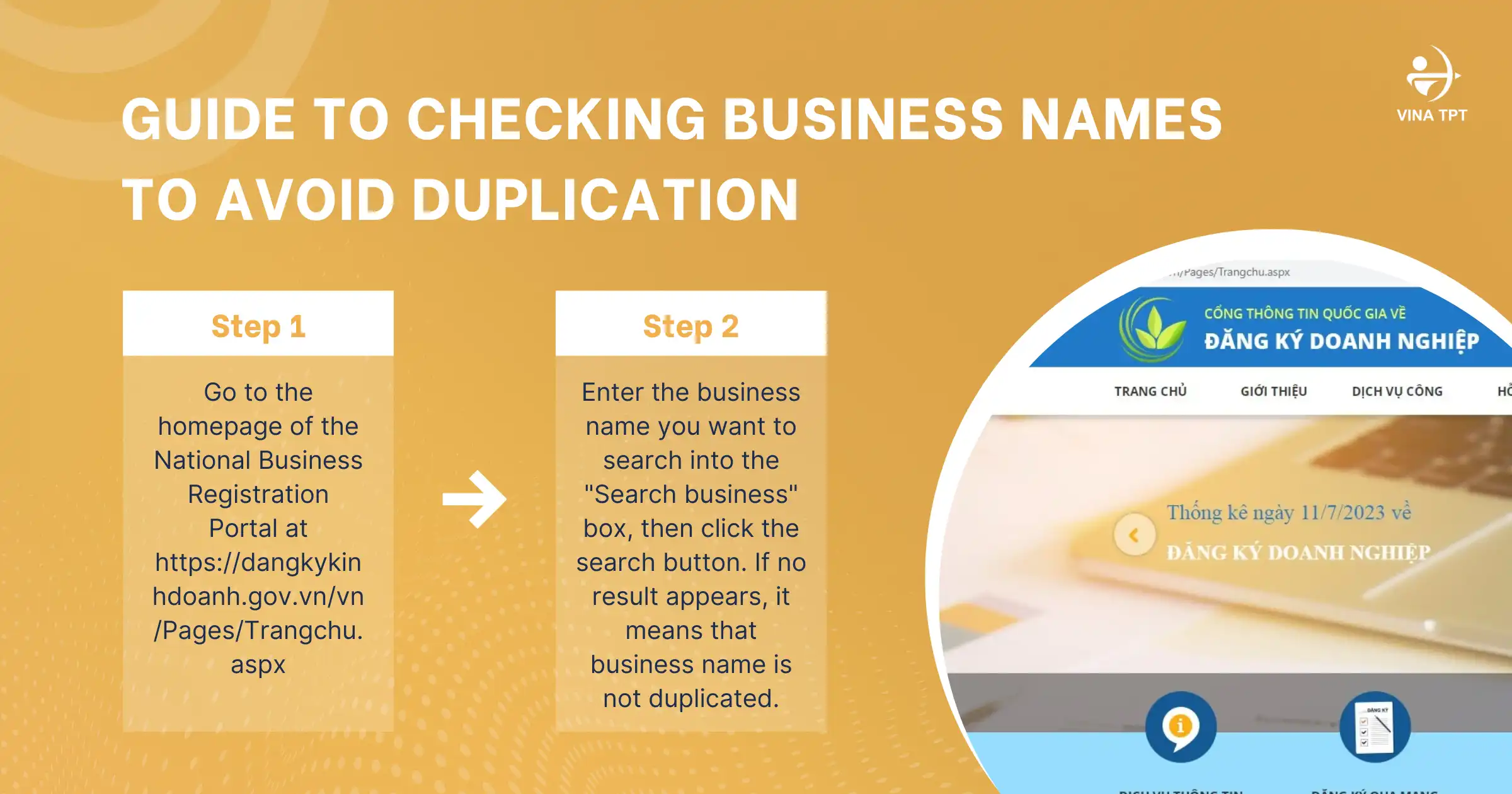
The National Business Registration Portal https://dangkykinhdoanh.gov.vn/vn/Pages/Trangchu.aspx  is the primary and most authoritative tool for business name lookup in Vietnam. It offers:

  • Nationwide database access with real-time updates of all registered business names.
  • Detailed legal information, including tax code, business status, and registered address.
  • Name similarity filtering, helping identify identical or confusing names in accordance with the Law on Enterprises 2020.
  • Direct data connection with provincial Departments of Planning and Investment (DPI), ensuring accuracy and consistency.

Using this portal helps businesses ensure name uniqueness, reduce the risk of rejection, and streamline registration procedures.

check your company name in Vietnam

3.2 IP Vietnam Trademark Database

Link: https://www.ipvietnam.gov.vn/en_US/web/english/trademarks 

  • Allows checking existing or pending trademarks related to names, brand identities, or logos.
  • Prevents conflicts between company names and protected intellectual property.
  • Essential for businesses requiring strong brand protection.

3.3 International Trademark Databases (WIPO Global Brand Database)

Link: https://branddb.wipo.int/en/similarname 

  • Supports searches for potential international naming conflicts, especially for brands planning cross-border operations.
  • Useful when the proposed company name is in a foreign language or intended for global use.

4. Tips to Ensure Your Chosen Name Complies

To get your business name approved and avoid the risk of rejection, entrepreneurs need to pay attention to some important points:

1. Choose a name that is easy to recognize and remember:

  • The name should be short, clear and reflect the business field.
  • Avoid naming that is too general and difficult to distinguish from other businesses.

2. Check for duplication or similarity with registered trademarks:

  • Use the National Information Portal and trademark protection databases to look up.
  • Avoid names that are confusing or too similar to large businesses, to limit legal risks and future disputes.

3. Comply with legal regulations on business names:

  • Including business types (LLC, Joint Stock Company, Private Enterprise).
  • Use valid characters (Latin letters, numbers, special characters as prescribed).
  • Do not use prohibited, confusing or offensive words.

4. Consider Vietnamese and foreign language names:

  • If your business plans to operate internationally, you should also check the English or other language versions to avoid duplication in the international market.

Following these tips increases the likelihood of your application being approved the first time and protects your brand in the long term, making it easier for your business to start up.

5. How Vina TPT Supports Company Name Registration

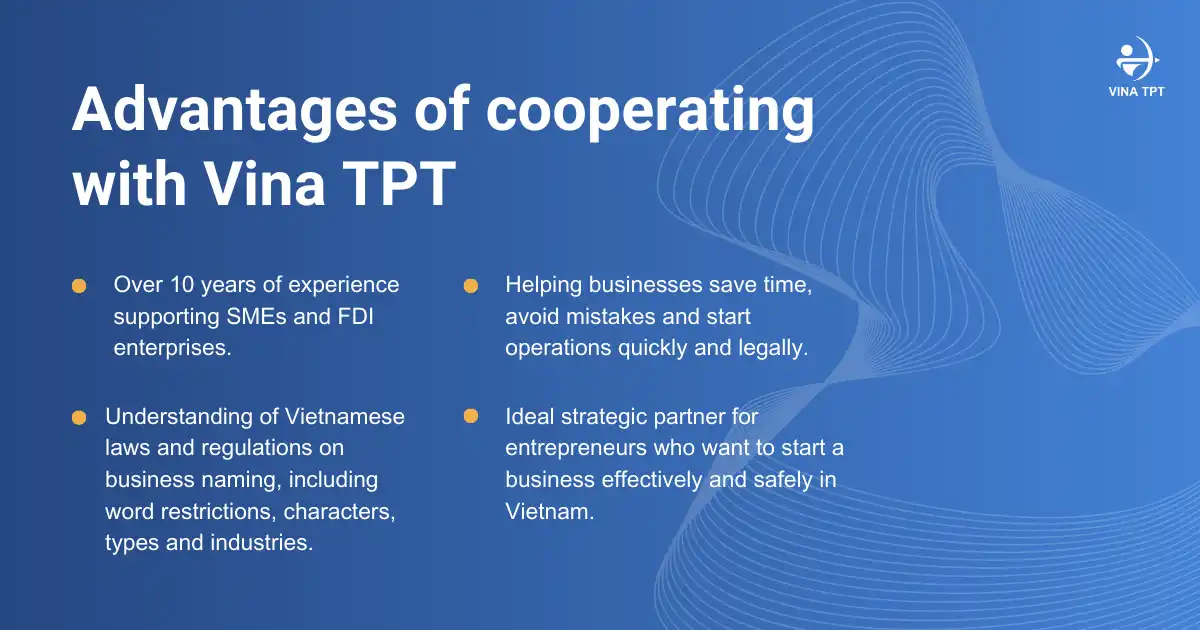
Starting a business in Vietnam can be complicated, especially when it is the first time for an entrepreneur to approach the market. Working with Vina TPT helps reduce legal pressure and optimize time. 

Ensure a legal and prominent business name in the Vietnamese market with comprehensive support from Vina TPT.

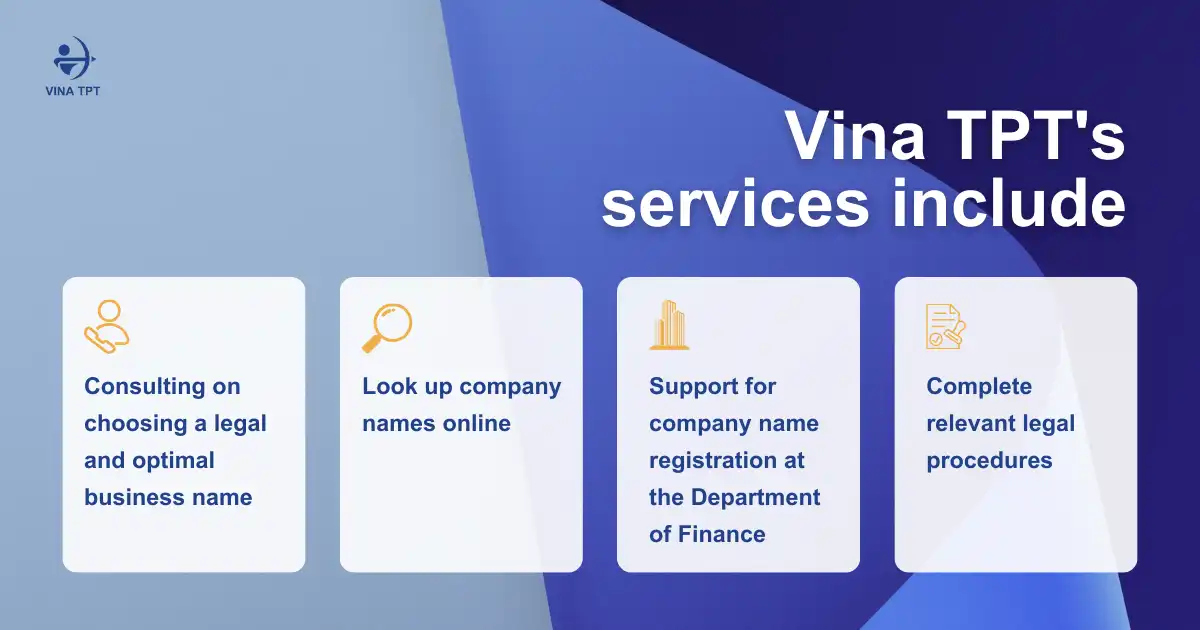
Vina TPT's services include

BOOK A FREE CONSULTATION

Fast, compliant and hassle free business name lookup and registration support by Vina TPT

Updated Rules on VAT Deductibility for Delayed Payments

Updated-Rules-on-VAT-Deductibility-for-Delayed-Payments-Vina-TPT

Updated-Rules-on-VAT-Deductibility-for-Delayed-Payments-Vina-TPT

Best Bookkeeping Services for Startups in Vietnam

Best-Bookeeping-Services-for-Startups-in-Vietnam-Vina-TPT

Best-Bookeeping-Services-for-Startups-in-Vietnam-Vina-TPT

1. Common Accounting Challenges Faced by Startups

Bookkeeping services are essential because startups in Vietnam often face many difficulties in accounting and financial management. First is the limited human resources, as many new businesses only have a few employees or do not have a dedicated accounting department.

Second is the high cost of hiring full-time staff or hiring an unsuitable accounting service company. Startups often have to consider limited budgets, while maintaining an internal team is expensive in terms of salary, benefits and training.

Finally, many startups lack experience in financial management and tax compliance. Errors in VAT, CIT, PIT declarations or social insurance payments can lead to legal risks, tax arrears or administrative fines. This is why many startups choose outsourced accounting services to ensure accurate financial operations and compliance with Vietnamese law.

SOLVE YOUR ACCOUNTING CHALLENGES

2. Core Accounting Services for Startups

Startups need essential accounting services to operate effectively and remain compliant with the law. Key services include:

Bookkeeping:

    • Record all transactions, invoices, and documents according to Vietnamese accounting standards. Classify and organize financial data, making it easy to track cash flow.

Monthly & Year-End Reporting:

    • Prepare monthly/quarterly financial reports to evaluate business performance. 
    • Prepare year-end reports to meet audit and tax requirements.

Tax Compliance:

Businesses must ensure full and timely compliance with Vietnam’s tax regulations, including Value Added Tax (VAT), Corporate Income Tax (CIT), Personal Income Tax (PIT), and Foreign Contractor Tax (FCT). Key responsibilities include:

  • Preparing accurate tax reports in accordance with current tax laws.
  • Submitting monthly, quarterly, and annual tax declarations to avoid penalties or late-filing fines.
  • Maintaining clear, consistent accounting records to support all reported figures.
  • Providing explanations and supporting documentation to tax authorities when required, including clarifying discrepancies or responding to official notices.
  • Handling tax audits and inspections professionally to ensure consistency between records and declarations.

Ensuring compliance with all tax obligations not only minimizes legal risks but also builds long-term credibility with regulatory authorities.

Payroll & Insurance Management:

This service ensures accurate and compliant management of employee compensation and social insurance obligations. Key responsibilities include:

  • Preparing payroll and calculating Personal Income Tax (PIT) for all employees.
  • Paying social insurance, health insurance, and unemployment insurance contributions in accordance with Vietnamese law.
  • Registering new employees for social insurance and processing all related insurance documents. 
  • Submitting labor reports and mandatory filings to relevant authorities as required by labor regulations.
  • Ensuring compliance with labor laws and personal income tax obligations for all employees.

Effective payroll and insurance management helps businesses minimize legal risks, maintain employee satisfaction, and ensure smooth operations in accordance with Vietnamese regulations.

Financial Consulting:

  • Cash flow analysis, cost optimization and budget planning.
  • Support startups to make accurate and timely financial decisions.

These services help startups operate transparently financially, save time and focus on product and market development instead of struggling with complicated accounting.

Best-Bookeeping-Services-for-Startups-in-Vietnam-Vina-TPT

4. How Outsourced Bookkeeping Ensures Accuracy

Vina TPT’s outsourced accounting service helps startups standardize all books and financial reports in accordance with Vietnamese accounting standards. All transactions, invoices and documents are systematically recorded, classified and checked, helping to ensure that all financial data is accurate and transparent. This process not only minimizes human errors but also creates clear and complete records, serving monthly, quarterly and year-end reporting. Thanks to that, startups can grasp cash flow, manage costs and evaluate business performance in a timely manner, thereby making more accurate financial decisions.

Moreover, Vina TPT also ensures full compliance with legal regulations on tax and financial reporting. Each report is cross-checked, compared with original documents and accurately calculates taxes payable, limiting the risk of being overcharged or administratively fined. In addition, the service also provides transparent, easy-to-read reports, helping investors, banks or partners clearly understand the financial situation of startups. Thanks to that, businesses not only feel secure about accuracy but also save operating time, focus on product and market development, and build credibility with business partners.

5. Why Vina TPT Is the Go-To Accounting Firm for Startups

Vina TPT Accounting Service is an ideal partner for startups in Vietnam thanks to:

  • Comprehensive services: bookkeeping, monthly/quarterly/annual reports, tax declarations, payroll management, financial consulting.
  • High expertise for startups: understanding the specifics of limited budgets, simple but legal processes.
  • Transparent processes: clear reports, easy to check and manage cash flow.
  • Reduced operational load: startups do not have to worry about accounting staff or legal errors, focus on business development.
  • Language advantage : services are available in both Vietnamese, English & Japanese, facilitating communication for foreign founders and easing compliance with local regulations.

Vina TPT helps startups operate finances effectively, comply with the law and develop sustainably.

BOOK A FREE CONSULTATION

bookkeeping-services


Vietnam Work Permit & Tax Compliance for Foreign Experts

Vietnam Work Permit & Tax Compliance for Foreign Experts-Vina TPT

 Vietnam Work Permit & Tax Compliance for Foreign Experts-Vina TPT

1. Key Compliance Requirements for Foreign Experts in Vietnam

When foreign experts work in Vietnam, they must fully meet three main groups of obligations: Vietnam Work permit legal documents, labor records, and tax and insurance obligations. Compliance is mandatory, and businesses are not allowed to let foreigners work without the appropriate license or visa.

1.1 Required legal documents

  • Work Permit or certificate of license exemption.
  • Vietnam work visa / TRC for the right purpose of work.
  • Labor contract signed after the work permit is approved.

1.2 Required labor records

  • Valid passport, degrees, professional certificates.
  • Confirmation of minimum experience according to job requirements.
  • Health certificate in the correct form.
  • Judicial record (if required by law).
  • All foreign documents must be consularized and notarized.

1.3 Tax and insurance obligations

  • Register for tax code and determine resident/non-resident status.
  • Deduct – declare – pay personal income tax according to Vietnam taxation regulations.
  • Participate in social insurance/health insurance if required.

1.4 Reporting and responsibilities of enterprises

  • Enterprises must explain the need to use foreign labor before applying for Work Permit.
  • Report foreign labor according to the deadline of the management agency.
  • Monitor visa, TRC, Work Permit expiration date to renew on time.

Failure to fully comply with regulations on work permits, work visas and Vietnam taxation can lead to serious consequences for both businesses and foreign experts. Businesses may be subject to high administrative fines, be suspended from employing foreign workers or be subject to increased inspections in subsequent periods. 

Workers are at risk of being denied or having their Work Permit/visa extended, forced to leave the country or restricted from returning to work in Vietnam. 

Therefore, full compliance and proactively updating regulations are of utmost importance for all businesses with foreign experts working in Vietnam.

 Vietnam Work Permit & Tax Compliance for Foreign Experts-Vina TPT

2. Work Permit & Work Visa Requirements 

2.1 Conditions for granting Work Permit

  • Enterprises must have written approval of the need to use foreign labor before submitting the application.
  • Workers must meet the professional standards:
    • Qualifications relevant to the position
    • Working experience according to the number of years specified for each position
  • Have a health certificate according to the form recognized in Vietnam (valid for 12 months).
  • Have a clean criminal record, no criminal record, valid and legalized according to regulations.
  • The labor contract or work agreement must be appropriate to the position applying for a Work Permit.

2.2 Classification of work visas and duration

  • DN Visa: for people who come to work with a business for a short time (not a replacement for a Work Permit).
  • LD Visa / Labor Visa: for people who work long-term and is the basis for applying for a temporary residence card.
  • Temporary Residence Card (TRC): is issued based on a Work Permit and has a corresponding term, up to 2 years.
  • The Work Permit term is according to the contract but not more than 2 years, and can be extended if conditions are met.

2.3 Work Permit Renewal Process

  • Submit your application when your Work Permit is still valid, 5-45 days before the expiry date.
  • The renewal application includes:
    • Current Work Permit
    • Confirmation of continued employment of foreign workers
    • Renewed or renewed employment contract
    • Health certificate, criminal record (if update required)
  • The labor agency reviews the new issuance according to the same procedure.

2.4 Work Permit Exemptions

  • Working in Vietnam for a short period of time according to the number of days allowed by law.
  • Members of diplomatic missions and their dependents who qualify.
  • Experts and lecturers invited or confirmed by state agencies.
  • Volunteers working for non-profit organizations or NGOs.
  • Some special cases according to the current decree, but still have to submit an exemption notification to the labor agency.

2.5 Common mistakes that cause applications to be rejected

  • Lack of notarized documents or using the wrong form according to regulations.
  • Degrees or experience do not demonstrate appropriate expertise.
  • Health certificate or criminal record expired / not legalized.
  • Inconsistent information between passport – contract – application.
  • The enterprise has not been approved to use foreign labor.
  • Using the wrong type of visa during the working period, leading to the application being evaluated as invalid.

REQUEST WORK PERMIT ASSISTANCE

3. Employment Contracts & Payroll Compliance

Foreign experts working in Vietnam must fully comply with tax obligations, focusing on personal income tax (PIT) and determining residency status. Enterprises are responsible for withholding, declaring and paying taxes according to regulations, and ensuring that the labor contract, working time and residency records of experts are properly managed. Determining whether an expert is a resident or non-resident directly affects the tax calculation, tax rate and income range that must be declared.

Important tax obligations to comply with:

  • Register for a personal tax code (MST) as soon as you start working.
  • Determine residency status based on the number of days present in Vietnam (≥183 days are considered residency).
  • Declare and pay PIT monthly or quarterly depending on the enterprise.
  • Annual tax finalization for resident individuals, or upon termination of the contract.
  • Declaring global income for individuals residing in Vietnam, if there is income generated abroad.
  • Store full tax documents for inspection purposes: labor contracts, payroll, deduction documents.

In addition, foreign experts need to ensure that their visas, Work Permits and labor contracts are consistent with the actual working time, to avoid being considered “illegible work”, leading to tax arrears or penalties. When there are changes such as position transfers, salary increases, changes in country of residence or contract termination, businesses must promptly update their tax records to avoid compliance risks and ensure transparency according to Vietnamese regulations.

 Vietnam Work Permit & Tax Compliance for Foreign Experts-Vina TPT

4. Personal Income Tax for Foreign Employees 

Foreign experts working in Vietnam must fully comply with personal income tax (PIT) obligations, including registering for a tax code, determining their residency status, and declaring and paying taxes on time. Residency status (resident or non-resident) directly affects the tax calculation, tax rate, and income range that must be declared. For resident individuals, global income arising from both Vietnam and abroad may be subject to declaration if it meets the prescribed conditions.

Main tax obligations to be performed

  • Register for a personal tax code as soon as you start working.
  • Determine residency status based on the number of days present in Vietnam (≥183 days/year).
  • Deduct, declare, and pay taxes monthly or quarterly through the enterprise.
  • Perform year-end tax settlement or upon termination of the labor contract.
  • Declare global income for resident individuals if they have income from abroad.
  • Keep complete documents to serve tax inspection when needed.

5. Annual Compliance Checklist for Foreign Experts Working in Vietnam

To avoid legal and tax risks, foreign experts and businesses need to comply with a set of annual inspection standards. This checklist helps ensure that Vietnam work Permits, visas, labor contracts, taxes and periodic reports are always updated on time, avoiding common errors such as incorrect visa types, expired documents, or inconsistent tax declarations. Annual Compliance Checklist including: 

  • Check the Vietnam work Permit validity and renew it on time.
  • Review visas / temporary residence cards (TRC) to ensure compliance with the length of stay.
  • Update labor contracts, salaries, and allowances according to reality.
  • Compare residence records with the number of days present in Vietnam.
  • Make personal income tax settlements on time.
  • Confirm compulsory social insurance obligations (if applicable).
  • Submit all foreign worker reports as required by the Department of Labor.
  • Review all documents: contracts, payroll, taxes, visa/Work Permit documents.

6. Vina TPT’s End-to-End Compliance Support for Foreign Experts

Vina TPT provides a comprehensive compliance support solution for foreign experts in Vietnam, including Work Permit, visa, tax and labor records management. The service is optimally designed for FDI enterprises, multinational corporations and experts working under long-term contracts. Thanks to standardized processes and a team of experts, Vina TPT helps businesses reduce legal risks, save time and ensure transparency when using foreign workers. Comprehensive support services include:

  • Vietnam work Permit consultation and submission, WP extension, WP exemption confirmation.
  • Visa processing, temporary residence card (TRC) for experts and relatives.
  • Salary optimization – personal income tax, residence status determination and tax declaration.
  • Labor contract management, foreign worker reporting.
  • Annual compliance review.
  • Representing businesses in meetings with tax and labor authorities.

To ensure foreign experts work legally in Vietnam, contact Vina TPT for full support on Work Permit, visa and tax.

BOOK A FREE CONSULTATION

 Vietnam Work Permit & Tax Compliance for Foreign Experts-Vina TPT

[Newsletter] Vietnam Tax Policy Updates October 2025- CIT, VAT, PIT and Social Insurance

October-2025-Newsletter-CIT-VAT-PIT-and-Social-Insurance-Vina-TPT

Newsletter-October-2025-Vina-TPT

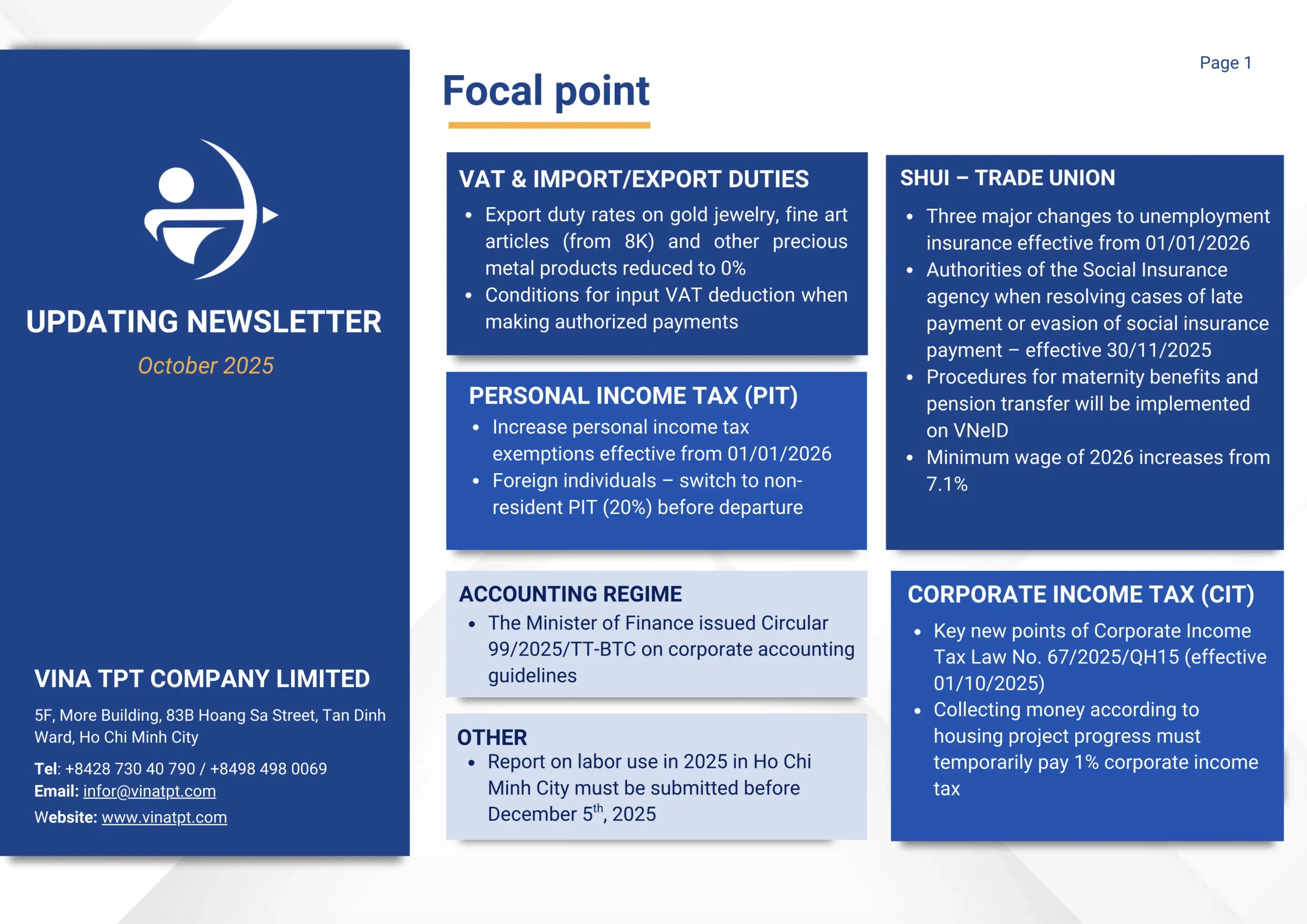
Vietnam is implementing a series of new tax, accounting, insurance, and labour regulations effective from October 2025. Notable updates include reduced export duty rates, clarified rules for input VAT deduction, higher PIT family circumstance deductions, a shift to non-resident taxation for certain foreign individuals, new CIT rates and deductible expense rules, and stricter sanctions on late or unpaid insurance contributions. These updates will reshape compliance requirements and influence core business operations, particularly in finance, payroll, and reporting functions.

This article outlines the essential policy changes businesses need to prepare for to ensure smooth compliance and operational continuity.

1. VAT & IMPORT/EXPORT DUTIES 

1.a. Export duty on gold jewellery, fine art articles (from 8K) and other precious metal products reduced to 0%  

Decree No. 260/2025/NĐ-CP dated 10/10/2025 of the Government amends the export duty rates for certain commodity lines under groups 71.13, 71.14 and 71.15 in the Export Tariff Schedule issued together with Decree No. 26/2023/NĐ-CP dated 31/05/2023. 

The Decree reduces the export duty rate from 1% to 0% for the following items: 

  • Jewellery and parts thereof, of other precious metal, whether or not plated or clad with precious metal (HS codes 7113.19.10 and 7113.19.90); 
  • Articles of goldsmiths’ or silversmiths’ wares and parts thereof, of other precious metal, whether or not plated or clad with precious metal (HS code 7114.19.00); 
  • Other articles of gold or silver (HS code 7115.90.10). 

Products that are currently subject to the 0% export duty rate will continue to enjoy the existing 0% rate. 

1.b. Input VAT deduction when payment is made via third-party authorisation  

Official Letter No. 4850/DON-QLDN1 dated 15/10/2025 of Đồng Nai Provincial Tax Department provides guidance on the deduction of input VAT in cases where non-cash payment is made through authorisation to a third party. 

According to the regulations, for the enterprise to be eligible for input VAT deduction, it must fully satisfy the general conditions prescribed in Clause 2, Article 14 of Law No. 48/2024/QH15: 

  • Possession of a VAT invoice for the purchase of goods and services or VAT payment document. 
  • Availability of non-cash payment evidence. 
  • For exported goods and services, additional documents are required: contract, invoice, non-cash payment evidence, customs declaration, and other related documents. 

In addition, when making payment through authorisation to a third party, the enterprise must comply with the further conditions stipulated in Decree No. 181/2025/NĐ-CP: 

  • The authorisation for payment to the third party must be specifically stipulated in a written contract. 
  • The third party must be an organisation or individual lawfully operating. 

If the company fully satisfies all the above conditions and other relevant legal provisions, it will be entitled to deduct the input VAT. 

2. PERSONAL INCOME TAX (PIT)

2.a. Increase in family circumstance deductions effective from 01/01/2026  

On 17 October 2025, the Standing Committee of the National Assembly issued Resolution No. 110/2025/UBTVQH15 adjusting the family circumstance deductions for personal income tax. This Resolution takes effect from 01 January 2026 and applies to the 2026 tax period. 

  • The deduction for the taxpayer himself/herself is increased from VND 11 million to VND 15.5 million per month (VND 186 million per year) (Article 1, point a). This means the taxpayer may deduct this amount when calculating taxable income, thereby reducing the tax payable. 
  • The deduction for each dependant is increased from VND 4.4 million to VND 6.2 million per month (Article 1, point b). Accordingly, taxpayers with dependants will enjoy an additional deduction corresponding to the number of dependants, further easing the tax burden. 

2.b. Foreign individuals – switch to non-resident PIT (20%) before departure  

On 03 October 2025, the Tax Department issued Official Letter No. 4221/CT-CS providing guidance on PIT for foreign individuals working in Vietnam for less than 183 days and required to finalise their tax obligations before leaving the country. Specifically, where a foreign individual has previously been subject to resident PIT withholding and has self-declared PIT on overseas-paid income arising from work performed in Vietnam, but the actual number of days present in Vietnam is less than 183 days, such individual must re-determine their PIT obligations under the non-resident regime. 

  • PIT is calculated at 20% on total Vietnam-sourced income, irrespective of where the income is paid or received. 
  • Tax finalisation must be completed prior to departure from Vietnam.

3. CORPORATE INCOME TAX (CIT) 

3.a. Key new points of Corporate Income Tax Law No. 67/2025/QH15 (effective 01/10/2025)  

Official Letter No. 2244/QNG-NVDTPC dated 13 October 2025 of Quảng Ngãi Provincial Tax Department introduces the key new points of the Corporate Income Tax Law No. 67/2025/QH15 (effective from 01 October 2025). The main changes are as follows: 

  1. Expanded scope of taxpayers:  

Addition of foreign enterprises that do not have a permanent establishment in Vietnam (including those engaged in e-commerce and digital platforms). 

      2. Taxable income:  

Additional provision stipulating that taxable income arising in Vietnam for foreign enterprises is income derived from Vietnam, regardless of where the business activities are conducted. 

      3.New CIT rates based on revenue: 

  • Standard rate: 20% 
  • Enterprises with total annual revenue not exceeding VND 3 billion: 15% 
  • Enterprises with total annual revenue exceeding VND 3 billion but not exceeding VND 50 billion: 17% 
  • Oil and gas exploration and production activities: 25% – 50% depending on the project. 

      4.Determination of taxable income: 

  • Taxable income from business activities is the total income from all business activities. 
  • Loss carry-forward is allowed between activities, except for real estate transfer activities, investment projects, and participation rights in investment projects when the entity is enjoying tax incentives. 
  • Income from the transfer of mineral exploration, extraction, and processing projects must be accounted for separately and may not be offset against other activities. 

       5.Tax exemption and reduction: 

  • Public-service entities providing public services in socio-economically disadvantaged areas are entitled to a 50% reduction of CIT payable. 
  • Enterprises converted from household businesses are exempt from CIT for two consecutive years from the year taxable income first arises. 

       6.Science and technology development fund:  

Maximum contribution rate increased to 20%. 

       7.New tax calculation method:  

Application of CIT as a percentage of revenue for enterprises with annual revenue ≤ VND 3 billion when revenue can be determined but costs and income cannot be determined. 

      8.Additional deductible expenses: 

  • Expenses related to seconded personnel participating in management, administration, and control at credit institutions under special control or commercial banks subject to mandatory transfer. 
  • Certain expenses incurred for business and production purposes but not yet generating corresponding revenue in the period, as stipulated by the Government. 
  • Expenses for supporting the construction of public infrastructure that simultaneously serves business and production activities. 
  • Expenses related to greenhouse gas emission reduction, carbon neutrality, net-zero initiatives, and environmental pollution reduction linked to business and production activities. 
  • Certain contributions to funds established by decision of the Prime Minister or the Government.


3.b. Temporary CIT payment of 1% on progress payments received for housing projects  

Official Letter No. 5129/CT-CS dated 12 November 2025 of the Tax Department on tax policies: 

  • For housing investment projects intended for transfer/sale: If the investor collects advance payments according to progress, it must make provisional quarterly Corporate Income Tax (CIT) payments equal to 1% of the amounts collected, pursuant to Point b, Clause 6, Article 8 of Decree No. 126/2020/NĐ-CP. 
  • Regarding interest expense for enterprises with related-party transactions: Deductible interest expense is subject to the cap under Clause 3, Article 16 of Decree No. 132/2020/NĐ-CP and applies to all enterprises with related-party transactions, irrespective of whether they are domestic or foreign-invested enterprises. 


4. SOCIAL, HEALTH & UNEMPLOYMENT INSURANCE – TRADE UNION 

4.a. Three major changes to unemployment insurance effective from 01/01/2026 (Law on Employment 2025) 

On 16 June 2025, the National Assembly passed the Law on Employment 2025, which officially takes effect from 01 January 2026. Accordingly, unemployment insurance policies will undergo significant changes, with the following three key updates to unemployment insurance effective from 01/01/2026: 

(1) No entitlement to unemployment benefits upon eligibility for pension 

From 01/01/2026, under point a, clause 1, Article 39 of the Law on Employment 2025, employees who terminate employment or end their labour contract upon reaching eligibility for pension benefits will not be entitled to unemployment benefits. Thus, effective from 01/01/2026, unemployment benefits will not be payable to individuals who meet pension eligibility criteria, regardless of whether pension procedures have been initiated. 

(2) Faster receipt of unemployment benefits with reduced waiting period to 10 days 

From 2025, pursuant to clause 3, Article 39 of the Law on Employment 2025, the commencement date for unemployment benefits effective from 01/01/2026 will be the 11th working day following the submission of a complete application dossier for unemployment benefits. This represents a reduction of 5 days from the current regulation, under which benefits commence from the 16th day after dossier submission. 

(3) Maximum level of unemployment benefits 

Pursuant to clause 1, Article 39 of the Law on Employment 2025, the maximum monthly unemployment benefit for all employees shall not exceed 5 times the regional minimum wage at the time of contract termination. 

4.b. Penalties for late or evaded compulsory social/health/unemployment insurance contributions – effective 30/11/2025  

On 16 October 2025, the Government issued Decree No. 274/2025/NĐ-CP detailing certain provisions of the Social Insurance Law regarding late payment, evasion of compulsory social insurance and unemployment insurance contributions; complaints and denunciations related to social insurance. This Decree takes effect from 30 November 2025. 

  • Late payment interest rate: 0.03% per day calculated on the amount and number of days of late or evaded payment (Article 3, Clause 1, Point d; Article 7, Clause 2). 
  • Conversion period to evasion: An act of late payment shall be converted to an act of evasion after 60 days from the expiry of the latest payment deadline, provided that the Social Insurance Agency has issued a written reminder (Article 6, Clause 1, Point c). 
  • Evasion by understating salary: The act of registering a salary base for social insurance contributions lower than prescribed under the Social Insurance Law shall be deemed evasion (Article 6, Clause 1, Point b). 
  • Exemption from evasion classification (force majeure): Specific enumeration of 4 force majeure cases not to be considered as evasion (such as storms, floods, dangerous epidemics, emergency situations) as announced by competent authorities (Article 4).


5. ACCOUNTING REGIME 

5.a. Circular 99/2025/TT-BTC guiding the accounting regime for enterprises  

On 27 October 2025, the Ministry of Finance issued Circular No. 99/2025/TT-BTC regulating the accounting regime for enterprises, replacing Circular No. 200/2014/TT-BTC dated 22 December 2014. Circular No. 99/2025/TT-BTC takes effect from 01 January 2026 and applies to financial years beginning on or after 01 January 2026. Pursuant to the regulations, Circular No. 99/2025/TT-BTC simultaneously repeals and replaces the following documents: 

  • Circular No. 200/2014/TT-BTC guiding the accounting regime for enterprises; 
  • Circular No. 75/2015/TT-BTC (amending Article 128 of Circular 200); 
  • Circular No. 53/2016/TT-BTC (amending and supplementing certain provisions of Circular 200); 
  • Circular No. 195/2012/TT-BTC dated 15 November 2012 guiding accounting for main investors. 

However, certain provisions related to the accounting for the equitisation of State-owned enterprises under Circular 200 shall continue to apply until the Ministry of Finance issues a new replacement document. 

Below are some key differences between Circular No. 99/2025/TT-BTC and Circular No. 200/2014/TT-BTC regarding the accounting regime for enterprises: 

Method of converting financial statements prepared in foreign currency to Vietnamese Dong: 

  • Assets and liabilities shall be converted to Vietnamese Dong at the average transfer buying/selling exchange rate of the commercial bank where the enterprise regularly conducts transactions as at the end of the accounting period; 
  • Owner’s equity (owner’s contributed capital, capital surplus, other capital, convertible bond options) shall be converted to Vietnamese Dong at the actual transaction exchange rate on the date of capital contribution; 
  • Revaluation differences of assets shall be converted to Vietnamese Dong at the actual transaction exchange rate on the revaluation date; ….. 

Chart of accounts: Reduced to 71 level-1 accounts, abolishing 6 accounts, including 4 accounts related to non-business funding sources, capital construction investments, and 2 accounts (611 and 631). 

Addition of accounts: Renaming of accounts and addition of new accounts (e.g., Account 215 – Biological assets, etc.). Abolition of certain accounts: 621 – Purchase costs, 631 – Production costs, etc. 

Accounting forms and financial statement templates: Enterprises may also design additional or amend and supplement accounting forms and financial statement templates compared to those guided under this Circular to suit the characteristics of production and business activities and management requirements. Renaming of the “Balance Sheet” template to “Statement of Financial Position”. 


6. OTHER 

6.a. 2025 Labour Utilisation Report for Ho Chi Minh City – Must be submitted before 05 December 2025 

Official Letter No. 9002/SNV-VLATLĐ dated 13 November 2025 of the Ho Chi Minh City Department of Home Affairs on the implementation of Article 4 of Decree No. 145/2020/NĐ-CP regarding labour utilisation reporting. 

The Ho Chi Minh City Department of Home Affairs provides the following guidance on the submission of the 2025 labour utilisation report by establishments within the territory of Ho Chi Minh City: 

  1. Entities required to submit the report: 
  • Agencies, organisations, enterprises, cooperatives, households, and individuals that hire, employ, or utilise labour. 
  • Those with headquarters or places of operation within the territory of Ho Chi Minh City. 

      2. Content of the report: 

  • To be completed in accordance with Form No. 01/PLI in Appendix I issued together with Decree No. 145/2020/NĐ-CP. 

      3. Method of submission (select one of the two options): 

  • Submission via the National Public Service Portal: Perform the “Integrated procedure for registering adjustments to compulsory social insurance, health insurance, unemployment insurance contributions and labour utilisation reporting”: https://dichvucong.gov.vn/. 

      4. Submission deadline: To be completed before 05 December 2025. 

      5. Important notes: 

  • After the prescribed deadline, the Department of Home Affairs will not accept any reports. 
  • The Department of Home Affairs will compile the implementation status as a basis for confirming compliance with legal regulations upon request from relevant agencies. 
  • Failure to submit the report on time may result in administrative violations under Clause 2, Article 8 of Decree No. 12/2022/NĐ-CP. 


CONTACT US FOR SUPPORT

Expert-Vietnam-VinaTPT

Good Business Ideas to Start in Vietnam: Company Setup & Profitable Opportunities

Good-Business-Ideas-to-Start-in-Vietnam_-Company-Setup-Profitable-Opportunities-Vina-TPT

 Good-Business-Ideas-to-Start-in-Vietnam_-Company-Setup-Profitable-Opportunities-Vina-TPT

1. Current Market Trends Shaping Business Opportunities

Vietnam is becoming an attractive destination for setting up a company in vietnam thanks to its stable economic growth, young population and dynamic workforce. Consumer demand is growing, especially in the technology, services and retail sectors. The booming online market also opens up opportunities for e-commerce and logistics models, while the F&B and tourism industries continue to recover strongly after the pandemic.

In addition, the interest in health, education and high technology also creates many new opportunities. Businesses that exploit this trend can take advantage of rapid growth and sustainable profits in the long term.

2. Emerging Business Models for New Entrepreneurs

The emerging business models in Vietnam today are diverse, suitable for many types of entrepreneurs:

  1. Retail & E-commerce: online sales, e-commerce platforms, dropshipping models.
  2. Logistics services: transportation, warehousing, fulfillment for e-commerce.
  3. Edu-tech: online learning platforms, skills training, specialized education.
  4. High-tech & Startups: AI, IoT, blockchain, enterprise software applications.
  5. Creative F&B: cafes, concept restaurants, organic food.
  6. Production: agricultural processing, processing, industrial equipment manufacturing.
  7. Tourism & Hospitality: experiential tourism, homestay, travel services.
  8. Healthcare & Wellness: clinics, health care, fitness, spa.

These models are growing rapidly thanks to changing consumer needs and the acceptance of new technology in life.

START YOUR BUSINESS JOURNEY

3. Essential Steps to Legally Start a Company

To start a business in Vietnam legally, entrepreneurs need to fully comply with basic legal procedures. Doing it right from the beginning helps avoid legal risks, ensures smooth business operations and easy expansion later.

 Good-Business-Ideas-to-Start-in-Vietnam_-Company-Setup-Profitable-Opportunities-Vina-TPT

3.1 Choose a business type and register a business

The first step is to determine the type of business that is suitable for the business goals:

  • Single-member LLC: suitable for individual business owners or sole investors; limited liability, simple management.
  • Two-member LLC or more: from 2-50 members, limited liability, suitable for small investor groups.
  • Joint Stock Company (JSC): suitable for businesses that want to raise capital from many shareholders; suitable for startups or large projects.
  • Private enterprise: easy to establish, but the business owner has unlimited liability.

After choosing the type, the business needs to name the company uniquely and submit the business registration application to the Department of Planning & Investment. The company name must not be the same as that of registered businesses and must accurately reflect the field of operation.

3.2 Completing additional legal procedures

After registering a business, the enterprise needs to perform the following steps:

  1. Registering a tax code (MST):
    • Required for declaring VAT, CIT and PIT if there are employees.
    • MST is the legal basis for conducting all tax transactions with the management agency.
  2. Applying for necessary business licenses:
    • Depending on the industry, some fields require sub-licenses such as F&B, logistics, education, and healthcare.
    • The license dossier includes conditions on facilities, expertise, and related documents.
  3. Opening a corporate bank account:
    • Needed for financial transactions, obtaining charter capital and managing cash flow.
  4. Complete other procedures:
    • Hanging company signs, registering digital signatures, submitting initial tax reports.
    • Ensuring that businesses fully comply with legal regulations from the beginning.

Fully implementing 3.1 and 3.2 helps businesses operate legally, reduce risks and easily develop long-term in the Vietnamese market.

4. Vina TPT as a Strategic Partner for New Businesses

Starting a business in Vietnam can be complicated, so working with a strategic partner like Vina TPT gives entrepreneurs peace of mind. Vina TPT provides a comprehensive solution from strategic consulting to company registration, including:

  • Choosing the right type of business.
  • Submitting business registration documents to the Department of Planning & Investment.
  • Applying for necessary sub-licenses according to the industry.
  • Instructions on tax management and proper declaration.

Starting a business in Vietnam becomes easier and safer with Vina TPT, a strategic partner providing comprehensive solutions. 

BOOK A FREE CONSULTATION

setting-up-a-company-in-vietnam

How to Handle Personal Income Tax Finalization 2025 for Foreign Employees in Vietnam

How-to-Handle-Personal-Income-Tax-Finalization-2025-for-Foreign-Employees-in-Vietnam-Vina-TPT

How-to-Handle-Personal-Income-Tax-Finalization-2025-for-Foreign-Employees-in-Vietnam-Vina-TPT

1. 2025 Updates: What’s New in Vietnam’s Personal Income Tax for Foreigners

Tax finalization in 2025 will be affected by several important changes in personal income tax (PIT) regulations in Vietnam that foreigners and businesses need to pay attention to. Key updates include:

  • Increased Family and Dependent Deductions: The personal relief will rise from 11 million VND/month to 15.5 million VND/month, and the dependent relief from 4.4 million VND/month to 6.2 million VND/month. This change, effective for the 2026 tax period, helps reduce the PIT burden for many taxpayers.
  • Broader Deductible Expenses: The draft PIT law proposes new deductible expenses for healthcare, education, and training costs for taxpayers and their dependents, allowing further optimization of taxable income if supported by valid invoices.
  • Tax Withholding for E-commerce Income: Starting from April 1, 2025, e-commerce and digital platforms (including international platforms) are required to withhold and pay PIT on behalf of individual sellers. Non-resident individuals providing services via these platforms must register and comply with PIT obligations in Vietnam.

These changes directly affect tax filing deadlines, tax calculation, and the final tax amount to be paid. Foreign investors and expatriates should prepare accordingly to ensure compliance and optimize their tax liabilities.

Foreign personnel such as experts, managers or expats working in Vietnamese companies need to clearly understand the new regulations to ensure full and timely declaration. Timely understanding of policies helps reduce the risk of administrative fines and facilitates tax refund requests or tax processing for foreign income.

2. Who Needs to File Personal Income Tax Finalization in Vietnam

Subjects required to make PIT settlement include residents and non-residents in Vietnam. 

Residents are those who have a residence period of 183 days or more in a year, or have a permanent residence in Vietnam. These individuals must declare all income in and outside Vietnam.

For non-residents, the obligation to make PIT settlement only applies to income generated in Vietnam, including salaries, bonuses, and income from service contracts.

Read more about Vietnam’s personal income tax changes: https://vinatpt.com/https-vinatpt-com-personal-income-tax-in-vietnam/ 

In addition, foreign employees working for Vietnamese companies but also having income from abroad need to correctly identify the type of income subject to tax in Vietnam and prepare documents proving the source of income to avoid double taxation.

3. Step-by-Step: How to Handle Tax Finalization for Foreign Employees

The PIT settlement process should start with collecting all relevant documents, including:

  • Employment contracts
  • Payroll records
  • Invoices proving deductible expenses
  • Foreign income documents (if any)

To calculate Personal Income Tax (PIT) in Vietnam for 2025, it is essential to distinguish between resident and non-resident individuals, as the methods and applicable deductions differ significantly:

  • Resident Individuals: An individual is considered a resident of Vietnam if he/she stays in Vietnam for 183 days or more in either the calendar year or the period of 12 consecutive months from the date of arrival or has a permanent residence as prescribed.

    • Taxed on global income, including both Vietnam-sourced and foreign-sourced income.
    • Eligible for personal deduction: 11 million VND/month (≈132 million VND/year in 2025; will increase to 15.5 million VND/month from 2026).
    • Eligible for dependent deduction: 4.4 million VND/month per dependent (≈52.8 million VND/year in 2025; will increase to 6.2 million VND/month from 2026).
    • Other deductible items include mandatory insurance contributions, voluntary pension schemes, and certain charitable donations.
    • Taxable income is calculated by subtracting all eligible deductions from total income.
    • Progressive tax rates apply, ranging from 5% to 35%, depending on monthly taxable income.
  • Non-Resident Individuals: An individual is considered non-resident in Vietnam if he/she stays in Vietnam for less than 183 days in a year or does not have a permanent residence in Vietnam.

    • Taxed only on Vietnam-sourced income.
    • No personal or dependent deductions are allowed.
    • Taxable income is directly subject to flat tax rates, usually 20% on employment income; other Vietnam-sourced income may be taxed from 0.1% to 20% depending on the type.

Understanding this distinction ensures correct calculation of PIT, prevents overpayment or underpayment, and keeps taxpayers fully compliant with the 2025 regulations.

Finally, declaring and submitting PIT settlement documents can be done online via the e-tax system or through the enterprise. After submitting, it is necessary to check confirmation from the tax authority and store the documents for comparison or future audit purposes.

How-to-Handle-Personal-Income-Tax-Finalization-2025-for-Foreign-Employees-in-Vietnam-Vina-TPT

AVOID PIT MISTAKES NOW

4. Common Mistakes in Expat PIT Finalization and How to Avoid Them

4.1 Under-declaring the Number of Days of Residence

  • Many foreign employees’ residence days in Vietnam are miscalculated.
  • Incorrect calculation affects resident status and tax payable.
  • Solution: Keep detailed records of arrival and departure dates for each employee.

4.2 Omitting Foreign Income

  • Some expatriates earn income from parent companies or projects abroad.
  • Failing to declare foreign income can result in additional tax collection during audits.
  • Solution: Confirm all income earned during the year and provide legal proof for each source.

4.3 Incorrect Application of Family or Legal Deductions

  • Family deductions and other legal deductions may be applied incorrectly if not updated.
  • Using outdated deduction limits can cause overpayment or non-compliance.
  • Solution: Update deductions according to the latest regulations of the General Department of Taxation and verify calculations before submission.

5. Tax Refunds and Double Taxation Agreements (DTA) in Vietnam

Foreign investors and employees can claim tax refunds if they have overpaid or been taxed twice on the same income. Vietnam has signed many double taxation agreements with countries such as Japan, Korea, Singapore, the US and Australia.

Applying for a DTA requires businesses and individuals to accurately determine their source of income, length of stay and the amount of tax paid abroad. This process includes preparing documents, submitting tax applications and contacting the tax authorities directly to confirm their rights.

How-to-Handle-Personal-Income-Tax-Finalization-2025-for-Foreign-Employees-in-Vietnam-Vina-TPT

6. How Vina TPT Tax Services Simplify PIT Finalization for Foreign Professionals

Vina TPT offers comprehensive Personal Income Tax (PIT) support for foreign employees in Vietnam, ensuring full compliance with local regulations while simplifying the process for businesses:

  • Record Review: Carefully examine labor contracts, payrolls, tax deduction documents, foreign income records, and related invoices to ensure all data is accurate and complete.
  • Tax Calculation: Compute taxable income, apply family and dependent deductions, and ensure proper application of Double Taxation Agreements (DTA) to avoid double taxation.
  • Declaration Preparation & Submission: Prepare PIT finalization dossiers and submit through the e-tax system or on behalf of the business, providing bilingual Vietnamese-English reports for easy monitoring.
  • Tax Refund Support: Assist with preparing and monitoring tax refund dossiers, liaising with tax authorities to secure timely and transparent refunds.
  • Ongoing Consultation: Represent the business in case of audits, additional document requests, or inquiries, helping to manage administrative requirements efficiently.

Ensure full compliance and maximize tax efficiency for your foreign employees – contact Vina TPT Tax Services today!

BOOK A FREE CONSULTATION


Tax Consultant’s Guide: Month/Quarter – End Filings for Vietnam

Tax-Consultants-Guide_-Month_Quarter-End-Filings-for-Vietnam-Vina-TPT

Tax-Consultants-Guide_-Month_Quarter-End-Filings-for-Vietnam-Vina-TPT

1. Mandatory Month/Quarter-End Tax Obligations in Vietnam

Tax consultant services are essential in Vietnam, where businesses must fulfill their tax obligations monthly or quarterly depending on their revenue and current regulations. Some mandatory obligations include:

  • Declaring VAT monthly or quarterly based on a revenue
  • Reporting on invoice usage (if still using paper invoices or in some special cases).
  • Temporarily paying corporate income tax (CIT) quarterly, based on actual business results.
  • Declaring PIT (Personal Income Tax) based on monthly or quarterly payroll.
  • Submit the FCT (Foreign Contractor Tax) declaration within 10 days from the date the tax obligation arises (i.e., the payment date to the foreign contractor).

The introduction helps businesses grasp the mandatory “to-do list” and avoid under-declaration, incorrect declaration or late declaration.

2. Month-End Filing Process Managed by Tax Consultants

Even though businesses have an in-house accounting team, many monthly tax filing errors still occur due to a lack of a standard process. To avoid errors and ensure compliance, tax consultants often guide businesses through each step systematically: from checking invoices, comparing data to preparing and submitting declarations on time. Below is the standard process that tax experts recommend businesses apply every month.

2.1 Collecting & Verifying Monthly Documents

Tax consultants will guide businesses to collect and check all important documents:

  • Input and output invoices of the month.
  • Contracts, receipts and payment vouchers, bank statements.
  • Timesheets, payroll, allowances for calculating personal income tax.
  • Non-cash payment records (conditions for VAT deduction).
  • Check the validity of invoices: tax code information, product description, tax rate, signing date.

2.2 Reconciliation of Accounting & Tax Data

Based on the guidance of tax experts, businesses conduct reconciliation:

  • Output VAT – input VAT to calculate the amount of tax payable or deductible.
  • Payroll and PIT to be deducted in the month.
  • Accounts receivable – payable.
  • Differences between actual documents and bookkeeping records.

2.3 Preparing Monthly Tax Returns

After the data has been reviewed, the tax consultant will guide the business to:

  • Prepare a monthly or quarterly VAT declaration (depending on the reporting period).
  • Prepare a PIT declaration deducted from monthly salary.
  • Check and match the data on the declaration with the accounting books.
  • Prepare an invoice report (if the business is subject to payment).

2.4 Internal Approval & Electronic Submission

Before submitting to the tax authority, the enterprise needs to:

  • The Director or finance department reviews and approves the declaration according to the tax consultant’s instructions.
  • Submit the electronic declaration on time.
  • Pay VAT/PIT incurred during the period.

2.5 Post-Filing Compliance Follow-up

After submitting the declaration, the tax consultant recommends that the business continue to:

  • Check the tax payment receipt to ensure the system accepts the declaration.
  • Archive the records for tax audits/audits.
  • Review errors from the previous period to adjust the declaration process for the next period.

Tax-Consultants-Guide_-Month_Quarter-End-Filings-for-Vietnam-Vina-TPT

3. Key Requirements for Quarter-End Fillings

Quarter-end filings in Vietnam involve more than just summing up numbers—they require careful planning, compliance with Vietnam income tax regulations, and meticulous verification. Engaging a tax consultant in Vietnam ensures your business meets all obligations accurately and avoids penalties from the tax department.

3.1 Gather Complete Documentation

Before submitting quarterly tax filings, businesses must prepare all source documents for review:

  • Sales invoices and delivery notes
  • Purchase invoices and payment receipts
  • Bank statements and financial agreements
  • Payroll records, labor contracts, and insurance contributions
  • Inventory counts and fixed asset schedules

3.2. Accurate Revenue and Expense Reporting

  • Recognize revenue according to Vietnam income tax rules and accrual accounting.
  • Match expenses to the correct revenue period.
  • Exclude non-deductible expenses as per Vietnam tax regulations.
  • Ensure all accruals, prepayments, and adjustments are correctly recorded.

3.3 VAT, CIT, and PIT Compliance

  • Reconcile VAT collected and VAT input credits.
  • Calculate PIT for employees, including part-time or foreign staff.
  • Determine corporate income tax (CIT) provisional payments for the quarter.
  • Check alignment between accounting records and tax reports to prevent discrepancies.

3.4 Reconciliation of Key Accounts

  • Bank account balances vs. bank statements
  • Accounts receivable and payable vs. confirmations from partners
  • Inventory records vs. physical stock counts
  • Fixed assets and depreciation schedules
  • Loans, interest expenses, and other financial obligations

3.5. Internal Controls and Review

  • Approval of all journal entries, adjustments, and corrections
  • Double-check by accounting manager or controller to ensure accuracy
  • Maintain segregation of duties to reduce errors
  • Keep a full audit trail for submission and future inspection

Following these steps under guidance from a professional tax consultant in Vietnam helps businesses stay compliant with Vietnam income tax, reduces risk of penalties, and ensures all filings to the tax department are accurate and timely.

SCHEDULE A COMPLIANCE CHECK

4. Role of Tax Consultants in Ensuring Accurate and Compliant Filings

Tax consultants in Vietnam play a key role in helping businesses maintain accurate and compliant tax records during month-end and quarter-end filings. Their work goes beyond simply preparing documents; they guide companies step by step to ensure that all financial data is properly reconciled and verified.

During this process, tax consultants focus on:

  • Reviewing input and output VAT to ensure proper deduction and reporting.
  • Checking personal income tax (PIT) calculations and payroll deductions.
  • Reconciling corporate income tax (CIT), Foreign Contractor Tax (FCT) prepayments with actual revenue.
  • Examining supporting documents to prevent missing invoices or non-deductible expenses.

In addition, tax consultants provide strategic advice on implementing internal procedures, keeping the company updated with the latest Vietnam income tax regulations, and standardizing accounting and tax processes. This proactive guidance reduces the risk of errors, fines, and audits, while building a reliable system that ensures transparency and smooth month-end and quarter-end tax compliance.

5. Vina TPT’s Professional Tax Filing and Compliance Support

Vina TPT supports businesses to fully perform their monthly/quarterly tax obligations with standardized procedures:

  • Check and evaluate the validity of documents.
  • Compare accounting and tax data to ensure no discrepancies.
  • Support VAT, PIT declaration, invoice and CIT, FCT reporting according to regulations.
  • Monitor deadlines and make electronic declarations on time.
  • Representatives work with the tax department when explanations are needed.
  • Accompanying long-term tax compliance consulting for FDI & SME enterprises.

Contact Vina TPT today for detailed guidance and to ensure full compliance with tax obligations in Vietnam.

BOOK A FREE CONSULTATION

accounting service Vietnam for FDI company vtpt