Best Accounting Firm in Da Nang: Outsourced Bookkeeping & Full-Service Accounting for SMEs

Best-Accounting-Firm-in-Da-Nang_-Outsourced-Bookkeeping-Full-Service-Accounting-for-SMEs-Vina-TPT

Best-Accounting-Firm-in-Da-Nang_-Outsourced-Bookkeeping-Full-Service-Accounting-for-SMEs-Vina-TPT

1. Why Da Nang Businesses Are Increasingly Outsourcing Accounting

Best outsourced accounting services are increasingly chosen by small and medium-sized enterprises (SMEs) in Da Nang, especially in the logistics, trade, and hospitality sectors, as a way to optimize human resources and internal management costs. Small and medium-sized enterprises (SMEs) in Da Nang, especially in the logistics, trade and hospitality sectors, increasingly choose to outsource accounting to optimize human resources and internal management costs. Hiring internal accountants is often costly due to the need to pay salaries, benefits, training and human resources management costs. Instead, outsourcing helps businesses transfer all accounting tasks to specialized units, saving costs and reducing the management burden.

Besides costs, the second reason is to increase efficiency and reduce legal compliance risks. Outsourcing businesses are supported by experts who understand tax laws, local regulations and Vietnamese accounting standards. This ensures that tax reports, financial reports and social insurance obligations are performed accurately and on time, while helping SMEs avoid errors that can lead to administrative fines or tax arrears. In addition, outsourcing also helps businesses focus on core business activities instead of wasting time on complex accounting operations.

2. Key Criteria to Identify the Best Accounting Firm in Da Nang

When choosing the best outsourced accounting services provider, businesses need to consider the following criteria:

  • Accuracy and information security: accounting records must be securely managed to avoid errors.
  • Tax expertise: in-depth knowledge of VAT, CIT, PIT, FCT, import taxes, and staying updated with the latest tax regulations.
  • Ability to handle periodic reports: monthly/quarterly and annual reports must be accurate and on time.
  • Understanding local regulations: especially important for SMEs in Da Nang to avoid legal risks.
  • Experience with diverse business models: from SMEs, FDI to logistics, trade and hospitality enterprises.

3. Monthly & Year-End Reporting Requirements in Da Nang

SMEs in Da Nang must comply with many monthly/quarterly and year-end accounting and tax requirements to ensure legal operations and avoid the risk of being fined. Hiring a local professional accounting firm helps businesses fulfill these obligations accurately and efficiently.

3.1 Monthly & Quarterly Reporting

  • Monthly bookkeeping: record all revenues and expenditures, invoices, and documents according to Vietnamese accounting standards (VAS).
  • VAT (Value Added Tax): declare and pay monthly or quarterly depending on revenue.
  • PIT (Personal Income Tax): deduct and pay taxes for employees, including foreign experts if any.
  • CIT (Provisional Corporate Income Tax): if the business is subject to provisional declaration and payment, it must be done quarterly.
  • Labor and Social Insurance Report: declare the number of employees, pay social insurance, health insurance, and unemployment insurance in full.

3.2 Year-End Reporting

  • Year-end financial report: prepare business results report, balance sheet, note to comply with Vietnamese accounting standards.
  • Personal Income Tax & CIT settlement: summarize all income, deduct tax paid and prepare settlement declaration.
  • Check and store documents: invoices, payroll, labor contracts, expense documents must be complete to serve audit or inspection.

4. Top Accounting Firms in Da Nang

Below are 6 reputable accounting companies in Da Nang that SMEs can refer to, in which Vina TPT stands out thanks to its full-package services and many years of experience:

  1. Vina TPT Accounting Service: full-package services from bookkeeping, tax declaration, financial reporting to tax consulting; specializing in serving SMEs and FDI enterprises; more than 10 years of experience, transparent costs, standard procedures and understanding of local regulations.
  2. Anpha Accounting Company: providing full-package accounting services, many years of experience, flexible fees.
  3. Quoc Viet Accounting Company: specializing in tax & accounting services for small and medium enterprises, clearly committed to costs.
  4. An Tin Law Company: combining accounting and legal services, supporting tax reporting and legal procedures.
  5. MAN Tax Consulting Management Company: accounting, auditing and tax consulting services, ensuring “doing it right the first time”.
  6. TAF Auditing Consulting Company: provides accounting, auditing and financial reporting services, suitable for SMEs.

Best-Accounting-Firm-in-Da-Nang_-Outsourced-Bookkeeping-Full-Service-Accounting-for-SMEs-Vina-TPT

CONTACT FOR PROFESSIONAL ACCOUNTING SERVICES

5. Why Vina TPT is One of the Best Outsourced Accounting Services in Da Nang

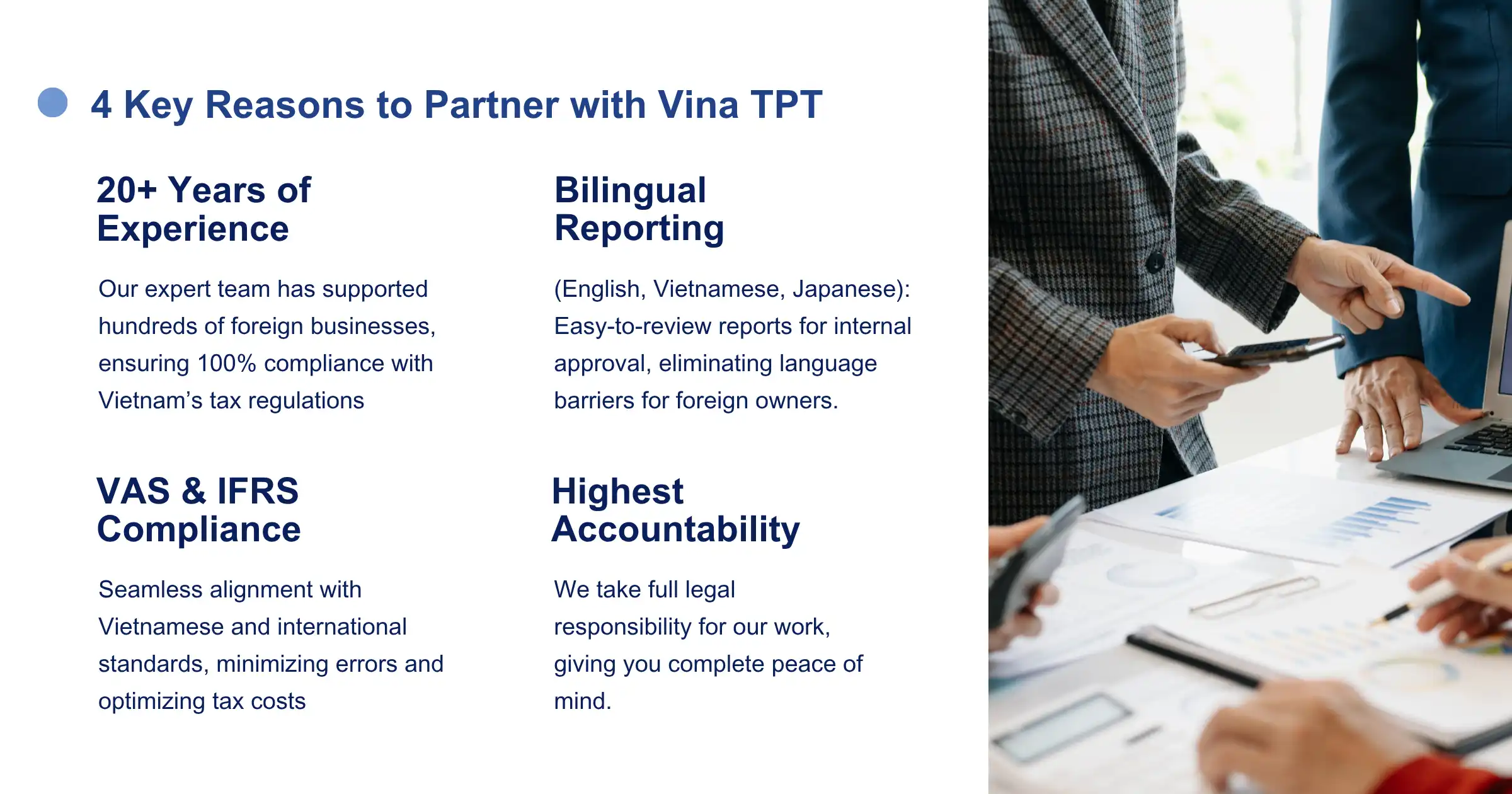
Vina TPT is trusted by many FDI enterprises in Da Nang thanks to more than 120 years of experience and full accounting services, from bookkeeping, tax declaration, financial reporting to strategic consulting. With the motto “accurate – transparent – effective”, Vina TPT helps businesses optimize operating costs, reduce legal risks and focus on business development.

Strengths that make Vina TPT stand out

  • Full-package service:

    • Manage all monthly accounting operations and annual reports.
    • Declaration of VAT, CIT, PIT, FCT, payment of social insurance for employees.
    • Consulting on tax strategies and optimizing legal costs.
  • Over 20 years of experience:

    • Serving a wide range of industries: logistics, trade, hospitality, SMEs and FDI. Solving complex tax and accounting issues, ensuring compliance with Vietnamese law.
  • Standardize processes & make costs transparent:

    • Transparent reporting and costs, avoiding unexpected costs.
    • Support businesses in building professional internal accounting processes.
  • Understand local laws and stay updated:

    • Mastering tax, social insurance and accounting regulations in Vietnam. 
    • Timely updating of legal changes so that businesses always comply with regulations.
  • Comprehensive support for businesses:

    • Reduces the workload of internal accounting operations, allowing businesses to focus on business development.
    • Represents businesses in dealing with tax and labor authorities when necessary.

Thanks to the above advantages, Vina TPT is not only a reputable accounting company but also a strategic partner, helping businesses in Da Nang effectively manage finances, optimize taxes, and maintain full legal compliance.

Contact Vina TPT now for full support in accounting, tax and financial reporting, helping operate effectively and comply with the law.

BOOK A FREE CONSULTATION

best-outsourced-accounting-services

How the Best Accounting Firms Handle Monthly and Year-End Closing

How-the-Best-Accounting-Firms-Handle-Monthly-and-Year-End-Closing-VTPT

How-the-Best-Accounting-Firms-Handle-Monthly-and-Year-End-Closing-VTPT

1. The Real Reason Businesses Struggle With Monthly & Year-End Closing

Best outsourced accounting services help businesses manage complex financial processes efficiently. Many businesses are often under great pressure at the end of the month and year due to non-standardized accounting processes or heavy reliance on manual work. When having to reconcile hundreds or thousands of documents, summarize revenue and expenses, check customer and supplier debts, and prepare periodic tax reports, accounting staff are prone to errors or delays. These errors can lead to inaccurate financial information, affect management decisions and make it difficult to evaluate business performance.

In addition, failure to comply with tax obligations on time also creates legal risks, from administrative fines to surprise inspections by tax authorities. Especially for small and medium-sized enterprises, the lack of an experienced accounting team can multiply these risks. Therefore, many businesses choose outsourced accounting services, which help standardize processes, ensure accurate, transparent and timely data, and free up resources to focus on business development.

2. What a Strong Monthly Accounting Process Looks Like

A professional monthly accounting process is divided into clear steps:

2.1 Prepare documents and data

  • Collect and check all invoices, payment vouchers, receipts and related documents.
  • Check data with ERP system or internal books.

2.2 Record and check revenue – expenses

  • Record full revenue by month, valid expenses.
  • Check the accuracy of tax deductions.

2.3. Check debt and account balance

  • Reconcile customer and supplier debt.
  • Compare bank balance and accounting books to ensure there are no discrepancies.

2.4. Review and approve

  • Triple check: accounting staff → general accountant → chief accountant.
  • Ensure month-end data is accurate, transparent, reducing risks when tax authorities inspect.

Small businesses with few employees often skip many of the above steps, leading to data errors. Using outsourced accounting services helps ensure this process is standardized, cost-effective, and still meets professional accounting standards.

best-outsourced-accounting-services

3. Year-End Closing: Why It’s a Completely Different Level of Complexity

While monthly closing helps businesses maintain stability, year-end closing is a “big test” summarizing all financial activities of the whole year. This is not just a step to accumulate data but also a process of confirming compliance with accounting standards, preparing for audits and reconciling tax obligations.

The workload has increased dramatically: data needs to be reviewed more deeply, documents are required more strictly and the risk level is also higher – especially for businesses that do not have standard accounting processes or are lacking in human resources. This is the reason why many businesses choose outsourced accounting services to ensure accuracy, transparency and limit errors in reporting.

During the year-end closing process, businesses are forced to review and reconcile all data of the whole year, including:

  • Checking and confirming revenue in the correct period and with the correct documents.
  • Reconciling expenses, ensuring completeness and correct accounting groups.
  • Reviewing receivables and payables and reconciling with partners.
  • Inventory and confirmation of inventory, handling of discrepancies if any.
  • Check fixed assets and compare original price – remaining value.
  • Calculate and review depreciation of fixed assets according to regulations.
  • Evaluate and update provisions (bad receivables, inventory discounts, warranties, etc.).

Year-end closing requires high accuracy, large workload and strict compliance. Even though standard accounting procedures are implemented every month, businesses cannot ignore this stage because any errors directly affect financial reports, taxes and the audit process.

GET PROFESSIONAL YEAR-END ACCOUNTING SUPPORT

4. How Vina TPT Ensures Smooth Monthly & Year-End Closing for Clients

Vina TPT implements a professional process to help customers close smoothly, including:

  • Direct consultation from the beginning: Understand the business model, assess tax risks, and develop a compliance plan.
  • Detailed document instructions: List of documents to be prepared, support for collection through a secure system.
  • Automatic error checking process: Multi-layer data checking, reducing manual errors.
  • Specialized closing team: Accountants, general accountants, chief accountants coordinate to triple check.
  • Support year-end settlement: Prepare financial statements, reconcile taxes, prepare audit documents, and report on time.

Therefore, businesses not only reduce the risk of errors but can also focus on product development and market expansion without having to worry about accounting or taxes.

If you want a smooth closing process and accurate financial reports from the first month, let Vina TPT accompany your business.

BOOK A FREE CONSULTATION


accounting service Vietnam for FDI company vtpt

Why Startups Need the Best Accounting Firms in Vietnam?

Why-Startups-Need-the-Best-Accounting-Firms-in-Vietnam_-VTPT

Why-Startups-Need-the-Best-Accounting-Firms-in-Vietnam_-VTPT

1. The Early Challenge: Why Accounting Is a Common Pain Point for Startups

Full-service accounting plays a crucial role in supporting the growth of foreign-invested enterprises. In recent years, Vietnam has not only attracted large corporations but also increasingly attracted startups from Japan, Korea, India, Singapore, the US, Taiwan and Australia. With the level of FDI capital continuously increasing, according to the report of the Foreign Investment Agency, in the first six months of 2025 alone, Vietnam attracted more than 21.5 billion USD of FDI capital, reaching a record in the past 15 years, it is clear that the FDI startup environment in Vietnam is more vibrant than ever.

However, foreign-invested startups face more challenges than domestic startups, especially in setting up accounting processes and tax compliance. FDI enterprises are subject to higher supervision in preparing financial reports according to Vietnamese standards, while still having to summarize data for their headquarters abroad. 

Therefore, choosing a reputable comprehensive accounting firm is an important strategy for FDI startups. A quality accounting unit not only keeps books but also supports tax compliance, prepares financial statements, manages cash flow and prepares for audits, helping founders focus on product development, market expansion and capital mobilization.

2. Full-Service Accounting: What It Really Means for Startups

Full-service accounting offers a complete suite of financial services, including:

  • Bookkeeping: Record and organize all financial transactions accurately, ensuring the company’s accounting data is up-to-date and reliable.
  • Financial Reporting: Prepare regular financial statements, enabling startups to track performance, assess cash flow, and support investor or management decisions.
  • Tax Filing: Handle all tax declarations (VAT, PIT, CIT, FCT) and submissions on time, ensuring compliance with local regulations and minimizing risk of penalties.
  • Payroll Management: Calculate and process employee salaries, social insurance, and personal income tax accurately, for both full-time and part-time staff.
  • Legal Compliance Consulting: Advise on accounting and financial regulations, helping startups follow laws, avoid errors, and standardize processes from the start.

Full-services also support startups to standardize internal processes, from invoice reconciliation, cost management, revenue tracking to management reporting. This helps businesses be ready to present accurate data to investors, prepare for audits, and build future expansion plans. Startups do not have to worry about reporting errors or violating the law while still controlling cash flow effectively.

Why-Startups-Need-the-Best-Accounting-Firms-in-Vietnam_-VTPT

3. Streamlining Accounting Procedures for Growth

One of the important factors for sustainable startup development is to establish a systematic accounting process. Professional accounting services help businesses build a system from recording transactions, managing costs, reconciling invoices, to preparing periodic financial reports.

The “lean accounting” method is applied to small startups to minimize accounting errors, save on personnel costs and increase transparency. Thanks to this process, startups can clearly understand the cash flow situation, forecast budgets, evaluate operational efficiency and prepare for fundraising rounds. The standardized process also helps businesses easily expand when growing in scale or developing new products.

BUILD A SYSTEMATIC ACCOUNTING PROCESS NOW

4. Outsourcing vs. In-house: What’s Smarter for a Startup Budget?

With limited budgets, many startups have difficulty recruiting, training, and managing internal accounting staff. Compared to building an in-house team, outsourcing accounting services offers many benefits:

  • Save on recruitment costs, salaries, and benefits for accounting staff.
  • Receive in-depth expertise from experienced experts handling complex and diverse business operations.
  • Flexibly expand or narrow services according to actual needs without long-term constraints.
  • Ensure accounting standards and tax compliance are maintained.

Many FDI startups in Vietnam choose to outsource right from the company’s establishment to focus resources on product and market development, instead of worrying about daily accounting operations.

Criteria In-house Outsourcing Accounting Services
Cost High (salaries, benefits, training, insurance, office) Lower, pay flexibly based on service package
Expertise Limited to staff capabilities Experienced specialists across multiple areas
Flexibility Hard to adjust team size Easy to scale services up or down
Legal Compliance Depends on staff, prone to errors Standardized, tax-compliant
Implementation Time Time-consuming recruitment & training Immediate, no waiting time

With limited budget and diverse business processing needs, outsourcing accounting is an effective solution to help startups save costs while ensuring accounting and tax standards.

5. How Vina TPT Supports Startups with Scalable Accounting Solutions

Vina TPT Accounting Service supports startups with a comprehensive accounting system:

  • Building a bookkeeping system, managing cash flow and preparing periodic tax reports.
  • Designing flexible processes for each stage of business development.
  • Ensuring all accounting data is transparent, accurate and easy to control.
  • Consulting on financial strategies: controlling costs, optimizing cash flow, preparing for fundraising.
  • Helping startups focus on products and expanding the market without worrying about accounting – tax – compliance issues.

Contact Vina TPT for free consultation and to build a professional accounting system, helping startups manage finances effectively and comply with the law right from the first steps.

BOOK A FREE CONSULTATION

full-service-accounting


Top 20 Sectors for Business Opportunities in Vietnam

Top-20-Sectors-for-Business-Opportunities-in-Vietnam-VTPT

Top-20-Sectors-for-Business-Opportunities-in-Vietnam-VTPT

1. Why Vietnam Is a Hotspot for Business

Business opportunities in Vietnam are abundant as the country emerges as one of Southeast Asia’s most attractive investment destinations, thanks to its consistent GDP growth, rapidly expanding middle class, and strong push toward industrialization. Major cities such as Ho Chi Minh City, Hanoi, Da Nang, and Hai Phong are witnessing rising consumer demand across multiple sectors, creating fertile ground for new business models and foreign startups.

FDI inflows continue to surge, with Vietnam recording one of its highest investment levels in recent years. This momentum is drawing businesses from Japan, South Korea, Singapore, the US, India, and beyond, all seeking opportunities in a market that is young, dynamic, and full of untapped potential.

In the following sections, we’ll explore key industries currently experiencing strong growth – helping foreign entrepreneurs identify where the most promising opportunities lie.

EXPLORE BUSINESS OPPORTUNITIES IN VIETNAM

2. Most Profitable Sectors to Consider

When considering business opportunities in Vietnam, investors should focus on industries with high profit potential, strong market demand and sustainable development trends. Below are 20 prominent industries:

  1. F&B: The food and beverage industry is still leading thanks to strong consumer demand, especially for restaurant, cafe and fast food chains under the franchise model. The market is oriented towards experience, quality and service, bringing stable profits to investors.
  2. Retail: Traditional retail and e-commerce are growing rapidly thanks to the expanding middle class and increasingly popular online shopping habits. Convenience store models, specialty stores and e-commerce are creating high-profit opportunities.
  3. Logistics and Supply Chain: Vietnam is becoming an export manufacturing hub, leading to a large demand for warehousing, transportation and fulfillment for e-commerce. The trend of investing in smart logistics and automated warehouses is prominent.
  4. Education & Training: Foreign language centers, soft skills training, STEM and e-learning are growing strongly, especially with startups targeting Gen Z and the FDI market.
  5. Tech Startups: Fintech, healthtech, applications and enterprise software are global investment trends, with high profit potential thanks to the ability to expand rapidly and integrate new technologies.
  6. Tourism & Hospitality: The tourism and hospitality industry has recovered strongly after the pandemic, especially experiential services, homestays and high-end resorts.
  7. Healthcare & Wellness: International clinics, health care, spas and fitness meet the growing needs of the middle class.
  8. Renewable Energy: Solar power, wind power and clean energy solutions are prioritized by investment incentives, while meeting global sustainability trends.
  9. Real Estate & Property Management: Apartments, urban areas, offices for rent and logistics real estate are increasing in price thanks to high demand for housing and commerce.
  10. Manufacturing & Supporting Industries: Manufacturing components, mechanics, household appliances for FDI and export, in line with preferential policies and supply chain connections.Top-20-Sectors-for-Business-Opportunities-in-Vietnam-VTPT
  11. Automotive & Mobility: Electric vehicles, repair services, logistics and auto parts following the green transformation trend and government support mechanisms.
  12. Agriculture & Agritech: Clean agricultural products, food processing, agricultural technology solutions to increase productivity and meet export needs.
  13. Consumer Electronics: Smart home appliances, smartphones and laptops with a dynamic young market that easily accepts new technology.
  14. Beauty & Cosmetics: Spa, imported cosmetics and skincare are growing strongly thanks to the need for personal beauty and international service standardization.
  15. Fashion & Apparel: Clothing, children’s fashion, online fashion to meet the trend of personalization and online shopping.
  16. Media & Entertainment: Digital content, movies, games, podcasts are booming thanks to the online entertainment habits of young people.
  17. Financial Services: Fintech, electronic payments, personal and business financial management following the digital trend.
  18. Professional Services: Law, accounting, management and tax consulting to meet the growing needs of FDI enterprises and startups.
  19. Green Construction: Environmentally friendly construction materials, smart homes following the sustainable and energy-saving trend.
  20. Food Processing & Export: Food processing, export of specialty agricultural products according to international standards, taking advantage of abundant raw materials and FDI investment in export.

These industries not only bring attractive profits but also suit modern consumption trends, opening up long-term opportunities for investors who know how to grasp the market and combine business strategies in the right direction.

3. Challenges New Investors Must Anticipate

Despite Vietnam’s strong potential, new foreign investors still face two major challenges: legal complexity and language barriers.

FDI enterprises must navigate stricter procedures in company registration, business licensing, and tax compliance, while differences in language and legal interpretation often slow down operations or create unnecessary risks.

However, with Vietnam’s commitment to international integration, investors are not alone. The market now has many professional corporate advisory and legal-compliance service providers that can support businesses from day one  especially those able to work fluently in English and understand the expectations of foreign founders.

Vina TPT Accounting Service is one of the trusted partners in this space, offering end-to-end support in company formation, accounting, financial reporting, and compliance for FDI enterprises. This ensures investors can enter the market smoothly, stay compliant, and focus on growing their business.

Top-20-Sectors-for-Business-Opportunities-in-Vietnam-VTPT

4. Strategic Approaches to Enter These Sectors

When entering the Vietnamese market, foreign investors can choose several effective approaches such as setting up a 100% foreign-owned company, partnering with local businesses, franchising, or pursuing M&A. Each option offers different levels of control, speed, and market access but all require strict compliance with Vietnam’s legal and licensing framework.

To avoid delays and risks, many investors rely on professional business formation and compliance partners. Vina TPT Business Formation supports foreign businesses with investment registration, company establishment, accounting, and licensing procedures, helping investors start operations quickly, stay compliant, and focus on growth.

5. How Vina TPT Supports Smart Market Entry

Vina TPT provide a full range of services:

  • Consulting on suitable investment and company structure
  • Preparing all legal documents for foreign investors
  • Company registration and obtaining required business licenses
  • Accounting, tax, and compliance support for FDI businesses
  • Ongoing advisory to ensure smooth and lawful operations in Vietnam

Turn Vietnam’s top business opportunities into real results.

Partner with Vina TPT Business Formation for fast, smooth, and compliant market entry.

Ready to expand to Vietnam? Explore our business setup services

Top-20-Sectors-for-Business-Opportunities-in-Vietnam-VTPT


Essential Tax Preparation Services Checklist for Year-End in Vietnam

Essential-Tax-Preparation-Services-Checklist-for-Year-End-in-Vietnam-VTPT

Essential-Tax-Preparation-Services-Checklist-for-Year-End-in-Vietnam-VTPT

1. Year-End Tax Pressure: Why Many Companies Struggle in Vietnam

Tax preparation services play a crucial role during the end-of-year period, which is always the peak time for businesses in Vietnam, especially in tax work. Many businesses are overloaded when having to suddenly process data, constantly update changes in tax policies, and at the same time prepare decision documents. The lack of specialized personnel or the asynchronous accounting system makes it easy for businesses to complete, lightly or completely fulfill tax obligations.

The system is often discovered to be accessed, fined for administrative violations or increased risks in tax payments and audits. Therefore, using Vietnamese tax consultants to support early preparation and control helps businesses significantly reduce pressure at the end of the year.

2. Core Tax Preparation Tasks Every Company Must Complete

Before entering the year-end settlement stage, every business in Vietnam must complete a number of mandatory tax tasks. These are fundamental tasks that directly affect financial reports, tax obligations and compliance throughout the fiscal year. Complete and correct implementation from the beginning helps businesses minimize errors, avoid the risk of being overcharged or fined, and ensure consistent data between the accounting system and the tax authority.

2.1. Consolidation and reconciliation of value added tax (VAT)

Businesses using tax preparation services must also review all electronic invoices issued and received throughout the year, including both output and input invoices. The reconciliation process must ensure that each invoice is valid, contains complete information in compliance with regulations, and is recorded in the correct accounting period. Simultaneously, businesses need to calculate deductible VAT, VAT payable, and prepare accurate reports in the prescribed format.

2.2. Personal Income Tax (PIT) Finalization

At the end of the year, businesses must summarize all employee income, including salaries, Tet bonuses, allowances, benefits and other payments. This is accompanied by checking tax codes, residence status, family deductions and comparing all insurance payment data. This is a mandatory step to ensure accurate PIT finalization records and avoid additional tax obligations for employees.

2.3. Calculating and preparing corporate income tax (CIT) declarations

Tax preparation services play a crucial role during the end-of-year period, which is always the peak time for businesses in Vietnam, especially in tax work. Many businesses are overloaded when having to suddenly process data, constantly update changes in tax policies, and at the same time prepare decision documents. The lack of specialized personnel or the asynchronous accounting system makes it easy for businesses to complete, lightly or completely fulfill tax obligations.

Businesses need to compile all revenue in the year, classify valid and invalid expenses according to tax regulations. Items such as depreciation, loan interest, hospitality expenses, management expenses from parent companies, associated service fees, etc., must be carefully reviewed to avoid exclusion during tax inspections. After reviewing, businesses determine taxable profits and prepare annual CIT declarations.

2.4. Review import tax and import VAT (if any)

For businesses with import activities, it is necessary to check HS code, customs value, customs declaration and tax paid during the year. This review helps ensure data is consistent with the customs system and avoid tax arrears or incorrect declaration of product codes leading to additional collection.

2.5. Compare accounting data with all tax declarations during the year

Before the end of the fiscal year, businesses must compare data between accounting books and submitted tax declarations. Any discrepancies between revenue, expenses, VAT, PIT or CIT need to be adjusted immediately to avoid risks when preparing financial statements or when tax authorities inspect.

Essential-Tax-Preparation-Services-Checklist-for-Year-End-in-Vietnam-VTPT

3. Common Errors Companies Make at Year-End

Many businesses make the same mistakes every year due to subjectivity or lack of experience in processing tax data. One of the most common mistakes is under- or over-reporting revenue because the data between internal accounting and sales software is not fully reconciled. Some businesses also miss expense documents or use invalid invoices, leading to disqualification when finalizing.

Late submission of declarations is also a serious problem because businesses can be fined by the day and have to pay late payment fees. Many units also make mistakes in classifying deductible and non-deductible expenses, leading to large discrepancies when calculating corporate income tax.

If not prepared early, these mistakes will put businesses at risk in the following year, especially when the tax authority conducts an in-depth inspection.

AVOID YEAR-END TAX MISTAKES – BOOK EXPERT SUPPORT

4. How Vina TPT Tax Consulting Ensures Accurate and Compliant Year-End Filing

To help businesses finalize taxes accurately and on schedule, Vina TPT applies an optimized and highly compliant year-end tax process. Our approach minimizes risks, shortens processing time, and ensures all documents meet Vietnamese tax regulations.

Here is what we can offer you:

  • Optimized workflow for completing year-end tax records quickly and in full compliance.
  • Direct expert consultation to understand the business model, assess tax risks, and propose the right compliance plan.
  • Free initial advisory session so businesses clearly understand all fiscal-year obligations.
  • Detailed document checklist to guide businesses in preparing required paperwork.
  • Secure document collection system that reduces time spent compiling files.
  • Error-prevention support, helping avoid missing invoices, incorrect payment methods, or non-deductible expenses.

Contact Vina TPT for free consultation and complete year-end tax reports accurately.

BOOK A FREE CONSULTATION

accounting service Vietnam for FDI company vtpt

Corporate Income Tax Finalization in Vietnam 2025: What Companies Should Prepare

Corporate Income Tax Finalization in Vietnam

Corporate Income Tax Finalization in Vietnam

1. 2025 Tax Policy Updates: What Foreign Investors Need to Know

In 2025, there will be many important updates to corporate income tax policies in Vietnam, especially affecting FDI enterprises. The General Department of Taxation will tighten post-audit regulations, strengthen document review and check the reasonableness of deductible expenses.

Foreign investors need to pay attention to cost classification, update tax incentives regulations, and ensure financial statements are in accordance with Vietnamese standards. Failure to comply with the new regulations may lead to administrative fines, tax arrears and affect the transfer of profits abroad.

2. Key Corporate Income Tax (CIT) Obligations for FDI Companies

.FDI enterprises in Vietnam are required to declare and pay corporate income tax both quarterly (provisional) and annually (finalization). Deductible expenses include production and business costs, salaries, insurance, and other legally supported expenses. Some enterprises may also benefit from sector-specific or local tax incentives.

2.1 Provisional Quarterly CIT Payment

  • Enterprises must estimate and pay CIT every quarter based on actual or expected revenue.
  • Deadline: within 30 days after the end of each quarter.
  • Proper documentation for deductible expenses and provisional calculations helps reduce errors and avoid fines.

2.2 Annual CIT Finalization

  • At the end of the fiscal year, enterprises must finalize CIT by reconciling provisional payments with actual taxable income.
  • Required documents: financial statements, accounting books, expense receipts, and relevant contracts.
  • Deadline: usually within 90 days after the fiscal year-end.
  • Preparing complete and accurate documents ensures compliance, minimizes risk of fines, and facilitates smooth interaction with tax authorities.

3. Common Mistakes in CIT Finalization

FDI enterprises in Vietnam often face issues in corporate income tax (CIT) reporting due to common mistakes that can lead to fines or tax adjustments. Key mistakes include:

3.1 Inaccurate Cost Accounting

  • Recording expenses that are not eligible for deduction or entering incorrect accounting items.
  • Leads to differences between accounting profit and taxable profit, affecting CIT calculation.
  • Impacts overall financial statements and auditing.
  • Enterprises should review all expenses, including personnel costs, office rentals, and fixed asset depreciation, to ensure reasonableness and legality.

3.2 Missing or Invalid Documents

  • Failing to provide valid invoices, international payment documents, or complete contracts.
  • Causes tax authorities to refuse deduction of expenses, increasing tax obligations and potential late payment penalties.
  • Proper scientific storage and management of documents is essential for smooth tax settlement.

3.3 Discrepancies Between Internal Accounting and Tax Declarations

  • Occurs when companies apply Vietnamese Accounting Standards (VAS) for tax reporting but maintain international or headquarters accounting standards.
  • Leads to discrepancies that require time-consuming adjustments.
  • Increases risk of inquiries, explanations, or administrative fines from tax authorities.

4. Steps to Ensure Smooth CIT Filing

Corporate Income Tax Finalization in Vietnam

To ensure a smooth corporate income tax (CIT) settlement and minimize risks of errors or penalties, FDI enterprises should follow a structured approach:

4.1 Step 1: Standardize Accounting Books

  • Check all accounts and review records of expenses and revenues.
  • Compare invoices and supporting documents.
  • Identify legally deductible items to minimize errors and create a reliable basis for financial statements.

4.2 Step 2: Review and Classify Valid Expense

  • Clearly identify which expenses are eligible for tax deductions.
  • Exclude invalid or non-deductible expenses.
  • Prepare detailed expense reports for each item to optimize tax obligations and reduce risk of post-submission adjustments by tax authorities.

4.3 Step 3: Collaborate with Auditors and Professional Tax Consultants

  • Auditors review data, detect potential errors, and ensure CIT reports comply with Vietnamese law.
  • Tax consultants assist with document preparation, timely report submission, and communication with tax authorities.
  • Helps minimize penalties and allows businesses to focus on growth and development.

5. How Vina TPT Tax Preparation Service Supports FDI Businesses

Vina TPT provides a complete tax preparation service for FDI enterprises, from consulting on corporate income tax settlement, preparing and declaring documents, to representing and working directly with tax authorities. A team of experienced experts helps to review books, standardize documents and ensure all expenses are valid, reducing the risk of errors and administrative fines.

In addition, Vina TPT supports the optimization of tax costs by properly applying legal incentives and exemptions, while helping enterprises comply with all the latest regulations of the General Department of Taxation. As a result, FDI enterprises can focus on operating and developing their businesses, while all tax-related issues are handled professionally and effectively.

Partner with Vina TPT to simplify CIT finalization, stay compliant, and focus on growing your business.

BOOK A FREE CONSULTATION

accounting service Vietnam for FDI company vtpt

Understanding Value Added Tax (VAT) in Vietnam: Registration, Invoicing, and Filing Procedures

VAT refund process for foreign investors in Vietnam

VAT-in-Vietnam

1. Understanding VAT in Vietnam

Value Added Tax (VAT) is an indirect tax applied to the added value of goods and services at each stage of production and distribution. In Vietnam, VAT is applied to most goods and services and is subject to the management of the tax authorities.

The common tax rate is 10% for most goods and services, while some essential or exported goods may apply 0% or 5%. Enterprises with revenue above the prescribed level or providing goods and services subject to VAT must register and declare VAT periodically. Understanding the tax calculation mechanism, taxable objects and how to prepare invoices is a basic step to ensure compliance and avoid the risk of penalties.

2. VAT Registration and Compliance Requirements

To operate legally in Vietnam, businesses need to register for VAT in Vietnam with the tax authorities. The registration dossier includes business information, business lines, tax codes and types of goods and services provided. After registration, businesses need to declare and pay taxes periodically on a monthly or quarterly basis, depending on revenue and business type.

Electronic invoices are mandatory for most businesses, helping to manage and control transparent invoice issuance, limiting the risk of errors. Businesses need to ensure that invoices record correct information, amounts, tax rates and are stored according to regulations. Full compliance with regulations on invoices and declarations helps businesses avoid administrative fines and increase transparency in business operations.

ENSURE ACCURATE VAT DECLARATIONS TODAY

3. VAT Refunds and Recovery for Foreign Investors

Foreign enterprises investing in Vietnam can request a VAT refund if the goods and services are exported or meet other tax refund conditions. The tax refund process includes preparing valid documents and invoices, declaring VAT in Vietnam and submitting a tax refund application to the tax authority.

Foreign investors in Vietnam can apply for VAT refunds, but understanding the requirements is crucial.

  • Tax refund conditions include valid VAT invoices, international payment documents, and proof that the goods or services were exported or used for the correct purpose.
  • Processing time usually takes several months.
  • Preparing complete and accurate documents is essential to help foreign investors receive refunds faster.

VAT-in-Vietnam

Read more about VAT refund conditions and eligible cases in our full guide: VAT Refund in Vietnam 2025: Updated Conditions and Eligible Cases Explained

4. Common VAT Challenges and How to Avoid Them

VAT management in Vietnam is often difficult for many businesses, especially foreign investors or FDI companies, due to constantly changing regulations and strict compliance requirements. Some common challenges include missing or incorrect data declarations, late tax payments, using incorrect invoice formats, and not keeping up to date with tax law changes.

4.1 Missing or Incorrect Data Declarations

  • Businesses may omit purchase or sale invoices or record incorrect tax rates or total values.
  • Leads to inaccurate VAT calculations, adjustments by tax authorities, recovery of paid tax amounts, and late payment penalties.

4.2 Late Tax Payments

  • New businesses or those without strict control processes can miss monthly or quarterly VAT in Vietnam deadlines.
  • Especially challenging when handling multiple taxes (e.g., corporate income tax, import/export tax).
  • Violations result in fines, interest charges, and can impact cash flow and business reputation.

4.3 Not Updating Tax Law Changes

  • Frequent amendments to VAT rates, document requirements, or policies make it easy to make declaration errors.
  • Businesses failing to track updates risk non-compliance and penalties.

How to Avoid VAT Risks

  • Build standardized processes for all VAT-related activities:
    • Manage input/output documents carefully
    • Reconcile invoices periodically
    • Store data completely and declare on time
  • Use professional invoice and accounting management software to automate steps, reduce errors, and improve transparency.
  • Partner with specialized units such as Vina TPT:
    • Advice on correct VAT declaration and electronic invoice creation
    • Review data and guide document submission
    • Monitor tax refund progress if applicable

VAT refund process for foreign investors in Vietnam

5. How Vina TPT Supports VAT Compliance and Advisory

Vina TPT offers comprehensive VAT in Vietnam services for foreign investors, including:

  • Consultancy for VAT registration
  • Electronic invoicing setup and management
  • Periodic VAT calculation and filing
  • Support for export tax refunds
  • Data review and standardization for smooth audits

Our services ensure timely declarations, minimize the risk of penalties, and guarantee full compliance with Vietnamese regulations. With expert guidance from day one, Vina TPT helps foreign enterprises save time, optimize cash flow, and operate confidently in Vietnam.

Contact Vina TPT to receive VAT in Vietnam advisory and implement an effective tax management system for foreign enterprises in Vietnam.

BOOK A FREE CONSULTATION

Vina TPT Accounting services


Trading Companies: Streamlined HCM Bookkeeping Services

Bookkeeping services for trading companies in Ho Chi Minh City by Vina TPT

bookkeeping-services

1. The Complexity of Bookkeeping in HCM’s Trading Sector

Bookkeeping services play a crucial role in helping trading companies control their financial data accurately. Trading companies in Ho Chi Minh City often have to manage many different types of transactions from import, export to domestic and online retail. Each transaction generates invoices, documents and requires timely tax declaration according to the regulations of the Vietnamese tax authorities.

The process of declaring VAT, CIT and import-export tax is constantly changing, making it difficult for businesses to update, calculate and store documents correctly. In addition, comparing invoices between branches or with foreign suppliers increases the possibility of errors if the business does not have a systematic accounting system.

If processed manually, businesses will spend a lot of time, easily make mistakes and fall into a situation of late tax payment, lack of valid documents or incomplete declaration, leading to administrative fines and affecting cash flow.

2. Challenges Small Trading Companies Face in Daily Accounting

Small trading companies often face common problems such as managing paper documents, reconciling invoices, calculating VAT, CIT and import taxes. Consolidating financial statements from multiple branches or separate business units is also difficult, especially when data is not standardized.

Many businesses lack professional accounting staff and have to rely on people who are not experienced in handling complex operations. This leads to the risk of declaring incorrect tax figures, not submitting reports on time or having problems in auditing. Common errors can be incorrect invoices, mismatching import documents with tax declarations, or missing deductible expenses.

bookkeeping services

3. Outsourced Bookkeeping as a Solution for Efficiency

Hiring outsourced bookkeeping services is an effective solution to help trading companies save on personnel costs, reduce the risk of errors and increase productivity. Vina TPT provides a complete service from collecting documents, entering data, preparing periodic reports to checking data, ensuring all figures are accurate and in accordance with Vietnamese tax laws.

With a team of experts who understand the regulations for trading businesses, Vina TPT can handle complex operations such as calculating VAT for imported goods, calculating corporate income tax, comparing invoices between branches and standardizing data to easily consolidate reports. This helps businesses reduce management pressure, save time and focus on business development.

BOOST YOUR BUSINESS WITH OUTSOURCED BOOKKEEPING

4. Ensuring Accuracy and Compliance Through Streamlined Processes

Vina TPT applies standardized accounting processes, ensuring accurate and audit-ready data, while complying with Vietnamese laws. This system helps track cash flow, manage costs and control invoices effectively. All VAT, CIT and financial reports are prepared and thoroughly checked before submitting to the tax authorities, minimizing the risk of fines and errors. 

In addition, applying an online system allows businesses to track documents and reports anytime, anywhere, increasing transparency and internal control. Businesses using professional services like Vina TPT can confidently expand operations and develop markets without worrying about compliance.

5. Tailored Bookkeeping Solutions by Vina TPT for Trading Companies

Vina TPT provides accounting and bookkeeping services customized to the needs of each trading company. Services include:

  • Preparing and managing complete accounting books
  • Preparing periodic financial reports and VAT, CIT, and import tax reports
  • Auditing support and preparing audit-ready documents
  • Setting up an online document management system, allowing businesses to track all transactions, minimizing the risk of errors

Bookkeeping services for trading companies in Ho Chi Minh City by Vina TPT

Vina TPT’s team of experts has many years of experience in bookkeeping in the trading field in Ho Chi Minh City, understanding the complex operations and legal requirements of tax authorities. Thanks to that, businesses not only save costs and time but also ensure compliance with the law, accurate and transparent data.

Ready to take control of your bookkeeping with confidence? Contact Vina TPT today for a complete outsourced bookkeeping service tailored to trading companies in Vietnam.

BOOK A FREE CONSULTATION

Expert-Vietnam-VinaTPT

How Tax Preparation Services Ensure VAT Compliance

tax-preparation-services

1. VAT Compliance Challenges for Foreign Investors in Vietnam

Tax preparation services play an essential role in helping businesses stay compliant with Vietnam’s VAT regulations. Value added tax is one of the most frequently audited taxes in Vietnam and is also the area where FDI enterprises are most likely to make mistakes. Many foreign investors say they have difficulty tracking policy changes, applying e-invoice regulations, determining the correct tax rate of 0, 5 or 10 percent and how to deduct input VAT for each tax period.

The e-invoice system requires synchronization between accounting software, voucher data and tax authority regulations. Even a small discrepancy in invoice date, product code or customer information can lead to invalid VAT records. These errors not only waste time editing but also create risks when being inspected or fined.

2. High-Risk Areas in VAT Filing That Can Affect Businesses

During the VAT declaration process, some potentially high-risk areas often appear. Inconsistencies between invoices, accounting books and banks are common errors. If input invoices are not in the correct format or lack required information, businesses will lose their right to deduct or be subject to tax collection.

Failure to update new policies in a timely manner is also the reason why many FDI enterprises make errors in tax declarations. Regulations on electronic invoices and input deductions frequently change, requiring businesses to always closely monitor and adjust their records immediately. In addition, late VAT payments also cause businesses to incur late payment penalties and be classified by tax authorities as high-risk.

3. How Outsourced Tax Preparation Services Mitigate VAT Risks

Outsourcing tax preparation services is an effective solution to ensure VAT compliance. Professional units such as Vina TPT review all invoices and VAT records before making declarations, helping to eliminate data errors, duplicate invoices or invalid documents.

Vina TPT experts also promptly update new tax policies and apply them correctly according to each industry. This helps businesses avoid declaring incorrect tax rates, recording incorrect invoice timings or declaring incorrect tax periods. The service also supports VAT optimization by accurately classifying preferential transactions or applying a 0 percent rate for exports, an area where many self-employed businesses often make mistakes.

OPTIMIZE YOUR VAT FILING

4. Streamlining VAT Processes with Automation and Expertise

Vina TPT combines technology and expertise to help businesses process VAT quickly and accurately. Electronic invoice management tools and automatic reconciliation software ensure data is always synchronized between invoices, documents and books. Multi-layered checking processes help detect errors early and make timely adjustments.

Tax experts continuously monitor changes in VAT policies and notify businesses, ensuring all records are always updated and ready for inspection or audit. This makes the VAT process smoother and businesses don’t have to worry about errors or violations of the law.

5. Maximizing Compliance While Reducing Operational Burden

Using tax preparation services not only helps businesses comply with VAT but also significantly reduces operational burden. Businesses don’t have to worry about recruiting or training internal tax staff. The entire process, from checking invoices, making declarations, submitting documents to explaining to tax authorities, is handled professionally by experts.

When VAT records are standardized and maintained in an audit-ready state, businesses can focus resources on business operations, market development and optimizing cash flow without worrying about the risk of violating the law.

In addition, tax preparation services give businesses access to updated regulations and expert insights that internal teams often lack. Consultants constantly monitor changes in VAT policies, e-invoice requirements, and deduction rules, ensuring that every declaration is accurate and compliant. This proactive approach helps businesses avoid common errors such as incorrect tax rates, invalid invoices, late submissions, or mismatched data between books and tax filings. By having a dedicated team oversee compliance risks in advance, businesses gain greater peace of mind and maintain a stronger, more transparent financial reporting system.

Contact Vina TPT for free consultation and ensure VAT compliance accurately, quickly and effectively.

Contact Vina TPT now for consultation on opening a business bank account

accounting service Vietnam for FDI company vtpt


Financial statement preparation and compliance in 2025 for Japanese firms

Financial statement preparation and compliance in 2025 for Japanese firms

Financial statement preparation and compliance in 2025 for Japanese firms

1. Why 2025 Brings New Financial Reporting Challenges for Japanese Companies in Vietnam

2025 is considered an important milestone for Japanese enterprises operating in Vietnam. The constant change in tax and accounting policies, especially the regulations on Value Added Tax (VAT) and Corporate Income Tax (CIT), makes the preparation of financial statements more complicated and requires higher accuracy than ever.

For foreign-invested enterprises (FDI), especially Japanese enterprises, annual financial statements must be independently audited before being submitted to the tax authorities. This process requires early preparation, data must be complete, clear and can be easily compared with the accounting system at the headquarters in Japan. Compared to domestic enterprises, Japanese companies often spend more time on the comparison, consolidation and review stages, especially when there are differences between Vietnamese and Japanese accounting standards.

2. Key Financial Reports Every Japanese Firm Must Prepare

In Vietnam, all enterprises, especially foreign-invested enterprises (FDI), must prepare a complete set of financial statements according to Vietnamese Accounting Standards (VAS). This set of reports is not only a legal requirement to submit to tax authorities and independent auditors, but also a basis for Japanese enterprises to consolidate financial data with their headquarters in Japan.

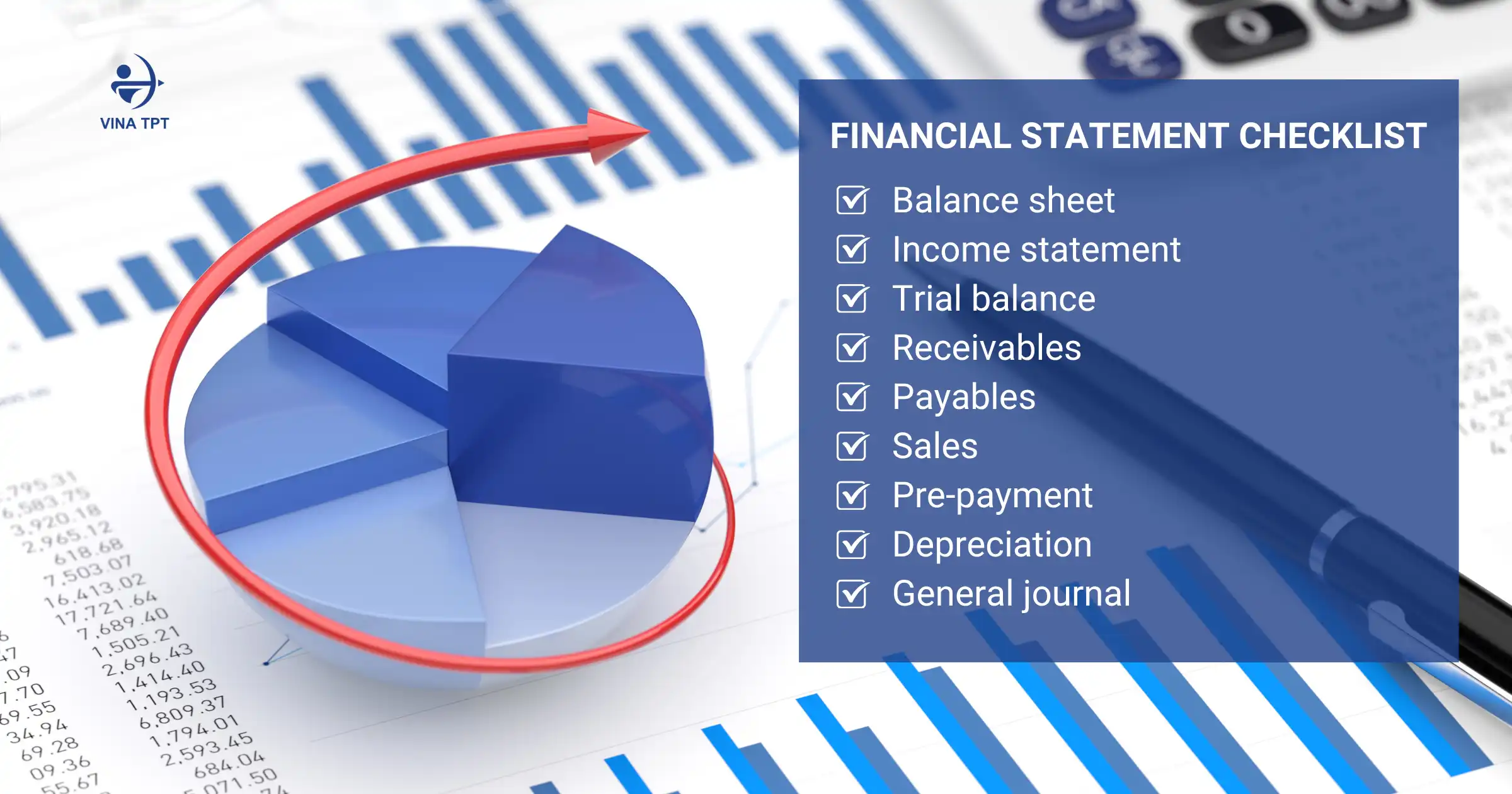
The three core reports include: Balance Sheet, Income Statement, and Cash Flow Statement.

Compared to J-GAAP (Japanese Generally Accepted Accounting Principles), VAS has some important differences that Japanese enterprises should note. For example, VAS requires depreciation of fixed assets according to the fixed time frame of the Ministry of Finance of Vietnam, while J-GAAP allows more flexibility based on the actual economic life of the asset. In addition, VAS recognizes revenue when ownership is transferred, not when invoices are issued as in some cases in Japan. Regarding consolidated reporting, VAS applies a different calculation method for minority interests and exchange rate differences than the Japanese standard, so if not adjusted in time, the data when consolidated to the parent company can be significantly different.

Therefore, during the financial statement preparation stage, Japanese companies often have to maintain two sets of data in parallel, one according to VAS standards to serve legal obligations in Vietnam, and one according to J-GAAP to serve the consolidated reporting to the head office. Handling this dual standard requires great care, in-depth understanding of both accounting systems, and close coordination between the internal accounting team, auditors, and consulting units such as Vina TPT Accounting service.

Financial statement preparation and compliance in 2025 for Japanese firms

3. Common Pitfalls in Year-End Financial Reporting

When it comes to preparing and submitting financial statements, many Japanese companies in Vietnam often encounter systematic errors that affect the auditing and tax compliance process.

3.1. Consolidation Differences Between Vietnam and Japan

One of the most common issues is the difference in financial statement consolidation between the branch in Vietnam and the headquarters in Japan. Vietnamese Accounting Standards (VAS) have many differences compared to J-GAAP, especially in handling exchange rate differences, classifying fixed assets and recording prepaid expenses.

According to i-Glocal’s analysis (2024), many Japanese FDI enterprises often have to prepare separate financial statements and consolidated reports in parallel, making the data reconciliation process complicated and prone to errors.

3.2. Lack of Valid Expense Documentation

Another common error is the lack of valid documents for deductible expenses. The 2023 report of the General Department of Taxation of Vietnam shows that more than 30% of tax inspection reports of FDI enterprises are related to invalid invoices, documents or incorrect accounting of deductible expenses.

These errors often lead to adjustments to taxable profits, collection of corporate income tax (CIT) and late payment penalties, directly affecting the reputation and financial planning of the parent company.

3.3. Exchange Rate Handling Issues

The handling of exchange rates is also a cause of discrepancies in financial statements. According to Circular 200/2014/TT-BTC, enterprises must use the actual exchange rate at the time of the transaction and prepare financial statements in Vietnamese Dong (VND).

However, many Japanese companies still use internal exchange rates according to Japanese accounting standards, leading to discrepancies when preparing reports to send to Vietnamese tax authorities, especially in the handling of foreign currency revenue and expenses.

3.4. Late Audit Submission and Transparency Requirements

Some Japanese enterprises in Vietnam also have problems submitting audit reports on time or not meeting financial transparency requirements. According to Vietnam Briefing (2024), all FDI enterprises must complete independent audits and submit financial reports within 90 days of the end of the fiscal year.

If the report is submitted late or does not meet standards, the enterprise may be subject to administrative fines, restricted from repatriating profits and face difficulties in renewing its investment license.

These risks not only increase compliance costs, but also directly affect the reputation and progress of consolidated reporting in Japan. Therefore, Japanese enterprises need to focus on controlling documents, complying with VAS and preparing financial records from the beginning to avoid being passive during the audit period.

In summary, full compliance with Vietnamese Accounting Standards (VAS) and financial statement regulations not only helps Japanese enterprises ensure financial transparency and accuracy, but also minimizes tax and audit risks. Proactively reviewing periodically and coordinating with professional accounting units in Vietnam is an important step to maintain stability in financial management and strengthen trust with Japanese management agencies and partners.

EXPERT YEAR-END FINANCIAL REPORTING SUPPORT

4. Outsourced Bookkeeping: The Smart Way to Stay Compliant

Faced with a large volume of accounting work and strict compliance requirements, more and more Japanese enterprises in Vietnam choose outsourced bookkeeping instead of maintaining an in-house accounting team. This solution helps save on personnel costs, ensures accuracy in reporting, and easily coordinates with auditors and tax authorities. Vina TPT Accounting service provides a complete outsourced bookkeeping service exclusively for Japanese enterprises, including: bookkeeping, preparing bilingual financial statements (English – Japanese – Vietnamese), and reviewing data before auditing. Vina TPT’s outstanding strength is its team of experts who can communicate fluently in Japanese, understand Japanese accounting standards (J-GAAP) and Vietnamese regulations (VAS), helping customers easily exchange, compare and consolidate financial data.

5. How Vina TPT Supports Japanese Firms for 2025 Compliance

Entering 2025, when the demand for financial transparency is increasing, Japanese enterprises need a partner who not only does accounting but also accompanies them throughout the entire compliance process.

Financial statement preparation and compliance in 2025 for Japanese firms

Vina TPT Accounting service provides comprehensive solutions including:

  • Preparing and reviewing bilingual financial statements (Japanese – Vietnamese): ensuring easy to understand, accurate and ready for audit.
  • Consulting on consolidated reports for Japanese corporations: supporting data conversion from VAS to J-GAAP or IFRS.
  • Consulting and coordinating audits: working directly with independent auditors, helping to reduce review time and limit post-audit adjustment risks.
  • Monitoring and updating the latest tax – accounting policies: ensuring reports are always in compliance with the regulations of the Ministry of Finance of Vietnam.

With a team of experienced accountants and auditors fluent in three languages ​​(Japanese, English, Vietnamese), Vina TPT helps Japanese enterprises in Vietnam maintain a transparent accounting system, comply with and optimize operating costs in accordance with international standards and Vietnamese law.
For comprehensive advice on financial statement preparation, auditing and tax compliance solutions in 2025, contact VinaTPT.

BOOK A FREE CONSULTATION

Vina TPT Accounting services