Tax Incentive in Vietnam 2025: Comprehensive Guide to Optimize Profits under New CIT Law

Overview of corporate tax incentives in Vietnam 2025 under the new CIT Law

Overview of corporate tax incentives in Vietnam 2025 under the new CIT Law

Tax Incentive: Comprehensive Guide to Corporate Tax Incentives in Vietnam 2025 – Optimize Profits with New CIT Law

With Vietnam’s Corporate Income Tax (CIT) Law 2025 officially in force from October 1, 2025, investors and CFOs are reassessing how to leverage tax incentives to strengthen profitability and compliance.

From 10 – 17% preferential CIT rates to multi-year tax holidays, the new regime gives both domestic and foreign companies more tools to optimize profits but only if you understand the rules.

In this guide, you’ll learn:

  1. What a tax incentive is and why it matters for 2025
  2. The main types of corporate tax incentives available in Vietnam
  3. Key eligibility requirements and risk management
  4. How to prepare and apply effectively with professional support

I. What is a Tax Incentive and Why Do Businesses Need to Know in 2025?

A tax incentive is a government policy designed to reduce or exempt tax liabilities for businesses that invest in targeted sectors or locations, with the aim of encouraging sustainable growth, innovation, and foreign direct investment (FDI).

Under the CIT Law 2025, tax incentives in Vietnam have evolved to:

  • Support the digital economy and green/clean industries.
  • Attract FDI via extended tax breaks and preferential schemes.
  • Motivate companies to reinvest profits inside Vietnam rather than only extracting them.

In today’s competitive ASEAN environment, understanding tax incentives isn’t optional, it’s a survival and growth strategy.

The standard corporate income tax rate remains 20 %. However, preferential rates are flexibly applied:

  • 15 % for enterprises with annual revenue ≤ VND 3 billion
  • 17 % for enterprises with revenue over VND 3 billion up to VND 50 billion
  • In specific cases (e.g., foreign-owned enterprises, cooperatives…) where cost/expense determination is difficult, a direct tax rate on revenue may apply

II. Key 2025 Updates: Major Types of Corporate Tax Incentives in Vietnam
Key Corporate Tax Incentives in Vietnam 2025

1. Expanded deductible expenses under the 2025 CIT Law

Enterprises are now allowed to deduct additional expenses related to scientific research, digital transformation, testing new technologies, emission reduction, and community activities. This aims to create favorable conditions for businesses to pursue sustainable growth and innovation.

2. Incentives by sector, location, and investment project

Investment projects in high-tech sectors such as semiconductor production, AI, data centers, automobile manufacturing, and electronic device production are eligible for a preferential tax rate of 10% for up to 15 years.
Expansion projects applying clean technologies or contributing to environmental improvements may also qualify for tax exemptions or reductions if they meet specific requirements.

3. Clear incentive rules to avoid overlapping

If an enterprise falls under multiple incentive categories, it has the right to choose the most favorable one.
In cases where preferential provisions exist under specialized laws, the 2025 CIT Law will take precedence, except for specially regulated circumstances.

4. Loss carry-forward and Science & Technology Development Fund

Enterprises are allowed to carry forward losses continuously for up to 5 years.
They may allocate up to 20% of annual taxable income to establish a Science & Technology Development Fund, provided it is used for the correct purposes.

To explore how our consulting team can help you secure and optimize CIT incentives effectively, visit our dedicated Tax Consulting Service page for more details.

Explore Tax Consulting Services

III. Common Mistakes and How to Avoid – Plus Profit Optimization

Even with the best intentions, many businesses still miss out on their tax incentive benefits due to simple yet costly mistakes. Below are the most common pitfalls and how to fix them effectively.

  1. Late or incomplete applications: One of the most frequent issues arises from delayed or missing documentation.
    How to avoid: Ensure all required forms and supporting evidence are submitted before your project begins generating income to maintain eligibility.
  2. Ignoring Permanent Establishment (PE) rules: With the 2025 update redefining PE status, overlooking this change can lead to unexpected tax liabilities.
    How to avoid: Reassess your operational and contractual structure under the new PE definition to avoid misclassification.
  3. Overlooking Double Taxation Treaties (DTT): Many foreign investors fail to leverage DTT benefits, leading to duplicate tax payments.
    How to avoid: Coordinate early with professional consultants to utilize DTT relief and minimize cross-border tax exposure.
  4. Unclear bookkeeping and expense tracking: Incomplete financial records can weaken your eligibility for incentives and invite compliance risks.
    How to avoid: Implement digital accounting and reporting systems to ensure transparency and traceability.
  5. No profit optimization strategy: Securing an incentive is only the first step, maximizing its impact requires strategic planning.
    How to avoid: Partner with Vina TPT’s tax consultants to align your incentive structure with long-term financial goals and ROI optimization.

IV. What Should Businesses Prepare to Seize Opportunities from the 2025 CIT Law?

To stay ahead of regulatory changes and fully capitalize on new incentives, businesses must prepare proactively and strategically:

  • Review and assess impact: Conduct a detailed analysis of current financial performance, income, expenses, and business operations. Identify any necessary adjustments to comply with the new Corporate Income Tax (CIT) Law.
  • Understand eligibility criteria for incentives: Study the specific requirements for benefiting from the 2025 CIT incentives. Ensure your business meets all conditions before submitting any application.
  • Update accounting and financial systems: Make sure your accounting software and bookkeeping procedures comply with new regulations on revenue and expense recognition.
  • Train internal teams: Equip your finance and accounting personnel with updated knowledge through training sessions or specialized CIT 2025 courses.
  • Seek expert consultation: Engaging professional tax advisors is a smart move to avoid compliance risks and legally optimize your tax obligations.

Instead of navigating complex tax regulations on your own, you can connect directly with VINA TPT – trusted partner specializing in tax, accounting, and financial consulting ready to support your business in maximizing benefits under the 2025 CIT Law.

Conclusion

Tax incentives in Vietnam are more than just government policy, they’re a strategic growth lever for businesses preparing to thrive in the 2025 landscape.

Key takeaways:

  • Vietnam offers preferential CIT rates of 10 – 17% for up to 30 years.
  • Incentives now extend to green, digital, and financial sectors.
  • Compliance and timing remain critical to securing approval.

V. Why Partnering with Vina TPT Is the Most Effective Way to Leverage Tax Incentives?

The 2025 CIT incentives offer substantial opportunities to reduce tax burdens and enhance profits, but leveraging them effectively isn’t always simple. Businesses must interpret complex eligibility criteria, prepare accurate documentation, and meet strict compliance deadlines. Without expert guidance, it’s easy to miss optimal incentive schemes or face regulatory risks. That’s why partnering with a professional tax consulting firm becomes a strategic advantage.

Vina TPT Tax Service is a trusted advisor to hundreds of FDI and domestic enterprises, including manufacturing, technology, and service companies across Vietnam. Our team consists of senior tax consultants and legal experts with over 15 years of experience in tax planning, accounting compliance, and investment incentives.

We provide end-to-end support, including:

  • Assessing eligibility for tax incentives under the 2025 CIT Law
  • Structuring incentive applications for maximum tax savings
  • Preparing and submitting exemption/reduction dossiers
  • Designing long-term tax strategies aligned with business growth objectives
  • Conducting compliance audits and managing tax risks

With Vina TPT Tax Service, businesses are not only compliant but also positioned to optimize costs and secure sustainable profitability through legally maximized tax benefits.

Contact Vina TPT today and ensure your business fully capitalizes on Vietnam’s 2025 tax incentive opportunities.

Contact Vina TPT for Consultation

Expert-Vietnam-VinaTPT

Business advisory for Singaporean investors establishing real estate businesses in Vietnam

alt="Business advisory services for Singaporean investors entering Vietnam’s real estate market"

business-advisory-services

1. Vietnam Real Estate: The Next Strategic Move for Singapore Investors

Over the past decade, Vietnam has become one of the most dynamic real estate markets in Asia, with rapid urbanization, high housing demand and a boom in industrial zones. In particular, Singapore is a leading financial, investment and business advisory center in the region, is considering Vietnam as a new “profit drop point” in its strategy to expand in Southeast Asia.

Singaporean investors see in Vietnam not only high profit potential, but also an opportunity to participate in a market that is changing strongly in terms of infrastructure, urban planning and Foreign Direct Investment attraction policies. Vietnam, with its affordable land prices, youthful workforce, and fast-growing transport infrastructure including airports, seaports, and metro lines, is emerging as a promising mirror of Singapore in its early development phase.

However, to realize the opportunity, investors need to clearly understand Vietnam’s legal framework, licensing process and tax mechanism – factors that can directly impact the profitability and safety of the project.

2. Before you invest: Understanding Vietnam’s Real Estate Landscape

Real estate in Vietnam is divided into many different types, including: industrial park development, housing projects, offices, resorts, trade – services and logistics. However, not all segments are open to foreign investors.

According to current regulations, investors can:

  • Contribute capital or buy shares in Vietnamese enterprises with existing real estate projects.
  • Establish a 100% foreign-owned company to develop projects if granted appropriate investment licenses.
  • Lease or sublease land in industrial parks, export processing zones, high-tech zones.

However, direct ownership of land in Vietnam is not allowed, because land is owned by the entire people and managed by the State. Investors can only use land through leasing or joint ventures with domestic partners.

In addition, the tax and regulatory systems related to real estate (VAT, CIT, transfer tax, land fees) also have significant differences compared to Singapore. Lack of understanding or misapplication of investment structures can lead to legal risks or reduced profit efficiency.

At this stage, partnering with a professional business advisory firm becomes essential. A qualified advisory team can help Singaporean investors navigate Vietnam’s complex real estate regulations, review investment structures, and ensure full compliance with local laws. With expert guidance on legal, financial, and tax aspects, investors can make informed decisions and minimize potential risks from the very beginning. Business Advisory

Business advisory for Singaporean investors establishing real estate businesses in Vietnam

3. From Licensing to Launch: Key Steps in Establishing a Real Estate Business

The process of setting up a real estate business in Vietnam usually includes four main stages, requiring close coordination between investors, lawyers and management agencies:

Stage 1: Investment strategy consulting: Business Advisory

Investors need to clearly define their goals (developing new projects, acquiring, cooperating or operating), assess the legal feasibility of the model and choose a locality with appropriate policies.

Stage 2: Applying for an Investment Registration Certificate (IRC):

This is the first license that allows foreign-invested enterprises to carry out projects in Vietnam.

Documents typically required for IRC application include:

  • Application for investment project implementation & Project proposal: Stating objectives, scope, scale, investment capital, location, and implementation schedule.
  • Proof of investor’s financial capacity: Bank statements, audited financial reports, credit contracts, or collateral documents.
  • Legal documents of the investor:
  • For individuals: Notarized passport, consular legalization.
  • For organizations: Business Registration Certificate or equivalent, consular legalization.
  • Evidence of project location: Office/land lease agreement or land use rights certificate.
  • Power of attorney/authorization letter (if the investor appoints a third party to handle procedures).

Stage 3: Enterprise Establishment (ERC):

After having IRC, investors register to establish an enterprise, determine the type of company (LLC, joint stock or joint venture). Choosing the right model will greatly affect the capital mechanism, voting rights and profit distribution.

Stage 4: Compliance and project implementation:

Enterprises must complete tax, insurance, financial and environmental procedures before officially starting operations. This is also the stage where business advisory services become especially important to ensure that all activities are legal and effective.

All foreign documents must be consular legalized and officially translated into Vietnamese before submission. This step often prolongs the preparation process, so it is recommended that investors cooperate with a reliable company registration service to ensure accuracy and save time.

4. Tax Business Advisory: Maximizing Profitability through Smart Structuring

In real estate investment, tax optimization and smart business structure are decisive factors for net profit. Vietnam applies corporate income tax (CIT) at 20%, but there are tax incentives for investment projects in industrial parks, economic zones or investment-encouraged sectors (logistics, infrastructure, social housing, etc.).

In addition, if investors know how to structure capital flows and divide profits reasonably, they can avoid double taxation between Vietnam and Singapore thanks to the Double Taxation Avoidance Agreement (DTA) signed by the two countries. This is a great advantage, but it can only be maximized when there is a business tax advisory team that understands both tax systems.

Vina TPT experts often advise Singaporean investors about business advisory on multi-level legal entity structure strategies, cash flow allocation and legal profit transfer, to ensure optimal profits while still strictly complying with regulations in Vietnam.

OPTIMIZE YOUR TAX STRUCTURE NOW

5. Common Mistakes Foreign Real Estate Investors Should Avoid

Despite the wide-open opportunities, many foreign investors including large corporations, have encountered trouble when investing in Vietnamese real estate due to common mistakes. Some typical mistakes include:

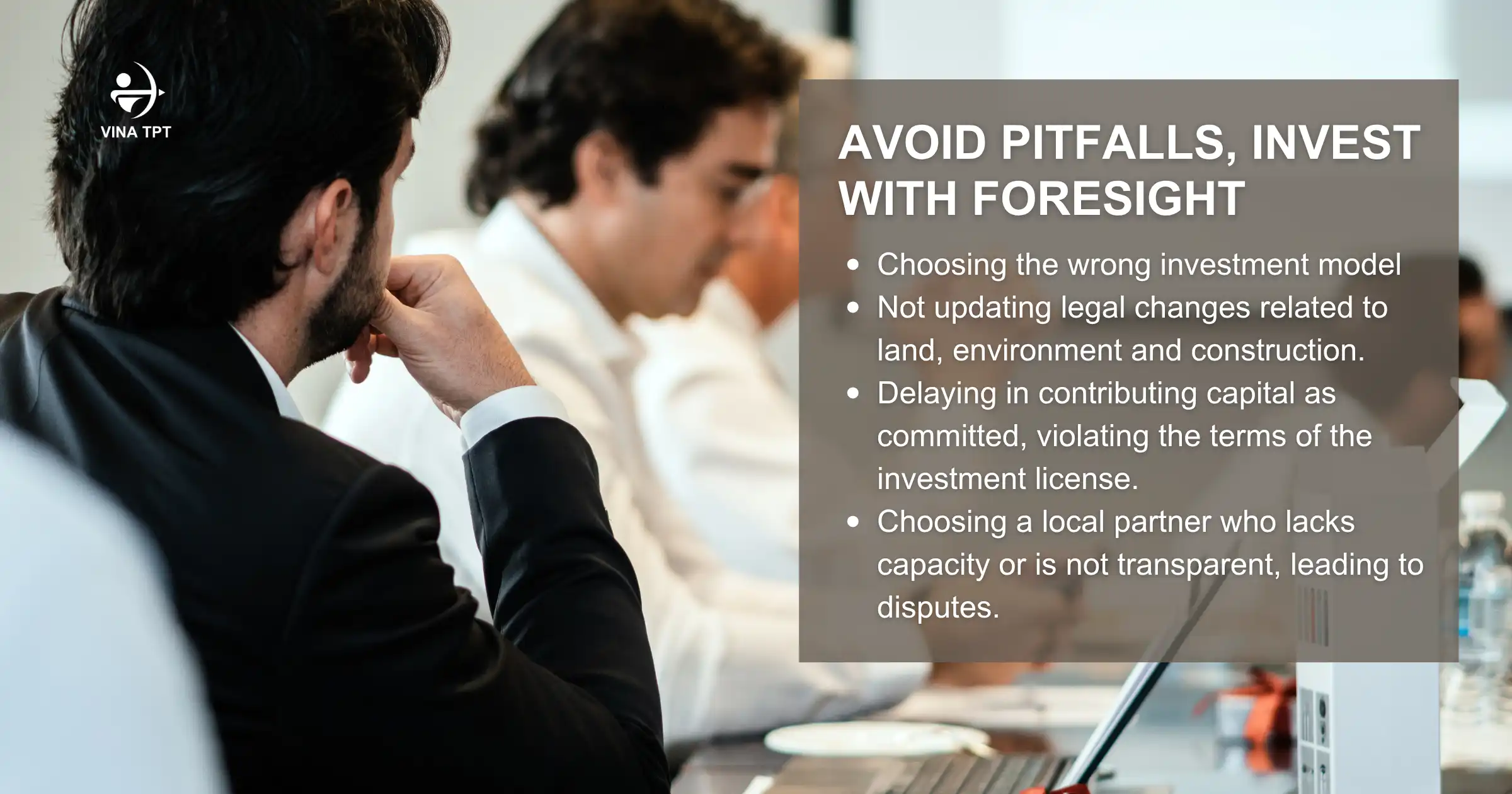
  • Choosing the wrong investment model (for example, registering a trading company instead of a project development company, leading to restrictions on land use).
  • Not updating legal changes related to land, environment and construction.
  • Delaying in contributing capital as committed, violating the terms of the investment license.
  • Choosing a local partner who lacks capacity or is not transparent, leading to disputes.

An excellent business advisory service will help investors avoid these mistakes right from the start, thanks to legal review, partner assessment and risk control throughout the investment process. 

Business advisory for Singaporean investors establishing real estate businesses in Vietnam

6. Why Partnering with Vina TPT Business Advisory Makes a Difference 

With over 15 years of experience in advising companies, Vina TPT Business Advisory Service’s team of legal, accounting and tax experts has worked with hundreds of international enterprises in the real estate, infrastructure and manufacturing sectors.

We provide end-to-end solutions, from developing investment strategies, applying for IRC/ERC licenses, advising on tax structures, to compliance management and post-investment operational accounting. Vina TPT’s strength lies in combining a deep understanding of Vietnamese law with international operational standards, helping Singaporean investors ensure compliance while optimizing profits.

If you are looking for a business consulting partner with market knowledge and the ability to handle everything from legal to tax, Vina TPT Business Advisory is the reliable bridge between Singapore and Vietnam.

BOOK A FREE CONSULTATION

business-advisory-services

HR outsourcing for Singapore logistics businesses in Vietnam

alt="HR outsourcing services for Singapore logistics companies operating in Vietnam"

alt="HR outsourcing services for Singapore logistics companies operating in Vietnam"

HR outsourcing

1. The Growing Footprint of Singapore Logistics in Vietnam

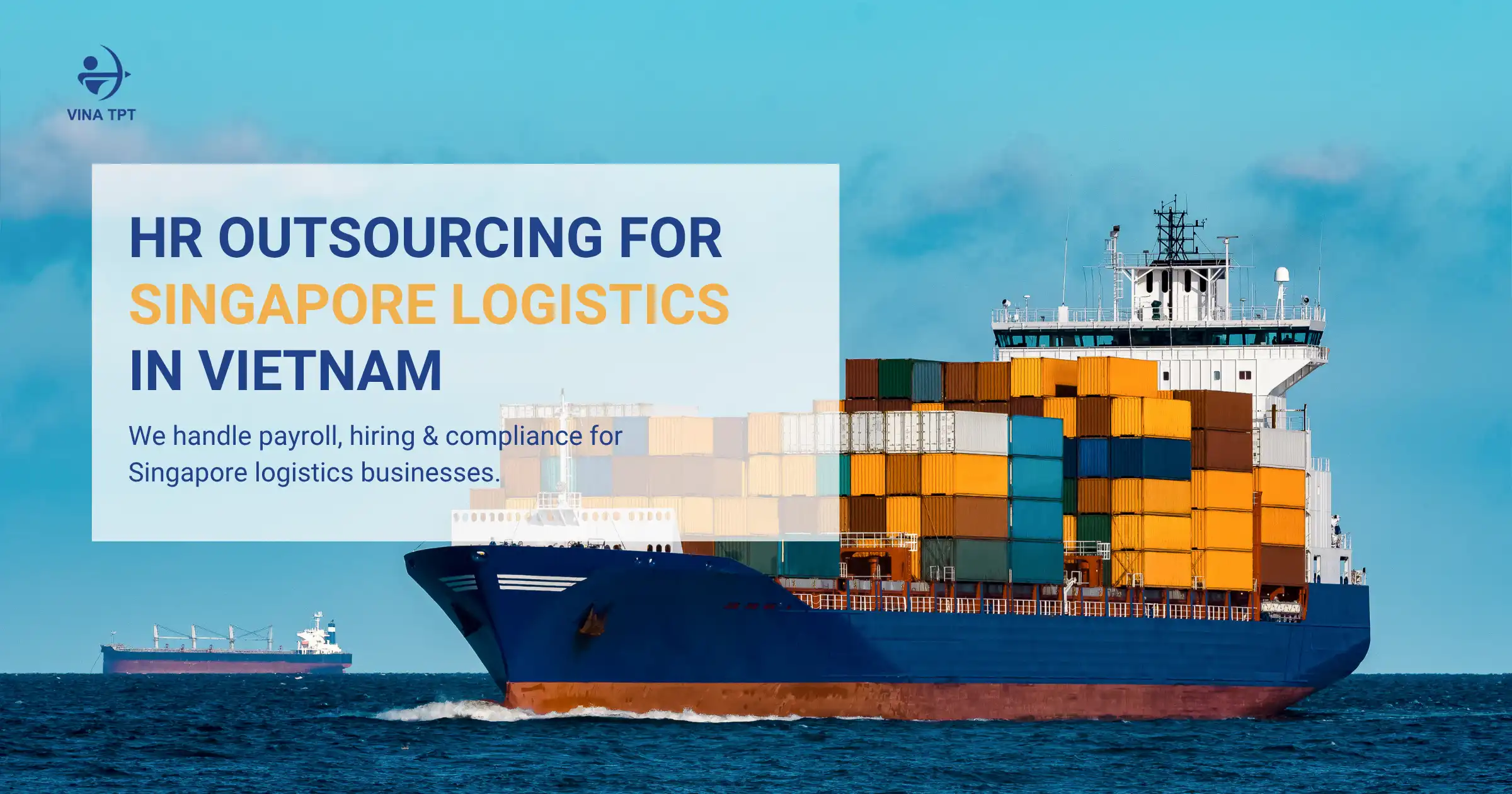
In the regional investment landscape, Vietnam is becoming a strategic destination for many Singaporean logistics companies. Along with the boom in e-commerce, the demand for cold supply chains, distribution centers and cross-border transportation has led to an unprecedented wave of investment in Singapore’s industrial parks, seaports and logistics centers in Vietnam. 

However, when businesses begin to expand their operations in Vietnam, one of the biggest challenges is not technology or infrastructure, but the human factor. The Vietnamese labor market is significantly different from Singapore’s – from human resource structure, working habits to legal regulations. This makes setting up an internal human resource system for foreign businesses complicated, especially in the early stages of investment or expansion.

2. The HR Puzzle in Vietnam’s Logistics Sector

Vietnam’s logistics industry is a dynamic sector, but also full of challenges in human resource management. The labor force is abundant but there is a shortage of specialized skills, especially in positions such as coordinators, warehouse operators, container drivers or refrigerated transport personnel. In addition, the nature of shift work and the requirement to operate 24/7 requires businesses to maintain a flexible staff while still ensuring compliance with regulations on working hours, leave, contracts and social insurance.

Not only that, the Vietnamese legal system on labor, personal income tax and compulsory insurance has detailed and regularly updated regulations. If foreign businesses do not fully understand, they can easily make administrative mistakes such as false declarations, late insurance payments or lack of valid documents. In addition, the high turnover rate among unskilled workers also causes businesses to spend a lot of money on recruitment and continuous training.

The cultural differences in management between Singapore, which emphasizes efficiency and discipline – and Vietnam, which emphasizes flexibility and humanity – also create a significant gap. That is why many Singaporean logistics enterprises choose HR outsourcing solutions to optimize processes and minimize operational risks.

3. How HR Outsourcing Simplifies Cross-Border Operations

HR outsourcing is becoming an inevitable trend for Singaporean businesses when expanding to Vietnam. Instead of establishing an internal HR department, businesses can entrust the entire recruitment process, contract management, timekeeping, payroll and insurance implementation to a professional unit.

This solution brings many obvious benefits. First of all, businesses significantly save fixed costs related to recruitment, training and maintaining the HR department. All operations are performed by experts with knowledge of Vietnamese law, ensuring absolute compliance with labor and tax regulations. Next, the payroll calculation and personnel records management process is fully automated and digitized, helping to eliminate manual errors and limit audit and reporting risks.

In particular, for logistics businesses operating in many provinces and cities, HR outsourcing helps synchronize the multi-location human resource management process, ensuring that all shifts, payrolls and contracts are centrally controlled. This not only saves management time but also increases overall operational efficiency.

SEE HOW IT WORKS

4. Tailored HR Solutions for Logistics Operations

Understanding the specifics of the logistics industry, Vina TPT HR Service has designed specialized HR outsourcing services packages to meet the actual needs of Singaporean businesses in Vietnam. Services include recruitment, initial training, signing and managing labor contracts, timekeeping, payroll calculation and personal income tax declaration for employees.

We especially focus on key positions such as drivers, coordinators, warehouse operators and shift supervisors, helping businesses maintain a stable team throughout the operation process. In addition, Vina TPT’s electronic payroll management system allows payroll processing at multiple branches at the same time, ensuring accuracy, transparency and timeliness.

In addition, the service also supports onboarding procedures for new employees, setting up welfare and social insurance regimes in accordance with regulations, as well as consulting on human resource strategies suitable for each expansion stage. Thanks to that, businesses can fully focus on core logistics activities – instead of being distracted by heavy administrative procedures.

5. Vina TPT: Local Expertise for Regional Expansion

With a team of Human Resource experts, lawyers and accountants with 10 to 20 years of experience, having worked with more than 200 FDI enterprises in Vietnam, Vina TPT HR Service is not only a service provider but also a strategic companion of Singaporean enterprises.

We understand the differences between the Vietnamese and Singaporean labor systems, thereby helping customers establish flexible human resource processes while still strictly complying with local laws. Our outsourced HR services ensure that businesses always operate stably, costs are optimized and legal risks are minimized.

In the context of Vietnam emerging as a new logistics hub of Southeast Asia, choosing a capable and experienced HR outsourcing partner like Vina TPT will be a solid foundation for Singaporean enterprises to accelerate sustainable development.

Vina TPT HR Service – Specialized human resource solutions, helping Singapore logistics businesses operate effectively and expand steadily in Vietnam.

BOOK A FREE CONSULTATION

Payroll-HR-Manager-Vietnam-VinaTPT

Business Setup Consultant Vietnam: Start Your Small Foreign Business Smoothly

alt="Foreign investors establish business in Vietnam with professional setup consultant support"

alt="Foreign investors establish business in Vietnam with professional setup consultant support"

1. Why Small Foreign Investors Choose to Establish Business in Vietnam

Vietnam is becoming an ideal destination for small investors thanks to its low operating costs, young workforce and large consumer market. Compared to many other countries in the region, establishing a business in Vietnam brings clear advantages in terms of rental costs, labor and customer access. In addition, the Vietnamese Government is increasingly issuing many preferential policies to attract FDI capital, especially in the fields of technology, education, trade services and clean agriculture.

Some small business sectors that are attracting the attention of foreign investors include:

  • International style restaurants and cafes
  • Foreign language and skills training centers
  • Small-scale e-commerce startups
  • Consulting and creative design services
  • Beauty & wellness services
  • Fashion and lifestyle boutiques
  • Cosmetics and personal care retail. These sectors are particularly attractive to investors from Japan, South Korea, the United States, and China, where consumer demand and business expansion opportunities in Vietnam are seen as highly promising.

With strong growth potential, opening a small-scale company is not only suitable for market exploration but also a foundation for future business expansion.

DISCOVER HOW BUSINESS SETUP CONSULTANT VIETNAM CAN HELP YOU 

2. Legal Basics for Small-Scale Foreign Businesses

To establish a business in Vietnam, small investors need to understand the basic legal regulations. The good news is that small-scale projects often require low investment capital and simpler procedures than large enterprises.

Some important legal factors include:

  • Minimum investment capital: depending on the field, many industries do not require high statutory capital, making it easy for investors to start.
  • Registered industries: need to choose industries that are allowed according to Vietnamese law and the WTO.
  • Business license: for conditional fields such as education, logistics services, or restaurants – cafes, businesses need to apply for additional specialized licenses.
  • Business type: the most popular for small investors is a Limited Liability Company (LLC) or Representative Office.

Understanding these conditions will help the business registration process go smoothly and legally from the beginning.

3. Step-by-Step Guide to Setting Up a Small Business

When small foreign investors plan to establish business in Vietnam, understanding the step-by-step process is essential to avoid unnecessary delays and legal risks. Setting up a business may sound complex, but with the right guidance, it can be smooth and straightforward.

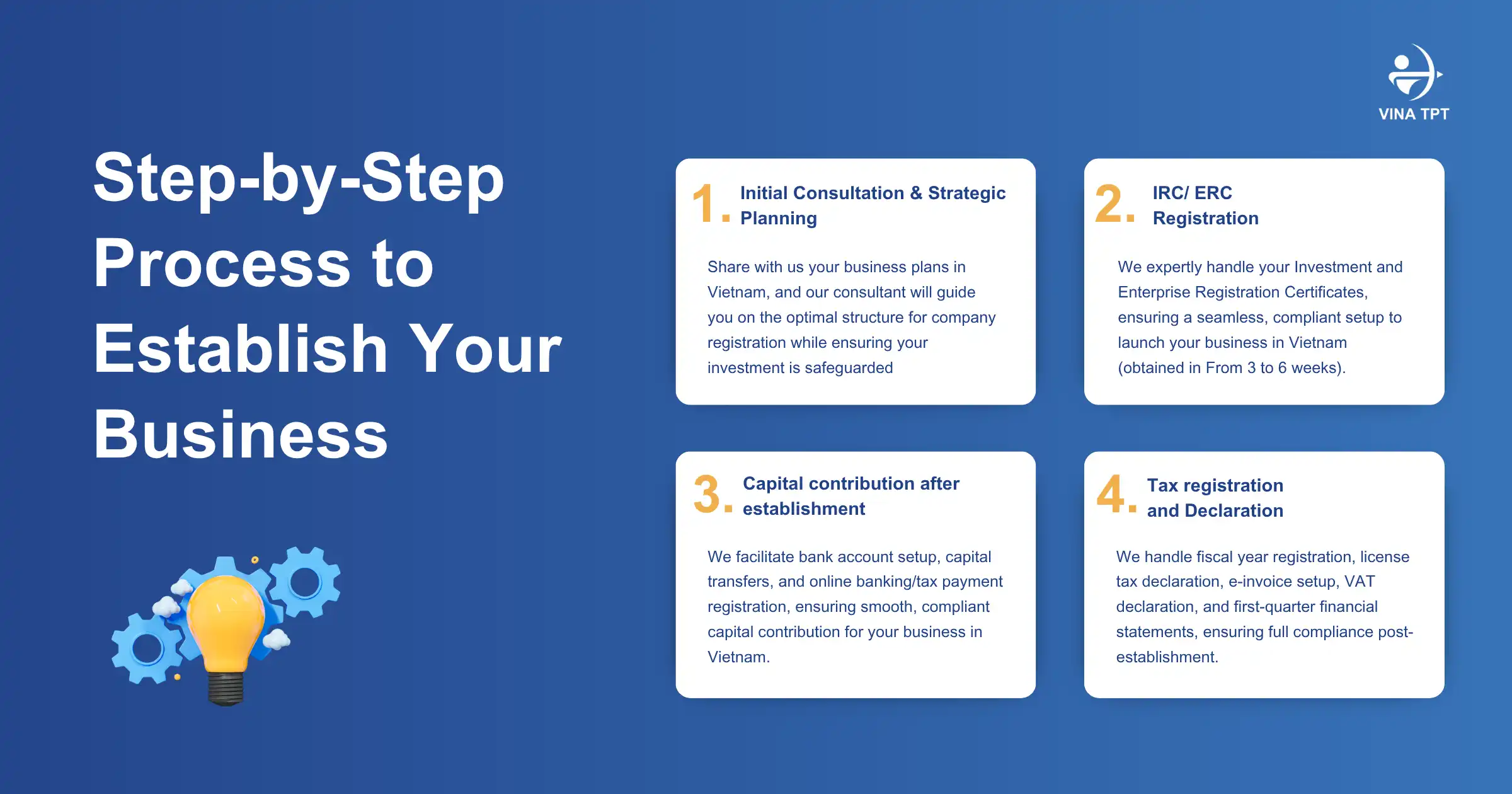
Step 1: Prepare the investment documents – This includes drafting the investment proposal, choosing the right business structure (LLC, joint venture, or representative office), and identifying the scope of activities. Investors need to ensure that their chosen industry is open for foreign participation under Vietnamese law.

Step 2: Apply for the Investment Registration Certificate (IRC) – For most foreign-owned companies, this is the first legal approval. It confirms the investor’s right to operate in Vietnam and outlines essential project details such as charter capital, investment scale, location, and business scope. Without the IRC, foreign investors cannot proceed to the next step of enterprise registration.

Documents typically required for IRC application include:

  • Application for investment project implementation & Project proposal: Stating objectives, scope, scale, investment capital, location, and implementation schedule.
  • Proof of investor’s financial capacity: Bank statements, audited financial reports, credit contracts, or collateral documents.
  • Legal documents of the investor:
  • For individuals: Notarized passport, consular legalization.
  • For organizations: Business Registration Certificate or equivalent, consular legalization.
  • Evidence of project location: Office/land lease agreement or land use rights certificate.
  • Power of attorney/authorization letter (if the investor appoints a third party to handle procedures).

All foreign documents must be consular legalized and officially translated into Vietnamese before submission. This step often prolongs the preparation process, so it is recommended that investors cooperate with a reliable company registration service to ensure accuracy and save time.

Step 3: Obtain the Enterprise Registration Certificate (ERC) – Once the IRC is granted, the next step is to register the business entity officially. This is comparable to a company registration service and provides the legal identity of the enterprise.

Step 4: Open a bank account and contribute charter capital. After receiving the Enterprise Registration Certificate (ERC), investors are required to open a capital account at a licensed commercial bank in Vietnam. This account will be used exclusively for injecting charter capital and handling transactions related to foreign investment.

Capital contribution timeline: The owner/members/shareholders must fully contribute the registered charter capital within 90 days from the issuance date of the ERC. Failure to meet this deadline may result in administrative penalties or forced adjustment of charter capital in the company’s registration.

Contributing capital on time is not only a compliance requirement but also strengthens the company’s credibility when applying for future business licenses, work permits, or expanding operations in Vietnam.

Step 5: Register for tax and post-licensing procedures – This includes obtaining tax codes, registering for VAT, and fulfilling labor and insurance obligations if hiring employees.

Step 6: Apply for additional sector-specific licenses (if required) – For industries such as F&B, education, or e-commerce, further permits may be necessary.

By working with a trusted business setup consultant Vietnam, small investors can streamline the above steps, reduce administrative burdens, and ensure full compliance with local regulations. Firms like Vina TPT company registration provide end-to-end assistance, helping investors save time and resources while minimizing costly mistakes.

I If you want to establish business in Vietnam without unnecessary delays, consider working with a reliable company registration service like Vina TPT. Our business setup consultant Vietnam team is ready to guide you through every step smoothly. With a team of seasoned lawyers and tax experts possessing 10–20 years of experience and having worked with more than 200 FDI enterprises, we are well-equipped to anticipate regulatory hurdles, streamline documentation, and ensure full compliance with local laws.

alt="Foreign investors establish business in Vietnam with professional setup consultant support"

4. Cost-Saving Tips for Small Investors

For small investors establishing a business in Vietnam, saving costs is an important factor in maintaining capital flow for business operations. One of the most effective ways is to choose a business type that is suitable for the scale and development goals, such as a limited liability company instead of a joint stock company. In addition, optimizing charter capital also helps reduce initial financial pressure while still ensuring compliance with legal requirements. Instead of handling all the complicated procedures themselves, investors should use a professional company registration service. This not only helps minimize the risk of errors, but also saves time and costs arising from delayed procedures or having to supplement them many times.

5. Working with a Business Setup Consultant

Working with a business setup consultant Vietnam brings great advantages to foreign investors, especially small businesses that are new to the market. With a deep understanding of the legal system, licensing conditions and administrative procedures, consultants will help the entire procedure take place quickly and legally. Moreover, they also play the role of strategic advisors, providing cost-optimized solutions, choosing feasible business lines and supporting the handling of problems arising during the business operation process. This helps investors not only shorten the time to set up a business but also focus on core business activities from the very first days.

To turn investment plans into reality quickly and economically, many small investors have chosen to accompany Vina TPT with a complete company registration service, ensuring legal and transparent procedures right from the first step.

6. Vina TPT Company Registration Service for Small Investors

With experience supporting hundreds of foreign investors, Vina TPT company registration service offers a complete solution specifically for small businesses.

Vina TPT’s strengths:

  • Advising on costs and reasonable capital structures for small startups.
  • Preparing complete and correct business registration documents.
  • Representing and monitoring the progress with state agencies.
  • Supporting post-registration procedures: seal engraving, account opening, tax declaration.

alt="Foreign investors establish business in Vietnam with professional setup consultant support"

Thanks to professional services and a team of legal experts, Vina TPT helps small investors establish businesses in Vietnam easily, quickly and legally.

Contact Vina TPT now to use the Business setup consultant Vietnam service to start your business journey in Vietnam with optimal costs and transparent procedures.

BOOK A FREE CONSULTATION

Laywer-Establish-business-Vietnam-VinaTPT


Cost Comparison: In-House HR vs Outsourced Payroll for FDI in Vietnam

Vina TPT HR outsourcing Vietnam solution for foreign businesses

hr-outsourcing-vietnam-consultant-service

1. HR Management Challenges for FDI Companies in Vietnam

As FDI companies expand their operations and investments in Vietnam, HR Outsourcing Vietnam becomes an increasingly relevant solution as one of the biggest challenges is hiring employees and building an internal HR department. The labor system in Vietnam has many specific regulations such as social insurance, health insurance, personal income tax law and regulations on labor contracts. For newly established businesses in Vietnam, understanding this entire legal framework often takes a lot of time, resources and is prone to errors. 

In addition, cultural differences and language barriers also create additional pressure when businesses want to recruit the right people, manage benefits and set up Human Resources Management Challenges for FDI Companies in Vietnam

As FDI companies expand their operations and investments in Vietnam, HR Outsourcing Vietnam becomes an increasingly relevant solution as one of the biggest challenges is hiring employees and building an internal Human Resources department. The labor system in Vietnam has many specific regulations such as social insurance, health insurance, personal income tax law and regulations on labor contracts. For newly established businesses in Vietnam, understanding this entire legal framework often takes a lot of time, resources and is prone to errors. 


In addition, cultural differences and language barriers also create additional pressure when businesses want to recruit the right people, manage benefits and set up Hiring Relation systems. This is the reason why more and more FDI companies choose HR & payroll service as a safer, more economical and effective solution than building an in-house HR team from the beginning.

2. Understanding In-House HR Costs

When maintaining an in-house HR department, FDI enterprises must consider many hidden and fixed costs. First is the recruitment cost, including advertising, headhunter fees, interviews, and training. Next is the salary and benefits for the Human Resources team, which are often higher due to the demand for personnel with legal knowledge and bilingual skills. Moreover, for every in-house employee, enterprises must also pay compulsory social insurance, health insurance, and unemployment insurance, which together amount to approximately 20.5% of the employee’s monthly salary.

In addition, enterprises need to invest in HR & payroll software systems, employee records management, timekeeping, and payroll calculation. Operating costs such as office space, equipment, and the management time required from the board of directors also cannot be overlooked. Particularly for businesses in Vietnam during the early stages, this total cost structure can easily exceed the planned budget, creating financial pressure and reducing operational flexibility. 

Therefore, outsourcing or applying HR & payroll service is becoming a more effective alternative, helping FDI enterprises balance finances and focus on business development.

DISCOVER HR OUTSOURCING VIETNAM BENEFITS

3. Breakdown of Outsourced HR & Payroll Service Expenses

When choosing HR & payroll service, businesses only need to pay service fee based on the number of employees, instead of bearing the entire fixed cost of in-house HR. HR outsourcing service usually includes many items: drafting labor contracts, registering for social insurance, managing employee records, processing monthly payroll, declaring and paying personal income tax. Some advanced packages also support legal advice, updating changes in labor laws, and providing periodic human resources reports. Compared to maintaining an entire HR department, outsourcing allows businesses to predict and control costs more clearly. Especially for companies that have just opened a business in Vietnam, Vina TPT Hiring Employees Service brings advantages thanks to its flexible model, all-inclusive services, and transparent costs, ensuring that businesses only pay for what is necessary without incurring unexpected fees.

4. Key Factors Beyond Cost

Although cost is an important factor, when comparing in-house HR and outsourced service, FDI enterprises need to consider more long-term values. One of them is compliance with Vietnamese labor laws, a factor that helps avoid legal risks and protect brand reputation. Next is flexibility, allowing enterprises to easily expand or reduce the size of their staff without having to recruit or fire them complicatedly. In addition, outsourcing also brings operational efficiency, helping the management focus resources on business development strategies in Vietnam instead of handling administrative procedures. 

With HR & payroll service, enterprises have access to experts who understand the market, laws and local HR processes. This is a factor that Vina TPT Hiring Employees Service is providing outstandingly, bringing peace of mind to FDI when managing human resources in Vietnam.

5. Cost-Benefit Analysis: In-House vs Outsourcing

If analyzed as a whole, we can see a clear difference between maintaining an in-house HR department and using HR outsourcing combined with HR & payroll service:

HR in-house:

  • Enterprises have the ability to directly control their human resources and internal processes.
  • However, the costs of recruitment, training, salaries, benefits and maintaining the management system are very high.
  • The risk of errors in compliance with labor laws and tax regulations often occurs, especially for FDI enterprises that have just started doing business in Vietnam.

Outsourced HR & payroll service:

  • Provides a cost-saving solution, easily scalable according to the size of the workforce.
  • Reduces costs by 30–50% compared to maintaining in-house HR while still ensuring transparency and effective management.
  • Minimizes legal and administrative risks, while ensuring compliance with labor and tax regulations in Vietnam.
  • Creating transparent human resource data, supporting businesses in long-term development planning.

Looking at both costs and benefits, outsourcing HR is not only a short-term option but also an optimal strategy for FDI companies that want to develop sustainably in Vietnam.

6. Vina TPT Hiring Employees Service Advantage

Vina TPT Hiring Employees Service is specially designed for FDI enterprises that want to build and operate their business in Vietnam effectively. With a team of experts knowledgeable in labor, insurance and tax laws, Vina TPT provides a complete HR & payroll service solution including: recruitment, contract drafting, salary and bonus management, social insurance, and personal income tax declaration. The big difference of Vina TPT is the ability to advise on human resource strategies in parallel with legal compliance, ensuring that businesses both save costs and operate transparently. Instead of spending months building in-house HR, businesses can quickly deploy an optimal HR system in just a few days. This is the advantage that helps FDI companies confidently expand their scale, flexibly manage human resources and develop sustainably in the Vietnamese market.

Vina TPT’s HR & payroll service helps businesses save costs, reduce risks and focus on business development in Vietnam. Contact now!

BOOK A FREE CONSULTATION

Payroll-HR-Manager-Vietnam-VinaTPT

Updated 2025 | Corporate Income Tax Rates in Vietnam

Updated 2025 Corporate Income Tax Regulations in Vietnam

Corporate Income Tax Rate in Vietnam in 2025

Since October 1, 2025, under the provisions of Law No. 67/2025/QH15, the Corporate Income Tax (CIT) rates will be officially adjusted and applied nationwide.

Businesses should pay attention to the changes in CIT rates, including the standard rate of 20%, higher tax rates for the natural resource extraction sector, and new CIT incentives for small and medium-sized enterprises (SMEs) as well as businesses operating in priority sectors.

The following article provides a comprehensive update on corporate income tax rates, eligible taxpayers, and major tax incentives applicable in 2025.

1. What is Corporate Income Tax (CIT)?

Corporate Income Tax (CIT) is a direct tax levied on the remaining profit after deducting all allowable expenses incurred during business operations.

It is a significant source of revenue for the state budget and serves as an indicator of a company’s operational efficiency during the accounting period.

2. Who is Subject to Corporate Income Tax (CIT)?

Corporate Income Tax (CIT) is a mandatory financial obligation for organizations engaged in profit-generating business activities.

Entities required to pay Corporate Income Tax include:

  • Enterprises established and operating in Vietnam
  • Foreign enterprises with a permanent establishment in Vietnam
  • Foreign enterprises without a permanent establishment in Vietnam but having income arising in Vietnam
  • Other enterprises established under Vietnamese law with business activities and income generation
  • Public service units with business activities
  • According to the 2025 CIT law effective from October 1, 2025, digital platforms and e-commerce entities without establishments in Vietnam but providing services domestically must also declare and pay CIT.

Who is Subject to Corporate Income Tax in Vietnam


3. Corporate Income Tax Rates 

According to current regulations, Corporate Income Tax (CIT) rates for 2025 are applied as follows:

3.1. Standard CIT Rate 20%

Applicable to most enterprises established under Vietnamese law, engaged in the production and business of goods and services.

This is the standard tax rate applied to most enterprises not eligible for tax incentives.

3.2. CIT Rate 32% – 50%

Tax rates from 32% to 50% apply to exploration and exploitation of oil and gas activities in Vietnam.

The specific tax rate will be determined based on:

  • Location of extraction
  • Extraction conditions
  • Reserve volume

3.3. CIT Rate 25% – 50%

Rates from 25% to 50% apply to oil and gas exploration, prospecting, and extraction (depending on location, extraction conditions, and reserve volume, rates will vary).

3.4. CIT Rate 50%

Applied to exploration and extraction of rare resources:

  • Platinum
  • Gold
  • Silver
  • Tin
  • Vonfram (wolfram)
  • Antimon
  • Gemstones
  • Rare earth
  • Other rare and precious resources as prescribed by law

3.5. CIT Rate 40%

Applied to mines with 70% or more of allocated area located in socio-economically difficult regions.

3.6. Preferential CIT Rates

Preferential rate 15%: applied to enterprises with annual total revenue not exceeding 3 billion VND.

Preferential rate 17%: applied to enterprises with annual total revenue over 3 billion VND up to 50 billion VND.

Revenue for eligibility determination is based on the total revenue of the immediately preceding CIT taxable period. 

A 10% CIT rate for 10–15 years is for:

  • New investment projects in high-tech fields
  • Enterprises in socio-economically disadvantaged areas
  • Enterprises in high-tech zones and high-tech agricultural application zones

4. Partnering with Vina TPT for Reliable Accounting and Corporate Tax Consulting Services

With over 15 years of experience and deep expertise in Vietnamese accounting and tax regulations, Vina TPT is a trusted partner for businesses seeking reliable support in managing their Corporate Income Tax obligations. Our team of seasoned professionals provides end-to-end services covering both Quarterly Corporate Income Tax (CIT) reporting and Annual CIT Finalization, ensuring full compliance with current laws and minimizing the risk of penalties or reporting errors.

As Corporate Income Tax regulations in Vietnam continue to evolve, it is essential for companies to stay updated and implement accurate tax strategies. Vina TPT’s comprehensive approach includes document review, deadline tracking, and strategic consulting tailored to your business size and sector. Whether you are a local enterprise or a foreign-invested company, our services are designed to help your business navigates Vietnam’s tax environment with confidence, optimize tax efficiency, and support your long-term financial goals.

Contact Vina TPT today for trusted full-service accounting and tax solutions in Vietnam.

BOOK A FREE CONSULTATION

accounting service Vietnam for Chinese company vtpt


VNeID for Foreigners in Vietnam | Step by step to Register

VNeID for Foreigners in Vietnam

VNeID for Foreigners in Vietnam

As Vietnam continues to digitize public services, understanding how to use VNeID for foreigners in Vietnam has become essential for long-term residents, travelers, and expatriates. VNeID, the official electronic identification app issued by the Ministry of Public Security, allows users to access various government services, prove identity, and travel more conveniently within the country. For foreigners, registering and activating VNeID can simplify daily activities such as checking into accommodations, accessing healthcare, or handling administrative procedures. The following article explains step-by-step process of obtaining and using VNeID for foreigners in Vietnam.

1. Are Foreigners in Vietnam Eligible for Electronic Identification (VNeID)? 

Based on Article 11 of Decree 59/2022/NĐ-CP, foreigners aged 14 and above entering Vietnam are eligible for a VNeID account. In cases where foreigners are under 14 or under guardianship, registration will be linked to the VNeID account of their parent or guardian. 

2. Why is VNeID Important to Foreigners in Vietnam?

VNeID for foreigners in Vietnam is increasingly important as Vietnam shifts toward digital governance and paperless identification. For foreigners living, working, or traveling in Vietnam, VNeID provides a secure and official way to verify identity, reducing the need to carry physical documents like passports or residence cards. The app is used for checking into hotels, booking domestic flights, accessing public services, and even during police checks or administrative procedures.

Also, VNeID integrates personal information such as visa status, address, and legal records, making interactions with Vietnamese authorities more efficient. As more services transition to digital platforms, having a VNeID becomes not just convenient but often required. Without VNeID, foreigners in Vietnam may get in troubles when accessing essential services. Overall, VNeID for foreigners in Vietnam plays a vital role in helping individuals stay compliant, access services easily, and navigate life with confidence.

3. How to Register for VNeID for Foreigners in Vietnam?

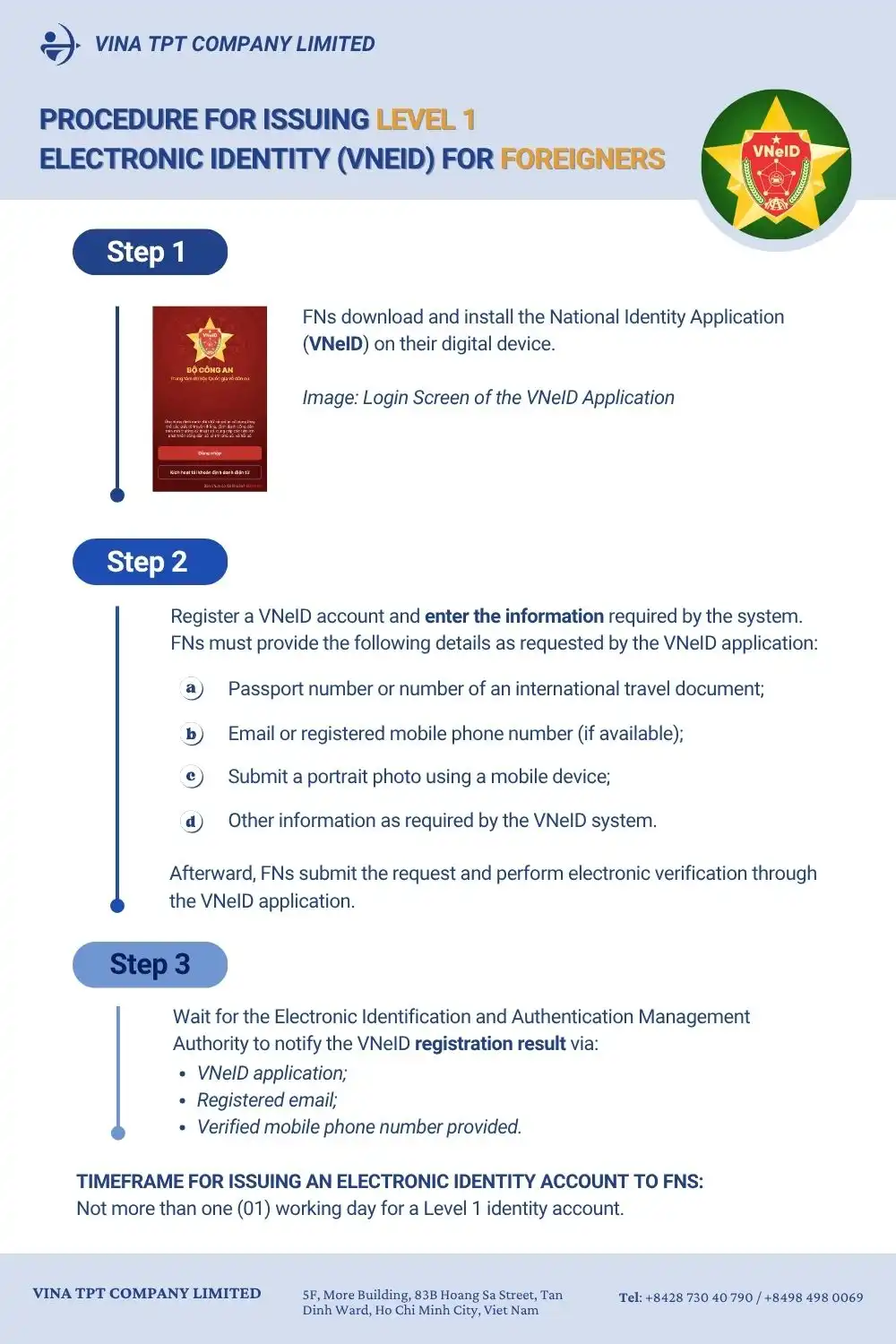
3.1 Procedure for Issuing Level 1 VNeID for Foreigners in Vietnam

VNeID Level 1

Step 1

Foreigners in Vietnam need to download and install the VNeID application on a digital device

Step 2

Select “Register for VNeID account” and fill in all the required information as prompted by the system.

The VNeID registration will require the following information:

  • Passport number or valid international travel document number
  • Registered email or phone number (if available)
  • Provide a portrait photo using a mobile device
  • Other information as required by the VNeID system

Following that, foreigners submit the request and verifies electronically via the VNeID application.

Step 3

Wait for the Electronic Identification and Authentication Management Authority to notify the VNeID registration result via:

  • VNeID application
  • Registered email
  • Verified phone number provided

Timeframe for issuing an Electronic Identity account to foreigners: Not more than one (01) working day for a level 1 identity account.

Explore Our Services For Foreigner

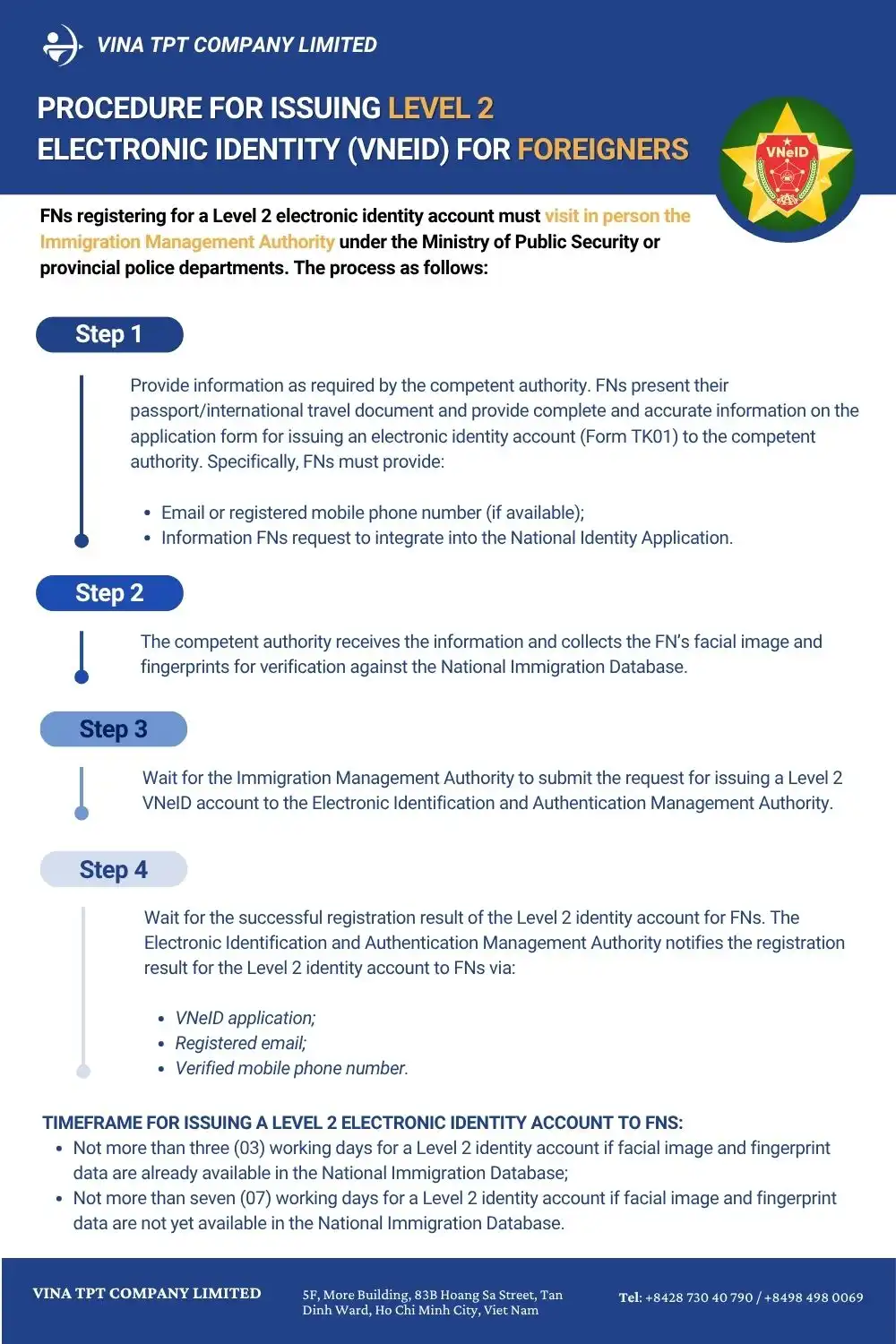
3.2 Procedure for Issuing Level 2 VNeID for Foreigners in Vietnam

VNeID Level 2

Foreigners registering for a Level 2 VNeID account must visit in person the Immigration Management Authority under the Ministry of Public Security or provincial police departments. The process as follows:

Step 1

Provide information as required by the competent authority. Foreigners need to present their passport/international travel documents and provide accurate information on the VNeID account request form (Form TK01 – below) to the competent authority. Specifically, Foreigners must provide:

  • Email/phone number registered for subscriber information (if available)
  • Information foreigners request to integrate into the national VNeID application

Step 2

The competent authority collects foreigner’s facial photo and fingerprints for verification against the national immigration database.

Step 3

Wait for the Immigration Management Authority to submit the request for issuing a Level 2 VNeID account to the Electronic Identification and Authentication Management Authority.

Step 4

Wait for the successful registration result of the Level 2 identity account for FNs. The Electronic Identification and Authentication Management Authority notifies the registration result for the Level 2 identity account to FNs via:

  • VNeID application
  • Registered email
  • Verified mobile phone number

Timeframe for issuing a Level 2 VNeID account to foreigners:

  • Not more than three (03) working days for a Level 2 identity account if facial image and fingerprint data are already available in the National Immigration Database
  • Not more than seven (07) working days for a Level 2 identity account if facial image and fingerprint data are not yet available in the National Immigration Database

4. Conclusion

In summary, obtaining a VNeID for foreigners in Vietnam is now an essential step in complying with local regulations and accessing key services. From travel and accommodation to public administration, this digital ID plays a vital role.

Vina TPT Expat HR Services offers comprehensive consulting and support services for obtaining electronic identification (VNeID) for foreigners in Vietnam. From document preparation to application submission and process monitoring, our team ensure every step is handled with accuracy and efficiency.

BOOK A FREE CONSULTATION

Payroll-HR-Manager-Vietnam-VinaTPT


How Singapore Investors Can Smoothly Establish Business in Vietnam

establish business in Vietnam with vtpt

establish business in Vietnam with vtpt

1. Why Singapore Investors Choose to Establish Business in Vietnam  

Vietnam is becoming an attractive investment destination for Singapore investors in Vietnam thanks to its strategic geographical location in Southeast Asia, competitive labor and operating costs, and free trade agreements (FTAs) that facilitate exports and trade.

For small and medium-sized enterprises from Singapore, establishing a business in Vietnam opens up opportunities to access a large consumer market, taking advantage of lower operating costs compared to other saturated markets. In addition, the preferential policies of the Vietnamese Government for a number of industries such as technology, manufacturing, education and renewable energy also increase the attractiveness, helping Singapore investors to expand their scale sustainably.

2. Key Legal Requirements for Singapore Companies

To ensure a smooth business establishment in Vietnam, Singapore investors need to understand the legal requirements. Choosing the type of business such as Limited Liability Company (LLC), Joint Stock Company (JSC) or Representative Office will determine the ownership structure, charter capital and management rights.

Investors need to determine the investment capital, business lines and licensing conditions. Some specific business lines may require additional licenses or pre-investment approval from state agencies. Basic legal documents include the company charter, list of shareholders/members, legal documents of the investor, legal head office address, and capital contribution plan.

For FDI projects, Singapore investors need to apply for an Investment Registration Certificate (IRC) to get investment approval, then apply for an Enterprise Registration Certificate (ERC) – the official business license and tax code of the enterprise. Compliance with these legal requirements is a prerequisite for legal and effective business operations.

3. Prepare Documents and Apply for Business License (IRC & ERC)

For Singapore investors in Vietnam, establishing a business in Vietnam cannot be separated from the steps of preparing documents and applying for licenses. This is an important stage, especially for FDI projects, because complete and accurate documents determine the progress of granting Investment Registration Certificate (IRC) and Enterprise Registration Certificate (ERC) – two mandatory licenses for businesses to operate legally.

3.1 Investment Registration Certificate (IRC) – For FDI

For projects with foreign investment capital, IRC is the first license, allowing investors to implement projects in Vietnam. The documents usually include:

  • Application for implementing investment projects and Investment Plan, clearly stating the objectives, scale, location, capital and progress of the project.
  • Evidence of the investor’s financial capacity, such as bank statements, credit contracts or mortgaged assets.
  • Legal documents of the investor: individuals submit notarized and consularized passports; legal entities submit notarized and consularized business registration certificates.
  • Project location, including lease contract or land/office use right certificate.

3.2 Enterprise Registration Certificate (ERC) – Operating License

After the IRC is issued (or for 100% domestic-owned enterprises), the investor submits an application for an ERC – which is an official license for the enterprise to operate and also a tax code. The ERC dossier includes:

  • Business registration application.
  • Company Charter, which stipulates the organizational structure, member/shareholder rights, capital contribution ratio and management method.
  • List of shareholders/members and legal representatives, clearly stating information, ownership ratio and voting rights.
  • Appointment decision and authorization letter (if any).
  • Capital contribution plan & proof of financial capacity, especially important for large capital projects.

3.3 General requirements and important notes

  • Notarization, consular legalization & translation into Vietnamese: all documents of foreign investors must be completed before submission. This is a step that often causes delays if the dossier has many shareholders or is complicated.
  • Legal head office address: do not use apartments or collective houses.
  • Unified information: company name, address, capital, and business lines must be consistent on all dossiers.
  • Choosing the right business line: ensure that investment conditions are met to avoid multiple amendments.

3.4 Time to prepare and submit documents

  • Document preparation: 1-2 weeks, depending on the volume and complexity of legalization.
  • IRC appraisal: about 20-45 working days.
  • ERC issuance: 10-20 days after IRC approval.

Due to the complicated process of preparing documents and applying for ERC/IRC, Singapore investors should hire outsourcing with professional services such as Vina TPT start-up business license service. This not only saves time, limits legal errors but also ensures that the licensing process is quick, transparent and safe.


GET EXPERT HELP WITH IRC & ERC REGISTRATION

4. Common Challenges and How to Overcome Them

Singaporean investors often face difficulties due to differences in laws, taxes, and administrative procedures between Vietnam and Singapore. Language barriers and incomplete understanding of regulations also hinder the preparation of documents and communication with authorities.

Common problems include delays in IRC or ERC approval, inconsistent information in documents, and additional licensing requirements for specific industries. Working with a business setup consultant Vietnam helps to minimize these risks through legal advice, accurate document preparation, and direct dealing with government agencies, allowing investors to focus on business planning and strategic operations.

establish business in Vietnam with vtpt

5. Role of a Business Setup Consultant in Vietnam

Using a business setup consultant Vietnam is an important strategy for Singapore investors to optimize the company registration process. Consultants help identify the appropriate type of business, review and prepare all legal documents, and ensure compliance with Vietnamese regulations.

In addition, consultants also provide strategic advice on capital allocation, investment approval, and application for specific industry licenses, helping investors avoid legal errors and shorten the time to complete documents. As a result, Singaporean businesses save costs, time, and feel more secure in long-term development in Vietnam.

6. Vina TPT Company Registration Service for Singapore Investors

Vina TPT company registration offers a complete solution for Singapore investors in Vietnam, with outstanding advantages:

  • Comprehensive support: From initial consultation, document preparation, document submission, to post-registration support.
  • Legal compliance: Ensure documents are valid for both IRC and ERC.
  • Industry expertise: Guidance on applying for additional licenses for regulated fields such as education, fintech, manufacturing.
  • Multilingual service: Bilingual support in Vietnamese and English, ensuring accurate and easy-to-understand information for investors.
  • Save time and costs: Help shorten the registration process, limit errors and reduce operating costs.

Singapore investors can rest assured when choosing Vina TPT company registration to establish business in Vietnam quickly, legally and effectively.

Contact Vina TPT today for advice and quick implementation of business registration in Vietnam!

BOOK A FREE CONSULTATION

Laywer-Establish-business-Vietnam-VinaTPT

Financial Statement Preparation in Vietnam for FDI: Key Differences Between Chinese and Vietnamese Accounting Standards

accounting service Vietnam for Chinese company vtpt

financial-statement-preparation-Vietnam

In recent years, Vietnam has emerged as a strategic destination for Chinese enterprises to invest in FDI, thanks to its advantages in labor costs, geographical proximity and open-door policies to attract foreign capital. However, besides the opportunities, Chinese companies face great challenges in familiarizing themselves with and complying with Vietnamese accounting standards (VAS), which are significantly different from PRC GAAP. This difference directly affects the process of financial statement preparation Vietnam, consolidated reports and tax obligations. To manage effectively and minimize risks, many enterprises choose the Vina TPT accounting system setup solution, which helps build a bilingual accounting system, ensuring transparency and compliance with both Vietnamese regulations and requirements from the parent company in China.

1. Why Chinese Investors Need to Understand Vietnamese Accounting Standards

When investing FDI in Vietnam, Chinese enterprises not only have to comply with the laws on investment and business, but also need to understand Vietnamese accounting standards (VAS). This is the basis for financial statement preparation Vietnam, declaring taxes, and demonstrating transparency to management agencies. Only applying PRC GAAP and ignoring financial statement preparation in Vietnam according to VAS can lead to audit risks, being subject to arrears or difficulties in distributing profits to the parent company. Therefore, understanding and correctly applying Vietnamese accounting standards is not only a matter of compliance, but also a foundation for enterprises to build trust with shareholders, partners and state agencies.

2. Overview of Chinese vs. Vietnamese Accounting Systems

PRC GAAP (Chinese Accounting Standards) and VAS (Vietnamese Accounting Standards) have the same goal of faithfully reflecting the financial situation, but their approaches are different:

  • PRC GAAP: Designed to serve internal management, strict supervision of the Chinese government, emphasizing capital control and compliance with domestic economic policies.
  • VAS: Built to suit the legal and tax environment of Vietnam, closely linked to tax declaration and reporting requirements to management agencies. However, VAS is in the process of integrating with IFRS to approach international standards.

For Chinese companies in Vietnam, this difference creates a gap that needs to be filled, especially when having to prepare reports for management agencies in Vietnam and meet the consolidated reporting requirements of the parent company in China.


TALK TO OUR CHINA–VIETNAM ADVISORS

3. Key Differences in Financial Statement Preparation Vietnam

When preparing financial statements in Vietnam, Chinese enterprises will encounter some major differences between PRC GAAP and VAS, specifically:

  • Revenue: Different ways of recording revenue, especially for long-term transactions or prepaid revenue.
  • Fixed assets: Different methods of asset valuation and depreciation, directly affecting profits and expenses.
  • Provisions and liabilities: VAS has its own provisions on provisioning, while PRC GAAP has a broader scope on estimating liabilities.
  • Presentation: VAS emphasizes compliance with the reporting format issued by the Ministry of Finance, while PRC GAAP is more flexible for enterprises in presentation.
  • International standards: FDI enterprises sometimes have to perform an additional step of converting from VAS to IFRS to serve global reporting.

Understanding these differences helps businesses limit errors and standardize financial data from the start.

4. Compliance Challenges for Chinese FDI Companies

In reality, many Chinese enterprises face difficulties in preparing financial statements in Vietnam. Standardizing bilingual financial statements, handling exchange rate differences, and converting from PRC GAAP to VAS or IFRS can create great pressure on the accounting department. Many enterprises face a lack of personnel who understand both systems, as well as the challenge of meeting the parent company’s expectations of transparency. This is the reason why hiring an accounting service in Vietnam for Chinese companies becomes important.

accounting service Vietnam for Chinese company vtpt

5. Setting Up a Reliable Accounting System in Vietnam

To overcome the above challenges, setting up a reliable accounting system in Vietnam is necessary. Chinese enterprises should choose software that is compatible with VAS and has the ability to export data according to PRC GAAP or IFRS. In addition, the accounting process needs to be standardized, have bilingual personnel, and have close coordination with the parent company.

Therefore, if a business wants to optimize its accounting system and ensure full compliance with Vietnamese regulations as well as requirements from the parent company, choosing a reputable partner like Vina TPT is a strategic step that cannot be ignored.

6. How Vina TPT Supports Chinese Companies Prepare Financial Statements Vietnam

We provides Vina TPT accounting system setup solutions for Chinese enterprises that want to establish business and operate accounting in Vietnam.

  • Comprehensive Accounting Service: Providing a full range of accounting services, from bookkeeping, financial reporting to tax management and bilingual reporting.
  • Dual-Language Expertise: Professional reporting, documentation and communication in both Vietnamese and Chinese, helping the parent company grasp information quickly and accurately.
  • Customized Accounting System Setup: Setting up an accounting system suitable for the scale and model of FDI, including software, processes and operational personnel.
  • Regulatory Compliance: Supporting businesses to fully comply with Vietnamese accounting standards (VAS) while meeting the reporting requirements of the parent company in China.
  • Strategic Financial Advisory: Providing financial strategy advice based on accurate data, helping businesses optimize cash flow, plan budgets and prepare for audits.

Please contact Vina TPT today for consultation on a complete accounting service solution in Vietnam, ensuring compliance and transparency for Chinese businesses in Vietnam.

BOOK A FREE CONSULTATION

financial-statement-preparation-Vietnam

Vietnam Accounting & Tax Services for Japanese Investors

vtpt hire accounting service

vtpt hire accounting service

1. The Need to Hire Accounting Service for Japanese Investors in Vietnam

Vietnam is emerging as one of the top investment destinations in Asia, attracting more and more Japanese businesses looking for new growth opportunities. However, differences in laws, accounting standards and business environments make hiring accounting services a strategic factor to ensure success right from the start.

For Japanese companies, cooperating with a reputable Vietnamese accounting service unit not only helps with daily financial management but also ensures Vietnam accounting compliance for Japanese business, meets the reporting requirements of the parent company and complies with strict regulations in Vietnam. Hiring Vina TPT accounting service helps investors reduce administrative burden, limit errors in tax declarations, and build a transparent accounting system, supporting the long-term business expansion process.

2. Common Financial Challenges for Japanese Businesses

When operating in Vietnam, Japanese businesses often encounter some unique difficulties related to Vietnam accounting compliance for Japanese businesses, including:

  • Different accounting standards: Vietnamese Accounting Standards (VAS) differ significantly from Japanese GAAP and IFRS, requiring accurate and continuous conversion of financial statements.
  • Cash flow and foreign currency management: Exchange rate fluctuations and foreign exchange regulations can affect cash flow, especially for companies that import or transact internationally.
  • Diverse tax requirements: Businesses need to comply with many types of taxes such as Corporate Income Tax (CIT), Value Added Tax (VAT), Foreign Contractor Tax, Personal Income Tax (PIT), as well as social and health insurance.
  • Parallel reporting system: Many companies must simultaneously meet reporting requirements of Vietnam and Japan, resulting in a large amount of accounting and auditing work.

These challenges not only increase the internal workload but also require the support of a highly qualified Vina TPT accounting service partner to help businesses operate financially stably and legally.


BRIDGE JAPAN-VIETNAM ACCOUNTING STANDARDS

3. Essential Services to Hire for Smooth Operations

To overcome barriers and ensure compliance, Japanese investors should hire an accounting service that provides a comprehensive and in-depth service package. Some important services include:

  • Bookkeeping & General Accounting: Standard accounting bookkeeping, invoice management, processing daily transaction documents to ensure accuracy and transparency.
  • Financial Reporting & Conversion: Prepare financial statements according to VAS standards and convert to Japanese GAAP or IFRS for auditing, consolidate reports for parent companies in Japan.
  • Tax Filing & Compliance Service: Support periodic tax declaration, submit CIT, VAT, PIT, social insurance and other tax obligations on time, helping to avoid late payment penalties.
  • Payroll & HR Accounting: Manage payroll, personal income tax and insurance for employees, ensuring compliance with Vietnamese labor laws.
  • Audit Preparation & Internal Control: Establishing an internal control system and preparing documents for independent audits, helping businesses prepare for any financial audit or assessment.

With the above services, Vina TPT accounting service helps Japanese businesses not only comply with Vietnam accounting compliance for Japanese business, but also optimize costs and improve long-term financial management efficiency.

vtpt hire accounting service

4. Ensuring Compliance with Vietnamese Standards and Japanese Reporting Requirements

For Japanese companies operating in Vietnam, dual compliance is not only a legal requirement but also a key factor in maintaining the trust of shareholders and parent companies. Enterprises need to ensure Vietnam accounting compliance for Japanese business, while also meeting international reporting standards such as Japanese GAAP, IFRS or the group’s consolidated standards. This process includes preparing consolidated financial statements, converting reports from VAS (Vietnamese Accounting Standards) to international standards, reconciling internal data, and closely managing multidimensional financial indicators.

Performing these dual requirements yourself requires in-depth knowledge, time and experienced personnel, so hiring a professional accounting service is the optimal solution. A reputable unit like Vina TPT accounting service will provide a complete accounting service Vietnam, support the preparation of bilingual financial reports (Vietnamese – Japanese/English), control input data, and standardize the accounting system to easily serve both the Vietnamese tax authorities and the parent company in Japan.

By combining tax compliance, financial reporting, and business accounting Vietnam in one comprehensive service, Vina TPT helps businesses minimize the risk of errors, optimize the inspection process, and ensure all reports are transparent, accurate, and timely. This is the strategic solution for Japanese businesses in Vietnam to maintain sustainable growth, strengthen their reputation in both markets, and enhance their ability to expand in the future.

5. Vina TPT’s Advantage for Japanese Investors

Vina TPT stands out in the Vietnamese accounting service market thanks to its team of Japanese-Vietnamese bilingual experts and in-depth knowledge of Vietnam accounting compliance for Japanese business. The accompaniment of Lawyer Le Quoc Duy, a legal expert who can communicate directly in Japanese, helps all legal and financial procedures to be implemented quickly, accurately and in accordance with Japanese corporate culture.

Outstanding strengths of Vina TPT accounting service:

  • Bilingual Expertise: Support communication, reporting and financial analysis in both Japanese and Vietnamese.
  • Tailored Accounting Solutions: Provide flexible services from bookkeeping, tax filing to financial advisory, suitable for the needs of each type of investment.
  • Regulatory Insights: Always update Vietnamese tax regulations and accounting standards, helping Japanese enterprises maintain Vietnam accounting compliance for Japanese business in a sustainable way.
  • Strategic Financial Planning: Support financial planning, optimize capital structure and prepare for international audits.

Download Vietnam Tax Handbook - Japanese Edition

6. Steps to Engage the Right Accounting Service in Vietnam

To choose the most suitable and effective hire accounting service, Japanese investors can follow these steps:

  • Determine specific needs: Evaluate business scale, reporting requirements, accounting standard conversion needs and level of support from partners.
  • Evaluate experience and expertise: Choose a partner with professional certification and experience providing accounting services in Vietnam for Japanese businesses.
  • Compare costs and scope of services: Ensure transparent fees, suitable for budget, and include important services such as bookkeeping, tax filing and compliance.
  • Sign the contract and implement the service: Clearly define responsibilities, reporting deadlines and information exchange methods to optimize cooperation efficiency.

With extensive experience and comprehensive services, Vina TPT accounting service is the ideal choice to ensure Vietnam accounting compliance for Japanese business, helping Japanese businesses develop sustainably in Vietnam.

Hire Vina TPT accounting service today to ensure Vietnam accounting compliance for Japanese business and fully meet Japanese reporting requirements.

BOOK A FREE CONSULTATION

Vina TPT Accounting services