Business setup and operational licensing for Chinese hotpot and bubble tea chains in Vietnam

Business setup and operational licensing for Chinese hotpot and bubble tea chains in Vietnam

Business setup and operational licensing for Chinese hotpot and bubble tea chains in Vietnam

1. Why Chinese Hotpot and Bubble Tea Chains Are Eyeing Vietnam Now

In recent years, Vietnam has become a top attractive destination to register a company in the fields of hotpot and bubble tea chains from China. This attraction comes from the impressive growth rate of the F&B market, the strong expansion of the middle class, and the experiential consumption trend of Gen Z in large cities such as Ho Chi Minh City, Hanoi and Da Nang.

According to a report by Vietnam Briefing (2024), the scale of the food service industry in Vietnam has reached 688.8 trillion VND, equivalent to about 27.3 billion USD, an increase of 16.6% compared to the previous year. Similarly, research by iPOS.vn and Nestlé Professional shows that the Vietnamese F&B industry will maintain a growth rate of about 9.6% per year in the period 2024-2025. Looking further ahead, Mordor Intelligence estimates that the Vietnamese food-service market will reach a size of 41.22 billion USD by 2030, with an average growth rate of 10.7%/year.

These figures clearly reflect the huge potential of the Vietnamese culinary industry, where the demand for dine-out and chain models is growing. With advantages in raw material supply, reasonable premises costs and a young population that loves to experience, Vietnam is becoming a “golden land” for hotpot and bubble tea brands from China.

However, opportunities always go hand in hand with challenges. To be successful, brands not only need to understand the procedures for registering a company or the company formation process, but also need to deeply understand local culinary culture, taste and consumer behavior, key factors that help turn the market boom into a sustainable advantage.

2. The Real Challenge: Localization, Not Just Licensing

Many Chinese brands entering Vietnam face difficulties not in licensing, but in adapting to the market (localization).

Vietnamese people prefer lighter, less spicy, less greasy tastes compared to Chinese cuisine. In addition, rental costs in central areas are increasing rapidly, while requirements for experience space, especially for high-end hotpot models, are increasingly strict.

Human resources to operate a chain of many branches is also a big challenge. Chinese brands inherently have a methodical process, but when applied in Vietnam, they need to standardize training, quality control and service processes to ensure consistency.

Therefore, licensing is just the tip of the iceberg. The bigger problem lies in adapting the operating model to suit the consumer culture and legal environment in Vietnam.

register-a-company

3. Choosing the Right Entry Model: Direct Ownership vs. Master Franchise

Before starting to register a company, investors need to determine the market penetration model. There are two popular strategies:

Direct Ownership (Self-investment and operation)

  • Advantages: Full control over the brand, product quality and customer experience.
  • Disadvantages: High investment costs, longer time to apply for licenses and set up operations.
  • Suitable for: Large brands that want to build a high-end image, create the first flagship store in Vietnam.

Master Franchise (Regional franchising)

  • Advantages: Helps brands expand quickly, reduce financial risks and take advantage of local networks.
  • Disadvantages: Requires a clear mechanism for quality monitoring, training and profit sharing.
  • Suitable for: Bubble tea chains or fast-casual hotpots that want to quickly cover the market.

In fact, many Chinese brands have chosen to combine both models: opening the first store directly to control the image, then franchising to expand to other provinces and cities.

Whichever direction is chosen, investors need to follow the company formation process and comply with the legal regulations on franchise business in Vietnam – including registering the franchise contract with the Ministry of Industry and Trade and periodically declaring taxes.

GET EXPERT GUIDANCE ON ENTRY MODELS

4. Building a Compliant but Scalable Operation

For hotpot or bubble tea chains to expand sustainably in Vietnam, building a legal foundation and licensing right from the beginning is a vital factor. Many international F&B brands have encountered difficulties when developing in Vietnam not because of their products or marketing strategies, but because they have not established a tight legal and operational system from the beginning. When starting a business in Vietnam, F&B businesses need to complete the following procedures:

  • Investment Registration Certificate (IRC) if there is a foreign capital element.
  • Enterprise Registration Certificate (ERC) to legally establish a company in Vietnam.
  • Registering conditional business codes: including food and beverage (5610), food processing (1079), and beverages (4722).

The estimated time for completion is:

  • Document preparation: 1-2 weeks, depending on the volume of documents and the level of complexity.
  • IRC appraisal: 20-45 working days.
  • ERC issuance: 10-20 working days after IRC (or similar if the enterprise is a domestic enterprise).

Applying for “sub-licenses” (operational licenses) including:

  • Food Safety Certificate.
  • Fire prevention and fighting license for each facility.
  • Alcohol sales license (if any).
  • Registering environmental and labor hygiene according to the scale of the restaurant.

These licenses are issued by different agencies (Department of Finance, Department of Food Safety, Fire Police…), so it requires smooth coordination in the documents. 

5. Your Strategic Next Step

As the Vietnamese F&B market is entering a period of fierce competition, having a consulting partner with a good understanding of the local legal and business environment will not only help businesses “open a shop”, but also “build a sustainable brand”. This is the value that Vina TPT company registration brings to F&B chains from China.

With more than 20 years of experience in registering a company and consulting on company formation for foreign businesses, Vina TPT has a deep understanding of each stage that a brand must go through – from the initial market survey, choosing an investment model, to completing legal documents and implementing chain operations.

Vina TPT’s team of experts not only handles administrative procedures, but also accompanies businesses as strategic advisors, helping them:

  • Consulting on suitable legal models: choosing between 100% foreign capital, joint ventures, or franchise business to optimize control and cost advantages.
  • Set up a complete investment profile & business registration package: prepare all IRC, ERC documents, register conditional industry codes for F&B, and apply for operating licenses.
  • Ensure compliance with local regulations: detailed guidance on tax, accounting, human resource management, and standardize operating procedures to meet inspection and testing requirements.

With professional support from Vina TPT company registration, businesses no longer have to worry about legal risks or complicated procedures – instead, they can focus all their efforts on developing their brand, improving customer experience and expanding market share in one of the most dynamic F&B markets in Southeast Asia.

Let Vina TPT become your strategic partner to help you start your business journey in Vietnam legally, effectively and sustainably.

CONTACT YOUR EXPERTS

register-a-company

Understanding Vietnam’s licensing requirements for premium F&B concepts from America

Understanding Vietnam’s licensing requirements for premium F&B concepts from America

Company-formation

1. Finding Your Market Fit Before Registering a Company in Vietnam

Vietnam is becoming an attractive destination for international F&B brands, especially high-end models from the US. However, before starting the company formation process, investors need to clearly understand local consumer behavior and culinary trends in major cities such as Ho Chi Minh City, Hanoi, and Da Nang. 

Unlike the US market, Vietnamese customers have a strong differentiation between high-end and mass consumer groups. Therefore, determining brand positioning such as casual dining, premium restaurant, or street concept, plays a decisive role in choosing an investment model. Careful research helps businesses avoid opening in the wrong segment, reducing financial risks when operating the first store.

2. Choosing the Right Business Model for Your F&B Chain

Not all models are suitable for Vietnamese regulations. American brands can choose three main directions:

  • 100% foreign-owned companies: proactively manage the brand, ensure consistent quality, but the legal process is more complicated.
  • Cooperating with local partners: helps shorten the time to penetrate the market, but requires a clear brand and financial control mechanism.
  • Franchising: suitable for brands with a reputation, but requires the franchise contract to be legally registered with the Ministry of Industry and Trade.
  • Mergers & Acquisitions (M&A): For investors seeking a faster route, acquiring an existing Vietnamese F&B company can be highly effective. However, this approach demands thorough due diligence, including legal, financial, and operational assessments to ensure compliance and minimize hidden risks.

The choice of model directly affects the type of legal entity when performing company registration services as well as the tax structure, licenses and initial investment costs.

SELECT THE BEST BUSINESS STRUCTURE IN VIETNAM

3. Company Registration Services That Simplify Expansion

Registering an F&B company in Vietnam requires careful legal preparation. Investors need to complete the investment certificate (IRC) – if there is foreign capital, and enterprise registration certificate (ERC).

The F&B sector in Vietnam belongs to the group of “conditional” industries, which means that after being granted an ERC, businesses cannot operate immediately but need to register additional related industry codes:

  • Code 5610: Restaurant and catering services.
  • Code 5629: Other food and beverage services.
  • Code 4632: Wholesale of food and beverages.
  • Code 4722: Retail sale of food in specialized stores.

Registering the correct industry code helps businesses to conveniently apply for sub-licenses such as Food Safety Certificate, Fire Prevention and Fighting License, Alcohol and Beer Sales License, etc.

To ensure the business establishment process is quick and in compliance with regulations, international F&B brands should cooperate with a professional company registration service provider. This solution helps shorten the multi-step legal process, ensures accurate records and completes procedures on time. 

Vina TPT company registration service helps businesses shorten the time, prepare documents according to FDI standards, and ensure compliance with all licensing regulations in Vietnam.

Company-formation

4. Licensing and Compliance: What F&B Investors Often Miss

Many international F&B brands fail in Vietnam not because of poor products, but because they do not understand the Vietnam F&B market licensing requirements. To operate legally, businesses need:

  • Food Safety License for processing or serving locations.
  • Fire prevention and fighting license for each facility, issued after completing technical acceptance.
  • License to sell wine, beer or alcoholic beverages if they are on the list of conditional businesses.
  • Environmental and labor hygiene license, especially for large-scale processing facilities.

Missing one of these licenses can result in a business being suspended or being fined. Preparing all documents and complying from the beginning helps the inspection, acceptance and licensing process go smoothly, while also building a professional brand image in the eyes of Vietnamese management agencies.

5. Building a Scalable System: HR, Tax & Operations

As the F&B chain expands, the management problem becomes more complicated. Investors need to have a tightly operating human resource (HR), tax and accounting management system. Vietnam requires businesses to declare taxes monthly, finalize taxes annually and comply with regulations on accounting for FDI enterprises.

Setting up an internal ERP system and cooperating with a local consulting unit helps businesses minimize fixed costs, while controlling financial activities, profits, and tax obligations. In addition, good compliance with business license tax and regulations on electronic invoices helps businesses avoid the risk of being subject to surprise inspections.

6. Partnering with Experts Like Vina TPT to Go Further

Instead of handling dozens of administrative procedures and legal regulations themselves, many international F&B brands choose Vina TPT company registration service as their strategic partner in Vietnam.

With a team of experts with numerous experience in the field of business registration, investment consulting and F&B licensing, Vina TPT provides full support from company formation, FDI dossier preparation, operating license to accounting and tax after establishment.

Vina TPT experts not only understand Vietnamese regulations, but also have experience supporting many American and Japanese brands to successfully deploy premium dining models. This helps investors focus on the core, customer experience and brand development, instead of wasting time on administrative procedures.

Start successfully in the Vietnamese market today by contacting Vina TPT now!

BOOK A FREE CONSULTATION

Company-formation

VAT and import tax solutions for e-commerce businesses

Vina TPT Tax Service - professional tax preparation services for e-commerce businesses in Vietnam

Vina TPT Tax Service - professional tax preparation service for e-commerce businesses in Vietnam

1. Navigating Complex Tax Requirements in Vietnam’s E-commerce Market

A professional tax preparation services is essential as the boom of e-commerce in Vietnam brings great growth opportunities, but also makes the tax system more complicated than ever. Online businesses, especially those doing business across borders, have to deal with declaring, paying, and refunding value added tax (VAT), and handling import duties when goods are imported into Vietnam.

In this context, the need for tax services is increasing, not only to comply with regulations, but also to optimize costs, avoid administrative fines and ensure transparent financial operations. Understanding the current e-commerce tax policy is the first step for businesses to develop sustainably on the digital platform.

2. Understanding VAT Obligations for Online Sellers

According to the Law on Value Added Tax, all organizations and individuals doing business in Vietnam, including through e-commerce platforms must declare and pay value added tax (VAT).

For domestic enterprises, the common VAT rate is 10% on revenue, except for some goods and services that enjoy preferential tax rates of 0% or 5%. Enterprises must issue electronic invoices for each transaction, including online orders. For e-commerce platforms or international sales platforms, tax authorities require registration and VAT declaration on behalf of foreign sellers when transactions arise in Vietnam.

E-commerce businesses also need to note: determining the location of tax generation, the time of revenue recognition, and the deduction method are important factors for accurate declaration, avoiding late payment or incorrect declaration of value added tobligations. This is one of the reasons why e-commerce companies should use a tax consultant specializing in VAT for guidance on declaration and risk control.

3. Managing Import Duty for Cross-Border E-commerce

For businesses importing goods for online sales, import duty is an indispensable financial obligation. The tax rate depends on the HS code of the product, the origin of the goods, and the trade agreement that Vietnam has signed (such as CPTPP, RCEP, or AJCEP).

Goods imported into Vietnam are not only subject to import duty, but also have to pay value added tax calculated on the total value of imported goods (CIF price + import tax). In addition, some items may also be subject to special consumption tax or environmental fees if they are on the controlled list.

For e-commerce businesses with a cross-border logistics model, managing customs documents, declared goods value, and tax refund procedures when returning or exchanging goods is very important. Small errors in import declarations can lead to tax arrears, late payment penalties, or delays at the port. Therefore, cooperating with a Vietnam tax consultant with experience in the field of import duty will help businesses minimize risks and control costs better.

GET EXPERT IMPORT DUTY SUPPORT

4. Common Tax Challenges for E-commerce Companies

E-commerce activities have high transaction speeds, large order volumes and many different sources of goods, leading to common tax errors. Some common problems include:

  • Incorrect declaration of HS code, leading to incorrect calculation of import tax rates.
  • Incorrect customs declaration value, changing the tax basis and being collected after inspection.
  • Incorrect VAT declaration, causing businesses to be fined for late payment or not eligible for deductions.
  • Lack of customs documents or electronic invoices, making it difficult to prove valid expenses and tax refunds.

These errors not only affect reputation but also increase operating costs. Using tax services helps e-commerce businesses review the entire tax process, minimize risks and optimize financial obligations.

5. Smart Tax Preparation & Compliance Solutions from Vina TPT

Vina TPT Tax Service provides professional solutions specifically for e-commerce businesses in Vietnam. With a team of experts with more than 20 years of experience in the field of tax consulting, accounting and compliance, Vina TPT provides comprehensive tax preparation including:

  • Consulting and declaring value added tax (VAT) in accordance with legal regulations.
  • Checking and confirming import duty for imported goods, optimizing valid HS codes.
  • Reviewing the system of accounting and customs documents, ensuring the validity of tax refunds and VAT deductions.
  • Building an e-commerce tax management strategy suitable for the scale and business model.

Vina TPT’s experts are not only knowledgeable about Vietnamese regulations but also proficient in international standards, helping Japanese, Korean, Singaporean or European businesses operating in the e-commerce field easily adapt to the Vietnamese tax system.

6. Why Professional Tax Consultants Make a Difference

Working with an experienced Vietnam tax consultant like Vina TPT helps businesses save a significant amount of time and compliance costs. Businesses no longer have to worry about periodic tax audits, newly issued regulations or incorrect Tax declarations. In addition, a professional tax consultant helps optimize cash flow, accurately determine deductible expenses, and support businesses in quick tax refund procedures. This allows the management team to focus resources on core activities such as developing online platforms, products and business strategies.

Contact Vina TPT Tax Service now to receive free consultation from our team of experts on tax services for e-commerce businesses.

Contact vina tpt tax service

accounting service Vietnam for FDI company vtpt

Company registration service for Japanese mechanical manufacturing

Company-registration-service-for-Japanese-mechanical-manufacturing

register-a-company-service-for-japanese

1. Vietnam – A Strategic Base for Japanese Mechanical Manufacturers

Register a company in Vietnam has become increasingly appealing, as the country has emerged over the past decade as a new manufacturing hub in Asia, particularly attractive to Japanese mechanical engineering companies. The reasons come from reasonable operating costs, highly skilled technical human resources and a favorable geographical location for connecting the regional supply chain. In addition, the Vietnamese government has also implemented many tax incentives and infrastructure support policies to attract FDI, especially in the field of mechanical engineering and supporting industries.

For Japanese enterprises, setting up a business in Vietnam not only helps reduce costs but also expands access to the ASEAN market, while maintaining production quality according to Japanese standards. This is the reason why more and more mechanical corporations choose Vietnam as a strategic production base in Southeast Asia.

2. Legal Requirements to Register a Mechanical Manufacturing Company

To register a mechanical manufacturing company in Vietnam, businesses need to carry out some important legal procedures:

2.1 Investment Registration Certificate (IRC) if there is foreign capital.

IRC is the first license allowing the investor to implement the project in Vietnam.

The required documents usually include:

  • Application for investment project implementation and Project proposal: stating the objectives, scale, location, investment capital, progress.
  • Proof of the investor’s financial capacity: bank statement, credit contract or collateral.
  • Legal documents of the investor:
    • Individual: Notarized passport, consular legalization.
    • Organization: Business registration certificate or equivalent document, consular legalization.
  • Project location: lease contract or land/office use rights certificate.

After the IRC is granted (or for 100% domestic-owned enterprises), the investor applies for an ERC – an official license for the enterprise to operate, and also the tax code of the company.

2.2 Enterprise Registration Certificate (ERC) at the Department of Finance.

The ERC dossier usually includes:

  • Application for enterprise registration.
  • Company Charter: stipulates the organizational structure, powers of members/shareholders, capital ratio and management method.
  • List of members/shareholders and legal representatives: clearly state information, ownership ratio, voting rights.
  • Appointment decision and authorization letter (if any).
  • Capital contribution plan & financial evidence: bank statement or credit contract (especially important for large capital projects).

For the mechanical industry, some activities such as heavy metal processing, precision mechanical equipment manufacturing or industrial machinery assembly may require additional specialized licenses or technical safety certificates.

Using a professional service to register a company helps investors avoid legal errors and ensures that documents are processed in accordance with the regulations of Vietnamese authorities.

REGISTER YOUR COMPANY IN VIETNAM NOW

3. Site Selection and Industrial Licensing for Manufacturing Facilities

Choosing a factory location is one of the most important strategic decisions when Japanese mechanical enterprises register a company in Vietnam. A suitable location not only affects the initial investment cost but also determines production efficiency and future expansion.

In terms of location, northern regions such as Bac Ninh, Hai Phong, Hung Yen have the advantage of being close to seaports, convenient for exporting to Japan and ASEAN. Meanwhile, southern regions such as Binh Duong, Dong Nai, Long An have good industrial infrastructure and support services, suitable for domestic supply chains. In addition to land rental costs, businesses also need to consider the ability to recruit technical workers – industrial parks near training centers in Hanoi or Ho Chi Minh City help reduce personnel costs.

register-a-company-service-for-japanese

Investment incentives are also a factor worth considering: corporate income tax exemption for the first 2-4 years, 50% reduction in the following years, support for infrastructure costs or land rental. Many localities also have their own promotion programs for Japanese investors.

After selecting a location, businesses must complete the factory operation licenses, including:

  • Construction license according to the approved industrial park planning.
  • Environmental impact assessment (EIA) report according to regulations of the Ministry of Natural Resources and Environment.
  • Certificate of safety of machinery and equipment, especially for imported mechanical lines.
  • Fire safety certification, ensuring safety systems and labor standards.

Completing all these procedures helps businesses operate legally, avoid interruptions in the production process and facilitate future expansion or investment incentives.

4. Understanding Vietnam’s Regulatory Standards for Mechanical Production to Register a Company 

For Japanese mechanical enterprises, establishing a factory in Vietnam involves not only investment and location but also compliance with local technical, safety, and quality standards, a key factor to maintain reputation and meet global requirements.

4.1. Technical Standards System

Vietnam applies two main groups of standards:

  • TCVN (Vietnam National Standards): Recommended standards based on ISO and JIS, used to control quality and production processes.
  • QCVN (Technical Regulations): Mandatory standards on safety, emissions, and energy use. Non-compliance can lead to fines or suspension.

For export-oriented firms, applying ISO 9001, ISO 14001, ISO 45001, and JIS standards ensures product quality equivalent to factories in Japan.

4.2. Equipment Inspection and Product Certification

All imported machinery are CNCs, lathes, welding, or lifting equipment, and must pass technical safety inspections before operation. Products supplied to FDI projects or exports require CR/CQ certificates, and some industries also need IATF 16949 certification.

Proactive inspection and certification reduce technical risks and enhance global competitiveness.

4.3. Environmental and Workplace Safety

Mechanical factories must install air, wastewater, and waste treatment systems meeting national standards. Enterprises also need regular safety training, inspection of lifting equipment and electrical systems, and proper protective gear.

Strict compliance not only fulfills legal requirements but reflects the Japanese values of safety, discipline, and quality.

4.4. Advantages of Japanese Enterprises

By maintaining JIS or Kaizen-5S management models, Japanese enterprises can:

  • Transfer technology easily
  • Build trust with authorities and partners
  • Access programs from JETRO, JBIC, and Vietnam-Japan cooperation projects

This foundation supports stable, long-term investment with optimized costs and minimal legal risk.

5. How Vina TPT Company Registration Service Simplifies the Setup Process

In the context of the increasingly complex Vietnamese legal system, register a company for foreign enterprises, especially in the mechanical field, requires in-depth knowledge of investment, accounting, tax and technical standards. Vina TPT company registration service was established with the mission of supporting foreign investors, especially Japanese enterprises, to set up business operations in Vietnam quickly, legally and effectively.

Vina TPT provides comprehensive solutions for the process of setting up a business in Vietnam, including:

  • Consulting on investment strategies and choosing a business model suitable for the scale of mechanical production.
  • Preparing documents and applying for an Investment Registration Certificate (IRC) and Enterprise Registration Certificate (ERC) according to the provisions of the Investment Law and the Enterprise Law.
  • Consulting on construction permits, environmental permits, equipment safety certificates and mechanical factory operation procedures.

register-a-company-service-for-japanese

Thanks to a closed service system, Vina TPT helps Japanese enterprises save maximum time, reduce legal risks and ensure the factory launch progress on schedule.

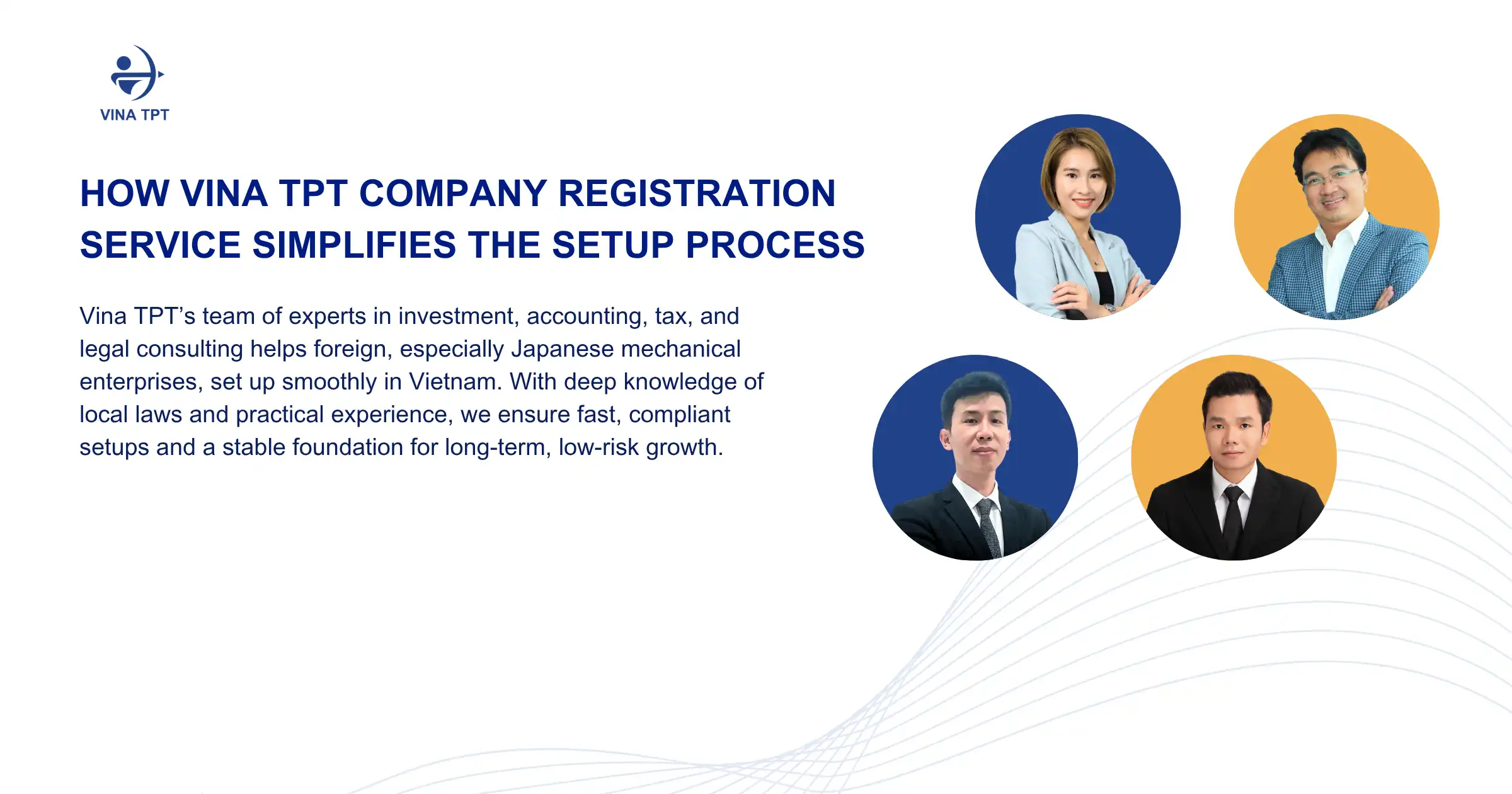
The biggest difference of Vina TPT company registration lies in the team of experts with over 20 years of practical experience in the field of corporate law, accounting, tax in Vietnam.

How Vina TPT Supports Japanese Manufacturing Enterprises: 

  • .Proven FDI Experience: Advised many Japanese projects in mechanics, electronics, and supporting industries, fully understanding local licensing and compliance.
  • Cultural Alignment: Operates with Japanese-style precision, transparency, and discipline in all documentation and processes.
  • End-to-End Support: A strategic partner from setup to operation and expansion.
  • Bilingual Team: Fluent Japanese communication ensures smooth coordination and minimized barriers.
  • Focused on Results: Ensures legal compliance, cost efficiency, and sustainable growth for every project.

Contact Vina TPT today for free consultation on the process register a company and setting up a mechanical factory in Vietnam.

CONTACT US NOW

register-a-company-service-for-japanese

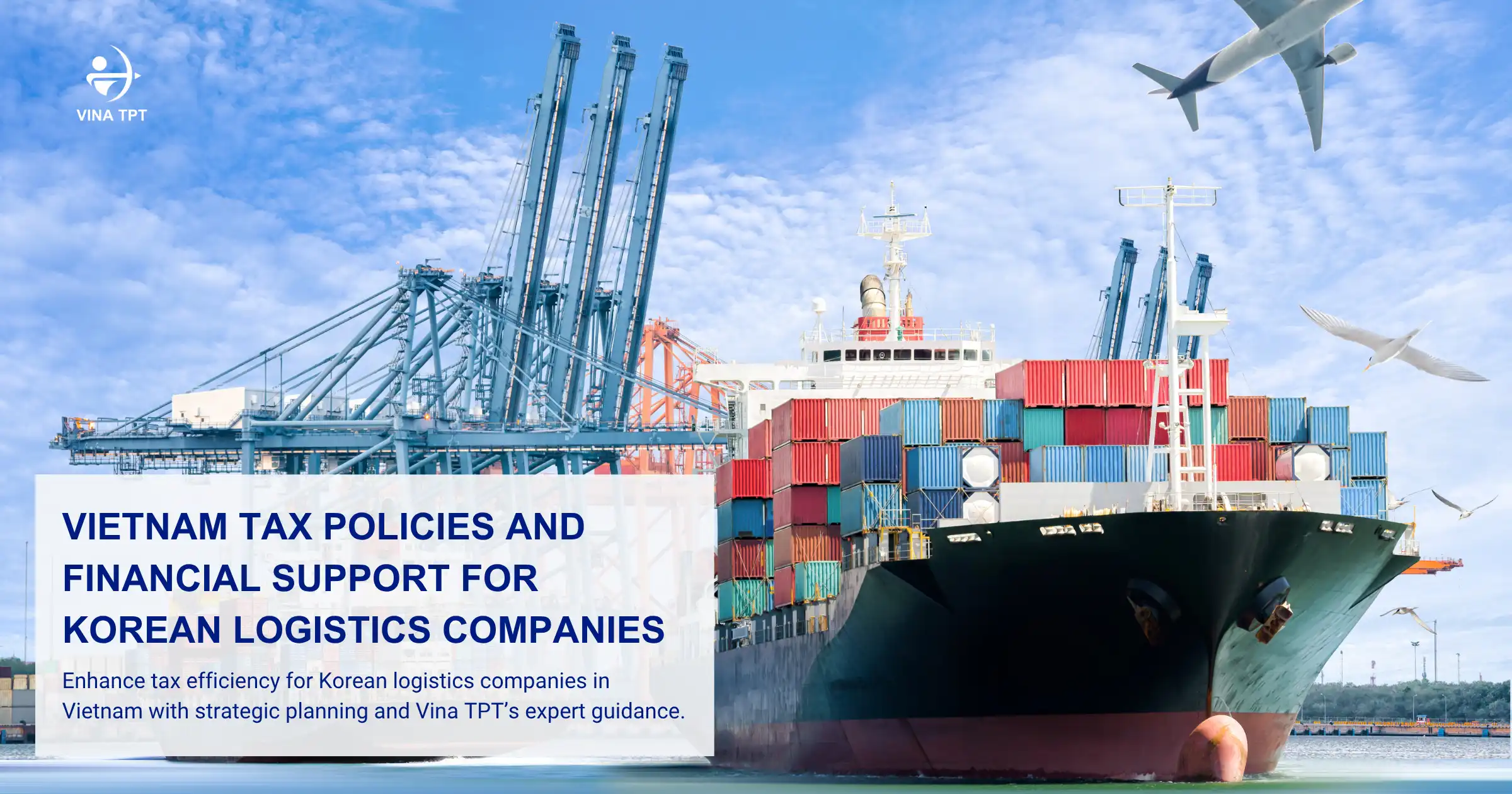
Vietnam Tax Policies and Financial Support for Korean Logistics Companies

Vietnam Tax Policies and Financial Support for Korean Logistics Companies-VTPT

tax-planning

1. Expanding Logistics Networks, Expanding Tax Challenges

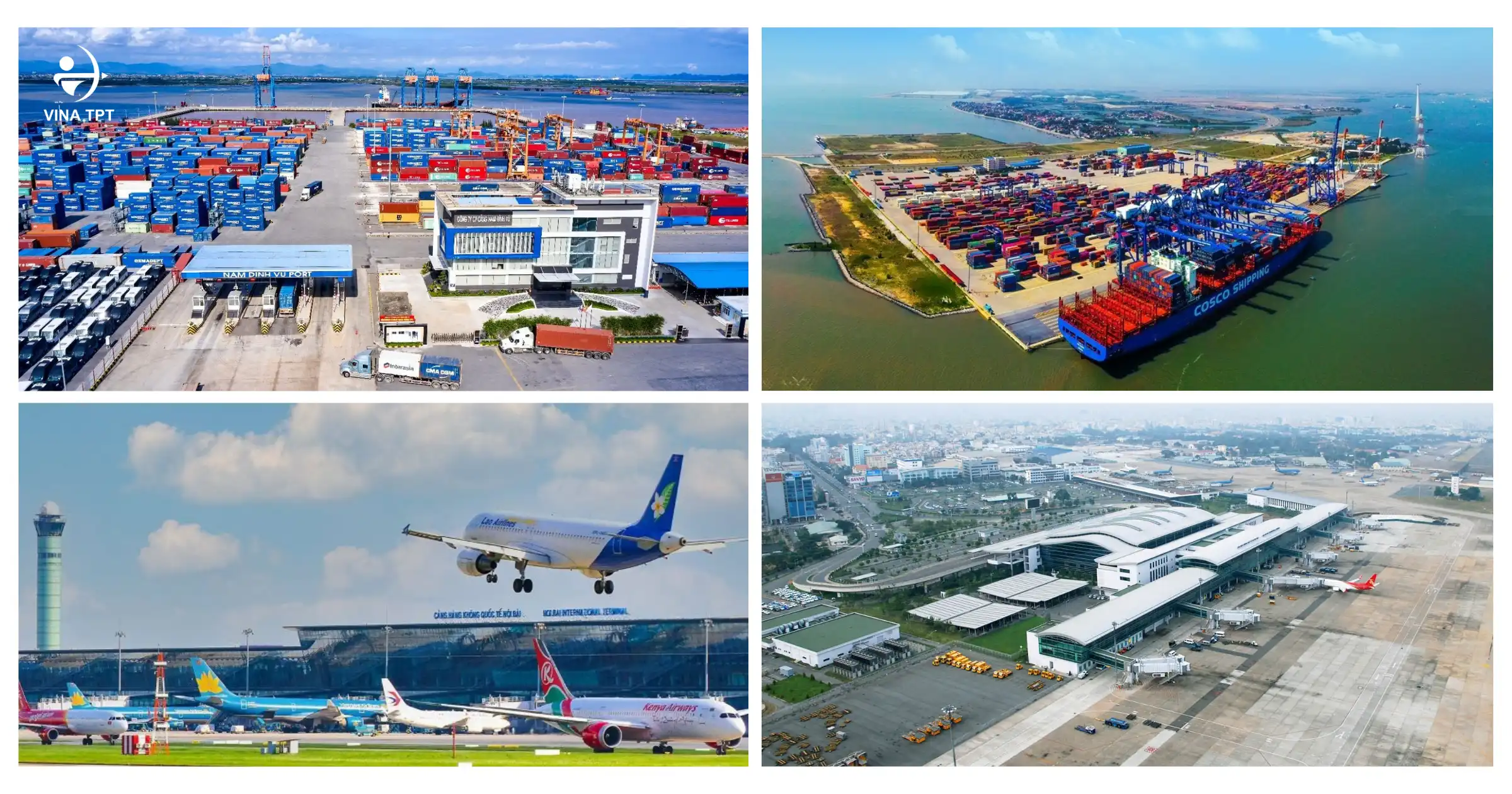
In recent years, a growing number of Korean logistics companies have opened branches, transit warehouses or distribution centers in Vietnam. This is a strategic move, as Vietnam is becoming the new logistics hub of Southeast Asia, with its favorable location and rapidly developing port and airport system.

However, along with the opportunity to expand its operating network comes a series of new challenges in tax planning. When a business operates in both countries, cash flow, contracts, and operating costs all need to be carefully calculated to comply with Vietnamese law while optimizing the overall profit of the group.

Lack of appropriate tax planning can lead to double taxation, loss of investment incentives or tax arrears due to incorrect declarations. Therefore, tax planning is not just the job of the accounting department, but a core financial strategy in cross-border operations.

2. Overview of Vietnam’s Tax Policies for Logistics Companies

Vietnam’s tax system for the logistics industry is highly specific, reflecting the diversity of activities in this sector.

First, businesses must comply with corporate income tax (CIT) usually at 20%. However, if the business operates in an industrial park or an encouraged economic zone, it may enjoy a lower preferential tax rate.

Next is value-added tax (VAT) on transportation services. Depending on the type of service – domestic, international or transit, the applicable VAT rate may vary, and determining the correct rate is important to avoid audit risks.

Companies that have contracts to hire contractors or use services from abroad should pay attention to Foreign Contractor Tax, which is often applied to service fees, software or outsourcing from the Korean headquarters. In addition, import duties on transport vehicles or specialized equipment (container trucks, forklifts, refrigeration systems, etc.) are also significant costs that need to be managed in the overall tax plan.

Understanding these policies in detail is essential for Korean logistics companies to operate efficiently and compliantly in Vietnam’s regulatory landscape.

3. Available Tax Incentives and Financial Support

In addition to tax obligations, Vietnam also offers many tax incentives and financial support to encourage foreign investment.

Korean logistics companies can enjoy corporate income tax exemptions or reductions when setting up facilities in industrial parks, high-tech parks, or border economic zones. For projects focusing on digital transformation, logistics process automation, or green investments (e.g., using electric vehicles, renewable energy), businesses can receive additional incentives on accelerated depreciation and tax exemptions for a certain period of time.

In addition, the Vietnamese government is implementing many financial support programs, including preferential credit packages for businesses applying smart technology in logistics operations, and a temporary VAT reduction policy to stimulate consumption and circulation of goods.

Taking advantage of tax incentives not only helps businesses reduce short-term costs but also enhances long-term competitiveness in the regional market.

MAXIMIZE YOUR VIETNAM TAX BENEFITS

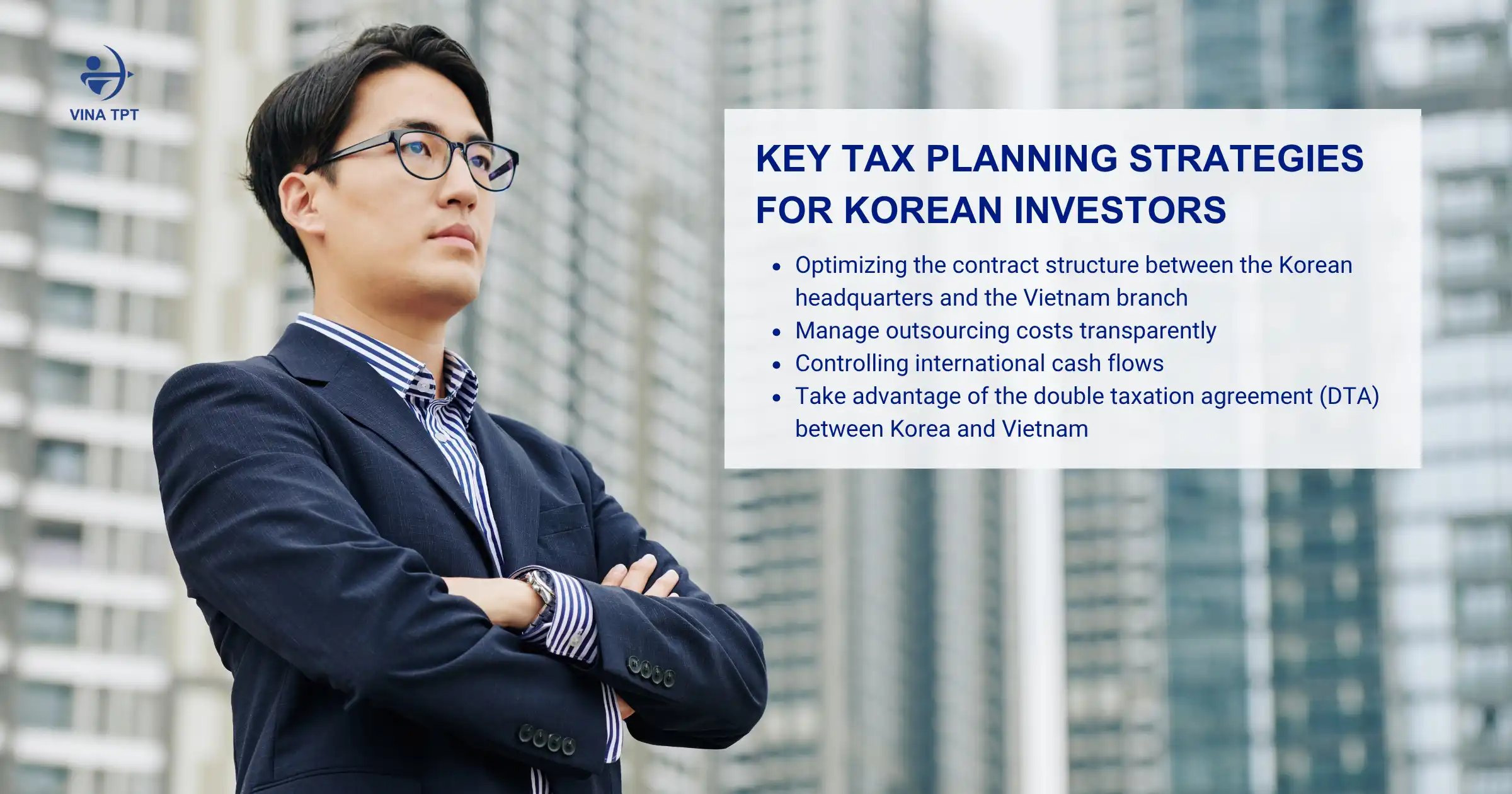
4. Key Tax Planning Strategies for Korean Investors

An effective tax planning strategy is not only based on correct declarations, but also needs to be linked to actual business operations. For Korean investors, this involves many layers of strategy.

First is optimizing the contract structure between the Korean headquarters and the Vietnam branch. Clearly defining the nature of the transaction, for example, a service contract, asset leasing or goods distribution, helps avoid the risk of being taxed in the wrong group.

Second, businesses need to manage outsourcing costs transparently. Outsourcing payments from the parent company or international suppliers must have records proving the value of the service, to avoid being adjusted under anti-transfer pricing regulations.

Third is controlling international cash flows, ensuring that payment flows between Korea and Vietnam are made at the right time, in the right currency, and with a clear legal basis.

Finally, Korean companies should take advantage of the double taxation agreement (DTA) between Korea and Vietnam. This agreement helps businesses avoid double taxation on the same income, while also providing a solid legal basis for cross-border operations.

These strategies are only effective when implemented under the guidance of tax advisory experts who understand both legal systems of Korea and Vietnam.

Download Vietnam Tax Handbook For Investor

tax-planning

5. How Vina TPT Tax Service Ensures Compliance and Optimization

In that context, Vina TPT Tax Service has become a trusted partner for Korean logistics companies operating in Vietnam. With in-depth expertise in Vietnam tax service for Korean logistics companies, Vina TPT not only helps businesses comply but also supports the optimization of tax strategies.

Vina TPT’s team of experts has practical experience in the logistics industry – from maritime transport, warehousing, to supply chain services. They not only advise on documents but also directly support businesses in the process of preparing reports, declaring taxes, working with tax authorities and conducting periodic reviews.

Vina TPT’s special feature is the “advisory and execution” model – meaning both strategic consulting and practical implementation. Thanks to that, Korean companies do not need to worry about the lack of personnel who understand Vietnamese regulations, while still ensuring the tax system operates accurately and effectively.

With the philosophy of “Transparency – Accuracy – Optimization”, Vina TPT helps foreign enterprises turn tax compliance into a sustainable competitive advantage.

Contact Vina TPT Tax Service now for free consultation on tax planning and tax incentives specifically for Korean logistics businesses in Vietnam – optimize costs, comply with the law and develop sustainably with leading experts.

BOOK A FREE CONSULTATION

tax-planning

Starting a Korean BBQ or Café in Vietnam? Here’s a 4-Step Registration Guide

 business-license-in-vietnam

1. Why Korean F&B Brands Are Thriving in Vietnam

Business license in Vietnam is a crucial step for any foreign F&B brand looking to enter the market. In recent years, Vietnam has become one of the fastest growing F&B markets in Southeast Asia, with spending on food and entertainment accounting for more than 35% of young consumers’ total disposable income. The booming middle class, the growing popularity of “eating out”, and the strong influence of Hallyu (Korean Wave) culture have created ideal conditions for Korean food brands to expand their business.

From Korean BBQ chains, Seoul-style cafes, to dessert shops, Vietnamese consumers especially Gen Z and Millennials see enjoying Korean food as a cultural experience rather than just eating. This explains why many Korean brands, from traditional restaurants to franchised coffee chains, are choosing Vietnam as their second strategic move after Korea.

However, behind that attractive potential are a series of legal challenges that foreign investors need to understand. Many Korean brands encounter difficulties when setting up a business in Vietnam (enterprise registration), applying for an F&B business license, or completing food safety and hygiene certifications. Therefore, understanding the correct legal establishment process is the first factor that determines success when establishing a business in Vietnam.

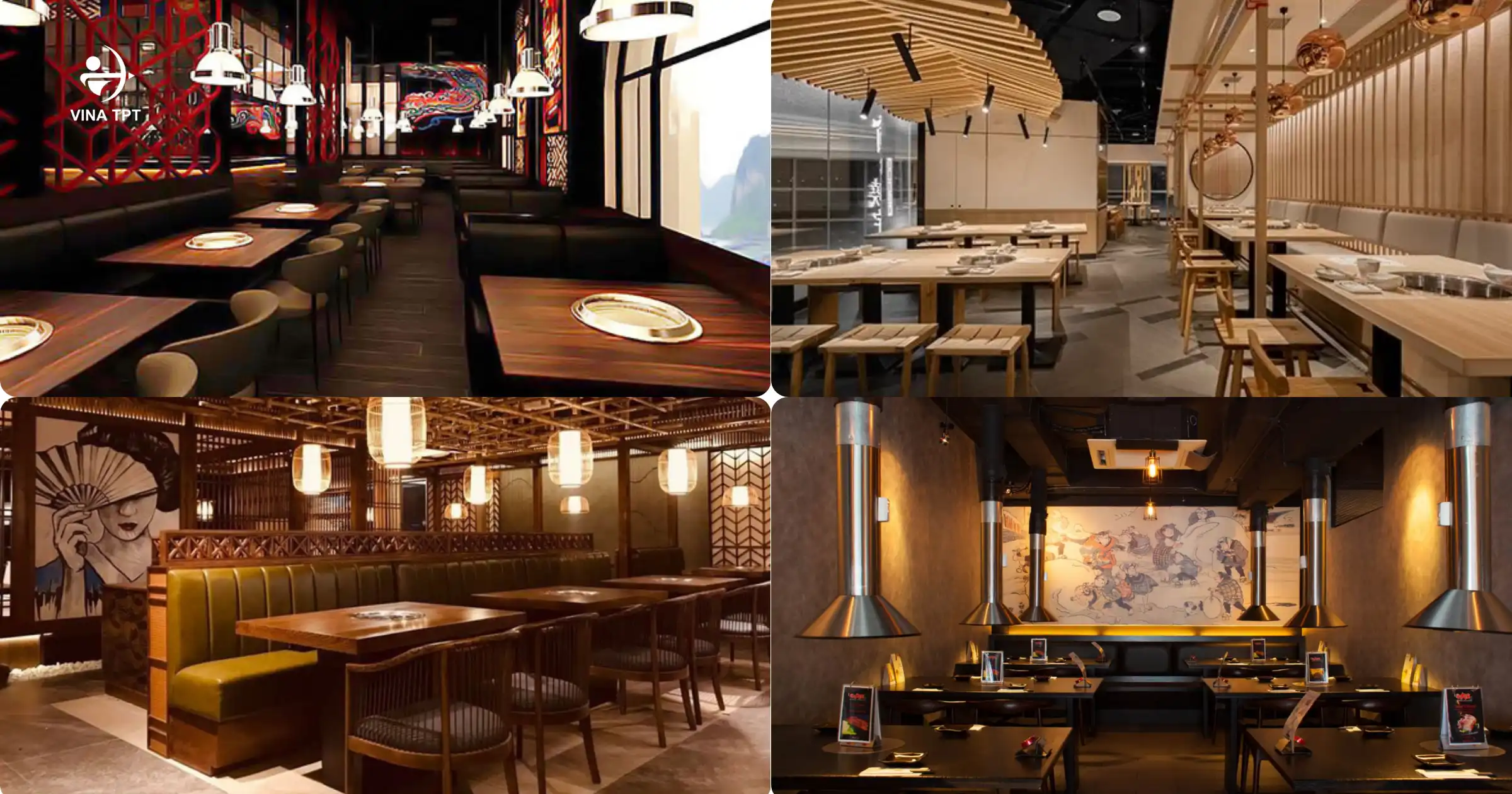
Before going into the licensing process, you can consider a few concepts that are very popular in Vietnam: Korean tabletop BBQ, K-café & dessert, fast-casual K-food (fried chicken, mixed rice), and fusion/comfort food concepts. Each concept will affect the scale, location, and type of license required, so you should determine the concept before starting

 business-license-in-vietnam


2. Step 1 – Understanding Vietnam’s F&B Business License Requirements

To open a restaurant or cafe in Vietnam, Korean investors need the following types of business licenses in Vietnam:

  • Investment Registration Certificate (IRC): certifying that the company legally authorizes an investment project and records its key details
  • Enterprise Registration Certificate (ERC): certifying that the company is legal and allowed to operate in Vietnam.
  • Food Safety and Hygiene Certificate: required for food processing or serving establishments.
  • Fire Safety Certificate: ensures that the location meets fire prevention and fighting standards.
  • Other local permits: such as sign registration, environmental license (if there is a food production scale).

Full preparation of these business license in Vietnam helps companies operate legally, avoiding the risk of being fined or having their business suspended. 

3. Step 2 – Choosing the Right Legal Structure for Korean Investors

When setting up a business in Vietnam, Korean investors can choose one of three popular legal forms:

  • 100% foreign-owned company: Full management, suitable for brands with experience and large capital.
  • Joint Venture: Cooperate with Vietnamese partners, helping to understand the market and process licenses faster.
  • Franchise model: Flexible solution for BBQ or cafe chains that want to expand their brand without directly managing operations.

Each model has its own advantages and disadvantages, depending on the scale, capital, and long-term development strategy of the Korean brand in Vietnam. In addition, at this stage, the most important thing is to determine whether to apply for an Investment Registration Certificate (IRC) or not, as this procedure will affect the entire time and plan of operation later.

According to the Vietnam Investment Law, an IRC is a mandatory license if Korean investors want to:

  • Establish a 100% Korean-owned company in Vietnam (e.g., a company managing a BBQ chain, cafe, bakery, etc.);
  • Contribute more than 51% of capital to a Vietnamese company operating in the F&B sector;
  • Open a branch or restaurant under a Korean parent company.

In this case, the process will include two stages:

  • Apply for IRC: Investment Registration Certificate, issued by the Department of Planning and Investment (DPI).
  • Apply for ERC: Enterprise Registration Certificate (similar to a company establishment license).

The estimated time for completion is:

Document preparation: 1-2 weeks, depending on the volume of documents and the level of complexity.

  • IRC appraisal: 20-45 working days.
  • ERC issuance: 10-20 working days after IRC (or similar if the enterprise is a domestic enterprise).

4. Step 3 – The Registration & Licensing Process Explained

 business-license-in-vietnam

The process of setting up a business license in Vietnam includes the following basic steps:

  1. Preparing legal documents (investor passport, company charter, legal head office address).
  2. Complete the application and apply for IRC, ERC.

If the project has FDI capital, IRC is the first license allowing the investor to implement the project in Vietnam.

The required documents usually include:

  • Application for investment project implementation and Project proposal: stating the objectives, scale, location, investment capital, progress.
  • Proof of the investor’s financial capacity: bank statement, credit contract or collateral.
  • Legal documents of the investor:
    • Individual: Notarized passport, consular legalization.
    • Organization: Business registration certificate or equivalent document, consular legalization.
  • Project location: lease contract or land/office use rights certificate.

After the IRC is granted (or for 100% domestic-owned enterprises), the investor applies for an ERC – an official license for the enterprise to operate, and also the tax code of the company.

The ERC dossier usually includes:

  • Application for enterprise registration.
  • Company Charter: stipulates the organizational structure, powers of members/shareholders, capital ratio and management method.
  • List of members/shareholders and legal representatives: clearly state information, ownership ratio, voting rights.
  • Appointment decision and authorization letter (if any).
  • Capital contribution plan & financial evidence: bank statement or credit contract (especially important for large capital projects).

      3.Register for tax code and electronic invoice.

      4.Open a company bank account and pay charter capital.

      5.Carve the company seal and register the sample seal with the authorities. 

GET EXPERT BUSINESS REGISTRATION SUPPORT

5. Step 4 – Post-License Requirements for F&B Businesses

After obtaining the operating license, the enterprise needs to complete the following post-registration procedures:

  • Renting a business premises in accordance with local planning
  • Signing a labor contract and registering personnel with the labor management agency
  • Registering taxes and social insurance for employees
  • Signing contracts with suppliers of raw materials and operating services
  • Checking and certifying food safety before opening
  • Registering for trademark protection to protect intellectual property rights in Vietnam

These steps help enterprises ensure comprehensive compliance and be ready to operate stably.

6. Simplify Your Market Entry with Vina TPT Company Registration Service

With many years of experience supporting Korean F&B brands in Vietnam, Vina TPT Company Registration Service provides a complete solution including:

  • Consulting on choosing the right type of business
  • Drafting and submitting registration documents to the Department of Planning and Investment
  • Applying for hygiene, fire prevention and trademark licenses
  • Setting up accounting, tax and labor systems according to Vietnamese regulations

Vina TPT acts as a “one-stop service” to help Korean investors shorten time, reduce legal risks and focus on brand development.

7. From Startup to Success: Launching Your Korean BBQ or Café Smoothly

Opening a Korean restaurant or cafe in Vietnam is not only an attractive business opportunity, but also a journey to bring Korean culinary culture closer to Vietnamese customers. With clear instructions and a reliable legal partner like Vina TPT, the business registration process will become simpler, more legal and sustainable than ever.

Contact Vina TPT today for detailed advice on the F&B business license in Vietnam – fast, transparent and legal.

BOOK A FREE CONSULTATION

Tax Services for Japanese Manufacturing Companies in Vietnam

Tax Services for Japanese Manufacturing Companies in Vietnam - VTPT

Tax Services for Japanese Manufacturing Companies in Vietnam - VTPT

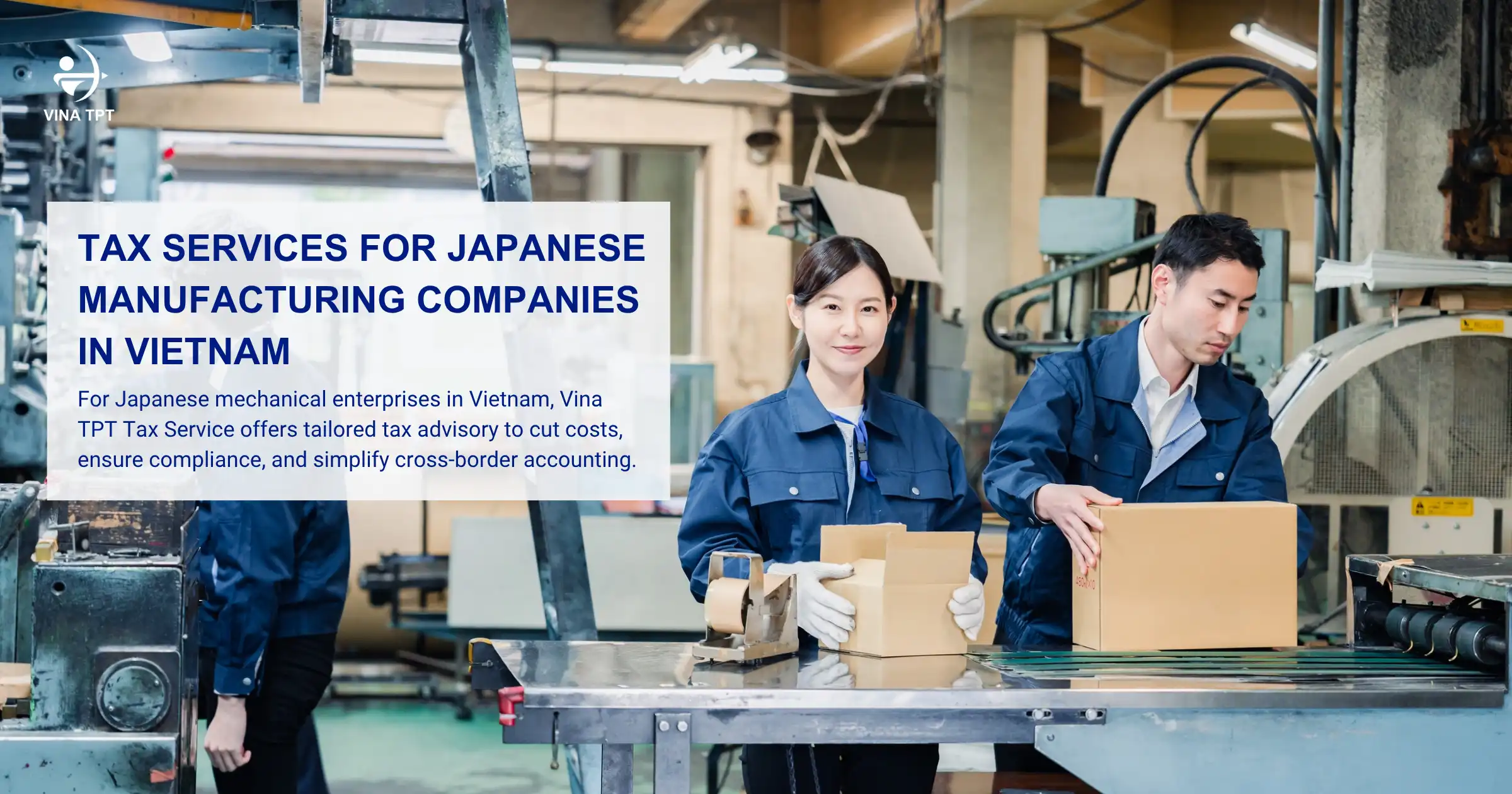
1. The Precision of Japanese Manufacturing Meets Vietnam’s Tax Reality

Japanese companies are globally renowned for their “Kaizen” spirit – precision and continuous improvement in production. When expanding their investment to Vietnam, especially in the mechanical engineering and machine manufacturing sector, they bring with them strict standards of quality and efficiency.

However, the tax system in Vietnam has its own characteristics. Regulations on import tax, value-added tax (VAT), or corporate income tax (CIT) all have different calculation methods and declaration deadlines than in Japan. This difference makes tax management and compliance a big challenge, especially when businesses have to simultaneously handle contracts for purchasing components, technology transfer, warranty – maintenance, and research and development (R&D) costs.

Therefore, many Japanese companies have sought specialized tax services in Vietnam to ensure that all financial activities are legal, transparent, and cost-optimized.

START YOUR VIETNAM TAX COMPLIANCE SETUP

2. The Tax Landscape for Mechanical Manufacturers

The mechanical engineering and machinery manufacturing industry is directly affected by many different taxes. Each transaction and each contract has potential risks if not handled properly.

First of all, import tax on components is an important factor, especially for factories importing spare parts from Japan. If the HS code (commodity code) is declared incorrectly, the enterprise may be subject to additional tax or administrative fines. In addition, VAT for industrial products has a rather complicated tax refund and deduction mechanism, requiring accurate accounting for each shipment.

In addition, depreciation of machinery and equipment must comply with the time limit and depreciation method prescribed in Vietnamese accounting standards. For mechanical enterprises, the value of fixed assets is often very large; therefore, even a small error in recording depreciation can affect financial statements and corporate income tax.

Technology transfer, maintenance and warranty costs also need to be recorded at the right time and have valid documents. These are areas where tax advisory services with mechanical expertise can save businesses hundreds of thousands of dollars each year.

Download Vietnam Tax Handbook - Japanese Edition

3. Typical Compliance Risks

In fact, many Japanese enterprises in Vietnam face common tax risks that are difficult to detect early. One of the biggest risks is inaccurate transfer pricing. When a Vietnamese branch purchases components, equipment or technical services from its parent company in Japan, incorrect pricing can be considered by tax authorities as an act of transferring profits abroad.

Another risk is invalid maintenance and warranty costs due to a lack of clear contracts or insufficient payment documents. In addition, incorrect recording of fixed assets – for example, including leased machinery in the ownership list – also leads to improper tax deductions.

In addition, VAT deduction errors are common in enterprises with many input and output invoices, especially in import and export transactions. These errors can cause enterprises to be subject to tax arrears, late payment penalties, and even affect their reputation with authorities.

This is why mechanical manufacturing companies need specialized tax advisory services to help them identify risks, review accounting processes and ensure compliance with Vietnamese laws.

Tax Services for Japanese Manufacturing Companies in Vietnam - VTPT

4. International Tax Services: Bridging Japan and Vietnam

One of the biggest challenges for Japanese businesses in Vietnam is the difference between the two accounting systems. Japan applies J-GAAP or IFRS accounting standards, while Vietnam follows VAS (Vietnamese Accounting Standards).

Therefore, international tax services act as a bridge between the two countries. This service not only helps businesses adjust accounting items to comply with regulations in Vietnam, but also supports reviewing internal contracts with parent companies, ensuring that R&D costs, royalties or technical service fees are recorded reasonably and have transparent documents.

A synchronous accounting system helps Japanese businesses report accurately to both markets, avoiding the situation of “one number, two reports” – both tax risks and loss of reputation with partners.

Thanks to international tax services, Japanese companies can operate in Vietnam with peace of mind while maintaining the same accuracy, transparency and efficiency as when operating at home.

5. Vina TPT’s Role in End-to-End Compliance

In Vietnam, Vina TPT Tax Service is one of the prestigious partners specializing in providing comprehensive solutions from Vietnam tax accounting to processing periodic reports and tax settlement.

The difference of Vina TPT lies in its deep understanding of the mechanical manufacturing industry and Japanese corporate culture. Their consulting team is not only good at tax expertise but also has a “Kaizen mindset” – a spirit of continuous improvement to help businesses operate more effectively every day.

Vina TPT supports businesses at every stage: from setting up the initial accounting system, preparing VAT and corporate income tax reports, to representing them in working with tax authorities when explanations are needed. The close coordination between the two teams – Japanese and Vietnamese – helps businesses not only comply with regulations but also optimize legal profits.

6. From Compliance to Competitiveness

Tax compliance is not only a legal obligation, but also the foundation of competitiveness. When the accounting and tax systems are managed transparently, businesses can easily calculate actual costs, control profits, and make more accurate investment decisions.

In the long term, a solid tax compliance strategy will help Japanese businesses in Vietnam not only avoid legal risks but also build a trustworthy image in the eyes of partners and management agencies.

With the support of Vina TPT Tax Service, that process becomes easier and more effective than ever.

Contact Vina TPT Tax Service now for free consultation on comprehensive tax management solutions.

BOOK A FREE CONSULTATION

Vina TPT Accounting services

Outsource Bookkeeping & Accounting for Singaporean Logistics Firms in Vietnam

Outsource Bookkeeping & Accounting for Singaporean Logistics Firms in Vietnam-VTPT

Outsource Bookkeeping & Accounting for Singaporean Logistics Firms in Vietnam-VTPT

1. The Financial Pulse of Every Logistics Company

In the world of logistics, everything revolves around numbers – from shipping costs, fuel costs to payments to suppliers. For Singaporean companies expanding operations in Vietnam, each month is a separate “financial cycle”. If a business is like a living body, monthly accounting is the “heartbeat” that keeps the system running smoothly. 

Recording, summarizing and reporting monthly financial information helps management understand the spending, revenue, and profit situation of each transportation route or each warehouse. Thanks to this data, businesses can quickly detect problems, for example, a certain route has an unusual increase in fuel costs, or a partner is late in paying and make adjustments within the month instead of waiting until the end of the fiscal year.

2. Inside a Typical Monthly Accounting Cycle

To put this into perspective, imagine a monthly accounting cycle in the logistics industry that starts with recording each bill of lading each shipment, each delivery becomes a financial data stream. The accounting department then reconciles it with the invoice from the transport provider, fuel payments, tolls, or warehousing costs.

In addition, the business must also take inventory of the inventory in the transit warehouse, calculate the loss and depreciation of the transport vehicles. Once all the data has been updated, the final step is to compile the monthly financial report including revenue, expenses, and profits.

A professional accounting bookkeeping service will take care of this entire process, ensuring that all the numbers are accurate, transparent, and updated promptly. This is especially important for companies with operations spread between Singapore and Vietnam, where small discrepancies in data can affect the entire reporting system.

GET A CUSTOMIZED ACCOUNTING SOLUTION

3. Why Outsource Bookkeeping Is Becoming a Strategic Move

In recent years, more and more Singapore logistics businesses have chosen to outsource bookkeeping instead of maintaining an in-house accounting team. The reason lies not only in saving on personnel costs, but also in accuracy and speed.

When outsourcing accounting services, businesses are supported by experienced specialists and modern software systems, allowing access to real-time data (real-time reporting). Managers in Singapore can immediately view the financial reports of the Vietnam branch at any time, without having to wait for manual file submission.

In addition, outsourced accounting services help increase cross-border transparency. All data is managed according to the same standards, avoiding discrepancies between countries. This not only helps the board of directors make decisions faster, but also minimizes risks in auditing and tax reporting.

4. Key Data Reports That Drive Logistics Decisions

In the logistics industry, financial data is not just a record but also a “compass” for all operational decisions. When properly compiled, monthly accounting reports become an “insight hub” that helps management see the big picture.

For example, an operating cost report might show that a shipping route from Ho Chi Minh City to Singapore is consuming more fuel than usual. A revenue report by route might show that domestic shipping is generating higher profit margins than international shipping. Or a profit report by partner helps managers see which partners are contributing the most to overall revenue.

Thanks to periodic reports, Singaporean investors no longer have to wait for annual audits to know the business situation. They can make quick decisions, reallocate resources, or adjust transportation strategies in just a few days, something that used to take months.

Download Vietnam Tax Handbook For Investor

Outsource Bookkeeping & Accounting for Singaporean Logistics Firms in Vietnam-VTPT

5. Compliance with Vietnamese Accounting Standards (VAS)

For foreign-invested logistics companies, especially those from Singapore, compliance with Vietnamese Accounting Standards (VAS) is mandatory. All financial statements, value-added tax (VAT) and corporate income tax (CIT) declarations must be prepared and submitted on time.

However, this is not easy, as the Vietnamese accounting system has many detailed regulations and is regularly updated. This is where a professional accounting bookkeeping service plays an important role: they help businesses ensure legal compliance, reconcile correct data, and maintain transparency in all financial data.

As a result, businesses avoid audit and tax risks, and can focus all their efforts on core activities like operating and expanding the logistics network.

6. Vina TPT Bookkeeping Service: Turning Numbers into Insights

When it comes to reliable outsourced accounting services in Vietnam, Vina TPT Bookkeeping Service is a prominent name. Vina TPT’s difference lies not only in accurate bookkeeping, but also in the ability to turn numbers into practical business strategies.

Vina TPT understands that each logistics enterprise has its own characteristics – from fleet size, warehouse model to transportation fee calculation. Therefore, they not only prepare financial reports according to VAS but also analyze monthly data, helping enterprises understand cost trends, route profits and the efficiency of each operation.

Through regular consulting sessions, the Vina TPT Bookkeeping Service team supports Singaporean enterprises to make more accurate investment decisions, manage cash flow more effectively, and gradually build a sustainable financial system in Vietnam.

Contact Vina TPT today for a free consultation and tailored solutions for your logistics business.

BOOK A FREE CONSULTATION

Vina TPT Accounting services

Ensuring Payroll Compliance for Chinese Restaurant Chains in Vietnam

Ensuring Payroll Compliance for Chinese Restaurant Chains in Vietnam-VTPT

payroll-services

1. Payroll Compliance: The Hidden Challenge in Chinese F&B Expansion

In recent years, a series of well-known Chinese F&B brands  such as Haidilao, Mixue, Heytea, and Luckin Coffee have rapidly expanded their restaurant chains across Vietnam. The country’s young population, strong consumer demand, and appetite for new dining experiences have made Vietnam one of the most attractive markets in Southeast Asia.

However, this fast-paced expansion also brings a less visible but serious challenge: payroll compliance. Many Chinese franchises face difficulties in managing payroll due to the large number of part-time and shift-based employees, frequent staff turnover, and the involvement of foreign managers who are unfamiliar with Vietnamese labor and tax regulations. As a result, even successful brands risk payroll miscalculations, delayed payments, or non-compliance penalties if they lack localized HR and payroll systems.

Many businesses are at risk because they do not fully understand the regulations on salary payment, social insurance, personal income tax (PIT) and labor contracts. Small errors in the payroll calculation process can lead to big consequences: administrative fines, damage to brand reputation, or even suspension of business licenses.

2. Payroll Management in the F&B Industry: What Makes It Complex

Unlike the manufacturing or office sector, the F&B industry operates with shift-based schedules, part-time employees, and a high turnover rate. Manual timekeeping or payroll calculated by hours or daily revenue often leads to data inconsistencies and payment errors.

In addition, social insurance and personal income tax (PIT) management are much more complex in this sector. Restaurants must frequently update employee records, process insurance contributions for both full-time and part-time staff, and ensure accurate PIT declarations.

When foreign employees or managers are involved, payroll compliance becomes even more complex, that requiring accurate handling of work permits, foreign income tax, and insurance policies aligned with Vietnamese regulations.

As the business expands from one store to ten or twenty branches, the volume of payroll and HR data multiplies significantly. In such cases, outsourced payroll processing services become the optimal choice, helping F&B chains automate payroll calculations, minimize manual errors, and ensure that all tax and insurance obligations are completed accurately and on time.

With Vina TPT’s payroll processing services, all these tasks from payroll calculation to social insurance management and PIT filing, are handled in an integrated, compliant, and transparent process, allowing F&B businesses to focus on operations rather than administrative burdens.

BOOK A FREE PAYROLL CONSULTATION

3. Key Compliance Requirements for F&B Businesses in Vietnam

Operating a food & beverage franchise in Vietnam involves navigating a complex framework of local labor laws and tax regulations. To ensure compliance, Chinese F&B chains must pay close attention to several core areas:

  • Employment contracts:

Every staff member, including part-time and probationary workers must have a legally valid labor contract that clearly defines salary structure, working hours, and overtime policies. Failure to issue proper contracts can result in penalties or disputes with labor authorities.

  • Social insurance (SI), health insurance (HI), and unemployment insurance (UI):

Vietnamese law requires employers to contribute to all three funds, based on each employee’s monthly income. Missing or under-reporting contributions can lead to back payments and administrative fines.

  • Personal income tax (PIT):

PIT must be calculated and reported monthly or quarterly, depending on the business size. For F&B franchises with multiple branches, this process becomes even more complex, especially when handling part-time employees with fluctuating income.

  • Overtime and minimum wage compliance:

Restaurants and beverage chains often rely on shift-based operations, so adhering to Vietnam’s overtime limits and regional minimum wage levels is crucial. Incorrect application of wage rates or unpaid overtime can trigger employee complaints and damage brand reputation.

  • Data management and reporting:

Accurate timekeeping, record-keeping, and digital reporting are required for labor audits. Many F&B chains still use manual or paper-based systems, which increases the risk of miscalculation and compliance violations.

4. How Payroll  Solves These Compliance Issues

Outsourcing payroll to a professional service provider offers F&B franchises a reliable and cost-efficient solution to handle these complexities.

Instead of maintaining an internal HR and accounting team, Chinese franchises can delegate payroll management to specialized experts who ensure accurate, on-time, and legally compliant processing. This includes everything from automated payroll calculation by shift to real-time integration with timekeeping systems.

payroll-services

Key advantages of payroll processing services:

  • Automation reduces human error: Manual calculation of working hours, tips, and overtime can easily lead to mistakes. Automated systems minimize these risks while maintaining consistency across multiple outlets.
  • Compliance assurance: Payroll service providers stay updated with Vietnam’s labor laws, tax regulations, and insurance policies ensuring your franchise avoids costly penalties.
  • Tax filing and reporting made easy: Outsourced services handle PIT declarations, Social Insurance/ Health Insurance/ Union contributions, and e-invoices on behalf of your business, freeing up internal resources.
  • Scalability for franchise growth: Whether operating one restaurant or ten, outsourced payroll systems can quickly scale to support expansion without disrupting operations.
  • Cost savings: Compared to hiring full-time accountants and HR staff, outsourcing can reduce administrative expenses by up to 30%, as reported by F&B clients who switched to external payroll management.
  • Transparency and bilingual reporting: With bilingual payslips and compliance reports (English, Vietnamese, Chinese), both local managers and overseas investors can clearly track salary data and performance metrics.

payroll-services

5. Payroll Compliance as Part of Franchise Reputation

In the service industry, paying salaries correctly, adequately and transparently is not only a legal obligation but also an important touchpoint of the brand. A professional payroll system helps businesses retain employees, reduce turnover and improve team morale.

At the same time, stable compliance creates trust for investors and franchise partners, that the Chinese brand is operating transparently, professionally and respecting regulations in Vietnam.

6. Why Chinese F&B Brands Choose Vina TPT Payroll Services

Vina TPT is one of the most reputable payroll services providers in Vietnam for restaurant chains, milk tea shops and F&B brands from China.

With a bilingual consulting team in Chinese – English – Vietnamese and many years of experience in the fields of accounting, human resources and law, Vina TPT helps businesses ensure compliance with Vietnamese labor regulations while maintaining flexible operating processes.

Unlike conventional accounting firms, Vina TPT designs a customized payroll processing services according to each chain’s model – from shift organization, hourly salary calculation, to integration with the brand’s existing ERP or POS system.

Thanks to that, businesses can rest assured about accuracy, transparency and synchronous management across the entire chain of stores.

7. Vina TPT Payroll Services

Vina TPT provides a complete payroll processing services, specifically designed for the F&B industry, including:

  • Automating the process of calculating salary by shift and integrating timekeeping data
  • Declaring and paying personal income tax (PIT) monthly/quarterly
  • Managing labor contracts, social insurance and legal compliance according to Vietnamese regulations
  • Issuing electronic payroll (online payslip) and periodic tax reports
  • Storing and securing employee data on a cloud computing platform, easy to access and check at any time.

All services are deployed on a highly secure system, supporting multiple languages ​​and ensuring absolute transparency in each transaction – helping businesses operate effectively, reduce administrative processes and focus on business development.

Talk to our experts at Vina TPT to build a compliant and efficient payroll system for your F&B business in Vietnam.

BOOK A FREE CONSULTATION

HR Manager Vina TPT Payroll services in Vietnam


Smart Payroll Solutions for Part-Time Staff in Japanese Restaurants in Vietnam

Smart Payroll Solutions for Part-Time Staff in Japanese Restaurants in Vietnam-VTPT

smart-payroll-services-for-small-business-vietnam

1. Managing Payroll for Part-Time Staff: The Hidden Challenge in F&B with Payroll Service for Small Business

Japanese restaurant chains in Vietnam often have dozens to hundreds of employees working in shifts, especially part-time employees in service positions, sous chefs or receptionists. The work schedule changes flexibly every week, making timekeeping, payroll and tax management much more complicated than in conventional business models.

Many Japanese restaurant owners still use Excel spreadsheets or manual records to calculate salaries, making the process both time-consuming and error-prone – especially when adding in items such as evening shift allowances, tips, productivity bonuses, or personal income tax (PIT) deductions based on working hours. This not only increases pressure on the accounting department but also poses risks to compliance with Vietnamese labor laws.

That’s why adopting a payroll service for small business is becoming an essential solution, helping restaurant owners automate payroll processes, reduce errors, and ensure compliance while focusing on improving service quality.

2. The Complexity of Payroll in Restaurant Operations

In the F&B industry, payroll for restaurants is one of the most complex operations due to the highly variable nature of human resources. Each employee can work in many branches, with different working hours and receive hourly, shift or daily wages.

In addition, restaurants also have to handle factors such as:

  • Tips divided by shift or work group;
  • Meal allowances, uniforms, parking;
  • Social insurance, health insurance, unemployment insurance obligations for eligible employees;
  • And especially the declaration and deduction of personal income tax for part-time employees with fluctuating income.

When these factors are processed manually, even a small error in Excel formulas can lead to incorrect payroll, affecting employee trust and violating legal regulations.

GET PROFESSIONAL PAYROLL SUPPORT

3. Why Online Payroll Processing Is the Game Changer

That is why more and more Japanese restaurants are switching to online payroll processing – an automated payroll system that simplifies the entire process. The system allows for shift-based timekeeping, real-time data updates, and automatic calculation of salaries, bonuses, and tax deductions with just a few steps.

For small business owners, using this solution helps:

  • Save up to 70% of payroll processing time
  • Reduce the risk of errors and tax violations
  • Easily track personnel costs by branch or shift
  • And quickly export electronic payroll or bilingual English – Vietnamese reports when needed.

smart-payroll-services-for-small-business-vietnam

Switching to an online payroll system not only helps restaurants modernize their human resource management but also demonstrates a standard operating style in the Japanese spirit – accurate, transparent, and on-time.

4. Vina TPT Payroll Service: Designed for Japanese Restaurants in Vietnam

Understanding the specifics of the F&B industry, Vina TPT Payroll Service has designed a payroll services for small businesses specifically for Japanese restaurant chains in Vietnam. Our solution fully meets the requirements of flexibility, security and bilingualism, making the payroll and human resource management process simpler than ever.

Services include:

  • Automating the payroll process by shift, integrating timekeeping data;
  • Supporting electronic invoices, tax reporting and PIT for part-time employees;
  • Bilingual reports (English – Vietnamese – Japanese) in accordance with corporate standards;
  • Consulting on legal compliance and updating the latest Vietnamese labor regulations.

With an online management system, restaurant owners can track personnel costs in real time, reduce errors and save significant time processing monthly payroll.

5. Simplify Payroll, Focus on Restaurant Quality

Behind Vina TPT’s optimal payroll solutions is a team of experts with in-depth knowledge of Japanese corporate culture and the Vietnamese legal system.

Vina TPT’s accounting, human resources and tax consultants are all well-trained from university level and above, with many years of experience working with Japanese enterprises in the restaurant, hotel and manufacturing sectors. They can communicate fluently in Japanese, understand the management style and internal reporting processes of Japanese investors.

Thanks to that, Japanese restaurant chains can completely focus on their main mission – bringing exquisite culinary experiences and Japanese-standard service to Vietnamese customers.

Contact Vina TPT Payroll Service today for advice on online payroll processing solutions suitable for Japanese restaurant models in Vietnam.

BOOK A FREE CONSULTATION

smart-payroll-services-for-small-business-vietnam