A limited liability company (LLC) is one of the most common business structures chosen by foreign investors when investing in Vietnam. This type of company allows the owner to be liable only within the scope of the contributed capital, has a relatively simple governance structure, and offers flexibility in choosing either 100% foreign ownership or cooperation with other partners.
So, how is the process of establishing an LLC in Vietnam carried out, and what should investors pay attention to during the company registration process? The article below provides detailed guidance on Vietnam LLC registration requirements as well as the necessary procedures.
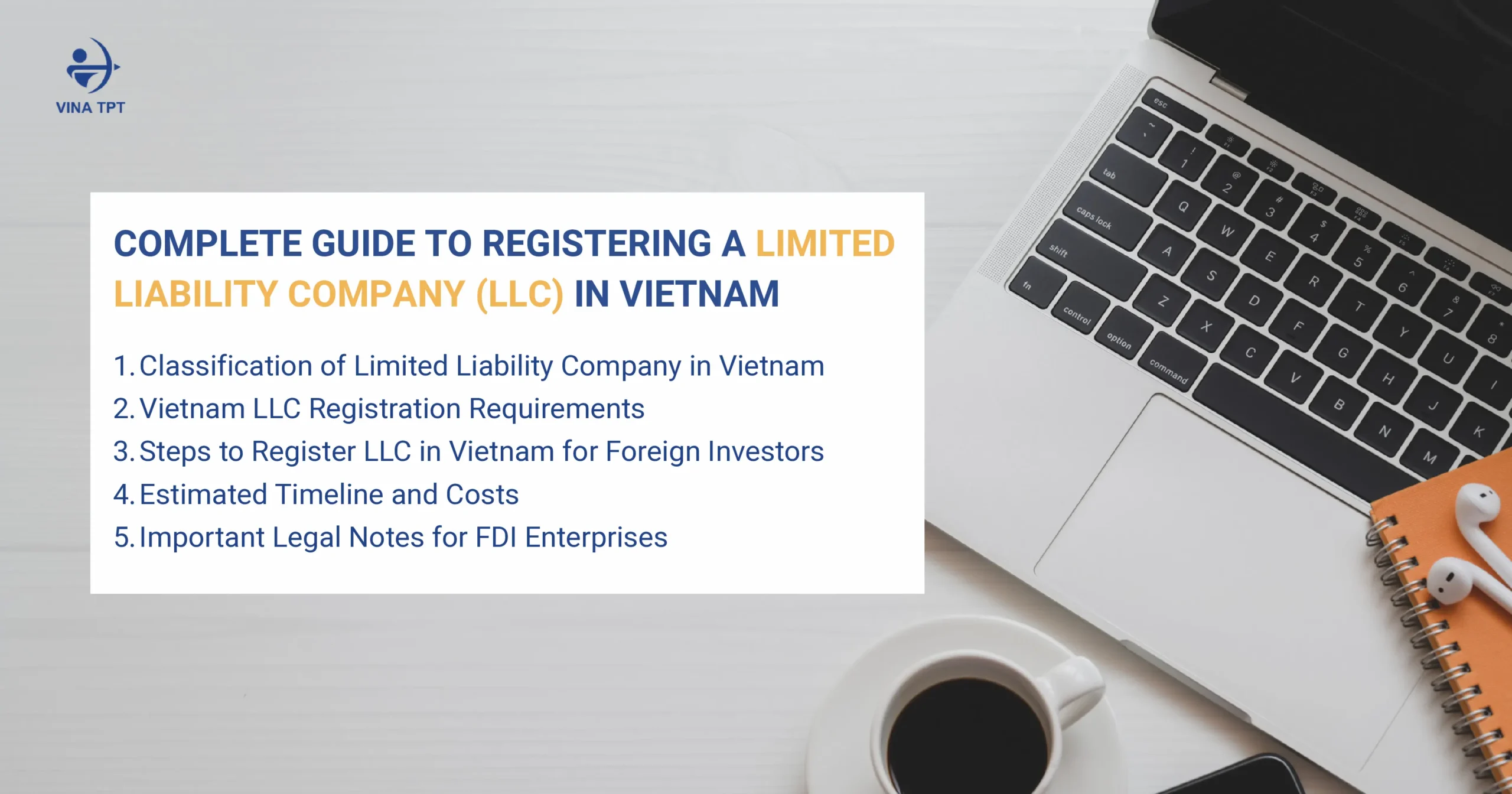
1. Classification of LLCs: Which type is suitable for your business?
Before reviewing the Vietnam LLC registration requirements, investors need to determine which business structure best fits their business plan. In Vietnam, a limited liability company has two main forms: a single-member LLC and a multi-member LLC.
The table below compares the key features of these two LLC types, helping investors choose the model that best suits their business plan and satisfies the Vietnam LLC registration requirements.
| Criteria | Single-member LLC | Multi-member LLC |
| Number of members | 1 individual or organization | From 2 to 50 members |
| Organizational structure | Relatively simple, including: Owner, Company President, and Director/General Director | More complex, including: Members’ Council, Chairman of the Members’ Council, and Director. If the company has more than 11 members, a Supervisory Board is mandatory to ensure transparency |
| Capital mobilization | Limited, 100% from the owner | More flexible, from multiple members in the Members’ Council |
| Suitable for | Investors who want to own 100% of the capital | Joint ventures or multiple investors |
If an investor wants full ownership and direct control over decision-making, a single-member LLC is often the more suitable choice.
Single-member LLC offers flexibility and full control, making it suitable for individuals who want to independently manage their business.
Meanwhile, a multi-member LLC is an ideal option for partnerships, allowing investors to mobilize capital and share risks, thereby creating a stronger foundation for larger-scale growth.
2. Vietnam LLC registration requirements
To establish an LLC in Vietnam, you need to clearly understand the Vietnam LLC registration requirements and the relevant legal regulations.
2.1. Company name
Company name is one of the important requirements when registering a business in Vietnam. According to the Law on Enterprises, the name of a limited liability company must include two components:
- Business type: “Limited Liability Company” or “LLC” (for a single-member company, it may be written as “Single-member Limited Liability Company”).
- Company’s proper name: Written using letters in the Vietnamese alphabet, and it may include the letters F, J, Z, W, numbers, and symbols.
For example: Harvion LLC.
When naming a company, investors should note the following regulations:
- The company name must not be identical or confusingly similar to an existing registered business name nationwide.
- Names of state agencies, political organizations, or armed forces units cannot be used unless permitted.
- Words or symbols that violate historical traditions, culture, ethics, or social norms are not allowed.
- A foreign-language name or abbreviated name must be translated from the Vietnamese name and must not duplicate another company’s name.
- Registered trademarks or protected trade names cannot be used as part of the company name without the owner’s consent.
In addition, before submitting a business registration application, investors should check the company name in advance on the National Business Registration Database to ensure that the proposed name is not duplicated or confusingly similar.
>>> Reference: How to check company name availability in Vietnam before registration
2.2. Head office address
One of the Vietnam LLC registration requirements is that the company must have a clear and lawful head office address, for example: 325 Hung Vuong, Dong Ha Ward, Quang Tri Province.
Under the Housing Law 2023, enterprises are not allowed to register their head office in apartment buildings used for residential purposes or collective housing.
The head office is where the company places its office, displays its signboard, and conducts business transactions.
If the company has not yet found a suitable location, using a virtual office provided by Vina TPT is also a common solution at the initial stage, as long as the address meets the legal conditions for enterprise registration:
- The virtual office address must not be located in a residential apartment or an area prohibited for business registration
- It must be capable of receiving mail and official correspondence from state authorities
- The lessor must have sufficient documents proving the lawful right to lease the premises
2.3. Charter capital
Charter capital is the amount of capital that you commit to contribute for operating the company. For FDI enterprises, although the law does not impose a general minimum charter capital, in practice the charter capital should be appropriate to the project scale and the investor’s financial capacity in order to satisfy the Vietnam LLC requirements.
Although there is no general minimum charter capital requirement, in practice the expected capital level often varies by industry. Typical reference ranges include:
- Trading and distribution sector: Charter capital is often around USD 10,000 – USD 50,000, with USD 10,000 commonly considered the minimum reference level.
- Fintech sector: Certain financial technology models may require charter capital of approximately USD 2 million, depending on the specific service model and licensing requirements.
- Commercial banking: The minimum charter capital is typically around USD 120 million.
- Real estate sector: Vietnamese law does not set a fixed charter capital requirement; however, it requires a minimum equity ratio of 20% for projects under 20 hectares and 15% for projects of 20 hectares or more, ensuring that investors have sufficient financial capacity to implement the project.
Therefore, when determining charter capital, investors should choose an amount that aligns with the business scale, investment plan, and financial capacity, while also ensuring compliance with the legal requirements of the intended business sector.
2.4. Business lines
Selecting the appropriate business lines is also part of the Vietnam LLC registration requirements. Enterprises may register business lines that are not included in the list of prohibited sectors under Vietnamese law.
However, certain conditional sectors such as education, healthcare, and real estate may require statutory capital, sector-specific licenses, or practicing certificates.
When establishing a company in Vietnam, investors can proactively look up business line codes and the corresponding scope of activities on the Business Line Code Lookup portal to minimize the risk of adjustments or additions during the appraisal process.
For FDI enterprises, some sectors require a specific foreign ownership ratio or other special conditions under the Investment Law. Please contact Vina TPT for detailed advice on the most suitable business lines.
2.5. Legal representative
The legal representative must satisfy the Vietnam LLC registration requirements, specifically:
- Be at least 18 years old
- Have full legal capacity
- Not necessarily be a capital-contributing member
The legal representative may be either Vietnamese or foreign, so FDI enterprises can be assured on this point.
In addition, under the Enterprise Law 2025, it is necessary to review the legal status of both the legal representative and the capital-contributing investors. Certain individuals, such as civil servants and public employees, may be restricted from or prohibited from establishing, contributing capital to, or managing an enterprise under current regulations.
3. Steps to register LLC in Vietnam for foreign investors
Step 1: Prepare the investment dossier
This is an important first stage in the steps to register LLC in Vietnam. The dossier must satisfy the Vietnam LLC registration requirements under the Investment Law 2025.
The dossier includes:
- A written request for implementation of the investment project
- Documents proving the investor’s legal status:
- For individuals: ID card/Passport (copy)
- For organizations: Certificate of Incorporation or equivalent legal document (copy)
- Investment project proposal (including investor information, project objectives, investment capital, scale, capital mobilization plan, location, timeline, and socio-economic efficiency assessment)
- Documents proving financial capacity:
- For individuals: savings book, bank balance confirmation
- For organizations: financial statements for the most recent 2 years, financial commitment from the parent company or a financial institution
- Head office lease agreement or documents proving the right to use the project location
- Technology explanation (for projects subject to technology appraisal)
- BCC contract, if the investment is made in the form of a business cooperation contract
The dossier is submitted to the Department of Finance in the province or city where the project’s head office is located.
Step 2: Apply for the Investment Registration Certificate (IRC)
This is an important step in the Steps to register LLC in Vietnam for foreign investors. The IRC approves the investor’s project and specifies the charter capital, scale, location, and business scope. Without the IRC, the investor cannot proceed with company registration.
Required documents include:
- Application form and detailed project proposal (objectives, scale, investment capital, location, and timeline)
- Proof of financial capacity (bank statements, audited financial statements, or credit agreements)
- Legal documents: notarized passport (for individuals) or business registration certificate (for organizations), both duly legalized
- Proof of project location (lease agreement or land use rights)
- Power of attorney (if using third-party services)
All foreign-issued documents must be consular legalized and officially translated into Vietnamese.
Normally, from submission to issuance, the IRC process takes around 5-6 weeks. To avoid delays and optimize processing time, investors should cooperate with a professional company formation service provider such as Vina TPT, where experienced specialists can provide support throughout the process.
Step 3: Obtain the Enterprise Registration Certificate (ERC)
After obtaining the IRC, the company continues with the Steps to register LLC in Vietnam by applying for the ERC in order to complete the Vietnam LLC registration requirements.
Normally, the ERC is issued within 7-14 days from the date of submission.
Step 4: Open a corporate bank account and contribute charter capital
Foreign investors who open a new company in Vietnam are required to:
- Open a dedicated investment capital account at a licensed bank operating in Vietnam
- Contribute the full charter capital within 90 days from the date of ERC issuance.
Note: This is an important legal requirement; however, in practice many investors overlook or delay fulfilling the capital contribution obligation after completing the company establishment procedures. Failure to contribute the full charter capital within the required timeframe may result in administrative penalties, mandatory adjustments to the charter capital, and may also affect the company’s credibility and ability to obtain other licenses or complete legal procedures in the future.
Therefore, enterprises should plan the capital transfer in advance and complete the capital contribution procedures within the statutory deadline.
Step 5: Apply for sector-specific licenses (if any)
Some conditional sectors require additional licenses such as a business license, import-export license, or environmental permit in order to fully satisfy the Vietnam LLC registration requirements.
By following these steps and keeping up to date with legal changes, foreign investors can successfully establish a company in Vietnam.
4. Estimated timeline and costs
The time required to complete all Vietnam LLC registration requirements is usually around 2-3 months, depending on the business line and the scale of investment.
5. Important legal notes for FDI enterprises to satisfy Vietnam LLC registration requirements
When establishing an FDI limited liability company in Vietnam, investors should pay attention to several important legal issues related to ownership ratios, capital contribution, and investment reporting obligations.
Foreign ownership ratio by sector
One of the most common questions foreign investors ask when considering setting up a business in Vietnam is: “Do foreign investors need to have a Vietnamese partner (local partner) in order to establish a company?”
Under the Investment Law 2025 and Decree 31/2021/ND-CP, foreign investors are allowed to own capital in Vietnamese enterprises. However, some sectors may be subject to market access restrictions or foreign ownership limits.
These restrictions are set out in the List of Sectors with Market Access Restrictions for Foreign Investors.
Where an enterprise operates in multiple sectors, the foreign ownership ratio must comply with the lowest limitation applicable among those sectors.
Regulations on capital contribution in foreign currency
Under the Foreign Exchange Ordinance and Circular 06/2019/TT-NHNN of the State Bank of Vietnam, foreign investors must make capital contributions through a Direct Investment Capital Account (DICA) opened at a licensed bank in Vietnam. All transactions related to capital contribution, repatriation of profits abroad, or transfer of capital must be conducted through this account to ensure compliance with foreign exchange control regulations.
As mentioned in the section on charter capital, investors must contribute the full charter capital within 90 days from the date the Enterprise Registration Certificate (ERC) is issued to avoid administrative penalties and potential legal complications in the future.
Investment Activity Reporting obligations
After an FDI enterprise is established and begins operations, it must submit periodic Investment Activity Reports in accordance with the Investment Law 2020, Decree 31/2021/ND-CP, and Circular 03/2021/TT-BKHDT. This obligation applies specifically to foreign-invested enterprises and must be submitted quarterly and annually through the National Investment Information System. The report typically includes information on investment capital implementation, revenue, labor, tax obligations, and the progress of project implementation.
Complying with these regulations helps ensure transparent investment activities and reduces legal risks during operation in Vietnam.
Overall, the process of establishing an LLC in Vietnam is not simple, especially for foreign investors who are unfamiliar with local laws and often face language and cultural barriers. Therefore, working with a professional consulting firm can make the company registration process faster and more efficient.
If an investor plans to establish a limited liability company (LLC) in Vietnam, Vina TPT can support the entire process, from obtaining the Investment Registration Certificate (IRC) and Enterprise Registration Certificate (ERC) to handling post-establishment procedures. Our English-speaking consultants will assist with preparing documentation and working with the relevant authorities. Contact Vina TPT for detailed consultation.