Accountant for Startups in Vietnam: How to choose the right Accounting Service

accountants-for-startups-in-vietnam-key-services-every-founder-should-know

accountants-for-startups-in-vietnam-key-services-every-founder-should-know

For foreign investors starting a business in Vietnam, you focus on building your product, acquiring customers, and scaling the market. Meanwhile, bookkeeping, tax compliance, and financial reporting, especially with Vietnam’s constantly evolving tax regulations, can quickly become major obstacles if not handled properly.

Accountants for startups are specialized accounting services, usually provided on an outsourcing basis. They offer flexible support ranging from transaction recording and tax filing to strategic financial advice. These services can scale with your business stages, deliver timely data, and help founders make better-informed decisions.

Below is essential information every founder should know when choosing accountants for startups in Vietnam in 2026.

Why startups need specialized accountants (Not just any Bookkeeper)

Startups are characterized by rapid growth, high cash burn, tight runway monitoring, and the need for investor-ready financial reports. A regular bookkeeper typically focuses on basic data entry and record-keeping.

In contrast, accountants for startups are typically provided as specialized outsourced accounting services, offering not only bookkeeping but also strategic financial support, tax optimization, and actionable insights to help founders make informed decisions.

Key reasons startups need specialized accounting services include:

  • Preparation of financial models and reports for fundraising
  • Taking advantage of tax incentives under Decree 20/2026 (corporate income tax exemption/reduction for startups)
  • Ability to scale quickly as the company grows
  • Distinguishing between simple data entry and strategic financial analysis

Therefore, accountants for startups go far beyond basic bookkeeping. They act as a vital tool to help startups control cash flow and avoid running out of money before achieving product-market fit.

2. 5 essential services accountants for startups

To evaluate whether an accounting service is suitable for your startup, founders should consider these 6 key functions:

2.1 Bookkeeping & Daily Transaction Management

Bookkeeping forms the foundation of your financial system. It involves recording and classifying daily transactions in accordance with Vietnamese Accounting Standards (VAS).

In the early stages, startups often have frequent small transactions. If not recorded accurately and promptly, discrepancies can accumulate and create serious financial control issues.

Key tasks include:

  • Recording transactions in accordance with Vietnamese Accounting Standards (VAS)
  • Using cloud-based software for real-time data entry and bank reconciliation
  • Categorizing expenses (marketing, server costs, salaries, etc.)

Cloud-based systems allow founders to access financial data anytime, while minimizing accumulated errors that could require major adjustments later.

Explore Accounting Services

2.2 Tax Filing

Tax filling services involves fulfilling all tax obligations, including declaration, payment, and staying updated with legal changes.

For startups, understanding and utilizing available tax incentives is crucial for optimizing early-stage costs.

Key tasks include:

  • Timely declaration and payment of VAT, Corporate Income Tax (CIT), and Personal Income Tax (PIT)
  • Application of tax incentives under Decree 20/2026/NĐ-CP (where applicable)
  • Handling electronic invoices and monitoring new tax regulations

Accurate tax filing is not only a legal requirement but also helps avoid administrative penalties. For newly established startups without an experienced internal team, outsourcing tax compliance is often the safest and most efficient choice.

2.3 Payroll & Employee Benefits

Payroll management covers salary processing and all employee-related obligations. In a startup environment, team structures change rapidly, often with flexible policies such as performance bonuses or stock options.

Key tasks include:

  • Calculating salaries, bonuses, and incentives
  • Handling social insurance (BHXH), health insurance (BHYT), unemployment insurance (BHTN), and PIT deductions

Efficient payroll management reduces labor disputes and helps maintain team stability.

GET PROFESSIONAL PAYROLL SUPPORT

2.4 Financial Reporting & Management Insights

Financial reporting services both compliance and management purposes. For startups, tracking burn rate and runway is essential for cash flow control.

Key tasks include:

  • Preparing monthly Profit & Loss (P&L) statements and cash flow reports
  • Monitoring gross and net burn rate as well as runway
  • Providing intuitive management dashboards

Real-time visibility into burn rate helps founders understand exactly how long their current capital will last and make proactive spending adjustments.

2.5 Audit & Compliance Readiness

Audit readiness means keeping your records and data prepared for audits or investor due diligence. As startups raise larger funding rounds, transparency requirements increase significantly.

Key tasks include:

  • Preparing documentation for audits
  • Support with appointing a Qualified Chief Accountant
  • Coordinating with external auditors throughout the audit process to finalize audited financial statements
  • Ensuring full regulatory compliance

Being audit-ready helps startups avoid delays during fundraising, pass tax inspections smoothly, and build credibility with investors.

accountants-for-startups-in-vietnam-key-services-every-founder-should-know

Why many startups choose to outsource Accounting instead of building in-house teams

Most startups prefer outsourcing accountants rather than building an internal finance team early on. Here are the main advantages:

  • Cost optimization: Building a full in-house accounting team (bookkeeping, tax, reporting, and chief accountant) involves high fixed costs for salaries, benefits, training, and software – a heavy burden when revenue is unstable.
  • Reduced compliance risks: Vietnam’s accounting and tax regulations change frequently. Experienced outsourced teams stay updated and have handled similar cases for many startups.
  • Timely reporting and better decision-making: Outsourced services deliver not only raw data but also management insights such as burn rate, runway, cash flow forecasts, and investor-ready reports.
  • Flexibility across growth stages: You can start with basic bookkeeping and scale up to strategic advisory as your startup grows, without locking in high fixed costs.
  • Focus on core activities: Founders and teams can concentrate on product development, customer acquisition, and market expansion instead of administrative tasks.

In today’s competitive startup ecosystem, outsourcing accounting is no longer just a cost-saving measure, it has become a strategic decision that enhances efficiency, reduces risk, and builds a solid foundation for sustainable growth.

Key considerations when choosing accountants for startups

When selecting accountants for startups, founders should evaluate more than just price. Consider these important factors:

  • Proven experience with startups and FDI companies
  • Strong knowledge of VAS (Circular 99), current tax regulations, and startup incentives
  • Use of modern cloud technology and real-time dashboards
  • Ability to provide strategic advisory and financial analysis
  • Flexible pricing models (package or stage-based)
  • Clear contract scope, reporting timelines, and SLA commitments
  • Relevant case studies with similar startups

accountants-for-startups-in-vietnam-key-services-every-founder-should-know

Why Vina TPT Is the Trusted Accountants for Startups in Vietnam

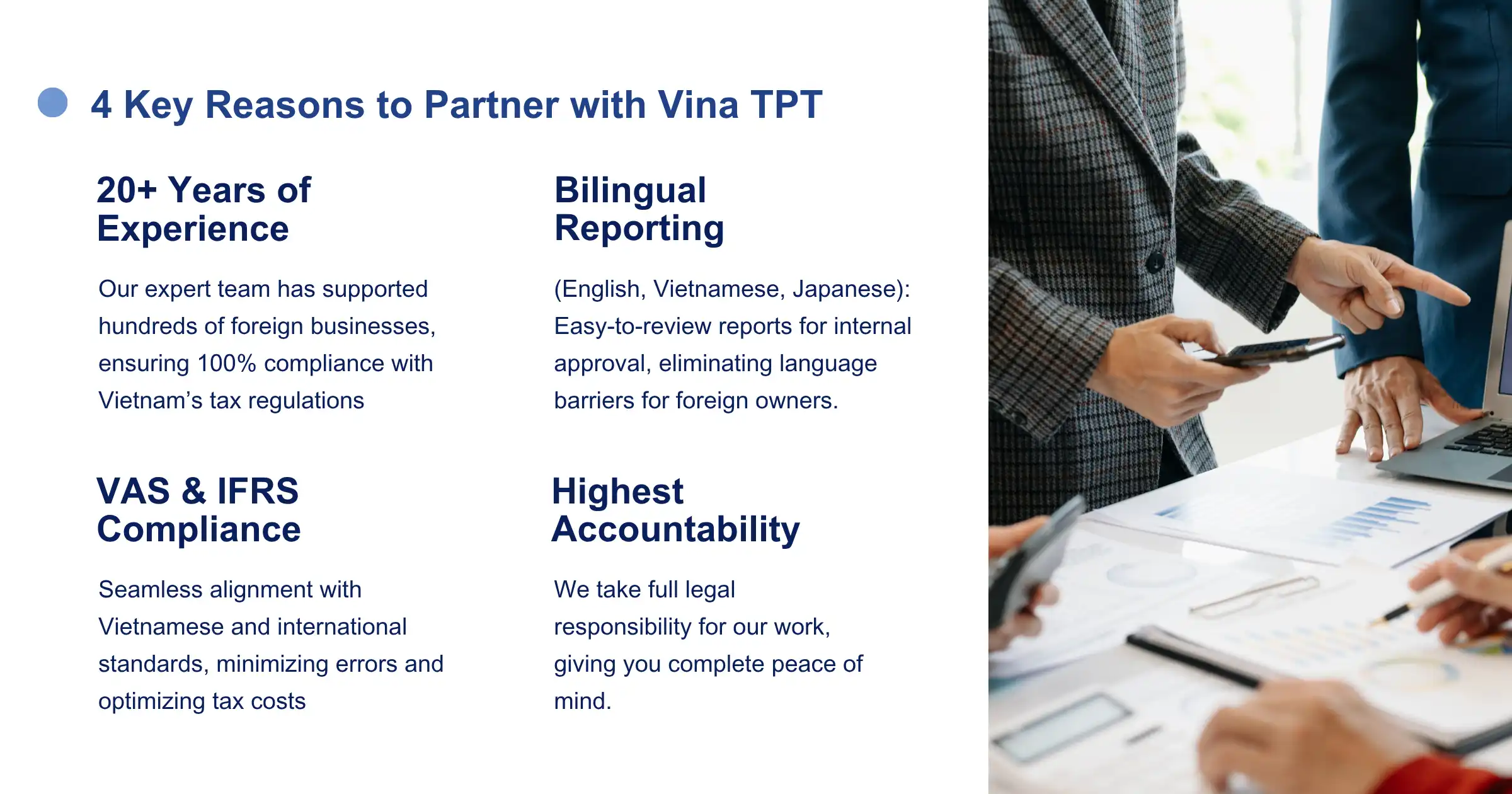
With over 20 years of experience supporting FDI companies and startups in Vietnam, Vina TPT offers comprehensive accountants for startups services with a professional and scalable approach:

  • Bookkeeping compliant with VAS and tax regulations
  • Flexible payroll solutions tailored for startup structures
  • Financial reporting with key metrics such as burn rate and runway
  • Strategic advisory including financial modeling and cost optimization
  • Support from company formation through audit and compliance readiness
  • Bilingual and multilingual reporting

Every client is supported by a multi-level expert team (Assistant – Senior – Manager), ensuring high quality and timely delivery of financial data.

Professional accountants for startups help you maintain transparent finances, reduce risks, utilize 2026 tax incentives, closely monitor burn rate & runway, and prepare effectively for fundraising rounds. The result is faster, more sustainable growth without being held back by administrative issues.

Contact Vina TPT today for personalized consultation and a tailored accountants for startups solution that matches your current growth stage.

BOOK A FREE CONSULTATION
Financial statement preparation and compliance in 2025 for Japanese firms

Financial statement preparation and compliance in 2025 for Japanese firms

Financial statement preparation and compliance in 2025 for Japanese firms

1. Why 2025 Brings New Financial Reporting Challenges for Japanese Companies in Vietnam

2025 is considered an important milestone for Japanese enterprises operating in Vietnam. The constant change in tax and accounting policies, especially the regulations on Value Added Tax (VAT) and Corporate Income Tax (CIT), makes the preparation of financial statements more complicated and requires higher accuracy than ever.

For foreign-invested enterprises (FDI), especially Japanese enterprises, annual financial statements must be independently audited before being submitted to the tax authorities. This process requires early preparation, data must be complete, clear and can be easily compared with the accounting system at the headquarters in Japan. Compared to domestic enterprises, Japanese companies often spend more time on the comparison, consolidation and review stages, especially when there are differences between Vietnamese and Japanese accounting standards.

2. Key Financial Reports Every Japanese Firm Must Prepare

In Vietnam, all enterprises, especially foreign-invested enterprises (FDI), must prepare a complete set of financial statements according to Vietnamese Accounting Standards (VAS). This set of reports is not only a legal requirement to submit to tax authorities and independent auditors, but also a basis for Japanese enterprises to consolidate financial data with their headquarters in Japan.

The three core reports include: Balance Sheet, Income Statement, and Cash Flow Statement.

Compared to J-GAAP (Japanese Generally Accepted Accounting Principles), VAS has some important differences that Japanese enterprises should note. For example, VAS requires depreciation of fixed assets according to the fixed time frame of the Ministry of Finance of Vietnam, while J-GAAP allows more flexibility based on the actual economic life of the asset. In addition, VAS recognizes revenue when ownership is transferred, not when invoices are issued as in some cases in Japan. Regarding consolidated reporting, VAS applies a different calculation method for minority interests and exchange rate differences than the Japanese standard, so if not adjusted in time, the data when consolidated to the parent company can be significantly different.

Therefore, during the financial statement preparation stage, Japanese companies often have to maintain two sets of data in parallel, one according to VAS standards to serve legal obligations in Vietnam, and one according to J-GAAP to serve the consolidated reporting to the head office. Handling this dual standard requires great care, in-depth understanding of both accounting systems, and close coordination between the internal accounting team, auditors, and consulting units such as Vina TPT Accounting service.

Financial statement preparation and compliance in 2025 for Japanese firms

3. Common Pitfalls in Year-End Financial Reporting

When it comes to preparing and submitting financial statements, many Japanese companies in Vietnam often encounter systematic errors that affect the auditing and tax compliance process.

3.1. Consolidation Differences Between Vietnam and Japan

One of the most common issues is the difference in financial statement consolidation between the branch in Vietnam and the headquarters in Japan. Vietnamese Accounting Standards (VAS) have many differences compared to J-GAAP, especially in handling exchange rate differences, classifying fixed assets and recording prepaid expenses.

According to i-Glocal’s analysis (2024), many Japanese FDI enterprises often have to prepare separate financial statements and consolidated reports in parallel, making the data reconciliation process complicated and prone to errors.

3.2. Lack of Valid Expense Documentation

Another common error is the lack of valid documents for deductible expenses. The 2023 report of the General Department of Taxation of Vietnam shows that more than 30% of tax inspection reports of FDI enterprises are related to invalid invoices, documents or incorrect accounting of deductible expenses.

These errors often lead to adjustments to taxable profits, collection of corporate income tax (CIT) and late payment penalties, directly affecting the reputation and financial planning of the parent company.

3.3. Exchange Rate Handling Issues

The handling of exchange rates is also a cause of discrepancies in financial statements. According to Circular 200/2014/TT-BTC, enterprises must use the actual exchange rate at the time of the transaction and prepare financial statements in Vietnamese Dong (VND).

However, many Japanese companies still use internal exchange rates according to Japanese accounting standards, leading to discrepancies when preparing reports to send to Vietnamese tax authorities, especially in the handling of foreign currency revenue and expenses.

3.4. Late Audit Submission and Transparency Requirements

Some Japanese enterprises in Vietnam also have problems submitting audit reports on time or not meeting financial transparency requirements. According to Vietnam Briefing (2024), all FDI enterprises must complete independent audits and submit financial reports within 90 days of the end of the fiscal year.

If the report is submitted late or does not meet standards, the enterprise may be subject to administrative fines, restricted from repatriating profits and face difficulties in renewing its investment license.

These risks not only increase compliance costs, but also directly affect the reputation and progress of consolidated reporting in Japan. Therefore, Japanese enterprises need to focus on controlling documents, complying with VAS and preparing financial records from the beginning to avoid being passive during the audit period.

In summary, full compliance with Vietnamese Accounting Standards (VAS) and financial statement regulations not only helps Japanese enterprises ensure financial transparency and accuracy, but also minimizes tax and audit risks. Proactively reviewing periodically and coordinating with professional accounting units in Vietnam is an important step to maintain stability in financial management and strengthen trust with Japanese management agencies and partners.

EXPERT YEAR-END FINANCIAL REPORTING SUPPORT

4. Outsourced Bookkeeping: The Smart Way to Stay Compliant

Faced with a large volume of accounting work and strict compliance requirements, more and more Japanese enterprises in Vietnam choose outsourced bookkeeping instead of maintaining an in-house accounting team. This solution helps save on personnel costs, ensures accuracy in reporting, and easily coordinates with auditors and tax authorities. Vina TPT Accounting service provides a complete outsourced bookkeeping service exclusively for Japanese enterprises, including: bookkeeping, preparing bilingual financial statements (English – Japanese – Vietnamese), and reviewing data before auditing. Vina TPT’s outstanding strength is its team of experts who can communicate fluently in Japanese, understand Japanese accounting standards (J-GAAP) and Vietnamese regulations (VAS), helping customers easily exchange, compare and consolidate financial data.

5. How Vina TPT Supports Japanese Firms for 2025 Compliance

Entering 2025, when the demand for financial transparency is increasing, Japanese enterprises need a partner who not only does accounting but also accompanies them throughout the entire compliance process.

Financial statement preparation and compliance in 2025 for Japanese firms

Vina TPT Accounting service provides comprehensive solutions including:

  • Preparing and reviewing bilingual financial statements (Japanese – Vietnamese): ensuring easy to understand, accurate and ready for audit.
  • Consulting on consolidated reports for Japanese corporations: supporting data conversion from VAS to J-GAAP or IFRS.
  • Consulting and coordinating audits: working directly with independent auditors, helping to reduce review time and limit post-audit adjustment risks.
  • Monitoring and updating the latest tax – accounting policies: ensuring reports are always in compliance with the regulations of the Ministry of Finance of Vietnam.

With a team of experienced accountants and auditors fluent in three languages ​​(Japanese, English, Vietnamese), Vina TPT helps Japanese enterprises in Vietnam maintain a transparent accounting system, comply with and optimize operating costs in accordance with international standards and Vietnamese law.

For comprehensive advice on financial statement preparation, auditing and tax compliance solutions in 2025, contact VinaTPT.

BOOK A FREE CONSULTATION

Vina TPT Accounting services