Smart Payroll Solutions for Part-Time Staff in Japanese Restaurants in Vietnam

Smart Payroll Solutions for Part-Time Staff in Japanese Restaurants in Vietnam-VTPT

smart-payroll-services-for-small-business-vietnam

1. Managing Payroll for Part-Time Staff: The Hidden Challenge in F&B with Payroll Service for Small Business

Japanese restaurant chains in Vietnam often have dozens to hundreds of employees working in shifts, especially part-time employees in service positions, sous chefs or receptionists. The work schedule changes flexibly every week, making timekeeping, payroll and tax management much more complicated than in conventional business models.

Many Japanese restaurant owners still use Excel spreadsheets or manual records to calculate salaries, making the process both time-consuming and error-prone – especially when adding in items such as evening shift allowances, tips, productivity bonuses, or personal income tax (PIT) deductions based on working hours. This not only increases pressure on the accounting department but also poses risks to compliance with Vietnamese labor laws.

That’s why adopting a payroll service for small business is becoming an essential solution, helping restaurant owners automate payroll processes, reduce errors, and ensure compliance while focusing on improving service quality.

2. The Complexity of Payroll in Restaurant Operations

In the F&B industry, payroll for restaurants is one of the most complex operations due to the highly variable nature of human resources. Each employee can work in many branches, with different working hours and receive hourly, shift or daily wages.

In addition, restaurants also have to handle factors such as:

  • Tips divided by shift or work group;
  • Meal allowances, uniforms, parking;
  • Social insurance, health insurance, unemployment insurance obligations for eligible employees;
  • And especially the declaration and deduction of personal income tax for part-time employees with fluctuating income.

When these factors are processed manually, even a small error in Excel formulas can lead to incorrect payroll, affecting employee trust and violating legal regulations.

GET PROFESSIONAL PAYROLL SUPPORT

3. Why Online Payroll Processing Is the Game Changer

That is why more and more Japanese restaurants are switching to online payroll processing – an automated payroll system that simplifies the entire process. The system allows for shift-based timekeeping, real-time data updates, and automatic calculation of salaries, bonuses, and tax deductions with just a few steps.

For small business owners, using this solution helps:

  • Save up to 70% of payroll processing time
  • Reduce the risk of errors and tax violations
  • Easily track personnel costs by branch or shift
  • And quickly export electronic payroll or bilingual English – Vietnamese reports when needed.

smart-payroll-services-for-small-business-vietnam

Switching to an online payroll system not only helps restaurants modernize their human resource management but also demonstrates a standard operating style in the Japanese spirit – accurate, transparent, and on-time.

4. Vina TPT Payroll Service: Designed for Japanese Restaurants in Vietnam

Understanding the specifics of the F&B industry, Vina TPT Payroll Service has designed a payroll services for small businesses specifically for Japanese restaurant chains in Vietnam. Our solution fully meets the requirements of flexibility, security and bilingualism, making the payroll and human resource management process simpler than ever.

Services include:

  • Automating the payroll process by shift, integrating timekeeping data;
  • Supporting electronic invoices, tax reporting and PIT for part-time employees;
  • Bilingual reports (English – Vietnamese – Japanese) in accordance with corporate standards;
  • Consulting on legal compliance and updating the latest Vietnamese labor regulations.

With an online management system, restaurant owners can track personnel costs in real time, reduce errors and save significant time processing monthly payroll.

5. Simplify Payroll, Focus on Restaurant Quality

Behind Vina TPT’s optimal payroll solutions is a team of experts with in-depth knowledge of Japanese corporate culture and the Vietnamese legal system.

Vina TPT’s accounting, human resources and tax consultants are all well-trained from university level and above, with many years of experience working with Japanese enterprises in the restaurant, hotel and manufacturing sectors. They can communicate fluently in Japanese, understand the management style and internal reporting processes of Japanese investors.

Thanks to that, Japanese restaurant chains can completely focus on their main mission – bringing exquisite culinary experiences and Japanese-standard service to Vietnamese customers.

Contact Vina TPT Payroll Service today for advice on online payroll processing solutions suitable for Japanese restaurant models in Vietnam.

BOOK A FREE CONSULTATION

smart-payroll-services-for-small-business-vietnam

How Korean IoT Startups Streamline Payroll Management in Vietnam

Vina TPT Payroll service streamlining outsource payroll for korean IoT startups

payroll-processing-companies

1. Payroll Challenges Faced by Korean IoT Startups in Vietnam

When Korean startups expand into Vietnam to develop IoT (Internet of Things) products, they often take advantage of the highly skilled and affordable Vietnamese engineering team. However, a major challenge arises right from the beginning: managing payroll and complying with Vietnamese labor regulations – an area where professional payroll processing companies play a crucial role in ensuring accuracy, compliance, and efficiency.

Many startups have to handle complex contracts, including full-time employees, part-time engineers, and freelancers. Calculating salaries, social insurance, personal income tax, and labor declarations are often done manually, leading to errors and legal violations.

That is why more and more Korean businesses choose to outsource payroll to local experts.

2. Why Payroll Outsourcing Is the Smart Choice for Tech Startups

For small tech companies or Korean IoT startups in Vietnam, maintaining an in-house accounting and human resources department is often costly and ineffective. Outsourcing payroll processing services is a smart choice to help them cut operating costs while still ensuring accuracy and legal compliance. When cooperating with payroll processing companies, businesses can automate the entire process of calculating salaries, deducting taxes and issuing electronic payslips, instead of having to manually process them using Excel spreadsheets.

This solution not only saves time but also limits the risk of errors and violations of labor regulations. Instead of spending hours checking data, startups can focus on product research, technology development and market expansion. Meanwhile, all issues related to payroll, taxes and insurance are handled quickly and transparently by a professional team – making outsourcing payroll the optimal choice for startups that want to develop sustainably in Vietnam.

3. Core Components of Payroll Processing Services

A comprehensive employee payroll service typically includes:

  • Collecting and validating timekeeping data.
  • Calculating salaries, bonuses, allowances, and deducting insurance and personal income tax.
  • Preparing periodic reports to tax and insurance authorities.
  • Issuing electronic payslips and storing personnel records.
  • Automatically updating when there are changes in minimum wages or new regulations.

As a result, businesses can save dozens of hours each month on repetitive administrative tasks.

GET PROFESSIONAL PAYROLL SUPPORT

4. Local Compliance for Foreign-Run Startups

When expanding operations to Vietnam, Korean IoT startups need to focus not only on technology development but also on ensuring compliance with all labor and tax regulations for foreign-invested enterprises. In Vietnam, all forms of salary payments, whether for Vietnamese or foreign employees, must be transparently declared and in accordance with regulations on labor contracts, personal income tax (PIT) and social insurance (SI).

What makes it difficult for many Korean startups is the difference in the legal systems between the two countries. For example, a Korean engineer working in Vietnam may have to pay taxes under two double taxation agreements (DTAs), or require a work permit and legal residence declaration. Meanwhile, Vietnamese employees are subject to different regulations regarding fixed-term contracts, overtime hours and compulsory insurance premiums.

Handling these discrepancies without expertise can easily lead to mistakes, such as underpaying insurance, miscalculating taxes, or creating contracts with incorrect formats. Therefore, Korean startups often choose payroll outsourcing services to ensure that the entire payroll and tax reporting process is carried out legally, on time, and always ready for audit. With support from experts who understand Vietnamese law, businesses can avoid legal risks and strengthen their reputation with regulators and investors.

5. How Payroll Outsourcing Integrates with IoT Business Operations

In the IoT industry, human resources often include short-term contract engineers, foreign experts, and R&D partners.

Managing payroll for this diverse group of human resources requires flexibility that conventional Excel spreadsheets cannot provide.

Cloud-based online payroll processing allows startups to:

  • Manage human resources data by project.
  • Track labor costs for each product group.
  • Generate quick reports for investors or headquarters in Korea.

In addition, when there are foreign employees working in Vietnam, the payroll system needs to ensure compliance with tax regulations for foreigners, that something that Vina TPT Payroll Service fully supports.

6. Why Korean Companies Choose Vina TPT Payroll Service

Vina TPT is one of the prestigious payroll processing companies in Vietnam, chosen by many Korean startups thanks to its experience in supporting technology businesses.

Highlights of Vina TPT Payroll Service include:

  • Bilingual interface and reports in English – Vietnamese.
  • Support for many types of contracts (full-time, part-time, freelancer).
  • Integration with the startup’s existing accounting system.
  • Ensuring the security and transparency of salary data.
  • Continuous compliance consulting, helping businesses develop with peace of mind.

With a standardized process, Vina TPT helps Korean startups save time, reduce legal risks and maintain trust with Vietnamese employees.

7. From Payroll Stability to Growth Readiness

A stable payroll system not only helps businesses operate smoothly, but also serves as a foundation for expansion and attracting investment capital.

With the administrative burden removed, Korean IoT startups can focus on their core strengths which are developing technology, expanding products and conquering the Southeast Asian market.

With Vina TPT Payroll Service, payroll is no longer a complicated problem but a stepping stone for sustainable growth in Vietnam.

BOOK A FREE CONSULTATION

payroll-processing-companies

Accounting service for Chinese tech firms in Vietnam

Accounting services for Chinese tech companies in Vietnam

accounting-services-for-chinese-companies

1. Fast-Growing Chinese Tech Firms Need Smarter Accounting Services in Vietnam

The wave of Chinese technology companies shifting production and investment to Vietnam is taking place strongly. From electronics, hardware, software companies to technology startups, Vietnam has become an attractive destination thanks to its competitive labor costs, preferential tax policies and strategic position in the regional supply chain.

However, along with that expansion speed are challenges in financial management. As the scale of operations increases rapidly, companies face the challenge of controlling cash flow, standardizing accounting processes, and ensuring compliance with Vietnamese regulations, which are significantly different from the Chinese system. A smart, automated and transparent accounting system is the foundation for Chinese technology companies to maintain stability during their development in Vietnam.

2. Bridging the Gap Between Tech Expansion and Accounting Readiness

Most Chinese technology companies, when first investing in Vietnam, focus on production or R&D, paying little attention to building an internal accounting team with a good understanding of local laws. This leads to a fragmented financial system that lacks standardization, making it difficult to prepare tax and financial reports according to Vietnamese regulations.

In addition, differences in language, forms, tax declaration procedures and accounting standards (VAS vs CAS) put many businesses at risk of compliance. Even small errors in declaration or late submission of reports can lead to administrative fines, affecting the reputation of the business and long-term investment projects. Clearly, to operate effectively, Chinese technology companies need a reliable accounting partner who understands both the business language and the laws of the two countries.

3. Why Accounting Outsourcing and Payroll Services Ensure Agility and Compliance

Accounting services is a popular trend among FDI companies in Vietnam, especially in the technology industry. Instead of recruiting, training and maintaining an accounting department, enterprises can use the services of a professional unit – helping to save up to 40-60% of operating costs, while eliminating human resource risks.

Units specializing in providing accounting services such as Vina TPT not only process books, prepare financial reports, declare and settle taxes, but also integrate China payroll services, ensuring that salary calculation, personal income tax and social insurance deductions are performed correctly, transparently and bilingually. This is especially important for Chinese companies with multinational staff, requiring a payroll and tax calculation system that is both accurate and easy to understand.

As a result, businesses can focus resources on core activities – product, technology and market development,  ​​while accounting, tax and human resources are guaranteed to operate smoothly and in compliance with the law.

GET ADVICE ON ACCOUNTING SERVICES IN VIETNAM

4. Modern Accounting Services for Business Growth in the Tech Industry

In the digital age, accounting is no longer a manual task, but an important part of the operational strategy. Modern accounting solutions today apply cloud computing (cloud accounting), automate reporting, and standardize financial data according to VAS – IFRS to increase processing speed and minimize errors.

For technology businesses, this is even more important when it comes to tracking R&D costs, depreciation of technology assets, or calculating cost of goods in the supply chain. Digital accounting systems help businesses access financial data in real time, make faster decisions, and coordinate easily between branches in Vietnam – China.

In addition, standardizing financial reports according to international standards also helps businesses easily mobilize capital, cooperate in investment or IPO in the future, when financial transparency becomes a key factor of market confidence.

5. From Data to Decision: Turning Accounting Insights into Business Advantage

A good accounting system not only reflects the past but also forecasts the future. When properly analyzed and presented, financial data will become a powerful tool to support leaders in making strategic decisions.

Through indicators of cash flow, personnel cost ratio, investment efficiency and gross profit, businesses can identify risks early, allocate budgets reasonably and optimize operations. This is especially important for technology businesses – where changes occur rapidly and every financial decision directly affects competitiveness.

Therefore, accounting is not just a compliance task, but a strategic foundation to help Chinese technology businesses develop sustainably in Vietnam.

6. Vina TPT Accounting Service – Trusted Partner for Chinese Tech Firms in Vietnam

With more than 10 years of experience serving FDI companies, Vina TPT Accounting Services has become a strategic partner of many Chinese, Korean and Singaporean technology companies operating in Vietnam. We have a team of bilingual English-Vietnamese, who are deeply trained in financial regulations, Vietnamese tax laws and international reporting standards.

Vina TPT experts not only perform accurate operations but also provide strategic consulting: building a standardized financial system, internal control, optimizing costs and supporting businesses in converting to a digital accounting model.

Vina TPT is committed to providing comprehensive, transparent and absolutely confidential accounting services, helping Chinese technology enterprises confidently develop in Vietnam without worrying about legal or operational barriers.

Vina TPT Accounting Service for business – a solid financial foundation for the sustainable growth of Chinese technology enterprises in Vietnam.

BOOK A FREE CONSULTATION

accounting-services-for-chinese-companies

Payroll & workforce management for Chinese electronics companies

Vina TPT Payroll Service consulting outsource payroll for Chinese companies

payroll-workforce-management-for-chinese-electronics-companies

1. Growing Presence of Chinese Electronics Companies in Vietnam

As global supply chains restructure, Vietnam has become a top destination for Chinese electronics manufacturers – offering both large-scale manufacturing capacity and tax advantages and a young workforce. As manufacturing costs in China continue to rise, many Chinese electronics corporations and businesses have chosen Vietnam as their next destination to expand their factories and optimize their supply chains. Vietnam not only has a strategic geographical location, close to China, but also possesses a young workforce, competitive labor costs and many attractive free trade agreements (FTAs). 

However, this rapid expansion also brings with it many challenges in human resource management and payroll processing. Electronic businesses need professional payroll services and workforce management systems to ensure legal compliance, maintain productivity and manage costs effectively. This is what makes the demand for payroll partners in Vietnam increasingly strong in the Chinese business community.

2. Payroll Challenges for Foreign Manufacturing Businesses in Vietnam

Vietnam has a complex legal and labor tax system, especially for foreign enterprises. Requirements for personal income tax (PIT), social insurance (SI), health insurance (HI) declarations and periodic labor reports make payroll management a multi-layered process. Even small errors in tax declarations or insurance payments can lead to administrative violations and audit risks.

In addition to legal factors, the operation of a non-synchronous payroll system between departments or factories makes it difficult for many enterprises to ensure accuracy, transparency and data security. In this context, professional payroll processing services become an inevitable choice that help Chinese enterprises minimize errors, save resources and focus on production goals.

TALK TO A PAYROLL EXPERT IN VIETNAM

3. Why Outsourced Payroll Services is the Smart Move for Chinese Manufacturers

Outsourcing payroll brings clear benefits to Chinese electronics manufacturers in Vietnam. Instead of setting up a complex human resource accounting department, businesses can entrust the entire process of calculating salaries, deducting taxes, and preparing reports to a specialized unit. This not only helps save fixed costs but also eliminates the risk of legal violations when Vietnam’s regulations change frequently.

Moreover, outsourcing payroll services helps businesses be more flexible when expanding production. As the number of employees increases rapidly in each stage, the service provider can adjust the management process accordingly, ensuring accuracy and timeliness. As a result, businesses do not need to invest in additional software infrastructure or internal personnel, while still maintaining consistency in salary and benefits management.

payroll-services-for-Chinese-companies

4. Key Features of Professional Payroll Processing Services in Vietnam

An effective payroll services needs to ensure that the entire process chain is operated accurately and transparently:

  • Collect and process timekeeping data from different departments and shifts.
  • Calculate salaries, allowances and bonuses according to each level, position and performance.
  • Deduct and declare personal income tax (PIT), along with social insurance (SI) according to regulations.
  • Issue payroll and transfer automatically on time, ensuring confidentiality.
  • Prepare periodic human resource and financial reports, serving internal auditing and management.

All these steps are performed on a secure, automated software platform and have the ability to flexibly integrate with the enterprise’s existing human resource management system.

In addition, professional service providers also:

  • Support timely tax declaration and payment, timely update of new regulations from tax authorities.
  • Labor policy and benefits consulting for Vietnamese employees and foreign workers.
  • Help Chinese electronics enterprises reduce administrative burden, while ensuring all human resources activities run smoothly and legally.

Once the payroll process is automated and transparent, the next step is to optimize the entire HR management system to operate more efficiently.

5. Integrating Workforce Management with Payroll Services for Smooth Operations

When a business implements workforce management integrated with payroll services, the entire internal operating system is connected into a seamless chain:  from timekeeping, shift assignment, performance tracking to payroll and HR reporting. Synchronizing data between departments not only helps managers accurately track productivity, turnover rates or HR costs, but also supports the leadership team in making strategic decisions quickly and based on real data.

In addition, an integrated HR management system also contributes to improving the employee experience. When factors such as salary, bonus, allowances, benefits or insurance are processed transparently, accurately and on time, employees will feel secure, thereby increasing engagement and reducing turnover.

Especially for large-scale Chinese electronics factories with many rotating shifts, applying payroll solutions combined with modern human resource management technology helps standardize operating processes, limit manual errors and ensure strict compliance with labor regulations in Vietnam. This is the foundation for businesses to operate stably, optimize costs and build a sustainable workforce in the long term.

6. Partnering with Vina TPT Payroll Service for Chinese Companies in Vietnam

Vina TPT Payroll Service is a leading partner in the field of payroll services and workforce management for foreign enterprises in Vietnam, especially Chinese electronics companies. With more than 15 years of experience working with large-scale manufacturing corporations, Vina TPT has built a team of experts including human resources specialists, tax accountants and corporate lawyers with in-depth expertise and understanding of the Vietnamese legal system.

Vina TPT experts not only support salary calculation, tax and insurance declaration but also advise on human resource management strategies, build a system of salary and welfare policies suitable for Chinese corporate culture. Thanks to the combination of consulting capacity and modern management technology, Vina TPT helps businesses operate effectively, minimize costs and ensure compliance with Vietnamese laws throughout the operation process.

Contact Vina TPT Payroll Service now to get advice on payroll outsourcing solutions in Vietnam that are suitable for your electronics factory model!

BOOK A FREE CONSULTATION

payroll-services-for-Chinese-companies

VAT Refund in Vietnam 2025: Updated Conditions and Eligible Cases Explained

VAT Refund in Vietnam 2025 Updated Conditions and Eligible Cases Explained-VTPT

VAT Refund in Vietnam 2025_ Updated Conditions and Eligible Cases Explained - VTPT

1.What is a VAT Refund and When is a Business Entitled to it?

Value-Added Tax (VAT) refund refers to the process by which the State reimburses the amount of VAT that a business has either paid into the State budget or has not yet been deducted. When a business meets specific VAT refund conditions, it will be entitled to receive back the paid tax amount. The purpose of this policy is to prevent double taxation and to support businesses in investment or export activities.

Businesses are eligible for VAT refunds when they fall under the cases stipulated by law and meet the specific refund conditions applicable to their business type. Detailed information will be provided by Vina TPT in this article.

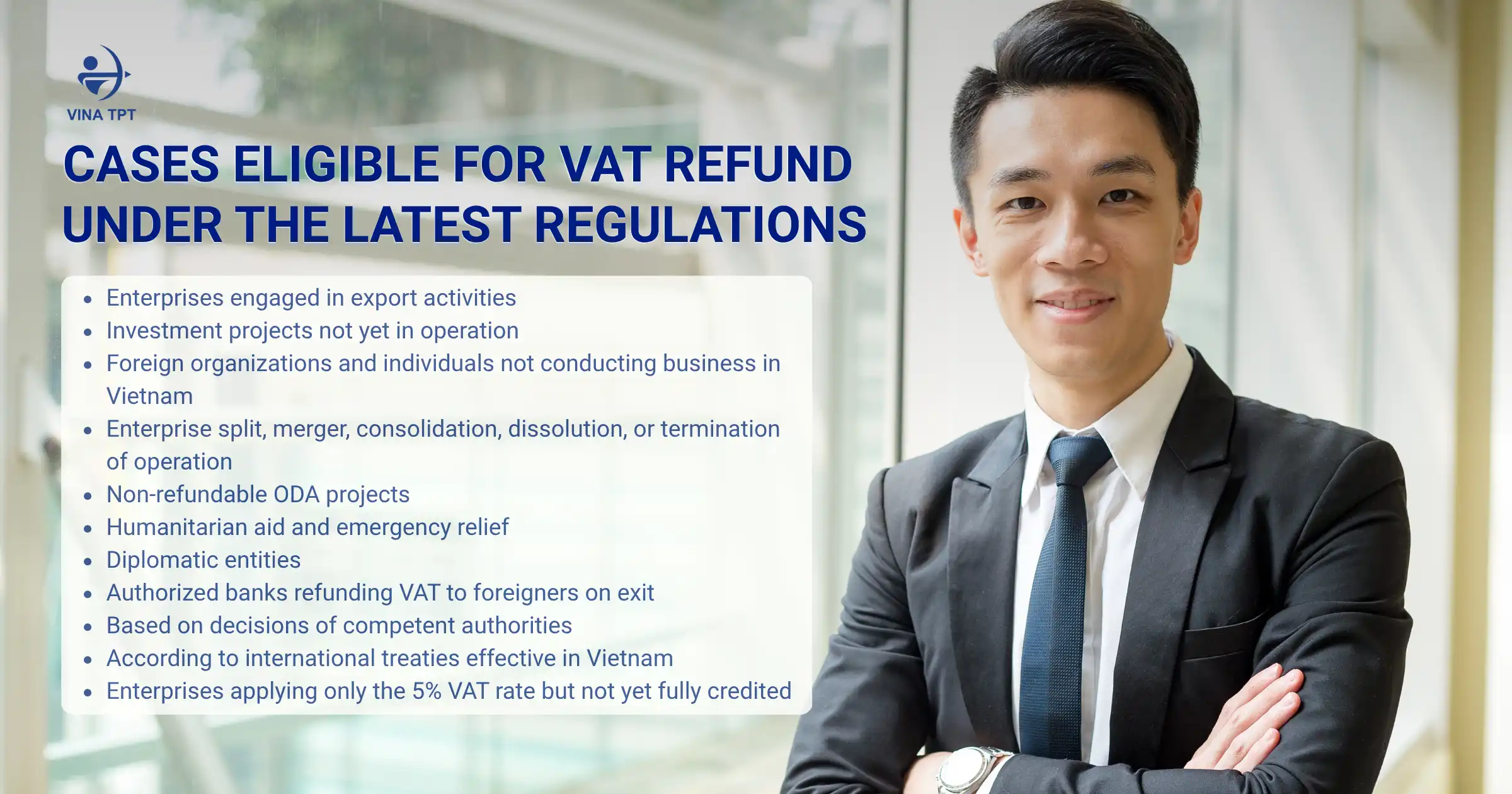
2.Cases Eligible for VAT Refund Under the Latest Regulations

VAT Refund in Vietnam 2025_ Updated Conditions and Eligible Cases Explained - VTPT

No.  Case eligible for VAT refund  Main conditions  Legal basis 
1  Enterprises engaged in export activities  Exported goods and services are subject to a 0% VAT rateInput VAT not yet credited is ≥ VND 300 million

Must have valid customs documents and bank payment records 

Article 13, VAT Law 2024 
2  Investment projects not yet in operation  The investment project has been duly registeredNo revenue has been generated

Input VAT not yet credited is ≥ VND 300 million 

Article 13, VAT Law 2024 
3  Enterprise split, merger, consolidation, dissolution, or termination of operation  The enterprise no longer operates to deduct input VATRemaining input VAT has not yet been credited  Article 13, Amended VAT Law 2008 
4  Foreign organizations and individuals not conducting business in Vietnam  Possess valid tax payment documentsDo not conduct regular business activities in Vietnam  Circular 219/2013/TT-BTC, Article 18 
5  Non-refundable ODA projects  Not using the state budget to pay VATPossess valid confirmation from the donor  VAT Law 2024, Circular 219 
6  Humanitarian aid and emergency relief  Must have a decision approving the receipt of aidMust provide valid documents related to goods and input invoices  Circular 219/2013/TT-BTC 
7  Đối tượng ngoại giao (miễn trừ)  Must have confirmation from the State Protocol DepartmentApplied under international treaties  Decree 134/2016/NĐ-CP 
8  Authorized banks refunding VAT to foreigners on exit  Must have a goods management systemMust prepare a tax refund list according to the prescribed form  Circular 92/2019/TT-BTC 
9  Based on decisions of competent authorities  Must have an official document/decision on tax refundApplied in special cases, subject to post-refund inspection  Decree 49/2022/NĐ-CP 
10  According to international treaties effective in Vietnam  Must fall under subjects clearly stated in the treatyMust provide complete dossiers and supporting documents  Law on International Treaties, Law on VAT 
11  Enterprises applying only the 5% VAT rate but not yet fully credited  Input VAT not yet credited ≥ 300 million VNDAfter 12 months or 4 consecutive quarters – applicable from 01/07/2025  Amended VAT Law 2024

 VAT 2025 Update:The 2024 Value Added Tax (VAT) Law will officially take effect from July 1, 2025.

3. Conditions for VAT refund

Depending on the type of enterprise, the conditions for VAT refund may vary

3.1. For domestic enterprises 

  • Undeducted input VAT of at least VND 300 million
  • Có Valid e-invoices andnon-cash payments for invoices from VND 20 million
  • Not under tax enforcement measures or committing tax violations
  • Proper and timely tax declaration 

3.2. For exporting enterprises 

  • Export contracts, customs declarations, and bank payment documents 
  • Continuous undeducted VAT for 3 periods or at least VND 300 million in one period
  • Exported goods must be cleared through customs
  • No fraudulent invoice transactions 

Note: From 2025, under the amended VAT Law, exporters with undeducted VAT over VND 100 million in a period may apply for refund earlier, reducing waiting time.

3.3. For investment projects 

  • Must have an Investment Registration Certificate 
  • No revenue generated, but large undeducted VAT incurred 
  • Separate bank account for the project 
  • Separate accounting for project expenses 

3.4. For foreign organizations/individuals 

  • Valid proof of VAT paid in Vietnam 
  • Non-regular business activities 
  • Full compliance with tax declaration and refund procedures 

Explore Our Tax Services

 4. Cases Not Eligible for VAT Refund

(According to Circular 219/2013/TT-BTC, amended by Circular 130/2016/TT-BTC)

  • Investment projects with insufficient charter capital contribution
    If, by the time of filing the VAT refund application (from July 1, 2016 onwards), the enterprise has not contributed the full registered charter capital it will not be eligible for refund. Instead, the uncredited input VAT will only be carried forward to the next CIT period.
  • Conditional investment sectors not meeting requirements under the Law on Investment
    This includes cases where the enterprise has not obtained the necessary license, certificate of eligibility, or written approval from the competent authority.  
  • Violation of conditions during project implementation
    If, during the implementation, the project has its license or certificate revoked, or is found no longer to meet conditional business requirements, VAT refund will be suspended from that point onward.  
  • Projects involving natural resource/mineral exploitation or production with ≥ 51% cost structure derived from natural resources
    Applicable to projects licensed from July 1, 2016. The determination of the resource ratio is guided under Clause 23, Article 4 of Circular 219.  
  • Imported goods for export but not exported through the prescribed customs area
    VAT refund is not eligible if export procedures are not carried out at the designated customs office.  
  • Exported goods not completing customs procedures at the customs-controlled area
    In this case, VAT refund is also not eligible. 

5. Key Notes on VAT Refund for Businesses

  • Do not consolidate VAT refund applications across multiple periods unless specifically guided by regulations. 
  • Carefully check the payment timeline and payment conditions of each invoice. 
  • For exporting enterprises, clearly keep records of customs declarations, bills of lading, and payment documents.
  • Always review the validity of input invoices – especially those from new suppliers. 

6. Simplify Your VAT Refund with Vina TPT’s Professional Support

Navigating the VAT refund process in Vietnam can be complex, especially with changing tax regulations and documentation requirements. Vina TPT offers professional support to help businesses simplify every step, from eligibility assessment to refund application and follow-up with tax authorities. With deep expertise in Vietnamese tax law, our team ensures accuracy, compliance, and maximum refund value for your company. Partnering with Vina TPT means saving time, avoiding costly errors, and gaining peace of mind knowing your VAT refund is handled by trusted professionals. Let Vina TPT streamline your refund process efficiently and transparently.

Contact Vina TPT today to simplify your VAT refund process!

Discuss Your Case with Our Specialists

accounting skills

Tax Incentive in Vietnam 2025: Comprehensive Guide to Optimize Profits under New CIT Law

Overview of corporate tax incentives in Vietnam 2025 under the new CIT Law

Overview of corporate tax incentives in Vietnam 2025 under the new CIT Law

Tax Incentive: Comprehensive Guide to Corporate Tax Incentives in Vietnam 2025 – Optimize Profits with New CIT Law

With Vietnam’s Corporate Income Tax (CIT) Law 2025 officially in force from October 1, 2025, investors and CFOs are reassessing how to leverage tax incentives to strengthen profitability and compliance.

From 10 – 17% preferential CIT rates to multi-year tax holidays, the new regime gives both domestic and foreign companies more tools to optimize profits but only if you understand the rules.

In this guide, you’ll learn:

  1. What a tax incentive is and why it matters for 2025
  2. The main types of corporate tax incentives available in Vietnam
  3. Key eligibility requirements and risk management
  4. How to prepare and apply effectively with professional support

I. What is a Tax Incentive and Why Do Businesses Need to Know in 2025?

A tax incentive is a government policy designed to reduce or exempt tax liabilities for businesses that invest in targeted sectors or locations, with the aim of encouraging sustainable growth, innovation, and foreign direct investment (FDI).

Under the CIT Law 2025, tax incentives in Vietnam have evolved to:

  • Support the digital economy and green/clean industries.
  • Attract FDI via extended tax breaks and preferential schemes.
  • Motivate companies to reinvest profits inside Vietnam rather than only extracting them.

In today’s competitive ASEAN environment, understanding tax incentives isn’t optional, it’s a survival and growth strategy.

The standard corporate income tax rate remains 20 %. However, preferential rates are flexibly applied:

  • 15 % for enterprises with annual revenue ≤ VND 3 billion
  • 17 % for enterprises with revenue over VND 3 billion up to VND 50 billion
  • In specific cases (e.g., foreign-owned enterprises, cooperatives…) where cost/expense determination is difficult, a direct tax rate on revenue may apply

II. Key 2025 Updates: Major Types of Corporate Tax Incentives in Vietnam

Key Corporate Tax Incentives in Vietnam 2025

1. Expanded deductible expenses under the 2025 CIT Law

Enterprises are now allowed to deduct additional expenses related to scientific research, digital transformation, testing new technologies, emission reduction, and community activities. This aims to create favorable conditions for businesses to pursue sustainable growth and innovation.

2. Incentives by sector, location, and investment project

Investment projects in high-tech sectors such as semiconductor production, AI, data centers, automobile manufacturing, and electronic device production are eligible for a preferential tax rate of 10% for up to 15 years.
Expansion projects applying clean technologies or contributing to environmental improvements may also qualify for tax exemptions or reductions if they meet specific requirements.

3. Clear incentive rules to avoid overlapping

If an enterprise falls under multiple incentive categories, it has the right to choose the most favorable one.
In cases where preferential provisions exist under specialized laws, the 2025 CIT Law will take precedence, except for specially regulated circumstances.

4. Loss carry-forward and Science & Technology Development Fund

Enterprises are allowed to carry forward losses continuously for up to 5 years.
They may allocate up to 20% of annual taxable income to establish a Science & Technology Development Fund, provided it is used for the correct purposes.

To explore how our consulting team can help you secure and optimize CIT incentives effectively, visit our dedicated Tax Consulting Service page for more details.

Explore Tax Consulting Services

III. Common Mistakes and How to Avoid – Plus Profit Optimization

Even with the best intentions, many businesses still miss out on their tax incentive benefits due to simple yet costly mistakes. Below are the most common pitfalls and how to fix them effectively.

  1. Late or incomplete applications: One of the most frequent issues arises from delayed or missing documentation.
    How to avoid: Ensure all required forms and supporting evidence are submitted before your project begins generating income to maintain eligibility.
  2. Ignoring Permanent Establishment (PE) rules: With the 2025 update redefining PE status, overlooking this change can lead to unexpected tax liabilities.
    How to avoid: Reassess your operational and contractual structure under the new PE definition to avoid misclassification.
  3. Overlooking Double Taxation Treaties (DTT): Many foreign investors fail to leverage DTT benefits, leading to duplicate tax payments.
    How to avoid: Coordinate early with professional consultants to utilize DTT relief and minimize cross-border tax exposure.
  4. Unclear bookkeeping and expense tracking: Incomplete financial records can weaken your eligibility for incentives and invite compliance risks.
    How to avoid: Implement digital accounting and reporting systems to ensure transparency and traceability.
  5. No profit optimization strategy: Securing an incentive is only the first step, maximizing its impact requires strategic planning.
    How to avoid: Partner with Vina TPT’s tax consultants to align your incentive structure with long-term financial goals and ROI optimization.

IV. What Should Businesses Prepare to Seize Opportunities from the 2025 CIT Law?

To stay ahead of regulatory changes and fully capitalize on new incentives, businesses must prepare proactively and strategically:

  • Review and assess impact: Conduct a detailed analysis of current financial performance, income, expenses, and business operations. Identify any necessary adjustments to comply with the new Corporate Income Tax (CIT) Law.
  • Understand eligibility criteria for incentives: Study the specific requirements for benefiting from the 2025 CIT incentives. Ensure your business meets all conditions before submitting any application.
  • Update accounting and financial systems: Make sure your accounting software and bookkeeping procedures comply with new regulations on revenue and expense recognition.
  • Train internal teams: Equip your finance and accounting personnel with updated knowledge through training sessions or specialized CIT 2025 courses.
  • Seek expert consultation: Engaging professional tax advisors is a smart move to avoid compliance risks and legally optimize your tax obligations.

Instead of navigating complex tax regulations on your own, you can connect directly with VINA TPT – trusted partner specializing in tax, accounting, and financial consulting ready to support your business in maximizing benefits under the 2025 CIT Law.

Conclusion

Tax incentives in Vietnam are more than just government policy, they’re a strategic growth lever for businesses preparing to thrive in the 2025 landscape.

Key takeaways:

  • Vietnam offers preferential CIT rates of 10 – 17% for up to 30 years.
  • Incentives now extend to green, digital, and financial sectors.
  • Compliance and timing remain critical to securing approval.

V. Why Partnering with Vina TPT Is the Most Effective Way to Leverage Tax Incentives?

The 2025 CIT incentives offer substantial opportunities to reduce tax burdens and enhance profits, but leveraging them effectively isn’t always simple. Businesses must interpret complex eligibility criteria, prepare accurate documentation, and meet strict compliance deadlines. Without expert guidance, it’s easy to miss optimal incentive schemes or face regulatory risks. That’s why partnering with a professional tax consulting firm becomes a strategic advantage.

Vina TPT Tax Service is a trusted advisor to hundreds of FDI and domestic enterprises, including manufacturing, technology, and service companies across Vietnam. Our team consists of senior tax consultants and legal experts with over 15 years of experience in tax planning, accounting compliance, and investment incentives.

We provide end-to-end support, including:

  • Assessing eligibility for tax incentives under the 2025 CIT Law
  • Structuring incentive applications for maximum tax savings
  • Preparing and submitting exemption/reduction dossiers
  • Designing long-term tax strategies aligned with business growth objectives
  • Conducting compliance audits and managing tax risks

With Vina TPT Tax Service, businesses are not only compliant but also positioned to optimize costs and secure sustainable profitability through legally maximized tax benefits.

Contact Vina TPT today and ensure your business fully capitalizes on Vietnam’s 2025 tax incentive opportunities.

Contact Vina TPT for Consultation

Expert-Vietnam-VinaTPT

Transfer Pricing Regulations and Guidelines for FDI Companies in Vietnam

Transfer pricing regulations and guidelines for FDI companies in Vietnam

Transfer pricing regulations and guidelines for FDI companies in Vietnam

1. Why Transfer Pricing Matters for FDI Companies in Vietnam

Transfer pricing is considered a key factor for Foreign-invested enterprises to plan tax strategies and ensure compliance with Vietnamese law. In fact, these rules greatly affects the way profits are allocated among related parties in many countries around the world. Therefore, if these companies do not strictly manage transfer pricing, this activity will lead to suspicions about profit transfer. This will lead to consequences that make businesses closely monitored by tax authorities. 

In Vietnam, pricing regulations is extremely strictly controlled because it directly affects tax revenue and economic fairness. If Overseas-invested companies do not comply, they will certainly face high risks such as administrative fines, prolonged inspections, and impacts on reputation and relationships with state agencies. Therefore, it can be seen that if those companies comply with good regulations, it will help reduce risks and build reputation and trust with investors and management agencies.

2. When do companies need to prepare

Transfer pricing documents are required when Foreign-capital enterprises conduct related transactions. Related transactions are known as transactions between companies in Vietnam and parent companies, other subsidiaries, or foreign affiliates. Typical examples for a clearer understanding are cross-border sales of goods, provision of internal services within the group, transfer of intellectual property rights, or internal lending.

According to regulations in Vietnam, operating enterprises are required to fully retain the pricing framework documents annually when exceeding the prescribed revenue and transaction value thresholds. This document is evidence proving that transactions comply with the arm’s length principle – that is, transactions are conducted at market prices, as between independent parties. The document plays an extremely important role, because if missing, enterprises will be subject to additional taxes and heavy penalties.

BOOK A TRANSFER PRICING CONSULTATION

3. Key Legal Rules that Every Company Must Know

In Vietnam, transfer pricing activities are regulated by Decree 132/2020/ND-CP and related guiding documents of the Ministry of Finance. This is the legal framework that stipulates the principles of determining related transaction prices, the requirement to prepare transfer pricing documents, and the method of comparison with market prices (arm’s length principle).

Some key points that FDI companies need to pay special attention to include:

  • Revenue & transaction value threshold: Enterprises with total revenue of VND 50 billion or total related transaction value of VND 30 billion or more are required to prepare and store transfer pricing records annually.
  • Required records: Includes 3 levels according to international standards – Local file, Master file and Country by Country Report (CbCR).
  • Submission and storage deadline: The documents must be prepared at the same time as the financial statements and tax declarations, and be ready to be provided when requested by the tax authorities.

Understanding and complying with these regulations not only helps businesses comply with the law but also avoids risks of late payment penalties, tax arrears and in-depth audits from the authorities.

4. How to Prepare for a Transfer Pricing Documents?

To create a complete and accurate transfer pricing document, FDI companies need to implement a process consisting of 4 basic steps:

4.1 Collect related transaction data for Transfer Pricing Documents

Synthesize all contracts, accounting documents, financial reports related to related transactions such as internal goods and services, technology licensing, internal loans, etc.

4.2 Analyze functions and risks 

Determine the role of each party in the transaction (service provider, distributor, R&D, brand management, etc.) to demonstrate reasonable profit margins.

4.3 Compare market prices 

Apply accepted methods (CUP, TNMM, RPM, CPM) to demonstrate that the transaction complies with the arm’s length principle.

4.4 Draft and archive documents 

The documents must clearly show business information, pricing methods, analysis results and reference documents. The storage must be made available upon request from tax authorities or during tax audits.

5. Practical Tips to Stay Compliant Without Penalties

To minimize risks and avoid being overcharged, enterprises need to proactively review internal transactions periodically, ideally quarterly or semi-annually, in order to make timely adjustments before the reporting period. At the same time, data synchronization between departments such as accounting, finance and legal plays a key role in ensuring that all information and related-party transaction contracts are updated accurately and consistently. 

In addition, cooperating with consulting units with knowledge of Vietnamese law and international standards such as Vina TPT helps enterprises prepare complete documents and receive in-depth consultation before determining the transfer price. 

This proactive approach not only helps enterprises maintain compliance, avoid administrative fines but also strengthens the image of transparency and reputation with management agencies.

6. Partnering with Vina TPT for Smooth Management

With more than 10 years of experience supporting Foreign Direct Investment Companies in Vietnam, Vina TPT tax audit support provides consulting services and prepares documents according to international standards, and supports businesses during tax audits.

Outstanding benefits when cooperating with Vina TPT:

  • Consulting on optimal transfer pricing strategies, minimizing tax risks.
  • Preparing a complete set of transfer pricing documents (Local file, Master file, CbCR) in accordance with regulations and on time.
  • Representing businesses in meetings with tax authorities, helping the inspection and examination process take place quickly and transparently.

Accompanying Vina TPT, every company can focus on business activities with peace of mind, while ensuring compliance with legal regulations in Vietnam.

BOOK A FREE CONSULTATION

Vina TPT Accounting services

Avoiding Accounting Errors in FDI Companies: A Practical Guide for Vietnam

accounting errors

accounting errors

1. Why Accounting Errors Are Risky for FDI Companies

Foreign Direct Investment (FDI) enterprises operating in Vietnam face a unique regulatory and business environment. While global companies may already be familiar with International Financial Reporting Standards (IFRS), compliance with Vietnamese Accounting Standards (VAS) introduces an additional layer of complexity. Small errors in accounting can escalate into serious consequences, such as tax penalties, reputational damage, and even restrictions on business activities.

For example, the Vietnam Ministry of Finance (MOF) has emphasized in its guidelines that misreporting revenue or late submission of tax returns can lead to administrative fines and limit access to future incentives. This is why proper accounting practices are not just about bookkeeping but are vital to protecting long-term business success in Vietnam.

2. Misclassifying Expenses and Revenues

2.1 Common misclassifications

A frequent error in FDI operations is the misclassification of expenses and revenues. Under VAS, certain costs such as staff training, marketing, or research may need to be classified differently compared to IFRS. Multinational managers often apply their global practices directly, only to discover later that these classifications conflict with local rules.

2.2 Consequences

Such mistakes can distort profit and loss statements, affect taxable income, and trigger audits by the General Department of Taxation (GDT). Incorrect expense recognition may either inflate profit – leading to higher taxes – or reduce profit – attracting suspicion from regulators.

2.3 Correction approach

Correcting these errors requires both retrospective adjustment and updated policies for future transactions. Companies must train their internal teams on VAS guidelines and, where needed, consult an expert like Vina TPT Accounting Service to review compliance.

3. Inaccurate Foreign Currency Conversions

3.1 Complexity of multi-currency

Many FDI enterprises in Vietnam transact in multiple currencies, especially USD, EUR, and JPY. VAS requires specific rules for translating foreign currency into VND. Failure to apply the correct exchange rate – spot, average, or official – can lead to serious inconsistencies in financial reports.

3.2 Risks and penalties

A World Bank report highlights that emerging markets face elevated risk of misreporting due to currency volatility. In Vietnam, regulators may impose penalties for discrepancies that result from inaccurate conversion, particularly if these errors understate taxable income.

3.3 Best practice

Companies must ensure that exchange rates are updated from official sources and applied consistently. Automated accounting systems can help, but human oversight remains crucial. External reviews by service providers such as Vina TPT guarantee that conversion practices remain compliant with both VAS and investor expectations.

accounting errors

4. Delayed or Missing Compliance Reports

4.1 Regulatory reporting challenges

FDI businesses in Vietnam are required to submit various reports: annual financial statements, quarterly tax declarations, and occasional disclosures for foreign investment registration. Delays or missing reports are among the most visible accounting errors.

4.2 Impact on business

Non-compliance does not only result in fines; it can also block access to tax incentives and financial support programs designed for FDI companies. In some cases, failure to report on time has led to suspension of investment licenses.

4.3 How to address

Creating an internal compliance calendar, supported by technology, is critical. Backed by more than 20 years of experience supporting FDI companies, we know that adopting automated compliance tools helps businesses cut reporting errors by as much as 40%. Partnering with local experts ensures that reports are not only timely but also accurate and aligned with both Vietnamese and international standards.

SCHEDULE A FINANCIAL HEALTH CHECK

5. Weak Internal Controls and Data Inconsistencies

5.1 Gaps in internal control

FDI firms often rely on global accounting systems that may not be fully adapted to Vietnam’s regulatory requirements. Weak internal controls, such as lack of segregation of duties or inadequate audit trails, increase the likelihood of data inconsistencies.

5.2 Risks of weak systems

Without strong internal audits, discrepancies may go unnoticed until an external review or tax inspection. These lapses not only create compliance risks but also undermine investor trust. The OECD stresses the importance of robust internal audit functions in supporting sustainable FDI operations.

5.3 Solutions

Strengthening internal controls requires training, technology upgrades, and independent reviews. Regular internal audits, aligned with VAS, help ensure that accounting data remains reliable. This is an area where Vina TPT’s professional services add measurable value.

6. How Vina TPT Accounting Service Helps FDI Companies Correct and Prevent Errors

Vina TPT Accounting Service offers comprehensive solutions tailored for FDI enterprises in Vietnam. The firm goes beyond bookkeeping by providing proactive troubleshooting, corrections, and preventive strategies.

By integrating knowledge of VAS with international best practices, Vina TPT helps companies:

  • Identify and correct misclassified expenses and revenues.
  • Implement accurate foreign currency conversion processes.
  • Establish compliance calendars to avoid reporting delays.
  • Strengthen internal audit and control systems.

Clients benefit from a smoother relationship with regulators, improved investor confidence, and reduced financial risk. For more details, explore Vina TPT Accounting Service.

Explore Vina TPT’s professional accounting and compliance services to keep your FDI company on the right track in Vietnam.

BOOK A FREE CONSULTATION

accounting skills

Vietnam Foreign Contractor Tax: Ultimate Guide for 2025 

vietnam foreign contractor tax

vietnam foreign contractor tax

Vietnam Foreign Contractor Tax (FCT), also known as Foreign Contractor Withholding Tax (FCWT), is a crucial withholding tax regime in Vietnam that applies to non-resident entities earning income from goods, services, or other activities sourced in the country. Governed primarily by Circular 103/2014/TT-BTC and updated through recent decrees like Decree 181/2025/ND-CP and Circular 69/2025/TT-BTC, FCT combines Value-Added Tax (VAT) and Corporate Income Tax (CIT) or Personal Income Tax (PIT) components to ensure foreign businesses comply with local tax obligations. This tax is particularly important for foreign contractors, suppliers, and digital service providers operating in Vietnam without a permanent establishment (PE), as non-compliance can lead to penalties, audits, and barriers to market entry. 

For quick assessment: Is FCT applicable to your business? 

1/ Checklist for Vietnam Foreign Contractor Tax Applicability: 

  • Are you a non-resident entity providing goods/services in Vietnam? (Yes/No) 
  • Does the transaction involve Vietnam-sourced income? (Yes/No) 
  • No permanent establishment in Vietnam? (Yes/No) 
  • If mostly “Yes,” FCT likely applies—consult a tax expert. 
Component  Description  Basic Rates (2025) 
VAT  Tax on added value in transactions  2-5% (with 2% reduction extended to Dec 2025) 
CIT  Income tax on profits  0.1-10% depending on activity 
PIT  For individuals  Up to 10% on gross income 

This overview sets the context: We’ll dive deeper into who pays, how to calculate, and tips for 2025 compliance, ensuring a logical flow from basics to advanced scenarios. 

2/ What is Vietnam Foreign Contractor Tax (FCT)? 

Foreign Contractor Tax (FCT) is a withholding tax imposed on payments made to foreign entities (non-residents) for income derived from Vietnam, regardless of where the contract is signed or services performed. It’s not a separate tax but a hybrid mechanism combining VAT and CIT (or PIT for individuals), withheld by the Vietnamese payer to simplify collection from non-residents. Introduced under Circular 103/2014/TT-BTC, FCT ensures foreign contractors contribute to Vietnam’s tax base without needing full residency. 

In 2025, updates via Circular 69/2025/TT-BTC emphasize stricter enforcement on e-commerce, aligning with global digital tax trends. Unlike standard withholding taxes (e.g., on dividends), FCT applies broadly to service-inclusive transactions, preventing tax evasion in cross-border deals. 

  • Key Components of FCT: 
  • VAT Portion: Covers value added, creditable for Vietnamese parties. 
  • CIT/PIT Portion: Taxes deemed profits. 
  • Hybrid Nature: Allows flexibility in calculation methods. 

For example, a foreign software firm licensing tech to a Vietnamese company pays FCT on royalties, contrasting with pure export taxes which might be exempt. This definition builds a foundation, leading to who it affects next. 

3/ Who is Subject to FCT? 

FCT targets non-resident foreign entities and individuals earning Vietnam-sourced income without a PE. This includes overseas contractors, subcontractors, suppliers, and digital platforms, as per updates in Official Letter 2200/CT-CS and 2025 regulations. 

Main Subjects: 

  • Foreign organizations providing services/goods in Vietnam. 
  • Non-resident individuals (e.g., consultants) without 183-day presence. 
  • E-suppliers like online marketplaces under new 2025 rules. 
Type of Subject  Conditions for Applicability  Examples 
Organizations  No PE; Vietnam-sourced income  Foreign engineering firms, SaaS providers 
Individuals  Non-residents earning fees  Expat freelancers, licensors 
E-Suppliers  Digital services to VN users  Streaming platforms, ad networks 

Checklist to Determine Liability: 

  • Income from VN contract? (Yes → Likely liable) 
  • Services performed in VN or goods with installation? (Yes → Liable) 
  • Treaty relief available? (Check DTAs) 
  • If unsure, register for clarification to avoid penalties. 

This section flows from definition to identification, highlighting 2025 e-supplier expansions for comprehensive coverage. 

Get to tax expert

Transactions Subject to FCT 

FCT applies to a wide range of cross-border transactions generating Vietnam-sourced income, including those with service elements. In 2025, this extends to digital distributions and royalties under tightened rules. 

Categories of Transactions: 

  • Goods sales bundled with services (e.g., equipment + installation). 
  • Pure services (e.g., consulting, training). 
  • Other income (e.g., interest, royalties, asset transfers). 
Transaction Type  Description  Examples  B2B vs. B2C Comparison 
Goods + Services  Sales with VN-linked support  Machinery import with setup  B2B: Higher scrutiny; B2C: Rare but taxable if services involved 
Services  Performed for VN entities  IT consulting  B2B: Standard FCT; B2C: E-commerce focus in 2025 
Other Income  Royalties, leases  Software licensing  Similar rates, but B2C digital often via platforms 

Risks include misclassifying pure goods as taxable—contextual examples like SaaS vs. physical sales add depth, transitioning to exemptions. 

Exemptions from FCT 

Certain transactions escape FCT if they meet strict criteria, reducing burdens for pure trade.  

  • Key Exemptions: 
  • Pure goods supply without VN services. 
  • Services wholly performed outside Vietnam. 
  • Reinsurance, international transport (partial). 
Exempt Scenario  Taxable Scenario  Reason 
Goods delivered at border  Goods + VN installation  No service element 
Offshore consulting  On-site training  Location of performance 
DTA-covered royalties  Non-treaty interest  Treaty provisions 

Always verify via DTAs; this hierarchy from common to specific ensures logical progression to calculations. 

Get expert support today

4/ Vietnam Foreign Contractor Tax Calculation Methods 

Foreign contractors can choose from three methods for FCT computation, each suiting different operational setups. Selection depends on eligibility and records, with 2025 updates favoring deduction for compliant firms. 

Method  Conditions  Pros/Cons 
Direct (Withholding)  No PE; simple records  Pros: Easy; Cons: Higher effective tax 
Deduction (VAS)  PE or 183+ days; full accounting  Pros: Lower on net; Cons: Audit-heavy 
Hybrid  Similar to Deduction; partial records  Pros: Flexible; Cons: Complex application 
  • Overview: Start with eligibility check, then apply rates—detailed sub-sections follow for hierarchy. 

4.1/ Direct Method (Withholding Method) 

The simplest approach: Tax is withheld on gross revenue using deemed rates. 

  • Steps: 
  • Identify gross turnover. 
  • Apply VAT (2-5%) + CIT (0.1-10%). 
  • Vietnamese party withholds within 10 days post-payment. 

Example: $100,000 service contract → VAT 5% ($5,000) + CIT 5% ($5,000) = $10,000 FCT. 

Revenue Gross  Rate  Tax Due 
$100,000  VAT 5% + CIT 5%  $10,000 

Flow: From formula to deadlines, ensuring practical application. 

4.2/ Deduction Method

Applicable Subjects:

Foreign contractors and foreign subcontractors are subject to tax when they meet all of the following conditions:

  • They have a permanent establishment in Vietnam or are identified as residents in Vietnam;
  • The duration of business operations in Vietnam under the contractor or subcontractor contract is 183 days or more, calculated from the effective date of the contract;
  • They comply with Vietnamese accounting regulations, register for tax, and are issued a tax identification number by the tax authority.
Methods of calculating VAT and Corporate Income Tax:
The declaration and determination of VAT and Corporate Income Tax are carried out according to the provisions of the VAT Law, the Corporate Income Tax Law, and related guiding documents.

4.3/ Hybrid Method 

Applicable Subjects:
Foreign contractors and foreign subcontractors, upon meeting the conditions for applying the declaration method or the direct method, and simultaneously implementing accounting procedures as prescribed by law on accounting and guidance from the Ministry of Finance, must register with the tax authorities to declare and pay taxes. Accordingly, VAT is applied using the deduction method and corporate income tax is calculated as a percentage of taxable revenue.
VAT for foreign contractors:
The determination and calculation of VAT are carried out according to the VAT Law and related guiding documents.
CIT for foreign contractors:
CIT is calculated using the direct method as prescribed by current regulations.

5/ FCT Rates 

Tax rates vary depending on the activity, with VAT at 2-5% (note that the 2% VAT reduction policy has been extended until the end of 2025 for certain industry groups) and corporate income tax from 1 -10%. Personal income tax (PIT) is governed by the law on PIT.

Activity  VAT Rate  CIT Rate  Examples 
Construction  3%  2%  Building projects 
Royalties  5%  10%  IP licensing 
Services  5%  5%  Consulting 


Get Free Consultation on Foreign Contractor Tax

6/ Declaration and Payment Procedures 

Steps: 

  • Register tax code (5 days before first transaction). 
  • Declare quarterly via GDT portal. 
  • Pay online within deadlines. 

Text Flowchart: Registration → Declaration (quarterly) → Payment (10 days post) → Audit if needed. 

7/ Frequently Asked Questions (FAQs) 

  1. What is the difference between FCT and standard withholding tax? FCT is broader, combining VAT/CIT for contractors, while standard applies to dividends/interest. 
  2. Is FCT applicable to e-commerce in 2025? Yes, with platforms withholding from July 1. 
  3. What if I have a PE? Switch to standard CIT; FCT may not apply. 
  4. Can I get a refund for overpaid FCT? Yes, via audit and claim within 5 years. 
  5. How to calculate FCT for hybrids? VAT on net, CIT on gross—consult for specifics. 
  6. Are there penalties for non-compliance? Up to 20% fines plus interest. 

If you need expert assistance with Foreign Contractor Tax (FCT) in Vietnam.

VINA TPT Tax Consultancy specializes in providing optimal solutions for Foreign Contractor Tax (FCT) for foreign businesses and partners in Vietnam. We help you understand and comply with the latest 2025 regulations, ensuring:

With a team of experts boasting over 20 years of experience and deep expertise in international taxation, VINA TPT is committed to supporting your business, from registration and declaration to crafting tax strategies tailored to your business model.

Book a Free Consultation with Our Expert

vina tpt accounting & tax firm

Accounting Services in Vietnam for FDI Compliance. 

What service do FDI company need to stay compliant in vietnam

Accounting services in Vietnam

As Vietnam’s economy thrives with a surge in foreign direct investment (FDI), the demand for accounting services in Vietnam has become critical for businesses to comply with local regulations and optimize operations. This comprehensive guide explores accounting solutions, from compliance to outsourcing, empowering you to make informed decisions. Discover how VINA TPT Company Limited, a leading provider, can support your business needs. 

What Are Accounting Services in Vietnam? 

Accounting services in Vietnam encompass professional solutions that help businesses manage finances, adhere to legal requirements, and produce accurate reports. Distinguished by local standards like Vietnamese Accounting Standards (VAS) and the transition to International Financial Reporting Standards (IFRS), these services are vital in an open economic landscape. 

  • Daily bookkeeping, including bank transactions and asset management. 
  • Preparation of financial statements compliant with VAS/IFRS, tailored for FDI companies. 
  • Tax advisory and lawful cost optimization. 
  • Audit support and financial due diligence. 

The growth of the accounting sector in Vietnam is closely tied to the rise of foreign enterprises, necessitating specialized solutions. For instance, a Japanese company in Ho Chi Minh City might require bilingual accounting services to meet internal and legal demands. 

Benefits of Outsourcing Accounting Services in Vietnam 

Outsourcing accounting services in Vietnam offers tangible benefits, especially for small and medium enterprises (SMEs) and FDI companies. Compared to in-house management, this approach saves costs, time, and reduces legal risks. 

  • Cost savings: Avoid investing in expensive staff and software, paying only for service packages as needed. 
  • Access to local expertise: Teams with deep knowledge of Vietnamese tax laws minimize penalty risks. 
  • Focus on core business: Free up resources to focus on strategic growth rather than bookkeeping. 
  • Rapid regulatory updates: Providers like VINA TPT stay updated with the latest regulations. 

For example, a U.S. company in Da Nang cut administrative costs by 30% by outsourcing to VINA TPT while ensuring timely VAT compliance. This highlights the practical value of outsourcing amid Vietnam’s growing international investment climate. 

Key Types of Accounting Services Available in Vietnam

1/ Bookkeeping and Financial Reporting 

Bookkeeping and financial reporting form the backbone of accounting services in Vietnam, ensuring transparent business operations. 

  • Record daily transactions, reconcile bank accounts, and manage assets. 
  • Prepare financial statements per VAS, with IFRS conversion support when required. 
  • Utilize accounting software like MISA or Fast for enhanced efficiency. 

A small business in Ho Chi Minh City improved report accuracy to 95% by adopting this process with expert assistance. 

2/ Tax Compliance and Advisory 

Tax compliance is mandatory, and accounting services in Vietnam help businesses optimize financial obligations. 

Tax Type  Rate (%)  Filing Period 
VAT  0, 5, 8, 10  Monthly/Quarterly 
CIT  15-17-20  Annually 
PIT  5-35  Quarterly 
  • File and submit VAT, CIT, and PIT taxes on time. 
  • Offer tax optimization, VAT refund assistance, and dispute resolution. 
  • Provide expertise in transfer pricing and Global Minimum Tax (Pillar Two). 

Download Vietnam Tax Handbook For Investor

3/ Payroll and HR Services 

Payroll and human resource management are crucial, particularly for foreign workers in Vietnam. 

  • Calculate salaries, contribute to social and health insurance. 
  • Assist with work permits and visas for foreign employees. 
  • Draft labor contracts and manage personnel records. 

Outsourcing saves 20% of administrative time compared to in-house management, especially in Ho Chi Minh City and Da Nang. 

4/ Chief Accountant Appointment 

Under Vietnamese law, companies must appoint a chief accountant, a need this service addresses. 

  • Register a chief accountant with tax authorities. 
  • Ensure compliance with related legal requirements. 
  • Reduce internal management burdens for small businesses. 

Outsourcing this role with VINA TPT helps new companies avoid violations. 

5/ Audit Assistance and Due Diligence 

Audit support and financial due diligence are essential for large enterprises. 

  • Prepare documents for annual audits. 
  • Conduct financial due diligence for M&A, adhering to Vietnamese standards. 
  • Assist in explanations to regulatory bodies. 

How to Choose the Right Accounting Service Provider in Vietnam 

How do you select the ideal accounting services in Vietnam provider? Consider these key factors. 

  • Experience: Teams with over 10 years in the field. 
  • Certifications: Chief accountant and tax advisory credentials from the Ministry of Finance. 
  • Bilingual support: Essential for FDI companies. 
Factor  In-house  Outsourced 
Cost  High (salaries, software)  Low (package-based) 
Expertise  Limited  High (specialists) 

VINA TPT offers bilingual (Vietnamese/English/Japanese) services and international certifications, surpassing many competitors. 

Top Accounting Firms and Providers in Vietnam 

Leading accounting services in Vietnam providers include: 

Company  Strength  Contact 
Acclime  Comprehensive FDI support  www.acclime.com 
TMF Group  Global services  www.tmf-group.com 
VINA TPT  Holistic solutions, expert team  www.vinatpt.com 

VINA TPT stands out with over 20 years of experience, offices in Ho Chi Minh City and Da Nang, and a team led by Mr. Lê Quốc Duy—a renowned consultant for Japanese and international firms, contributing to Mizuho Asia Report and Japanese journals.

Top accounting services in vietnam

Frequently Asked Questions (FAQs) 

  • What are the main taxes for foreign companies in Vietnam? VAT, CIT, and PIT with specific rates per regulation. 
  • How much do accounting services cost in Vietnam? Ranges from $85-800/month depending on the package; contact VINA TPT for a quote. 
  • Is outsourcing compliant with Vietnamese law? Yes, when using reputable providers like VINA TPT. 
  • What documents are needed for tax filings? Invoices, financial statements, and labor contracts. 
  • How to process a VAT refund? Reach out to VINA TPT for step-by-step assistance. 


EXPLORE OUR ACCOUNTING SERVICE