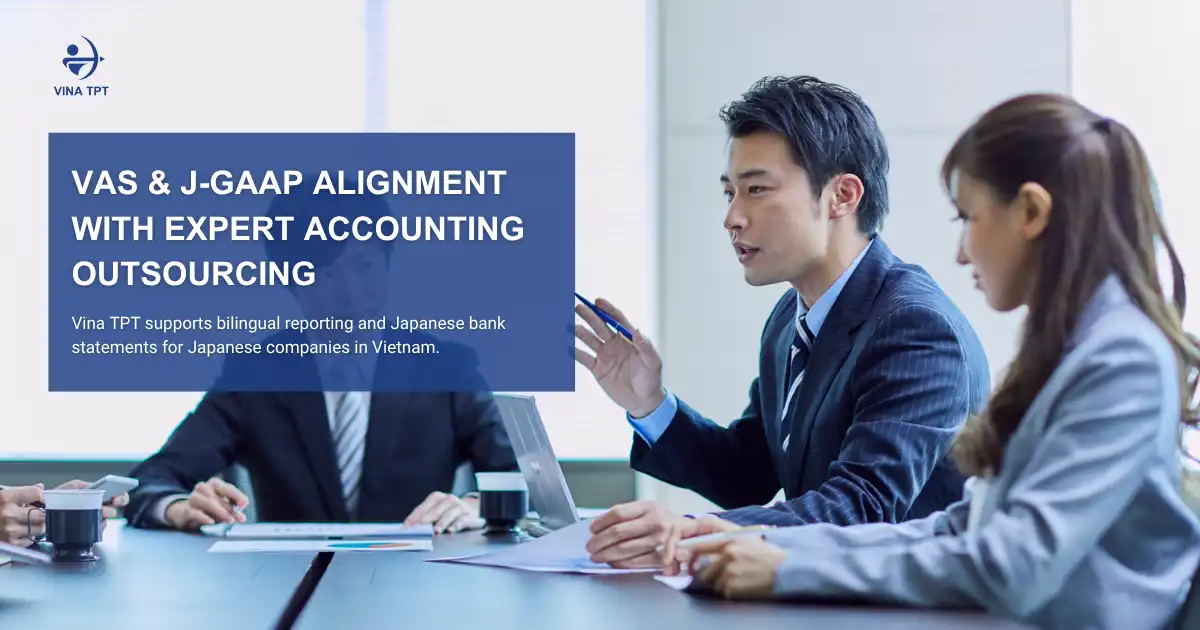
Bridging VAS and J-GAAP: Accounting Outsourcing Solutions for Japanese Companies in Vietnam

Accounting and financial reporting for Japanese companies in Vietnam under VAS and J-GAAP standards

accounting-outsourcing-services-for-japanese

1. Japanese Firms Face Complex Financial Localization in Vietnam

Japanese corporations are known for their strict financial and accounting processes and high standards of transparency. However, when expanding operations to Vietnam, they face significant differences between Vietnamese accounting standards (VAS) and Japanese accounting standards (J-GAAP). This difference lies not only in the way revenue and expenses are recorded, but also affects the way financial statements are presented and reconciled between the parent company in Japan and its branch in Vietnam.

Many Japanese enterprises share that ensuring compliance with VAS as required by Vietnamese tax authorities while maintaining the internal reporting format according to J-GAAP is a complex problem. To handle these challenges efficiently, many turn to accounting outsourcing services provided by a professional accounting services company in Vietnam. These services not only ensure accurate reconciliation between the two systems but also support the preparation of bilingual reports and bank statements in Japanese, helping Japanese corporations maintain compliance, transparency, and efficiency across borders.

2. Challenges in Reconciling VAS and Japanese GAAP

What makes Japanese companies difficult is not only the difference in accounting regulations, but also in the actual operation process. The way revenue is recognized between the two systems can be different: VAS is based on the time of completion of the delivery obligation, while J-GAAP can record according to the contract conditions.

Another problem is the difference in exchange rates: VAS uses actual or average exchange rates, while J-GAAP may require re-recording at the end-of-period exchange rate, leading to discrepancies in consolidated reports. In addition, preparing bank statements in Japanese or bilingual financial statements to send to the parent company is also a significant challenge, requiring accounting personnel who are both knowledgeable in the field and fluent in the language.

In many cases, Japanese companies have to maintain two separate sets of accounting systems or spend a lot of time adjusting data. This not only increases operating costs but also prolongs the auditing process, reducing the effectiveness of internal financial management.

GET JAPAN-VIETNAM ACCOUNTING SUPPORT

3. Why Accounting Outsourcing Services Is the Optimal Solution

Accounting outsourcing services is becoming an inevitable trend in the Japanese business community in Vietnam. Instead of building a large internal team, businesses can cooperate with a professional unit – both understanding Vietnamese tax regulations and the J-GAAP system.

This solution helps businesses significantly save on personnel costs, minimize the risk of errors in declarations, and maintain standard bilingual financial reports (English – Japanese – Vietnamese), meeting the requirements of both tax authorities and parent companies. In particular, professional accounting service companies can build a data standardization process, ensuring that reports can be directly integrated into the group’s management system in Japan.

Accounting outsourcing services also helps businesses be more flexible – easily expanding or reducing the scale of accounting when there are changes in the project, without affecting the continuity of financial operations.

4. How Vina TPT Simplifies Accounting for Japanese Companies

Vina TPT Accounting Service is the leading accounting services company providing accounting and financial solutions for Japanese enterprises in Vietnam. We deeply understand the differences between VAS and J-GAAP and have built a specialized process to help Japanese clients localize their financial systems while maintaining the transparency standards of the parent corporation.

Vina TPT’s team of experts includes Japanese – English bilingual accountants and tax consultants, who are intensively trained in Japanese accounting standards, Vietnamese taxes, and specialized communication skills in Japanese. 

In particular, Mr. Le Quoc Duy, the chief expert in charge of Japanese customers, has more than 2015 years of experience working with large corporations in the fields of manufacturing, finance, and logistics of Japan in Vietnam.
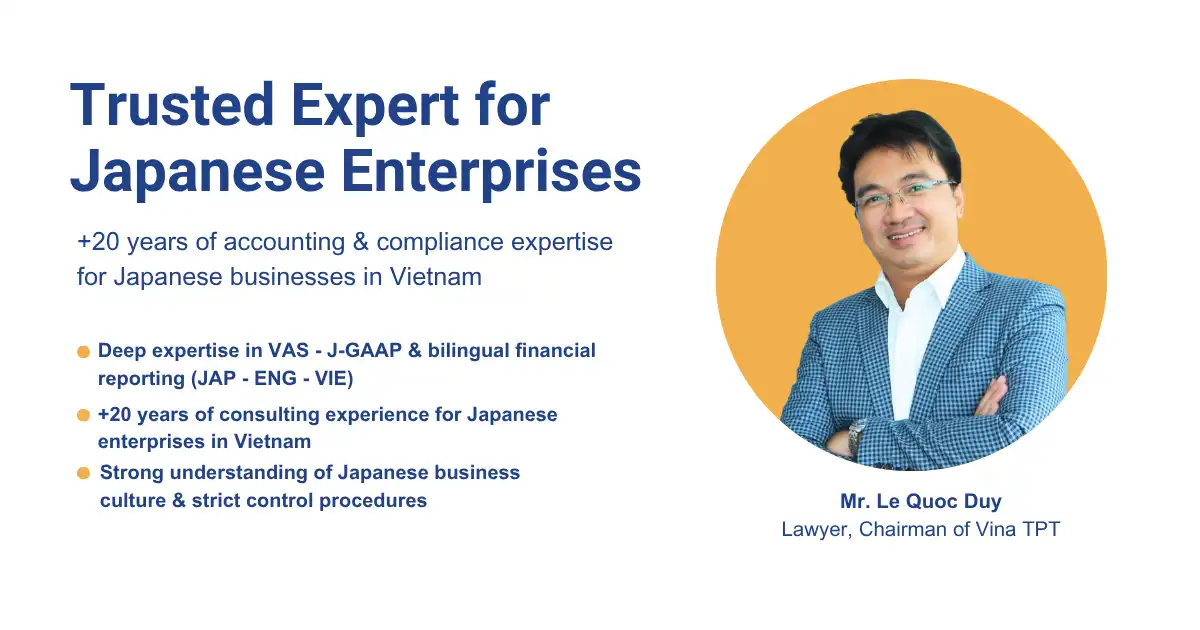
accounting-outsourcing-services-for-japanese

We support businesses in the entire process:

  • Standardizing data and preparing bank statements in Japanese
  • Reconciling and converting reports from VAS to J-GAAP
  • Review documents before sending to HQ
  • And provide regular advice to ensure accuracy and compliance in the long term.

5. Build Transparent, Compliant and Cross-Cultural Financial Systems

With specialized accounting outsourcing services, Japanese enterprises in Vietnam not only solve compliance issues, but also create a transparent, reliable and cross-culturally compatible financial system. Standardized and bilingual financial data helps strengthen trust between the Vietnamese branch and the Japanese parent company, and facilitates smoother group audits.

In the long term, maintaining a transparent accounting and financial system not only helps companies control costs and optimize profits, but also demonstrates a standard operating philosophy that is consistent with Japanese business culture: accuracy – discipline – reliability.

Contact Vina TPT Accounting Service today for advice on outsourcing accounting solutions and bilingual financial reporting in accordance with J-GAAP standards. We help Japanese businesses in Vietnam operate more easily – accurately, compliantly and sustainably.

BOOK A FREE CONSULTATION

Accounting-and-financial-reporting-for-Japanese-companies-in-Vietnam

Payroll & workforce management for Chinese electronics companies

Vina TPT Payroll Service consulting outsource payroll for Chinese companies

payroll-workforce-management-for-chinese-electronics-companies

1. Growing Presence of Chinese Electronics Companies in Vietnam

As global supply chains restructure, Vietnam has become a top destination for Chinese electronics manufacturers – offering both large-scale manufacturing capacity and tax advantages and a young workforce. As manufacturing costs in China continue to rise, many Chinese electronics corporations and businesses have chosen Vietnam as their next destination to expand their factories and optimize their supply chains. Vietnam not only has a strategic geographical location, close to China, but also possesses a young workforce, competitive labor costs and many attractive free trade agreements (FTAs). 

However, this rapid expansion also brings with it many challenges in human resource management and payroll processing. Electronic businesses need professional payroll services and workforce management systems to ensure legal compliance, maintain productivity and manage costs effectively. This is what makes the demand for payroll partners in Vietnam increasingly strong in the Chinese business community.

2. Payroll Challenges for Foreign Manufacturing Businesses in Vietnam

Vietnam has a complex legal and labor tax system, especially for foreign enterprises. Requirements for personal income tax (PIT), social insurance (SI), health insurance (HI) declarations and periodic labor reports make payroll management a multi-layered process. Even small errors in tax declarations or insurance payments can lead to administrative violations and audit risks.

In addition to legal factors, the operation of a non-synchronous payroll system between departments or factories makes it difficult for many enterprises to ensure accuracy, transparency and data security. In this context, professional payroll processing services become an inevitable choice that help Chinese enterprises minimize errors, save resources and focus on production goals.

TALK TO A PAYROLL EXPERT IN VIETNAM

3. Why Outsourced Payroll Services is the Smart Move for Chinese Manufacturers

Outsourcing payroll brings clear benefits to Chinese electronics manufacturers in Vietnam. Instead of setting up a complex human resource accounting department, businesses can entrust the entire process of calculating salaries, deducting taxes, and preparing reports to a specialized unit. This not only helps save fixed costs but also eliminates the risk of legal violations when Vietnam’s regulations change frequently.

Moreover, outsourcing payroll services helps businesses be more flexible when expanding production. As the number of employees increases rapidly in each stage, the service provider can adjust the management process accordingly, ensuring accuracy and timeliness. As a result, businesses do not need to invest in additional software infrastructure or internal personnel, while still maintaining consistency in salary and benefits management.

payroll-services-for-Chinese-companies

4. Key Features of Professional Payroll Processing Services in Vietnam

An effective payroll services needs to ensure that the entire process chain is operated accurately and transparently:

  • Collect and process timekeeping data from different departments and shifts.
  • Calculate salaries, allowances and bonuses according to each level, position and performance.
  • Deduct and declare personal income tax (PIT), along with social insurance (SI) according to regulations.
  • Issue payroll and transfer automatically on time, ensuring confidentiality.
  • Prepare periodic human resource and financial reports, serving internal auditing and management.

All these steps are performed on a secure, automated software platform and have the ability to flexibly integrate with the enterprise’s existing human resource management system.

In addition, professional service providers also:

  • Support timely tax declaration and payment, timely update of new regulations from tax authorities.
  • Labor policy and benefits consulting for Vietnamese employees and foreign workers.
  • Help Chinese electronics enterprises reduce administrative burden, while ensuring all human resources activities run smoothly and legally.

Once the payroll process is automated and transparent, the next step is to optimize the entire HR management system to operate more efficiently.

5. Integrating Workforce Management with Payroll Services for Smooth Operations

When a business implements workforce management integrated with payroll services, the entire internal operating system is connected into a seamless chain:  from timekeeping, shift assignment, performance tracking to payroll and HR reporting. Synchronizing data between departments not only helps managers accurately track productivity, turnover rates or HR costs, but also supports the leadership team in making strategic decisions quickly and based on real data.

In addition, an integrated HR management system also contributes to improving the employee experience. When factors such as salary, bonus, allowances, benefits or insurance are processed transparently, accurately and on time, employees will feel secure, thereby increasing engagement and reducing turnover.

Especially for large-scale Chinese electronics factories with many rotating shifts, applying payroll solutions combined with modern human resource management technology helps standardize operating processes, limit manual errors and ensure strict compliance with labor regulations in Vietnam. This is the foundation for businesses to operate stably, optimize costs and build a sustainable workforce in the long term.

6. Partnering with Vina TPT Payroll Service for Chinese Companies in Vietnam

Vina TPT Payroll Service is a leading partner in the field of payroll services and workforce management for foreign enterprises in Vietnam, especially Chinese electronics companies. With more than 15 years of experience working with large-scale manufacturing corporations, Vina TPT has built a team of experts including human resources specialists, tax accountants and corporate lawyers with in-depth expertise and understanding of the Vietnamese legal system.

Vina TPT experts not only support salary calculation, tax and insurance declaration but also advise on human resource management strategies, build a system of salary and welfare policies suitable for Chinese corporate culture. Thanks to the combination of consulting capacity and modern management technology, Vina TPT helps businesses operate effectively, minimize costs and ensure compliance with Vietnamese laws throughout the operation process.

Contact Vina TPT Payroll Service now to get advice on payroll outsourcing solutions in Vietnam that are suitable for your electronics factory model!

BOOK A FREE CONSULTATION

payroll-services-for-Chinese-companies

Business Established in Vietnam for Korean Electronics Manufacturers

Korean investor receiving business license in Vietnam

setting-up-electronics-business-in-Vietnam

1. Vietnam – The Next Hub for Korean Electronics Manufacturers

As Korean companies continue to look for new growth opportunities across Asia, Vietnam has become one of the most attractive destinations for manufacturing expansion. With a favorable investment climate and a streamlined business license in Vietnam process for foreign enterprises, Vietnam offers Korean electronics manufacturers an ideal entry point to establish long-term operations. Supported by government incentives and a robust supply chain ecosystem, the country is quickly evolving into a major production hub in the region.

Major corporations such as Samsung, LG, and Hanwha have established large-scale production complexes in Bac Ninh, Thai Nguyen, and Hai Phong, regions that are rapidly becoming Vietnam’s key electronics hubs, supported by modern logistics networks, seaports, and government investment incentives.

Moreover, Vietnam’s active participation in free trade agreements such as CPTPP and EVFTA has unlocked significant tariff advantages, enhancing its competitiveness in the global supply chain. A young, skilled workforce combined with the nation’s push for digital transformation positions Vietnam as the “new manufacturing base” for the global electronics industry, much like South Korea’s industrial rise in the 1990s.

For Korean investors, establishing a business in Vietnam not only optimizes production costs but also opens access to ASEAN, China, and India markets. By obtaining the appropriate business license in Vietnam and leveraging professional strategic consulting, Korean electronics enterprises can streamline the enterprise registration process and transform Vietnam into a sustainable hub for manufacturing and innovation in the region.

2. Strategic Considerations Before Enterprise Registration in Vietnam

Before starting the registration process, investors need to carefully consider strategic factors.

Location is key: Northern regions such as Bac Ninh, Hai Phong, Thai Nguyen currently have many Korean electronics factories, convenient for connecting and sharing the supply chain.

Legal form also directly affects the right to operate and tax obligations. Enterprises can choose to establish a 100% foreign-owned company, joint venture with a Vietnamese partner or open a representative office.

In addition, the domestic supply chain in Vietnam is expanding rapidly, providing components and logistics services suitable for electronics production. Understanding these factors helps Korean enterprises optimize costs and limit risks when entering new markets.

Book a Free Consultation on Your Business License

3. Understanding Business License in Vietnam and Compliance for Electronics Companies

After being granted the Investment Registration Certificate (IRC) and Enterprise Registration Certificate (ERC), the electronics enterprise needs to apply for a business license appropriate to the field of operation.

The electronics manufacturing industry has its own requirements on environmental safety, technology standards and fire prevention.

The estimated time for completion is:

Document preparation: 1-2 weeks, depending on the volume of documents and the level of complexity.

  • IRC appraisal: 20-45 working days.
  • ERC issuance: 10-20 working days after IRC (or similar if the enterprise is a domestic enterprise).

In fact, if the enterprise cooperates with a reputable company registration service, it will help the enterprise quickly handle the consular legalization, translation and submission of documents, shortening the time and increasing the possibility of being licensed the first time.

setting-up-electronics-business-in-Vietnam

4. How to Establish Business in Vietnam and Maintain Legal Compliance

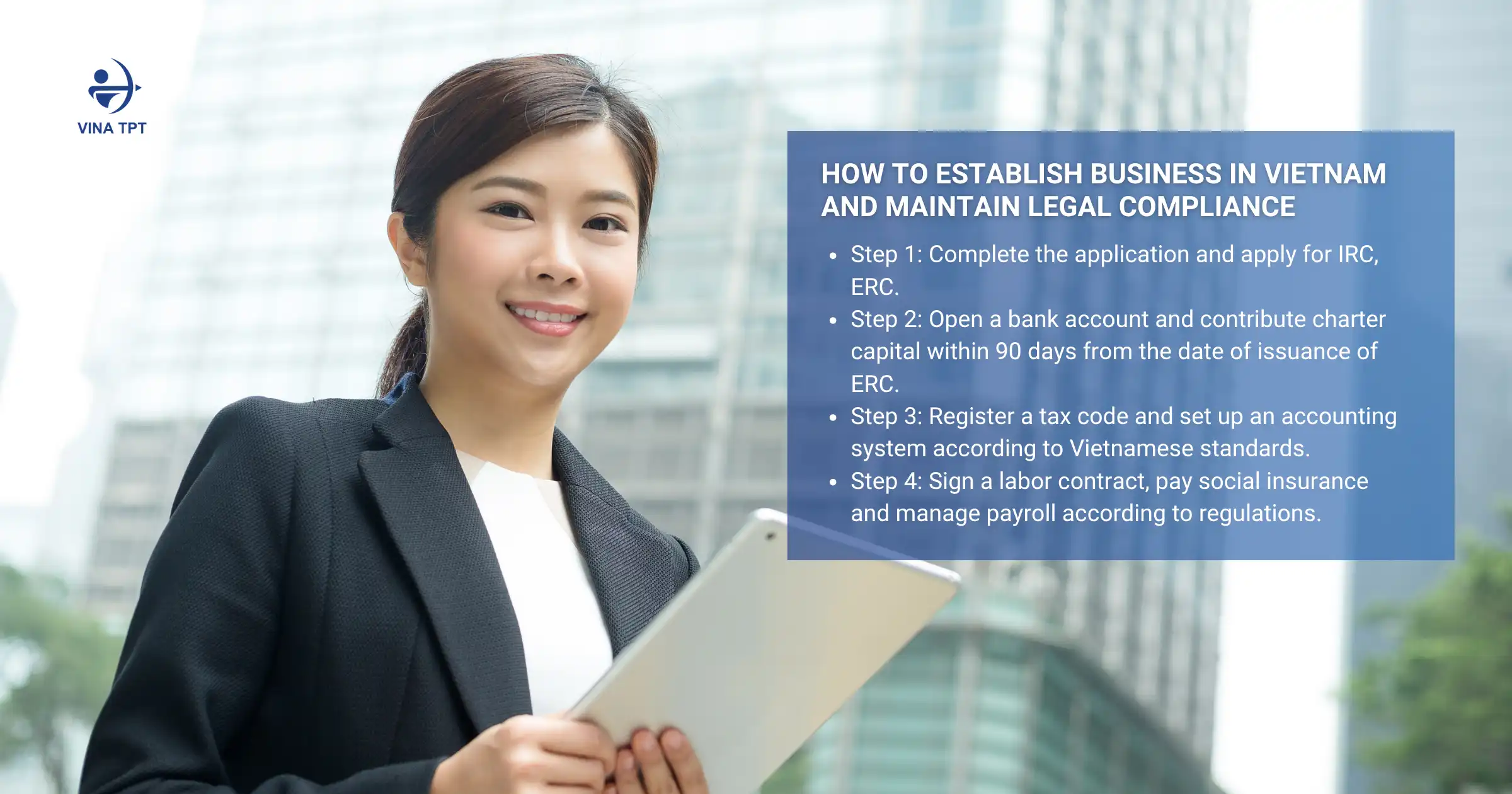
To successfully establish a business in Vietnam, investors need to take the following important steps:

Step 1: Complete the application and apply for Business License in Vietnam IRC, ERC.

If the project has FDI capital, IRC is the first license allowing the investor to implement the project in Vietnam.

The required documents usually include:

  • Application for investment project implementation and Project proposal: stating the objectives, scale, location, investment capital, progress.
  • Proof of the investor’s financial capacity: bank statement, credit contract or collateral.
  • Legal documents of the investor:
    • Individual: Notarized passport, consular legalization.
    • Organization: Business registration certificate or equivalent document, consular legalization.
  • Project location: lease contract or land/office use rights certificate.

After the IRC is granted (or for 100% domestic-owned enterprises), the investor applies for an ERC – an official license for the enterprise to operate, and also the tax code of the company.

The ERC dossier usually includes:

  • Application for enterprise registration.
  • Company Charter: stipulates the organizational structure, powers of members/shareholders, capital ratio and management method.
  • List of members/shareholders and legal representatives: clearly state information, ownership ratio, voting rights.
  • Appointment decision and authorization letter (if any).
  • Capital contribution plan & financial evidence: bank statement or credit contract (especially important for large capital projects).

Step 2: Open a bank account and contribute charter capital within 90 days from the date of issuance of ERC.

Step 3: Register a tax code and set up an accounting system according to Vietnamese standards.

Step 4: Sign a labor contract, pay social insurance and manage payroll according to regulations.

5. Vina TPT Company Registration – Partnering with Korean Electronics Manufacturers for a Sustainable Setup

With more than a decade of experience in investment consulting and business registration services, Vina TPT has successfully assisted hundreds of FDI enterprises, including a large number of Korean electronics manufacturers in establishing and expanding their operations in Vietnam.

Our comprehensive service scope covers every stage of the process — from investment model consulting and legal documentation, to business license application in Vietnam, business license renewal, and regulatory compliance. This integrated approach ensures a smooth and compliant market entry for Korean investors.

Backed by a team of seasoned professionals with in-depth knowledge of Vietnam’s business, tax, and labor laws, Vina TPT provides end-to-end business license advisory and compliance support, helping investors confidently execute their projects while focusing on production growth and long-term success.

Partnering with Vina TPT Business Advisory and Company Registration means more than saving time and costs. It’s about having a trusted local partner who truly understands how to help Korean investors establish, operate, and sustain successful ventures in Vietnam.

Contact Vina TPT for consultation and support on business registration in Vietnam quickly, legally and at optimal cost.

BOOK A FREE CONSULTATION

setting-up-electronics-business-in-Vietnam

Transfer Pricing Regulations and Guidelines for FDI Companies in Vietnam

Transfer pricing regulations and guidelines for FDI companies in Vietnam

Transfer pricing regulations and guidelines for FDI companies in Vietnam

1. Why Transfer Pricing Matters for FDI Companies in Vietnam

Transfer pricing is considered a key factor for Foreign-invested enterprises to plan tax strategies and ensure compliance with Vietnamese law. In fact, these rules greatly affects the way profits are allocated among related parties in many countries around the world. Therefore, if these companies do not strictly manage transfer pricing, this activity will lead to suspicions about profit transfer. This will lead to consequences that make businesses closely monitored by tax authorities. 

In Vietnam, pricing regulations is extremely strictly controlled because it directly affects tax revenue and economic fairness. If Overseas-invested companies do not comply, they will certainly face high risks such as administrative fines, prolonged inspections, and impacts on reputation and relationships with state agencies. Therefore, it can be seen that if those companies comply with good regulations, it will help reduce risks and build reputation and trust with investors and management agencies.

2. When do companies need to prepare

Transfer pricing documents are required when Foreign-capital enterprises conduct related transactions. Related transactions are known as transactions between companies in Vietnam and parent companies, other subsidiaries, or foreign affiliates. Typical examples for a clearer understanding are cross-border sales of goods, provision of internal services within the group, transfer of intellectual property rights, or internal lending.

According to regulations in Vietnam, operating enterprises are required to fully retain the pricing framework documents annually when exceeding the prescribed revenue and transaction value thresholds. This document is evidence proving that transactions comply with the arm’s length principle – that is, transactions are conducted at market prices, as between independent parties. The document plays an extremely important role, because if missing, enterprises will be subject to additional taxes and heavy penalties.

BOOK A TRANSFER PRICING CONSULTATION

3. Key Legal Rules that Every Company Must Know

In Vietnam, transfer pricing activities are regulated by Decree 132/2020/ND-CP and related guiding documents of the Ministry of Finance. This is the legal framework that stipulates the principles of determining related transaction prices, the requirement to prepare transfer pricing documents, and the method of comparison with market prices (arm’s length principle).

Some key points that FDI companies need to pay special attention to include:

  • Revenue & transaction value threshold: Enterprises with total revenue of VND 50 billion or total related transaction value of VND 30 billion or more are required to prepare and store transfer pricing records annually.
  • Required records: Includes 3 levels according to international standards – Local file, Master file and Country by Country Report (CbCR).
  • Submission and storage deadline: The documents must be prepared at the same time as the financial statements and tax declarations, and be ready to be provided when requested by the tax authorities.

Understanding and complying with these regulations not only helps businesses comply with the law but also avoids risks of late payment penalties, tax arrears and in-depth audits from the authorities.

4. How to Prepare for a Transfer Pricing Documents?

To create a complete and accurate transfer pricing document, FDI companies need to implement a process consisting of 4 basic steps:

4.1 Collect related transaction data for Transfer Pricing Documents

Synthesize all contracts, accounting documents, financial reports related to related transactions such as internal goods and services, technology licensing, internal loans, etc.

4.2 Analyze functions and risks 

Determine the role of each party in the transaction (service provider, distributor, R&D, brand management, etc.) to demonstrate reasonable profit margins.

4.3 Compare market prices 

Apply accepted methods (CUP, TNMM, RPM, CPM) to demonstrate that the transaction complies with the arm’s length principle.

4.4 Draft and archive documents 

The documents must clearly show business information, pricing methods, analysis results and reference documents. The storage must be made available upon request from tax authorities or during tax audits.

5. Practical Tips to Stay Compliant Without Penalties

To minimize risks and avoid being overcharged, enterprises need to proactively review internal transactions periodically, ideally quarterly or semi-annually, in order to make timely adjustments before the reporting period. At the same time, data synchronization between departments such as accounting, finance and legal plays a key role in ensuring that all information and related-party transaction contracts are updated accurately and consistently. 

In addition, cooperating with consulting units with knowledge of Vietnamese law and international standards such as Vina TPT helps enterprises prepare complete documents and receive in-depth consultation before determining the transfer price. 

This proactive approach not only helps enterprises maintain compliance, avoid administrative fines but also strengthens the image of transparency and reputation with management agencies.

6. Partnering with Vina TPT for Smooth Management

With more than 10 years of experience supporting Foreign Direct Investment Companies in Vietnam, Vina TPT tax audit support provides consulting services and prepares documents according to international standards, and supports businesses during tax audits.

Outstanding benefits when cooperating with Vina TPT:

  • Consulting on optimal transfer pricing strategies, minimizing tax risks.
  • Preparing a complete set of transfer pricing documents (Local file, Master file, CbCR) in accordance with regulations and on time.
  • Representing businesses in meetings with tax authorities, helping the inspection and examination process take place quickly and transparently.

Accompanying Vina TPT, every company can focus on business activities with peace of mind, while ensuring compliance with legal regulations in Vietnam.

BOOK A FREE CONSULTATION

Vina TPT Accounting services

Driving Growth Through Effective Financial Management for FDI Businesses

international accounting standards

international accounting standards

1. Setting the Foundation: Understanding FDI Financial Structures

Establishing strong financial management practices is the cornerstone of success for foreign direct investment (FDI) companies in Vietnam. Every investment requires a clear financial structure that aligns with both the investor’s home country standards and the host country’s regulatory framework.

Foreign-capital businesses must carefully decide how to allocate capital, manage equity contributions, and set up local subsidiaries or joint ventures. For example, a manufacturing firm entering Vietnam may need to balance its initial equity with local bank loans to secure working capital. Without a strong foundation, misaligned structures can lead to tax inefficiencies and compliance risks.

The World Bank notes that transparent and well-structured financial systems directly impact the long-term stability of Foreign Direct Investment inflows in emerging markets like Vietnam.

Set Up Financial Structure

2. Building Strong Cash Flow Management for Long-Term Stability

One of the biggest challenges for Foreign Direct Investment enterprises is maintaining consistent cash flow management. In Vietnam, companies often face delays in payments due to differences in local business culture and long supply chain cycles.

By implementing robust forecasting tools, Foreign-capital businesses can predict cash inflows and outflows more accurately. For example, using rolling cash flow forecasts helps companies adjust their strategies for seasonal demand or currency fluctuations. Ensuring liquidity not only prevents short-term financial distress but also builds investor confidence for expansion.

On the Vina TPT homepage, businesses can explore consulting services designed to strengthen financial structures and ensure stability through effective cash flow solutions.

3. Profit Optimization Techniques Tailored for FDI Enterprises

For these enterprises, profit optimization is not just about increasing revenue – it is about aligning financial strategies with Vietnam’s unique market conditions. Adjusting pricing strategies for local demand, streamlining supply chain costs, and leveraging tax incentives can significantly boost margins.

Additionally, transfer pricing strategies must comply with Vietnamese regulations while ensuring profits are not eroded by double taxation. Many investors also overlook the benefits of reinvesting profits in Vietnam to take advantage of available financial support programs.

According to PwC Vietnam, businesses that regularly review their cost structures and adjust to local market dynamics outperform those that apply “one-size-fits-all” strategies.

4. Integrating Financial Management with Local Compliance in Vietnam

An essential element of managing FDI operations is aligning financial management with Vietnam’s compliance requirements. Unlike international standards such as IFRS, Vietnamese Accounting Standards (VAS) have specific rules that businesses must follow.

Areas like tax reporting, value-added tax (VAT), and labor-related expenses can create complications if not handled correctly. Non-compliance not only leads to financial penalties but also threatens business continuity.

Internal policies must ensure that accounting procedures, audit processes, and statutory filings are regularly updated to reflect local requirements. To see related strategies, check our article on Accounting Procedures for FDI Operations in Vietnam.

Ensure VAS Compliance

5. Leveraging Technology for Smarter Financial Management

Technology is reshaping how Foreign Direct Investment companies approach management in finance. Automated accounting software, cloud-based ERP systems, and AI-driven analytics help businesses optimize cash flow, track performance in real time, and improve accuracy in reporting.

In Vietnam, digital transformation is also supported by government initiatives that encourage businesses to adopt e-invoicing and digital tax reporting. These tools reduce administrative burdens and improve compliance, giving companies more time to focus on growth.

By investing in modern financial technology, Foreign Direct Investment enterprises can strengthen decision-making and stay competitive in a fast-evolving business landscape.

6. Partnering with Vina TPT for Sustainable Growth

Even with strong internal systems, navigating Vietnam’s financial landscape requires expert guidance. Vina TPT Financial Management provides tailored solutions that help Foreign-invested companies align financial structures, optimize cash flow, and ensure compliance with local laws.

From preparing accurate financial reports to advising on profit optimization and leveraging technology for smarter management, we acts as a long-term partner for sustainable growth.

With our deep expertise in both Vietnamese regulations and global standards, we empower businesses to not only survive but thrive in the competitive Vietnamese market.

Learn more about our Financial Management Services and discover how Vina TPT can help you maximize your investment potential in Vietnam.

Vina TPT Financial Management

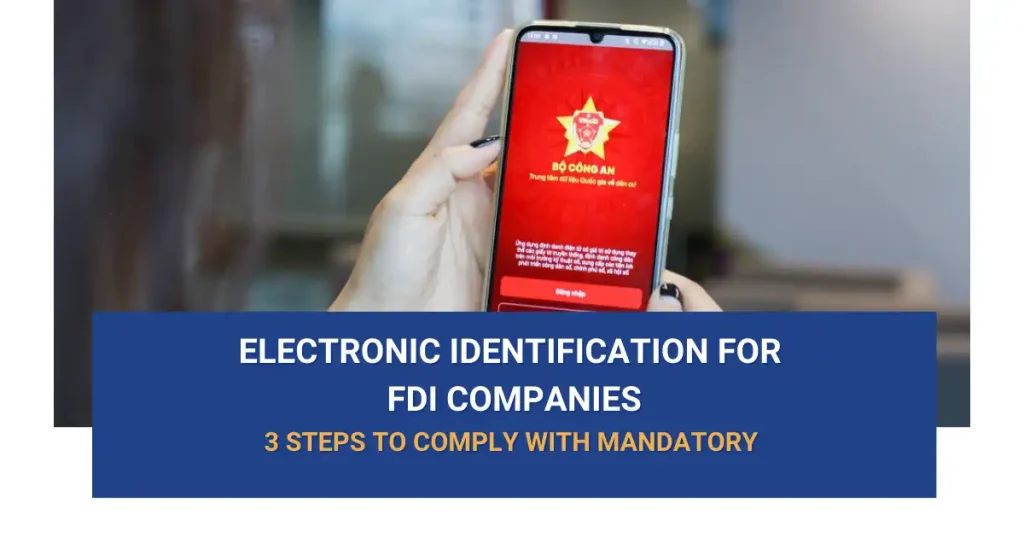
Electronic Identification for FDI company in Vietnam

Electronic Identification for FDI company in Vietnam

Electronic Identification for FDI company in Vietnam

Electronic identification is mandatory for Foreign Direct Investment (FDI) companies in Vietnam, effective from July 1, 2025, when conducting administrative procedures through the Vietnam Public Service Portal.

Using an identification account on VNeID not only helps verify the legal status of the enterprise but also serves as a condition for submitting electronic documents, digital signing, and receiving online results.

In this article, VINA TPT will provide guidance on the process, precautions, and detailed answers for foreign enterprises operating in Vietnam.

1/ Are FDI Company with a Foreign Legal Representative Required to Register a VNeID Electronic Identification Account?

According to Article 2 of Decree 69/2024/ND-CP, the subjects subject to regulations on registering an electronic identification account include: “Vietnamese organizations and individuals, as well as foreign organizations and individuals residing and operating on Vietnamese territory, participating in or related to electronic identification, electronic authentication, and electronic identity activities.”

Therefore, FDI company with a foreign legal representative fall within the scope of this Decree and are required to register and use an electronic identification account (VNeID) in accordance with legal regulations.

2/ Why Do FDI Company in Vietnam Need Electronic Identification?

Electronic identification is not only a legal requirement but also provides practical benefits for FDI company in Vietnam:

Mandatory for Conducting Electronic Administrative Procedures

According to Clause 4, Article 40 of Decree 69/2024/ND-CP, accounts created by the National Public Service Portal and the administrative procedure information systems at the ministerial and provincial levels for agencies and organizations are valid until June 30, 2025.

Thus, from July 1, 2025, these accounts will no longer be valid. Generally, enterprises will need to use an electronic identification account on VNeID to access and connect with administrative information systems. Failure to register an identification account will cause difficulties in performing administrative procedures, significantly impacting business operations.

Support for Remote Business Management

For cases where the legal representative is frequently absent from Vietnam, an electronic identification account enables the fulfillment of legal obligations remotely, such as signing documents, submitting applications, and checking the status of procedure processing.

Enhanced Validity and Transparency

Identification information is directly authenticated by the Ministry of Public Security, ensuring reliability when connecting to the national public service portal and platforms for tax, customs, insurance, etc.

3/ Guidance on Electronic Identification FDI company in Vietnam

Guide to Registering an Electronic Identification Account for a Foreign Legal Representative

STEP 1: Foreign individuals must directly visit the Immigration Management Department under the Ministry of Public Security or the provincial police to submit an application for an account, including:

  • Passport/international travel document;
  • Application form for an electronic identification account (Form TK01 attached to Decree 69/2024/ND-CP) for the competent authority;
  • Email/phone number registered with subscriber information (if available);
  • Information that the foreign individual requests to integrate into the national identification application;

STEP 2: : The electronic identification and authentication management agency will notify the foreign individual of the Level 2 identification account registration result via: The VNeID application; Registered email; Verified phone number.

STEP 3: Proceed with registering electronic identification for the enterprise using the VNeID application on a mobile phone, with details available HERE. TẠI ĐÂY

Registering electronic identification for enterprises in general, and foreign enterprises in particular, is not only a mandatory requirement from July 1, 2025, but also a standardization step that enables FDI enterprises to easily perform administrative procedures, connect with public service systems, and manage operations remotely effectively.

VINA TPT provides support services for registering electronic identification for FDI company in Vietnam, including: consulting on conditions, preparing documents, representing dealings with competent authorities, and synchronizing information with the system.

Explore our additional services at Corporate Secretary Services and Back Office Support.

Contact VINA TPT for Support

📞 (+84) 984 980 069
📧infor@vinatpt.com
🌐 https://vinatpt.com
🏢 5th Floor, More Building, 83B Hoang Sa, Da Kao Ward, District 1, HCMC 

Leave a Reply

Your email address will not be published. Required fields are marked *