TRC Vietnam 2026: Guide to applying for a Temporary Residence Card for Foreign Investors

TRC-Vietnam-2026

As a foreign investor operating an FDI project in Vietnam, do you often face difficulties with short-term visas? Frequent entry and exit not only disrupts your work but also increases costs and affects long-term business management.

The Temporary Residence Card (TRC) offers a practical solution. It allows foreign investors to reside legally in Vietnam for an extended period, from 2 to 10 years, without repeatedly renewing short-term visas. The TRC provides flexible multiple-entry/exit privileges and supports essential procedures such as opening bank accounts, signing contracts, and proving residency.

This article delivers a detailed guide on eligibility, required documents, application process, processing time, fees, and key considerations for obtaining a TRC in Vietnam. It also explains how Vina TPT can support your company throughout the entire process.

TRC-Vietnam-2026

1. What is a TRC Vietnam?

A Temporary Residence Card (TRC Vietnam) is a residency document issued by the Vietnam Immigration Department (under the Ministry of Public Security) to eligible foreigners. It replaces a visa and allows continuous legal residence in Vietnam for the period stated on the card (typically 2 to 10 years, depending on the visa category).

Important clarification: TRC (Temporary Residence Card) is completely different from a Tax Residency Certificate. The TRC relates to immigration and residency rights, while the Tax Residency Certificate is issued by tax authorities to apply double tax avoidance agreements (DTAs).

2. Benefits of obtaining a TRC Vietnam

Holding a TRC Vietnam delivers significant practical advantages for foreign investors:

  • Business benefits: Stable residency enables you to focus on project management, operations, and oversight without visa-related interruptions.
  • Personal benefits: Freedom to enter and exit Vietnam multiple times, plus easier sponsorship of family members.
  • Legal and tax benefits: Helps prove residency duration when needed, especially for double taxation avoidance agreements.
  • Cost benefits: Substantially reduces expenses and time compared to repeatedly renewing short-term visas.

In practice, many FDI investors report significantly improved operational efficiency and greater focus on long-term business development after obtaining their TRC.

3. Who can apply for a TRC Vietnam as a foreign investor?

Not every foreign investor qualifies for a TRC. To be eligible, you generally need to meet these conditions:

  • Have capital contribution or investment in a Vietnamese enterprise
  • Hold a valid DT visa (DT1, DT2, DT3, or DT4)
  • Possess a passport valid for at least 13 months
  • Provide legal documents of the company (Enterprise Registration Certificate – ERC and/or Investment Registration Certificate – IRC)
  • Have valid temporary residence registration with local police

The table below compares DT visa types and corresponding TRC eligibility (updated according to the Law on Investment 2025):

DT Visa Type

Minimum Capital Contribution Maximum Visa Duration Maximum TRC Duration

Notes

DT1

≥ 100 billion VND or incentivized sectors Up to 10 years Up to 10 years Highest priority for large-scale projects

DT2

50 – under 100 billion VND or incentivized sectors Up to 5 years Up to 5 years Applies to encouraged investment projects

DT3

3 – under 50 billion VND Up to 3 years Up to 3 years Most common for medium-sized investors

DT4

Under 3 billion VND 12 months Not eligible Short-term visa only


Note on the Law on Investment 2025 (effective March 1, 2026): The new law allows greater flexibility. In many cases (especially non-restricted sectors), foreign investors can obtain the Enterprise Registration Certificate (ERC) before the Investment Registration Certificate (IRC). This change helps investors prove capital contribution, business address, and investment status earlier, making the TRC application smoother and faster.

EXPLORE OUR SERVICES

4. Step-by-step guide to apply for a TRC Vietnam

The application process for a TRC in Vietnam typically includes the following steps:

  1. Prepare eligibility: Ensure you hold a valid DT visa and your company has completed legal procedures (ERC and/or IRC), along with proof of capital contribution.
  2. Prepare documents: Gather all required paperwork. Foreign documents must be notarized, translated into Vietnamese, and consular legalized as needed.
  3. Submit the application: File in person or online at the Immigration Department office where your company is headquartered.
  4. Receive the result: Standard processing time is about 5 working days once the file is complete and valid. Additional time may be required if supplementary documents are needed.
  5. Renewal (if necessary): Apply for renewal before the TRC expires.

TRC-Vietnam-2026

5. Frequently asked questions about TRC Vietnam

Foreign investors often have many practical questions when preparing to apply for a TRC Vietnam (Temporary Residence Card). Below are the most common questions with clear, concise, and realistic answers.

5.1 How long does it take to obtain a TRC in Vietnam?

The official processing time for TRC application is 5 working days from the date the Immigration Department receives a complete and valid dossier.

In practice:

  • If your dossier is perfect with no missing documents, you can typically receive the TRC within 5-7 working days.
  • If additional documents are required, the process may take 10-15 working days.

5.2 What documents are required to apply for a TRC Vietnam?

The TRC application requires a detailed set of documents. Here is the standard list:

  • Original passport valid for at least 13 months and a valid DT visa
  • Application form NA6 (sponsored by organization) or NA8 (individual)
  • Two 2×3 cm passport photos with white background
  • Temporary residence confirmation issued by local police
  • Notarized copies of ERC and/or IRC
  • Documents proving capital contribution
  • Company seal-related documents (if required)
  • Sponsorship letter from the company

All foreign documents must be consular legalized, notarized, and officially translated into Vietnamese. Failure to meet these requirements is one of the most common reasons for application rejection or delays.

5.3 How much does a TRC Vietnam cost?

The fee for issuing a TRC depends on the validity period of the card (updated for 2026):

  • Up to 2 years: approximately 145 USD
  • From over 2 years to 5 years: approximately 155 USD
  • From over 5 years to 10 years: approximately 165 USD

This fee is paid directly at the Immigration Department when submitting the application.

5.4 What are the most common mistakes to avoid when applying for a TRC Vietnam?

Submitting incomplete or invalid documents: Many applicants submit foreign documents that have not been consular legalized, translations that are not properly notarized, incorrectly completed NA6/NA8 forms, or photos that fail to meet the strict requirements (size, background, or recency).

  • Consequence: The dossier is returned multiple times, turning a simple 5-day process into weeks or months of delay.
  • How to avoid it: Create a detailed checklist and have your entire application reviewed by a professional before submission.

Using the wrong type of investment visa (DT visa)

  • Consequence: The Immigration Department may reject the TRC application outright or require you to apply for a new visa, significantly delaying the entire process.
  • How to avoid it: Determine the correct DT visa type (DT1, DT2, or DT3) from the very beginning based on your investment capital and industry.

Delays in obtaining temporary residence confirmation: Failing to secure the temporary residence confirmation (Form NA17) on time due to unclear lease agreements or lack of coordination with the landlord.

  • Consequence: This step often becomes a major bottleneck, stalling the entire application.
  • How to avoid it: Prepare a legally compliant office address early and work closely with the landlord to complete the temporary residence confirmation promptly.

Insufficient proof of capital contribution: Missing bank statements, capital contribution minutes, or discrepancies between the actual contributed amount and the registered capital in the ERC/IRC.

  • Consequence: The application is either sent back for supplementation or rejected due to failure to prove financial capacity.
  • How to avoid it: Keep complete and clear records of all capital transfers and contribution documents from the moment the investment is made.

Most mistakes stem from inadequate preparation or lack of familiarity with Vietnam’s immigration procedures. Working with an experienced consulting firm from the early stages can help you avoid these risks, minimize delays, and obtain your TRC smoothly and on time.

6. How Vina TPT can help you secure your TRC smoothly

With over 20 years of experience supporting FDI enterprises, Vina TPT provides a comprehensive approach to TRC applications, from initial advisory to final approval. 

We support businesses in structuring their investment to meet visa and TRC requirements, while handling the entire documentation process, including notarization, translation, and consular legalization. Our team works directly with the Immigration Department to ensure smooth processing, while also integrating related services such as company establishment, work permit exemption, and finance and tax support. This end-to-end approach helps minimize risks, ensure compliance, and significantly reduce processing time for investors.

TRC-Vietnam-2026

We are committed to accuracy, speed, and efficiency so you can focus on your business instead of administrative procedures.

Contact Vina TPT today for personalized advice and professional support tailored to your investment needs in Vietnam.

BOOK A FREE CONSULTATION

5 Key functions you should include in your outsourced finance and accounting package

5 key functions you should include in your outsourced finance and accounting package

5-key-functions-you-should-include-in-your-outsourced-finance-and-accounting-package

The period 2025-2026 marks significant developments in Vietnam’s tax and accounting framework. Circular 99/2025/TT-BTC, effective from January 1, 2026, introduces updates to accounting guidance, including changes to the chart of accounts and financial reporting, contributing to Vietnam’s gradual alignment with IFRS standards.

In addition, recent amendments to Corporate Income Tax regulations and the revised Law on Personal Income Tax (effective from July 1, 2026) will have a direct impact on compliance and business operations. Furthermore, the temporary VAT reduction to 8% (subject to government extension policies) continues to affect tax planning and cost structures for businesses.

These changes create challenges for many FDI enterprises in staying compliant, especially when simultaneously handling Vietnamese Accounting Standards (VAS), reconciliation with International Financial Reporting Standards (IFRS), tax management, and payroll for foreign employees (expatriates).

In this context, many companies choose outsourced finance and accounting services as a strategic solution. These services ensure compliance, optimize costs, reduce operational burden, and allow businesses to focus on core activities.

This article provides a comprehensive overview of the 5 key functions you should look for in an outsourced finance and accounting package. It is designed to help foreign investors select a reputable and suitable service provider in Vietnam.

1. Bookkeeping Management

Bookkeeping services (in outsourced finance and accounting package) involve the collection, verification, and recording of all financial transactions according to applicable accounting standards. It forms the foundation for preparing financial statements, tax declarations, and working with auditors.

From 2026 onward, with the implementation of Circular 99/2025/TT-BTC, enterprises must comply with the new chart of accounts and regulations under Vietnamese Accounting Standards (VAS). At the same time, they often need to address differences between VAS (used for local regulatory reporting) and IFRS (required by headquarters or parent companies). Accurate recording from the very beginning is therefore essential.

A professional outsourced finance and accounting package typically includes the following bookkeeping services:

Monthly tasks:

  • Collection, verification, and secure storage of valid accounting documents (vouchers)
  • Data entry and review of accounts according to the new chart of accounts under Circular 99
  • Preparation of detailed monthly financial statements
  • Provision of ad-hoc managerial reports upon request

Year-end tasks:

  • Preparation of annual financial statements in accordance with VAS
  • Close coordination with independent auditors (liaising with auditors)
  • Support for VAS–IFRS reconciliation for headquarters reporting

Important note: A common misconception is that simply entering all documents is sufficient. In reality, transactions must be recorded correctly according to Vietnamese accounting principles (VAS). Even small deviations can lead to tax adjustments, prolonged audits, and unnecessary additional costs.

>>> You may also be interested in: Best Bookkeeping Services for Startups in Vietnam

2. Financial Reporting & Management Reports

Financial reporting is crucial not only for regulatory compliance but also as a vital tool for monitoring business performance and supporting timely decision-making.

In an outsourced finance and accounting package, financial reporting services usually include:

  • Preparation of monthly and annual financial statements in accordance with Vietnamese accounting standards
  • Consolidation of financial statements (where required)
  • Delivery of customized management reports, such as cash flow statements, budget variance analysis, KPI tracking, and cost analysis

For FDI companies, receiving timely monthly financial reports is particularly important. These reports enable leadership to closely monitor the company’s financial position and adjust business plans promptly.

3. Tax Compliance & Filing

For foreign-invested enterprises, lack of familiarity with Vietnam’s tax regulations is a frequent cause of errors and penalties. Obligations include Value-Added Tax (VAT), Corporate Income Tax (CIT), Personal Income Tax (PIT), Foreign Contractor Tax (FCT), Withholding Tax (WHT), and specialized reports such as investment activity reports.

A comprehensive Tax Compliance & Filing service within outsourced finance and accounting typically covers:

  • Monthly or quarterly VAT declaration and payment
  • Provisional CIT declaration and finalization under the Corporate Income Tax Law 
  • Monthly, quarterly, and annual PIT declaration and payment according to the new 5-bracket progressive tax schedule effective 2026
  • Handling of Foreign Contractor Tax (FCT) and Withholding Tax (WHT)
  • Support for VAT refund and transfer pricing documentation
  • Preparation of statistical reports and Investment Activity Reports (IAR) specifically required for FDI companies

Non-compliance can result in administrative fines, tax reassessments, late-payment interest, or even temporary suspension of the tax code – all of which directly impact business operations. This is why many FDI enterprises rely on professional tax compliance services to ensure full adherence from the outset.

EXPLORE OUR ACCOUNTING & TAX SERVICES

5-key-functions-you-should-include-in-your-outsourced-finance-and-accounting-package

4. Payroll & Employee Tax Handling

Payroll and employee tax handling involves the calculation of salaries, benefits administration, and management of all tax and insurance obligations related to employees. This is a critical function in business operations, as it directly affects employee welfare and the company’s legal compliance.

A professional outsourced finance and accounting package typically includes the following payroll services:

  • Monthly payroll calculation and preparation of confidential payroll reports
  • Processing of mandatory social insurance, health insurance, and unemployment insurance contributions in accordance with Vietnamese regulations
  • Withholding, declaration, and annual finalization of Personal Income Tax (PIT)
  • Specialized support for matters involving foreign employees (expatriates)

Important note for FDI companies: When a company employs expatriates, additional requirements such as visas, work permits, Temporary Residence Cards, and residency-based Personal Income Tax rules must be handled accurately and in coordination with payroll processing. Therefore, it is recommended to choose a outsourced finance and accounting provider that can support these immigration-related requirements alongside payroll services. This helps ensure consistency, optimize costs, and minimize operational risks.

In practice, effective payroll management goes far beyond simply calculating salaries. It encompasses numerous legal and tax obligations that are frequently updated in Vietnam. By outsourcing this function, many FDI enterprises can significantly reduce the workload on their internal HR teams, ensure full regulatory compliance, and maintain workforce stability – even as labor and tax regulations continue to evolve.

>>> You may also be interested in:

EXPLORE OUR PAYROLL SERVICES

5. Advisory & Ongoing Support

Outsourced finance and accounting should not be limited to execution. It must also provide proactive, strategic advisory support.

At Vina TPT, we go beyond basic services by offering:

  • Legally compliant tax optimization advice
  • Guidance on capital structuring and transfer pricing for related-party transactions
  • Support during tax audits and liaison with auditors
  • Services of a Qualified Chief Accountant (authorized to sign documents and represent the company with state authorities)
  • Assistance in setting up accounting systems and internal controls

Many of our FDI clients have successfully avoided major risks thanks to early advice on the Global Minimum Tax and changes under the 2025 CIT Law. We act not only as a service provider but as a long-term strategic partner – supporting your company from initial setup through expansion.

How to build the right outsourced finance package for your FDI company

To choose the most suitable outsourced finance and accounting package, consider the following:

  • Scale of transactions, number of employees, and expatriate requirements
  • Level of advisory support needed (from basic bookkeeping to full strategic advisory)

When selecting a service provider, FDI enterprises should also evaluate:

    • Professional expertise and clear workflows that ensure full compliance with Vietnamese Accounting Standards (VAS)
    • Responsiveness and team-based support model (rather than reliance on a single individual)
  • Risk management capabilities and clear contractual responsibilities
  • Strong data confidentiality clauses, including scope of information use, security obligations, and breach remedies

5-key-functions-you-should-include-in-your-outsourced-finance-and-accounting-package

With over 20 years of experience in company establishment consulting and financial services tailored for FDI enterprises, Vina TPT fully meets these criteria. We support clients from the initial structuring and setup phase through ongoing finance and accounting operations after incorporation.

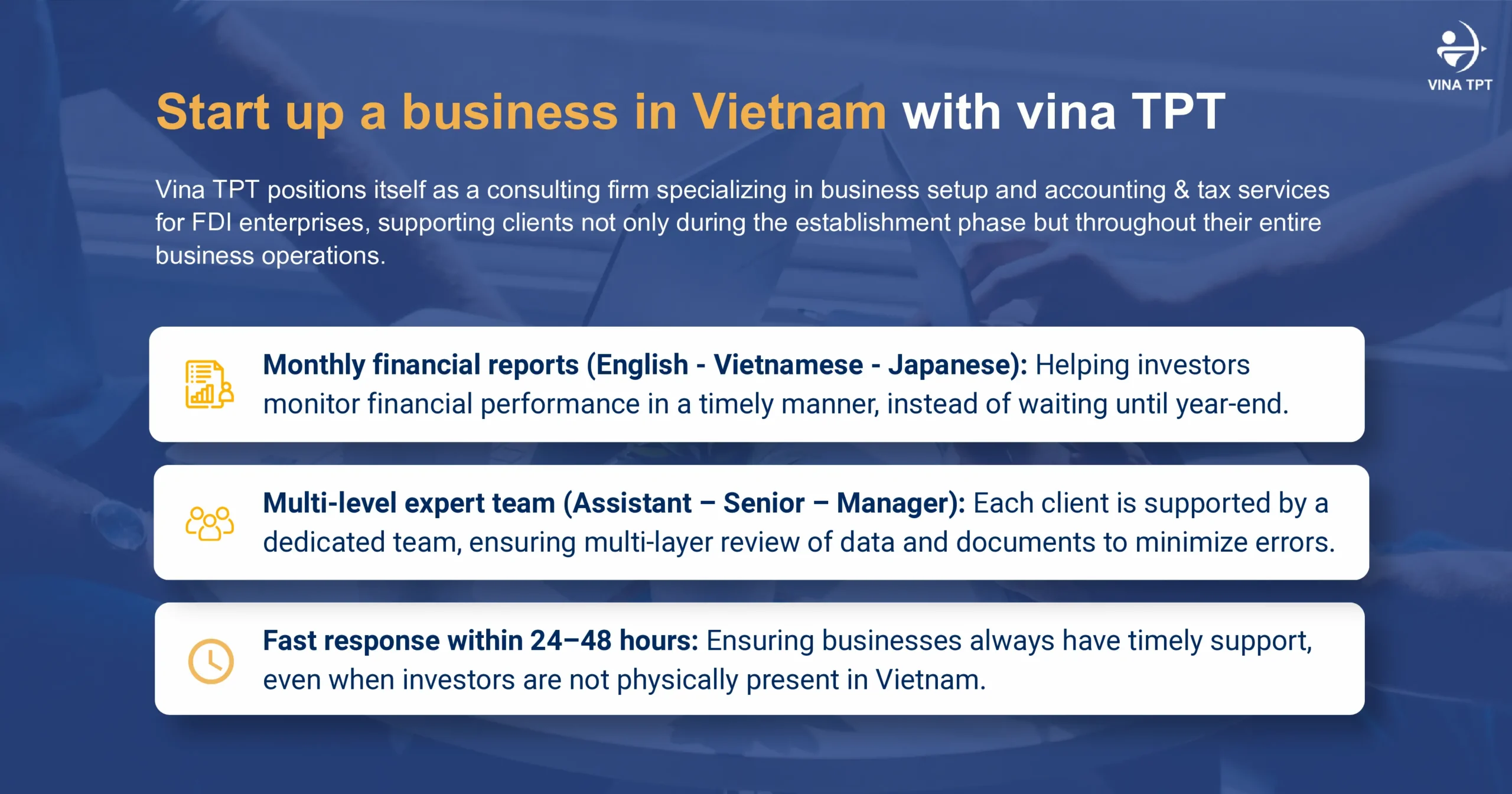
Each client is assigned a dedicated team (Assistant – Senior – Manager levels) for multi-layer review and timely issue resolution. We commit to responding within 24-48 hours, ensuring continuous support throughout your operations in Vietnam.
Contact Vina TPT today for a free consultation and to build the most suitable outsourced finance and accounting package for your business model. 

BOOK A FREE CONSULTATION


How Do I Start a Business in Vietnam? Guide for Foreign Investors

how-do-i-start-a-business-in-vietnam-from-idea-to-legal-setup-with-local-experts

When asking the question “How do I start a business?”, foreign investors are entering the stage of clarifying their business ideas and moving toward building a legally compliant and operational business model in Vietnam.

Based on over 20 years of experience in business consulting and supporting the establishment and operation of hundreds of FDI enterprises in Vietnam, this article will guide investors through each step, from preparation to registration and operation, while highlighting key considerations to ensure efficiency and minimize risks.

1. How can foreign investors start a business in Vietnam?

how-do-i-start-a-business-in-vietnam-from-idea-to-legal-setup-with-local-experts

1.1. Requirements for foreign investors to establish a company in Vietnam

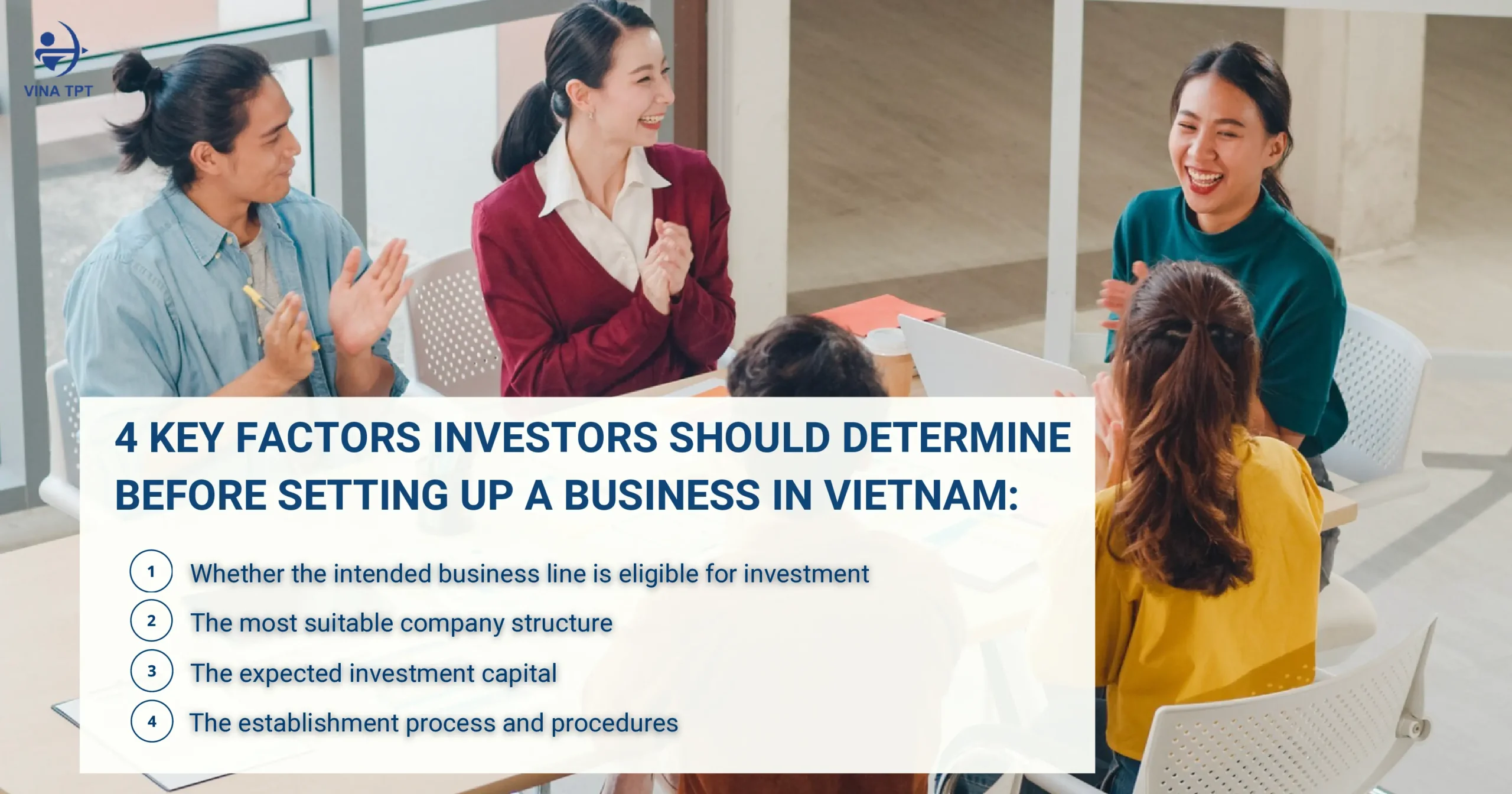
Before answering the question “How do I start a business?”, foreign investors need to determine whether their intended business line is eligible for investment. Under the Investment Law, business sectors in Vietnam are classified based on market access levels and regulatory conditions.

In practice, business sectors can be grouped into five main categories:

  • Unconditional business sectors (accounting for approximately 80%): These are sectors that are not subject to specific investment conditions or foreign ownership restrictions. Investors can proceed with standard business registration and comply with general regulations (tax, accounting, labor, etc.).
    Examples: manufacturing, wholesale trading, software development, consulting services, F&B.
  • Investment incentive sectors: These sectors are encouraged by the government and may benefit from incentives such as Corporate Income Tax (CIT) reductions, land rental incentives, or other support policies depending on the project.
    Examples: high technology, R&D, renewable energy, high-tech agriculture, digital transformation.
  • Conditional business sectors: These sectors are allowed to operate but require additional conditions such as sub-licenses, legal capital, technical standards, or professional certifications.
    Examples: education, healthcare, real estate, logistics, food services.
  • Market access restricted sectors for foreign investors: Foreign investors may face limitations on ownership ratio, investment structure, or scope of operations in these sectors.
    Examples: retail distribution, telecommunications, aviation, advertising, financial services.
  • Prohibited business sectors: These activities are strictly prohibited under Vietnamese law due to national security, social ethics, or public health concerns.
    Examples: drug trafficking, human trafficking, prostitution, explosives.

Note:

In practice, the majority of business sectors in Vietnam fall under unconditional categories (around 80%), meaning investors can enter the market relatively easily. However, some industries may overlap across categories (for example, renewable energy can be both incentivized and conditional).

To avoid confusion and streamline the licensing process, investors are advised to check the relevant business codes and applicable conditions on the Business Line Code Lookup page before submitting their applications.

1.2. What company types are suitable?

According to the Investment Law 2020, when exploring how to start a business in Vietnam, foreign investors can choose from several common business structures:

  • Limited Liability Company (LLC): This includes single-member LLCs or multi-member LLCs (with up to 50 capital contributors). This is the most commonly chosen structure by foreign investors due to its simple governance, strong control over operations, and flexibility in either 100% foreign ownership or joint ventures with local partners.
  • Joint Stock Company (JSC): Requires at least three shareholders with no maximum limit. This structure is suitable for businesses planning to raise capital, expand operations, or pursue long-term growth strategies.
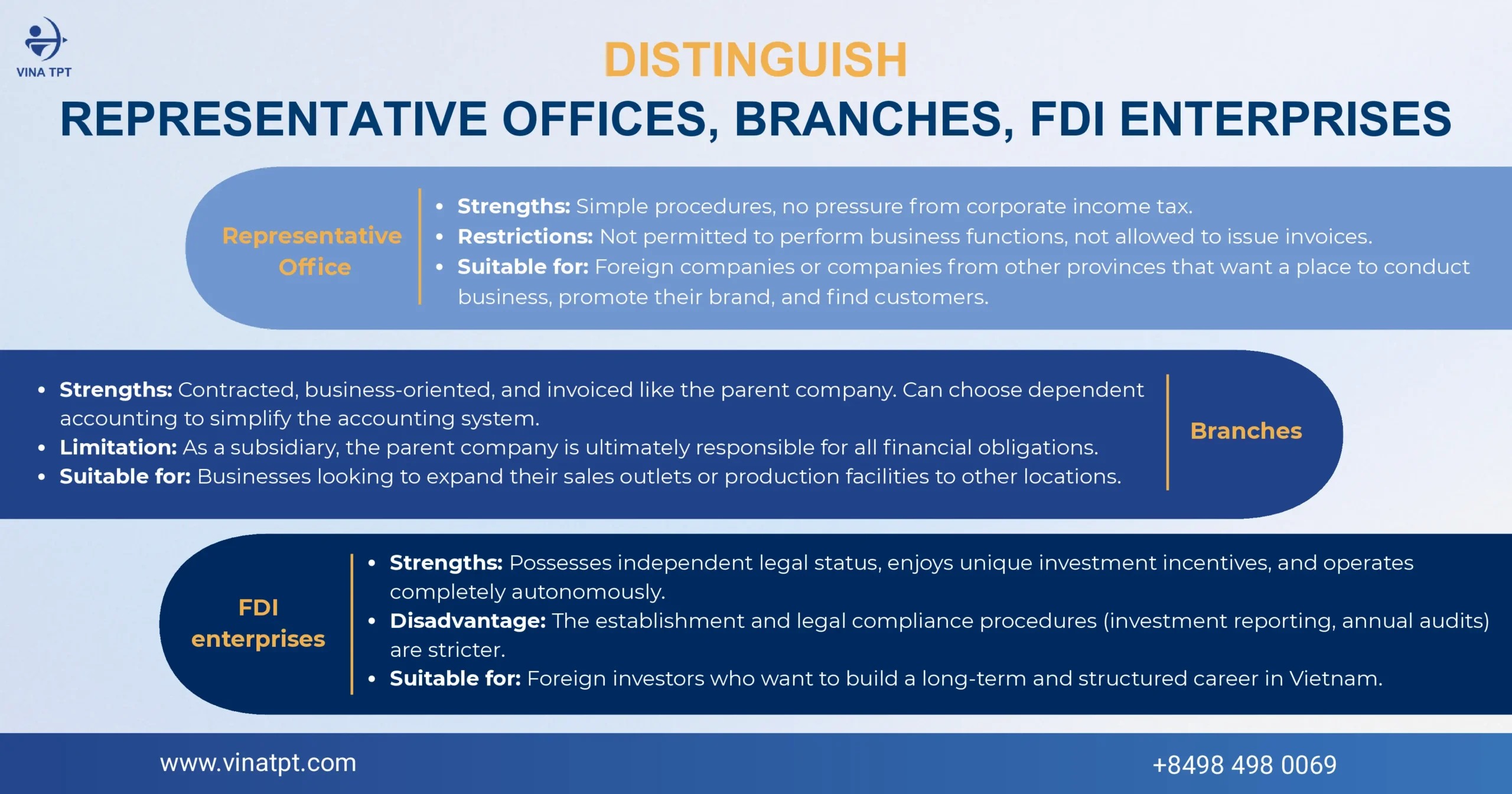
  • Representative Office: This entity does not have a commercial function and is primarily used for market research, trade promotion, and liaison activities with partners in Vietnam.

In practice, most foreign investors prefer an LLC when they want full ownership and simplified management, while a JSC is generally more suitable for projects with long-term expansion and capital mobilization plans.

how-do-i-start-a-business-in-vietnam-from-idea-to-legal-setup-with-local-experts

1.3. How much investment capital is required?

One of the key questions when exploring how do I start a business is the required capital. Vietnamese law does not impose a universal minimum charter capital across all sectors. However, in practice, capital must align with project scale, industry, and financial capacity.

Reference capital levels by industry:

  • Trading & distribution: Typically USD 10,000 – 50,000 (USD 10,000 is often considered a minimum reference level).
  • Fintech: Some models may require around USD 2 million depending on licensing conditions.
  • Commercial banking: Minimum capital requirement of approximately USD 120 million.
  • Real estate: No fixed capital requirement, but requires minimum equity of 20% (projects under 20 ha) or 15% (projects over 20 ha).

The above capital levels are for reference only and may vary depending on the investor’s specific business plan and the requirements of the licensing authority.

In practice, charter capital is not merely a formal requirement but directly impacts the application review process and the feasibility of project implementation. If the registered capital does not align with the scale of operations, the business may be required to provide explanations or make adjustments during the licensing process.

1.4. Business registration process in Vietnam

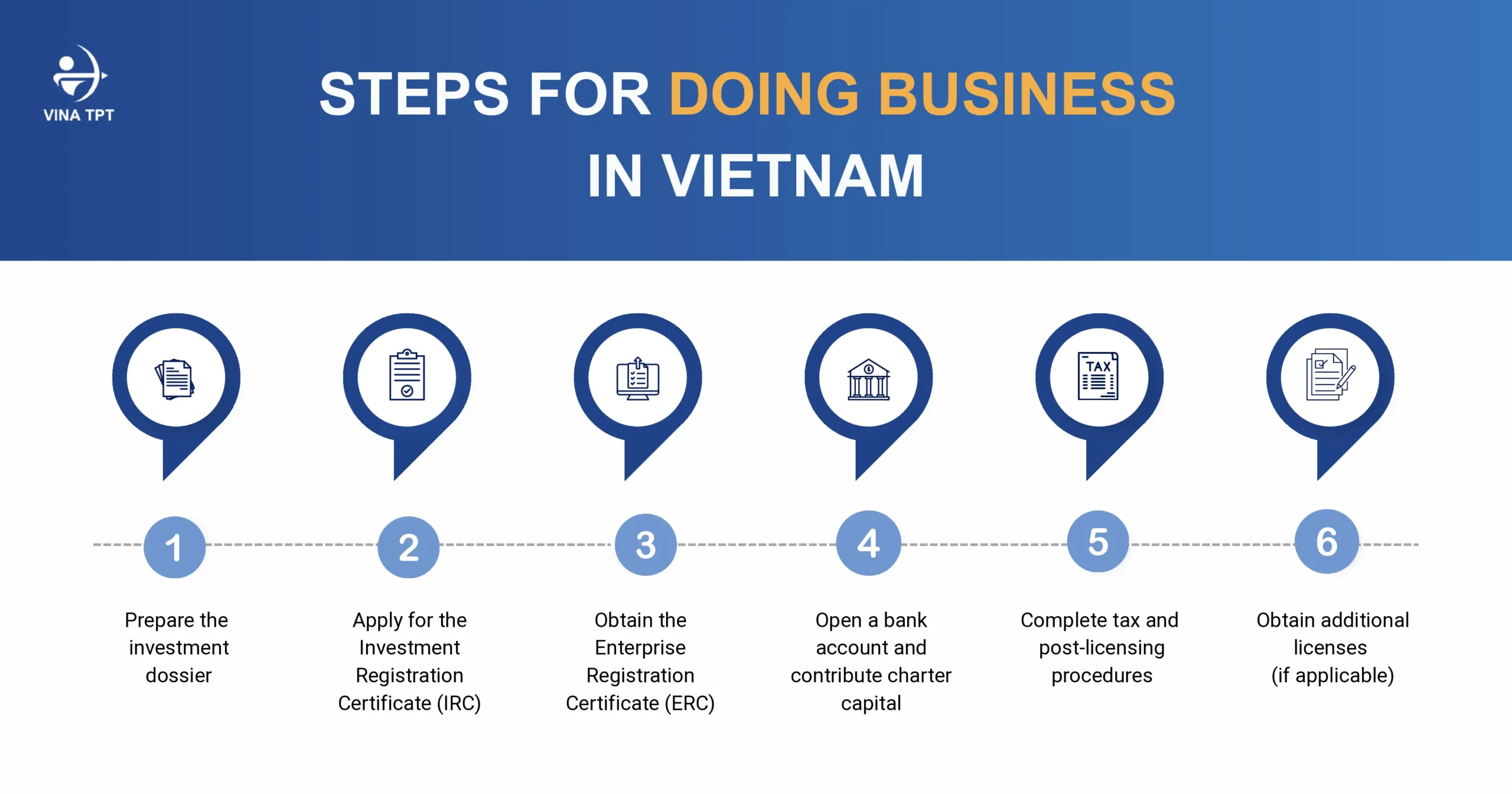
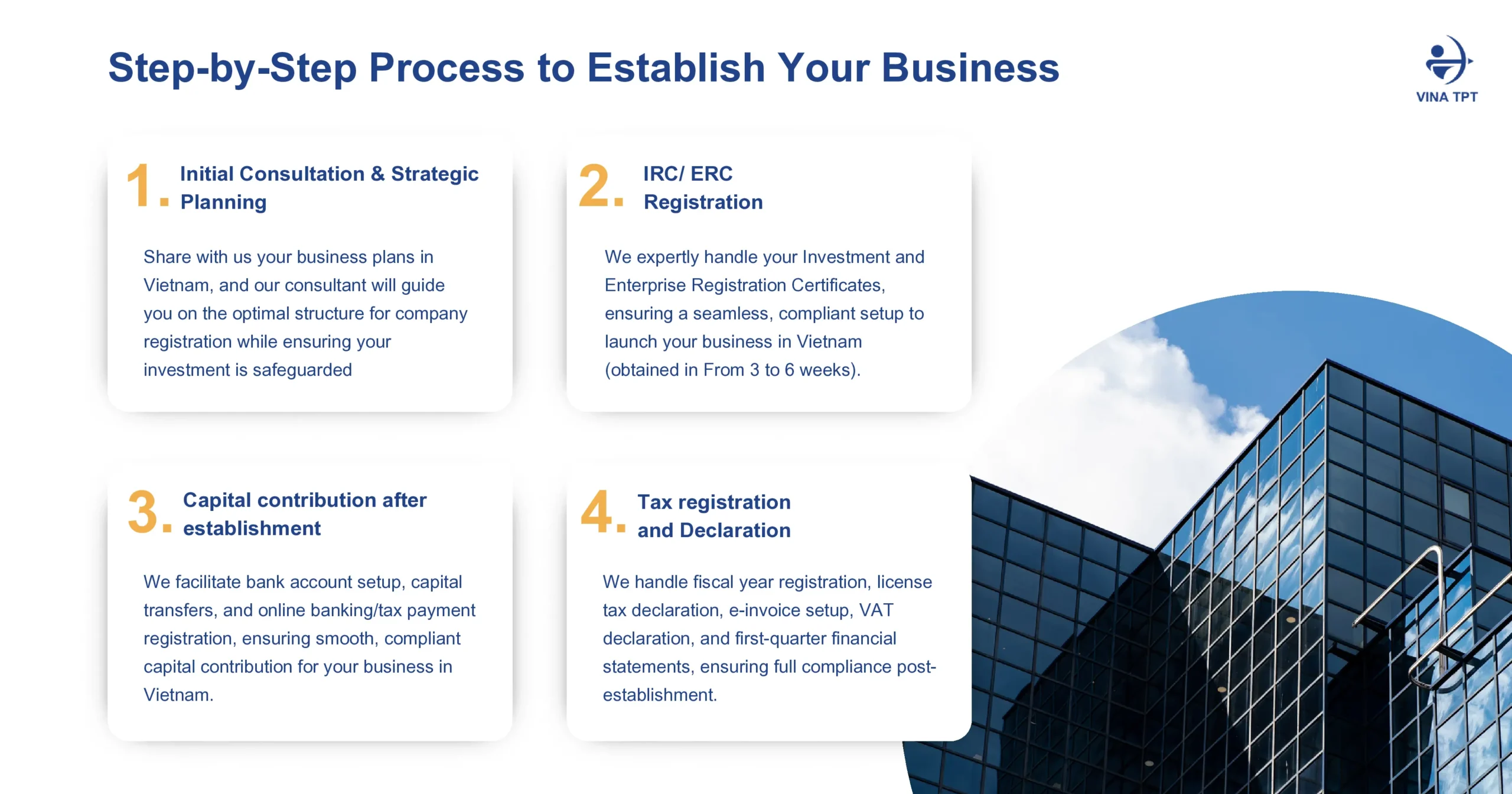
The process of setting up a business in Vietnam typically includes 6 steps, taking around 8-10 weeks depending on the industry:

  • Step 1: Prepare and submit the IRC application
  • Step 2: Obtain the Investment Registration Certificate (IRC)
  • Step 3: Obtain the Enterprise Registration Certificate (ERC)
  • Step 4: Open a capital account and contribute capital (within 90 days)
  • Step 5: Complete post-licensing procedures (tax, e-invoices, labor registration)
  • Step 6: Apply for sub-licenses (if applicable)

In practice, many companies underestimate post-licensing procedures and capital contribution obligations, leading to delays or compliance issues. Proper preparation from the beginning helps shorten timelines and avoid revisions.

After answering “How do I start a business?”, companies move into the operational stage, focusing on financial reporting, tax compliance, hiring, and payroll management.

EXPLORE OUR SERVICES

2. Legal and tax considerations investors should note from the beginning

2.1. What taxes must businesses declare?

After establishment, companies in Vietnam must comply with several taxes, including:

Value-Added Tax (VAT): VAT is one of the most frequently arising taxes during business operations, especially for companies engaged in trading goods, services, or import-export activities. 

Corporate Income Tax (Corporate Income Tax – CIT): CIT is calculated based on the company’s profits. This obligation not only includes annual finalization but also requires quarterly provisional payments and ongoing monitoring of business performance to ensure compliance with regulations.

Personal Income Tax (Personal Income Tax – PIT): Businesses are responsible for withholding, declaring, and paying PIT on behalf of employees for salaries, wages, and other taxable income. Proper compliance is essential to avoid risks such as tax reassessment and administrative penalties.

In practice, many businesses encounter issues from the early stages due to a lack of understanding of filing cycles, tax-specific obligations, or inconsistencies between reports. Having a clear understanding of each tax type helps companies establish an effective accounting and tax system from the beginning.

>>> For more details, refer to: Tax Tips for Small Business in Vietnam: Avoid Common Compliance Mistakes

2.2. Key considerations for hiring and payroll management

Managing payroll in Vietnam can be challenging for FDI companies, especially in the early stages:

  • Labor and insurance regulations (social, health, unemployment insurance) frequently change
  • Salary structures and PIT calculations are complex
  • Language barriers and legal differences create additional challenges

In reality, knowing how do I start a business is not enough without understanding local practices, many FDI companies choose payroll outsourcing services to ensure compliance and reduce internal workload.

>>> See more: Payroll Outsourcing Services in Vietnam: Benefits and Choosing the Right Provider

3. Important considerations when starting a business in Vietnam

Even after understanding how do I start a business, many investors still face challenges due to frequently changing regulations and local administrative practices.

For example, similar applications may require different procedures depending on the authority or location. Tax and labor policies are also regularly updated.

Without proper knowledge, businesses may face repeated revisions, delays, and unnecessary costs.

Therefore, many FDI companies choose to work with consulting firms for partial or full-service support to ensure compliance and efficiency.

4. When should investors work with a consulting firm?

Outsourcing business setup services is especially recommended when:

  • Entering Vietnam for the first time
  • Operating in conditional business sectors
  • Needing fast project implementation
  • Wanting to optimize tax, accounting, and HR from the beginning

For many investors, outsourcing support is the most effective way to answer how do I start a business in Vietnam. Professional consulting firms act as long-term partners, helping businesses minimize risks and operate effectively in Vietnam.

how-do-i-start-a-business-in-vietnam-from-idea-to-legal-setup-with-local-experts

If you are planning how do I start a business in Vietnam, working with an experienced consulting firm is highly recommended. Learn more about Vina TPT’s services to receive tailored consultation for your investment plan.

BOOK A FREE CONSULTATION

Important Notes on Personal Income Tax Finalization 2025 – Latest Updates

important-notes-on-personal-income-tax-finalization-2025

Are you responsible for tax matters in your company, or an individual planning to complete your own tax declaration? Understanding the personal income tax finalization 2025 process, submission deadlines, and key considerations will help minimize errors and optimize processing time.

This article summarizes essential information to help you complete personal income tax finalization 2025 accurately and efficiently.

important-notes-on-personal-income-tax-finalization-2025

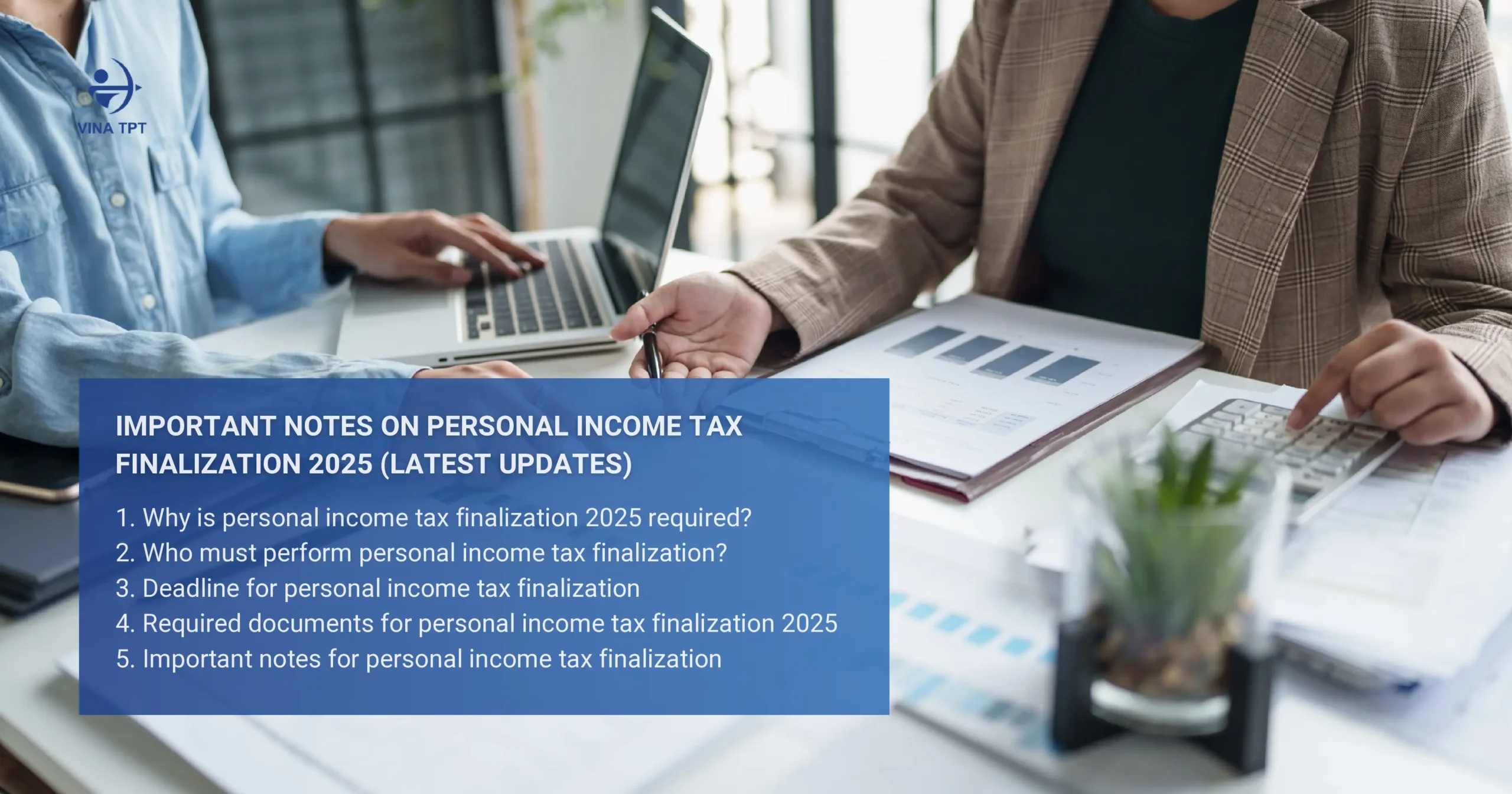
1. Why is personal income tax finalization 2025 required?

Personal income tax finalization is the process in which an individual consolidates all income earned during the year (from January 1 to December 31), recalculates the exact amount of Personal Income Tax (PIT) payable in accordance with regulations, and compares it with the tax already provisionally paid or withheld to determine whether there is any additional tax payable or a tax refund due.

In cases where additional tax is payable, it must be settled on time. Late payment may result in penalties, with late payment interest charged at 0.03% per day on the outstanding tax amount.

The finalization results may lead to:

  • Additional payment if there is a shortfall (late payment penalty: 0.03% per day)
  • A tax refund if excess tax has been paid

In addition, completing tax obligations helps individuals avoid legal risks in the future. In many cases such as purchasing property, applying for bank loans, or visa applications, authorities may require proof of completed tax obligations. Without completing tax finalization, individuals may not be able to provide these documents when needed.

2. Who must perform personal income tax finalization 2025?

Not only employees, but also income-paying organizations are responsible for conducting personal income tax finalization 2025 in accordance with Decree 126/2020/ND-CP and Official Letter 883/TCT-DNNCN.

For organizations:

  • Enterprises or organizations paying income that are authorized to finalize tax on behalf of individuals
  • Applicable regardless of whether tax has been withheld, except in cases where no income is paid

For individuals:

  • Resident individuals in Vietnam (those staying 183 days or more in a calendar year or within 12 consecutive months from the first date of arrival in Vietnam) who have additional tax payable or overpaid tax and wish to claim a tax refund or carry it forward to the next tax period are required to conduct personal income tax finalization. (Except where the additional tax payable does not exceed VND 50,000 or the individual does not request a refund or offset.)
  • Foreign individuals who terminate their labor contracts in Vietnam before leaving the country are also required to complete personal income tax finalization.
  • Resident individuals earning income from salaries and wages who are eligible for tax reduction due to natural disasters, fires, or other force majeure events must also perform tax finalization.

Cases not required to declare PIT:

Individuals are not required to perform personal income tax finalization in the following cases:

  • The additional tax payable does not exceed VND 50,000
  • There is overpaid tax, but the individual does not request a tax refund or carry it forward to the next period

To better understand how to determine the payable tax in specific scenarios, you may refer to the detailed guide here: How to Calculate Personal Income Tax 2026 in Vietnam 

3. Deadline for personal income tax finalization 2025

According to Article 44 of the Law on Tax Administration 2019, deadlines are as follows:

For income-paying organizations:

  • No later than the last day of the third month from the end of the calendar year (i.e., March 31, 2025)
  • If the deadline falls on a public holiday, it is extended to the next working day (usually April 1)

For individuals self-finalizing PIT:

  • No later than April 30 of the following year
  • If the deadline coincides with a holiday, it is extended to the next working day

Note: If an individual is eligible for a tax refund, late submission will not be subject to administrative penalties for late filing (Clause 4, Article 28, Circular 111/2013/TT-BTC).

important-notes-on-personal-income-tax-finalization-2025

EXPLORE OUR SERVICES

4. Required documents for personal income tax finalization 2025

According to Subsection 1, Section IV of Official Letter No. 13762/CTHN-HKDCN (2023), the required documents for personal income tax (PIT) finalization are categorized by subject as follows:

For individuals conducting self-finalization

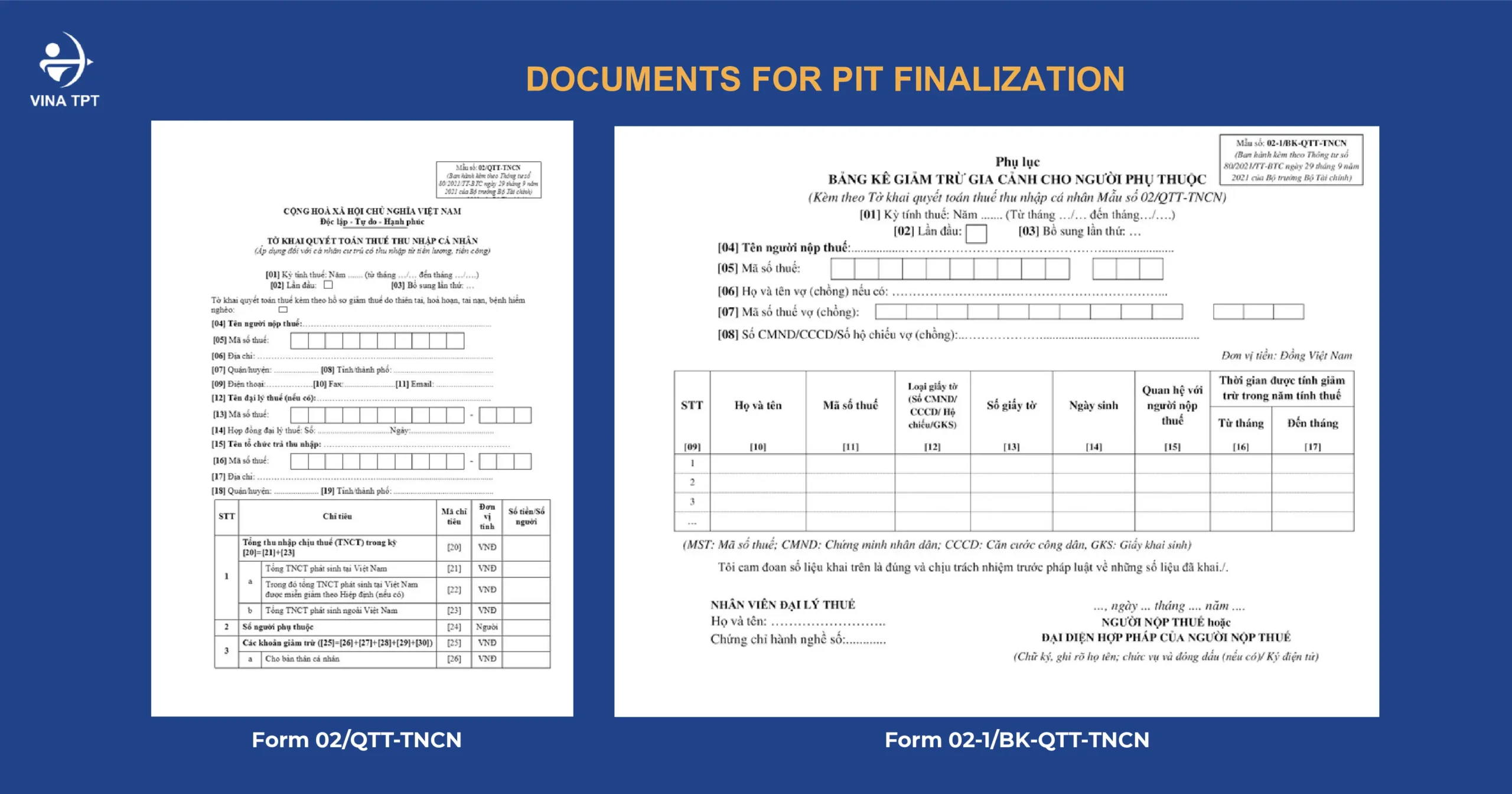
  • PIT finalization declaration form No. 02/QTT-TNCN
  • Dependent deduction appendix No. 02-1/BK-QTT-TNCN (if applicable)
  • PIT withholding certificates (tax deduction documents)
  • Proof of tax payment (for income earned abroad)
  • Supporting documents for deductions (charity, humanitarian contributions, insurance, etc.)
  • Dependent registration documents (if not previously registered)
  • Bank account details (in case of tax refund request)
  • Identification documents (if required by tax authorities for verification)

For companies conducting finalization on behalf of employees

  • PIT finalization declaration form No. 05/QTT-TNCN
  • Appendices: 05-1/BK-QTT-TNCN, 05-2/BK-QTT-TNCN (if applicable)
  • List of authorized individuals for tax finalization (Form No. 08/UQ-QTT-TNCN)

Internal documents for finalization and explanation purposes:

  • Payroll and employee income records
  • Income payment supporting documents
  • Issued PIT withholding certificates
  • Other relevant documents as required by tax authorities (if any)

important-notes-on-personal-income-tax-finalization-2025

Individuals and businesses can complete personal income tax finalization 2025 via the General Department of Taxation’s e-portal or the eTax Mobile application.

5. Important notes for personal income tax finalization 2025

To ensure accurate personal income tax finalization 2025 and minimize risks, taxpayers should note:

Review all taxable income

Compile all income sources, including salary, bonuses, allowances, and other income. Cross-check with the PIT Law 2025 to determine taxable and exempt income correctly.

>>> Reference: Personal Income Tax 2026: Key Changes Directly Affecting Employees

Register dependents on time

Dependent deductions are only applicable if properly registered. Late registration may result in losing deduction eligibility.

Reconcile withheld tax amounts

Compare the amount of tax already withheld (tax deduction) with the actual payable amount after finalization to avoid underpayment or missing a tax refund.

Overall, understanding personal income tax finalization 2025, preparing complete documentation, and meeting deadlines will help individuals and businesses avoid penalties while optimizing tax benefits. In complex cases, working with a professional advisory firm can help save time and ensure full compliance.

Follow the Insights & News section of Vina TPT to stay updated on the latest tax, accounting, and legal regulations for businesses and expats.

BOOK A FREE CONSULTATION

How Finance and Accounting Outsourcing Helps Small Businesses in Vietnam scale efficiently

how-finance-and-accounting-outsourcing-helps-small-businesses-in-vietnam-grow-faster

During the process of establishing and operating a business, one of the most critical factors determining the stability of a small business in Vietnam is its ability to manage finances and cash flow. Ineffective cost control, errors in tax declarations, or a lack of financial direction can not only lead to losses but also slow down business growth.

However, not every business has sufficient resources to build a complete in-house finance and accounting team from the beginning. This is why finance and accounting outsourcing has become a preferred solution for many small businesses, helping optimize costs, ensure compliance, and more importantly, free up internal resources to focus on growth.

how-finance-and-accounting-outsourcing-helps-small-businesses-in-vietnam-grow-faster

1. Why finance and accounting outsourcing helps small businesses optimize resources and scale efficiently

To operate effectively, a small business typically requires multiple specialized roles such as tax accountants, accounts payable/receivable staff, or internal auditors. However, building a full finance function is not only costly but also requires time for management, training, and supervision.

For newly established businesses, this represents a significant investment with no guaranteed efficiency, especially when risks of tax declaration errors still exist if the team lacks experience.

In this context, many businesses turn to finance and accounting outsourcing as an effective alternative, with the following key benefits:

Access to experienced professionals

Businesses can work with accounting, tax, and finance experts who have practical experience, helping ensure compliance and reduce operational errors.

In practice, some providers (such as Vina TPT) even offer clear commitments regarding responsibility in case of tax-related errors. Therefore, businesses should prioritize partners with transparent commitments to protect their long-term interests.

Reduced risks and errors

Professional providers of accounting outsourcing services in Vietnam typically implement multi-layer control processes, continuously update legal regulations, and establish mechanisms to minimize accounting and tax risks.

However, since businesses must share internal financial data with third parties, choosing a provider with clear data security policies is especially important.

Flexibility across different growth stages

Outsourcing services can be adjusted based on business needs:

  • Increased support during peak periods (tax season, audits)
  • Cost optimization during slower business periods
  • Additional expertise when scaling operations

Overall, these benefits significantly reduce the time and resources spent on finance and accounting tasks, allowing businesses to focus on core activities such as product development, market expansion, and revenue growth.

In other words, finance and accounting outsourcing not only ensures stable operations but also acts as a growth accelerator for small businesses.

2. How accounting outsourcing services work

2.1. Finance and accounting outsourcing models for different business stages

Depending on business size and operational needs, companies can choose different finance and accounting outsourcing models. Selecting the right model helps optimize costs while ensuring effective financial management at each stage of growth.

Model

Scope of Work

Suitable For

Transactional Outsourcing – Data entry and accounting transaction recording

– Invoice processing and payments

– Bank and expense reconciliation

Businesses with high transaction volumes seeking operational efficiency
Full-Service Accounting – Bookkeeping and monthly financial reporting

– Management reports and cash flow monitoring

– Compliance advisory under VAS

Small businesses without an in-house accounting team
Controller Services – Internal process setup and controls

– Data review and audit preparation

– Supervision of accounting operations

Growing businesses requiring stronger financial control
Fractional CFO – Financial planning and cash flow forecasting

– Fundraising and M&A advisory

– KPI development and investor reporting

Businesses needing long-term financial direction
End-to-end Service (Vina TPT) – Monthly accounting (bookkeeping, financial statements, management reports)

– Tax declaration & finalization (VAT, CIT, PIT)

– Annual financial statements and audit support

– Compliance advisory and tax updates

Businesses looking to fully outsource accounting and tax while ensuring compliance

2.2. Workflow between businesses and service providers

To ensure transparency and efficiency, professional accounting outsourcing services in Vietnam typically follow a structured workflow:

Step 1: Information and document collection
The service provider collects business information, including accounting documents, previous reports, and specific requirements.

Step 2: Service agreement signing
Both parties agree on the scope of work, timeline, fees, and responsibilities.

Step 3: Execution and reporting
The provider performs bookkeeping, prepares financial and tax reports, and submits them for business review and approval.

Step 4: Record retention and ongoing support
Documents are stored in compliance with regulations, and the business receives support for explanations or additional information when needed.

EXPLORE OUR SERVICES

3. Four criteria for choosing a reliable service provider

Selecting an accounting outsourcing provider not only affects costs but also determines the level of compliance and financial risk of a business. Below are four important criteria to consider:

Experience and track record

Businesses should prioritize providers with many years of experience in accounting and tax services, especially those who have worked with companies in similar industries or business models. Practical experience enables faster problem-solving and reduces the likelihood of errors.

Team expertise

The accounting team should have strong professional knowledge, a solid understanding of legal regulations, and hands-on experience in handling real cases. For businesses with foreign elements, the ability to work in English or Japanese is a significant advantage.

Service quality and reputation

Service quality can be evaluated through client feedback, partner portfolios, or professional certifications. In addition, businesses should review the provider’s working process, level of transparency, and ability to provide support when issues arise.

Cost and pricing structure

The cost of accounting outsourcing services in Vietnam typically depends on transaction volume and business complexity.

For small business in Vietnam with limited transactions, basic accounting and tax services usually start from around VND 3 million per month for bookkeeping and periodic tax filings.

For businesses with more complex operations, such as inventory management, payroll, or advanced management reporting requirements, pricing is often customized based on the actual scope of work.

Therefore, businesses should choose a service provider with pricing that matches their needs, while ensuring that the scope of work, responsibilities, and commitments are clearly defined in the contract. Choosing the right finance and accounting outsourcing partner not only helps control costs but also ensures compliance and builds a stable financial foundation for long-term growth.

4. Finance and accounting outsourcing services at Vina TPT

Unlike many providers that focus solely on document processing and periodic reporting, Vina TPT aims to help businesses proactively manage financial control and compliance throughout their operations.

One of the key differentiators is the provision of monthly financial reports in three languages (English – Vietnamese – Japanese). This allows business owners and foreign investors to monitor their financial performance on an ongoing basis, rather than waiting until year-end.

In addition, Vina TPT places strong emphasis on responsiveness and client support. All client inquiries are handled within 24-48 hours, ensuring that businesses receive timely guidance when issues arise, particularly in areas related to tax compliance and accounting treatment. This level of responsiveness helps create a sense of reliability and continuity in day-to-day operations.

Furthermore, each client at Vina TPT is supported by a 3-level team structure (Assistant – Senior – Manager) rather than a single point of contact. All financial data and reports undergo three layers of independent review, ensuring accuracy, regulatory compliance, and minimizing potential risks. This structured approach is particularly important for businesses that require a high level of reliability in financial reporting and tax compliance.

how-finance-and-accounting-outsourcing-helps-small-businesses-in-vietnam-grow-faster

If you are looking for a reliable partner to manage your accounting and tax compliance in Vietnam, Vina TPT is ready to support. Contact Vina TPT today to receive tailored advice for your business model and ensure full compliance from day one.

BOOK A FREE CONSULTATION

Tax Tips for Small Businesses in Vietnam to Avoid Mistakes

Tax-Tips-Small-business-in-Vietnam

Tax-Tips-Small-business-in-Vietnam

After completing the business establishment procedures, most companies begin to pay closer attention to tax policies in Vietnam. In practice, many businesses choose to use third-party services (such as outsourcing accounting services or other accounting & financial services) to handle tax and accounting matters. However, proactively understanding the basic regulations is still essential to minimize potential risks and help businesses work more effectively with service providers.
This article summarizes three important types of taxes that small business need to pay attention to from the early stages of establishment and operation in Vietnam. At the same time, practical tax tips are also shared to help businesses declare and pay taxes in compliance with regulations, avoiding common mistakes such as late submissions, missing documentation, or unnecessary costs.

1. Tax tips for three important taxes that small business must comply with

Any business established in Vietnam is required to fulfill multiple tax obligations. Proper and comprehensive understanding of these obligations is the foundation for applying effective tax tips, as well as coordinating well with accounting & financial services during business operations.

The three important taxes that businesses need to pay special attention to include: Value Added Tax (VAT), Corporate Income Tax (CIT), and Personal Income Tax (PIT) applied to employees. Fully understanding the obligations related to these taxes is a fundamental factor for effective tax management.

Tax-Tips-Small-business-in-Vietnam

1.1. Tax tips for VAT: Filing regulations and key considerations

Value Added Tax (VAT) is one of the most frequently incurred tax obligations for businesses, especially in trading and import-export activities. The VAT filing frequency depends on the revenue of the previous year:

  • Revenue above VND 50 billion: monthly filing
  • Revenue of VND 50 billion or less: quarterly filing is allowed

For newly established businesses, quarterly filing is commonly applied in the initial stage. Determining the correct filing cycle helps businesses minimize errors and avoid compliance risks.

Key tax tips for VAT

Tip 1: Meet conditions for input VAT credit
According to Decree 181/2025/ND-CP, to be eligible for input VAT credit, businesses must:

  • Have valid VAT invoices or corresponding tax payment documents
  • For transactions from VND 5 million or more (including VAT): non-cash payment is mandatory

Tip 2: Choose the correct filing cycle

  • Revenue > VND 50 billion: monthly filing or revenue ≤ VND 50 billion: quarterly filing is allowed
  • Monthly VAT Declaration: Businesses filing monthly must submit their VAT declaration and payment no later than the 20th day of the following month. VAT for January must be declared and paid by February 20. If the 20th falls on a weekend or public holiday, the deadline is automatically extended to the next working day.
  • Quarterly VAT Declaration: Businesses eligible for quarterly filing must submit their VAT declaration and payment no later than the last day of the first month of the following quarter. Example: VAT for Q1 (January-March) must be declared and paid by April 30. If the deadline falls on a weekend or public holiday, it shifts to the next working day.

In addition, businesses should note that VAT declaration is a mandatory obligation. If not performed or if declared under the wrong cycle, the business may be subject to administrative penalties.

Tip 3: Prepare complete and consistent VAT documentation

Whether applying the credit method or the direct method, retaining both input and output documentation is mandatory. These documents typically include VAT invoices, contracts, payment records, and other relevant supporting materials to substantiate the legitimacy of declared revenue and expenses.

In addition, businesses must ensure consistency between declared VAT figures, taxes paid, and accounting records. Any discrepancies or missing valid documentation may result in tax reassessments, administrative penalties, or prolonged reviews with tax authorities.

In practice, establishing a proper document management and internal control system from the outset helps minimize errors and significantly reduces the burden during periodic tax inspections and audits.

1.2. Tax tips for CIT: Tax payment and finalization

Corporate Income Tax (CIT) is calculated based on the company’s profit. For businesses, CIT obligations include not only annual finalization but also interim and periodic reporting.

Key tax tips for CIT

Tip 1: Pay provisional CIT on time
Businesses must make quarterly provisional CIT payments no later than the 30th day of the first month of the following quarter (for example: April 30 for Q1).

An important point to note is the 80% rule: by the end of the third quarter, the total provisional CIT paid must reach at least 80% of the total CIT payable for the entire year. If underpaid, the business may be subject to late payment interest. Therefore, businesses should regularly review their business performance and adjust provisional tax payments accordingly.

Tip 2: Complete CIT finalization on time
After the end of the fiscal year, businesses must finalize CIT using Form 03/TNDN under Circular 80/2021/TT-BTC. The submission deadline is the last day of the third month after the fiscal year ends (usually March 31).

Tax finalization is an important step to reconcile accounting profit and taxable income, and to determine the additional tax payable or refundable amount. Late or inaccurate submission may result in penalties and tax audits.

Tip 3: Prepare complete CIT finalization documentation
Businesses must prepare full documentation to support declared figures, including:

  • CIT finalization return (Form 03/TNDN)
  • Annual audited financial statements prepared in accordance with Vietnamese Accounting Standards, submitted within 90 days from the fiscal year-end
  • Documents related to tax incentives and loss carry-forward (if any)
  • Transfer pricing documentation for enterprises with related-party transactions

In addition, businesses should retain provisional tax payment records and authorization letters (if any) for inspection purposes.

Complete and consistent documentation helps businesses minimize the risk of tax reassessment or requests for explanation from tax authorities.

Tax-Tips-Small-business-in-Vietnam

1.3. Tax tips for Personal Income Tax (PIT): Withholding and employer obligations

Definition: A business operating in Vietnam is responsible for withholding, declaring, and paying Personal Income Tax (PIT) on salaries, wages, and other taxable income of its employees.

Tip 1: Withhold at the right time and ensure full compliance with filing and finalization obligations
Businesses must withhold Personal Income Tax (PIT) before paying income to employees. This means that at the time of salary, bonuses, or other payments, companies must accurately determine taxable income and the corresponding tax amount to be withheld, rather than making adjustments afterward.

After withholding, businesses are required to declare and pay PIT based on the applicable filing cycle:

  • Monthly filing: no later than the 20th day of the following month
  • Quarterly filing: no later than the last day of the first month of the following quarter

In addition to periodic filings, businesses must also conduct annual personal income tax finalization under the company’s tax code for all income paid to employees (including cases where employees authorize the company to finalize on their behalf).

Failure to withhold, declare, or pay taxes on time may result in tax reassessment, late payment interest, and administrative penalties in accordance with regulations.

Tip 2: Issue PIT withholding certificates in compliance with regulations
Businesses are responsible for issuing PIT withholding certificates to employees upon request, especially when individuals conduct their own tax finalization.

According to regulations, these certificates serve as the basis for employees to:

  • Finalize taxes directly with tax authorities
  • Prove the amount of tax already paid
  • Claim a tax refund (if applicable)

If the company has completed tax finalization on behalf of authorized employees, it is not required to issue withholding certificates for that portion of income. However, for income outside the authorized scope, the company must still provide certificates upon request.

Failure to issue or issuing incorrect withholding certificates may directly affect employees’ rights and create compliance risks for the business.

Tip 3: Stay updated with changes in PIT regulations
Personal Income Tax (PIT) policies in Vietnam are frequently updated.

For example, on December 10, 2025, the National Assembly passed a revised PIT Law (effective from 2026), introducing significant changes to progressive tax rates, personal deductions, and taxable income scope. Specifically:

  • The personal deduction has increased to VND 15.5 million/month (equivalent to VND 186 million/year), compared to VND 11 million/month previously
  • The dependent deduction has been adjusted to VND 6.2 million/month per dependent

Therefore, businesses must promptly update these changes in their payroll systems and review how taxable income and withholding amounts are calculated. Delays in updating may lead to incorrect withholding, resulting in additional tax payable or tax refunds during annual finalization.

>>> For more details: 

EXPLORE OUR SERVICES

  1. Tax tips for filing taxes via the electronic system in Vietnam

Currently, all businesses in Vietnam submit tax declarations and payments through the tax authority’s electronic portal. This system helps save time, reduce paperwork, and improve transparency in tax compliance.

When filing and paying taxes electronically, businesses should pay attention to the following:

  • Use the correct e-tax portal and retain electronic receipts after submission as proof of filing time
  • Ensure the digital signature is valid and properly registered under the legal representative or authorized person
  • Carefully review tax data, indicators, and appendices before submission, even though the system includes automatic error checks
  • Proactively complete electronic tax payments and monitor payment status to ensure obligations are fulfilled on time
  • Track the processing status using transaction codes and store records for internal audits or explanations when required

Tax-Tips-Small-business-in-Vietnam

3. How Vina TPT supports small business tax compliance (practical tax tips)

In practice, many small businesses fail to fully comply with mandatory tax obligations due to common mistakes such as selecting the wrong filing cycle, submitting tax returns late, lacking valid supporting documents, or not keeping up with updated tax regulations. These issues often stem from a limited understanding of Vietnam’s legal framework, leading to administrative penalties, tax reassessments, and in more serious cases, suspension of the tax code. As a result, businesses may be unable to issue invoices, face operational disruptions, and incur additional time and costs to restore their active status.

Therefore, businesses need more than just a service provider for tax filing, they need a partner capable of managing risks, ensuring ongoing compliance, and supporting issue resolution throughout operations.

With extensive experience of more than 20 years supporting small enterprises in Vietnam, Vina TPT has developed a structured workflow covering initial consultation, document collection, report preparation and review, submission, and post-filing support. This approach enables businesses not only to meet tax obligations on time but also to proactively manage risks, minimize errors, and maintain stable operations.

Tax-Tips-Small-business-in-Vietnam

If your business is in the setup phase or facing challenges with tax compliance in Vietnam, working with an experienced consulting firm can help reduce risks and optimize operations from the outset. Contact Vina TPT for tailored solutions aligned with your business model.

BOOK A FREE CONSULTATION

A Complete Guide for Japanese Investors Setting Up a Business in Vietnam

According to the Ministry of Finance, in the first eight months of 2025, newly registered FDI capital from Japan to Vietnam reached USD 877.9 million, accounting for about 8% of total registered investment capital. In addition, a survey by the Japan Bank for International Cooperation (JBIC) ranks Vietnam second among the most attractive overseas investment destinations for Japanese enterprises.

So when considering setting up a business in Vietnam, what types of enterprises can Japanese investors choose? What is the company establishment process, and what legal issues should investors pay attention to? This article outlines common company structures, the company establishment process, and key considerations for Japanese investors investing in Vietnam.
a-complete-guide-for-japanese-investors-setting-up-a-business-in-vietnam

1. Why Vietnam is an attractive destination for Japanese investors

Vietnam is becoming an increasingly attractive investment destination for many Japanese companies due to several advantages:

  • Stable Vietnam – Japan relations: The two countries maintain a Comprehensive Strategic Partnership, creating a stable foundation for long-term cooperation and a reliable investment environment for Japanese enterprises considering setting up a business in Vietnam.
  • Competitive production costs and investment incentives: Vietnam has a young workforce, competitive production costs, and various tax incentive policies designed to attract foreign investment.
  • Strategic location in the regional supply chain: Located in the center of Southeast Asia and participating in major free trade agreements such as the Comprehensive and Progressive Agreement for Trans-Pacific Partnership (CPTPP) and the Regional Comprehensive Economic Partnership (RCEP), Vietnam provides favorable conditions for Japanese companies to expand manufacturing and export activities to many markets in the region.
  • A rapidly growing domestic market: With a population of over 100 million people and a growing middle class, Vietnam represents a promising consumer market for many Japanese companies considering setting up a business in Vietnam.

So what company types for foreign investors in Vietnam are available for Japanese investors?

2. Các loại hình thành lập doanh nghiệp phổ biến tại Việt Nam cho nhà đầu tư Nhật

According to Article 21 of the Investment Law 2020, Japanese investors may establish four main types of business entities when setting up a business in Vietnam, including:

  • Single-member limited liability company (100% foreign-owned): This is a company owned by a single individual or organization. In foreign investment cases, the owner is typically a foreign investor or a foreign company.
  • Multi-member limited liability company: This is one of the most common company types for foreign investors in Vietnam, allowing 2 to 50 capital contributors. Foreign investors may participate with ownership ratios permitted under the relevant business sector regulations.
  • Joint-stock company: This type of enterprise has at least three shareholders and is allowed to issue shares to raise capital from investors.
  • Representative office: A representative office does not conduct business activities like a company. It mainly performs functions such as market research, trade promotion, and liaison support with local partners.

Below is a comparison of the key characteristics, advantages, and disadvantages of each structure available when setting up a business in Vietnam.

Criteria

Single-member LLC Multi-member LLC Joint-stock company

Representative office

Suitable for Investors wanting 100% ownership and full control Joint ventures or cooperative projects Large companies requiring capital mobilization Foreign companies exploring the market
Members/shareholders 1 individual or organization 2–50 members Minimum 3 shareholders, unlimited maximum Not applicable
Legal entity status Yes Yes Yes Not an independent legal entity
Organizational structure Members’ Council, Director/General Director Members’ Council, Chairman, Director/General Director, Supervisory Board (if required) General Meeting of Shareholders, Board of Directors, Director/General Director, Supervisory Board or Internal Audit Chief Representative
Capital mobilization Limited, mainly from owner Capital contribution from members High, can issue shares No capital mobilization function
Share issuance rights No No Yes No
Advantages Simple structure, full decision-making authority Risk and capital shared among members High fundraising ability, possibility of stock exchange listing Simple establishment procedure, suitable for market research
Disadvantages Difficult to raise external capital Member limit (max 50) More complex governance structure Not allowed to conduct business activities

In general, choosing the right company types for foreign investors in Vietnam directly affects the company’s operational strategy and governance structure after setting up a business in Vietnam. The choice will largely depend on the investor’s objectives and business strategy.

EXPLORE OUR SERVICES

3. Step-by-step process for setting up a business in Vietnam

Step 1: Prepare the investment dossier

This is the critical first step in the process of setting up business in Vietnam. The dossier must be prepared in accordance with the Investment Law 2025.

  • Written request for implementation of the investment project
  • Documents proving the investor’s legal status:
    • For individuals: Citizen ID/Passport (copy)
    • For organizations: Certificate of incorporation or equivalent legal document (copy)
  • Investment project proposal (including investor information, objectives, investment capital, scale, capital mobilization plan, location, schedule, and socio-economic efficiency assessment)
  • Documents proving financial capacity:
    • Individuals: savings book, bank balance confirmation
    • Organizations: financial statements for the last two years, financial commitment from the parent company or a financial institution
  • Head office lease agreement or documents proving the right to use the project location
  • Technology explanation (for projects subject to technology appraisal)
  • BCC business cooperation contract (if investing under this form)

The dossier is submitted to the Department of Finance in the province/city where the project’s head office is located.

Step 2: Submit the application for the Investment Registration Certificate (IRC)

Obtaining the Investment Registration Certificate is also a key step in business registration in Vietnam for Japanese investors, as this certificate officially approves and confirms the company’s investment project.

Required documents include:

  • Application form and a detailed project proposal (objectives, scale, investment capital, location, and timeline)
  • Proof of financial capability (bank statements, audited financial reports, or credit agreements)
  • Legal documents: notarized passport (individual) or business registration certificate (organization), both legalized
  • Proof of location (lease agreement or land use rights)
  • Power of attorney (if using a third-party service)

Foreign documents must be consular legalized and officially translated into Vietnamese. The processing time for an IRC application is typically 5-6 weeks , depending on the nature of the project and the review requirements of the investment registration authority. It is recommended to work with a professional service provider such as Vina TPT to avoid delays.

Step 3: Obtain the Enterprise Registration Certificate (ERC)

After the IRC is issued, the next step in setting up business in Vietnam is obtaining the ERC to establish the company’s legal entity status. Typically, the ERC is issued within 7-14 days from the submission date.

Step 4: Open a corporate bank account and inject charter capital

Foreign investors who open new company in Vietnam are required to:

  • Open a dedicated investment capital account at a licensed bank in Vietnam
  • Contribute the full charter capital within 90 days from the ERC issuance date to avoid penalties and maintain credibility for future licenses

Step 5: Complete tax registration and post-licensing procedures

Before officially commencing operations, the enterprise must:

  • Register for a tax code and purchase a digital signature
  • Apply for e-invoice issuance/registration
  • Register labor and enroll employees in social insurance

Tax and labor obligations are the final steps in doing business in Vietnam before official operations begin.

Step 6: Apply for sector-specific licenses (if applicable)

Conditional business sectors may require additional sub-licenses such as business licenses, import-export licenses, or environmental permits.

By following these steps and staying updated on regulations, foreign investors can successfully establish operations in Vietnam.

4. Common challenges for Japanese investors when setting up a business in Vietnam

Although Vietnam is an attractive investment destination, the process of setting up a business in Vietnam may present several challenges for foreign investors, especially those entering the market for the first time.

  • Differences in legal systems: Vietnam’s legal system and licensing procedures differ significantly from Japan’s. For example, companies must obtain an Investment Registration Certificate (IRC) before applying for an Enterprise Registration Certificate (ERC). Some sectors also require additional sub-licenses, which can make the licensing process more complex.
  • Language and business culture barriers: Most legal documents and administrative procedures related to setting up a business in Vietnam are conducted in Vietnamese, including contracts, registration documents, and tax filings. Even with interpreters, reviewing legal documents in detail can still be challenging.
  • Administrative procedures involving multiple authorities: Administrative procedures in Vietnam often involve several regulatory bodies. For example: Representative offices must register with the Department of Industry and Trade and Branches of foreign traders may need to register with the Ministry of Industry and Trade. Incorrectly identifying the competent authority may delay the licensing process.
  • Tax and accounting compliance: After setting up a business in Vietnam, investors must comply with various tax obligations such as: Value Added Tax (VAT), Corporate Income Tax (CIT), Personal Income Tax (PIT)…These regulations are regularly updated. For instance, the personal income tax policy was updated at the end of 2025 and is expected to take effect from July 1, 2026. Without proper expertise, businesses may face compliance risks and unnecessary financial costs.

For this reason, many foreign investors choose to work with professional consulting firms to support the entire process from company establishment to legal compliance and operational management.

5. Support solutions for Japanese investors setting up a business in Vietnam

With over 20 years of experience in consulting and setting up a business in Vietnam, Vina TPT has supported numerous foreign investors in establishing and operating their businesses in Vietnam.

Notably, more than 80% of Vina TPT’s clients are Japanese companies, giving our team extensive practical experience in setting up a business in Vietnam and handling business registration in Vietnam for Japanese investors.

Our specialists can communicate and work directly in Japanese, helping ensure that communication and document processing are carried out quickly and accurately. In addition to company establishment services, Vina TPT also provides accounting and tax consulting services after incorporation, helping businesses maintain full compliance with Vietnamese regulations. In particular, monthly financial reports are provided in three languages (Japanese, English, and Vietnamese) allowing investors to easily monitor business performance.

Furthermore, Vina TPT also supports all related procedures for foreign investors and experts, including visa, work permits, and Temporary Residence Cards (TRC). As a result, investors do not need to work with multiple service providers while still being able to operate their business in Vietnam smoothly and efficiently.

If you are planning setting up a business in Vietnam, contact Vina TPT today for professional consultation and step-by-step support, from investment licensing to post-establishment compliance.

BOOK A FREE CONSULTATION

Vietnam LLC Registration Requirements: A Complete Guide for Investor

Vietnam LLC Registration Requirements: A Complete Guide for Investor

A limited liability company (LLC) is one of the most common business structures chosen by foreign investors when investing in Vietnam. This type of company allows the owner to be liable only within the scope of the contributed capital, has a relatively simple governance structure, and offers flexibility in choosing either 100% foreign ownership or cooperation with other partners.

So, how is the process of establishing an LLC in Vietnam carried out, and what should investors pay attention to during the company registration process? The article below provides detailed guidance on Vietnam LLC registration requirements as well as the necessary procedures.

Vietnam LLC Registration Requirements: A Complete Guide for Investor

1. Classification of LLCs: Which type is suitable for your business?

Before reviewing the Vietnam LLC registration requirements, investors need to determine which business structure best fits their business plan. In Vietnam, a limited liability company has two main forms: a single-member LLC and a multi-member LLC.

The table below compares the key features of these two LLC types, helping investors choose the model that best suits their business plan and satisfies the Vietnam LLC registration requirements.

Criteria Single-member LLC Multi-member LLC
Number of members 1 individual or organization From 2 to 50 members
Organizational structure Relatively simple, including: Owner, Company President, and Director/General Director More complex, including: Members’ Council, Chairman of the Members’ Council, and Director. If the company has more than 11 members, a Supervisory Board is mandatory to ensure transparency
Capital mobilization Limited, 100% from the owner More flexible, from multiple members in the Members’ Council
Suitable for Investors who want to own 100% of the capital Joint ventures or multiple investors

If an investor wants full ownership and direct control over decision-making, a single-member LLC is often the more suitable choice.

Single-member LLC offers flexibility and full control, making it suitable for individuals who want to independently manage their business.

Meanwhile, a multi-member LLC is an ideal option for partnerships, allowing investors to mobilize capital and share risks, thereby creating a stronger foundation for larger-scale growth.

2. Vietnam LLC registration requirements

To establish an LLC in Vietnam, you need to clearly understand the Vietnam LLC registration requirements and the relevant legal regulations.

2.1. Company name

Company name is one of the important requirements when registering a business in Vietnam. According to the Law on Enterprises, the name of a limited liability company must include two components:

  • Business type: “Limited Liability Company” or “LLC” (for a single-member company, it may be written as “Single-member Limited Liability Company”).
  • Company’s proper name: Written using letters in the Vietnamese alphabet, and it may include the letters F, J, Z, W, numbers, and symbols.

For example: Harvion LLC.

When naming a company, investors should note the following regulations:

  • The company name must not be identical or confusingly similar to an existing registered business name nationwide.
  • Names of state agencies, political organizations, or armed forces units cannot be used unless permitted.
  • Words or symbols that violate historical traditions, culture, ethics, or social norms are not allowed.
  • A foreign-language name or abbreviated name must be translated from the Vietnamese name and must not duplicate another company’s name.
  • Registered trademarks or protected trade names cannot be used as part of the company name without the owner’s consent.

In addition, before submitting a business registration application, investors should check the company name in advance on the National Business Registration Database to ensure that the proposed name is not duplicated or confusingly similar.

>>> Reference: How to check company name availability in Vietnam before registration

2.2. Head office address

One of the Vietnam LLC registration requirements is that the company must have a clear and lawful head office address, for example: 325 Hung Vuong, Dong Ha Ward, Quang Tri Province.

Under the Housing Law 2023, enterprises are not allowed to register their head office in apartment buildings used for residential purposes or collective housing.

The head office is where the company places its office, displays its signboard, and conducts business transactions.

If the company has not yet found a suitable location, using a virtual office provided by Vina TPT is also a common solution at the initial stage, as long as the address meets the legal conditions for enterprise registration:

  • The virtual office address must not be located in a residential apartment or an area prohibited for business registration
  • It must be capable of receiving mail and official correspondence from state authorities
  • The lessor must have sufficient documents proving the lawful right to lease the premises

2.3. Charter capital

Charter capital is the amount of capital that you commit to contribute for operating the company. For FDI enterprises, although the law does not impose a general minimum charter capital, in practice the charter capital should be appropriate to the project scale and the investor’s financial capacity in order to satisfy the Vietnam LLC requirements.

Although there is no general minimum charter capital requirement, in practice the expected capital level often varies by industry. Typical reference ranges include:

  • Trading and distribution sector: Charter capital is often around USD 10,000 – USD 50,000, with USD 10,000 commonly considered the minimum reference level.
  • Fintech sector: Certain financial technology models may require charter capital of approximately USD 2 million, depending on the specific service model and licensing requirements.
  • Commercial banking: The minimum charter capital is typically around USD 120 million.
  • Real estate sector: Vietnamese law does not set a fixed charter capital requirement; however, it requires a minimum equity ratio of 20% for projects under 20 hectares and 15% for projects of 20 hectares or more, ensuring that investors have sufficient financial capacity to implement the project.

Therefore, when determining charter capital, investors should choose an amount that aligns with the business scale, investment plan, and financial capacity, while also ensuring compliance with the legal requirements of the intended business sector.

2.4. Business lines

Selecting the appropriate business lines is also part of the Vietnam LLC registration requirements. Enterprises may register business lines that are not included in the list of prohibited sectors under Vietnamese law.

However, certain conditional sectors such as education, healthcare, and real estate may require statutory capital, sector-specific licenses, or practicing certificates.

When establishing a company in Vietnam, investors can proactively look up business line codes and the corresponding scope of activities on the Business Line Code Lookup portal to minimize the risk of adjustments or additions during the appraisal process.

For FDI enterprises, some sectors require a specific foreign ownership ratio or other special conditions under the Investment Law. Please contact Vina TPT for detailed advice on the most suitable business lines.

EXPLORE OUR SERVICES

2.5. Legal representative

The legal representative must satisfy the Vietnam LLC registration requirements, specifically:

  • Be at least 18 years old
  • Have full legal capacity
  • Not necessarily be a capital-contributing member

The legal representative may be either Vietnamese or foreign, so FDI enterprises can be assured on this point.

In addition, under the Enterprise Law 2025, it is necessary to review the legal status of both the legal representative and the capital-contributing investors. Certain individuals, such as civil servants and public employees, may be restricted from or prohibited from establishing, contributing capital to, or managing an enterprise under current regulations.

3. Steps to register LLC in Vietnam for foreign investors

Step 1: Prepare the investment dossier

This is an important first stage in the steps to register LLC in Vietnam. The dossier must satisfy the Vietnam LLC registration requirements under the Investment Law 2025.

The dossier includes:

  • A written request for implementation of the investment project
  • Documents proving the investor’s legal status:
    • For individuals: ID card/Passport (copy)
    • For organizations: Certificate of Incorporation or equivalent legal document (copy)
  • Investment project proposal (including investor information, project objectives, investment capital, scale, capital mobilization plan, location, timeline, and socio-economic efficiency assessment)
  • Documents proving financial capacity:
    • For individuals: savings book, bank balance confirmation
    • For organizations: financial statements for the most recent 2 years, financial commitment from the parent company or a financial institution
  • Head office lease agreement or documents proving the right to use the project location
  • Technology explanation (for projects subject to technology appraisal)
  • BCC contract, if the investment is made in the form of a business cooperation contract

The dossier is submitted to the Department of Finance in the province or city where the project’s head office is located.

Step 2: Apply for the Investment Registration Certificate (IRC)

This is an important step in the Steps to register LLC in Vietnam for foreign investors. The IRC approves the investor’s project and specifies the charter capital, scale, location, and business scope. Without the IRC, the investor cannot proceed with company registration.

Required documents include:

  • Application form and detailed project proposal (objectives, scale, investment capital, location, and timeline)
  • Proof of financial capacity (bank statements, audited financial statements, or credit agreements)
  • Legal documents: notarized passport (for individuals) or business registration certificate (for organizations), both duly legalized
  • Proof of project location (lease agreement or land use rights)
  • Power of attorney (if using third-party services)

All foreign-issued documents must be consular legalized and officially translated into Vietnamese.

Normally, from submission to issuance, the IRC process takes around 5-6 weeks. To avoid delays and optimize processing time, investors should cooperate with a professional company formation service provider such as Vina TPT, where experienced specialists can provide support throughout the process.

EXPLORE OUR SERVICES

Step 3: Obtain the Enterprise Registration Certificate (ERC)

After obtaining the IRC, the company continues with the Steps to register LLC in Vietnam by applying for the ERC in order to complete the Vietnam LLC registration requirements.

Normally, the ERC is issued within 7-14 days from the date of submission.

Step 4: Open a corporate bank account and contribute charter capital

Foreign investors who open a new company in Vietnam are required to:

  • Open a dedicated investment capital account at a licensed bank operating in Vietnam
  • Contribute the full charter capital within 90 days from the date of ERC issuance.

Note: This is an important legal requirement; however, in practice many investors overlook or delay fulfilling the capital contribution obligation after completing the company establishment procedures. Failure to contribute the full charter capital within the required timeframe may result in administrative penalties, mandatory adjustments to the charter capital, and may also affect the company’s credibility and ability to obtain other licenses or complete legal procedures in the future.

Therefore, enterprises should plan the capital transfer in advance and complete the capital contribution procedures within the statutory deadline.

Step 5: Apply for sector-specific licenses (if any)

Some conditional sectors require additional licenses such as a business license, import-export license, or environmental permit in order to fully satisfy the Vietnam LLC registration requirements.

By following these steps and keeping up to date with legal changes, foreign investors can successfully establish a company in Vietnam.

4. Estimated timeline and costs

The time required to complete all Vietnam LLC registration requirements is usually around 2-3 months, depending on the business line and the scale of investment.

5. Important legal notes for FDI enterprises to satisfy Vietnam LLC registration requirements

When establishing an FDI limited liability company in Vietnam, investors should pay attention to several important legal issues related to ownership ratios, capital contribution, and investment reporting obligations.

Foreign ownership ratio by sector

One of the most common questions foreign investors ask when considering setting up a business in Vietnam is: “Do foreign investors need to have a Vietnamese partner (local partner) in order to establish a company?”

Under the Investment Law 2025 and Decree 31/2021/ND-CP, foreign investors are allowed to own capital in Vietnamese enterprises. However, some sectors may be subject to market access restrictions or foreign ownership limits.

These restrictions are set out in the List of Sectors with Market Access Restrictions for Foreign Investors.

Where an enterprise operates in multiple sectors, the foreign ownership ratio must comply with the lowest limitation applicable among those sectors.

Regulations on capital contribution in foreign currency

Under the Foreign Exchange Ordinance and Circular 06/2019/TT-NHNN of the State Bank of Vietnam, foreign investors must make capital contributions through a Direct Investment Capital Account (DICA) opened at a licensed bank in Vietnam. All transactions related to capital contribution, repatriation of profits abroad, or transfer of capital must be conducted through this account to ensure compliance with foreign exchange control regulations.

As mentioned in the section on charter capital, investors must contribute the full charter capital within 90 days from the date the Enterprise Registration Certificate (ERC) is issued to avoid administrative penalties and potential legal complications in the future.

Investment Activity Reporting obligations

After an FDI enterprise is established and begins operations, it must submit periodic Investment Activity Reports in accordance with the Investment Law 2020, Decree 31/2021/ND-CP, and Circular 03/2021/TT-BKHDT. This obligation applies specifically to foreign-invested enterprises and must be submitted quarterly and annually through the National Investment Information System. The report typically includes information on investment capital implementation, revenue, labor, tax obligations, and the progress of project implementation.

Complying with these regulations helps ensure transparent investment activities and reduces legal risks during operation in Vietnam.

Overall, the process of establishing an LLC in Vietnam is not simple, especially for foreign investors who are unfamiliar with local laws and often face language and cultural barriers. Therefore, working with a professional consulting firm can make the company registration process faster and more efficient.

If an investor plans to establish a limited liability company (LLC) in Vietnam, Vina TPT can support the entire process, from obtaining the Investment Registration Certificate (IRC) and Enterprise Registration Certificate (ERC) to handling post-establishment procedures. Our English-speaking consultants will assist with preparing documentation and working with the relevant authorities. Contact Vina TPT for detailed consultation.

BOOK A FREE CONSULTATION

Cases Eligible for VAT Tax Refund in Vietnam in 2026 

cases-eligible-for-vat-tax-refund-in-vietnam-in-2026

In practice, the amount of VAT tax refund that a business may receive is often significant, especially when the deductible input VAT eligible for refund reaches VND 300 million or more. For this reason, tax refund procedures are always a matter of concern for domestic enterprises, foreign-invested enterprises (FDIs), and accounting departments.

The article below summarizes the cases eligible for VAT tax refund under the Law on Value Added Tax 2024, while clarifying the applicable conditions and important notes that businesses should understand when carrying out refund procedures.

cases-eligible-for-vat-tax-refund-in-vietnam-in-2026

1. What is a VAT tax refund?

A VAT tax refund is the return by the tax authority of VAT amounts that an enterprise or individual has paid or is entitled to deduct, provided that the legal conditions are satisfied. This typically applies when input VAT exceeds output VAT or when special tax incentive policies are available.

Carrying out a VAT tax refund helps reduce financial pressure on businesses, improve working capital, and encourage investment, exports, and other incentivized economic activities. It also helps ensure fairness in tax collection and avoids situations of overpayment.

Example: Company H exports fashion products (T-shirts) and is not required to pay output VAT because the applicable VAT rate is 0%. During the period, the company incurred VND 70 million in input VAT for raw materials. Under the regulations, Company H may receive a VAT tax refund of VND 70 million from the tax authority to offset the tax already paid.

2. Cases eligible for VAT tax refund

Under Article 15 of the Law on Value Added Tax 2024 and the related guiding documents, businesses and organizations may be entitled to a VAT tax refund in certain situations.

Below are 9 common cases eligible for VAT tax refund under the current regulations.

Case 1: VAT tax refund for exported goods and services

Case Condition Tax treatment
Business establishments with exported goods or services during the tax declaration period Input VAT not yet fully deducted exceeds VND 300 million Eligible for VAT tax refund on a monthly or quarterly basis
Input VAT not yet fully deducted is below VND 300 million Carried forward to the next tax declaration period for continued deduction

Pursuant to Clause 1, Article 15 of the Law on Value Added Tax 2024 and Article 29 of Decree 181/2025/ND-CP, businesses engaged in export activities may be entitled to a VAT tax refund in the following cases:If a business has both exported goods and domestic sales, it must separately account for the input VAT relating to export activities.

If separate accounting is not possible, the input VAT for exported goods is determined based on the ratio of export revenue to total taxable revenue.

After offsetting against the VAT payable for domestic sales, if the remaining input VAT is VND 300 million or more, the business may be granted a VAT tax refund. However, the refund amount must not exceed 10% of export revenue.

Some export-related cases eligible for refund include:

Case Eligible subject
Export under entrusted export arrangement The business that entrusts goods for export
Export processing The business entering into a processing contract with a foreign party
Export for overseas construction projects The business exporting materials or goods for overseas projects
On-the-spot export The business exporting goods on the spot

Note: A VAT tax refund is not available for imported goods that are subsequently exported to another country without processing or manufacturing in Vietnam.

Case 2: VAT tax refund for investment projects

Under Clause 2, Article 15 of the Law on Value Added Tax 2024 and Article 30 of Decree 181/2025/ND-CP, a business with an investment project may receive a VAT tax refund if the following conditions are met:

Case Tax treatment
A business applying the deduction method has a new or expanded investment project Input VAT arising during the investment phase is offset against VAT payable from current business activities
After offsetting, the remaining input VAT is VND 300 million or more Eligible for VAT tax refund

If the investment project has been completed but the business did not apply for refund during the investment phase, it may still submit a VAT tax refund dossier within one year from the project completion date.

Note: A VAT tax refund is not available in the following cases:

  • The enterprise has not fully contributed its charter capital as registered
  • The project belongs to a conditional business sector but the required conditions have not yet been met
  • The business fails to maintain the required business conditions during operation
  • The project involves exploitation of natural resources or minerals (except oil and gas exploration and field development projects), or production projects using extracted minerals that have been processed into other products as prescribed by law

Case 3: VAT tax refund for goods and services subject to the 5% VAT rate

Under Clause 3, Article 15 of the Law on Value Added Tax 2024 and Article 31 of Decree 181/2025/ND-CP, businesses that only produce or supply goods and services subject to the 5% VAT rate may receive a VAT tax refund if:

Case Condition Tax treatment
Business establishments supplying only goods and services subject to the 5% VAT rate Input VAT not yet deducted reaches VND 300 million or more after 12 consecutive months or 4 consecutive quarters Eligible for VAT tax refund

If the business produces or supplies multiple categories of goods or services subject to different VAT rates, it must separately account for the input VAT of the activities subject to the 5% rate.

If separate accounting is not possible, the input VAT for such activities is determined based on the ratio of revenue from goods and services subject to the 5% VAT rate to total taxable revenue during the refund period.

After offsetting against VAT payable from other business activities, if the remaining input VAT is VND 300 million or more, the business may be considered for a VAT tax refund.

Case 4: VAT tax refund upon dissolution or bankruptcy

Under Clause 4, Article 15 of the Law on Value Added Tax 2024 and Article 32 of Decree 181/2025/ND-CP:

A business applying the deduction method, upon dissolution or bankruptcy, may be entitled to a VAT tax refund if:

  • It has overpaid VAT, or
  • It still has input VAT not yet fully deducted

In cases where a cooperative group is converted into a cooperative, or a branch is dissolved, the enterprise or cooperative inheriting the business may continue to deduct or request a VAT tax refund for the uncredited VAT amount in accordance with the regulations.

EXPLORE OUR SERVICES

Case 5: VAT tax refund for goods carried upon exit from Vietnam

Under Clause 5, Article 15 of the Law on Value Added Tax 2024 and Article 33 of Decree 181/2025/ND-CP:

Case Tax treatment
Foreigners or overseas Vietnamese purchasing goods in Vietnam and carrying them abroad upon exit Eligible for VAT tax refund corresponding to the value of the goods carried

Case 6: VAT tax refund for ODA-funded programs and projects

Under Clause 6, Article 15 of the Law on Value Added Tax 2024:

Case Tax treatment
Program owners, project owners, main contractors, or organizations designated by foreign donors to manage ODA-funded programs/projects purchasing goods and services in Vietnam for project implementation Eligible for VAT tax refund for VAT paid on goods and services purchased in Vietnam
Organizations in Vietnam using non-refundable aid or humanitarian aid from foreign organizations or individuals to purchase goods and services for the program or project Eligible for VAT tax refund for VAT paid on goods and services used for the project

Case 7: VAT tax refund for subjects entitled to diplomatic privileges and immunities

Under Clause 7, Article 15 of the Law on Value Added Tax 2024:

Case Tax treatment
Subjects entitled to diplomatic privileges and immunities purchasing goods and services in Vietnam Eligible for VAT tax refund for the VAT amount shown on the invoice

Case 8: VAT tax refund under international treaties

Under Clause 8, Article 15 of the Law on Value Added Tax 2024:

Organizations or business establishments may receive a VAT tax refund if such refund is granted under a decision of the competent authority or under an international treaty to which Vietnam is a party.

Case 9: VAT tax refund under a decision of a competent authority

In addition to the cases above, a business establishment may also receive a VAT tax refund when a competent state authority issues a refund decision in accordance with the law.

3. Frequently asked questions about VAT tax refund

Question 1: How long does a VAT tax refund take?

After receiving the VAT tax refund dossier, the tax authority will classify it into two categories:

Case 1: Refund first, inspection later

Within 6 working days from the date the tax authority issues a notice of dossier acceptance, the tax authority will take one of the following actions:

  • Issue a refund decision if the dossier is eligible
  • Transfer the dossier to the “inspection before refund” category if inspection is required
  • Issue a notice of non-refund if the dossier does not meet the conditions

If the tax authority finds that the dossier contains unclear information or discrepancies compared with its data, it may request the taxpayer to provide explanations or supplement the dossier.

Note: The time taken by the taxpayer to provide explanations or supplement the dossier is not included in the refund processing time.

Case 2: Inspection first, refund later

For dossiers subject to prior inspection, the tax authority will carry out an inspection or audit at the taxpayer’s premises to determine the refundable VAT amount.

The processing time in this case must not exceed 40 days from the date the tax authority issues the notice of dossier acceptance.

After the inspection is completed, the tax authority will issue either a refund decision or a notice of non-refund if the dossier is not eligible.

Question 2: After receiving the refund decision, how long does it take to receive the money?

After issuing the refund decision, the tax authority will transfer the refund amount to the taxpayer within 3 working days if the refund is made via bank account.

In some cases where further verification is required, the payment period may be extended but must not exceed 6 working days from the date of the refund decision.

Question 3: What is the difference between VAT tax refund and VAT deduction?

A VAT tax refund means the tax authority returns the remaining input VAT not yet fully deducted to the business in certain cases prescribed by law, such as export activities, investment projects, or subjects enjoying special incentives.

By contrast, VAT deduction means the business offsets input VAT against output VAT payable. If, after offsetting, some input VAT remains unused, that amount is carried forward to the next tax declaration period for continued deduction.

This is also a common issue businesses look into when they want to understand how to get VAT refund in Vietnam in each specific situation.

Question 4: What is the minimum amount required to be eligible for VAT tax refund?

Under the current regulations, a business is only considered for a VAT tax refund if the input VAT not yet deducted is VND 300 million or more.

If the remaining undeducted input VAT is below VND 300 million, the business will not receive a refund and must continue carrying it forward to the next declaration period for deduction.

Although the rules on VAT tax refund are clearly provided in the law, in practice the process of preparing the dossier and working with the tax authority is often quite complicated, especially for businesses with limited experience in handling refund dossiers.

Even a minor error in the dossier, invoice, or supporting document may cause the tax authority to request additional documents or prolong the processing time. For this reason, many businesses choose to cooperate with a professional tax consulting firm to ensure that the dossier is properly prepared and the refund process is optimized.

4. VAT tax refund service process at Vina TPT

Typically, the VAT tax refund support process is implemented through the following steps:

Step 1: Consultation and refund eligibility assessment
Vina TPT discusses with the enterprise to understand its tax status, business model, and the specific refund case. Based on this information, our specialists will evaluate the eligibility for a VAT tax refund and propose an appropriate implementation approach.

Step 2: Review and preparation of the refund dossier
Vina TPT’s specialists assist the enterprise in reviewing invoices, supporting documents, tax declarations, and other relevant materials to ensure the dossier is complete and compliant before submission to the tax authority.

Step 3: Submission of the dossier and working with the tax authority
The dossier is submitted to the tax authority (directly, by post, or electronically). Vina TPT supports communication and explanations if additional information is required.

Step 4: Monitoring and receiving the refund amount
After the dossier is approved, the tax authority issues the refund decision and transfers the refund amount to the enterprise’s bank account. 

The processing time for a VAT tax refund dossier is typically:

  • Approximately 6 working days for cases of refund first – inspection later.
  • Up to 40 working days for cases of inspection first – refund later.

cases-eligible-for-vat-tax-refund-in-vietnam-in-2026

If your business needs detailed advice on VAT tax refund conditions or support in preparing a refund dossier, the specialists at Vina TPT are ready to assist so that your business can complete the procedure quickly and in compliance with the regulations.

BOOK A FREE CONSULTATION

Payroll Outsourcing Services in Vietnam: Benefits and Choosing the Right Provider

payroll-outsourcing-services-in-vietnam-benefits-for-fdi-enterprises-and-how-to-choose-a-reliable-provider

It is not uncommon for FDI enterprises to face penalties due to payroll management errors during their first years of operation in Vietnam. Payroll often becomes one of the biggest challenges for foreign investors entering the market, given the differences in labor regulations, tax policies, and the local operating environment.

In this context, payroll outsourcing services are increasingly chosen by businesses to ensure compliance and optimize internal resources. So, what are payroll outsourcing services, which businesses should use them, and how can companies select a reliable service provider? The article below clarifies these issues.

payroll-outsourcing-services-in-vietnam-benefits-for-fdi-enterprises-and-how-to-choose-a-reliable-provider


1. Why is payroll management challenging for FDI enterprises in Vietnam?

Labor law and social insurance regulations are frequently updated

Regulations relating to salaries, social insurance, health insurance, and unemployment insurance in Vietnam are regularly revised to align with labor and social welfare policies. As a result, many FDI enterprises face difficulties in tracking and promptly applying new rules when managing payroll.

The legal framework for salary and personal income tax is relatively complex

Vietnam’s salary-related regulations go beyond base salary and also involve personal income tax (PIT), allowances, employee benefits, and mandatory insurance obligations. Accurately calculating and declaring these items requires businesses to have a solid understanding of the law and the relevant reporting procedures.

Language barriers and differences in the legal environment

In addition to legal factors, language barriers and differences in working culture can make HR and payroll management even more complicated for FDI enterprises. In many cases, an incomplete understanding of local regulations or the application of unsuitable HR processes may result in errors in payroll management, employee benefits, and compliance obligations.

Because of these challenges, many FDI enterprises choose payroll outsourcing services to ensure legal compliance and optimize internal resources.

2. What are payroll outsourcing services? How is the service implemented?

2.1. What is payroll outsourcing?

Payroll outsourcing services refer to the arrangement in which a company hires a professional third-party provider to handle all or part of the activities related to payroll administration and labor compliance obligations. Instead of building an internal team to manage complex issues related to salaries, taxes, and insurance, businesses can transfer these functions to a specialized service provider.

In practice, payroll outsourcing services usually include activities such as:

  • Preparing and calculating monthly payroll
  • Declaring personal income tax for employees
  • Registering and managing mandatory insurance contributions (social insurance, health insurance, and unemployment insurance)
  • Preparing and submitting labor reports as required by law
  • Supporting the company in complying with labor and tax regulations

By using payroll outsourcing services, businesses can reduce administrative workload, minimize payroll errors, and improve compliance, especially in a legal environment like Vietnam where labor and tax regulations contain many detailed requirements.

2.2. Payroll outsourcing service implementation process

In practice, payroll management goes far beyond simply calculating employee salaries. It also includes multiple steps related to HR data, tax and insurance obligations, and reporting to competent authorities.

Typically, payroll outsourcing services are implemented through the following process:

Step 1: Collecting and verifying payroll data

At the initial stage of payroll outsourcing services, the service provider will coordinate with the enterprise to collect the information necessary for payroll calculation, including:

  • Employment contract information
  • Salary levels and allowances
  • Attendance records or working hour data
  • Employee movement information (new hires/resignations)
  • Relevant deductions or employee benefits

After collection, the data is reviewed and verified to ensure accuracy before payroll calculation begins.

Step 2: Preparing and calculating payroll

Based on the verified data, the payroll provider will:

  • Calculate the monthly payroll for employees
  • Determine the amount of personal income tax (PIT) to be withheld
  • Calculate mandatory insurance contributions such as social insurance, health insurance, and unemployment insurance

Once completed, the payroll statement is sent to the company for review and approval before proceeding to the next stage.

Step 3: Issuing payslips and supporting salary payment

After the payroll is approved, the payroll provider will prepare and issue payslips for each employee. Payslip distribution must be handled confidentially and sent to the correct recipients.

Step 4: Handling tax and insurance obligations

An important part of payroll outsourcing services is ensuring that the company fulfills its obligations to state authorities. These tasks commonly include:

  • Declaring and paying personal income tax
  • Registering and paying mandatory insurance contributions for employees
  • Registering dependents for tax deductions, where applicable
  • Supporting the processing of insurance benefits such as maternity leave, sick leave, or occupational accident benefits

You may also be interested in: Personal Income Tax 2026: Key Changes Directly Affecting Employees

Step 5: Labor reporting and legal compliance

In addition to payroll processing, payroll outsourcing services also help enterprises fulfill their legal reporting obligations, such as:

  • Reporting labor usage status (increase/decrease in headcount)
  • Updating employee information with the social insurance authority
  • Preparing periodic labor- and salary-related reports

Following these steps helps enterprises maintain a transparent, accurate, and compliant payroll system while minimizing HR administration errors.

3. Why do FDI enterprises in Vietnam prefer payroll outsourcing services?

For foreign-invested enterprises, managing payroll in a new market like Vietnam often creates many challenges related to labor law, taxation, and mandatory insurance systems. In addition, differences in legal frameworks and operating practices between countries can make it difficult to establish an effective internal payroll system.

In this context, many FDI enterprises choose payroll outsourcing services as a solution to improve operations, ensure legal compliance, and strengthen HR management efficiency.

3.1. Focusing on core business activities

When using payroll outsourcing services, enterprises do not need to allocate excessive resources to administrative tasks such as payroll calculation, tax filing, or insurance administration.

This allows management teams and HR departments to focus on strategic activities such as market expansion, business development, and workforce management.

3.2. Saving costs and improving operational efficiency

Building an in-house payroll system often requires investment in payroll software, IT systems, and personnel with expertise in tax and insurance matters.

For FDI enterprises, these costs can be considerable in the early stages of operation. Payroll outsourcing services help reduce initial investment costs while allowing businesses to leverage the expertise of professional service providers.

3.3. Strengthening compliance and minimizing legal risks

Payroll management is directly linked to a wide range of regulations, including labor law, personal income tax rules, and mandatory insurance obligations. These regulations are updated regularly and may differ significantly from the legal framework in the investor’s home country.

As a result, ensuring full compliance with local rules can become a major challenge for FDI enterprises. By using payroll outsourcing services, businesses can reduce the risk of errors in filings and reporting while ensuring that all legal obligations are handled properly.

3.4. Improving employee experience and retaining talent

A transparent and accurate payroll system plays an important role in building employee trust. When salaries, taxes, and insurance contributions are calculated clearly and paid on time, employees feel more secure about their entitlements.

For FDI enterprises competing for talent in Vietnam, maintaining a professional and transparent payroll process is also a key factor in improving employee experience and retaining high-quality staff.

EXPLORE OUR SERVICES

4. Four criteria for choosing a reliable payroll outsourcing services provider in Vietnam

Selecting the right payroll outsourcing services provider is especially important for FDI enterprises, as payroll is not only about paying employees but also closely tied to tax obligations, insurance contributions, and compliance with Vietnamese labor law.

Below are four key criteria businesses should consider when selecting a payroll service partner.

4.1. Experience and professional capability

A reliable provider of payroll outsourcing services is usually reflected through the following factors:

  • Proven track record and successful client base: Providers with many years of experience generally have a solid understanding of labor law, tax, and insurance regulations, and are better equipped to handle practical issues flexibly. Long operating history and a strong client portfolio are two important indicators when assessing a provider’s capability and reliability.

  • A clear payroll management system: Payroll statements should have a transparent structure, be easy to review, and be managed through a suitable payroll system. Components such as salaries, bonuses, allowances, and employee benefits should be clearly defined to ensure both accuracy and transparency.

  • An experienced team of specialists: A service provider should have specialists who understand labor law and taxation in depth. In particular, experience working with FDI enterprises is a significant advantage, because such specialists not only understand Vietnam’s legal environment but are also familiar with the working practices of international businesses. This helps ensure effective implementation and timely updates on legal changes.

4.2. Transparent and reasonable service fees

Service fees often reflect the professionalism of payroll outsourcing services. If the fees are too high, the enterprise may bear unnecessary operating costs. On the other hand, fees that are too low may indicate risks in service quality or a lack of transparency in the service agreement.

A professional provider typically offers a clear and transparent pricing structure that corresponds to the scope of services delivered. Therefore, businesses should prioritize providers that offer transparent quotations, clearly drafted service contracts, and specific commitments regarding the scope of work.

4.3. Data confidentiality policy

Payroll involves sensitive data relating to both the enterprise and its employees, including:

  • Employees’ personal information
  • Salary details and employee benefits
  • Personal income tax and insurance data

For this reason, a payroll outsourcing services provider must have a clear confidentiality policy and a secure data management system to ensure that such information is protected throughout the cooperation period.

Businesses should also prioritize providers that maintain strict data control procedures and include confidentiality commitments in the service contract.

4.4. A comprehensive HR service ecosystem

In practice, FDI enterprises often have broader HR administration and labor compliance needs beyond payroll management alone. Therefore, choosing a payroll service provider with a comprehensive HR service ecosystem can bring substantial benefits.

Additional services commonly provided alongside payroll outsourcing services may include:

  • Support for visas and work permits for foreign experts
  • Consulting on HR policies and employee benefits
  • Support for personal income tax finalization and periodic labor reporting

This allows businesses to simplify HR administration, optimize operating costs, and maintain better legal compliance.

payroll-outsourcing-services-in-vietnam-benefits-for-fdi-enterprises-and-how-to-choose-a-reliable-provider

5. Why is Vina TPT a leading payroll outsourcing services partner for FDI enterprises?

Based on the provider selection criteria outlined above, Vina TPT not only meets the required standards of expertise, experience, and data security, but also brings added value to businesses.

With more than 20 years of experience in business consulting, HR, and accounting services, Vina TPT has supported thousands of domestic and foreign enterprises in establishing and operating in Vietnam. Notably, more than 80% of Vina TPT’s clients are Japanese enterprises, a group of investors well known for their high standards in accuracy, process discipline, and compliance.

In addition, Vina TPT is currently supporting many international enterprises from Germany, Taiwan, the United States, the United Kingdom, Russia, Canada, Australia, Singapore, and many other countries, helping them build payroll systems that are transparent, accurate, and aligned with Vietnamese law.

Thanks to its practical experience and a team of specialists with strong knowledge of labor law and tax regulations, Vina TPT provides effective payroll services in Vietnam, helping enterprises optimize payroll administration, minimize compliance risks, and allocate more resources to core business operations.

payroll-outsourcing-services-in-vietnam-benefits-for-fdi-enterprises-and-how-to-choose-a-reliable-provider

BOOK A FREE CONSULTATION