Payroll Outsourcing Services in Vietnam: Benefits and Choosing the Right Provider

payroll-outsourcing-services-in-vietnam-benefits-for-fdi-enterprises-and-how-to-choose-a-reliable-provider

It is not uncommon for FDI enterprises to face penalties due to payroll management errors during their first years of operation in Vietnam. Payroll often becomes one of the biggest challenges for foreign investors entering the market, given the differences in labor regulations, tax policies, and the local operating environment.

In this context, payroll outsourcing services are increasingly chosen by businesses to ensure compliance and optimize internal resources. So, what are payroll outsourcing services, which businesses should use them, and how can companies select a reliable service provider? The article below clarifies these issues.

payroll-outsourcing-services-in-vietnam-benefits-for-fdi-enterprises-and-how-to-choose-a-reliable-provider


1. Why is payroll management challenging for FDI enterprises in Vietnam?

Labor law and social insurance regulations are frequently updated

Regulations relating to salaries, social insurance, health insurance, and unemployment insurance in Vietnam are regularly revised to align with labor and social welfare policies. As a result, many FDI enterprises face difficulties in tracking and promptly applying new rules when managing payroll.

The legal framework for salary and personal income tax is relatively complex

Vietnam’s salary-related regulations go beyond base salary and also involve personal income tax (PIT), allowances, employee benefits, and mandatory insurance obligations. Accurately calculating and declaring these items requires businesses to have a solid understanding of the law and the relevant reporting procedures.

Language barriers and differences in the legal environment

In addition to legal factors, language barriers and differences in working culture can make HR and payroll management even more complicated for FDI enterprises. In many cases, an incomplete understanding of local regulations or the application of unsuitable HR processes may result in errors in payroll management, employee benefits, and compliance obligations.

Because of these challenges, many FDI enterprises choose payroll outsourcing services to ensure legal compliance and optimize internal resources.

2. What are payroll outsourcing services? How is the service implemented?

2.1. What is payroll outsourcing?

Payroll outsourcing services refer to the arrangement in which a company hires a professional third-party provider to handle all or part of the activities related to payroll administration and labor compliance obligations. Instead of building an internal team to manage complex issues related to salaries, taxes, and insurance, businesses can transfer these functions to a specialized service provider.

In practice, payroll outsourcing services usually include activities such as:

  • Preparing and calculating monthly payroll
  • Declaring personal income tax for employees
  • Registering and managing mandatory insurance contributions (social insurance, health insurance, and unemployment insurance)
  • Preparing and submitting labor reports as required by law
  • Supporting the company in complying with labor and tax regulations

By using payroll outsourcing services, businesses can reduce administrative workload, minimize payroll errors, and improve compliance, especially in a legal environment like Vietnam where labor and tax regulations contain many detailed requirements.

2.2. Payroll outsourcing service implementation process

In practice, payroll management goes far beyond simply calculating employee salaries. It also includes multiple steps related to HR data, tax and insurance obligations, and reporting to competent authorities.

Typically, payroll outsourcing services are implemented through the following process:

Step 1: Collecting and verifying payroll data

At the initial stage of payroll outsourcing services, the service provider will coordinate with the enterprise to collect the information necessary for payroll calculation, including:

  • Employment contract information
  • Salary levels and allowances
  • Attendance records or working hour data
  • Employee movement information (new hires/resignations)
  • Relevant deductions or employee benefits

After collection, the data is reviewed and verified to ensure accuracy before payroll calculation begins.

Step 2: Preparing and calculating payroll

Based on the verified data, the payroll provider will:

  • Calculate the monthly payroll for employees
  • Determine the amount of personal income tax (PIT) to be withheld
  • Calculate mandatory insurance contributions such as social insurance, health insurance, and unemployment insurance

Once completed, the payroll statement is sent to the company for review and approval before proceeding to the next stage.

Step 3: Issuing payslips and supporting salary payment

After the payroll is approved, the payroll provider will prepare and issue payslips for each employee. Payslip distribution must be handled confidentially and sent to the correct recipients.

Step 4: Handling tax and insurance obligations

An important part of payroll outsourcing services is ensuring that the company fulfills its obligations to state authorities. These tasks commonly include:

  • Declaring and paying personal income tax
  • Registering and paying mandatory insurance contributions for employees
  • Registering dependents for tax deductions, where applicable
  • Supporting the processing of insurance benefits such as maternity leave, sick leave, or occupational accident benefits

You may also be interested in: Personal Income Tax 2026: Key Changes Directly Affecting Employees

Step 5: Labor reporting and legal compliance

In addition to payroll processing, payroll outsourcing services also help enterprises fulfill their legal reporting obligations, such as:

  • Reporting labor usage status (increase/decrease in headcount)
  • Updating employee information with the social insurance authority
  • Preparing periodic labor- and salary-related reports

Following these steps helps enterprises maintain a transparent, accurate, and compliant payroll system while minimizing HR administration errors.

3. Why do FDI enterprises in Vietnam prefer payroll outsourcing services?

For foreign-invested enterprises, managing payroll in a new market like Vietnam often creates many challenges related to labor law, taxation, and mandatory insurance systems. In addition, differences in legal frameworks and operating practices between countries can make it difficult to establish an effective internal payroll system.

In this context, many FDI enterprises choose payroll outsourcing services as a solution to improve operations, ensure legal compliance, and strengthen HR management efficiency.

3.1. Focusing on core business activities

When using payroll outsourcing services, enterprises do not need to allocate excessive resources to administrative tasks such as payroll calculation, tax filing, or insurance administration.

This allows management teams and HR departments to focus on strategic activities such as market expansion, business development, and workforce management.

3.2. Saving costs and improving operational efficiency

Building an in-house payroll system often requires investment in payroll software, IT systems, and personnel with expertise in tax and insurance matters.

For FDI enterprises, these costs can be considerable in the early stages of operation. Payroll outsourcing services help reduce initial investment costs while allowing businesses to leverage the expertise of professional service providers.

3.3. Strengthening compliance and minimizing legal risks

Payroll management is directly linked to a wide range of regulations, including labor law, personal income tax rules, and mandatory insurance obligations. These regulations are updated regularly and may differ significantly from the legal framework in the investor’s home country.

As a result, ensuring full compliance with local rules can become a major challenge for FDI enterprises. By using payroll outsourcing services, businesses can reduce the risk of errors in filings and reporting while ensuring that all legal obligations are handled properly.

3.4. Improving employee experience and retaining talent

A transparent and accurate payroll system plays an important role in building employee trust. When salaries, taxes, and insurance contributions are calculated clearly and paid on time, employees feel more secure about their entitlements.

For FDI enterprises competing for talent in Vietnam, maintaining a professional and transparent payroll process is also a key factor in improving employee experience and retaining high-quality staff.

EXPLORE OUR SERVICES

4. Four criteria for choosing a reliable payroll outsourcing services provider in Vietnam

Selecting the right payroll outsourcing services provider is especially important for FDI enterprises, as payroll is not only about paying employees but also closely tied to tax obligations, insurance contributions, and compliance with Vietnamese labor law.

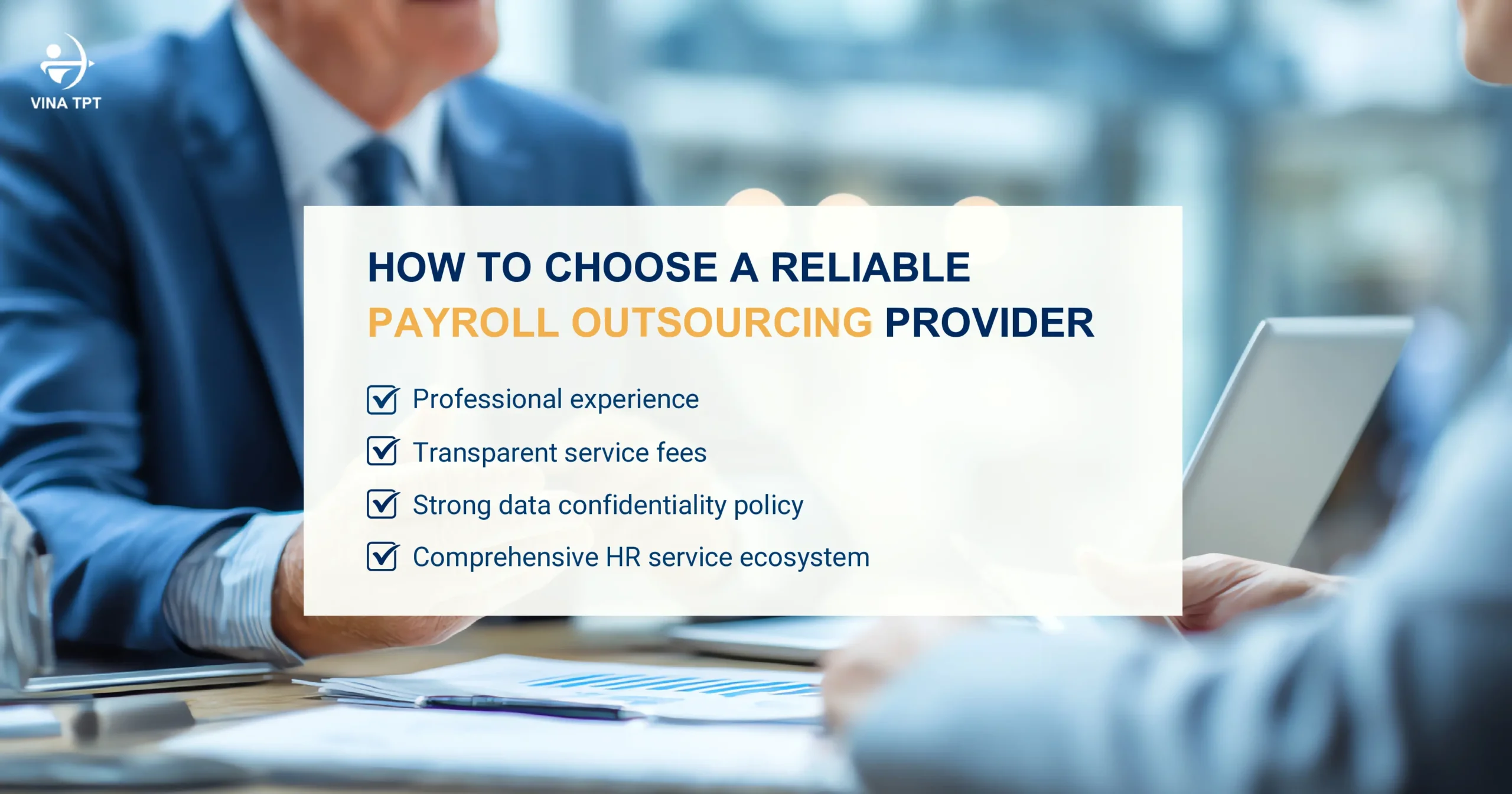
Below are four key criteria businesses should consider when selecting a payroll service partner.

4.1. Experience and professional capability

A reliable provider of payroll outsourcing services is usually reflected through the following factors:

  • Proven track record and successful client base: Providers with many years of experience generally have a solid understanding of labor law, tax, and insurance regulations, and are better equipped to handle practical issues flexibly. Long operating history and a strong client portfolio are two important indicators when assessing a provider’s capability and reliability.

  • A clear payroll management system: Payroll statements should have a transparent structure, be easy to review, and be managed through a suitable payroll system. Components such as salaries, bonuses, allowances, and employee benefits should be clearly defined to ensure both accuracy and transparency.

  • An experienced team of specialists: A service provider should have specialists who understand labor law and taxation in depth. In particular, experience working with FDI enterprises is a significant advantage, because such specialists not only understand Vietnam’s legal environment but are also familiar with the working practices of international businesses. This helps ensure effective implementation and timely updates on legal changes.

4.2. Transparent and reasonable service fees

Service fees often reflect the professionalism of payroll outsourcing services. If the fees are too high, the enterprise may bear unnecessary operating costs. On the other hand, fees that are too low may indicate risks in service quality or a lack of transparency in the service agreement.

A professional provider typically offers a clear and transparent pricing structure that corresponds to the scope of services delivered. Therefore, businesses should prioritize providers that offer transparent quotations, clearly drafted service contracts, and specific commitments regarding the scope of work.

4.3. Data confidentiality policy

Payroll involves sensitive data relating to both the enterprise and its employees, including:

  • Employees’ personal information
  • Salary details and employee benefits
  • Personal income tax and insurance data

For this reason, a payroll outsourcing services provider must have a clear confidentiality policy and a secure data management system to ensure that such information is protected throughout the cooperation period.

Businesses should also prioritize providers that maintain strict data control procedures and include confidentiality commitments in the service contract.

4.4. A comprehensive HR service ecosystem

In practice, FDI enterprises often have broader HR administration and labor compliance needs beyond payroll management alone. Therefore, choosing a payroll service provider with a comprehensive HR service ecosystem can bring substantial benefits.

Additional services commonly provided alongside payroll outsourcing services may include:

  • Support for visas and work permits for foreign experts
  • Consulting on HR policies and employee benefits
  • Support for personal income tax finalization and periodic labor reporting

This allows businesses to simplify HR administration, optimize operating costs, and maintain better legal compliance.
payroll-outsourcing-services-in-vietnam-benefits-for-fdi-enterprises-and-how-to-choose-a-reliable-provider

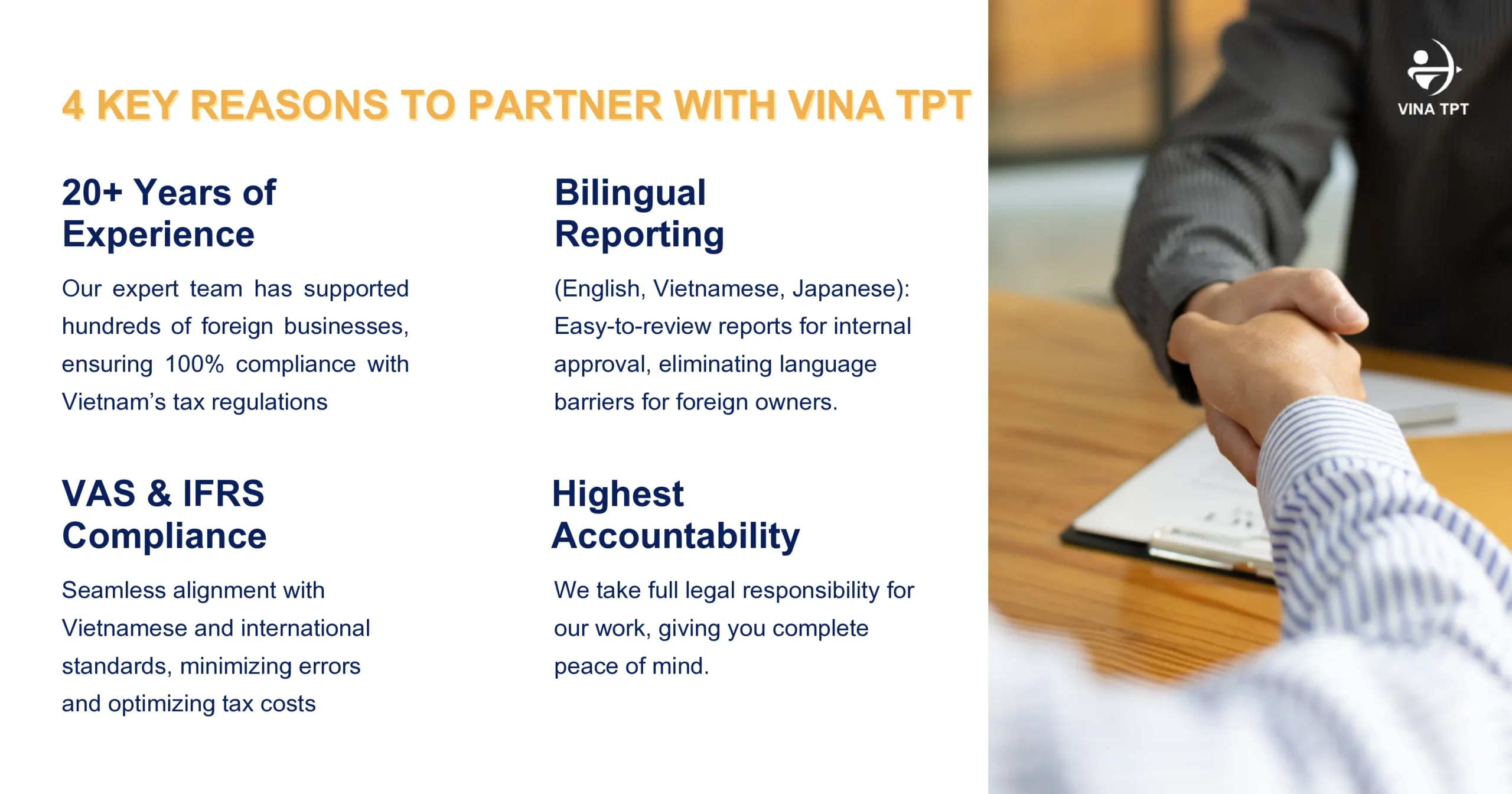
5. Why is Vina TPT a leading payroll outsourcing services partner for FDI enterprises?

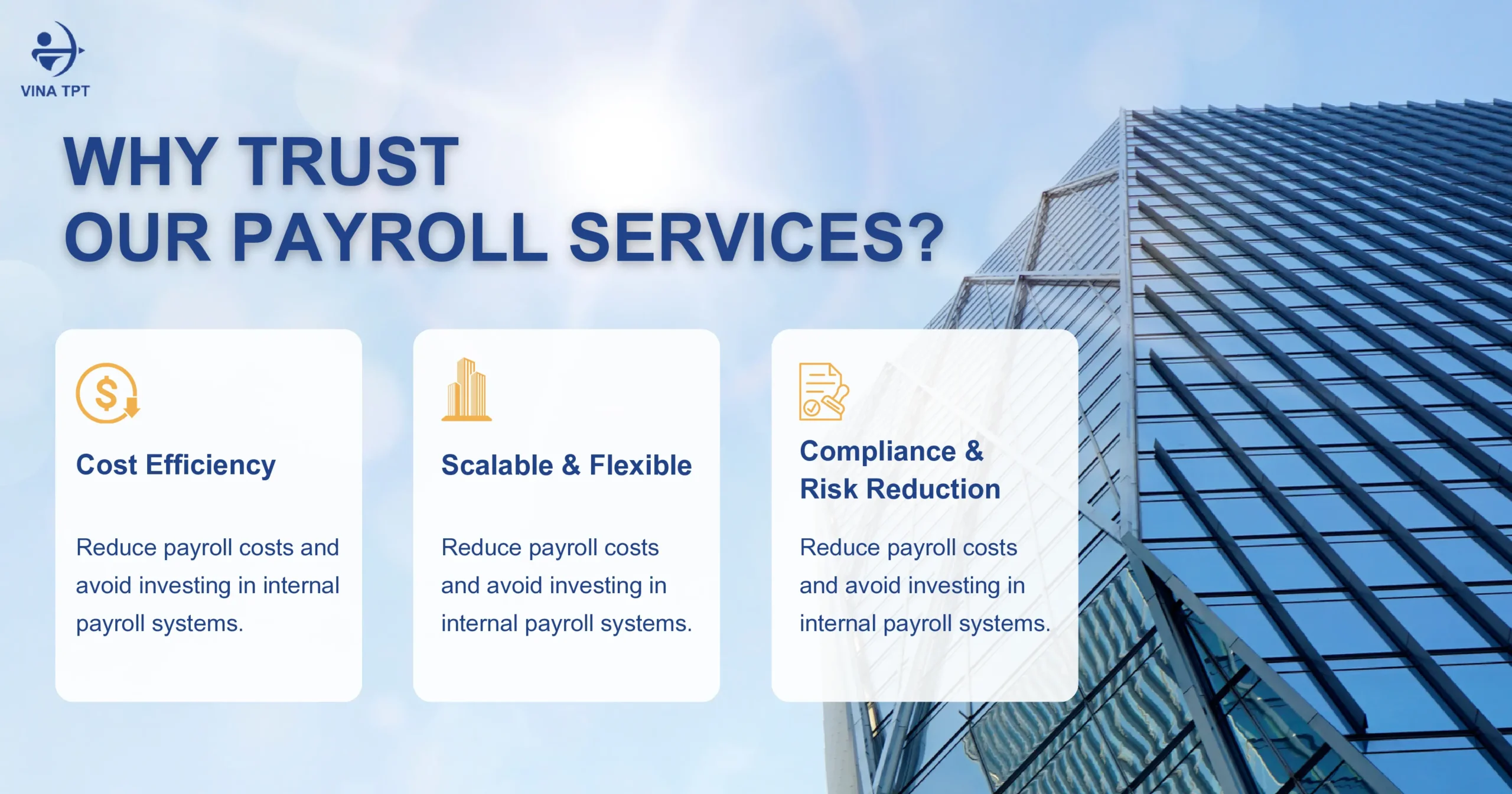
Based on the provider selection criteria outlined above, Vina TPT not only meets the required standards of expertise, experience, and data security, but also brings added value to businesses.

With more than 20 years of experience in business consulting, HR, and accounting services, Vina TPT has supported thousands of domestic and foreign enterprises in establishing and operating in Vietnam. Notably, more than 80% of Vina TPT’s clients are Japanese enterprises, a group of investors well known for their high standards in accuracy, process discipline, and compliance.

In addition, Vina TPT is currently supporting many international enterprises from Germany, Taiwan, the United States, the United Kingdom, Russia, Canada, Australia, Singapore, and many other countries, helping them build payroll systems that are transparent, accurate, and aligned with Vietnamese law.

Thanks to its practical experience and a team of specialists with strong knowledge of labor law and tax regulations, Vina TPT provides effective payroll services in Vietnam, helping enterprises optimize payroll administration, minimize compliance risks, and allocate more resources to core business operations.

payroll-outsourcing-services-in-vietnam-benefits-for-fdi-enterprises-and-how-to-choose-a-reliable-provider

BOOK A FREE CONSULTATION

Overview of Vietnam public holidays for Employees in 2026

Vietnam public holidays in 2026: updated holiday schedule, paid leave rules, and key labor law considerations for employers and employees

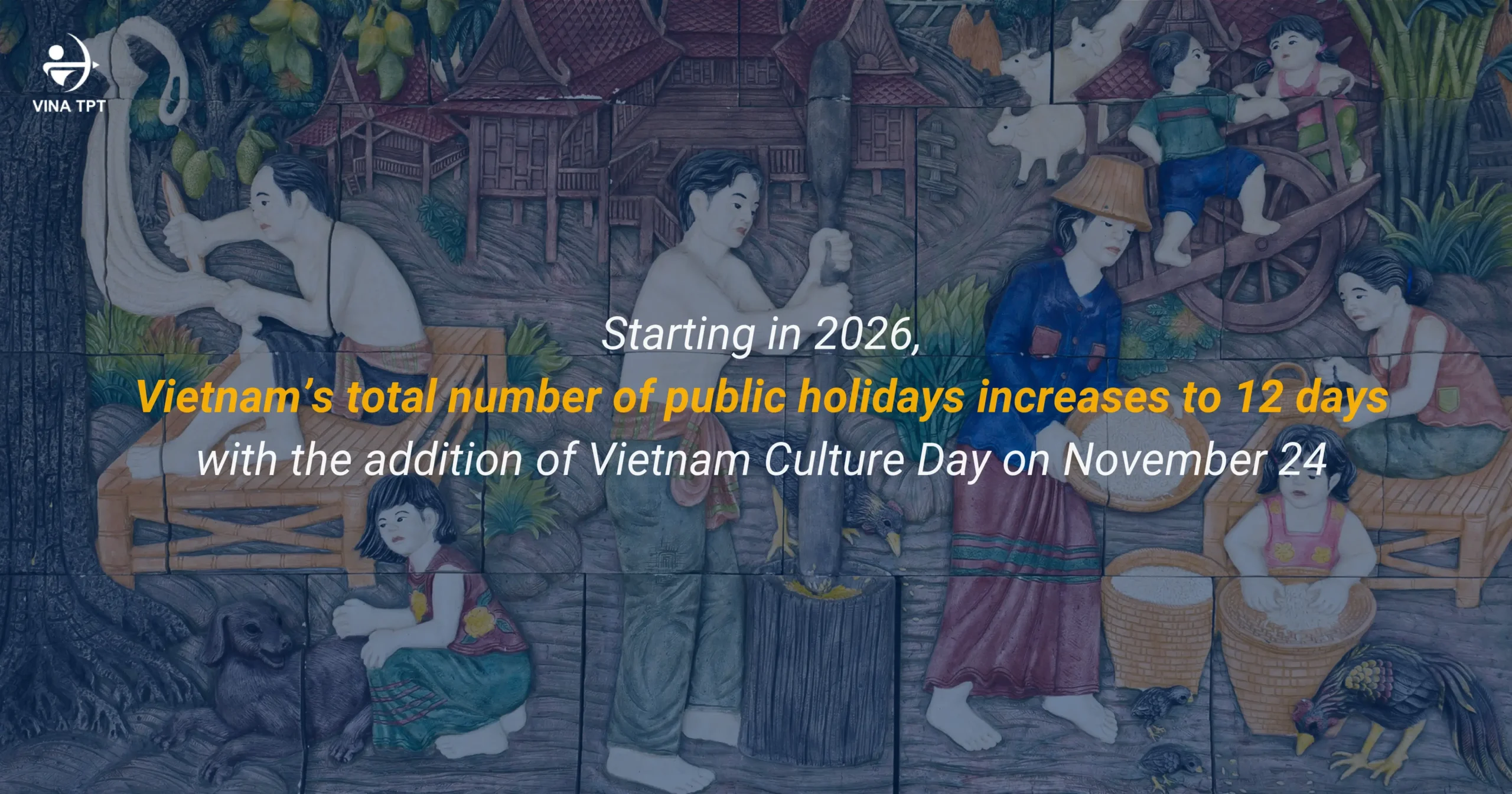
Starting from 2026, employees in Vietnam may be entitled to 12 Vietnam public holidays with paid leave each year, an increase of one day compared to previous regulations. These changes in Vietnam public holidays not only affect employees’ holiday plans but also directly impact human resource management and operational costs for businesses, particularly foreign-invested enterprises (FDIs).

The article below provides a comprehensive overview of Vietnam public holidays in 2026 and highlights important regulations that companies should consider when managing their workforce.

overview-of-vietnam-public-holidays-for-employees-in-2026

1. Latest regulations and updates on Vietnam public holidays

Under the Labor Code 2019, employees in Vietnam are entitled to days off with full salary during Vietnam public holidays as prescribed by the State. This is a mandatory benefit applicable to all employees working under labor contracts.

If a Vietnam public holiday coincides with a weekly day off, employees are entitled to a substitute day off on the following working day.

Previously, the system of Vietnam public holidays included 11 paid days off per year, including:

  • New Year’s Day: 1 day (January 1)
  • Lunar New Year (Tet): 5 days
  • Hung Kings’ Commemoration Day: 1 day (10th day of the 3rd lunar month)
  • Reunification Day: 1 day (April 30)
  • International Labor Day: 1 day (May 1)
  • National Day: 2 days (September 2 and one adjacent day)

However, on March 3, 2026, the Politburo approved Resolution No. 80-NQ/TW on the development of Vietnamese culture, officially designating November 24 each year as “Vietnam Culture Day.” This day is expected to become an official holiday to encourage cultural activities and improve the spiritual life of citizens.

For foreign employees working in Vietnam, in addition to the above Vietnam public holidays, they are entitled to two additional days off:

  • 1 traditional holiday of their home country
  • 1 national day of their home country

Both days are granted as paid leave under their labor contracts.

overview-of-vietnam-public-holidays-for-employees-in-2026

2. List of Vietnam public holidays in 2026

Based on the Labor Code and the tentative holiday schedule announced by the government, Vietnam public holidays in 2026 may include the following periods:

Holiday Date Total Days Off Notes
New Year Holiday From Jan 1 to Jan 4, 2026 4 days Including weekend days
Lunar New Year (Tet) From Feb 14 to Feb 22, 2026 9 days Including weekends
Hung Kings’ Commemoration Day Apr 26, 2026 1 day Substitute holiday on Apr 27, 2026
Reunification Day & Labor Day From Apr 30 to May 3, 2026 4 days Including weekend days
Vietnam National Day From Aug 29 to Sep 2, 2026 5 days Including weekend days
Vietnam Culture Day (new) Nov 24, 2026 1 day Official paid holiday

3. Other paid leave regimes besides Vietnam public holidays

In addition to Vietnam public holidays, employees are also entitled to other paid leave regimes under the Labor Code. These include annual leave, maternity leave, and several other special leave cases.

3.1 Annual paid leave in Vietnam

Under the Labor Code, employees who work for the same employer for 12 months are entitled to annual paid leave as follows:

  • 12 days for employees working under normal conditions
  • 14 days for minors, employees with disabilities, or those working in hazardous conditions
  • 16 days for employees performing extremely hazardous or dangerous work

Other important provisions include:

  • Employees who have not completed 12 months of service receive leave calculated proportionally based on months worked
  • Employees working for the same company for over 5 years receive one additional leave day per year
  • When terminating a labor contract, employers must compensate employees for unused annual leave days

3.2 Maternity leave and adoption leave

Under Vietnamese labor and social insurance regulations:

  • Female employees are entitled to 6 months of maternity leave
  • In the case of multiple births, an additional 30 days of leave is granted for each additional child starting from the second child
  • Female employees with children under 12 months old are entitled to 60 minutes of paid break per working day for childcare

3.3 Paternity leave

Male employees participating in social insurance are entitled to paternity leave within 30 days after childbirth, including:

  • 5 days for natural birth
  • 7 days for cesarean delivery
  • 10-14 days in cases of multiple births

EXPLORE OUR SERVICES

4. Recommendations for FDI enterprises regarding Vietnam Public Holidays

For foreign-invested enterprises, managing Vietnam public holidays is not merely about scheduling time off. It also directly affects payroll obligations, overtime costs, and compliance with Vietnamese labor regulations. Mistakes in calculating holiday pay or arranging substitute leave may lead to labor disputes or compliance risks during inspections.

Therefore, companies should standardize HR processes from the early stage of building their HR system, including:

  • Establishing mechanisms to calculate holiday pay and other paid leave in compliance with regulations
  • Controlling overtime costs during major holidays such as Tet
  • Managing additional holiday entitlements for foreign employees
  • Regularly updating regulatory changes related to Vietnam public holidays

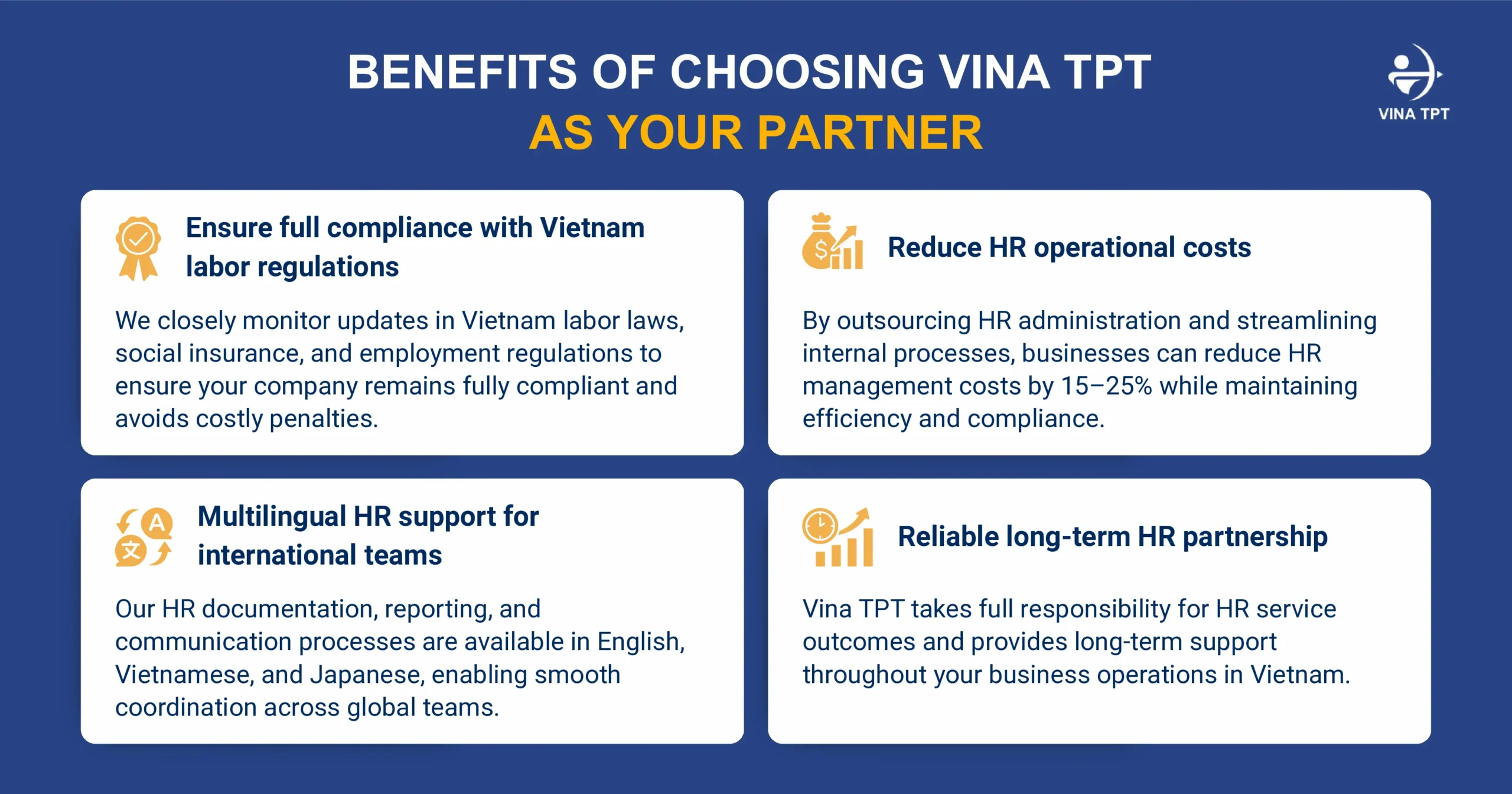
For FDI enterprises operating in Vietnam, working with a knowledgeable HR consultant who understands local labor laws can help build a transparent payroll system, reduce compliance risks, and optimize long-term operational costs.

At Vina TPT, our team of HR and legal experts supports businesses in establishing structured systems for holiday management, payroll processing, and labor law compliance. Vina TPT currently provides HR and legal consulting services for many FDI companies operating in Vietnam. Standardizing HR processes from the beginning helps businesses minimize legal risks and focus on sustainable growth strategies in the Vietnamese market.

overview-of-vietnam-public-holidays-for-employees-in-2026

BOOK A FREE CONSULTATION

Personal Income Tax 2026: Key Changes Directly Affecting Employees

personal-income-tax-2026-key-changes-directly-affecting-employees

On December 10, 2025, following the National Assembly’s approval of the Personal Income Tax 2026 Law, several significant changes were introduced regarding the progressive tax schedule, personal and dependent deductions, and the scope of taxable income. These revisions may directly affect the personal income tax obligations of employees and foreign experts working in Vietnam.

The article below highlights the key updates and provides guidance on how to calculate personal income tax in accordance with the regulations applicable from 2026.

personal-income-tax-2026-key-changes-directly-affecting-employees

1. When does the Personal Income Tax Law 2026 take effect?

The amended Personal Income Tax Law 2025 (Law No. 109/2025/QH15), passed by the National Assembly, will officially take effect from July 1, 2026, replacing the 2007 Personal Income Tax Law.

However, for income derived from salaries and wages, important provisions such as the progressive tax schedule and personal deduction levels will apply to the 2026 tax year (from January 1, 2026). This means they will apply to the entire income generated during the year when conducting tax filing and finalization.

2. Key changes under Personal Income Tax 2026

2.1. Reduction of the progressive tax brackets from 7 to 5 levels

The reduction of tax brackets simplifies the calculation of personal income tax and makes it more transparent and easier to apply. This is one of the most notable reforms under Personal Income Tax 2026, aiming to streamline the tax system.

New progressive tax schedule (applicable from the 2026 tax year – from January 1, 2026):

Tax Bracket

Monthly Taxable Income (VND million) Tax Rate (%)

1

Up to 10

5%

2

Over 10 – 30

10%

3

Over 30 – 60

20%

4

Over 60 – 100

30%

5 Over 100

35%

The highest tax rate remains 35%, applied to the portion of taxable income exceeding VND 100 million per month. This adjustment maintains the progressive nature of personal income tax without placing excessive pressure on middle-income earners.

2.2. Significant increase in personal and dependent deductions

Another major change under Personal Income Tax 2026 is the increase in deduction levels for taxpayers and their dependents. According to Article 29(2) of the 2025 amended law, the new deduction levels apply from the 2026 tax year (January 1, 2026):

  • Personal deduction: increased to VND 15.5 million/month (VND 186 million/year), compared to the previous VND 11 million/month.
  • Dependent deduction: increased to VND 6.2 million/month per dependent.

The increase significantly reduces the payable personal income tax for employees with families. When conducting tax filing (kê khai thuế), taxpayers must register their dependents within the prescribed timeline to benefit from these deductions.

2.3. Updated scope of taxable income in the digital economy

The amended law clarifies the scope of taxable and non-taxable income, particularly in the context of the digital economy, freelance work, and multiple income streams. Income generated from digital platforms and online business activities remains subject to personal income tax under general principles.

Taxable income includes:

  • Salaries and wages and wage-related income
  • Remuneration, bonuses, and benefits in cash or in kind
  • Allowances, subsidies, and other income, except for those exempted under regulations

Non-taxable income includes:

  • Allowances for war veterans and national defense/security
  • Hazardous and remote-area allowances
  • Social insurance benefits, occupational accident and disease allowances
  • Severance pay, maternity benefits, adoption allowances
  • Social protection allowances and other government-regulated exemptions

personal-income-tax-2026-key-changes-directly-affecting-employees

3. Increased revenue threshold for household and individual businesses to 500.000.000 VND per year

Under Article 7(1) of the 2025 amended law, resident individuals engaged in business activities with annual revenue of 500.000.000 VND or less are not subject to personal income tax.

Accordingly, from the 2026 tax year, the revenue threshold for personal income tax applicable to household and individual businesses increases to 500.000.000 VND per year, five times higher than the previous VND 100 million threshold applied in 2025.

This adjustment reduces the tax burden on small businesses, increases disposable income, and encourages transparent business operations. It also reflects a broader tax reform trend aimed at supporting sustainable development of the household business sector.

EXPLORE OUR SERVICES

4. How to calculate Personal Income Tax 2026 under the new tax schedule

4.1. Formula for calculating personal income tax in 2026

Personal income tax payable = Taxable income × Applicable progressive tax rate

Where:

Taxable income = Total taxable income − Deductions − Mandatory insurance contributions

Deductions include:

  • Personal deduction: VND 15.500.000 VND/month
  • Dependent deduction: VND 6.200.000 VND/month per dependent
  • Mandatory insurance contributions (social insurance, health insurance, unemployment insurance) and other allowable deductions

The remaining taxable income is then subject to the 5-tier progressive tax schedule. Each portion of income falling within a bracket is taxed at the corresponding rate rather than applying a single rate to the entire income.

4.2. Example of personal income tax calculation

Example: Mr. B earns VND 60.000.000 VND per month and contributes mandatory insurance as follows:

  • Social insurance: 8%
  • Health insurance: 1.5%
  • Unemployment insurance: 1%

He has two dependents and no charitable contributions or additional deductions.

Step 1: Total taxable income
= 60.000.000 VND

Step 2: Total deductions

  • Personal deduction: 15.500.000 VND
  • Dependent deduction: 6.200.000 × 2 = 12.400.000 VND
  • Mandatory insurance: 60.000.000 × (8% + 1.5% + 1%) = 5.757.000 VND

→ Total deductions = 15.500.000 + 12.400.000 + 5.757.000 = 33.657.000 VND

Step 3: Taxable income
= 60.000.000 − 33.657.000 = 26.343.000 VND

Step 4: Apply progressive tax rates

  • First 10.000.000 × 5% = 500.000 VND
  • Remaining 16.343.000 × 10% = 1.634.000 VND

→ Total monthly personal income tax payable: approximately 2.134.000 VND

To understand the calculation method and see a practical example, you can read our detailed guide on How to Calculate Personal Income Tax 2026 in Vietnam.

5. Important notes when applying personal income tax 2026

Employees must accurately determine the timing of income generation to apply the correct tax period and deduction levels. Income arising from 2026 onward will fully apply the revised provisions of Personal Income Tax 2026, including cases where salary payments are made late.

In addition, registering dependents in a timely and complete manner remains a mandatory condition to benefit from deduction policies. Failure to register on time may result in higher temporary withholding during the year, with adjustments or refunds processed during annual tax finalization and tax filing procedures.

To stay updated on the latest developments regarding personal income tax, tax policies, and HR-related regulations, please follow the Events & Insights section of Vina TPT.

BOOK A FREE CONSULTATION

How to Start a Business in Vietnam: Consulting Sector Guide

how-to-start-a-business-in-vietnam-consulting-sector-guide

Vietnam’s business landscape has been expanding rapidly as the government places increasing emphasis on developing the private sector. Today, private enterprises account for around 50% of the country’s GDP and employ more than 80% of the national workforce, with over 940,000 registered businesses currently operating nationwide. 

As this entrepreneurial ecosystem continues to grow, many companies face challenges in areas such as management, marketing strategy, business development, and digital transformation. As a result, professional consulting services are becoming increasingly important for businesses seeking to improve competitiveness and navigate Vietnam’s evolving market environment.

If you are considering establishing a consulting company in Vietnam, understanding the legal framework and business registration process is an essential first step

how-to-start-a-business-in-vietnam-consulting-sector-guide 

1. Is consulting a conditional business line?

Under the Investment Law 2025 (effective from January 3, 2026), most common consulting services, such as management consulting, business consulting, marketing consulting, human resources consulting, and strategy consulting are not classified as conditional business lines.

This allows foreign investors to establish a 100% foreign-owned enterprise without requiring a Vietnamese partner and without applying for additional sub-licenses after obtaining the IRC and ERC. This is a significant advantage compared to sectors included in the restricted market access list.

However, for certain specialized consulting sectors, how to start a business will be more complex because additional industry-specific conditions must be satisfied. In such cases, the enterprise must comply with requirements relating to professional practicing certificates, capacity conditions, or separate licenses in accordance with regulations of the relevant ministries.

Therefore, before initiating procedures, investors should review Decree 31/2021/ND-CP and Decree 239/2025/ND-CP to determine whether the intended business line falls under the conditional category, thereby ensuring that they start a consulting business in Vietnam in the right direction and minimize the risk of dossier amendments.

2. Key consulting services currently in demand in Vietnam

In Vietnam, several consulting sectors are attracting the attention of foreign investors who are determining how to start a business at an early stage, including:

  • Management consulting: Including strategic planning, corporate restructuring, operational optimization, and performance management.
  • Technology and software consulting: Associated with digital transformation, IT system advisory, software solutions, automation, and data management.
  • Marketing consulting: Including brand building, market research, communications, and digital advertising. This group of business support services has been committed to market opening by Vietnam under WTO agreements and does not require a separate sub-license.
  • Tourism and service development consulting: Consulting on product development strategies, destination management, and tourism service operations. For each service group, how to start a business may differ in terms of operational scope and personnel requirements.
  • Healthcare management consulting: Primarily focusing on hospital management, service development strategies, and optimization of healthcare systems. If the enterprise provides medical examination and treatment services or specialized medical practice, it will be subject to conditions under the Law on Medical Examination and Treatment.

In general, strategic and business-support consulting services enjoy a high level of openness to foreign investors, while services directly related to technical expertise or specialized professional practice are subject to stricter conditions.

Explore Our Services

3. Conditions for establishing a consulting company in Vietnam for foreign investors

When establishing a foreign-invested consulting company in Vietnam, investors must meet several basic conditions relating to capital, office location, and management structure. 

3.1 Capital and financial capacity requirements

Although the Enterprise Law 2025 does not set a minimum charter capital for consulting companies, the Department of Finance will review the registered capital to ensure it is appropriate for the company’s operational scale, business plan, and proposed services.

In practice:

  • Charter capital of approximately USD 20,000-50,000 is generally considered appropriate for a professional consulting model with stable personnel and office operations.
  • For smaller-scale models with a limited service scope, charter capital in the range of USD 10,000 may still be accepted if the business plan clearly demonstrates reasonable and low initial investment costs.

Determining an appropriate capital level not only serves dossier appraisal requirements but also creates a financial foundation for operations in the early stage, especially when the enterprise is exploring how to start a business and has not yet generated stable revenue.

3.2 Office location requirements

When a foreign enterprise determines how to start a business in Vietnam, the head office location is a mandatory and important requirement. The location must:

  • Be permitted for use as an office or commercial premises;
  • Not be a residential apartment used solely for housing or a property without business function;
  • Have legal documentation proving the lawful right of use by the lessor.

Choosing an appropriate office location directly affects the validity of the dossier in the process of how to start a business.

If the enterprise has not yet secured a suitable location, Vina TPT provides consultation on virtual office solutions that satisfy enterprise registration conditions in accordance with legal regulations.

The use of a virtual office is a flexible solution in the early stage of how to start a business and is fully acceptable provided that:

  • The address is not located in a residential apartment building or a prohibited business registration area;
  • It is capable of receiving correspondence and official documents from state authorities;
  • The lessor has sufficient documentation proving lawful leasing rights;
  • The building is designated for “office” or “commercial – service” functions.

This solution helps enterprises optimize initial costs while still ensuring legal conditions for obtaining the Investment Registration Certificate (IRC) and the Enterprise Registration Certificate (ERC).

3.3 Legal representative requirements

Another important aspect in how to start a business is the appointment of a legal representative.

A foreign-invested consulting company must have at least one legal representative residing in Vietnam. The legal representative may be a foreign investor lawfully residing in Vietnam, or another individual (a Vietnamese citizen or a foreigner with valid residence documents) appointed by the enterprise.

This person is responsible for:

  • Organizing and managing company operations;
  • Fulfilling tax and financial reporting obligations;
  • Registering labor and social insurance;
  • Working with state authorities in administrative procedures.

Appointing a legal representative residing in Vietnam is a mandatory requirement and plays an important role in ensuring continuity in corporate governance and legal compliance. Lack of appropriate personnel preparation may cause difficulties in how to start a business, particularly when planning to start a consulting business in Vietnam with a foreign management team.

how-to-start-a-business-in-vietnam-consulting-sector-guide

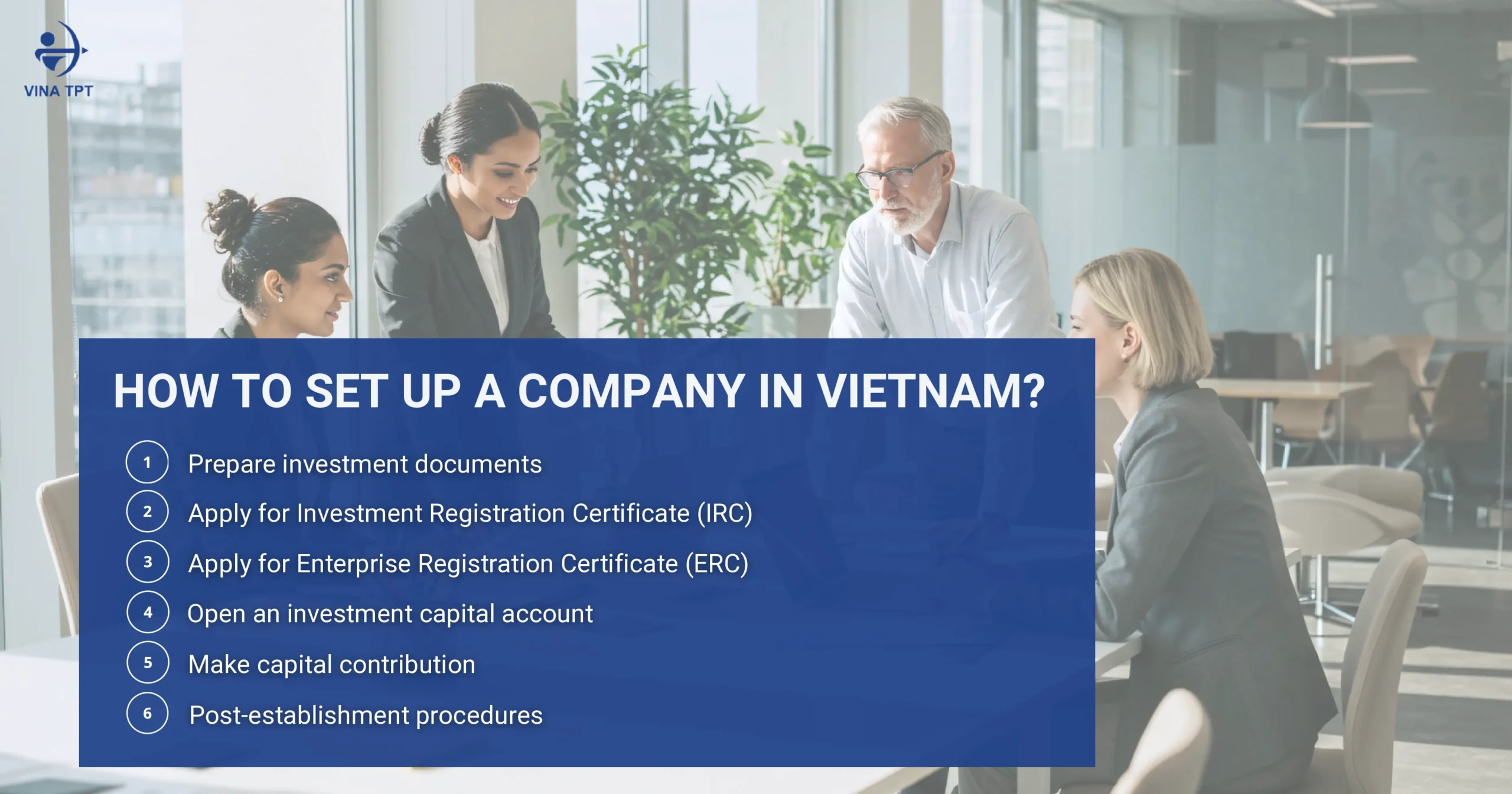
4. How to start a business in Vietnam for a consulting company – detailed step-by-step procedures

For the consulting sector, how to start a business generally includes the following steps:

Step 1: Prepare the application dossier for the Investment Registration Certificate (IRC)

Under the Investment Law 2025, investors are required to prepare:

  • A written request for implementation of the investment project;
  • Legal documents of the investor (passport for individuals; business registration certificate for organizations);
  • Investment project proposal (objectives of providing consulting services, scale, capital, location, duration of operation);
  • Documents proving financial capacity;
  • Office lease agreement or documents proving the lawful right to use the project location;
  • Technology explanation (if the project involves technology subject to appraisal).

The dossier is submitted to the competent investment registration authority in the province/city where the head office is located.

Note: Foreign documents must undergo consular legalization and be translated into Vietnamese.

Step 2: Obtain the Investment Registration Certificate (IRC)

The IRC records basic information of the consulting project, including:

  • The investor;
  • The registered consulting service business lines;
  • Investment capital and charter capital;
  • Location and duration of operation.

For standard consulting services (not classified as conditional business lines), this procedure mainly focuses on the validity of the dossier and financial capacity.

Step 3: Register the enterprise and obtain the Enterprise Registration Certificate (ERC)

After obtaining the IRC, the enterprise proceeds with company registration under the Enterprise Law 2025 to receive the Enterprise Registration Certificate (ERC).

The ERC establishes the company’s legal entity status and records:

  • The name of the consulting company;
  • Head office address;
  • Legal representative;
  • Charter capital;
  • Business lines (corresponding consulting service codes).

Step 4: Open an investment capital account and contribute capital

Immediately after obtaining the ERC, the enterprise must open a dedicated investment capital account at a bank licensed to operate in Vietnam.

The full charter capital must be contributed within 90 days from the ERC issuance date to avoid administrative penalties and ensure compliance of the enterprise.

Step 5: Complete post-establishment procedures

Before commencing operations, the consulting company must:

  • Complete initial tax registration and register for electronic invoices;
  • Purchase a digital signature;
  • Register labor and social insurance (if employees are hired).

After licensing, tax procedures and capital contribution complete the overall picture of how to start a business in Vietnam; from a practical perspective, this is the “final sprint” of the business registration process in Vietnam that many enterprises tend to underestimate.

Step 6: Obtain sector-specific licenses (if operating in conditional consulting sectors)

If the company provides consulting services in specialized sectors such as construction consulting, legal consulting, securities investment consulting, etc., the enterprise must satisfy additional requirements relating to practicing certificates or professional licenses under the corresponding specialized laws.

Complying with the correct sequence helps ensure that how to start a business proceeds smoothly and minimizes dossier amendments, especially when planning to start a consulting business in Vietnam in sectors requiring specialized expertise.

how-to-start-a-business-in-vietnam-consulting-sector-guide

5. Common mistakes when opening a consulting company in Vietnam

Many investors fail not because the market is difficult, but because they do not properly understand how to start a business. Below are common mistakes foreign investors often make when establishing a consulting company in Vietnam:

Mistake 1: Choosing an inappropriate enterprise structure

Many investors choose an enterprise structure based on habits in their home country without evaluating governance needs and capital mobilization capacity in Vietnam. An unsuitable choice (single-member LLC, multi-member LLC, joint stock company) may misalign with how to start a business, creating limitations in ownership structure, capital transfer, or future fundraising, and may even require conversion procedures later.

To avoid costly adjustments, investors should clearly determine growth objectives, number of shareholders/members, and fundraising plans before submitting the dossier.

Mistake 2: Failing to carefully review business line conditions

Registering business lines that fall under restricted market access or conditional sectors without reviewing relevant regulations often results in IRC dossiers being requested for clarification, amendment, or extended processing time.

Failure to thoroughly review business lines poses legal risks in how to start a business with foreign investment.

Investors should review the list of restricted market access sectors, specialized licensing conditions, and operational scope before finalizing project objectives.

Mistake 3: Selecting the wrong CPC code when registering business lines

For foreign-invested enterprises determining how to start a business correctly, in addition to registering Vietnam Standard Industrial Classification (VSIC) codes, investors must also refer to Vietnam’s WTO service commitments schedule, where services are classified under CPC (Central Product Classification) codes.

Common CPC codes in consulting and business services include:

  • Management consulting services – CPC 865
  • Marketing consulting services (marketing management) – CPC 86503
  • HR consulting services – CPC 86504 (management consulting); labor supply services – CPC 872
  • Software consulting services – CPC 842

Incorrect identification of CPC codes may result in:

  • Misapplication of market access conditions;
  • Misunderstanding of foreign ownership limits;
  • Unnecessary requirements for specialized licenses;
  • IRC dossier amendments.

Therefore, properly reviewing CPC codes before submitting the investment dossier is crucial to ensure accurate appraisal and minimize future amendment risks.

Mistake 4: Confusing the IRC and ERC procedures

Foreign-invested enterprises must generally follow the sequence: obtain the IRC (project approval) first, then register the ERC (legal entity establishment).

Confusing these procedures or preparing dossiers in the wrong order may delay implementation plans and lead to amendments.

Investors should build a legal roadmap in stages and prepare documentation corresponding to each certificate type.

Mistake 5: Lack of post-establishment financial and tax planning

Many enterprises focus on licensing but fail to anticipate tax obligations, operating costs, and periodic filing schedules, leading to penalties and operational disruption.

Immediately after establishment, enterprises should set up an accounting system, register e-invoices and digital signatures, and establish monthly/quarterly compliance plans to ensure stable operations.

Mistake 6: Failure to prepare labor and work permit plans

For foreign managers or experts, work permits and lawful residence status are required for long-term employment in Vietnam.

Without prior planning, enterprises may face management time limitations or urgent administrative procedures affecting operations.

Labor planning, work permits, and temporary residence cards should be integrated immediately after completing establishment procedures.

Mistake 7: Lack of understanding of the local business environment and culture

Differences in working styles, administrative procedures, and communication standards may affect negotiations, HR management, and coordination with partners or authorities.

Understanding the local context and establishing appropriate internal processes helps reduce operational friction and improve implementation efficiency from the early stage.

In cases where investors wish to optimize how to start a business and minimize potential risks, engaging professional consulting services can help standardize the entire process.

With over 20 years of experience supporting FDI enterprises in company formation, tax – accounting, and HR services in Vietnam, Vina TPT provides comprehensive consulting and implementation solutions, ensuring compliance with regulations and alignment with long-term investment objectives.

Contact Vina TPT for detailed consultation on how to start a business in line with your business model and investment goals.

how-to-start-a-business-in-vietnam-consulting-sector-guide

BOOK A FREE CONSULTATION

Americans Doing Business in Vietnam (2026): Legal Guidance & Detailed Procedures

americans-doing-business-in-vietnam-2026-legal-guidance-detailed-procedures

In recent years, Vietnam has continued to strengthen its position as a strategic destination for U.S. investors thanks to a stable economic environment, competitive costs, and an extensive network of free trade agreements. However, doing business in Vietnam requires foreign investors to comply with strict legal regulations and tax obligations.

The article below provides detailed guidance on key conditions, procedures, and important legal matters when doing business in Vietnam.

americans-doing-business-in-vietnam-2026-legal-guidance-detailed-procedures

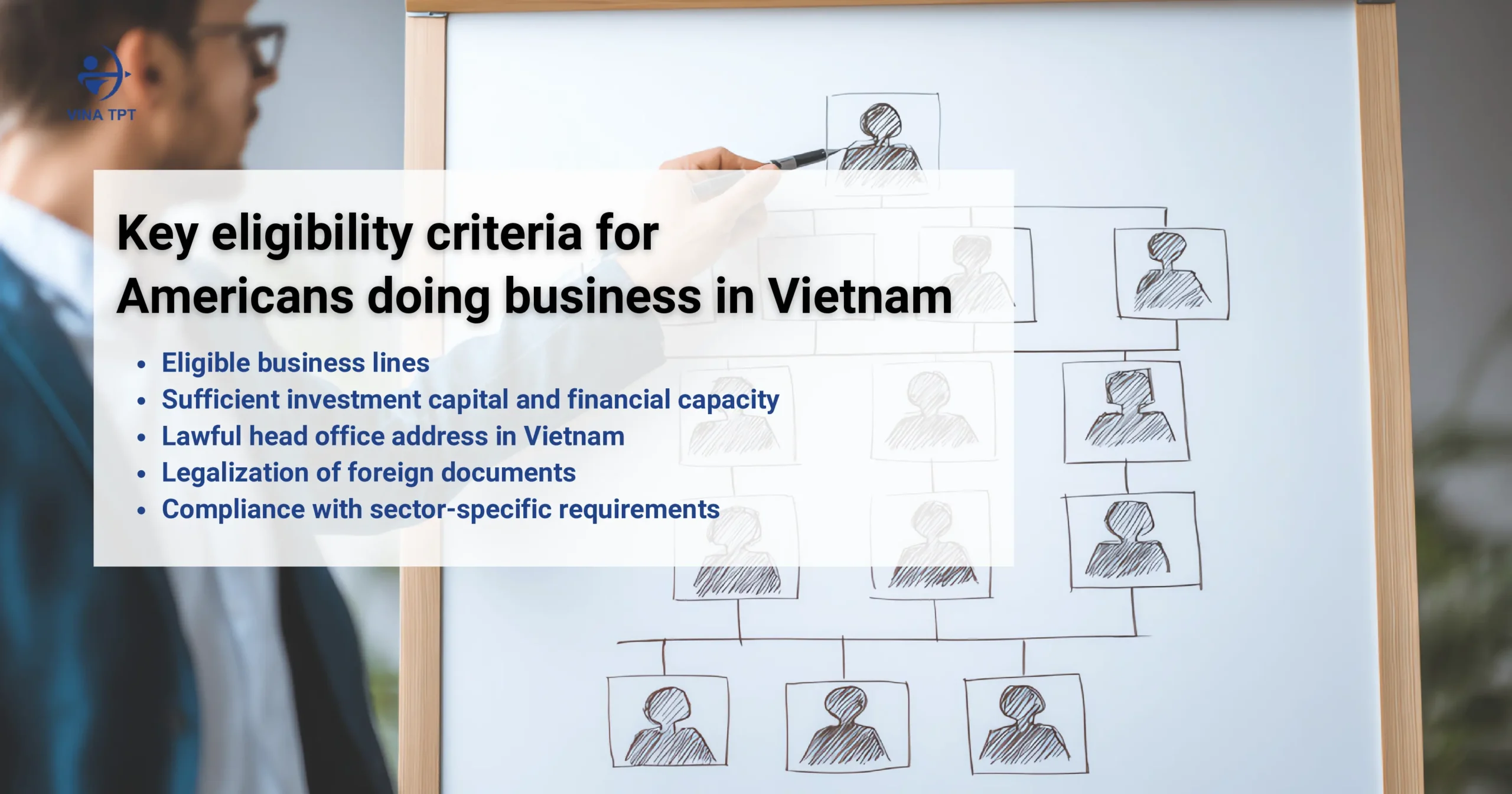
1. What are the conditions for Americans doing business in Vietnam?

Legal eligibility of investment business lines

Before doing a business in Vietnam, investors need to determine whether their intended business activities are permitted for investment. Under the Investment Law 2020, business sectors are classified into several main categories with different levels of accessibility and regulatory conditions.

Typically, investment sectors can be classified into four main groups:

No.

Category Definition

Typical Examples

1 Unconditional business sectors (80% of all sectors) Sectors that are not included in the list of conditional or market-restricted business lines. Businesses only need to complete business registration and comply with general legal regulations (tax, environment, safety, etc.). General manufacturing, wholesale trading, management consulting, IT (software), F&B, certain domestic logistics services…
2 Investment incentive sectors Sectors encouraged by the government. Incentives (such as Corporate Income Tax (CIT) benefits, land rental incentives, etc.) depend on the industry, location, and project scale. High technology, R&D, renewable energy, high-tech agriculture, supporting industries, digital transformation, semiconductors…
3 Conditional business sectors Sectors that are permitted to operate but must meet specific conditions (such as sub-licenses, legal capital, technical standards, or professional certificates). These are regulated under Appendix IV of the Investment Law and its amendments. Education, healthcare, real estate, logistics, food services, transportation, cosmetics manufacturing…
4 Market access restricted sectors for foreign investors Sectors where foreign investors are subject to restrictions on ownership ratio, investment form, or scope of operations. The list is issued by the Government (currently under Decree 31/2021/ND-CP and its amendments). Retail distribution, telecommunications, aviation, advertising, financial services, media…
5 Prohibited business sectors Activities that are strictly prohibited for reasons of national security, social ethics, or public health under Article 6 of the Investment Law. Applicable to both domestic and foreign investors. Drug trafficking, human/organ trafficking, prostitution, explosives, human cloning, trading endangered wildlife…

Note:
The majority of business sectors in Vietnam fall under unconditional sectors (accounting for approximately 80%). However, some industries may simultaneously belong to multiple categories (for example, renewable energy can be both an incentivized sector and a conditional business sector).

To avoid confusion and streamline the licensing process, investors are advised to check the relevant business codes and applicable conditions on the Business Line Code Lookup page before submitting their applications.

Meeting investment capital and financial capacity requirements

Vietnam’s enterprise law does not set a general minimum charter capital when foreign investors do business in Vietnam; however, certain conditional business lines require statutory capital under specialized regulations.

Therefore, the investment registration authority requires investors to demonstrate sufficient financial capacity to implement the project. This is commonly evidenced by:

  • Bank statements of the parent company/investing entity
  • Audited financial statements for the most recent year
  • A financial guarantee letter from a bank

Having a lawful company head office in Vietnam

The company must have a clear and lawful head office address within Vietnam. When doing business in Vietnam, investors need to prove this address with documents such as:

  • A lease agreement for office premises with a valid lease term
  • Documents proving the lessor’s land use/ownership rights, such as a Land Use Right Certificate

The enterprise must record this address on the Enterprise Registration Certificate, as government authorities will send notices and may conduct inspections at this address.

However, if the enterprise has not yet found a suitable office location, using a Virtual Office is also a common solution when doing business in Vietnam, provided that: the virtual office address is not located in a residential apartment building or a prohibited area for business registration; it is able to receive mail and official correspondence from authorities; and the lessor has sufficient documents proving a lawful right to lease.

Within Vina TPT’s Company Setup Services in Vietnam, we provide reputable virtual office solutions suitable for each operating model – helping ensure the dossier is complete from the start and minimizing later amendments.

International legalization of the investor’s legal documents

To do business in Vietnam, investors are required to prepare several legal documents issued in their home country. Common documents include:

  • Passport of the individual investor
  • Business Registration Certificate or Certificate of Incorporation (for corporate investors)
  • Financial documents proving the investor’s financial capacity, if requested by the competent authority
  • Other supporting documents related to the investment project (depending on the specific case)

For these documents to be recognized by the competent authorities in Vietnam, they must undergo a consular legalization process. This process typically includes the following steps:

  • Notarization in the issuing country
  • Consular legalization at the Vietnamese Embassy/Consulate in that country
  • Certified translation into Vietnamese after legalization

Only after completing all of these procedures can the documents be used as part of the investment registration dossier submitted to the competent authorities in Vietnam.

Explore Our Services

Other specific requirements

Depending on the sector, a project for doing business in Vietnam may need to satisfy additional requirements such as:

  • Environmental impact assessment (for projects with potential environmental impacts)
  • Technology solutions and qualified personnel plans
  • Land use plan (if the project requires land allocation/lease from the State)

americans-doing-business-in-vietnam-2026-legal-guidance-detailed-procedures-2

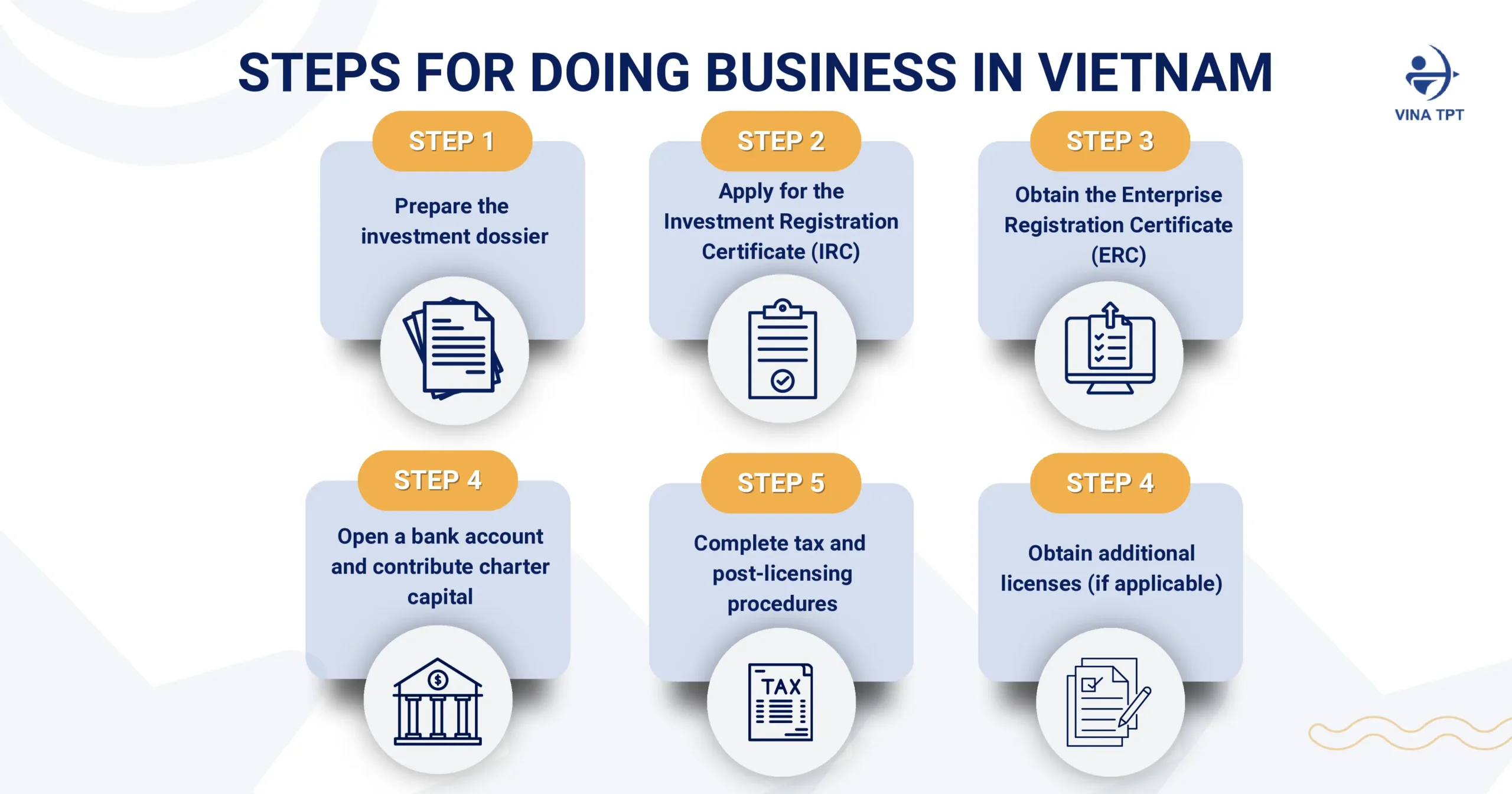
2. Step-by-step procedure for doing business in Vietnam

Doing business in Vietnam with foreign investment requires a clear, structured process to ensure full legal compliance and smooth operations. This step-by-step guide is designed specifically for foreign-invested trading or commercial businesses.

Step 1: Prepare the investment dossier

This is the critical first step in the process of doing business in Vietnam. The dossier must be prepared in accordance with the Investment Law 2025.

  • Written request for implementation of the investment project
  • Documents proving the investor’s legal status:
    • For individuals: Citizen ID/Passport (copy)
    • For organizations: Certificate of incorporation or equivalent legal document (copy)
  • Investment project proposal (including investor information, objectives, investment capital, scale, capital mobilization plan, location, schedule, and socio-economic efficiency assessment)
  • Documents proving financial capacity:
    • Individuals: savings book, bank balance confirmation
    • Organizations: financial statements for the last two years, financial commitment from the parent company or a financial institution
  • Head office lease agreement or documents proving the right to use the project location
  • Technology explanation (for projects subject to technology appraisal)
  • BCC business cooperation contract (if investing under this form)

The dossier is submitted to the Department of Finance in the province/city where the project’s head office is located.

Step 2: Submit the application for the Investment Registration Certificate (IRC)

The IRC is a prerequisite for open new company in Vietnam for foreign investors. The IRC approves the investor’s project and specifies charter capital, scale, location, and business scope. Without an IRC, investors cannot proceed with company registration.

Required documents include:

  • Application form and a detailed project proposal (objectives, scale, investment capital, location, and timeline)
  • Proof of financial capability (bank statements, audited financial reports, or credit agreements)
  • Legal documents: notarized passport (individual) or business registration certificate (organization), both legalized
  • Proof of location (lease agreement or land use rights)
  • Power of attorney (if using a third-party service)

Foreign documents must be consular legalized and officially translated into Vietnamese. The processing time for an IRC application is typically 5-6 weeks , depending on the nature of the project and the review requirements of the investment registration authority. It is recommended to work with a professional service provider such as Vina TPT to avoid delays.

Step 3: Obtain the Enterprise Registration Certificate (ERC)

After the IRC is issued, the next step in doing business in Vietnam is obtaining the ERC to establish the company’s legal entity status. Typically, the ERC is issued within 7-14 days from the submission date.

Step 4: Open a corporate bank account and inject charter capital

Foreign investors who open new company in Vietnam are required to:

  • Open a dedicated investment capital account at a licensed bank in Vietnam
  • Contribute the full charter capital within 90 days from the ERC issuance date to avoid penalties and maintain credibility for future licenses

Step 5: Complete tax registration and post-licensing procedures

Before officially commencing operations, the enterprise must:

  • Register for a tax code and purchase a digital signature
  • Apply for e-invoice issuance/registration
  • Register labor and enroll employees in social insurance

Tax and labor obligations are the final steps in doing business in Vietnam before official operations begin.

Step 6: Apply for sector-specific licenses (if applicable)

Conditional business sectors may require additional sub-licenses such as business licenses, import-export licenses, or environmental permits.

By following these steps and staying updated on regulations, foreign investors can successfully establish operations in Vietnam.

americans-doing-business-in-vietnam-2026-legal-guidance-detailed-procedures

3. Frequently Asked Questions when doing business in Vietnam

Can Americans own 100% of a company in Vietnam?

U.S. investors can fully own up to 100% equity when doing business in Vietnam, except in restricted business lines. Certain conditional sectors such as pharmaceuticals, oil and gas, or printing may impose ownership caps or require a local partner.

How long does the process take?

Doing business in Vietnam for foreign investors typically takes 6-8 weeks (about 1-2 months), depending on the business line, complexity, and the province/city of registration. In particular:

  • The IRC usually takes 30 – 45 working days
  • The ERC takes 7-14 days

What is the minimum capital required to do business in Vietnam?

Under the Enterprise Law 2025, Vietnam does not impose a general minimum capital requirement for enterprises.

However, conditional business lines may require statutory capital (e.g., real estate, banking, insurance, security services). Authorities commonly recommend at least USD 10,000 to demonstrate financial capacity and avoid delays. The exact amount depends on the business plan and scale.

How can a foreigner start doing business in Vietnam?

To officially operate in Vietnam, foreign investors should follow a clear legal roadmap rather than simply registering a company.

In general, the process includes:

  • Obtaining the Investment Registration Certificate (IRC) – recording and approving the investment project
  • Obtaining the Enterprise Registration Certificate (ERC) – establishing the company’s legal entity in Vietnam
  • Completing post-licensing procedures such as opening a corporate bank account and contributing charter capital according to the registered schedule
  • Completing initial tax registration and, if required, applying for a business license or sector-specific licenses before officially operating

In practice, each step has distinct dossier and legal requirements, especially for conditional business lines or special projects. Therefore, preparing correctly from the beginning helps shorten processing time and minimize requests for supplementation.

With extensive experience supporting FDI enterprises throughout establishment and operations, Vina TPT provides end-to-end advisory and implementation services to ensure the process is accurate, transparent, and compliant with current regulations.

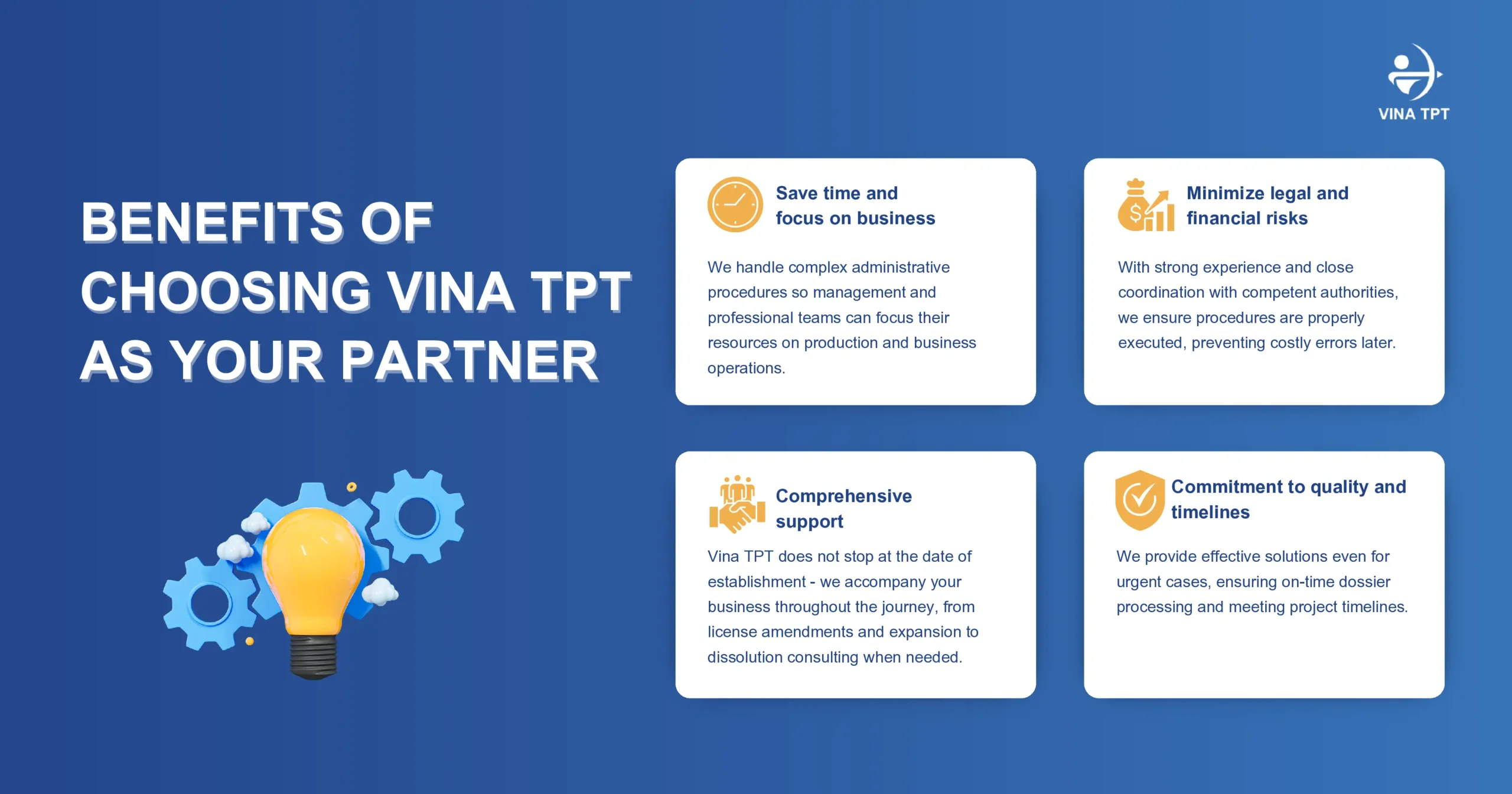
4. Vina TPT solutions for doing business in Vietnam

Vina TPT’s Company Setup Services in Vietnam for foreign investors include:

  • Orientation consulting & planning: Simply share your business plan in Vietnam, and our specialists will advise the most suitable company registration option – while prioritizing investment safety.
  • Business licensing (IRC/ERC): We support the full preparation and submission of IRC and ERC dossiers, ensuring a smooth and compliant establishment process. Estimated timeline: 3-6 weeks.
  • Post-establishment capital contribution: We assist with bank account opening, capital transfer, and online banking/tax payment registration to ensure charter capital contribution is smooth and compliant for your enterprise in Vietnam.
  • Tax registration and filings: Vina TPT continues to support post-establishment procedures such as fiscal year registration, business license tax declaration, e-invoice setup, VAT filings, and preparation of the first quarter financial report – helping the business operate properly from day one.

americans-doing-business-in-vietnam-2026-legal-guidance-detailed-procedures 

Doing business in Vietnam can be complex and requires careful preparation. If investors lack experience and want to focus more on business operations, you should consider professional advisory services such as Vina TPT. We not only understand the law and possess strong expertise, but also have hands-on experience and deep understanding of corporate culture. Contact Vina TPT today for free consultation.

BOOK A FREE CONSULTATION