


In recent years, Vietnam has continued to strengthen its position as a strategic destination for U.S. investors thanks to a stable economic environment, competitive costs, and an extensive network of free trade agreements. However, doing business in Vietnam requires foreign investors to comply with strict legal regulations and tax obligations.
The article below provides detailed guidance on key conditions, procedures, and important legal matters when doing business in Vietnam.
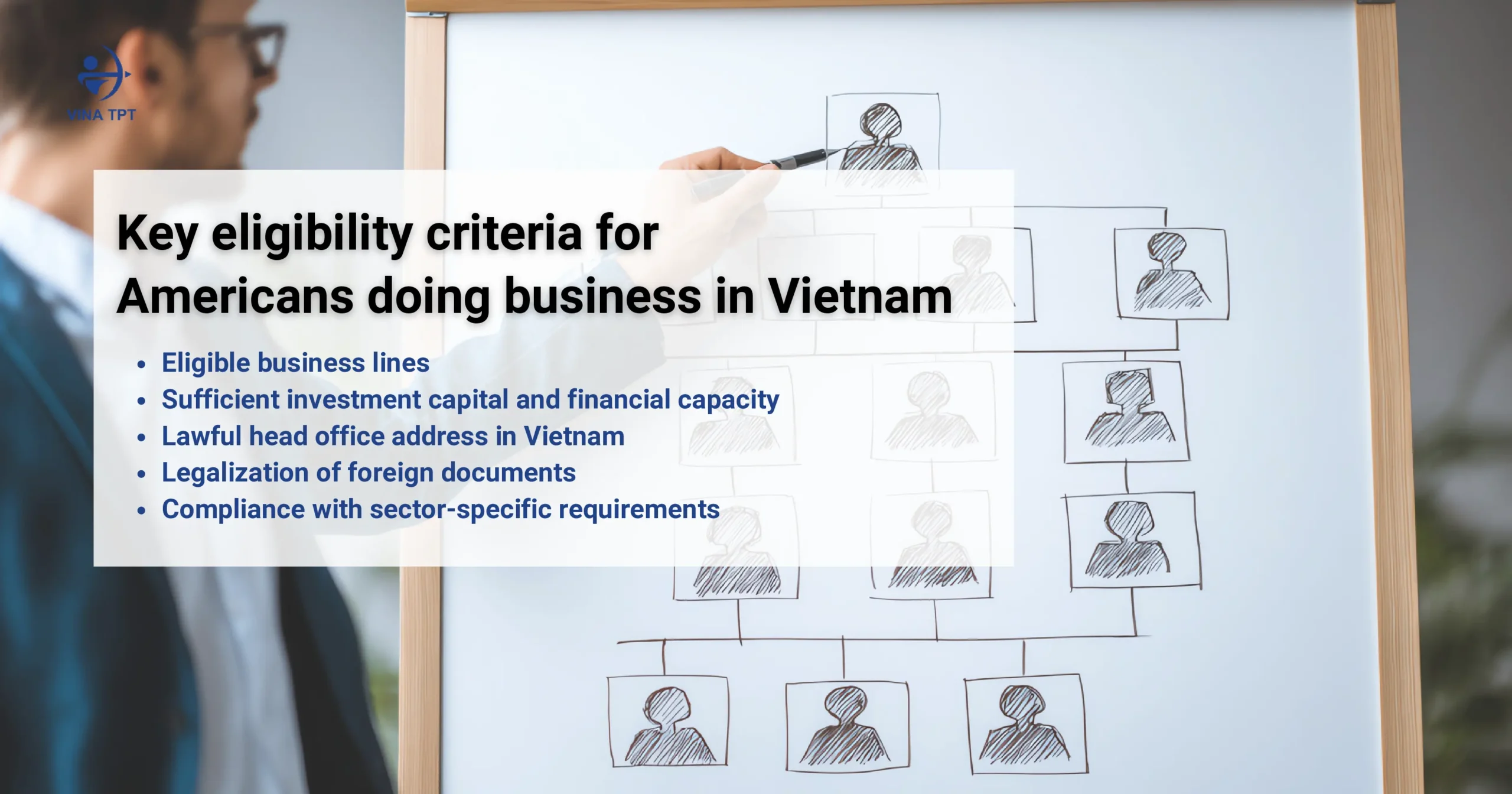
1. What are the conditions for Americans doing business in Vietnam?
Legal eligibility of investment business lines
Before doing a business in Vietnam, investors need to determine whether their intended business activities are permitted for investment. Under the Investment Law 2020, business sectors are classified into several main categories with different levels of accessibility and regulatory conditions.
Typically, investment sectors can be classified into four main groups:
|
No. |
Category | Definition |
Typical Examples |
| 1 | Unconditional business sectors (80% of all sectors) | Sectors that are not included in the list of conditional or market-restricted business lines. Businesses only need to complete business registration and comply with general legal regulations (tax, environment, safety, etc.). | General manufacturing, wholesale trading, management consulting, IT (software), F&B, certain domestic logistics services… |
| 2 | Investment incentive sectors | Sectors encouraged by the government. Incentives (such as Corporate Income Tax (CIT) benefits, land rental incentives, etc.) depend on the industry, location, and project scale. | High technology, R&D, renewable energy, high-tech agriculture, supporting industries, digital transformation, semiconductors… |
| 3 | Conditional business sectors | Sectors that are permitted to operate but must meet specific conditions (such as sub-licenses, legal capital, technical standards, or professional certificates). These are regulated under Appendix IV of the Investment Law and its amendments. | Education, healthcare, real estate, logistics, food services, transportation, cosmetics manufacturing… |
| 4 | Market access restricted sectors for foreign investors | Sectors where foreign investors are subject to restrictions on ownership ratio, investment form, or scope of operations. The list is issued by the Government (currently under Decree 31/2021/ND-CP and its amendments). | Retail distribution, telecommunications, aviation, advertising, financial services, media… |
| 5 | Prohibited business sectors | Activities that are strictly prohibited for reasons of national security, social ethics, or public health under Article 6 of the Investment Law. Applicable to both domestic and foreign investors. | Drug trafficking, human/organ trafficking, prostitution, explosives, human cloning, trading endangered wildlife… |
Note:
The majority of business sectors in Vietnam fall under unconditional sectors (accounting for approximately 80%). However, some industries may simultaneously belong to multiple categories (for example, renewable energy can be both an incentivized sector and a conditional business sector).
To avoid confusion and streamline the licensing process, investors are advised to check the relevant business codes and applicable conditions on the Business Line Code Lookup page before submitting their applications.
Meeting investment capital and financial capacity requirements
Vietnam’s enterprise law does not set a general minimum charter capital when foreign investors do business in Vietnam; however, certain conditional business lines require statutory capital under specialized regulations.
Therefore, the investment registration authority requires investors to demonstrate sufficient financial capacity to implement the project. This is commonly evidenced by:
- Bank statements of the parent company/investing entity
- Audited financial statements for the most recent year
- A financial guarantee letter from a bank
Having a lawful company head office in Vietnam
The company must have a clear and lawful head office address within Vietnam. When doing business in Vietnam, investors need to prove this address with documents such as:
- A lease agreement for office premises with a valid lease term
- Documents proving the lessor’s land use/ownership rights, such as a Land Use Right Certificate
The enterprise must record this address on the Enterprise Registration Certificate, as government authorities will send notices and may conduct inspections at this address.
However, if the enterprise has not yet found a suitable office location, using a Virtual Office is also a common solution when doing business in Vietnam, provided that: the virtual office address is not located in a residential apartment building or a prohibited area for business registration; it is able to receive mail and official correspondence from authorities; and the lessor has sufficient documents proving a lawful right to lease.
Within Vina TPT’s Company Setup Services in Vietnam, we provide reputable virtual office solutions suitable for each operating model – helping ensure the dossier is complete from the start and minimizing later amendments.
International legalization of the investor’s legal documents
To do business in Vietnam, investors are required to prepare several legal documents issued in their home country. Common documents include:
- Passport of the individual investor
- Business Registration Certificate or Certificate of Incorporation (for corporate investors)
- Financial documents proving the investor’s financial capacity, if requested by the competent authority
- Other supporting documents related to the investment project (depending on the specific case)
For these documents to be recognized by the competent authorities in Vietnam, they must undergo a consular legalization process. This process typically includes the following steps:
- Notarization in the issuing country
- Consular legalization at the Vietnamese Embassy/Consulate in that country
- Certified translation into Vietnamese after legalization
Only after completing all of these procedures can the documents be used as part of the investment registration dossier submitted to the competent authorities in Vietnam.
Other specific requirements
Depending on the sector, a project for doing business in Vietnam may need to satisfy additional requirements such as:
- Environmental impact assessment (for projects with potential environmental impacts)
- Technology solutions and qualified personnel plans
- Land use plan (if the project requires land allocation/lease from the State)
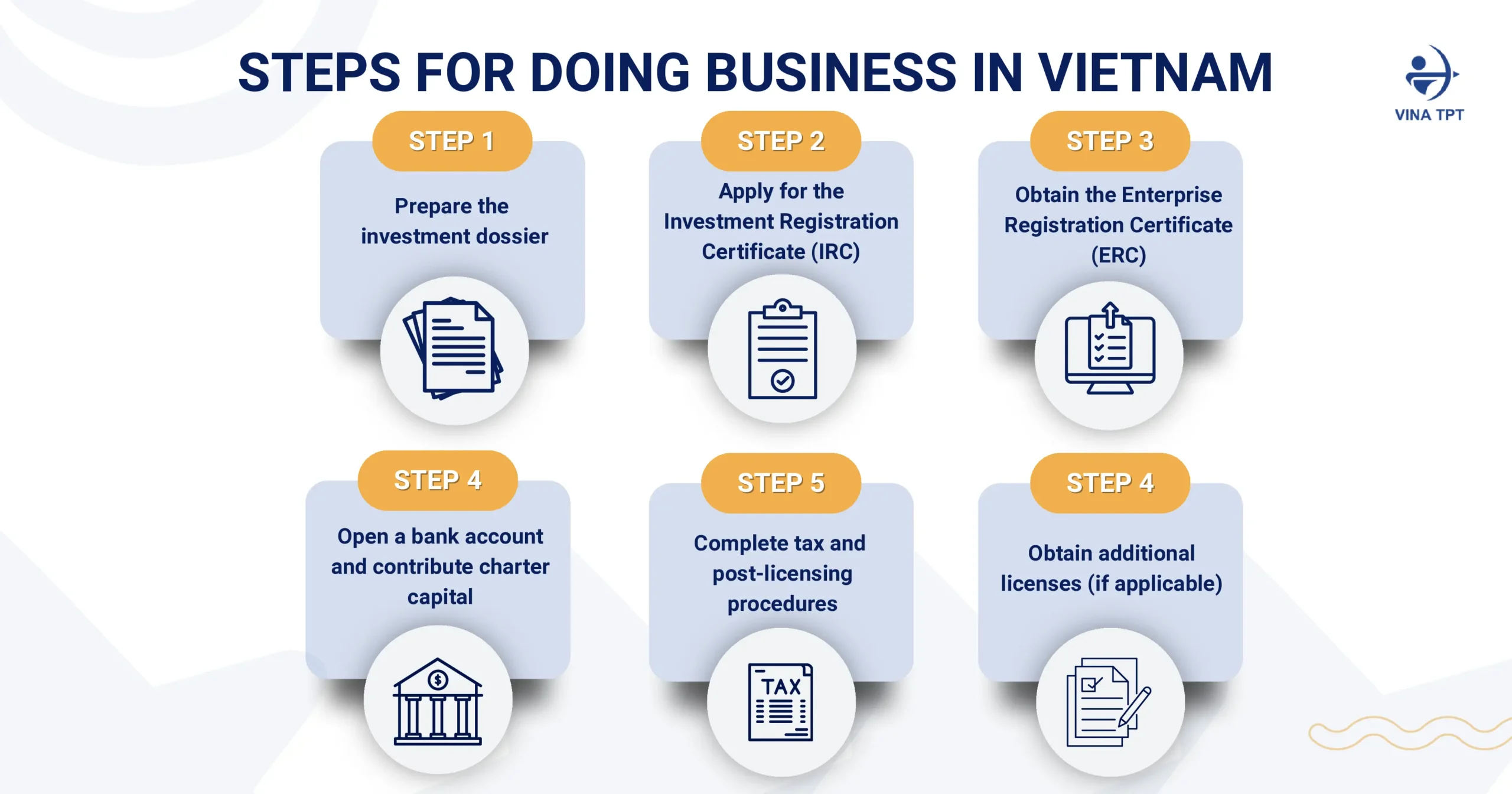
2. Step-by-step procedure for doing business in Vietnam
Doing business in Vietnam with foreign investment requires a clear, structured process to ensure full legal compliance and smooth operations. This step-by-step guide is designed specifically for foreign-invested trading or commercial businesses.
Step 1: Prepare the investment dossier
This is the critical first step in the process of doing business in Vietnam. The dossier must be prepared in accordance with the Investment Law 2025.
- Written request for implementation of the investment project
- Documents proving the investor’s legal status:
- For individuals: Citizen ID/Passport (copy)
- For organizations: Certificate of incorporation or equivalent legal document (copy)
- Investment project proposal (including investor information, objectives, investment capital, scale, capital mobilization plan, location, schedule, and socio-economic efficiency assessment)
- Documents proving financial capacity:
- Individuals: savings book, bank balance confirmation
- Organizations: financial statements for the last two years, financial commitment from the parent company or a financial institution
- Head office lease agreement or documents proving the right to use the project location
- Technology explanation (for projects subject to technology appraisal)
- BCC business cooperation contract (if investing under this form)
The dossier is submitted to the Department of Finance in the province/city where the project’s head office is located.
Step 2: Submit the application for the Investment Registration Certificate (IRC)
The IRC is a prerequisite for open new company in Vietnam for foreign investors. The IRC approves the investor’s project and specifies charter capital, scale, location, and business scope. Without an IRC, investors cannot proceed with company registration.
Required documents include:
- Application form and a detailed project proposal (objectives, scale, investment capital, location, and timeline)
- Proof of financial capability (bank statements, audited financial reports, or credit agreements)
- Legal documents: notarized passport (individual) or business registration certificate (organization), both legalized
- Proof of location (lease agreement or land use rights)
- Power of attorney (if using a third-party service)
Foreign documents must be consular legalized and officially translated into Vietnamese. The processing time for an IRC application is typically 5-6 weeks , depending on the nature of the project and the review requirements of the investment registration authority. It is recommended to work with a professional service provider such as Vina TPT to avoid delays.
Step 3: Obtain the Enterprise Registration Certificate (ERC)
After the IRC is issued, the next step in doing business in Vietnam is obtaining the ERC to establish the company’s legal entity status. Typically, the ERC is issued within 7-14 days from the submission date.
Step 4: Open a corporate bank account and inject charter capital
Foreign investors who open new company in Vietnam are required to:
- Open a dedicated investment capital account at a licensed bank in Vietnam
- Contribute the full charter capital within 90 days from the ERC issuance date to avoid penalties and maintain credibility for future licenses
Step 5: Complete tax registration and post-licensing procedures
Before officially commencing operations, the enterprise must:
- Register for a tax code and purchase a digital signature
- Apply for e-invoice issuance/registration
- Register labor and enroll employees in social insurance
Tax and labor obligations are the final steps in doing business in Vietnam before official operations begin.
Step 6: Apply for sector-specific licenses (if applicable)
Conditional business sectors may require additional sub-licenses such as business licenses, import-export licenses, or environmental permits.
By following these steps and staying updated on regulations, foreign investors can successfully establish operations in Vietnam.
3. Frequently Asked Questions when doing business in Vietnam
Can Americans own 100% of a company in Vietnam?
U.S. investors can fully own up to 100% equity when doing business in Vietnam, except in restricted business lines. Certain conditional sectors such as pharmaceuticals, oil and gas, or printing may impose ownership caps or require a local partner.
How long does the process take?
Doing business in Vietnam for foreign investors typically takes 6-8 weeks (about 1-2 months), depending on the business line, complexity, and the province/city of registration. In particular:
- The IRC usually takes 30 – 45 working days
- The ERC takes 7-14 days
What is the minimum capital required to do business in Vietnam?
Under the Enterprise Law 2025, Vietnam does not impose a general minimum capital requirement for enterprises.
However, conditional business lines may require statutory capital (e.g., real estate, banking, insurance, security services). Authorities commonly recommend at least USD 10,000 to demonstrate financial capacity and avoid delays. The exact amount depends on the business plan and scale.
How can a foreigner start doing business in Vietnam?
To officially operate in Vietnam, foreign investors should follow a clear legal roadmap rather than simply registering a company.
In general, the process includes:
- Obtaining the Investment Registration Certificate (IRC) – recording and approving the investment project
- Obtaining the Enterprise Registration Certificate (ERC) – establishing the company’s legal entity in Vietnam
- Completing post-licensing procedures such as opening a corporate bank account and contributing charter capital according to the registered schedule
- Completing initial tax registration and, if required, applying for a business license or sector-specific licenses before officially operating
In practice, each step has distinct dossier and legal requirements, especially for conditional business lines or special projects. Therefore, preparing correctly from the beginning helps shorten processing time and minimize requests for supplementation.
With extensive experience supporting FDI enterprises throughout establishment and operations, Vina TPT provides end-to-end advisory and implementation services to ensure the process is accurate, transparent, and compliant with current regulations.
4. Vina TPT solutions for doing business in Vietnam
Vina TPT’s Company Setup Services in Vietnam for foreign investors include:
- Orientation consulting & planning: Simply share your business plan in Vietnam, and our specialists will advise the most suitable company registration option – while prioritizing investment safety.
- Business licensing (IRC/ERC): We support the full preparation and submission of IRC and ERC dossiers, ensuring a smooth and compliant establishment process. Estimated timeline: 3-6 weeks.
- Post-establishment capital contribution: We assist with bank account opening, capital transfer, and online banking/tax payment registration to ensure charter capital contribution is smooth and compliant for your enterprise in Vietnam.
- Tax registration and filings: Vina TPT continues to support post-establishment procedures such as fiscal year registration, business license tax declaration, e-invoice setup, VAT filings, and preparation of the first quarter financial report – helping the business operate properly from day one.
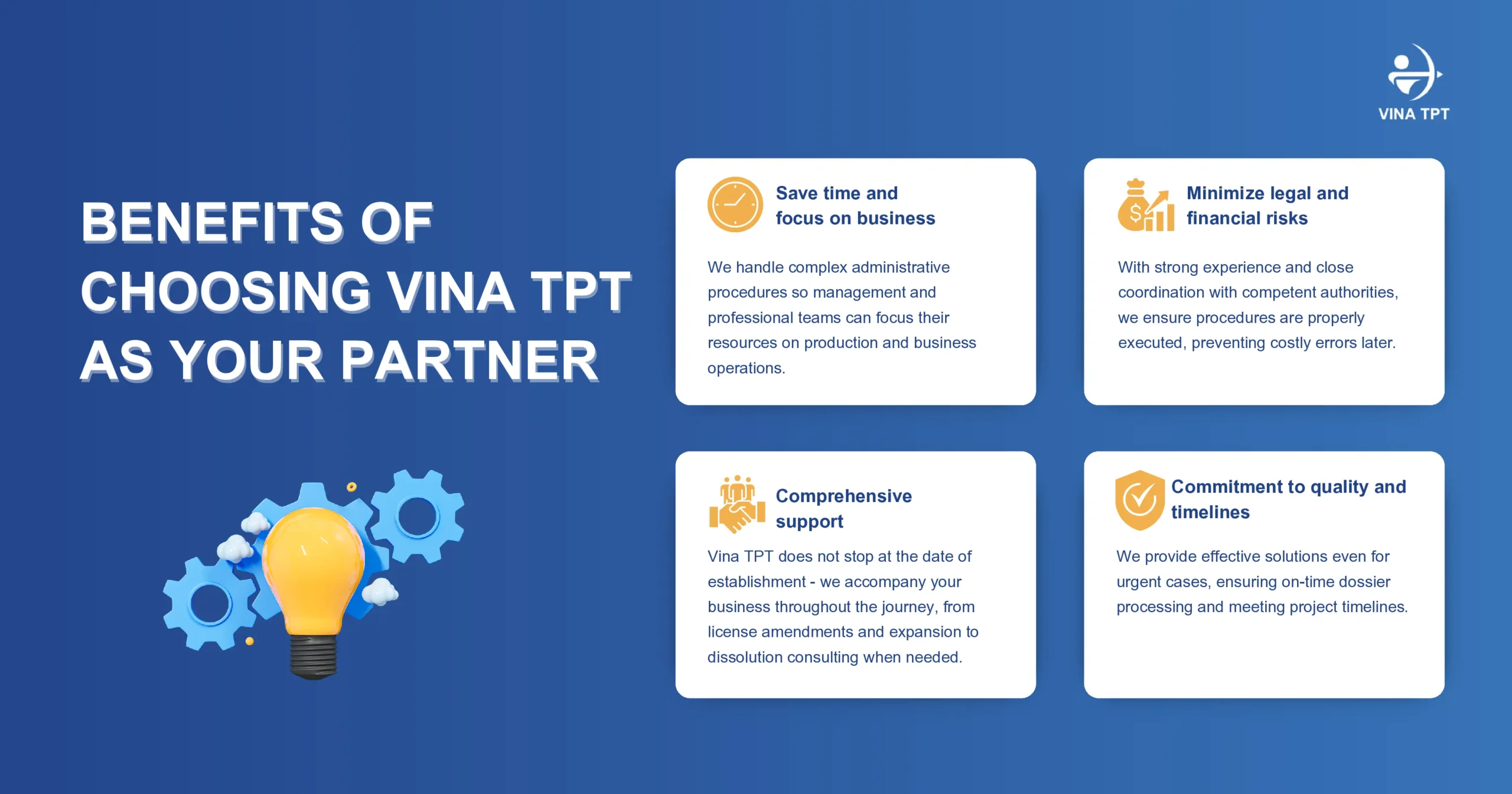
Doing business in Vietnam can be complex and requires careful preparation. If investors lack experience and want to focus more on business operations, you should consider professional advisory services such as Vina TPT. We not only understand the law and possess strong expertise, but also have hands-on experience and deep understanding of corporate culture. Contact Vina TPT today for free consultation.