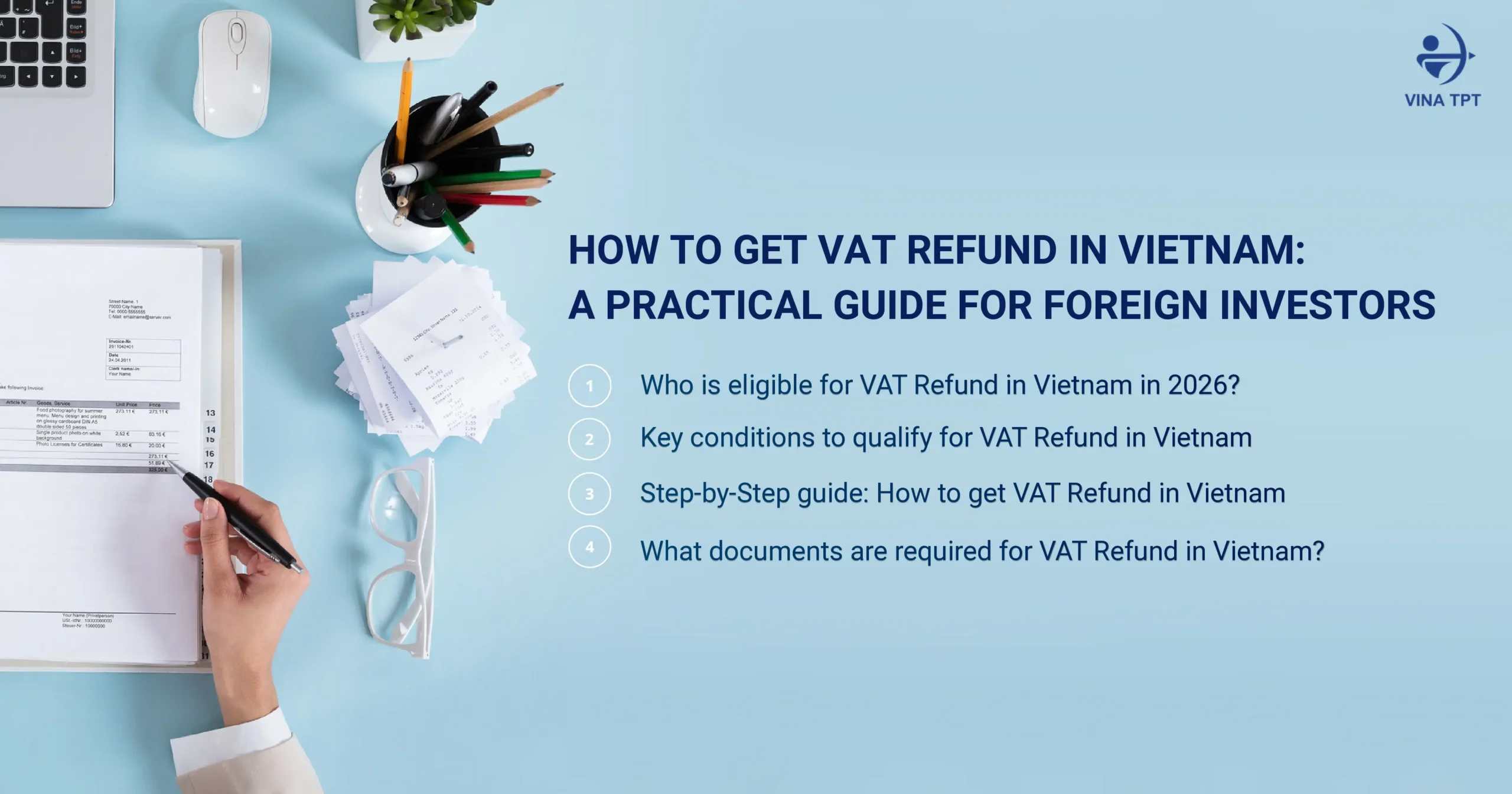
How to get VAT Refund in Vietnam: A Practical Guide for Foreign Investors 2026

how-to-get-vat-refund-in-vietnam-a-practical-guide-for-foreign-investors-2026

how-to-get-vat-refund-in-vietnam-a-practical-guide-for-foreign-investors-2026

Many businesses in Vietnam, especially export enterprises and FDI companies, have a large amount of capital stuck in unrefunded input Value-Added Tax (VAT). This amount can reach hundreds of millions or even billions of VND, directly affecting cash flow and operational capabilities.

Obtaining a VAT refund is not only a legitimate right but also an important financial tool that helps businesses optimize their cash flow. However, in practice, not every business clearly understands the conditions, procedures, and how to prepare documents to successfully receive a VAT refund.

This article provides a detailed guide on how to get VAT refund in Vietnam, including eligibility conditions, required documents, step-by-step procedures, processing timeline, and common mistakes to avoid in 2026. This entering Vietnam market guide is designed to give you a complete roadmap from preparation to operation.

1. Who is eligible for VAT Refund in Vietnam in 2026?

Not every business in Vietnam is eligible for a VAT refund. According to Article 15 of the Law on Value-Added Tax 2024, the most common cases that qualify for a VAT refund include: 

  • Enterprises exporting goods and services (subject to the 0% VAT rate)
  • Businesses with new or expanded investment projects, particularly FDI projects that are still in the investment phase
  • Enterprises with excess VAT paid after quarterly or annual input tax credit
  • Companies undergoing dissolution, bankruptcy, or termination of operations

To be eligible for a VAT refund, businesses must also meet several general requirements:

  • Declare and pay VAT using the deduction method
  • Maintain complete and accurate accounting records with valid supporting documents
  • Hold a bank account registered under the company’s tax code
  • For any transaction of VND 5 million or more (VAT inclusive), payment must be made via bank transfer (cash payments are not accepted)

Businesses engaged in exports and FDI investment projects are often given priority under the “refund first, audit later” mechanism. This allows them to receive VAT refunds more quickly, helping improve cash flow during the critical early stages of investment.

2. Key conditions to qualify for VAT Refund in Vietnam (What You Must Meet)

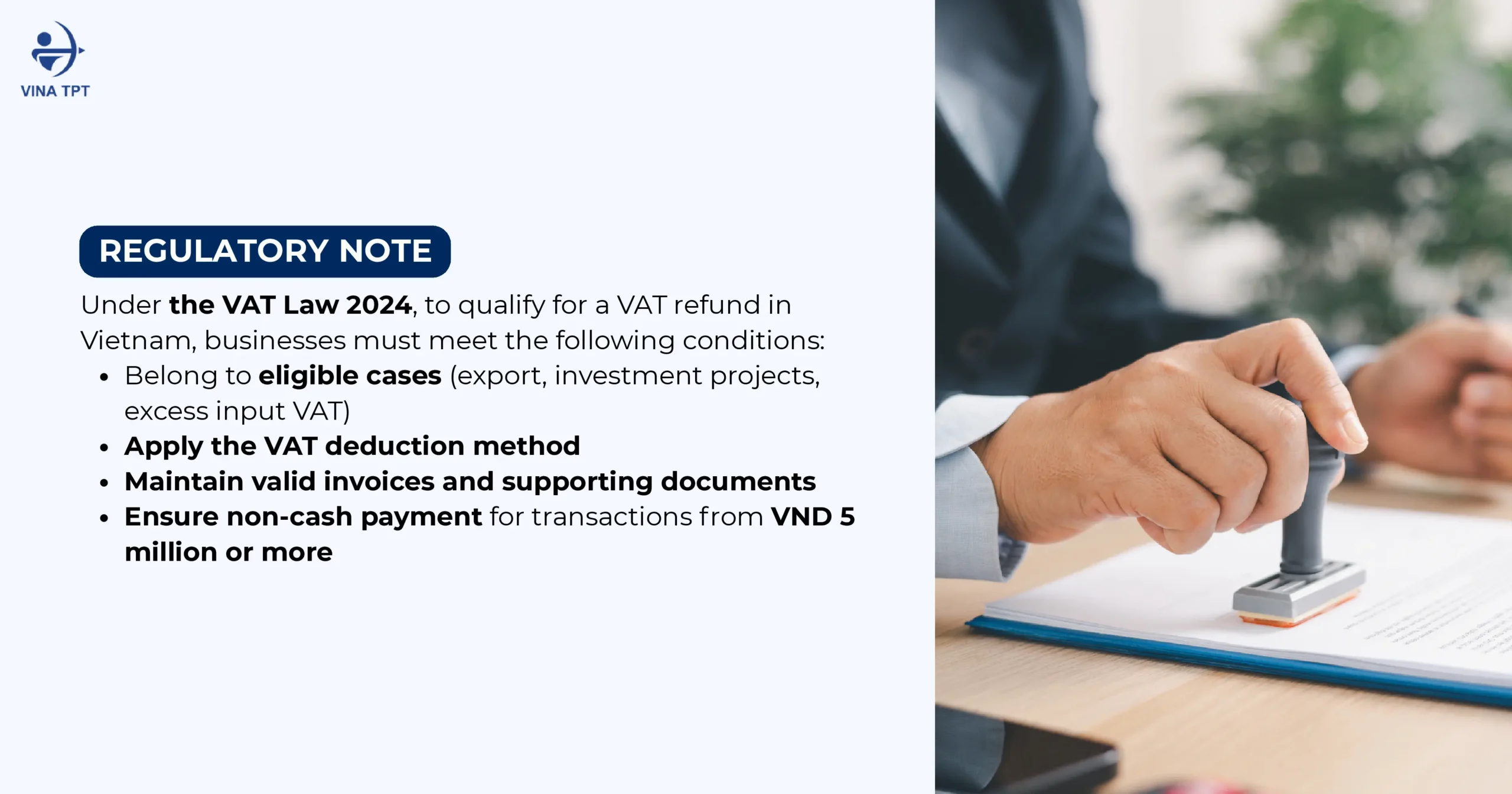
To qualify for a VAT refund in Vietnam in 2026, businesses must simultaneously meet two main conditions:

2.1. Belong to the Eligible Categories under Clauses 1, 2, 3, and 4 of Article 15 of the Law on Value-Added Tax 2024

The most common eligible cases include:

  • Enterprises exporting goods and services (subject to the 0% VAT rate)
  • Businesses undertaking new or expanded investment projects (especially FDI projects)
  • Enterprises with excess VAT paid after quarterly or annual input tax credits
  • Companies undergoing dissolution, bankruptcy, or termination of operations

2.2. Declare and Pay VAT Using the Deduction Method and Comply with Input VAT Deduction Regulations under Clause 2 of Article 14 of the Law on Value-Added Tax 2024

Specifically, businesses must:

  • Possess valid VAT invoices or equivalent supporting documents
  • Make payment via bank transfer for any transaction of VND 5 million or more (VAT inclusive) – cash payments are not accepted
  • For exported goods and services, in addition to the general conditions, the following documents are required: a contract with the foreign party (for sale, processing, or service provision), invoices, non-cash payment proof, customs declaration (for exported goods), and supporting documents such as packing list, bill of lading, and insurance certificate (if any). The Government also provides specific regulations on input VAT credit conditions for exports via overseas e-commerce platforms and other special cases. 

Only when conditions are fully satisfied can a business submit a VAT refund application.
how-to-get-vat-refund-in-vietnam-a-practical-guide-for-foreign-investors-2026

>>> You may find this article helpful: Cases Eligible for VAT Tax Refund in Vietnam in 2026 

3. Step-by-Step guide: How to get VAT Refund in Vietnam

Understanding the required documents is one of the most important steps in learning how to get VAT refund in Vietnam successfully. To carry out a VAT refund, businesses need to go through the following steps:

Below is the detailed procedure for how to get VAT refund in Vietnam in 2026. The entire process is now mainly carried out electronically, helping to shorten the time compared to before.

Step 1: Check and prepare documents

Businesses need to carefully check the eligible input VAT amount and compile all related documents (electronic VAT invoices, customs declarations, export contracts…).

Step 2: Declare VAT

Carry out VAT declaration monthly or quarterly accurately and on time as prescribed.

Step 3: Submit VAT refund application

Submit the electronic VAT refund dossier through the eTax system of the General Department of Taxation. This is an important step that determines the subsequent processing speed.

Step 4: Tax authority review and decision

The tax authority will review the dossier. If it qualifies for “refund first – audit later”, you will receive the refund decision faster.

Step 5: Receive VAT refund

After receiving the refund decision, the money will be transferred directly to the business’s bank account within the prescribed time.

Step 6: Handle additional requests (if any)

In case the dossier needs clarification, businesses must quickly explain or supplement documents as requested by the tax authority to avoid prolonging the processing time.

Explore VAT Refund Services

4. What documents are required for VAT Refund in Vietnam?

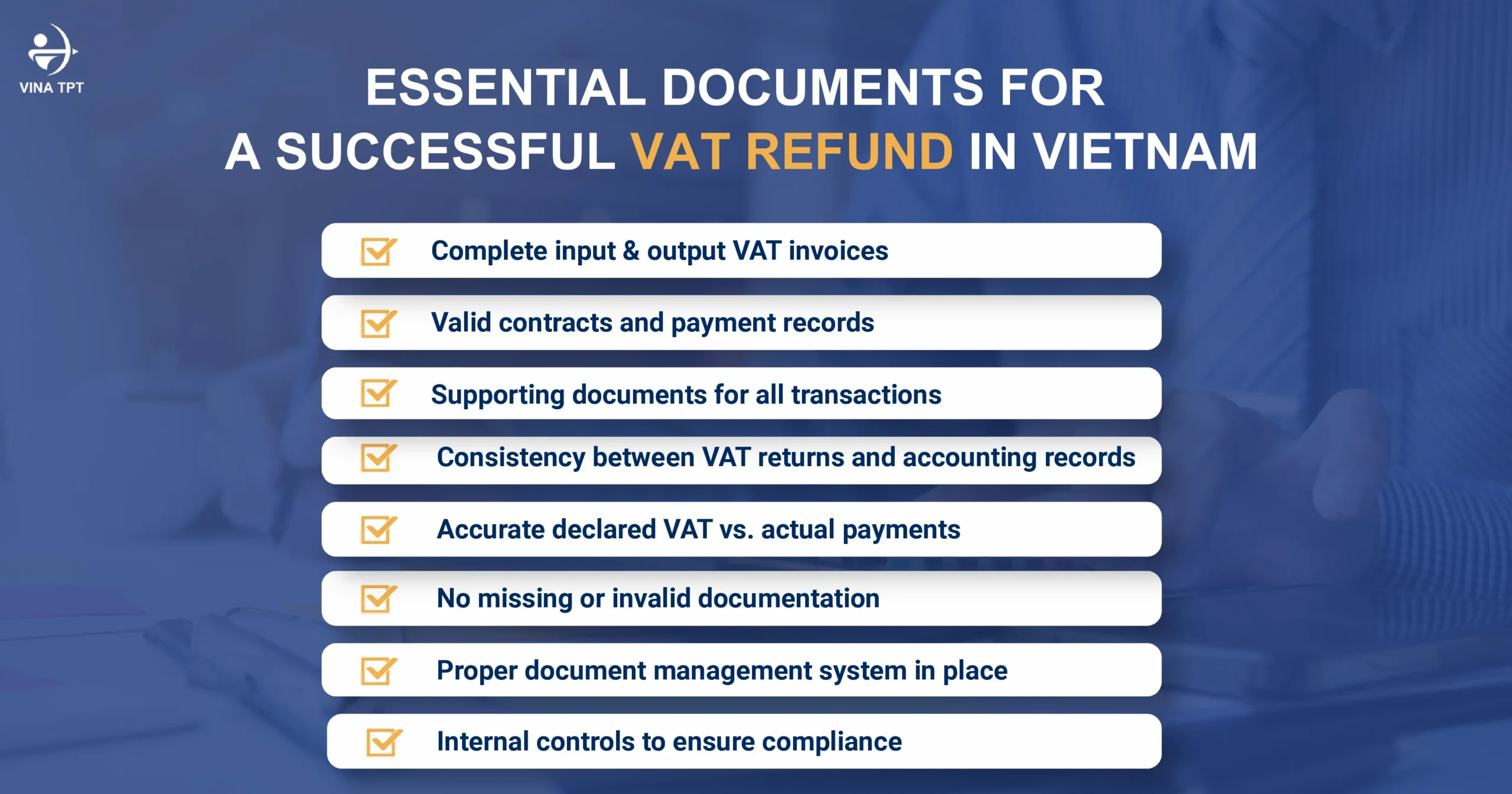
Whether the business uses the deduction method or the direct method, it is mandatory to properly store all input and output documents. These documents usually include electronic VAT invoices, contracts, payment vouchers, and related records to prove the legitimacy of declared revenue and expenses.

In addition, businesses must ensure consistency between the declared VAT data, paid tax amounts, and the accounting books. Any discrepancy or lack of valid documents may lead to tax reassessment, administrative penalties, or prolonged processing time with the tax authority.

In practice, establishing a document management and internal control system from the beginning will help minimize errors and significantly reduce pressure during periodic tax inspections or audits later.

Processing Time

  • Refund first – audit later: approximately 15 days
  • Audit first – refund later: approximately 40 days

However, in practice in 2026, the processing time may be longer if the dossier is incomplete or requires multiple explanations.

5. Common VAT Refund mistakes that delay or reject your application

Although the VAT refund process has been digitized, many businesses (especially FDI enterprises and export companies) still encounter situations where their dossiers are delayed, require multiple additional submissions, or are even rejected. One of the biggest challenges when learning how to get VAT refund in Vietnam is avoiding documentation and declaration mistakes that may delay approval.

  • Invalid or mismatched invoices and documents This is the most common error. Many businesses submit VAT invoices that do not qualify for deduction, invoices with incorrect information, or fail to fully match them with customs declarations and contracts. As a result, the dossier is suspended or removed from the refund list.
  • Late tax declaration or incorrect data Declaring incorrect input VAT data or being late by even one day can lead to penalties and delay the entire refund process.
  • Not preparing sufficient explanation documents when requested When the tax authority requests explanations, many businesses respond slowly or lack supporting documents, causing the dossier to be delayed or rejected.
  • Choosing the wrong refund method Some businesses choose the “audit first – refund later” method even though they qualify for “refund first – audit later”, significantly prolonging the time to receive the money.
  • Not completing other tax obligations Businesses with outstanding PIT, CIT, or other taxes will not be eligible for VAT refund until those obligations are settled.

Practical Advice: Before submitting the VAT refund dossier, carefully check all documents and data. Cooperating with a professional consulting firm like Vina TPT will help you avoid most of the above mistakes, increase the success rate of the refund, and significantly shorten the time to receive the money.

6. How Vina TPT Helps You Get VAT Refund Faster and Safer

With more than 20 years of experience supporting FDI enterprises and export businesses, Vina TPT deeply understands the VAT refund process and the practical requirements of the tax authorities. We help clients get VAT refunds faster, safer, and with a higher success rate.

Specifically, Vina TPT provides comprehensive support as follows:

  • Thorough checking and review of input VAT dossiers before submission
  • Full preparation and optimization of documents to increase the refund success rate
  • Representing clients in submitting electronic VAT refund applications and regularly monitoring progress
  • Timely support for explanations and supplementary documents when requested by the tax authority
  • Integration with outsourced finance & accounting services for overall tax management, avoiding arising errors

Thanks to our professional process, we help businesses significantly shorten the time to receive VAT refunds while minimizing the risk of additional requests or dossier rejection.

Most importantly, when cooperating with Vina TPT, you can focus on your core business activities instead of spending time dealing with complex administrative procedures.

If your business needs professional support on how to get VAT refund in Vietnam, Vina TPT is ready to assist from document preparation to tax authority procedures.

how-to-get-vat-refund-in-vietnam-a-practical-guide-for-foreign-investors-2026

BOOK A FREE CONSULTATION

Bookkeeping services for Startups in Vietnam: Essential tasks your business should never skip

bookkeeping-services-for-startups-in-vietnam-7-essential-tasks-every-founder-must-know

bookkeeping-services-for-startups-in-vietnam-7-essential-tasks-every-founder-must-know

As a startup founder, most of your time is spent developing your product and acquiring customers. However, if your accounting system is not set up and managed properly, it can quickly become a major bottleneck – leading to tax errors, lack of financial transparency, and insufficient data when approaching investors.

In reality, many startups in Vietnam struggle due to limited budgets, constantly changing tax regulations, and the need for fast, accurate reporting to support fundraising. Building a competent in-house accounting team from day one is often difficult and expensive.

This article will help you understand the 7 essential bookkeeping tasks every startup in Vietnam should prioritize, along with important considerations when choosing the right bookkeeping services for startups in Vietnam. This is why many founders start looking for bookkeeping services for startups early to build a solid financial foundation.

Essential bookkeeping tasks for Startups in Vietnam

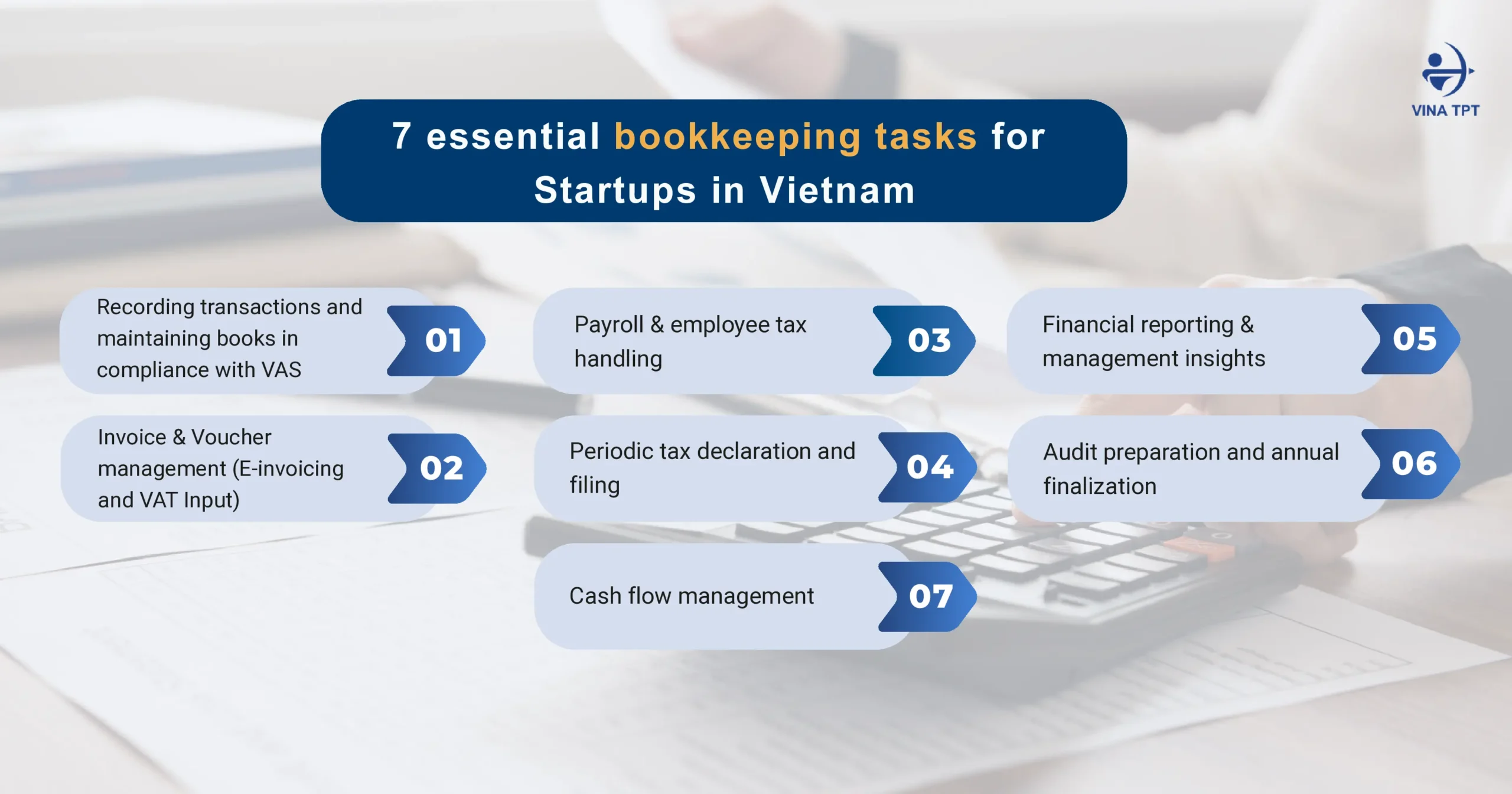
Understanding these tasks also helps you evaluate the quality of bookkeeping services for startups before outsourcing. Here are the 7 core tasks that every startup should focus on when implementing bookkeeping for startups in Vietnam:

1.1. Recording transactions and maintaining books in compliance with VAS

VAS (Vietnamese Accounting Standards) is the foundation of any reliable accounting system. Every transaction – revenue, expenses, and payments – must be recorded accurately and in full compliance with current Vietnamese Accounting Standards.

For startups, incorrect or incomplete recording from the beginning can distort all future reports. This not only affects decision-making but also creates serious tax risks during finalization.

Using professional startup accounting services in Vietnam ensures your data is recorded correctly from day one and remains audit-ready.

1.2. Invoice & Voucher management (E-invoicing and VAT Input)

Electronic invoicing and proper voucher management are mandatory in Vietnam. Startups must closely track input VAT invoices to ensure accurate tax claims and deductions.

Missing valid invoices or improper storage can result in non-deductible expenses and higher tax liabilities

This function can generally be handled by an in-house accountant. However, to ensure that invoices are issued and processed in full compliance with regulations, many businesses still choose bookkeeping services for startups to minimize errors and reduce tax risks.

1.3. Cash flow management

For startups, profitability is often secondary – cash flow is everything.

Many startups fail not because their product is bad, but because they run out of money before reaching product-market fit. Therefore, closely monitoring burn rate (monthly cash consumption) and runway (months of operation left before running out of cash) is critical.

This task includes:

  • Weekly and monthly tracking of cash inflows and outflows
  • Comparing actual cash flow against forecasts
  • Early warning when burn rate increases unexpectedly
  • Regular runway updates to help founders plan fundraising on time

Investors usually require clear, updated cash flow reports at the beginning or end of each month. Without them, securing funding becomes significantly harder. Many bookkeeping services for startups include cash flow monitoring as a core feature to support fundraising readiness.

Explore Bookkeeping Services

1.4. Periodic tax declaration and filing

Tax compliance is mandatory. This includes monthly or quarterly VAT declarations, provisional Corporate Income Tax (CIT) filings, annual finalization, and PIT withholding from employee salaries.

With frequent tax law changes in 2026, staying updated is essential. Late or incorrect filings can result in daily penalties (0.03% per day) and, more seriously, suspension of electronic invoicing – which can immediately disrupt sales and cash flow.

1.5. Financial reporting & management insights

Financial reports are not only for tax authorities but also serve as vital tools for founders to understand their business performance.

For startups, management reports on cash flow, operating costs, and profitability help leaders make faster and more accurate decisions.

1.6. Audit preparation and annual finalization

When a startup grows and prepares for subsequent funding rounds, financial audits often become a requirement from investors. In particular, for FDI enterprises in Vietnam, annual financial statement audits are mandatory under local regulations.

If the accounting system is not properly structured from the beginning, the audit process can be prolonged, lead to additional adjustment costs, and even impact fundraising timelines.

A professionally managed accounting system ensures that financial data is always clear, transparent, and well-documented. As a result, both the audit process and annual tax finalization can be completed more efficiently, reducing costs and enhancing credibility with investors.

In practice, accounting service providers typically work directly with auditors to finalize audited financial statements. This means businesses not only have audit-ready data but also receive end-to-end support throughout the process—significantly reducing internal workload and minimizing potential risks.

This is exactly why many founders choose outsourced bookkeeping services early – so they are always prepared when audit time comes.

1.7. Payroll & employee tax handling

Payroll management involves more than just paying salaries. It includes social insurance (BHXH), health insurance (BHYT), unemployment insurance, and Personal Income Tax (PIT) deductions.

This is also a service commonly bundled with bookkeeping services for startups, helping businesses ensure accurate calculations, timely filings, and full compliance with labor and tax regulations.

bookkeeping-services-for-startups-in-vietnam-7-essential-tasks-every-founder-must-know

Important considerations when choosing bookkeeping services for Startups in Vietnam

Not all bookkeeping services for startups are the same, which is why careful evaluation is necessary. Choosing the right bookkeeping services for startups in Vietnam can determine whether you can focus on growth with peace of mind. Here are the key questions every founder should ask:

  • Does the provider have real experience with startups? Startups typically operate with limited budgets and relatively low transaction volumes, yet they still require monthly reporting to effectively monitor cash flow and financial performance.
  • How strong is their cloud system and real-time reporting? You need an easy-to-use dashboard to monitor your financial health anytime.
  • What is their commitment on deadlines and error handling? A good provider must have a clear Service Level Agreement (SLA) and fast response mechanisms.
  • Do they offer tax advisory and management reporting? Beyond basic bookkeeping, you need strategic advice for tax optimization and fundraising preparation.
  • Is the pricing transparent with no hidden fees? Choose a clear, predictable package to avoid unexpected costs later.

Selecting the wrong provider can be not only expensive but also create legal risks and slow down your startup’s development.

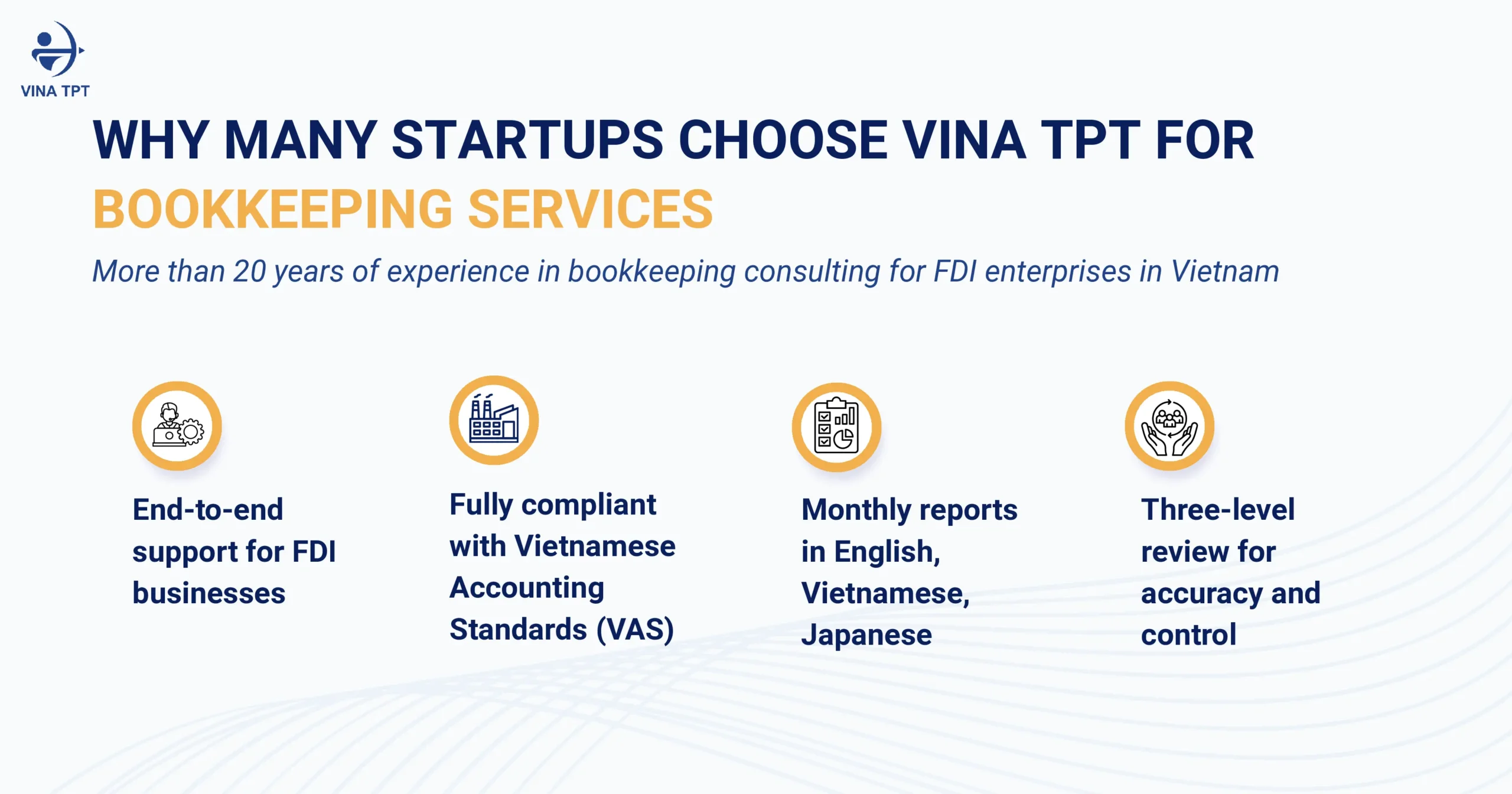
Why many startups choose Vina TPT for bookkeeping services

With over 20 years of experience, Vina TPT has supported hundreds of FDI companies and startups in Vietnam in building efficient accounting systems.

We offer comprehensive solutions including VAS compliant bookkeeping, tax declaration, payroll processing, management reporting, and Qualified Chief Accountant services. Every package is designed to be flexible according to each startup’s growth stage.

What makes Vina TPT different is not only our expertise but also our multilingual support and modern cloud-based system, allowing founders to track their financial situation anytime, anywhere. This enables you to focus fully on growth instead of being distracted by accounting issues.

Choosing the right bookkeeping services for startups can significantly impact your long-term growth and compliance. Contact Vina TPT today for a free consultation and to build the most suitable bookkeeping services for startups package for your current stage of development. Our team is ready to support your startup from day one.

bookkeeping-services-for-startups-in-vietnam-7-essential-tasks-every-founder-must-know

BOOK A FREE CONSULTATION

How to start import export business in Vietnam: A comprehensive guide for Foreign Investors (2026)

how-to-start-an-import-export-business-in-vietnam-a-comprehensive-guide-for-foreign-investors-2026

how-to-start-an-import-export-business-in-vietnam-a-comprehensive-guide-for-foreign-investors-2026

Vietnam has become an ideal destination to start an import-export business thanks to its strategic logistics location, competitive costs, young and abundant workforce, and a robust network of free trade agreements (EVFTA, CPTPP, RCEP, and others).

With the Law on Investment 2025 taking effect from March 1, 2026, establishing an FDI company in the import-export sector has never been easier. Foreign investors can now own 100% of the capital in most trading activities and do not require a general import-export license – only the appropriate business line registration is needed. 

This article provides a detailed, step-by-step guide on how to start import export business in Vietnam in 2026, covering everything from product selection and company structure to legal procedures and actual operations. Understanding how to start import export business correctly from the beginning will help investors avoid unnecessary risks.

Potential import and export products in Vietnam when learning how to start import export business

Before diving deeper into how to start import export business, choosing the right product is a critical first step. Vietnam enjoys strong advantages in both exports and imports. Here are the most promising product categories for 2026:

Strong Export products

Promising Import products

  • Textiles, garments, footwear, and fashion accessories
  • Mobile phones, electronic components, and computers
  • Coffee, cashew nuts, pepper, rice, and other agricultural products
  • Seafood (shrimp, pangasius, tuna)
  • Wood and furniture
  • Machinery, equipment, and production lines
  • Electronic components and industrial raw materials
  • Chemicals, steel, and plastic resins
  • Automobiles, spare parts, and transportation vehicles
  • High-end consumer goods and technology products

To choose the right products when starting your own business, you should:

  • Prioritize items where Vietnam has a competitive edge or enjoys preferential treatment under FTAs
  • Evaluate profit margins, market demand, logistics risks, and legal requirements
  • Start with products you already have experience in or an established supply chain to minimize initial risks

Advice: Conduct thorough market research when learning how to start import export business to reduce risks.

One important note is that although import-export activities in Vietnam do not require a general license, certain products may still be subject to specific business conditions or require specialized permits. Therefore, in addition to selecting high-potential products, investors should carefully review the relevant legal requirements to avoid operational risks.

Once you have a clear overview, you can begin implementing the specific steps to start an import export business in Vietnam.

how-to-start-an-import-export-business-in-vietnam-a-comprehensive-guide-for-foreign-investors-2026

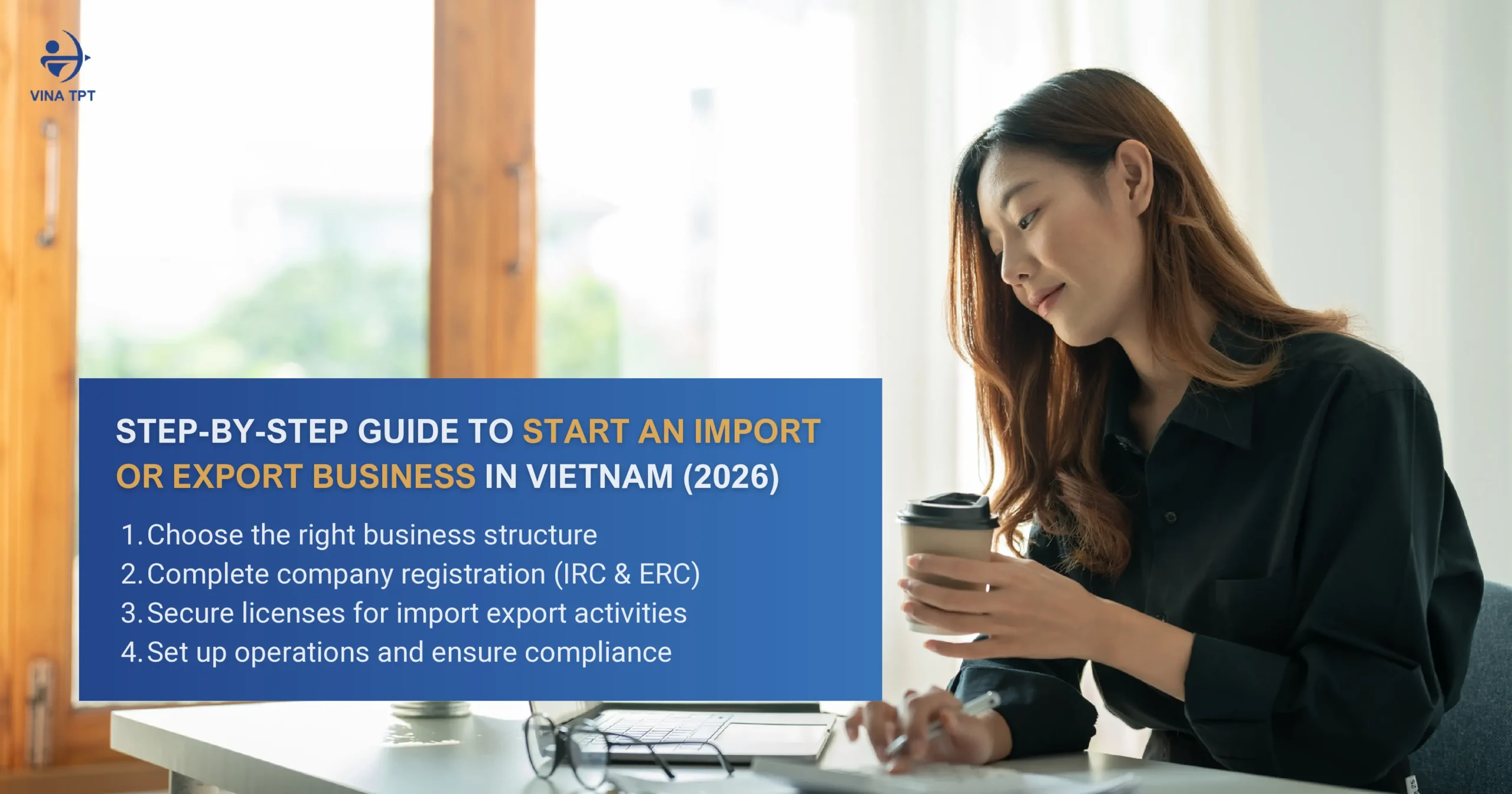
Step 1 – Choose the right business structure

Choosing the correct business structure is the first critical step when starting an import export business in Vietnam. The type of company directly affects governance, capital raising ability, control, and long-term development plans.

The two most popular structures for foreign investors are:

  • Limited Liability Company (LLC): The most common choice for foreign investors due to its simple, flexible management structure. It is ideal for startups and small-to-medium enterprises, allowing full control and quick decision-making.
  • Joint Stock Company (JSC): More suitable for businesses planning to raise capital from multiple investors or aiming for future listing on the stock exchange.

Recommendation: This is especially important for investors who are new to how to start import export business in Vietnam, a 100% foreign-owned LLC is strongly recommended. This structure offers absolute control, simpler procedures, and easier management. Later, when the company grows and needs additional capital, you can flexibly convert it into a Joint Stock Company.

Selecting the right structure from the beginning helps save time, reduce costs, and avoid unnecessary risks. This decision plays a key role in how to start import export business efficiently in Vietnam.

Step 2 – Company registration process (IRC & ERC)

This is the most important step when starting an import export business in Vietnam. Under the Law on Investment 2025, the registration process has become more flexible. In many non-restricted sectors, foreign investors can now register the Enterprise Registration Certificate (ERC) before completing the Investment Registration Certificate (IRC).

Step 2.1: Prepare investment documents

A clear understanding of how to start import export business will help you prepare the correct documents from the beginning. This is the foundational step. The dossier must meet all requirements under the Law on Investment 2025, including:

  • Application for investment project implementation
  • Proof of the investor’s legal status (passport or Certificate of Incorporation)
  • Detailed investment project proposal (objectives, scale, capital, location, timeline, and socio-economic impact)
  • Proof of financial capacity (bank statements, audited financial reports, or parent company support letter)
  • Documents proving the business address (office lease agreement)
  • Technology explanation (if required)

Step 2.2: Apply for the Investment Registration Certificate (IRC)

The IRC approves the investment project and specifies capital, business lines, location, and incentives. Processing time usually ranges from 30 – 45 working days.

Step 2.3: Obtain the Enterprise Registration Certificate (ERC)

After receiving the IRC (or in permitted cases, before it), you apply for the ERC – the document that officially establishes the company’s legal entity. This step typically takes 7–14 working days.

Explore FDI Company Formation Services

Step 3 – Setup Operations (Bank Account, Office, HR & Compliance)

Once licenses are obtained, you should promptly complete the following:

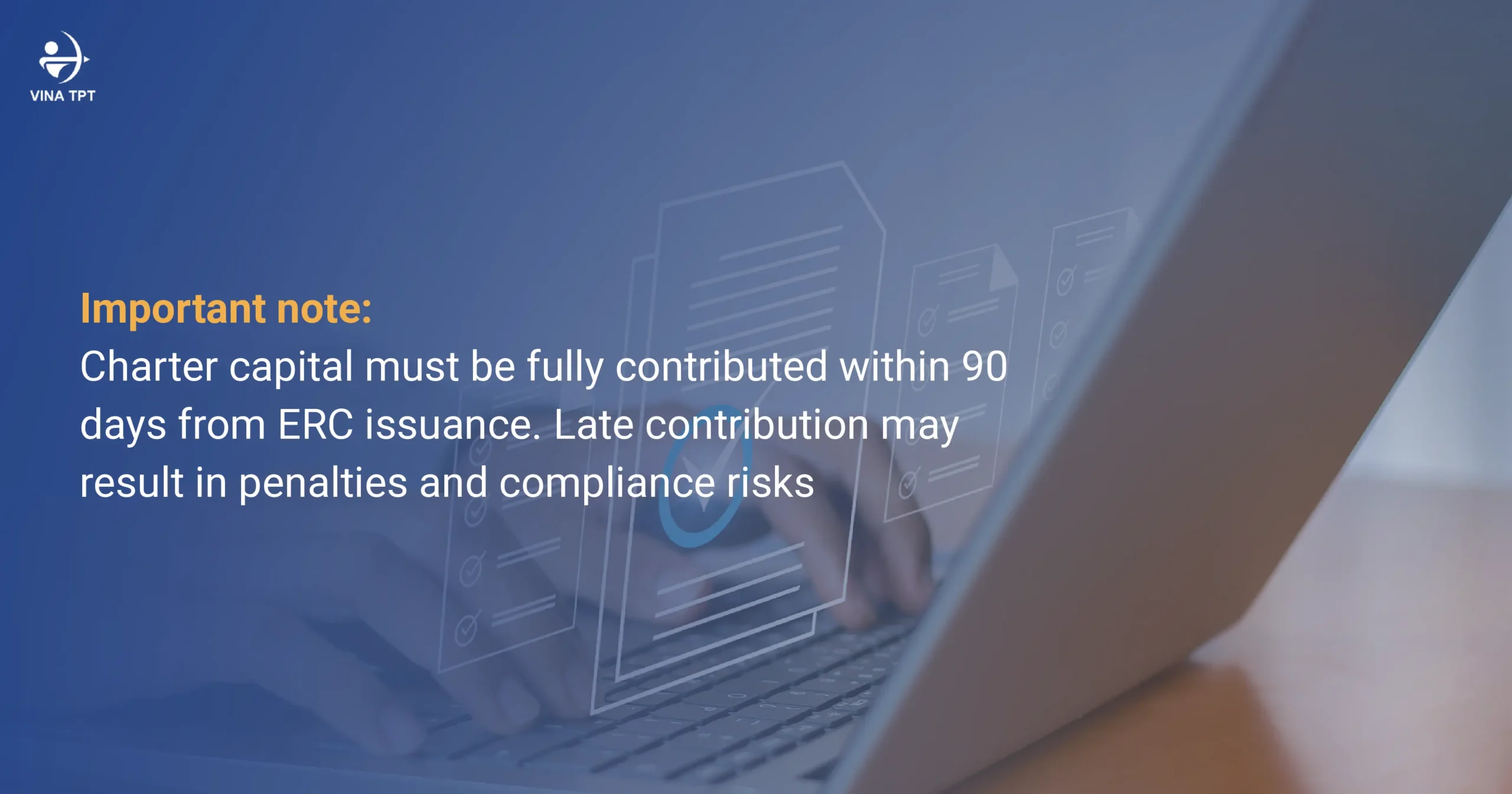
  • Open an investment capital account and transaction account (charter capital must be fully contributed within 90 days of receiving the ERC)
  • Register initial tax accounts and complete business identification procedures on the VNeID system.
  • Monitor mandatory tax filing deadlines, especially Value-Added Tax (VAT), even if no business activities have occurred.
  • Apply for work permits, Temporary Residence Cards (TRC), and business visas for foreign investors or employees working in Vietnam for more than 3 months.

Note: Early compliance is crucial when learning how to start import export business in Vietnam to avoid penalties. Many investors choose outsourced finance & accounting services to reduce risks and focus on core business activities. At this stage, investors can clearly see how to start import export business in a practical and compliant way.

Step 4 – Obtain necessary licenses and permits for import export

A major advantage is that no general import-export license is required if you register the correct business lines.

However, certain products still need specific permits, such as:

  • Food, pharmaceuticals, cosmetics, chemicals, and agricultural products
  • Goods under specialized management (defense, security, environment, etc.)
  • If a company is not only engaged in import export activities but also participates in trading activities in Vietnam, such as distribution or retail, it will be required to obtain business license and retail Outlet Establishment License.

You will also need to:

  • Register for tax code and customs code
  • Connect to the electronic invoicing system
  • Register import-export rights (automatically granted with appropriate business lines)

how-to-start-an-import-export-business-in-vietnam-a-comprehensive-guide-for-foreign-investors-2026

Explore Outsourced Accounting Services

6. Common challenges when starting an Import Export Business in Vietnam

Although Vietnam offers many advantages, the process of starting an import export business is not always smooth, especially for first-time foreign investors.

Administrative procedures, while improved, can still be time-consuming if documents are incomplete. Language barriers and differences in working culture may also slow down progress when dealing with government agencies or local partners.

Other common challenges include cash flow management, foreign exchange fluctuations, and logistics costs. Additionally, Vietnam’s legal and policy framework continues to evolve, requiring businesses to stay updated to avoid compliance risks.

Having a knowledgeable local consulting partner from the beginning can significantly reduce these risks and ensure smoother implementation.

7. Why Vina TPT can help you successfully start your Import Export Business

For investors learning how to start import export business, having the right consulting partner can make a significant difference.

With over 20 years of experience supporting FDI enterprises, Vina TPT fully understands the practical difficulties foreign investors face when starting an import-export business in Vietnam.

We provide end-to-end solutions, from advising on suitable business lines and products, completing IRC/ERC procedures, assisting with Temporary Residence Cards (TRC), to setting up compliant accounting and tax systems from day one.

What sets Vina TPT apart is our ability to connect all these steps into a seamless process. Our multilingual team can support you remotely, making the entire journey more convenient – especially for investors who have not yet established a physical presence in Vietnam.

If you are still unsure how to start import export business, working with experts can significantly shorten your setup time. Contact Vina TPT today for a free consultation and to build the most suitable roadmap for your import export business in Vietnam.

BOOK A FREE CONSULTATION


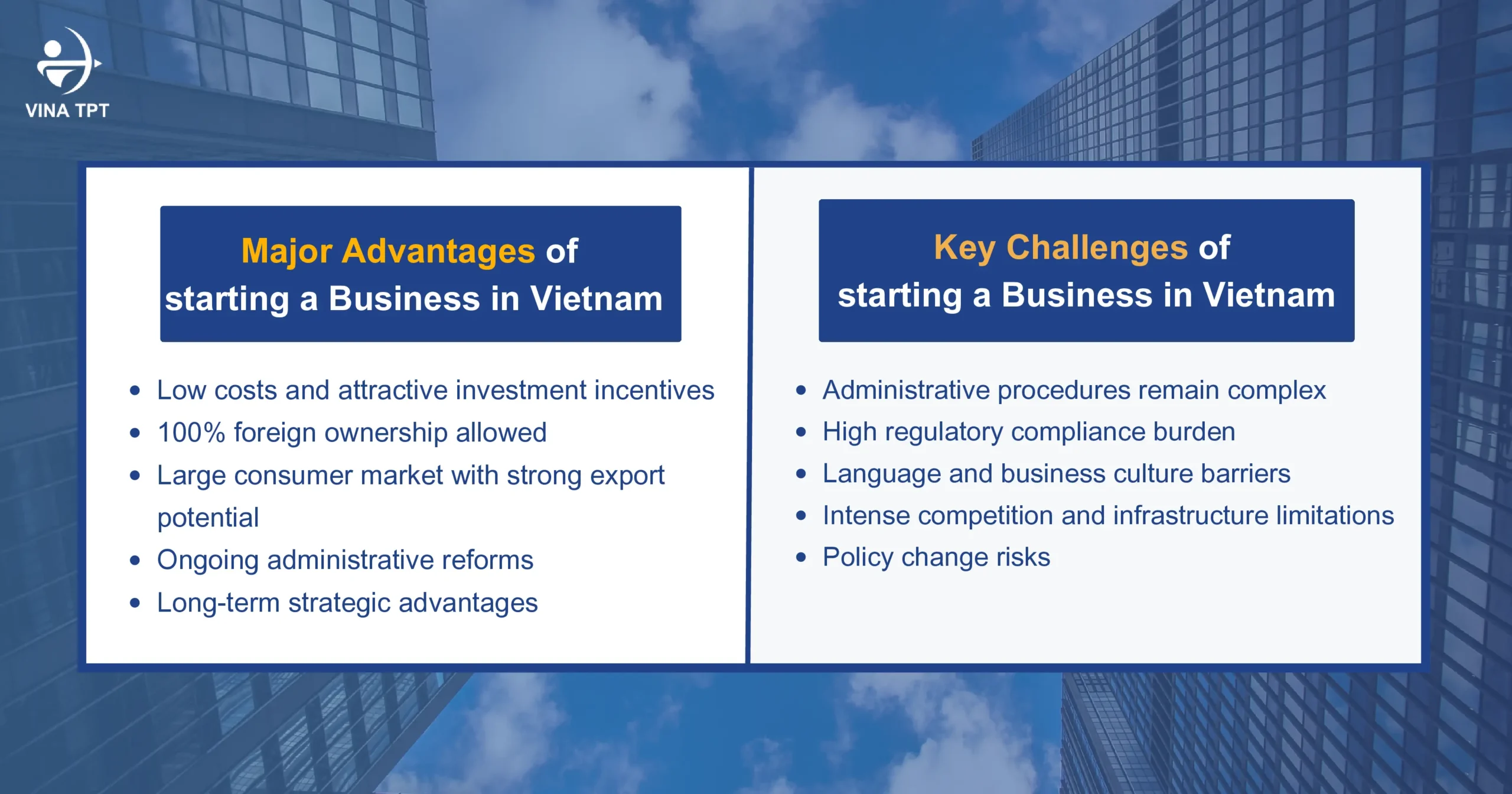
Advantages and disadvantages of starting your own business in Vietnam

advantages-and-disadvantages-of-starting-your-own-business-in-vietnam

advantages-and-disadvantages-of-starting-your-own-business-in-vietnam

Many entrepreneurs and foreign investors are planning to start their own business in Vietnam – a fast-growing market with competitive costs and a strategic location in Southeast Asia. With the Law on Investment 2025 officially taking effect from March 1, 2026, Vietnam continues to implement strong reforms to attract foreign direct investment (FDI).

However, establishing an FDI company brings both significant opportunities and real challenges. This article provides a balanced analysis of the advantages and disadvantages of starting your own business in Vietnam, helping you gain a comprehensive view before making an informed decision before making a decision about the advantages and disadvantages of starting your own business in Vietnam.

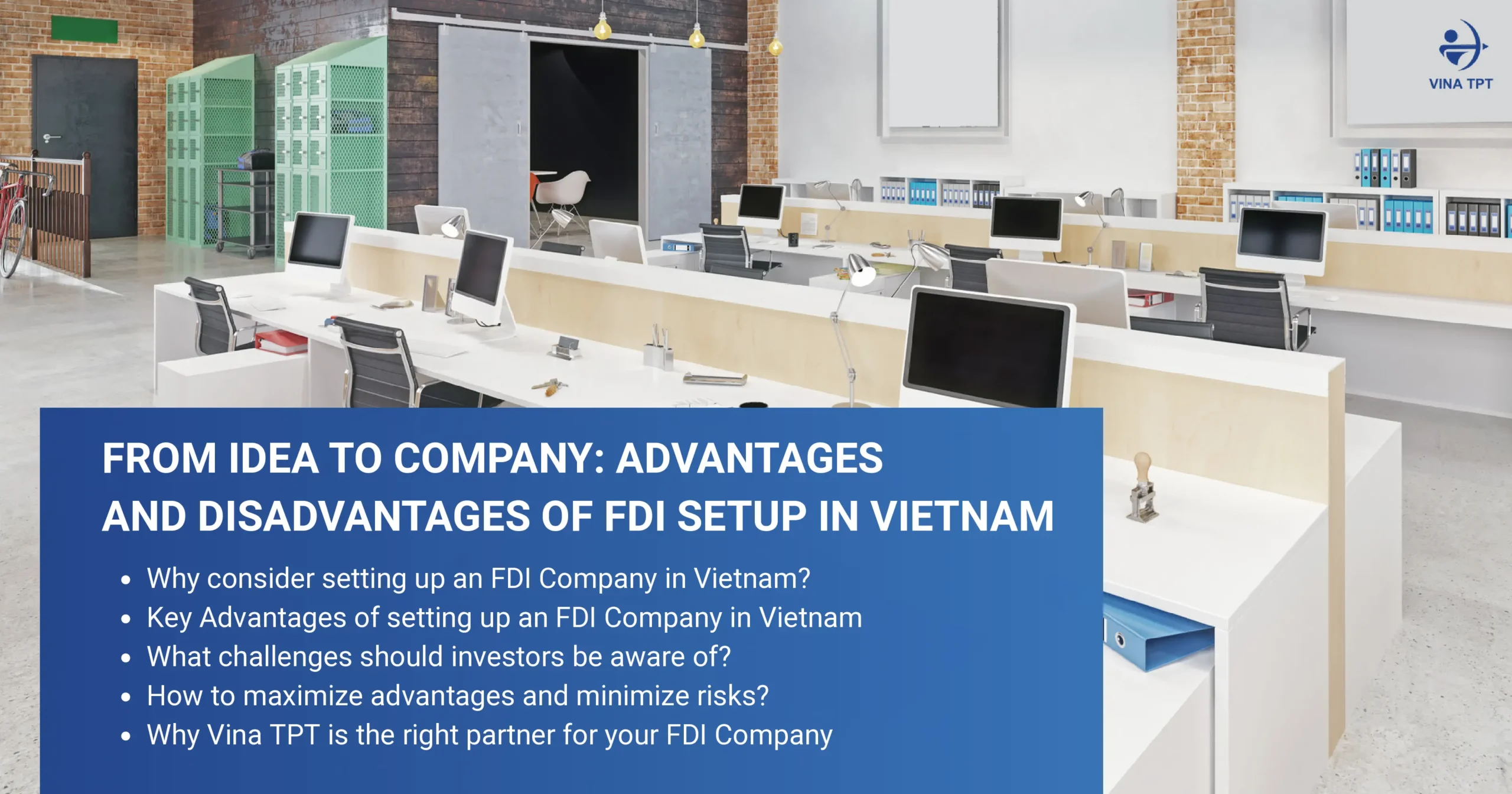
1. Why consider setting up an FDI Company in Vietnam?

Vietnam has become one of the most attractive investment destinations in Southeast Asia. The main reasons many investors choose to set up a business in Vietnam under the FDI model include:

  • Stable economic growth with consistently high GDP growth rates over many years
  • A young, abundant, and cost-competitive workforce
  • Strategic logistics position as a gateway connecting ASEAN, China, and global markets
  • Extensive network of free trade agreements that create export and expansion opportunities, including:
    • Comprehensive and Progressive Agreement for Trans-Pacific Partnership (CPTPP)
    • EU-Vietnam Free Trade Agreement (EVFTA)
    • UK-Vietnam Free Trade Agreement (UKVFTA)
  • Increasingly favorable FDI policies, especially following the Law on Investment 2025

This is a crucial and strategic step when you decide to start your own business in Vietnam through through foreign direct investment, especially when evaluating the advantages and disadvantages of starting your own business.

2. Key Advantages of setting up an FDI Company in Vietnam

When evaluating the advantages and disadvantages of starting your own business, Vietnam offers several compelling benefits for foreign investors.

One of the biggest advantages is low operating costs. Labor, office rental, and general business expenses in Vietnam are significantly lower than in many developed markets. Additionally, companies can enjoy attractive tax incentives, especially in industrial zones or priority sectors.

Another major advantage is capital ownership flexibility. Under the Law on Investment 2025, foreign investors can own up to 100% of the capital in most sectors, allowing full control over management and operations.

Vietnam also boasts strong market potential, with a rapidly expanding middle class. Furthermore, the country serves as an excellent manufacturing hub, enabling businesses to integrate deeply into global supply chains.

Recent reforms have also shortened the company establishment timeline. In many cases, investors can now obtain the Enterprise Registration Certificate (ERC) before the Investment Registration Certificate (IRC), making the setup process faster and more flexible.

Overall, these advantages create favorable conditions for successfully starting your own business in Vietnam in an efficient and sustainable manner.

Explore Vina TPT’s End-to-End Business Setup Services

3. What challenges should investors be aware of?

Alongside the benefits, it is important to understand the disadvantages of starting your own business when choosing the FDI route in Vietnam.

Despite many reforms, administrative procedures can still be complex, especially for investors unfamiliar with the Vietnamese legal system. Preparing documents and working with government authorities sometimes takes longer than expected.

Compliance pressure is another notable challenge. Companies must strictly follow Vietnamese Accounting Standards (VAS), tax regulations, electronic invoicing requirements, and periodic reports such as the Investment Activity Report (IAR). Without proper expertise or professional support, the risk of errors is relatively high.

Additionally, language and cultural barriers can affect communication and daily operations. Understanding how to navigate the local business culture is essential for building strong relationships and achieving long-term success.

Increasing competition in many sectors and occasional limitations in infrastructure or high-quality talent are also factors to consider.

Understanding these risks is essential when analyzing the advantages and disadvantages of starting your own business in Vietnam.
advantages-and-disadvantages-of-starting-your-own-business-in-vietnam

4. How to maximize advantages and minimize risks?

To make the most of the advantages and disadvantages of starting your own business in Vietnam, investors should develop a clear strategy from the beginning:

  • Choose the right type of company structure: Carefully consider between 100% foreign-owned companies and joint ventures, as each model has different implications for control and risk.
  • Prepare thorough and accurate documentation while fully utilizing the new provisions of the Law on Investment 2025.
  • Partnering with a professional consulting firm helps minimize legal and operational risks. Beyond supporting company formation, these firms typically provide comprehensive solutions covering legal, accounting, and tax services – three core areas that are closely monitored by regulatory authorities in Vietnam.
  • Build a strong local team and establish a robust compliance system from day one.
  • Develop a detailed financial and cash flow plan to handle potential delays in administrative procedures.

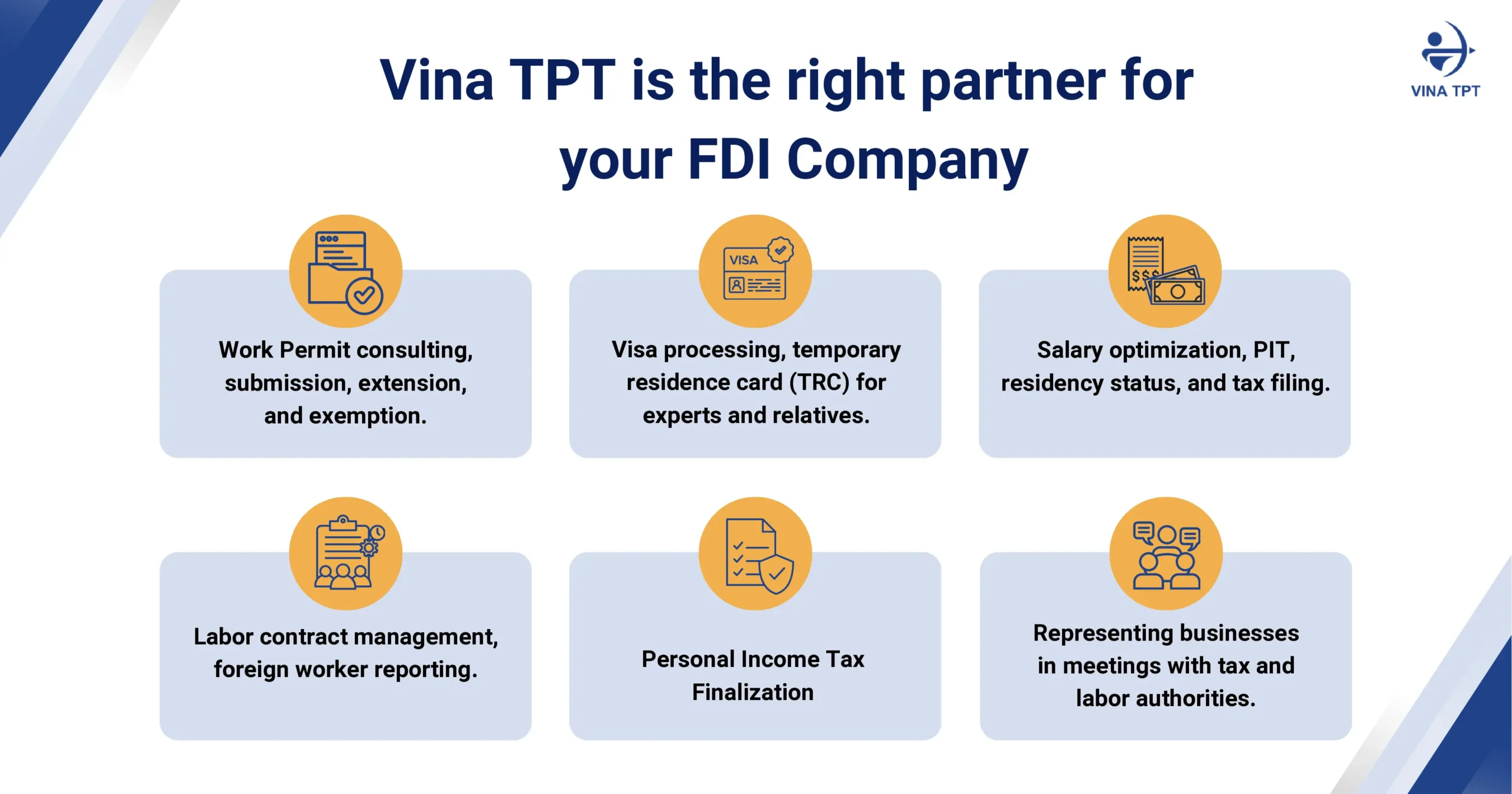
5. Why Vina TPT is the right partner for your FDI Company

When considering the advantages and disadvantages of starting your own business, choosing the right partner is critical for long-term success.

With over 20 years of experience supporting FDI enterprises, Vina TPT deeply understands the real challenges foreign investors face when starting their own business in Vietnam.

We provide comprehensive services, including:

  • Investment consulting and company establishment (IRC/ERC)
  • Support for Temporary Residence Cards (TRC) for foreign employees
  • Qualified Chief Accountant and outsourced finance & accounting services

In addition, we have a team of legal experts with hands-on experience working directly with competent authorities throughout the company establishment and operational process. With a deep understanding of procedures, requirements, and common challenges, Vina TPT can support businesses in implementing processes efficiently while ensuring full compliance with Vietnam Accounting Standards (VAS), tax regulations, and reporting obligations. At the same time, we provide timely financial insights to support informed decision-making.

With multilingual capabilities and extensive practical experience, Vina TPT helps businesses not only “comply with the law” but also operate efficiently and successfully.

Conclusion

Understanding the advantages and disadvantages of starting your own business through the FDI model in Vietnam is a critical step before making your investment decision.

With the strong reforms introduced by the Law on Investment 2025, opportunities in Vietnam are more open than ever. However, success requires careful preparation and a well-thought-out strategy.

Contact Vina TPT today for a free consultation. Let our expert team help you build the most suitable FDI company establishment plan tailored to your business model in Vietnam.

BOOK A FREE CONSULTATION

advantages-and-disadvantages-of-starting-your-own-business-in-vietnam

Law on Investment 2025: Major improvements making Vietnam more attractive for investors

law-on-investment-2025-major-improvements-making-vietnam-more-attractive-for-investors

law-on-investment-2025-major-improvements-making-vietnam-more-attractive-for-investors

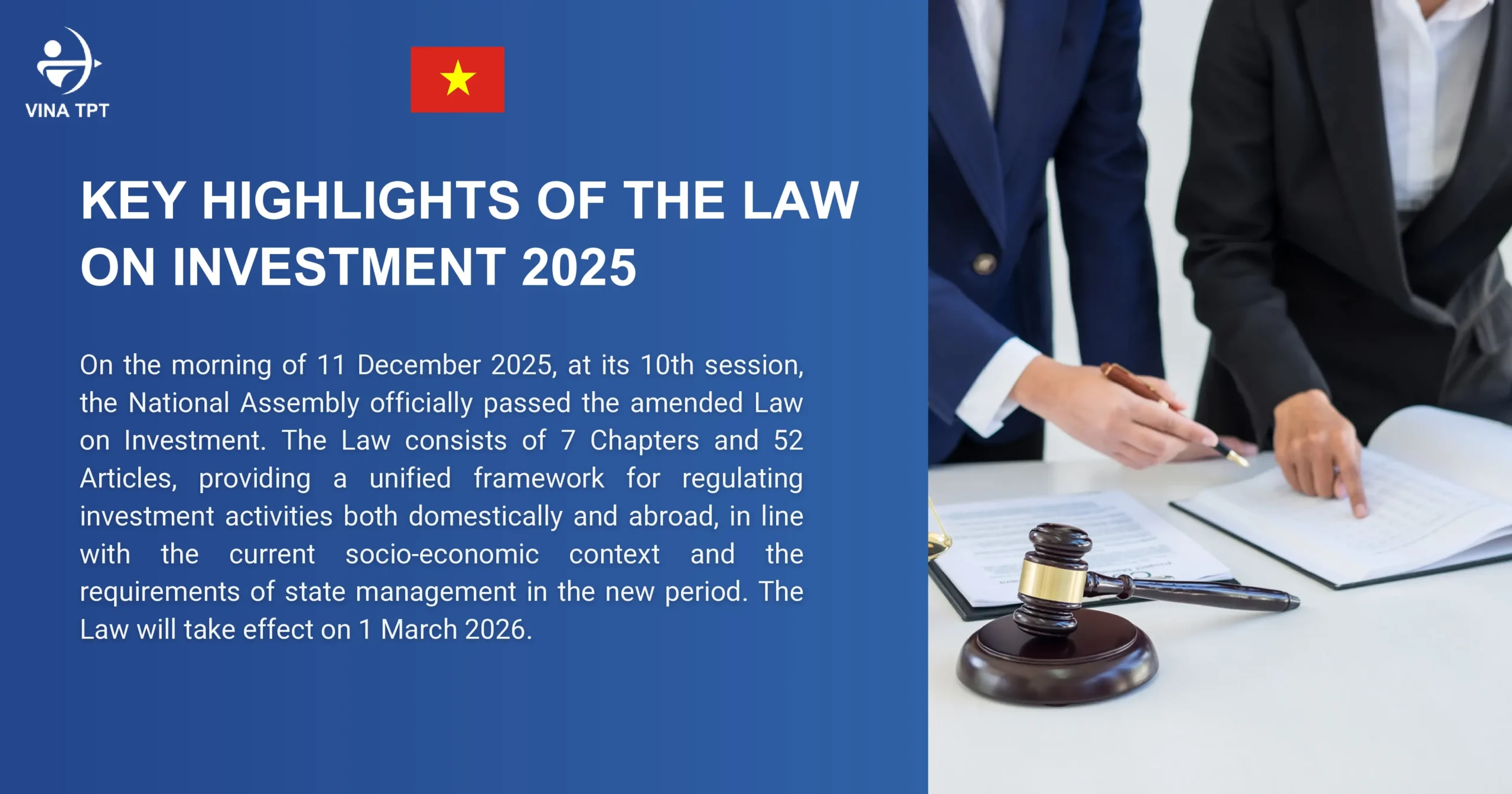
The Law on Investment 2025 (No. 143/2025/QH15), passed by the National Assembly on December 11, 2025 and officially effective from March 1, 2026, is considered one of the most important reforms in recent years. It aims to build a more transparent, favorable, and competitive investment environment in Vietnam.

The new law significantly reduces administrative procedures, lowers market entry barriers, and focuses on attracting high-quality FDI, particularly in technology, innovation, and strategic economic sectors.

This article highlights the key improvements under the Law on Investment 2025, helping both domestic and foreign investors better understand the practical benefits when starting a business in Vietnam or expanding their investment operations.

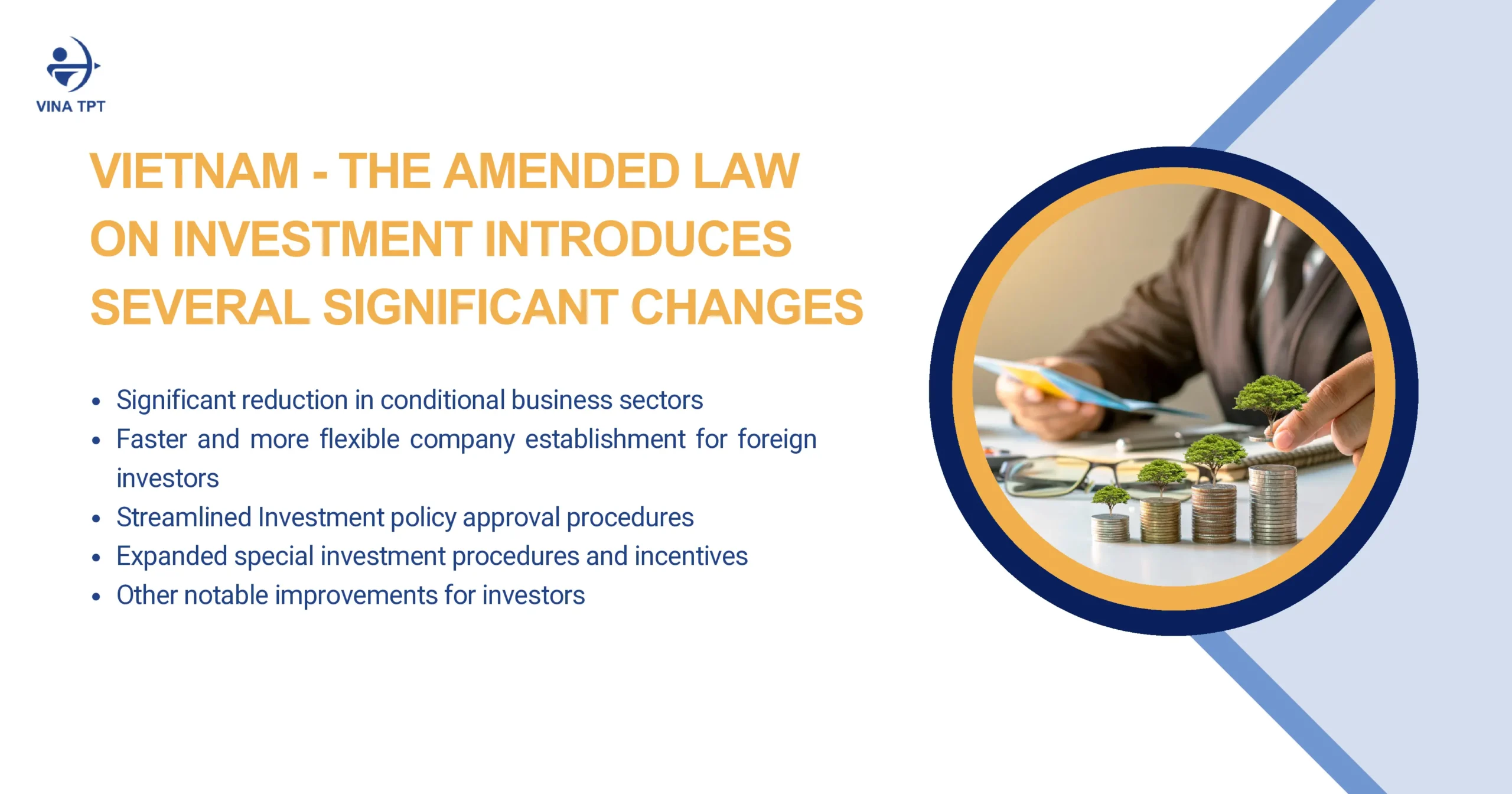
1. Significant reduction in conditional business sectors

One of the most prominent reforms in the Law on Investment 2025 is the substantial reduction in conditional business sectors.

Specifically, the law:

  • Removes 38 conditional investment and business sectors
  • Revises the scope of 20 other sectors

These changes significantly lower market entry barriers. Investors – especially startups, technology companies, digital service providers, and foreign investors, can now implement business activities more easily without having to navigate numerous sub-licenses.

By simplifying business conditions, the law not only expands economic freedom but also enhances the competitiveness of Vietnam’s investment climate, while still ensuring effective oversight through a strengthened post-audit mechanism.

2. Faster and more flexible company establishment for foreign investors

The Law on Investment 2025 introduces significant improvements for foreign investors when starting a business in Vietnam.

Previously, investors were generally required to secure an approved investment project before establishing a company. Under the new regulations:

  • It is no longer mandatory to have an investment project in place before company incorporation.
  • In many cases, investors can obtain the Enterprise Registration Certificate (ERC) first and complete the Investment Registration Certificate (IRC) afterward.

This change delivers clear advantages and saves considerable time:

  • Before: IRC had to be obtained before ERC – resulting in longer timelines and higher costs.
  • After: Companies can establish their legal entity earlier, allowing greater flexibility to prepare for operations.

As a result, businesses can quickly establish their presence in Vietnam – leasing offices, opening bank accounts, recruiting staff, and commencing operations without being delayed by lengthy procedures.

Important Note:

Although companies may now obtain the Enterprise Registration Certificate (ERC) before the Investment Registration Certificate (IRC), investors are still required to complete the IRC procedure within 6 months from the date the ERC is issued. Failure to do so may result in suspension of business activities or administrative penalties as stipulated by law.

law-on-investment-2025-major-improvements-making-vietnam-more-attractive-for-investors

3. Streamlined Investment policy approval procedures

The new law significantly narrows the scope of projects requiring investment policy approval, limiting it to large-scale or sensitive projects involving national defense, security, environment, or land use.

Additionally, two previous adjustment requirements have been removed:

  • Capital increases of 20% or more
  • Changes in technology

These reforms greatly reduce “pre-approval” procedures, shorten project implementation timelines, and minimize unnecessary administrative delays. Investors can now respond more proactively to business opportunities and bring projects into operation at the right time.

4. Expanded special investment procedures and incentives

The Law on Investment 2025 expands the application of special investment procedures and incentives in:

  • Industrial zones
  • High-tech zones
  • Free trade zones
  • Key economic regions

The law also introduces enhanced incentives for strategic sectors, including:

  • Semiconductor and chip manufacturing
  • Research and development (R&D)
  • High technology, digital transformation, and green economy

These policies enable investors to access more attractive incentives related to taxation, land use, and administrative procedures, thereby encouraging capital flows into high value-added industries.

5. Other notable improvements for investors

In addition to the major changes, the Law on Investment 2025 brings several other meaningful improvements:

  • More flexible project duration
  • Simplified procedures for outward investment (removal of approval requirements in certain cases)
  • Stronger emphasis on post-audit mechanisms instead of pre-approval
  • Enhanced protection of investors’ legitimate rights, while effectively screening out inefficient projects

These improvements contribute to building a more transparent, stable, and trustworthy investment environment in Vietnam.

law-on-investment-2025-major-improvements-making-vietnam-more-attractive-for-investors

How these changes benefit domestic and foreign investors

For foreign investors (FDI):

  • Reduced time and cost of company establishment
  • Greater flexibility when entering the Vietnamese market
  • Easier access to investment incentives
  • Lower administrative and procedural risks

For Vietnamese enterprises:

  • Expanded freedom of business operations
  • Increased opportunities for international cooperation
  • Reduced administrative burden
  • Better access to foreign capital and technology

Overall benefits:

  • A significantly improved national investment climate
  • Enhanced competitiveness
  • Accelerated digital transformation
  • Stronger support for sustainable economic development

Practical implications and recommendations for investors

Although the Law on Investment 2025 offers many advantages, thorough preparation remains essential to fully capitalize on the new regulations.

Investors should pay attention to the following:

  • Prepare complete and accurate documentation from the initial stage
  • Fully understand the post-audit mechanism to minimize potential risks
  • Develop a clear plan to maximize available incentives

Recommendation:

To make the most of the opportunities presented by the Law on Investment 2025, businesses should engage a professional consulting firm early in the planning process. Vina TPT, with extensive experience in investment consulting and FDI company formation, provides comprehensive support, from corporate structuring and IRC/ERC procedures to post-establishment outsourced finance & accounting services.

Conclusion

The Law on Investment 2025 represents a major milestone in improving Vietnam’s investment environment, delivering tangible benefits for both domestic and international investors.

Contact Vina TPT today for a free consultation on how to effectively leverage the Law on Investment 2025 when establishing or expanding your business in Vietnam. Our expert team is ready to support you from the initial idea through to successful implementation.

BOOK A FREE CONSULTATION

Optimizing cash flow with accounts payable outsourcing services

optimizing-cash-flow-with-accounts-payable-outsourcing-services

optimizing-cash-flow-with-accounts-payable-outsourcing-services

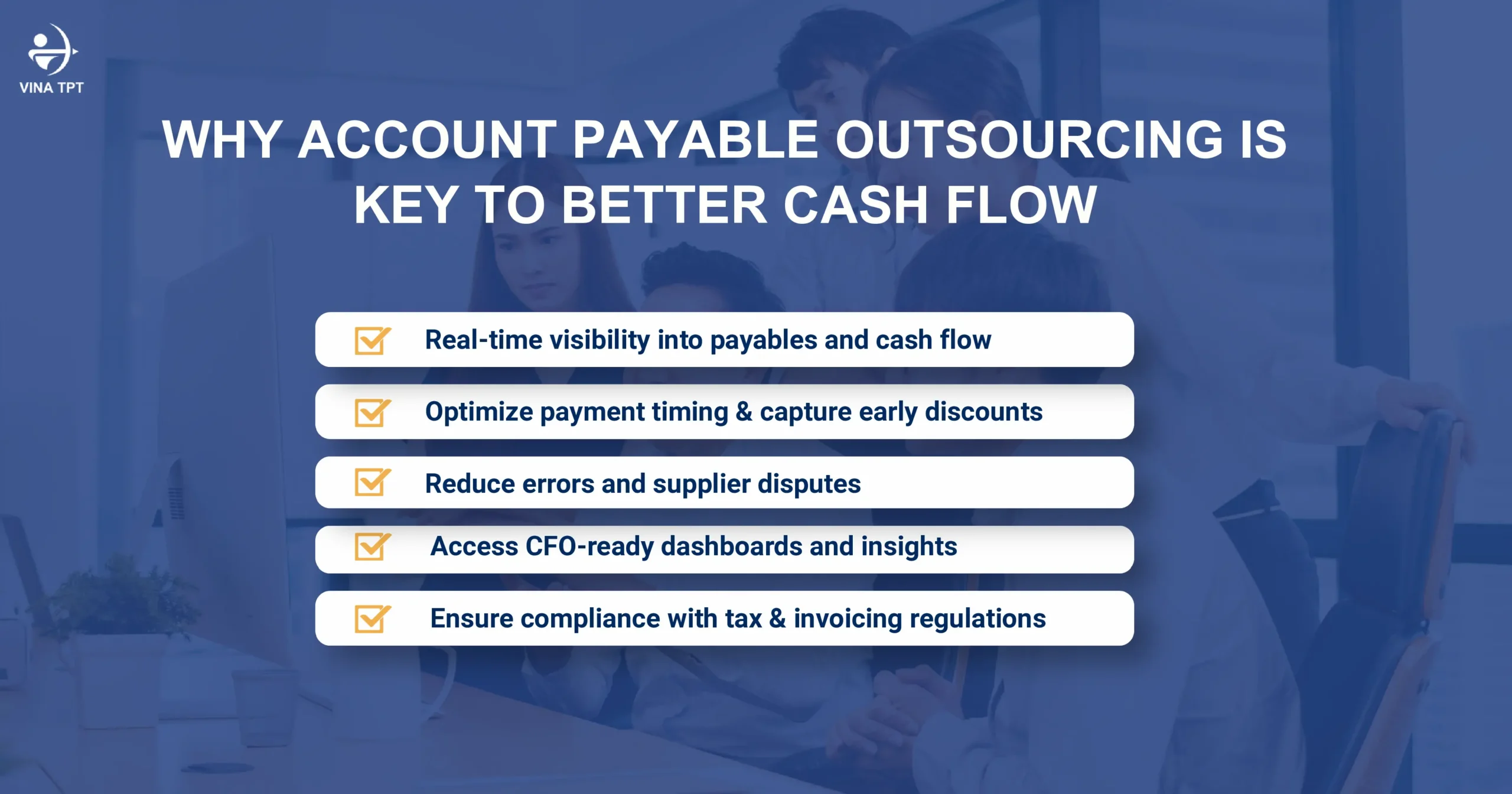
In many businesses, cash flow problems do not stem from insufficient revenue, but from poor management of payables. Slow invoice processing, poorly timed payments, or lack of visibility into outstanding obligations can lead to sudden cash shortages, missed investment opportunities, or unnecessary financing costs.

In Vietnam’s current environment of rising operating costs and increasingly strict compliance requirements, maintaining a manual and fragmented Accounts Payable process has become a major barrier to financial efficiency.

Accounts Payable Outsourcing Services offer a completely different approach: transforming the payment process from an administrative function into a strategic tool that helps businesses gain better control over cash flow, optimize costs, and make more accurate financial decisions.

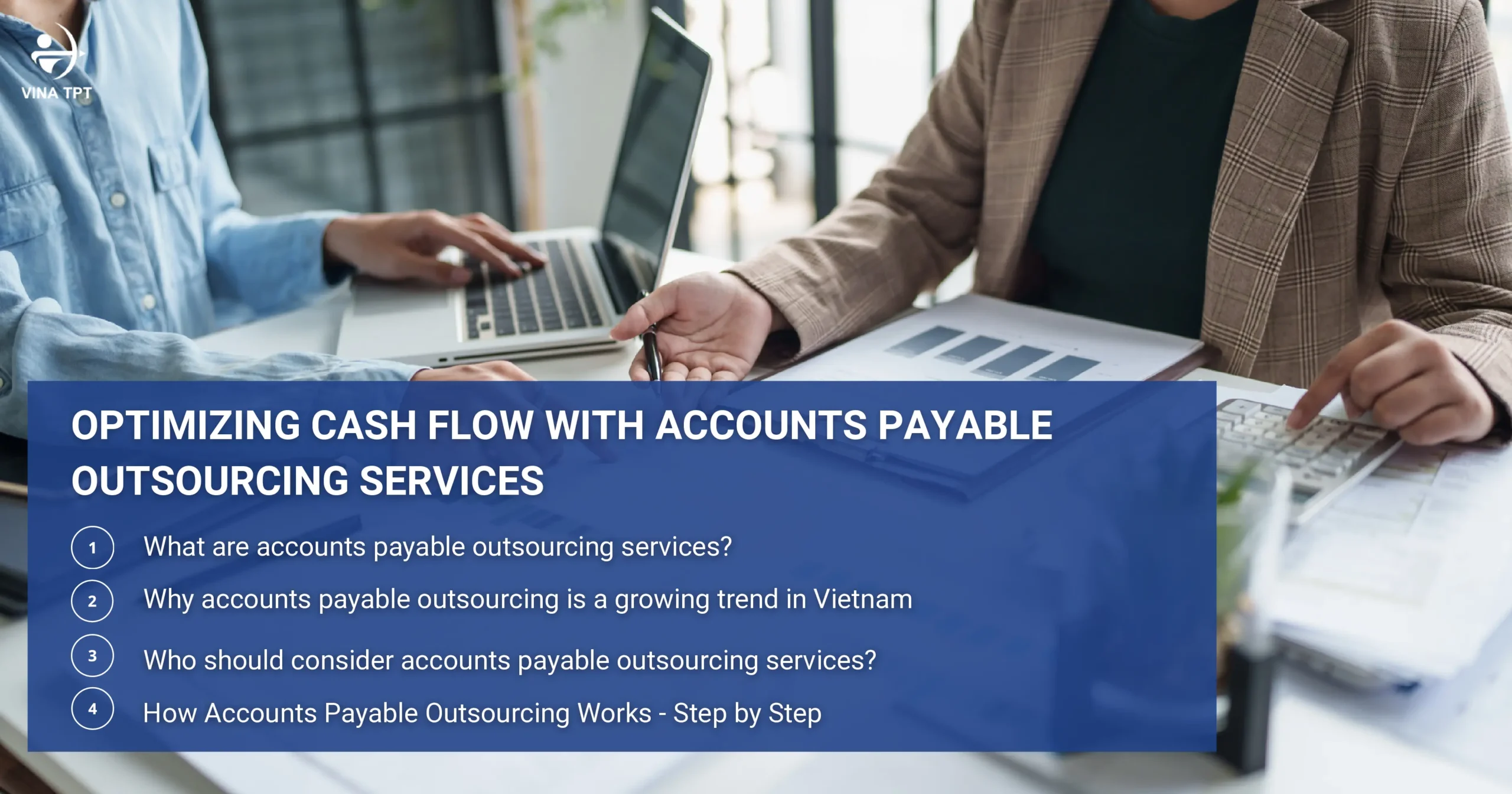
1. What are accounts payable outsourcing services?

Accounts Payable Outsourcing Services involve transferring all or part of the Accounts Payable (AP) process – the management of supplier payments – to a specialized external provider.

Instead of your internal accounting team handling everything from invoice receipt and verification to approval, payment, and reconciliation, you simply forward the relevant documents to the service provider. Their expert team then manages the entire process with speed, accuracy, and full compliance with Vietnamese regulations.

A comprehensive AP outsourcing package typically includes:

  • Invoice receipt and digitalization
  • Three-way matching (invoice vs. purchase order vs. goods receipt)
  • Automated approval workflows
  • Payment execution (domestic and cross-border)
  • Vendor management and statement reconciliation
  • Regular reporting and analysis

With this service, Accounts Payable is no longer a repetitive administrative burden, it becomes a powerful strategic tool for effective cash flow control and optimization.

2. Why accounts payable outsourcing is a growing trend in Vietnam 2026

In 2026, Accounts Payable Outsourcing Services have emerged as a clear and rapidly growing trend in Vietnam. This shift is driven by several key realities in the business environment:

  • Surging transaction volumes and invoice numbers due to expanding manufacturing, trading, distribution, and strong FDI inflows.
  • Severe shortage of qualified accounting talent, coupled with continuously rising costs for salaries, training, and retention.
  • Increasing compliance pressure from Circular 99/2025/TT-BTC, mandatory electronic invoicing, and updated VAT and withholding tax regulations.

What was once viewed as a routine back-office task has now become a strategic lever for optimizing cash flow, tightening cost control, and elevating overall financial management.

EXPLORE OUR ACCOUNTING SERVICE

3. Optimizing cash flow with accounts payable outsourcing services

This is the core benefit many companies seek when moving from an in-house process to professional Accounts Payable Outsourcing.

  • Improved visibility into payables: All invoices are digitized and tracked in a centralized system, giving you real-time clarity on what is due and when. This leads to far more accurate cash flow forecasting and helps avoid sudden shortfalls or idle cash.
  • Maximize early payment discounts and avoid late fees: The service provider proactively identifies discount opportunities and ensures payments are made on time, delivering immediate cost savings while preventing unnecessary penalties.
  • Strategic payment scheduling: Based on actual cash flow, payments can be timed optimally within agreed credit terms – keeping cash in your business longer without harming supplier relationships.
  • Fewer errors and supplier disputes: Automated three-way matching catches discrepancies early, reducing invoice conflicts. Stronger supplier relationships often lead to better payment terms and pricing in the long run.
  • Real-time reporting and CFO-ready dashboards: Leadership gains instant access to aging reports, cash requirements, and vendor performance data, enabling faster and more informed decisions.
  • Significant operating cost savings: Reduce the need for dedicated AP staff, software licenses, and manual processing time – often cutting related expenses by 30–40%.
  • Higher accuracy and lower risk: Multi-level quality control minimizes human error, a common issue when handling high invoice volumes internally.
  • Stronger regulatory compliance: Full adherence to 2026 rules on VAT, withholding tax, and electronic invoicing reduces the risk of penalties during audits.
  • Freed-up internal resources: Your accounting team can focus on financial analysis, budgeting, and strategic work instead of processing hundreds of invoices each month.

In essence, Accounts Payable Outsourcing shifts your focus from simply “managing payables” to professionally “optimizing cash flow” – delivering far superior results compared to traditional in-house processes.

optimizing-cash-flow-with-accounts-payable-outsourcing-services

4. Who should consider accounts payable outsourcing services?

This service is particularly valuable for companies with high invoice volumes and complex payable processes, including:

  • Manufacturing companies – dealing with large volumes of raw material, machinery, and logistics invoices that require tight cost and supplier control.
  • Trading, distribution, and retail businesses – processing hundreds or thousands of supplier invoices monthly across multiple vendors.
  • FDI enterprises – needing reliable local support to ensure VAS compliance, multi-currency handling, and transparent reporting to headquarters.

If your business falls into any of these categories and faces pressure on cash flow or accounting workload, Accounts Payable Outsourcing is a solution worth serious consideration.

5. How Accounts Payable Outsourcing Works – Step by Step

At Vina TPT, the Accounts Payable Outsourcing process is structured, transparent, and fully integrated with your accounting system. It follows four clear steps:

Step 1: Invoice Receipt & Validation

You send invoices, purchase orders, and supporting documents. Our team verifies completeness and compliance before recording.

Step 2: Recording & Payables Tracking

Invoices are accurately recorded in the accounting system. A detailed payables ledger is maintained by the vendor and due date for full visibility.

Step 3: Reconciliation & Variance Analysis

We perform three-way matching and reconcile accounting records with actual documents. Any discrepancies are immediately flagged with recommended solutions. Close integration with your overall accounting data ensures consistency and fast issue resolution.

Step 4: Payment Planning & Reporting

Based on your real cash flow situation, we propose an optimized payment schedule, execute payments, and deliver detailed reports to help leadership control costs effectively.

The entire process runs on a secure modern cloud platform and integrates seamlessly with your existing accounting system.

optimizing-cash-flow-with-accounts-payable-outsourcing-services

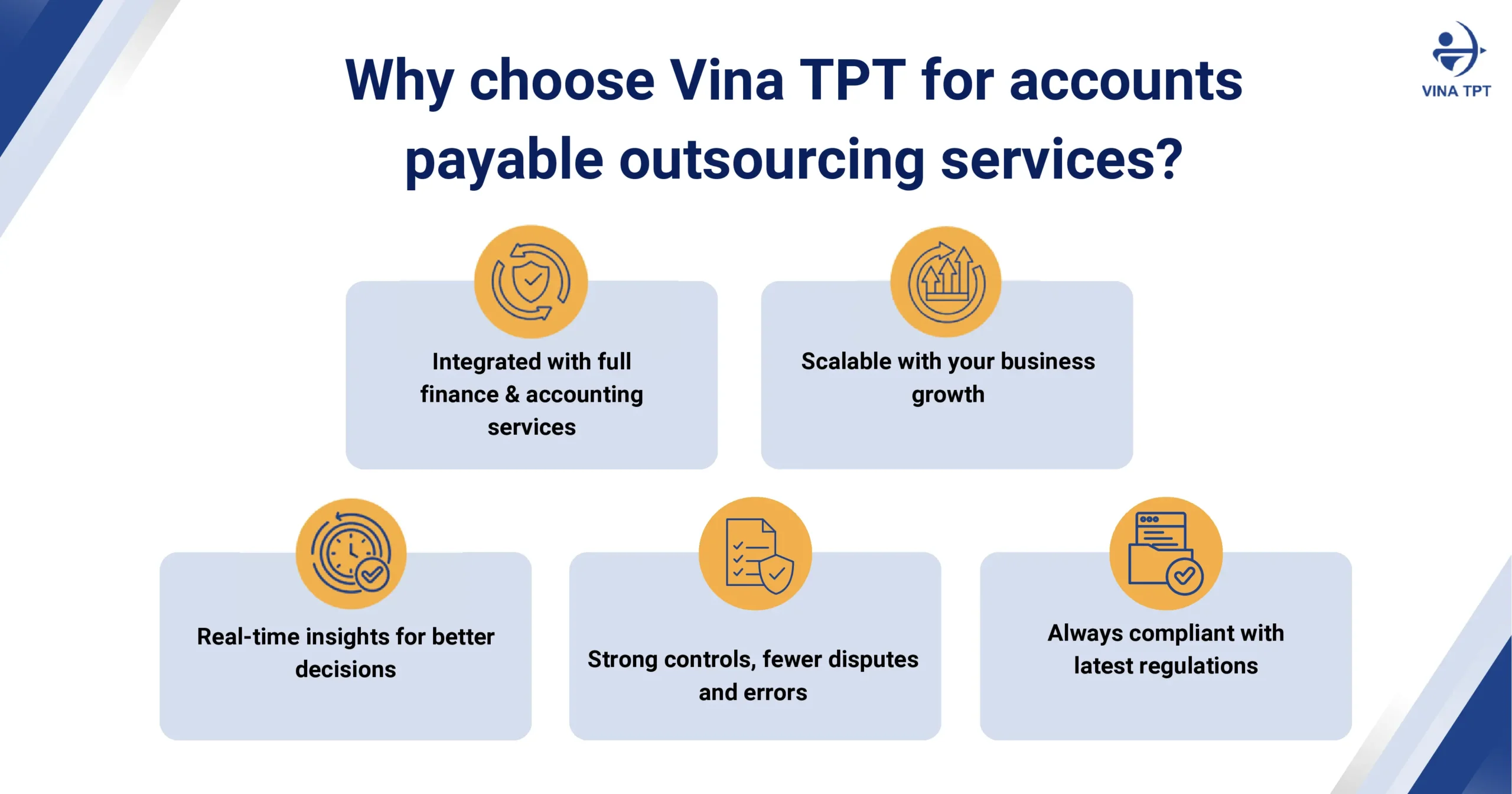
Vina TPT does not simply process invoices and payments, we deliver a comprehensive Accounts Payable solution that actively helps you control payables and optimize cash flow.

With over 20 years of experience supporting FDI and Vietnamese companies across manufacturing, trading, and distribution, we deeply understand the real challenges you face – from data discrepancies and delayed payments to complex compliance requirements.

Contact Vina TPT today for a free consultation and to build a customized Accounts Payable Outsourcing solution tailored to your business.

BOOK A FREE CONSULTATION

Outsource financial accounting services: The dominant operational trend for Vietnam businesses in 2026 and beyond

outsource-financial-accounting-services-the-dominant-operational-trend-for-vietnam-businesses-in-2026-and-beyon

outsource-financial-accounting-services-the-dominant-operational-trend-for-vietnam-businesses-in-2026-and-beyon

In the context of rapid digital economy growth and the Law on Investment 2025 taking effect from March 1, 2026, Vietnamese businesses are swiftly shifting toward more flexible and efficient operating models. Outsourced financial accounting services have emerged as a key trend during 2025–2026.

Major changes in accounting and tax regulations – notably Circular 99/2025/TT-BTC replacing Circular 200 from January 1, 2026, along with new provisions on VAT, Corporate Income Tax (CIT), and Personal Income Tax (PIT) – have created significant pressure on fixed costs and compliance requirements. Combined with the ongoing digital transformation, many businesses have realized that maintaining a large in-house accounting team is no longer the optimal solution.

This article analyzes why outsourcing financial accounting services is becoming the dominant trend, its practical benefits, future development directions through 2030, and the 5 important questions you should ask before selecting the right service provider.

1. Why outsource financial accounting services is becoming a major trend in Vietnam 2026

Currently, SMEs account for more than 98% of all enterprises in Vietnam, while FDI inflows continue to grow strongly in both scale and volume. However, maintaining a full in-house accounting team has become an increasingly heavy burden for many businesses.

The main challenges stem from:

  • Continuously rising costs of qualified accounting personnel
  • Frequent changes in tax laws and accounting regulations (VAS, Circular 99/2025/TT-BTC, electronic invoicing, VAT policies, etc.)
  • Pressure from digital transformation, which demands fast, accurate, and real-time reporting systems
  • Difficulties in recruiting and retaining talented accountants who possess deep knowledge of both Vietnamese standards and international practices

In response to these challenges, more and more businesses are adopting a hybrid model – maintaining a small, lean in-house accounting team for daily operations while outsourcing more complex functions such as financial reporting, tax compliance, and strategic advisory.

It is clear that outsourcing financial accounting services is no longer merely a cost-saving solution. It has evolved into a smart operational strategy that enhances businesses’ long-term competitiveness in Vietnam’s dynamic and ever-changing business environment.

2. Key benefits of outsource financial accounting services for SMEs and FDI companies

Unlike in the past when outsourcing was mainly viewed as a cost-cutting solution, businesses today use it as a lever to elevate the quality of financial management.

Outsourcing financial accounting services delivers many practical and long-term benefits:

  • Significant cost savings: Reduce expenses by 30-40% compared to building and maintaining a full in-house accounting team, including salaries, training, accounting software, and office costs.
  • Reduced compliance and tax penalty risks: Professional providers stay up-to-date with legal changes, ensure full compliance with VAS, support timely tax filings, and are ready to assist during tax audits or inspections.
  • Timely reporting and better decision-making: Deliver clear management reports, real-time dashboards, and necessary financial analysis, enabling leaders to proactively monitor cash flow and business performance.
  • High flexibility and scalability: Easily adjust service scope according to the company’s development stage – from basic bookkeeping to strategic financial advisory and Fractional CFO support.
  • Focus on core business activities: Leadership and specialized teams can dedicate time and resources to product development, customer service, and business expansion instead of being distracted by administrative compliance tasks.

In summary, outsource financial accounting services not only helps businesses reduce costs and risks but also provides a clear competitive advantage through optimized resource allocation and improved financial decision-making.

3. Future trends of Outsourced Financial Accounting services in Vietnam

Unlike in the past, when outsourcing was primarily viewed as a cost-saving measure, Vietnamese businesses today are increasingly adopting outsourced financial accounting services as a strategic lever to elevate the overall quality of financial management.

outsource-financial-accounting-services-the-dominant-operational-trend-for-vietnam-businesses-in-2026-and-beyon

These benefits extend far beyond immediate gains and point toward strong development trends in the period 2026-2030. Outsourced financial accounting services in Vietnam are expected to evolve significantly with the following key features:

  • Cloud-based systems and AI automation: Accounting processes will be heavily automated through cloud technology and artificial intelligence, reducing human error, accelerating processing speed, and improving overall accuracy.
  • Real-time reporting and data analytics: Businesses will no longer need to wait for periodic reports. Instead, they can monitor critical financial indicators anytime through intuitive online dashboards.
  • Strategic advisory and Fractional CFO services: Outsourcing will shift from pure execution to high-level strategic consulting, including long-term financial planning, capital structure optimization, and risk management.
  • Stronger alignment with international standards: Particularly IFRS and ESG reporting, helping FDI companies more easily meet requirements from foreign investors and parent companies.
  • Hybrid outsourcing model becomes the norm: Combining a lean in-house team with specialized outsourced services will be the most common and balanced approach.
  • Vietnam emerges as a regional Accounting BPO hub: With competitive costs and a high-quality accounting workforce, Vietnam is rapidly becoming an attractive destination for multinational corporations to establish their accounting Business Process Outsourcing (BPO) centers.

In conclusion, outsourced financial accounting services not only provide immediate practical advantages but also represent a long-term strategic solution. They empower Vietnamese businesses to compete more effectively and sustainably in the dynamic business environment of 2026 and beyond.

Explore Accounting Services

5 important questions you should ask before choosing an outsource financial accounting Provider

Choosing the right partner for outsource financial accounting services will determine your business’s success and peace of mind for years to come. Here are the 5 most critical questions to ask before signing a contract:

1. How many years of experience does your company have in supporting FDI enterprises and ensuring VAS compliance in Vietnam?

Practical experience with FDI companies and VAS-compliant accounting is essential, given the high compliance risks and the need to understand differences between Vietnamese and international standards.

Recommendation: FDI businesses should prioritize providers with accounting professionals who have at least 10 years of specialized experience in this field.

2. How does your workflow and technology support real-time reporting?

In today’s fast-paced environment, leaders need quick access to financial data. A reputable provider must offer modern cloud platforms and online dashboards for timely and effective financial monitoring.

3. What are your commitments regarding deadlines and liability in case of errors or delays?

The service contract must include a comprehensive Service Level Agreement (SLA) that clearly defines processing deadlines for key tasks and establishes a fair compensation mechanism should any errors or delays occur due to the provider’s responsibility.

Furthermore, a high-quality service provider will maintain a fast and responsive communication system, ensuring timely support and quick resolution whenever you require assistance.

4. Does your team provide tax advisory, financial structuring support, and assistance during audits or inspections?

Quality outsourcing goes beyond bookkeeping – it should include strategic advice and practical support for tax inspections, audits, and financial optimization.

A reputable service provider must offer practical, hands-on support during tax inspections, audits, or any issues arising with government authorities. This assistance helps minimize potential disruptions and significantly reduces the risk and amount of penalties.

5. Can you provide case studies or client references from similar industries?

Real case studies and references help evaluate the provider’s industry knowledge, reliability, and execution capability.

At Vina TPT, we are always ready to answer these questions clearly and transparently. We believe a good provider should not only excel at technical tasks but also become a trusted business partner for your long-term sustainable development.

5. Why Vina TPT Is the Trusted Partner for Outsource Financial Accounting Services

With more than 20 years of experience supporting FDI and Vietnamese enterprises, Vina TPT is one of the most experienced providers of outsourced financial accounting services in Vietnam.

We offer comprehensive, flexible solutions tailored to each business’s actual needs. Our service package includes:

  • Bookkeeping in full compliance with VAS
  • Tax Compliance & Filing
  • Payroll Processing
  • Financial Reporting & Management Insights
  • Strategic Advisory and Qualified Chief Accountant services

outsource-financial-accounting-services-the-dominant-operational-trend-for-vietnam-businesses-in-2026-and-beyon

Conclusion

Outsource financial accounting services is no longer a temporary trend – it has become a necessary operational strategy for most businesses in Vietnam in 2026 and beyond.

Choosing the right partner will help you achieve significant cost savings, minimize compliance risks, strengthen financial control, and support more effective business decision-making.

Contact Vina TPT today for a free consultation and to build the most suitable outsourced financial accounting solution for your business scale and development goals.

BOOK A FREE CONSULTATION

Starting a business in Vietnam: 12 frequently asked questions by foreign investors

starting-a-business-in-vietnam-12-frequently-asked-questions-by-foreign-investors

Vietnam continues to be an attractive destination for FDI capital thanks to its strategic location, competitive costs, and continuously improving business environment. With the Law on Investment 2025 taking effect from March 1, 2026, the company incorporation process has become more flexible. In many cases, investors can now obtain the Enterprise Registration Certificate (ERC) before the Investment Registration Certificate (IRC).

However, understanding the legal procedures, required documents, timelines, and ongoing compliance obligations remains a challenge for many new foreign investors.

This article compiles the 12 most frequently asked questions by foreign investors when starting a business in Vietnam. The content is organized by stage to give you a clear overview of the entire process – from preparation to operation.

12 most frequently asked questions about starting a business in Vietnam 2026

starting-a-business-in-vietnam-12-frequently-asked-questions-by-foreign-investors

1. Can foreigners own 100% of a company in Vietnam in 2026?

Most business sectors in Vietnam allow 100% foreign ownership. According to Vietnam’s WTO commitments and the Law on Investment 2025, only a few sectors, such as advertising, logistics, tourism, and education, may have ownership restrictions or require joint ventures with Vietnamese partners.

Tip: Check the business line code and market access conditions carefully before planning to avoid having to amend your application during the appraisal process.

2. What is the minimum charter capital required for a foreign-owned company?

Vietnamese law does not set a universal minimum charter capital for all sectors. However, the registered capital must be appropriate to the project scale and will be reviewed by the licensing authority.

In practice, common reference levels include:

  • Trading and distribution: USD 10,000 – 50,000 (USD 10,000 is often considered the practical minimum)
  • Fintech: around USD 2 million, depending on the business model and licensing requirements
  • Commercial banks: approximately USD 120 million (under specialized regulations)
  • Real estate: No fixed minimum, but a minimum equity ratio of 20% (for projects under 20 hectares) or 15% (for projects of 20 hectares and above) is required.

Important note: Charter capital must be fully contributed within 90 days from the date the Enterprise Registration Certificate (ERC) is issued. Failure to do so may result in administrative penalties and affect the company’s credibility with authorities and partners.

3. What documents must foreign investors prepare and do they require consular legalization?

Document preparation is a critical step when starting a business in Vietnam. The main required documents include:

  1. Application for investment project implementation
  2. Proof of the investor’s legal status (passport for individuals; Certificate of Incorporation for organizations)
  3. Investment project proposal (including objectives, scale, total investment capital, funding plan, location, timeline, and socio-economic impact assessment)
  4. Proof of financial capacity (bank statements or parent company support letter)
  5. Documents proving the project location (office lease agreement or proof of legal right to use the premises)
  6. Technology explanation (if the project requires technology appraisal)
  7. Business Cooperation Contract (BCC)

Important: All foreign documents must be consular legalized, notarized, and officially translated into Vietnamese. This is a mandatory requirement for the application to be accepted.

EXPLORE OUR SERVICES

4. Which business lines are still conditional or restricted for foreign investors?

Approximately 80% of business lines in Vietnam have no conditions, allowing relatively straightforward operations after company registration.

However, investors should pay attention to:

  • Conditional business lines: Education, healthcare, logistics, tourism, advertising, real estate, etc. (require sub-licenses, facilities, or professional capacity)
  • Restricted market access sectors: May limit foreign ownership percentage or require joint ventures with Vietnamese partners
  • Prohibited sectors: As stipulated by Vietnamese law

From July 1, 2026, the updated list of conditional business lines under the Law on Investment 2025 will be fully applied. Always verify your business line code and specific conditions before registration.

5. Should I choose a Limited Liability Company (LLC) or Joint Stock Company (JSC)?

The choice depends on your investment objectives, project scale, and future development plans.

  • Limited Liability Company (LLC): Most popular among foreign investors due to its simple structure, high flexibility, and suitability for startups or medium-sized businesses.
  • Joint Stock Company (JSC): Better suited for companies planning to raise capital from multiple investors or prepare for future listing.

For the initial stage of starting a business in Vietnam, an LLC is usually recommended. You can later convert to a JSC when scaling or seeking larger investments.

starting-a-business-in-vietnam-12-frequently-asked-questions-by-foreign-investors

6. What is the difference between IRC and ERC under the new Investment Law 2026?

  • IRC (Investment Registration Certificate): Approves the investment project, including capital, business lines, location, and incentives (if any).
  • ERC (Enterprise Registration Certificate): Establishes the company’s legal entity status, including the tax code and business registration details.

Under the Law on Investment 2025, in non-restricted sectors, investors can apply for the ERC before the IRC. This allows the company to obtain legal status earlier for opening bank accounts, leasing offices, or applying for visas.

7. How long does it actually take to register a company in Vietnam in 2026?

The timeline depends on the project type and document quality. The process typically includes:

  • Investment Registration Certificate (IRC): 30 – 45 working days
  • Enterprise Registration Certificate (ERC): 7 – 10 working days after IRC approval

With complete and valid documents, the total process usually takes 6 to 8 weeks. Proper preparation and working with an experienced consultant can significantly reduce delays.

EXPLORE OUR SERVICES

8. Do I need a Vietnamese legal representative or director?

Every company in Vietnam must have at least one legal representative residing in Vietnam. This person can be a Vietnamese citizen or a foreigner holding a valid Temporary Residence Card (TRC).

Foreign investors can serve as the legal representative themselves if they meet the residency requirements.

>>> You may also be interested in: Nominee Director in Vietnam: Legal Risks, Requirements, and Safer Alternatives for Foreign Investors (2026 Guide)

9. Can I apply for a Temporary Residence Card (TRC) during or right after registration?

Yes. Investors can apply for a TRC after the company receives its ERC and holds an appropriate DT visa (DT1-DT3 depending on capital contribution).

Processing time is typically 5-15 working days. Many investors apply for the TRC immediately after company registration to secure long-term residency.

>>> You may also be interested in: Guide to Securing a TRC Vietnam for Foreign Investors in 2026

starting-a-business-in-vietnam-12-frequently-asked-questions-by-foreign-investors

10. What must I do immediately after receiving the Enterprise Registration Certificate (ERC)?

After receiving the ERC, you should promptly complete the following:

  • Open an investment capital account (DICA) and fully contribute charter capital within 90 days
  • Register for tax, obtain a digital signature, and issue electronic invoices
  • Register and announce the company seal (if required)
  • Register employees and social insurance (if hiring staff)

11. What are the key ongoing compliance obligations (tax, reporting, IAR…)?

Once operational, companies in Vietnam must fulfill regular compliance obligations, including:

  • Declaration and payment of VAT, Corporate Income Tax (CIT), and Personal Income Tax (PIT)
  • Submission of Investment Activity Reports (IAR) – quarterly and annually for FDI companies
  • Preparation of annual financial statements (some companies require statutory audit)
  • Updating any changes in company registration (capital, business lines, legal representative, etc.)

12. When and why should I consider outsourced financial accounting services?

It is highly recommended to engage outsourced accounting services from the early stage if you do not yet have an internal team familiar with VAS and Vietnamese tax regulations.

Outsourcing helps control costs, minimize compliance risks, and ensures timely, accurate financial reports for both management and investors.

Looking for a reliable accounting partner? Explore Vina TPT’s outsourced accounting services to find the right solution for your business.

Explore Accounting Service

Why choose Vina TPT for starting and operating your business in Vietnam

With over 20 years of experience supporting FDI enterprises, Vina TPT provides comprehensive solutions for foreign investors when starting a business in Vietnam:

  • Full support for IRC, ERC, TRC, and work permit procedures
  • Qualified Chief Accountant and outsourced finance & accounting services (bookkeeping, tax, payroll)
  • Bilingual and multilingual reporting (Vietnamese – English – Japanese)
  • End-to-end support from company formation through operations and expansion

Each client is supported by a multi-level expert team (Assistant – Senior – Manager), ensuring accuracy and timeliness.

starting-a-business-in-vietnam-12-frequently-asked-questions-by-foreign-investors

Conclusion

With the Law on Investment 2025, starting a business in Vietnam has become more transparent and flexible. However, thorough preparation regarding documents, capital, and compliance obligations remains essential for success.

Partnering with a professional consulting firm will help you save time, reduce risks, and focus on your core business activities.

Contact Vina TPT today for personalized consultation and a tailored solution for your investment plan in Vietnam.

BOOK A FREE CONSULTATION

Accountant for Startups in Vietnam: How to choose the right Accounting Service

accountants-for-startups-in-vietnam-key-services-every-founder-should-know

accountants-for-startups-in-vietnam-key-services-every-founder-should-know

For foreign investors starting a business in Vietnam, you focus on building your product, acquiring customers, and scaling the market. Meanwhile, bookkeeping, tax compliance, and financial reporting, especially with Vietnam’s constantly evolving tax regulations, can quickly become major obstacles if not handled properly.

Accountants for startups are specialized accounting services, usually provided on an outsourcing basis. They offer flexible support ranging from transaction recording and tax filing to strategic financial advice. These services can scale with your business stages, deliver timely data, and help founders make better-informed decisions.

Below is essential information every founder should know when choosing accountants for startups in Vietnam in 2026.

Why startups need specialized accountants (Not just any Bookkeeper)

Startups are characterized by rapid growth, high cash burn, tight runway monitoring, and the need for investor-ready financial reports. A regular bookkeeper typically focuses on basic data entry and record-keeping.

In contrast, accountants for startups are typically provided as specialized outsourced accounting services, offering not only bookkeeping but also strategic financial support, tax optimization, and actionable insights to help founders make informed decisions.

Key reasons startups need specialized accounting services include:

  • Preparation of financial models and reports for fundraising
  • Taking advantage of tax incentives under Decree 20/2026 (corporate income tax exemption/reduction for startups)
  • Ability to scale quickly as the company grows
  • Distinguishing between simple data entry and strategic financial analysis

Therefore, accountants for startups go far beyond basic bookkeeping. They act as a vital tool to help startups control cash flow and avoid running out of money before achieving product-market fit.

2. 5 essential services accountants for startups

To evaluate whether an accounting service is suitable for your startup, founders should consider these 6 key functions:

2.1 Bookkeeping & Daily Transaction Management

Bookkeeping forms the foundation of your financial system. It involves recording and classifying daily transactions in accordance with Vietnamese Accounting Standards (VAS).

In the early stages, startups often have frequent small transactions. If not recorded accurately and promptly, discrepancies can accumulate and create serious financial control issues.

Key tasks include:

  • Recording transactions in accordance with Vietnamese Accounting Standards (VAS)
  • Using cloud-based software for real-time data entry and bank reconciliation
  • Categorizing expenses (marketing, server costs, salaries, etc.)

Cloud-based systems allow founders to access financial data anytime, while minimizing accumulated errors that could require major adjustments later.

Explore Accounting Services

2.2 Tax Filing

Tax filling services involves fulfilling all tax obligations, including declaration, payment, and staying updated with legal changes.

For startups, understanding and utilizing available tax incentives is crucial for optimizing early-stage costs.

Key tasks include:

  • Timely declaration and payment of VAT, Corporate Income Tax (CIT), and Personal Income Tax (PIT)
  • Application of tax incentives under Decree 20/2026/NĐ-CP (where applicable)
  • Handling electronic invoices and monitoring new tax regulations

Accurate tax filing is not only a legal requirement but also helps avoid administrative penalties. For newly established startups without an experienced internal team, outsourcing tax compliance is often the safest and most efficient choice.

2.3 Payroll & Employee Benefits

Payroll management covers salary processing and all employee-related obligations. In a startup environment, team structures change rapidly, often with flexible policies such as performance bonuses or stock options.

Key tasks include:

  • Calculating salaries, bonuses, and incentives
  • Handling social insurance (BHXH), health insurance (BHYT), unemployment insurance (BHTN), and PIT deductions

Efficient payroll management reduces labor disputes and helps maintain team stability.

GET PROFESSIONAL PAYROLL SUPPORT

2.4 Financial Reporting & Management Insights

Financial reporting services both compliance and management purposes. For startups, tracking burn rate and runway is essential for cash flow control.

Key tasks include:

  • Preparing monthly Profit & Loss (P&L) statements and cash flow reports
  • Monitoring gross and net burn rate as well as runway
  • Providing intuitive management dashboards

Real-time visibility into burn rate helps founders understand exactly how long their current capital will last and make proactive spending adjustments.

2.5 Audit & Compliance Readiness

Audit readiness means keeping your records and data prepared for audits or investor due diligence. As startups raise larger funding rounds, transparency requirements increase significantly.

Key tasks include:

  • Preparing documentation for audits
  • Support with appointing a Qualified Chief Accountant
  • Coordinating with external auditors throughout the audit process to finalize audited financial statements
  • Ensuring full regulatory compliance

Being audit-ready helps startups avoid delays during fundraising, pass tax inspections smoothly, and build credibility with investors.

accountants-for-startups-in-vietnam-key-services-every-founder-should-know

Why many startups choose to outsource Accounting instead of building in-house teams

Most startups prefer outsourcing accountants rather than building an internal finance team early on. Here are the main advantages:

  • Cost optimization: Building a full in-house accounting team (bookkeeping, tax, reporting, and chief accountant) involves high fixed costs for salaries, benefits, training, and software – a heavy burden when revenue is unstable.
  • Reduced compliance risks: Vietnam’s accounting and tax regulations change frequently. Experienced outsourced teams stay updated and have handled similar cases for many startups.
  • Timely reporting and better decision-making: Outsourced services deliver not only raw data but also management insights such as burn rate, runway, cash flow forecasts, and investor-ready reports.
  • Flexibility across growth stages: You can start with basic bookkeeping and scale up to strategic advisory as your startup grows, without locking in high fixed costs.
  • Focus on core activities: Founders and teams can concentrate on product development, customer acquisition, and market expansion instead of administrative tasks.

In today’s competitive startup ecosystem, outsourcing accounting is no longer just a cost-saving measure, it has become a strategic decision that enhances efficiency, reduces risk, and builds a solid foundation for sustainable growth.

Key considerations when choosing accountants for startups

When selecting accountants for startups, founders should evaluate more than just price. Consider these important factors:

  • Proven experience with startups and FDI companies
  • Strong knowledge of VAS (Circular 99), current tax regulations, and startup incentives
  • Use of modern cloud technology and real-time dashboards
  • Ability to provide strategic advisory and financial analysis
  • Flexible pricing models (package or stage-based)
  • Clear contract scope, reporting timelines, and SLA commitments
  • Relevant case studies with similar startups

accountants-for-startups-in-vietnam-key-services-every-founder-should-know

Why Vina TPT Is the Trusted Accountants for Startups in Vietnam

With over 20 years of experience supporting FDI companies and startups in Vietnam, Vina TPT offers comprehensive accountants for startups services with a professional and scalable approach:

  • Bookkeeping compliant with VAS and tax regulations
  • Flexible payroll solutions tailored for startup structures
  • Financial reporting with key metrics such as burn rate and runway
  • Strategic advisory including financial modeling and cost optimization
  • Support from company formation through audit and compliance readiness
  • Bilingual and multilingual reporting

Every client is supported by a multi-level expert team (Assistant – Senior – Manager), ensuring high quality and timely delivery of financial data.

Professional accountants for startups help you maintain transparent finances, reduce risks, utilize 2026 tax incentives, closely monitor burn rate & runway, and prepare effectively for fundraising rounds. The result is faster, more sustainable growth without being held back by administrative issues.

Contact Vina TPT today for personalized consultation and a tailored accountants for startups solution that matches your current growth stage.

BOOK A FREE CONSULTATION

Restaurant Bookkeeping services in Vietnam: 6 key functions every owner needs

restaurant-bookkeeping-services-in-vietnam-6-key-functions-every-owner-needs-in-2026

restaurant-bookkeeping-services-in-vietnam-6-key-functions-every-owner-needs-in-2026

Running a restaurant in Vietnam involves managing multiple moving parts – kitchen operations, customer service, staff scheduling, and delivery platforms. Revenue can fluctuate seasonally, while food cost and labor cost often account for 60-70% of total expenses. Additionally, integrating POS systems with delivery apps like Grab, ShopeeFood makes accurate data recording and control increasingly complex.

Restaurant Bookkeeping services are specialized accounting solutions designed for the F&B industry. They focus on handling perishable inventory, multi-channel revenue, shift-based labor costs, and daily prime cost tracking. Outsourcing this function helps restaurant owners obtain accurate, timely reports that comply with Vietnamese Accounting Standards (VAS) under Circular 99, while ensuring full adherence to the 8% VAT rate applied to food and beverage services through December 31, 2026.

Below are the 6 key functions every restaurant owner or F&B investor should look for when choosing professional Restaurant Bookkeeping services in Vietnam.

1. Sales & Revenue Tracking

Sales and revenue tracking involves recording, reconciling, and analyzing all income from various sources to ensure data accuracy and consistency between operations and accounting records.

Key tasks include:

  • Direct integration with POS systems and delivery platforms (Grab, ShopeeFood, Baemin, etc.)
  • Reconciliation of revenue by payment method: cash, card, bank transfer, and e-wallets
  • Breakdown of sales by shift, by menu item, and by day

In the F&B sector, revenue is generated continuously – often hour by hour. Weekly reconciliation is therefore essential to detect cash discrepancies, data errors, or missing orders in a timely manner, helping minimize losses and maintain tight revenue control.

2. Inventory & Cost of Goods Sold (COGS) Management

For restaurants, profitability depends heavily on effective cost control of raw materials. Inventory and COGS management tracks stock levels and calculates the actual cost of each dish.

Because ingredients are constantly received and used, recorded data may not always reflect real consumption. Without regular stocktaking and reconciliation, small discrepancies can lead to significant losses.

Key tasks include:

  • Analysis of variances between theoretical and actual inventory, along with recommended adjustments.
  • Accurate calculation of COGS and food cost percentage.
  • Monitoring product expiry timelines and coordinating with internal staff for timely handling.
Food cost typically represents a significant portion of total expenses. Even small discrepancies in recording or inventory data can lead to substantial losses if not identified and addressed in a timely manner.

3. Expense Categorization & Vendor Management

Expense categorization and vendor management ensure all costs are recorded accurately and transparently.

Restaurants often work with numerous suppliers. Without clear categorization and regular reconciliation, businesses risk misrecording expenses or making duplicate payments.

Key tasks include:

  • Categorizing expenses (food, beverages, overhead, marketing, utilities, etc.)
  • Managing suppliers, reconciling invoices, and controlling payments
  • Tracking contract terms and payment schedules

Accurate expense categorization helps optimize overhead costs while maintaining service quality.

restaurant-bookkeeping-services-in-vietnam-6-key-functions-every-owner-needs-in-2026

4. Payroll & Employee Cost Handling

This function covers salary calculation, labor cost management, and fulfillment of tax and insurance obligations for employees.

Most restaurant staff work flexible shifts, with overtime and customer tips. Without a clear payroll system, errors in income allocation can easily occur, leading to staff disputes or tax filing inaccuracies.

Key tasks include:

  • Calculating wages based on shifts, overtime, bonuses, and tip allocation
  • Handling social insurance (BHXH), health insurance (BHYT), unemployment insurance (BHTN), and Personal Income Tax (PIT) deductions under 2026 regulations
  • Managing leave, maternity benefits, and staff changes
  • Preparing confidential payroll reports and payslips for each employee

Accurate payroll management helps control labor costs while ensuring full compliance with Vietnam’s labor and tax laws.

EXPLORE PAYROLL SERVICES

5. Financial Reporting & Management Insights

Financial reporting and management insights involve preparing financial statements and analyzing data to provide timely information that supports operational and strategic decision-making.

A restaurant may generate high revenue but low profit due to uncontrolled ingredient or labor costs. Without detailed daily or shift-based reports, owners struggle to identify problems and make timely adjustments.

Key tasks include:

  • Preparing Profit & Loss (P&L) statements by day, week, and month according to VAS standards
  • Delivering management reports such as prime cost reports, cash flow forecasts, and menu profitability analysis
  • Providing bilingual (Vietnamese – English) or multilingual reports (including Japanese if needed)
  • Real-time data visualization through dashboards

The goal is to deliver clear, timely financial data so restaurant owners can not only monitor performance but also proactively optimize operations.

6. Tax Compliance & Filing

This function ensures the business fulfills all tax obligations, including declaration, payment, and reporting as required by Vietnamese law.

Key tasks include:

  • Declarate Value Added Tax (VAT)
  • Corporate Income Tax (CIT) and Personal Income Tax (PIT) finalization
  • Handling electronic invoices
  • Support during tax audits or inspections

Proper tax compliance minimizes risks of penalties and supports stable long-term operations.

>>> You may also be interested in: 

7. Why outsourcing Restaurant Bookkeeping services Is a game changer

Outsourcing restaurant bookkeeping services enables F&B businesses to ensure compliance while significantly improving operational efficiency and financial control. In an industry characterized by fluctuating revenue, high ingredient costs, and shift-based operations, having an accurate and timely accounting system is essential.

Key benefits include:

  • Cost optimization and time savings: Eliminate the need for a specialized in-house accounting team, reducing training, software, and personnel management costs.
  • Higher accuracy and compliance: Data is processed according to VAS standards and updated tax regulations, minimizing errors and penalty risks.
  • Better control and decision-making: Timely financial reports allow owners to monitor performance, control costs, and adjust operations flexibly.
  • Access to F&B industry expertise: Work with professionals who understand restaurant-specific best practices for cost control and operations.
  • Support for multi-branch expansion: Standardized accounting systems make scaling easier while maintaining consistency.
  • Real-time technology: Cloud-based tools provide anytime access to data, reduce data loss risks, and enable real-time financial monitoring.

Vina TPT Bookkeeping services: Tailored for Restaurants in Vietnam

Understanding the unique operational needs of the F&B sector, Vina TPT has developed specialized bookkeeping services for restaurant businesses and FDI enterprises in Vietnam. Our solutions emphasize flexibility, data security, and multilingual support to simplify financial and HR management.

Our restaurant-focused services include:

  • Automated shift-based payroll calculation integrated with timekeeping systems
  • Electronic invoicing, tax reporting, and PIT handling for part-time staff
  • Bilingual and multilingual financial reports (English – Vietnamese – Japanese) tailored to corporate standards
  • Ongoing legal compliance support and updates on the latest labor regulations in Vietnam

With our multi-level review process (Assistant – Senior – Manager), all data and reports undergo thorough checking before delivery. This ensures restaurant owners can monitor labor costs in real time, maintain full compliance with Vietnamese Accounting Standards (VAS), minimize errors, and optimize processing time.

Contact Vina TPT today to receive personalized consultation and build the most suitable restaurant bookkeeping service package for your business scale and operating model. Our expert team is ready to support you in achieving stable operations and sustainable growth.

BOOK A FREE CONSULTATION

restaurant-bookkeeping-services-in-vietnam-6-key-functions-every-owner-needs-in-2026