


According to the Ministry of Finance, in the first eight months of 2025, newly registered FDI capital from Japan to Vietnam reached USD 877.9 million, accounting for about 8% of total registered investment capital. In addition, a survey by the Japan Bank for International Cooperation (JBIC) ranks Vietnam second among the most attractive overseas investment destinations for Japanese enterprises.
So when considering setting up a business in Vietnam, what types of enterprises can Japanese investors choose? What is the company establishment process, and what legal issues should investors pay attention to? This article outlines common company structures, the company establishment process, and key considerations for Japanese investors investing in Vietnam.

1. Why Vietnam is an attractive destination for Japanese investors
Vietnam is becoming an increasingly attractive investment destination for many Japanese companies due to several advantages:
- Stable Vietnam – Japan relations: The two countries maintain a Comprehensive Strategic Partnership, creating a stable foundation for long-term cooperation and a reliable investment environment for Japanese enterprises considering setting up a business in Vietnam.
- Competitive production costs and investment incentives: Vietnam has a young workforce, competitive production costs, and various tax incentive policies designed to attract foreign investment.
- Strategic location in the regional supply chain: Located in the center of Southeast Asia and participating in major free trade agreements such as the Comprehensive and Progressive Agreement for Trans-Pacific Partnership (CPTPP) and the Regional Comprehensive Economic Partnership (RCEP), Vietnam provides favorable conditions for Japanese companies to expand manufacturing and export activities to many markets in the region.
- A rapidly growing domestic market: With a population of over 100 million people and a growing middle class, Vietnam represents a promising consumer market for many Japanese companies considering setting up a business in Vietnam.
So what company types for foreign investors in Vietnam are available for Japanese investors?
2. Các loại hình thành lập doanh nghiệp phổ biến tại Việt Nam cho nhà đầu tư Nhật
According to Article 21 of the Investment Law 2020, Japanese investors may establish four main types of business entities when setting up a business in Vietnam, including:
- Single-member limited liability company (100% foreign-owned): This is a company owned by a single individual or organization. In foreign investment cases, the owner is typically a foreign investor or a foreign company.
- Multi-member limited liability company: This is one of the most common company types for foreign investors in Vietnam, allowing 2 to 50 capital contributors. Foreign investors may participate with ownership ratios permitted under the relevant business sector regulations.
- Joint-stock company: This type of enterprise has at least three shareholders and is allowed to issue shares to raise capital from investors.
- Representative office: A representative office does not conduct business activities like a company. It mainly performs functions such as market research, trade promotion, and liaison support with local partners.
Below is a comparison of the key characteristics, advantages, and disadvantages of each structure available when setting up a business in Vietnam.
|
Criteria |
Single-member LLC | Multi-member LLC | Joint-stock company |
Representative office |
| Suitable for | Investors wanting 100% ownership and full control | Joint ventures or cooperative projects | Large companies requiring capital mobilization | Foreign companies exploring the market |
| Members/shareholders | 1 individual or organization | 2–50 members | Minimum 3 shareholders, unlimited maximum | Not applicable |
| Legal entity status | Yes | Yes | Yes | Not an independent legal entity |
| Organizational structure | Members’ Council, Director/General Director | Members’ Council, Chairman, Director/General Director, Supervisory Board (if required) | General Meeting of Shareholders, Board of Directors, Director/General Director, Supervisory Board or Internal Audit | Chief Representative |
| Capital mobilization | Limited, mainly from owner | Capital contribution from members | High, can issue shares | No capital mobilization function |
| Share issuance rights | No | No | Yes | No |
| Advantages | Simple structure, full decision-making authority | Risk and capital shared among members | High fundraising ability, possibility of stock exchange listing | Simple establishment procedure, suitable for market research |
| Disadvantages | Difficult to raise external capital | Member limit (max 50) | More complex governance structure | Not allowed to conduct business activities |
In general, choosing the right company types for foreign investors in Vietnam directly affects the company’s operational strategy and governance structure after setting up a business in Vietnam. The choice will largely depend on the investor’s objectives and business strategy.
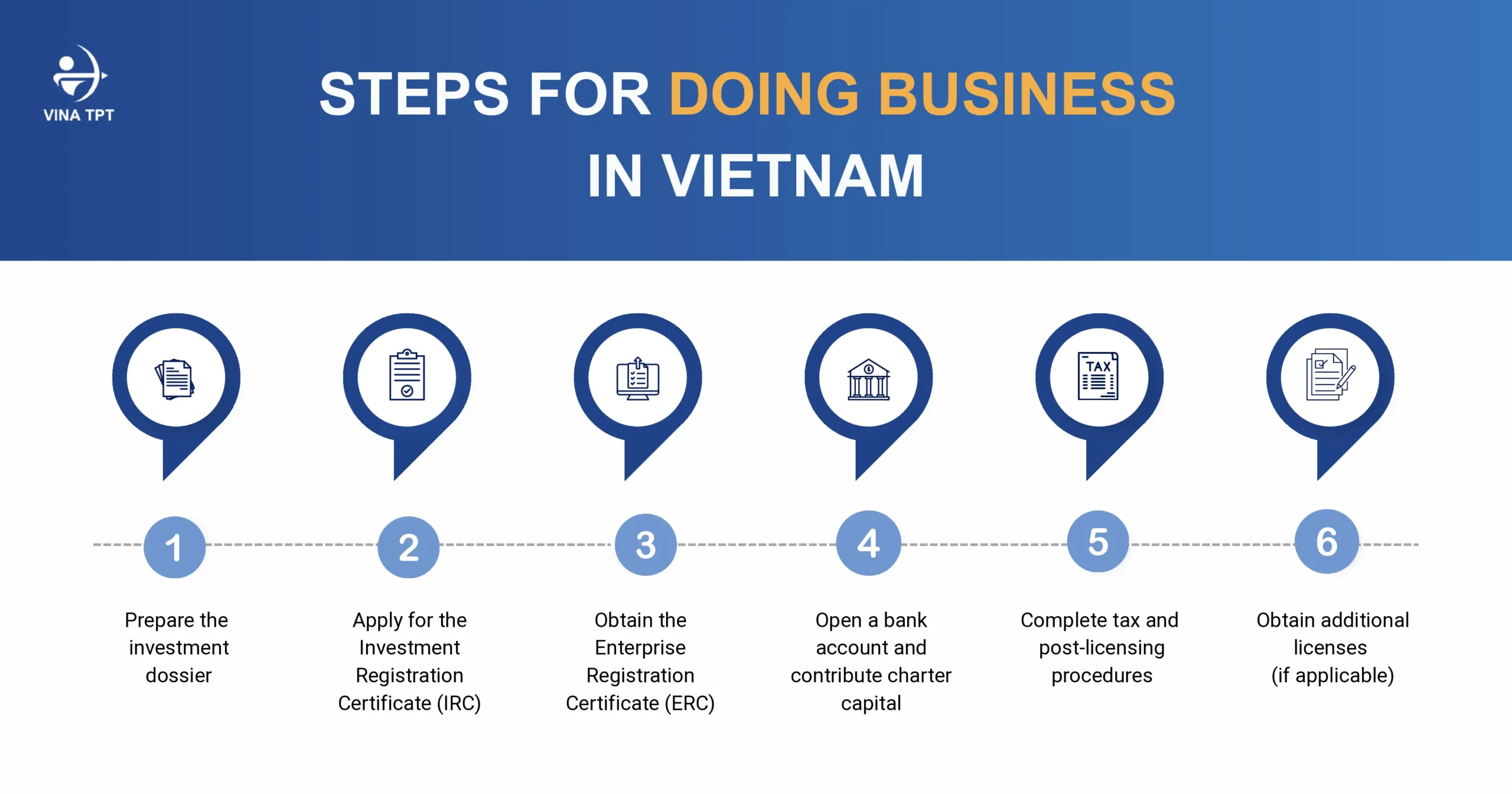
3. Step-by-step process for setting up a business in Vietnam
Step 1: Prepare the investment dossier
This is the critical first step in the process of setting up business in Vietnam. The dossier must be prepared in accordance with the Investment Law 2025.
- Written request for implementation of the investment project
- Documents proving the investor’s legal status:
- For individuals: Citizen ID/Passport (copy)
- For organizations: Certificate of incorporation or equivalent legal document (copy)
- Investment project proposal (including investor information, objectives, investment capital, scale, capital mobilization plan, location, schedule, and socio-economic efficiency assessment)
- Documents proving financial capacity:
- Individuals: savings book, bank balance confirmation
- Organizations: financial statements for the last two years, financial commitment from the parent company or a financial institution
- Head office lease agreement or documents proving the right to use the project location
- Technology explanation (for projects subject to technology appraisal)
- BCC business cooperation contract (if investing under this form)
The dossier is submitted to the Department of Finance in the province/city where the project’s head office is located.
Step 2: Submit the application for the Investment Registration Certificate (IRC)
Obtaining the Investment Registration Certificate is also a key step in business registration in Vietnam for Japanese investors, as this certificate officially approves and confirms the company’s investment project.
Required documents include:
- Application form and a detailed project proposal (objectives, scale, investment capital, location, and timeline)
- Proof of financial capability (bank statements, audited financial reports, or credit agreements)
- Legal documents: notarized passport (individual) or business registration certificate (organization), both legalized
- Proof of location (lease agreement or land use rights)
- Power of attorney (if using a third-party service)
Foreign documents must be consular legalized and officially translated into Vietnamese. The processing time for an IRC application is typically 5-6 weeks , depending on the nature of the project and the review requirements of the investment registration authority. It is recommended to work with a professional service provider such as Vina TPT to avoid delays.
Step 3: Obtain the Enterprise Registration Certificate (ERC)
After the IRC is issued, the next step in setting up business in Vietnam is obtaining the ERC to establish the company’s legal entity status. Typically, the ERC is issued within 7-14 days from the submission date.
Step 4: Open a corporate bank account and inject charter capital
Foreign investors who open new company in Vietnam are required to:
- Open a dedicated investment capital account at a licensed bank in Vietnam
- Contribute the full charter capital within 90 days from the ERC issuance date to avoid penalties and maintain credibility for future licenses
Step 5: Complete tax registration and post-licensing procedures
Before officially commencing operations, the enterprise must:
- Register for a tax code and purchase a digital signature
- Apply for e-invoice issuance/registration
- Register labor and enroll employees in social insurance
Tax and labor obligations are the final steps in doing business in Vietnam before official operations begin.
Step 6: Apply for sector-specific licenses (if applicable)
Conditional business sectors may require additional sub-licenses such as business licenses, import-export licenses, or environmental permits.
By following these steps and staying updated on regulations, foreign investors can successfully establish operations in Vietnam.
4. Common challenges for Japanese investors when setting up a business in Vietnam
Although Vietnam is an attractive investment destination, the process of setting up a business in Vietnam may present several challenges for foreign investors, especially those entering the market for the first time.
- Differences in legal systems: Vietnam’s legal system and licensing procedures differ significantly from Japan’s. For example, companies must obtain an Investment Registration Certificate (IRC) before applying for an Enterprise Registration Certificate (ERC). Some sectors also require additional sub-licenses, which can make the licensing process more complex.
- Language and business culture barriers: Most legal documents and administrative procedures related to setting up a business in Vietnam are conducted in Vietnamese, including contracts, registration documents, and tax filings. Even with interpreters, reviewing legal documents in detail can still be challenging.
- Administrative procedures involving multiple authorities: Administrative procedures in Vietnam often involve several regulatory bodies. For example: Representative offices must register with the Department of Industry and Trade and Branches of foreign traders may need to register with the Ministry of Industry and Trade. Incorrectly identifying the competent authority may delay the licensing process.
- Tax and accounting compliance: After setting up a business in Vietnam, investors must comply with various tax obligations such as: Value Added Tax (VAT), Corporate Income Tax (CIT), Personal Income Tax (PIT)…These regulations are regularly updated. For instance, the personal income tax policy was updated at the end of 2025 and is expected to take effect from July 1, 2026. Without proper expertise, businesses may face compliance risks and unnecessary financial costs.
For this reason, many foreign investors choose to work with professional consulting firms to support the entire process from company establishment to legal compliance and operational management.
5. Support solutions for Japanese investors setting up a business in Vietnam
With over 20 years of experience in consulting and setting up a business in Vietnam, Vina TPT has supported numerous foreign investors in establishing and operating their businesses in Vietnam.
Notably, more than 80% of Vina TPT’s clients are Japanese companies, giving our team extensive practical experience in setting up a business in Vietnam and handling business registration in Vietnam for Japanese investors.
Our specialists can communicate and work directly in Japanese, helping ensure that communication and document processing are carried out quickly and accurately. In addition to company establishment services, Vina TPT also provides accounting and tax consulting services after incorporation, helping businesses maintain full compliance with Vietnamese regulations. In particular, monthly financial reports are provided in three languages (Japanese, English, and Vietnamese) allowing investors to easily monitor business performance.
Furthermore, Vina TPT also supports all related procedures for foreign investors and experts, including visa, work permits, and Temporary Residence Cards (TRC). As a result, investors do not need to work with multiple service providers while still being able to operate their business in Vietnam smoothly and efficiently.
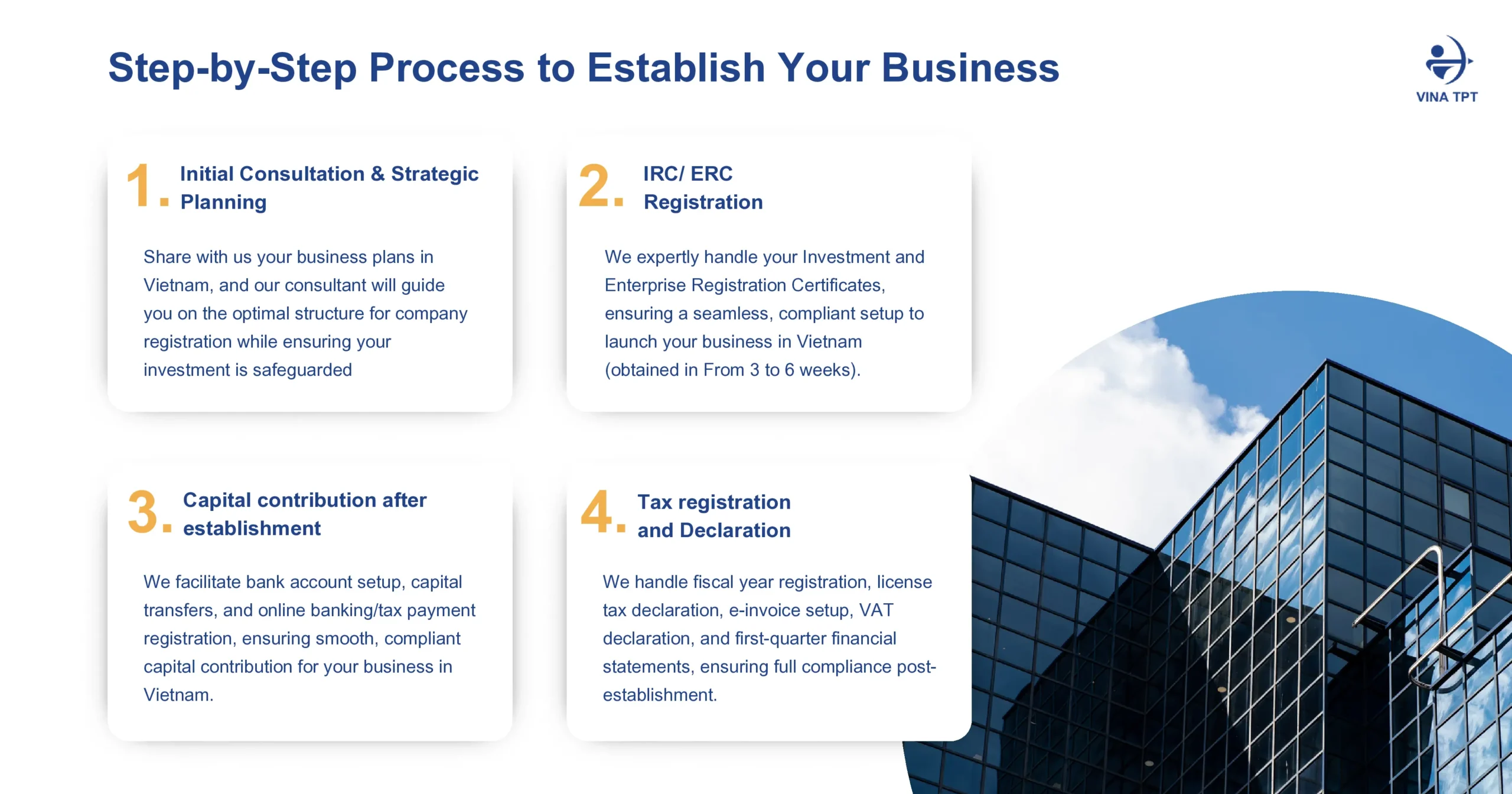
If you are planning setting up a business in Vietnam, contact Vina TPT today for professional consultation and step-by-step support, from investment licensing to post-establishment compliance.