

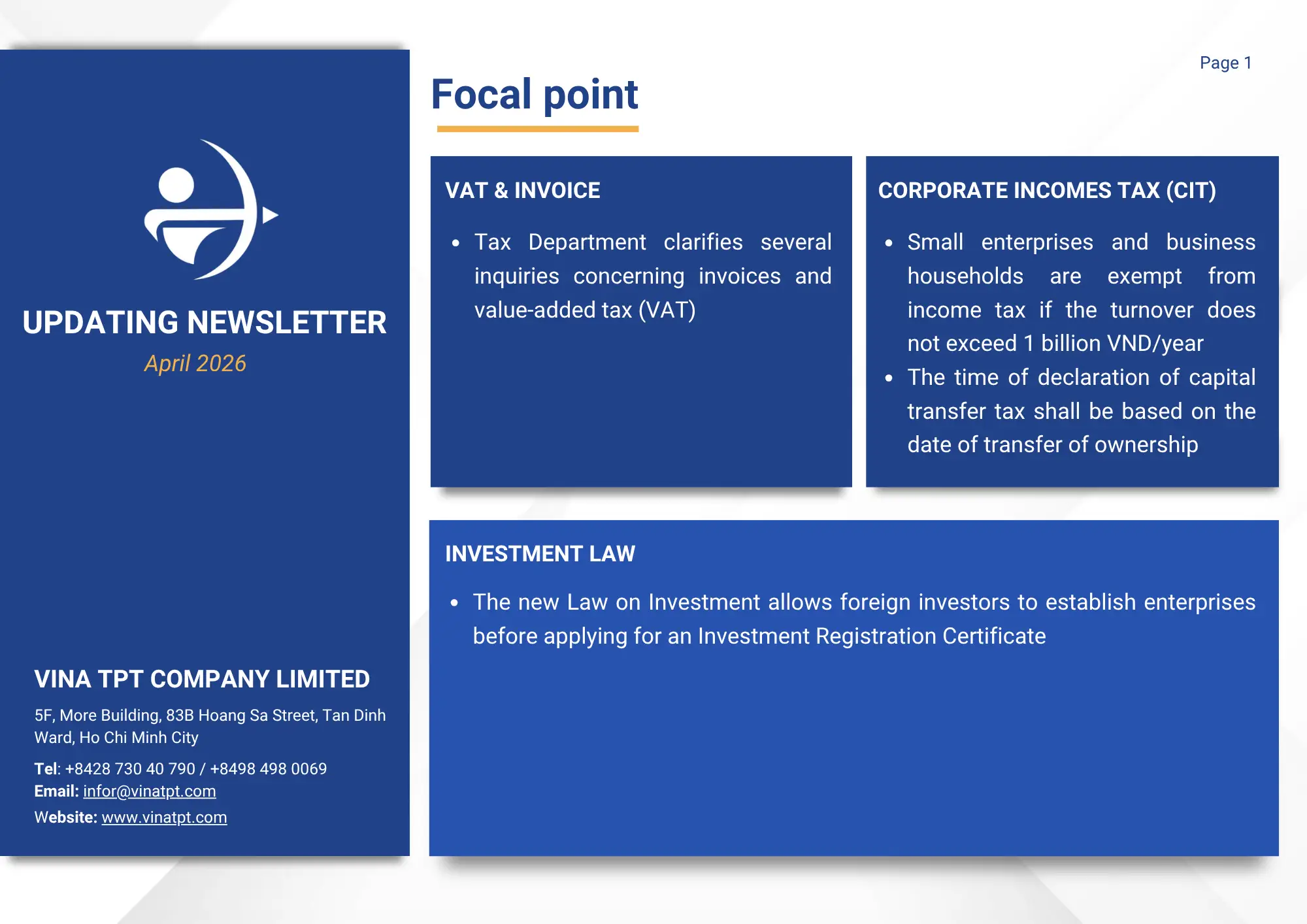
The Vietnam tax & legal landscape for foreign-invested enterprises (FDI) has undergone significant adjustments as of April 2026. From new corporate income tax (CIT) exemptions for small businesses to modernized investment registration procedures and clarified invoicing regulations, staying informed is critical for operational compliance. This update provides a comprehensive overview of the latest decrees and official letters that will impact your business strategy in Vietnam.
New Tax Exemption Threshold for Small Businesses (Decree 141/2026/ND-CP)
The Government of Vietnam recently promulgated Decree No. 141/2026/ND-CP (effective from January 1, 2026), amending policies for business households and individuals, as well as measures guiding the implementation of the Law on Corporate Income Tax.
Key Changes
- Exemption Threshold: The government has raised the income tax exemption threshold for business households and individuals to VND 1 billion per year.
- CIT Exemption: Small businesses with an annual turnover not exceeding VND 1 billion are also exempt from CIT starting in 2026.
- Overpaid Tax Handling: For small businesses that temporarily paid CIT in the first quarter of 2026, such amounts will be offset or refunded according to overpaid tax principles.
This exemption policy does not apply to small businesses that operate as subsidiaries if their parent company reports a total annual revenue exceeding VND 1 billion.
Streamlining FDI Entry: Business Establishment Before IRC
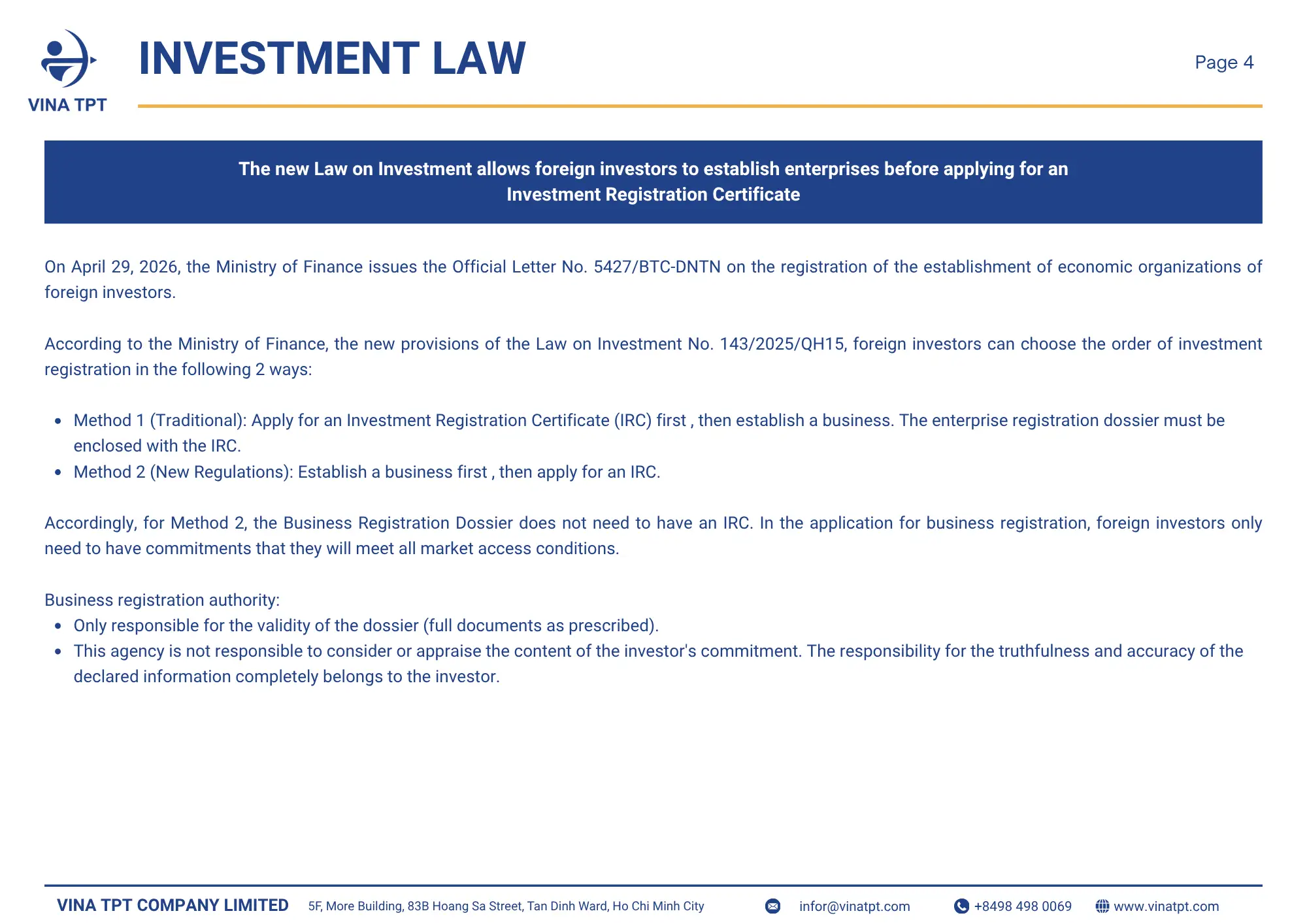
On April 29, 2026, the Ministry of Finance issued Official Letter No. 5427/BTC-DNTN, clarifying new provisions under the Law on Investment No. 143/2025/QH15. Foreign investors now have greater flexibility in the order of their investment registration.
Comparison of Investment Registration Methods
| Method | Registration Order | Requirements |
| Method 1 (Traditional) | Apply for IRC first, then establish business | Enterprise registration dossier must include the IRC |
| Method 2 (New) | Establish business first, then apply for IRC | Business registration dossier does not require IRC |
Under Method 2, foreign investors only need to provide formal commitments that they will meet all market access conditions. The business registration authority is responsible only for verifying the validity of the dossier; it is not responsible for appraising the content of the investor’s commitment, which remains the sole responsibility of the investor.
Updates on E-Invoices and VAT Compliance (Official Letter 2193/CT-CS)
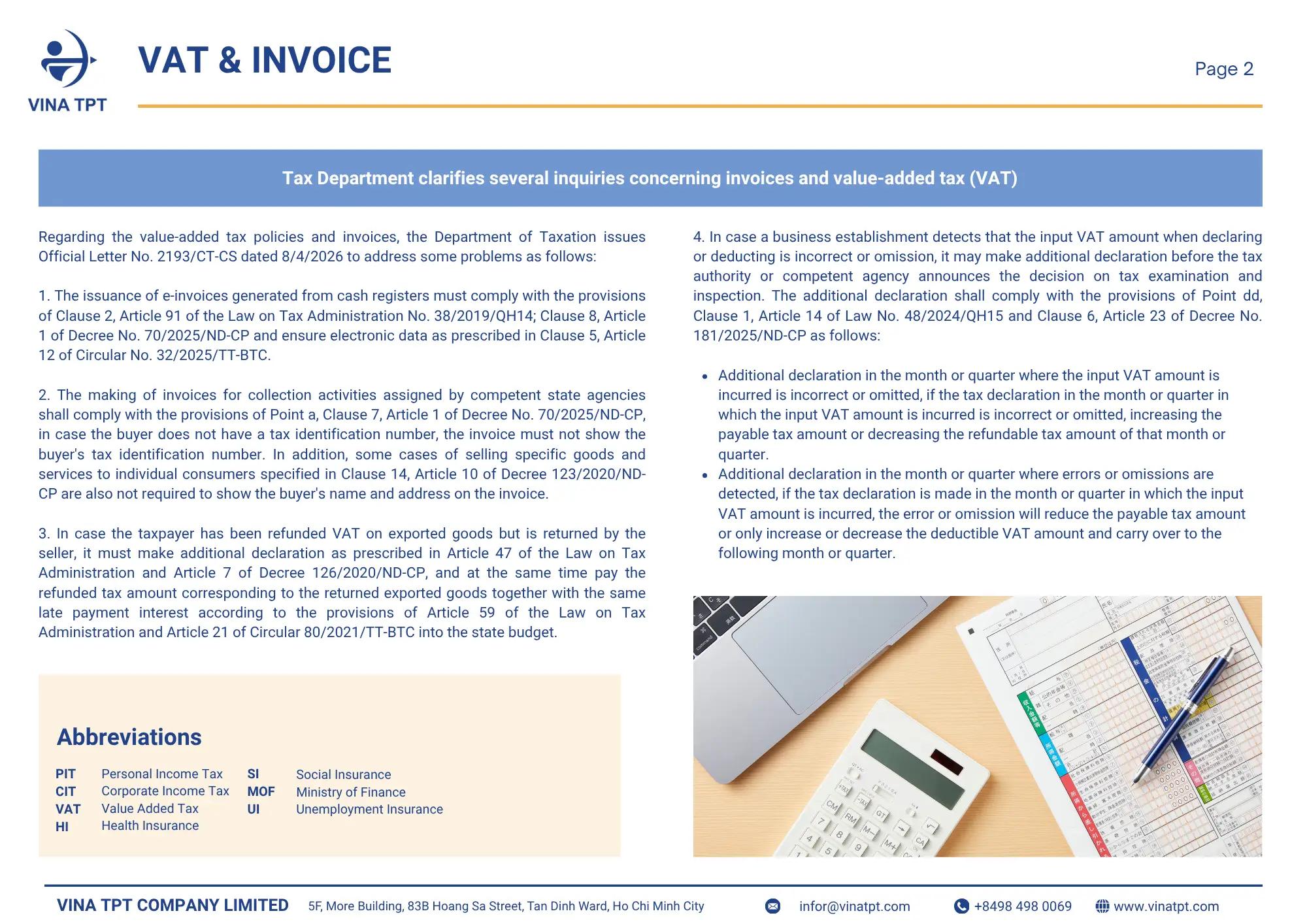
The Department of Taxation issued Official Letter No. 2193/CT-CS on April 8, 2026, to address ongoing concerns regarding electronic invoices and value-added tax (VAT).
Critical Compliance Points
- Cash Register Invoices: E-invoices generated from cash registers must strictly comply with Clause 2, Article 91 of the Law on Tax Administration and relevant decrees to ensure data integrity.
- Collection Activities: For invoices related to collections assigned by state agencies, if the buyer lacks a tax identification number, the invoice must not display one. Additionally, specific goods/services sold to individual consumers are exempt from showing the buyer’s name and address.
- Exported Goods Returns: If exported goods for which VAT was previously refunded are returned, taxpayers must file an additional declaration (Article 47, Law on Tax Administration) and pay back the refunded tax plus late payment interest.
- Input VAT Corrections: If a business discovers errors in input VAT deduction, they may file an additional declaration before the tax authority announces an official inspection decision.
- If the error increased the payable tax, it is declared in the month/quarter the error was incurred.
If the error reduced the payable tax or impacted deductible VAT, it may be adjusted in the period the error was detected.
Capital Transfer Tax: Determining the Precise Taxable Timing
Regarding share transfer activities, the Tax Department noted in Official Letter No. 2710/CT-CS (April 28, 2026) that the time of determining taxable income from capital transfer is the time of actual transfer of capital ownership under the transfer contract.
- Ownership-Based: This timing applies regardless of whether the payment has been collected or not.
- Declaratory Responsibility: The Vietnamese company where the capital transfer between foreign investors occurs is responsible for declaring and paying the tax on behalf of the foreign investor, pursuant to Circular 78/2014/TT-BTC.
Frequently Asked Questions (FAQs)
Q: If my small business is a subsidiary, am I eligible for the new CIT exemption?
A: No, if your parent company has a total annual revenue exceeding VND 1 billion, the subsidiary is not entitled to this specific exemption.
Q: Can I establish a business in Vietnam before getting an Investment Registration Certificate?
A: Yes, under the new Law on Investment No. 143/2025/QH15, you may establish the business first and apply for the IRC later.
Q: What if I detect an input VAT error after the tax period has passed?
A: You may make an additional declaration, provided the tax authority has not yet announced a decision on tax examination or inspection.
Conclusion & Strategic Consultation
The legal landscape in 2026 presents both new opportunities and complex compliance requirements. Ensuring your business remains aligned with these updates is essential to avoid penalties and optimize tax efficiency.
If you require professional guidance on restructuring your tax filings, managing investment registration, or ensuring compliance with the latest VAT regulations, our team is ready to assist.