Vietnam Tax Updates [June 2026] Key Changes to VAT, PIT, CIT and E-Invoices
Vietnam’s tax landscape continues to evolve in 2026, with several new regulations affecting Value Added Tax (VAT), Personal Income Tax (PIT), Corporate Income Tax (CIT), tax payment deadlines, and electronic invoices.
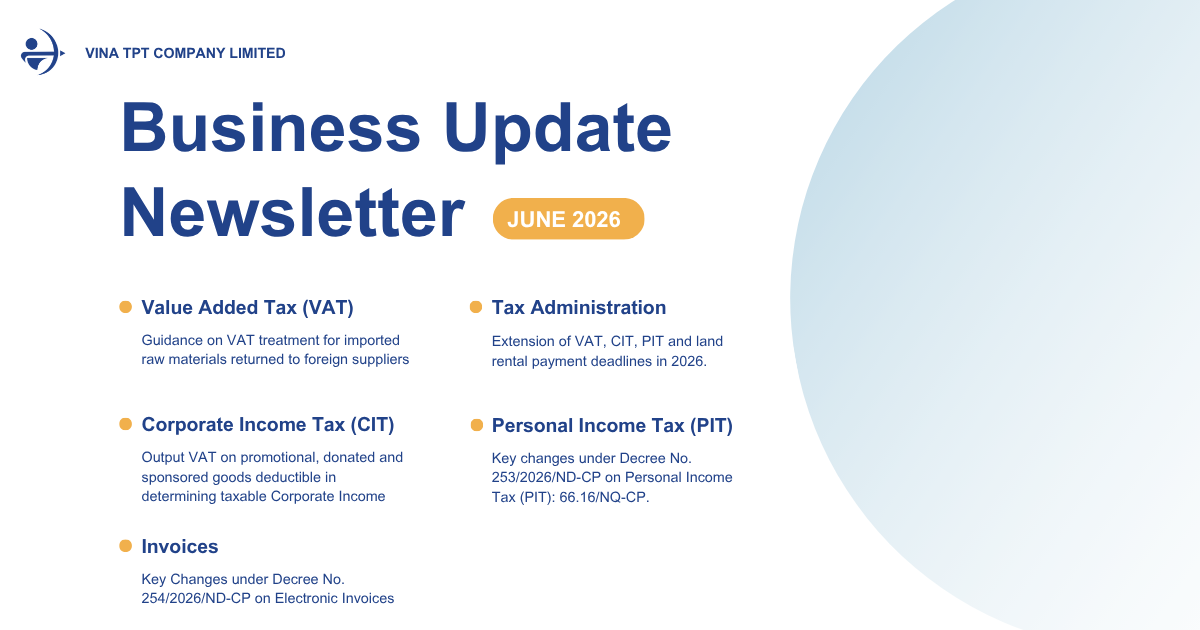
This Vietnam Tax Updates in June 2026 guide highlights several important tax developments that businesses and individuals should be aware of, including the VAT treatment of imported raw materials, deductible expenses related to promotional and sponsored goods, new PIT rules, extended tax payment deadlines, and changes to electronic invoice requirements.
1. Guidance on VAT Treatment for Imported Raw Materials Returned to Foreign Suppliers
According to Official Letter No. 6884/NBI-QLDN2 dated May 21, 2026, of the Ninh Binh Provincial Tax Department, the VAT treatment depends on how imported raw materials are subsequently handled.
Imported raw materials returned to foreign suppliers
Where an enterprise imports raw materials but does not use them and subsequently returns them to the foreign supplier without generating any sales revenue, the import VAT paid cannot be deducted as input VAT or refunded.
The enterprise must also adjust and reduce the corresponding input VAT in accordance with the applicable regulations.
Imported raw materials exported for sale
Where imported raw materials are not used for production but are instead exported for sale to another country, generating export revenue, the enterprise may deduct the input VAT, provided that all statutory conditions are satisfied.
However, under the current regulations, the enterprise is not entitled to a VAT refund in this case.
2. Output VAT on Promotional, Donated and Sponsored Goods Deductible for Corporate Income Tax Purposes
Pursuant to Clause 12, Article 10 of Decree No. 320/2025/ND-CP dated December 15, 2025, enterprises may deduct certain expenses corresponding to output VAT when determining taxable Corporate Income.
Specifically, an enterprise may deduct:
- Expenses corresponding to the output VAT on promotional goods provided free of charge for business operations;
- Expenses corresponding to the output VAT on donated goods provided free of charge for business operations; and
- Output VAT payable on goods and services used for sponsorship activities.
These expenses are deductible provided that the applicable statutory conditions are satisfied.
3. Key Personal Income Tax Changes Under Decree No. 253/2026/ND-CP
Another important area covered by the Vietnam Tax Updates 2026 is Personal Income Tax (PIT).
Decree No. 253/2026/ND-CP introduces several changes affecting taxable employment income, PIT withholding, individual deductions, annual leave payments, and voluntary retirement contributions.
3.1 Mid-Shift and Lunch Allowances of Up to VND 1.2 Million per Month Are Exempt from PIT
Where an employer provides mid-shift or lunch allowances to employees in cash, only the portion exceeding VND 1.2 million per employee per month is subject to PIT.
Where the employer provides meals directly, purchases meal vouchers, or arranges meal services, these benefits are not treated as taxable income for PIT purposes.
3.2 PIT Withholding Threshold for Irregular Income Increased to VND 5 Million per Payment
Organizations and individuals paying income to resident individuals who do not have an employment contract, or who have an employment contract of less than three months, are required to withhold PIT at a rate of 10% on payments of VND 5 million or more per payment before making the payment.
For payments below VND 5 million per payment, the 10% PIT withholding is applied only upon the individual’s request.
3.3 New Deductions for Medical and Education Expenses
Resident individuals are entitled to additional deductions from employment income for qualified medical and education expenses, subject to the applicable conditions and limits.
The maximum deductions are:
- Medical expenses: up to VND 23 million per year for qualified expenses incurred at domestic healthcare facilities;
- Education and training expenses: up to VND 24 million per year for qualified expenses incurred at domestic educational institutions.
The combined maximum deduction is therefore VND 47 million per year for eligible expenses incurred for taxpayers and their dependants.
3.4 PIT Exemption for Payments in Lieu of Unused Annual Leave
Salary and wages paid in lieu of unused annual leave are exempt from PIT, provided that such payments are made in accordance with the Labour Code, the Law on Cadres and Civil Servants, and the Law on Public Employees.
3.5 Increased Deductible Limit for Voluntary Retirement Contributions
Contributions to supplementary pension insurance under the Social Insurance Law, voluntary pension insurance, and life insurance are deductible in determining taxable income, subject to the applicable conditions.
The combined deductible limit is increased to VND 3 million per month.
This limit includes both contributions made by employers on behalf of employees and contributions made by employees themselves, where applicable.

4. Extension of VAT, CIT, PIT and Land Rental Payment Deadlines in 2026
Under Article 5 of Decree No. 245/2026/ND-CP dated June 27, 2026, certain tax and land rental payment deadlines in 2026 are extended.
4.1 VAT Payment Deadline
The payment deadline for Value Added Tax, including apportioned VAT and VAT payable for each occurrence, is extended by up to five months.
The applicable deadlines are:
- VAT for the May 2026 tax period: no later than November 20, 2026;
- VAT for the June, July, August and September 2026 tax periods: no later than December 21, 2026;
- VAT for the second quarter of 2026: no later than November 2, 2026.
This extension does not apply to import VAT.
4.2 PIT Payment Deadline for Household and Individual Businesses
The payment deadline for Personal Income Tax payable by household businesses and individual businesses is also extended by up to five months under the applicable conditions.
4.3 Provisional CIT Payment Deadlines
The payment deadline for provisional Corporate Income Tax is extended as follows:
- Second-quarter 2026 provisional CIT: extended by three months, with a payment deadline of November 2, 2026;
- Third-quarter 2026 provisional CIT: extended by two months, with a payment deadline of December 30, 2026.
4.4 Land Rental Payment Deadline
The payment deadline for 50% of the land rental payable in 2026 is extended by five months.
Businesses should review their tax payment schedules to determine whether they qualify for these extensions and ensure that the extended deadlines are properly applied.
5. Key Changes Under Decree No. 254/2026/ND-CP on Electronic Invoices
Electronic invoice regulations are another important part of the Vietnam Tax Updates 2026.
Decree No. 254/2026/ND-CP introduces and clarifies several requirements concerning when electronic invoices are required, invoice issuance for service contract deposits, and the information that must appear on electronic invoices.
5.1 Cases Where Electronic Invoices Are Not Required from July 1, 2026
Article 7 of Decree No. 254/2026/ND-CP provides cases where electronic invoices are not required.
These include certain activities of household businesses and individual businesses, such as:
- Procurement of goods;
- Real estate leasing;
- Provision of digital services to overseas customers;
- Lottery agency activities;
- Insurance agency activities; and
- Multi-level marketing agency activities.
The regulation also covers certain financial and banking transactions, capital contributions in the form of assets, internal asset transfers, lending of machinery and equipment, and transactions that are not subject to VAT declaration and payment under the applicable regulations.
5.2 No Invoice Required Upon Receipt of Deposits for Service Contracts
Article 9.2 of Decree No. 254/2026/ND-CP clarifies the timing of invoice issuance for deposits received under service contracts.
Deposits received to secure the conclusion or performance of a service contract in accordance with the 2015 Civil Code are not subject to invoice issuance at the time the deposit is received.
This new regulation extends the treatment to all service contracts, rather than limiting it to certain specified services under the previous regulations.
5.3 New Requirements for Electronic Invoice Contents
The Appendix to Decree No. 254/2026/ND-CP supplements and clarifies the required contents of electronic invoices for certain specific cases.
These include requirements applicable to:
- Household businesses and individual businesses;
- Petroleum trading enterprises;
- Authorized electronic invoices; and
- Auction sales of assets.
The Decree also provides additional guidance concerning purchaser information.
Where an individual consumer does not provide identification information, the invoice must state “Sale to Consumer” instead of leaving the purchaser information blank.
Where the purchaser is a foreign individual, the invoice must include the passport or other entry/exit document number and nationality.
Conclusion
The Vietnam Tax Updates June 2026 introduce important changes across VAT, PIT, CIT, tax payment deadlines, and electronic invoices. Understanding how these changes apply to your business is essential for maintaining tax compliance and managing your tax obligations effectively.
If you need further clarification or assistance in assessing how these updates may affect your business, contact Vina TPT. Our tax and accounting professionals can provide practical guidance and support your business in navigating Vietnam’s evolving tax regulations.