Vietnam business accounting and tax landscape is undergoing sweeping structural reforms between 2025 and 2026. Foreign Direct Investment (FDI) enterprises must align with five critical regulatory shifts: Decree 70/2025/ND-CP (e-invoicing rules), Circular 99/2025/TT-BTC (new accounting framework replacing Circular 200), the 2024 Value Added Tax (VAT) Law (effective July 1, 2025), the 2025 Corporate Income Tax (CIT) Law No. 67/2025/QH15, and the 2025 Personal Income Tax (PIT) Law.
This guide examines the business impacts of Vietnam’s 2025–2026 tax and accounting reforms on foreign-invested firms under Vietnamese Accounting Standards (VAS).
- Key Overview: Recent Tax & Accounting Regulatory Reforms in Vietnam
- 5 Major Ways Tax Reforms Directly Affect FDI Business Accounting Requirements
- Comprehensive Business Accounting Services Tailored for FDI Enterprises
- Frequently Asked Questions
Key Overview: Recent Accounting and Tax Regulatory Reforms in Vietnam
The General Department of Taxation (GDT) and the Ministry of Finance (MOF) in Vietnam are rapidly accelerating digital tax administration, big-data cross-reconciliation, and international compliance integration. The modern regulatory environment leaves zero margin for record-keeping delays or bookkeeping discrepancies.
For foreign-invested enterprises operating across Ho Chi Minh City (TPHCM), Hanoi, and key industrial zones, tax and accounting compliance is no longer a passive administrative routine. Regulatory compliance directly influences cash flow timing, profit repatriation, transfer pricing audit exposure, and corporate reputation. Understanding the full scope of informational and navigational requirements across legislative mandates is essential for maintaining tax health and operational continuity in Vietnam.
Timeline of Critical Accounting and Tax Changes (2025–2026)
- 01/06/2025 — Decree 70/2025/ND-CP: Amends e-invoice regulations, enforcement mechanisms, data submission timing, and mandatory invoice contents. Introduces strict cut-offs for customs-linked transaction recording.
- 01/07/2025 — Law on VAT 2024 (Law No. 48/2024/QH15): Officially comes into force, tightening input VAT deduction criteria, mandating non-cash payment verification, and restricting VAT refund eligibility for export-import and investment projects.
- 01/10/2025 — Law on CIT 2025 (Law No. 67/2025/QH15): Takes effect for the 2025 tax year onwards, overhauling deductible expense conditions, related-party transaction controls, and foreign enterprise taxation rules.
- 01/01/2026 — Circular 99/2025/TT-BTC: Enforces a modernized accounting system replacing the decades-old Circular 200/2014/TT-BTC framework, altering chart of accounts, foreign exchange treatments, and financial statement presentations.
- 01/07/2026 — Law on Personal Income Tax 2025: Officially applies to individual income tax calculations, streamlining tax brackets and adjusting personal and dependent relief thresholds.
5 Ways Accounting & Tax Reforms Impact FDI Business Accounting Requirements
The convergence of these regulatory updates shifts tax compliance from periodic reporting to real-time verification. For FDI enterprises operating in Vietnam, structural mismatches between accounting entries, bank settlement records, customs declarations, and tax filings will automatically trigger tax authority risk alerts.
Decree 70/2025/ND-CP: Stricter E-Invoice and Transaction Recording Requirements
Decree 70/2025/ND-CP fundamentally alters the operational rules governing e-invoice generation, content accuracy, and timing. One of the most vital changes for export-oriented FDI companies is the strict requirement that e-invoices for exported goods must be issued no later than the next working day after customs clearance completion.
Furthermore, Decree 70/2025 clarifies e-invoice requirements for cross-border digital services, software licenses, and complex intercompany transactions requiring multi-system data reconciliation. Accounting teams can no longer delay issuing invoices until month-end or quarter-end closing. Sales recognition, invoice logs, customs clearance timestamps, and tax declaration periods must be tightly aligned to avoid severe timing mismatch penalties.
Expert Insight (Decree 70/2025):
This is far more than an administrative “e-invoice compliance” task. For FDI enterprises engaged in import/export or cross-border intercompany service charges, an incorrect invoice issuance date directly disrupts revenue recognition timing under VAS/IFRS and invalidates 0% export VAT treatment during tax audits.
Circular 99/2025/TT-BTC: New Accounting and Financial Reporting Requirements
Effective from January 1, 2026, Circular 99/2025/TT-BTC officially replaces the long-standing Circular 200 accounting regime. This represents the most comprehensive accounting overhaul in Vietnam over the past decade, introducing updated rules for accounting vouchers, the statutory chart of accounts, general ledger posting routines, foreign-exchange difference treatments, and year-end financial statement disclosures.
Foreign-invested companies operating in Vietnam must systematically update their ERP systems (e.g., SAP, Oracle, Microsoft Dynamics) and local chart-of-accounts mapping. Simply rolling forward previous bookkeeping setups will result in non-compliant statutory financial statements, blocking profit remittance approvals from the State Bank of Vietnam (SBV) and tax authorities.
Expert Insight (Circular 99/2025):
Circular 99 is the cornerstone change for business accounting services. It directly dictates how transactions are recorded, books are closed, and statutory financial statements are compiled. FDI management must conduct an immediate ERP chart-of-accounts gap analysis prior to the 2026 fiscal year.
EXPLORE ACCOUNTING SERVICES FOR FDI BUSINESS
2025 Personal Income Tax Law: Major Changes to Payroll Tax Calculations
Beginning in the 2026 tax assessment year, Vietnam’s Personal Income Tax system transitions from seven progressive tax brackets down to five streamlined tax brackets. Simultaneously, the personal deduction allowance increases to VND 15.5 million per month (VND 186 million annually), and the dependent allowance increases to VND 6.2 million per month per dependent.
FDI employers employing expatriates, key foreign executives, and high-earning local personnel must reconfigure their HR payroll engine, employee tax profiles, dependent documentation archives, and monthly tax withholding logic. Given that expatriate compensation often involves gross-up packages, housing allowances, and school fee benefits, accurate PIT withholding calculations are vital to control corporate payroll costs.
Expert Insight (2025 PIT Law):
With foreign experts and senior management earning high income packages, the shift in progressive tax brackets directly recalibrates net compensation, tax gross-up expenses, and monthly corporate cash flow projections. Payroll accounting must be seamlessly integrated with corporate tax compliance.
2025 Corporate Income Tax Law: Greater Focus on Taxable Income and Deductible Expenses
The 2025 Corporate Income Tax Law (No. 67/2025/QH15), effective October 1, 2025 and applicable to the 2025 tax year, establishes stringent conditions for deductible expenses, taxable income determination, tax incentive eligibility criteria, and foreign contractor income taxation. Foreign-invested businesses face heightened documentation standards for intercompany management fees, technical consulting services, trademark royalties, and interest deductions under transfer pricing rules (Decree 132/2020/ND-CP framework).
Accounting teams must establish robust internal controls to substantiate economic substance, benefit tests, and direct transfer pricing documentation for all related-party transactions prior to year-end tax finalization.
Expert Insight (2025 CIT Law):
For FDI companies, CIT compliance extends far beyond multiplying accounting profit by 20%. The core challenge lies in proving that overseas parent company charges—such as regional management fees, IT allocations, and royalty fees—are fully deductible under Vietnamese tax rules with adequate supporting dossier proof.
2025 Value Added Tax Law: Stricter Input VAT Deduction and Payment Controls
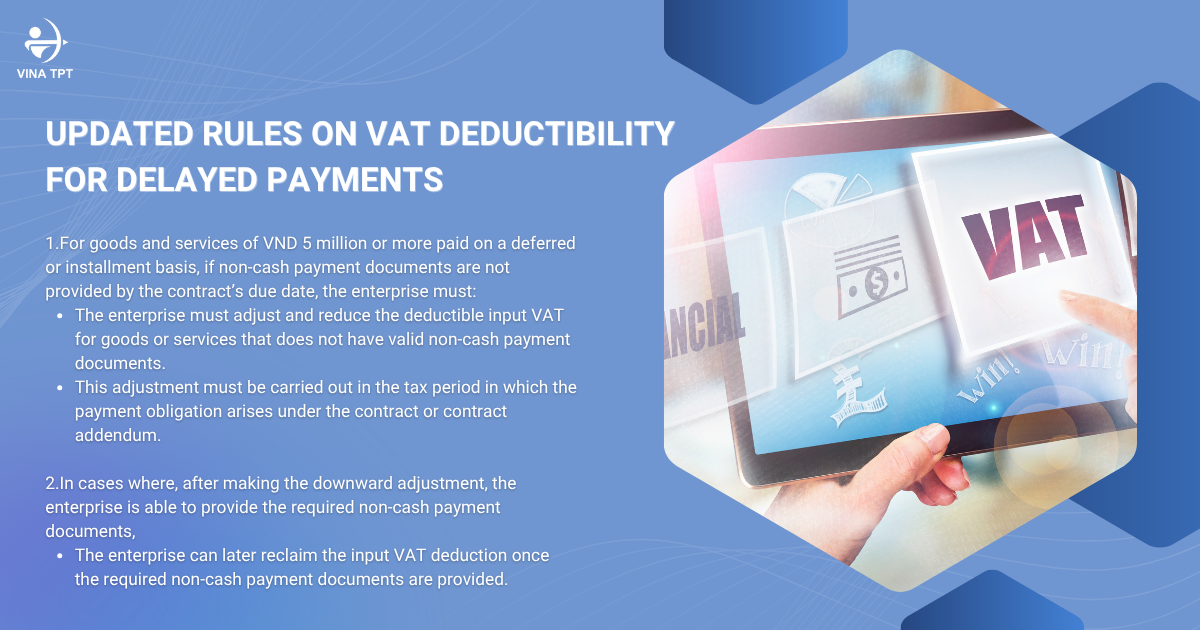
Enforced from July 1, 2025, the 2024 VAT Law drastically tightens input VAT deduction rules. Most notably, the statutory threshold for mandatory non-cash payment documentation is reduced from VND 20 million down to VND 5 million (VAT-inclusive) for any purchase transaction. Furthermore, transaction aggregation rules prevent split-invoicing tactics designed to bypass bank transfer requirements.
Under these stricter rules, tax officers will automatically disallow input VAT deductions and corresponding CIT expense deductions if payment records fail to match the official corporate bank account of the issuing vendor.
Expert Insight (2025 VAT Law):
In daily accounting practice, accountants cannot merely verify whether an e-invoice is authentic on the GDT portal. They must perform a 3-way match: valid e-invoice + compliant non-cash payment proof + transaction contract/delivery note. Any flaw in payment evidence will trigger input VAT clawbacks and tax interest penalties.
Vina TPT: Comprehensive Business Accounting Services Tailored for FDI Enterprises
Vina TPT is a premier business consultancy and accounting firm operating in Ho Chi Minh City (TPHCM) and key economic hubs across Vietnam. We specialize in empowering Foreign Direct Investment (FDI) companies, foreign contractors, and multinational branches to navigate Vietnam’s complex regulatory environment with absolute financial clarity and 100% legal compliance.
Our tailored business accounting services bridge the critical gap between international financial management standards (IFRS/US GAAP) and mandatory Vietnamese statutory requirements (VAS, Circular 99/2025, GDT tax laws).
Why Leading FDI Enterprises Choose Vina TPT:
- Full-Scope VAS & IFRS-Compliant Bookkeeping: Accurate monthly bookkeeping and statutory financial reporting under Vietnamese Accounting Standards (VAS) and IFRS upon request, delivered with comprehensive monthly management reports and dedicated bilingual accounting professionals.
- Periodic VAT Compliance & Filing: Complete preparation and timely filing of monthly or quarterly Value Added Tax (VAT) returns.
- Payroll Processing & Social Insurance Management: End-to-end payroll administration, precise salary calculations, gross-up tax modeling, and seamless handling of mandatory Social Insurance (SI/HI/UI) compliance and employee profiles.
- PIT Calculation & Periodic Tax Filing: Compliant Personal Income Tax (PIT) computation for both local and expatriate employees, dependent registrations, and preparation of periodic PIT declarations and annual tax finalizations.
- FDI Investment & Statutory Reporting: Timely preparation and submission of mandatory periodic investment activity reports to foreign investment authorities (MPI/DOIT), ensuring strict regulatory compliance for FDI projects.
- Back-Office & Document Administration: Comprehensive operational support including e-invoice issuance, systematic archiving of physical and digital accounting vouchers, and management of statutory business records.
- Proactive Tax Advisory & Regulatory Updates: Continuous monitoring and real-time updates on new tax and accounting regulations, backed by proactive advisory support to resolve operational queries and shield your business from compliance risks.
Frequently Asked Questions (FAQ)
The 2025 CIT Law maintains tax incentives (e.g., 10-17% preferential tax rates, tax holidays, and 50% reduction periods) for targeted sectors like high-tech, green energy, and encouraged industrial zones. However, FDI firms must meet strict substance rules, investment capital disbursements, and accurate VAS accounting tracking under Circular 99 to retain these tax incentive benefits.
FDI companies must submit monthly VAT and PIT returns by the 20th of the following month (or quarterly by the last day of the month following the quarter). Annual CIT finalization, PIT finalization, and audited financial statements prepared under VAS must be submitted within 90 days from the end of the fiscal year.
No. All companies legally incorporated in Vietnam are strictly required to maintain statutory accounting records and submit tax returns in accordance with Vietnamese Accounting Standards (VAS) and Circular 99/2025/TT-BTC. While parent companies may request IFRS management reports, VAS remains the sole legal basis for local tax compliance and profit remittance.
Need Professional Accounting & Tax Support for Your FDI Business?
Contact Vina TPT today for a free consultation and customized solution tailored to your compliance needs!
BOOK A FREE CONSULTATION