For international investors and first-time foreign founders, researching how to start a business in Vietnam often feels complex and easy to get lost in legal terms. You will keep meeting concepts such as the Investment Registration Certificate (IRC), the Enterprise Registration Certificate (ERC), charter capital, consular legalization, and the requirement for a lawful head-office address. These elements are tightly linked in a strict sequence: until the business-line codes are fixed, you cannot tell whether a sub-license is needed; and without a legally qualified head-office address, the entire investment-registration file stops at intake. The process can still be simple, transparent, and efficient if you understand how the steps actually run in practice.
This article from Vina TPT walks through the launch path in five sequential steps (in the order they must be completed). The core aim of the guide is to draw a clear line: which original documents the investor must prepare in the home country, which work a professional advisor in Vietnam will take on in full, and which milestones must never be done out of order.
Step 1 – Check If Your Sector Is Open for Foreign Ownership
First, when setting up a company in Vietnam, the investor must look up and confirm whether the intended business line is lawful in Vietnam. If it is permitted, the next step is to place it in one of these two groups:
- Encouraged lines: Foreign investors opening a new company in Vietnam may receive land and tax incentives.
- Conditional lines: These may cap the foreign-ownership ratio, impose statutory-capital requirements, or require an additional industry license. Education and training, cosmetics manufacturing, medical examination and treatment, and healthcare services, for example, usually need extra conditions on premises, qualified personnel, and an operating license from the specialized regulator.
The practical solution for investors: To save time and avoid mistakes, contact a reputable advisory firm at the outset. You only need a short explanation of how the business will operate and the intended model. The advisors will then review the industry codes, analyze the legal conditions in detail, and provide a list of the dossiers and licenses required. That lets the investor set the plan from day one and sharply reduces the risk of having to amend or add business lines later – a change that stretches the appraisal timeline.
Step 2 – Prepare Documents: Clear Split of Responsibilities
The document-preparation stage for a foreign-invested company often worries founders because of the volume of paperwork. The process becomes much lighter once the split of work between the investor and the accompanying advisory firm is clear.
To complete a valid investment-registration dossier, the work is divided as follows:
2.1. The investor’s responsibility (original documents from abroad)
The individual or foreign-organization investor must prepare the initial legal papers issued in the home country:
- Personal passport: A copy of the individual investor’s valid passport (or of the organization’s Legal Representative).
- Proof of financial capacity: The investor’s most recent bank statement, issued by the bank, showing a balance equal to or greater than the charter capital committed to Vietnam.
- Mandatory process: All of these original documents must go through consular legalization at the Vietnamese embassy or consulate in the home country, then be sent to Vietnam for a notarized Vietnamese translation.
>>> You may also be interested in: Documents Required (IRC-ERC) for Vietnam Company Registration
2.2. The advisory firm’s responsibility (handled in full by Vina TPT)
The more complex legal file, prepared to Vietnamese state-authority standards, is drafted in full by the advisor, including:
- The application to implement the investment project and a detailed investment proposal (objectives, capital scale, and economic efficiency).
- The enterprise registration form, the company charter, and the list of members or founding shareholders.
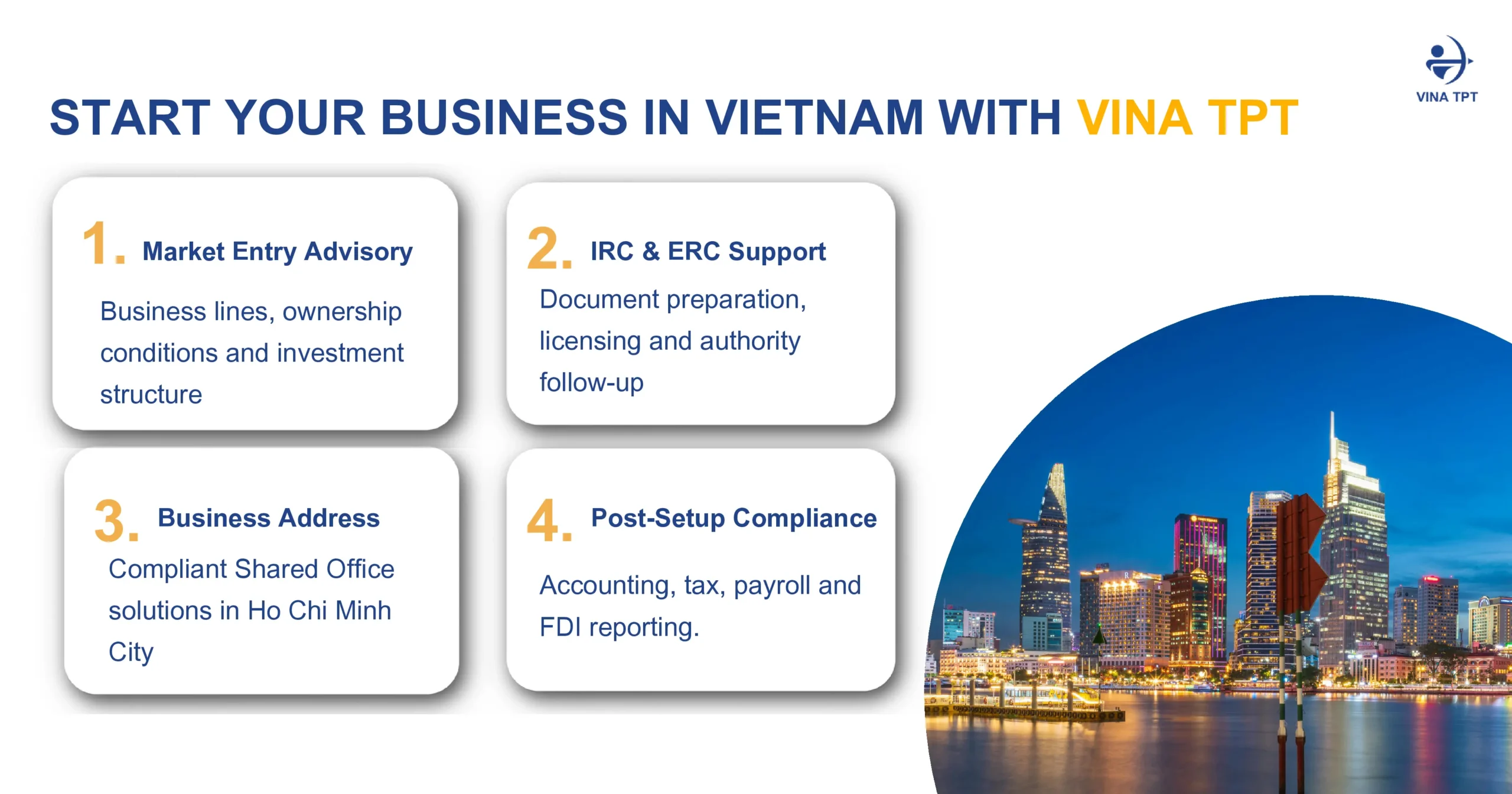
- Head-office solution: If the investor has not yet leased a long-term traditional office, Vina TPT provides a Shared Office service with a lawful lease that meets business-registration conditions and the tax authority’s on-site inspection criteria.
- The advisor presents the complete file for the investor to sign, then represents the investor in direct dealings with the Department of Finance.
The advisory team also reviews the file so that personal details (full name, passport number, permanent address) and project particulars (charter capital, head-office address) match 100% across every translated page and every form filed with the state – removing the risk of the file being returned because of a character discrepancy.
[Tham khảo dịch vụ thành lập doanh nghiệp trọn gói của Vina TPT]
Step 3 – Get Investment Registration Certificate (IRC) Then ERC
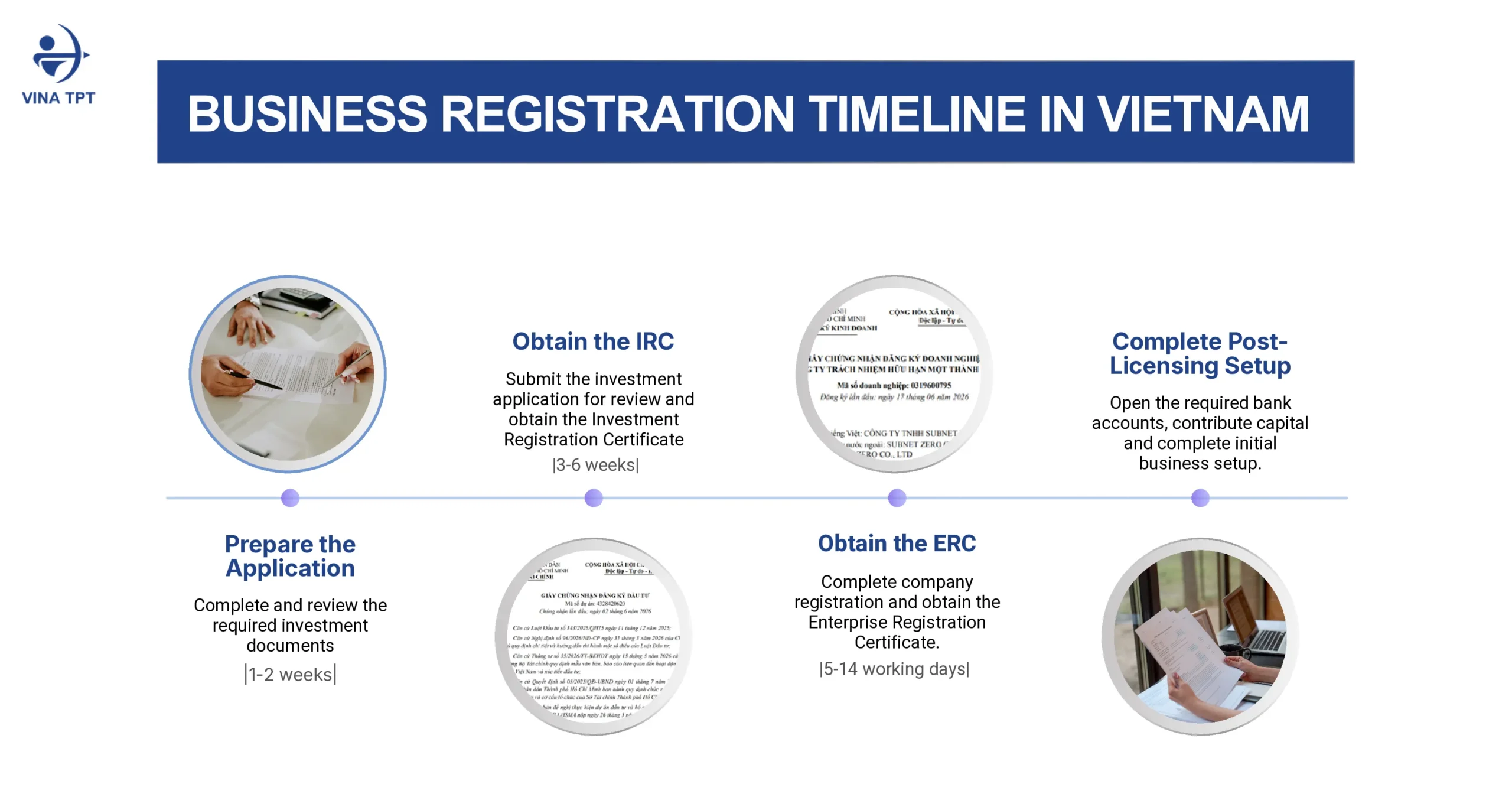
Once the consular-legalized file and the signed registration documents are complete, licensing follows the order set by the Law on Investment.
Stage 1: Investment Registration Certificate (IRC)
- Execution: The advisory firm files the investment-project dossier with the Department of Finance (or the industrial-park management board). The authority appraises the project objectives, the head-office location, and the investor’s financial capacity.
- Practical timeline: Usually 3-6 working weeks, depending on whether the industry requires comments from line ministries.
Stage 2: Enterprise Registration Certificate (ERC)
- Execution: As soon as the IRC is issued, the advisory firm files the enterprise-registration dossier to obtain the ERC. This certificate records the enterprise code (which is also the tax code) and the Legal Representative’s details.
- Practical timeline: 5-14 working days.
The total time to hold both the IRC and the ERC is typically 4-8 weeks. Under the Law on Investment 2025, some projects that fully meet published market-access conditions may obtain the ERC first and complete the IRC afterward. Whatever path is used, the project may start commercial operations only after a valid IRC is in place.
Step 4 – Bank Account, Capital Injection and Initial Tax Setup
As soon as the Enterprise Registration Certificate (ERC) is issued, the company is, as a matter of law, an independent legal entity in Vietnam. From that moment, it must complete initial registration and financial-management requirements in full.
4.1. Opening a corporate bank account
Opening a bank account for an FDI company is stricter than for a domestic company. The commercial bank will require:
- The company’s legal file (notarized copies of the IRC, ERC, and charter).
- A valid visa or Temporary Residence Card of the Legal Representative.
- The decision appointing the Chief Accountant (or the person in charge of accounting), plus personal identification.
- Two accounts at the same time: a Direct Investment Capital Account (DICA) to receive capital from abroad, and a VND current account for day-to-day business in Vietnam.
4.2. Contributing charter capital on time
A foreign investor must transfer the capital contribution from a personal account or the parent company’s overseas account into the company’s Direct Investment Capital Account (DICA) in Vietnam within 90 days from the date the Enterprise Registration Certificate (ERC) is issued, unless the law sets a different contribution period.
Late capital contribution affects the company’s compliance status when it later applies for sub-licenses, and it can lead to administrative fines. In serious cases, if the company fails to remedy the breach or falls within a statutory ground for revocation, it also risks having its Enterprise Registration Certificate (ERC) revoked.
4.3. Setting up initial tax compliance
After the ERC is issued, the company must register its initial tax profile, the accounting regime, the financial year, and the e-tax account, so that periodic tax returns can be filed on time:
- Register and purchase a digital signature (CA Token) and register e-invoices with the managing tax office.
- File the initial VAT, CIT, and PIT returns on the statutory cycle – even while the company has not yet generated revenue or costs.
>>> You may also be interested in:
- Tax Tips for Small Businesses in Vietnam to Avoid Mistakes
- Vietnam Tax Compliance for FDI Business: Key Taxes & CPA Support
- VAT Rate in Vietnam: Complete Guide to Value Added Tax Regulations
Step 5 – Start Operating Without Missing Compliance Reports
Once the company is operating, keeping legal compliance aligned is essential for sustainable growth and for avoiding barriers when profits are later remitted abroad. The investor needs tight control of four core obligations:
- VAS accounting and financial statements: The company must keep books under Vietnamese Accounting Standards (VAS), appoint a legally qualified Chief Accountant, and prepare annual financial statements that are independently audited. If the company does not yet have a local team, a professional tax compliance Vietnam service can keep this entire bookkeeping system in order.
- HR and payroll: Register personal tax codes for staff, run payroll, contribute compulsory social insurance, health insurance, and unemployment insurance, and file periodic labor-change reports with the labor authority.
- Mandatory FDI investment reporting: Besides tax duties, a foreign-invested company must file the project-implementation report and the periodic investment-monitoring report – even when revenue is zero. Missing FDI reports will later block license amendments or capital increases.
- Work Permit and Temporary Residence Card (TRC): A founder or foreign employee working in Vietnam must obtain a Work Permit and a TRC for the correct purpose. Without lawful residence documents, the Legal Representative will struggle to use digital signatures on public-service portals or deal with banks. An advisory firm such as Vina TPT can handle this entire process.
How Vina TPT Helps First-Time Foreign Founders
Entering and operating successfully in a fast-growing market like Vietnam requires a consulting partner that thinks clearly and understands how the system works in practice. Vina TPT provides end-to-end support through lawyers, legal specialists, CPAs, and Chief Accountants with 10-20 years of experience. We deliver a full service package and peace of mind for clients doing business in Vietnam:
- Investment and industry strategy: Assessing market-access conditions under the Law on Investment 2025, advising on the capital structure, and designing an efficient company model.
- Full-package company setup: Representing the investor to standardize the dossier, complete IRC and ERC procedures, engrave the seal, and finish post-licensing formalities.
- Head-office solution (Shared Office): A lawful business-registration address in central Ho Chi Minh City that meets the tax authority’s inspection standards, at a cost that fits a newly set-up company, with reception, meeting rooms and the option to move into a private office as the team grows. See Vina TPT Shared Office.
- Post-establishment operating ecosystem (Tax Advisory Vietnam): Full management of VAS accounting, tax compliance Vietnam, payroll, social insurance, periodic FDI investment reporting, Work Permit applications, and Temporary Residence Cards (TRC).
If you are researching how to start a business in Vietnam and need a safe, accurate execution path from an experienced specialist team, contact Vina TPT for detailed advice today.