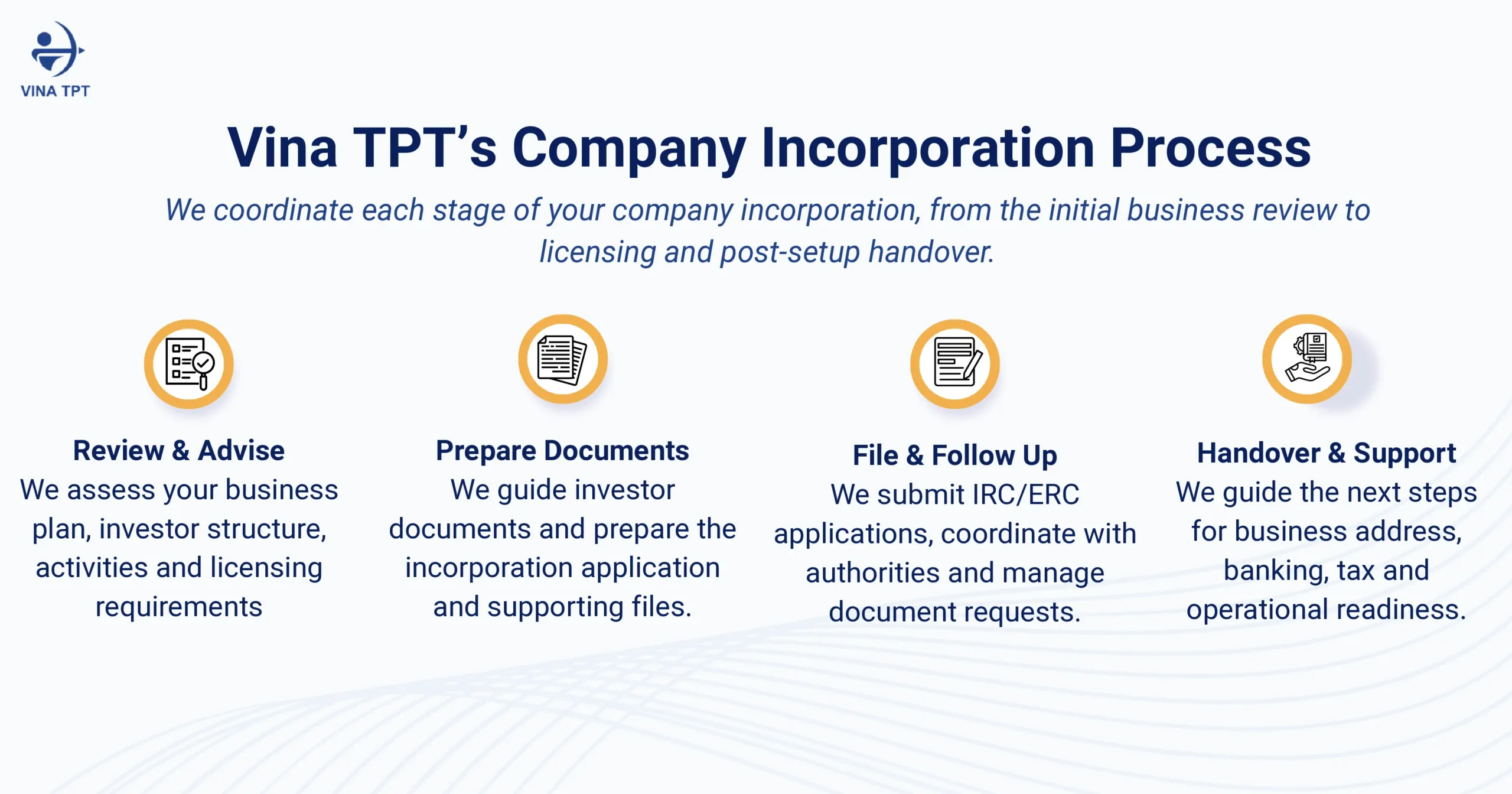
 You need a partner who carries out Vietnam company incorporation in full compliance with the law and in the correct document sequence. However, before cooperation begins, the most important thing is for the investor to clearly understand which part of the work you must prepare and which part the advisory firm will be responsible for drafting, filing, and tracking. Clearly defining this boundary helps founders avoid missing original documents and stay in control of the timeline without wasting time waiting for the advisory firm to handle tasks that depend on decisions from the investor’s side.
Drawing on our experience as an investment advisory firm, we explain how Vina TPT manages the Vietnam company incorporation process, what documents investors need to prepare, and how both parties coordinate from business activity planning and IRC/ERC filing to post-licensing procedures.
1. Confirm the Entity and Sector Before Any Filing
The first step in Vietnam company incorporation is to determine the appropriate legal structure and registered business activities before preparing the application documents. A Limited Liability Company is the optimal and most common choice when the investor wants to sell goods, provide services, and issue VAT invoices in Vietnam. A Joint Stock Company is more suitable when you plan to raise capital or gather multiple shareholders from the outset. Note that a Representative Office (RO) cannot replace a newly established company if your objective is to record revenue directly in Vietnam.
In parallel, Vina TPT will review market-access conditions: whether the sector allows 100% foreign ownership, whether a sub-license is required, and whether the capital contribution scale is commensurate with the operating model.
To receive accurate advice and the most optimal solution, the investor needs to describe their business plan clearly:
- If trading: Do you plan to wholesale or retail to end consumers? What are the specific products? Will you conduct import-export activities or only domestic distribution?
- If operating F&B or services: Where do you plan to open the location? Will you sell alcohol, beer, tobacco, or accompanying entertainment services? vietnam company incorporation
The more detailed the information you provide, the more streamlined and focused the list of next steps Vina TPT provides, ensuring the company both complies with the law and operates commercially smoothly right after licensing.
2. IRC and ERC Licensing: Clear Division of Work and Timelines
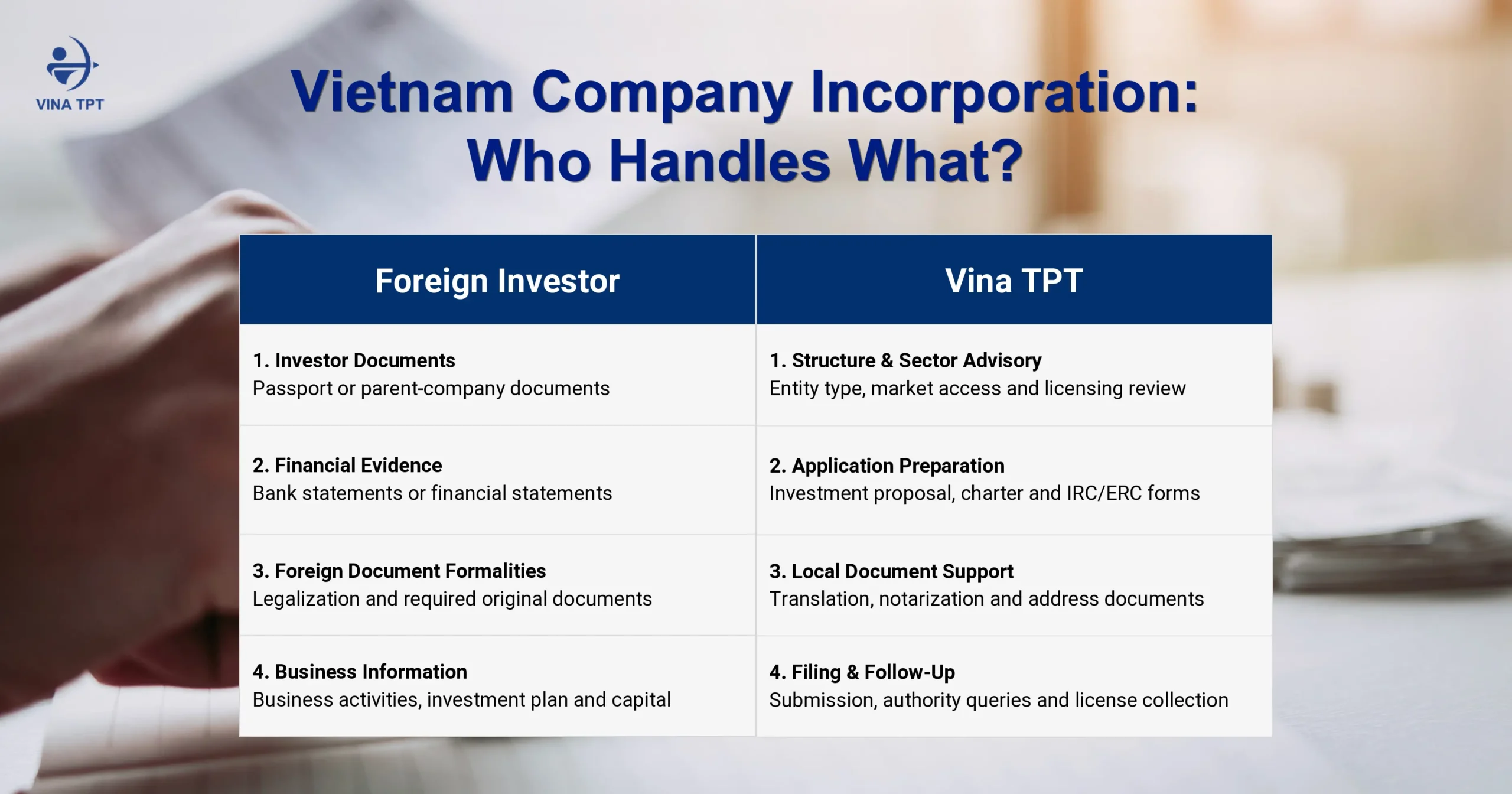
The process of filing for the Investment Registration Certificate (IRC) and the Enterprise Registration Certificate (ERC) requires a clear division of work between the investor and Vina TPT to ensure the licensing timeline proceeds accurately according to plan.
Investor’s responsibilities (Your Part)
The investor is responsible for preparing the input information and the original legal documents from the country of origin:
- Detailed business information and plan: Provide a specific description of the products, services, commercial model, target market, and capital utilization plan. This is the core basis for Vina TPT to prepare the investment project proposal and register the appropriate industry codes.
- Legal-entity / personal documents (already consularized): A copy of a valid passport (for individual investors) or Certificate of Incorporation / extract of parent company information (for corporate investors). All documents issued by foreign authorities must be notarized and consularized at the Vietnamese Embassy/Consulate in the home country before being sent to Vietnam.
- Proof of financial capacity (already consularized): Audited financial statements for the most recent 2 years (for the parent company) or a bank account balance confirmation of the investor showing a balance corresponding to the registered capital. These documents must be consularized together with the legal-entity file to ensure validity when submitted to the investment registration authority.
Vina TPT’s responsibilities (Our Part)
Vina TPT is responsible for all technical stages, translation, and coordination with the Department of Finance in Vietnam:
- Drafting in detail the full IRC and ERC application file, the investment project proposal, the company charter, standard registration forms, and the office lease contract (in the case of using an address provided by Vina TPT).
- Performing judicial notarized translation into Vietnamese for all foreign documents as soon as the consularized originals are received.
- Representing the client in working with, filing documents, proactively providing explanations, and handling supplementary rounds with the Department of Planning and Investment (or the Management Board of the Industrial Park/Economic Zone).
Implementation process and reference timeline
- Procedure sequence: File and receive the IRC first (investment project approval), then file and receive the ERC (legal-entity establishment). Where the project meets market-access conditions under the Law on Investment 2025, the processing can be optimized according to the latest operational guidance.
- Reference timeline: Approximately 4–8 weeks from the date Vina TPT receives the complete set of valid consularized original documents.
- Personnel aspect: The investor is not required to be continuously present in Vietnam throughout the process. The appearance of the Legal Representative or an authorized individual will be scheduled flexibly by Vina TPT according to each specific working milestone.
3. Use a Valid Address If You Do Not Have an Office Yet
In the FDI company formation file in Vietnam, the business premises lease contract is one of the most important legal documents. The investment registration authority and the tax authority apply location-inspection rules to foreign-invested companies that are far stricter than those for domestic companies, to ensure the project has a real operating location and complies with specialized zoning.
The business registration address must be in a building with a commercial or office function. Residential apartments or collective housing are completely ineligible for registering a company headquarters or for receiving tax officers for on-site inspections.
For investors who have not yet secured a permanent office, a legally compliant shared office can be a practical solution during the Vietnam company incorporation process, helping reduce initial costs while providing a suitable registered business address.
Vina TPT provides a legal business registration address solution in a central location, accompanied by a full office lease contract for filing the incorporation application, integrated with professional reception and meeting-room services. This solution gives the company a legal address immediately to receive the ERC, and when the workforce expands, you can move to a private office without encountering initial procedural obstacles.
>>>> See also: Shared Office Ho Chi Minh City – Vina TPT Workspace for Foreign Companies
4. Post-Licensing & Initial Tax Registration Requirements
The Vietnam company incorporation process does not end when the Enterprise Registration Certificate (ERC) is issued. Foreign investors must also complete the relevant post-licensing procedures before their companies are fully prepared for operations. Even though the legal entity has been formed, the company still cannot issue invoices or contribute capital if the following post-licensing legal obligations have not been completed:
- Company Seal & Digital Signature (Token): Engrave the legal-entity seal to complete the legal validity of internal documents and transactions. At the same time, the company needs to register and purchase an electronic digital signature (Token/HSM CA) for filing tax reports, declaring social insurance, and conducting electronic transactions with state authorities.
- Initial Tax Registration: Complete the initial tax registration file with the directly managing tax office. This step includes registering the accounting regime (VAS standards), selecting the fixed-asset depreciation method, registering the company’s financial year, appointing the Chief Accountant / person in charge of accounting, and activating the electronic tax account (eTax).
- Corporate VNeID identity: Activate the electronic identity account for the organization under current regulations.
- Open bank accounts and contribute capital: Open the Direct Investment Capital Account (DICA) and the VND current account. The investor must transfer 100% of the registered capital contribution within 90 days from the ERC issuance date (or according to the schedule recorded on the IRC). Late capital contribution will result in administrative fines and the risk of license revocation.
5. How Vina TPT Supports Vietnam Company Incorporation
With over 20 years of practical experience in FDI investment advisory, accounting, and corporate legal services, Vina TPT provides comprehensive Vietnam company incorporation support, from initial business planning and licensing to post-establishment compliance.
- End-to-end process: Advise on entity type and business lines – Draft an accurate file – Represent in filing and receiving the IRC/ERC – Provide a business registration address – Hand over the full initial tax and bank-account procedure package.
- Bilingual communication: The team works fluently in English and Vietnamese, supporting effective remote operations for founders who do not yet reside in Vietnam.
- Clear service-boundary commitment: We take the highest responsibility for the accuracy of the file and the working timeline with state authorities, based on the information and legal documents provided by the investor.
Please send Vina TPT information on (1) the intended business sector and (2) the investor type (individual or parent company organization). We will send you the document checklist and a detailed implementation roadmap completely free of charge. Contact Vina TPT today.