


Based on our practical experience advising foreign investors, many delays in the company setup in Vietnam process begin long before the application reaches the investment registration authority. They stem from inaccurate decisions made earlier: choosing the wrong form of legal presence, registering business-line codes before checking foreign-ownership conditions, locking in an unsuitable capital level, or leaving foreign legal documents until close to the filing date before starting consular legalization.
This article from Vina TPT will not repeat the entire theoretical process of applying for the IRC and ERC. If you need to review the detailed list of documents, forms, and the file-preparation procedures from both the investor’s side and the advisory firm’s side, please see the article: Documents Required (IRC-ERC) for Vietnam Company Registration.
Within the scope of this article, we focus on analyzing 6 practical mistakes that foreign investors (FDI founders) must absolutely avoid before and immediately after company formation, accompanied by a checklist to help you review accurately before officially submitting the file.
Mistake 1 – Choosing the Wrong Business Structure for Company Setup Vietnam
A Representative Office (RO) and a foreign-invested company (FDI company) are designed for two completely different operational objectives. A Representative Office is only suitable for liaison activities, trade promotion, and market research within the scope permitted by law. It is absolutely not a legal structure for conducting direct business activities, signing commercial contracts, selling goods, issuing VAT invoices, or recording revenue in Vietnam.
If the investor’s objective is to generate revenue and operate an actual business, establishing an independent legal entity is mandatory. In that case:
- Limited Liability Company (LLC): This is the most popular and flexible structure for the majority of small and medium-sized FDI companies (owned by 1 member or by 2 to 50 members), with limited liability and a lighter governance structure than a Joint Stock Company.
- Joint Stock Company (JSC): Suitable for large-scale projects that require a structure of 3 or more shareholders and that plan to raise capital, offer shares, or list in the future.
Investors need to finalize the commercial model and legal structure before preparing the document set abroad. Changing the company type after documents have already been translated and notarized will force you to redo the entire process from the beginning.
Mistake 2 – Ignoring Foreign Ownership Rules During Company Setup Vietnam
One of the most common mistakes during company setup in Vietnam is selecting business-line codes (VSIC) based solely on their names without first checking the applicable foreign ownership and market-access conditions. The correct process requires the investor to clearly determine what products/services the company sells, to whom it supplies them, and under what operating model.
Wholesale, direct retail to end consumers, consulting services, pure import-export, or F&B operations – each model leads to completely different market-access conditions, maximum foreign-ownership limits, and specialized sub-license requirements.
Failing to carefully check market-access conditions before filing will lead to the risk of the file being suspended during appraisal, or the state authority requesting opinions from relevant ministries and agencies, extending the licensing timeline by many additional months. Sending a description of the business model to the advisory firm for a legal-condition review before drafting the file is the most important step to optimize the FDI company setup process.
Mistake 3 – Setting Capital Without a Realistic Business Plan (company setup vietnam)
When planning company setup in Vietnam, foreign investors should determine their charter capital and investment capital based on actual business needs rather than simply choosing the lowest possible amount. Except for certain sectors that require statutory capital under separate regulations, Vietnamese law generally does not prescribe a common minimum capital level for all industries. However, the registered capital must be reasonable and commensurate with the project scale, premises rental costs, headcount, and the plan to sustain actual operating cash flow.
A registered capital level that is too low relative to actual operating costs will cause the investment registration authority to doubt financial capacity and request transparent explanations. In addition, the investor’s proof of financial capacity (bank balance confirmation / financial statements) must match 100% with the committed capital contribution amount.
After formation, the company is required to contribute 100% of the charter capital within 90 days from the date the ERC is issued (or according to the schedule recorded on the IRC). If capital contribution is delayed beyond the prescribed 90-day period, the company will face serious administrative fines, late-payment interest, and a high risk that the business registration authority will revoke the Enterprise Registration Certificate. Therefore, the registered capital level must be determined based on the actual business plan and funding plan, rather than based solely on initial setup costs.
Mistake 4 – Starting Consular Legalization Too Late
Consular legalization is the legal process in the country of origin that takes the most time, yet it is often started too late by investors. To keep the file from being interrupted, preparation responsibilities must be carried out in parallel between the investor and the advisory firm:
|
Party responsible |
Scope of work and documents |
|
Investor |
Prepare original documents abroad: Passport (individual) or Certificate of Incorporation / Charter / Appointment decision (parent company), financial statements or bank balance confirmation. Carry out consular legalization at the Vietnamese Embassy/Consulate in the home country (ideally within 30 days before filing). |
|
Advisory firm (Vina TPT) |
Draft the domestic file: Investment project proposal, company charter, enterprise registration forms, and registered office address contract. Receive the consularized originals to perform notarized judicial translation into Vietnamese. |
The most critical factor at this step is consistency. Full name, passport number, enterprise registration number, permanent address, parent company name, and registered capital must be accurate and match 100% across all translated pages and state-filing forms. Even a small character discrepancy between the passport and the bank balance confirmation is enough for the file to be returned, generating many additional weeks of processing.
Explore Vina TPT’s Company Formation Services
Mistake 5 – Choosing a Business Address Before Checking Its Legal Eligibility
A location that is suitable for working in practice is not necessarily a legally eligible address for registering the head office or the project implementation site. Before placing a deposit or signing a long-term lease, the investor must check the land/building use purpose of the landlord, the right to sublease, and the accompanying legal file. Residential apartments or collective housing are strictly not permitted to be used as a registered business office.
If the investor does not need a traditional office right from the initial stage, a shared office / serviced office that fully meets legal conditions is the optimal option: it already has a legal lease contract, a central business registration address, and can easily be upgraded to a private office when headcount expands.
Reviewing the legal status of the address before paying a deposit helps the company eliminate one of the most common and costly company setup mistakes in Vietnam.
Mistake 6 – Assuming Company Setup Vietnam Ends with the ERC
This is the most serious and most frequent mistake for investors entering the market for the first time. The Enterprise Registration Certificate (ERC) only establishes the company’s independent legal-entity status in theory. Receiving the ERC does not mean that the company’s operational, financial, and tax-compliance systems are ready to go into operation.
Immediately after receiving the ERC, the company must activate the post-licensing legal procedure chain:
- Issue the decision appointing the Chief Accountant and engrave the legal-entity seal.
- Open the Direct Investment Capital Account (DICA) and the VND current account at a commercial bank.
- Purchase a digital signature (CA Token) and activate the company’s VNeID electronic identity.
- File the initial tax registration with the directly managing tax office.
- Register and activate the e-invoice template before any sales transactions or the first invoice is issued.
- Open the VAS-standard accounting book system, register a social insurance unit code, and process Work Permit / Temporary Residence Card (TRC) procedures for foreign staff.
- Fulfill the obligation to file periodic investment project implementation reports.
(The detailed 30-day sequence for setting up the tax-compliance system after formation is presented in the article “Tax Registration Requirements After Your Business Setup Vietnam”.)
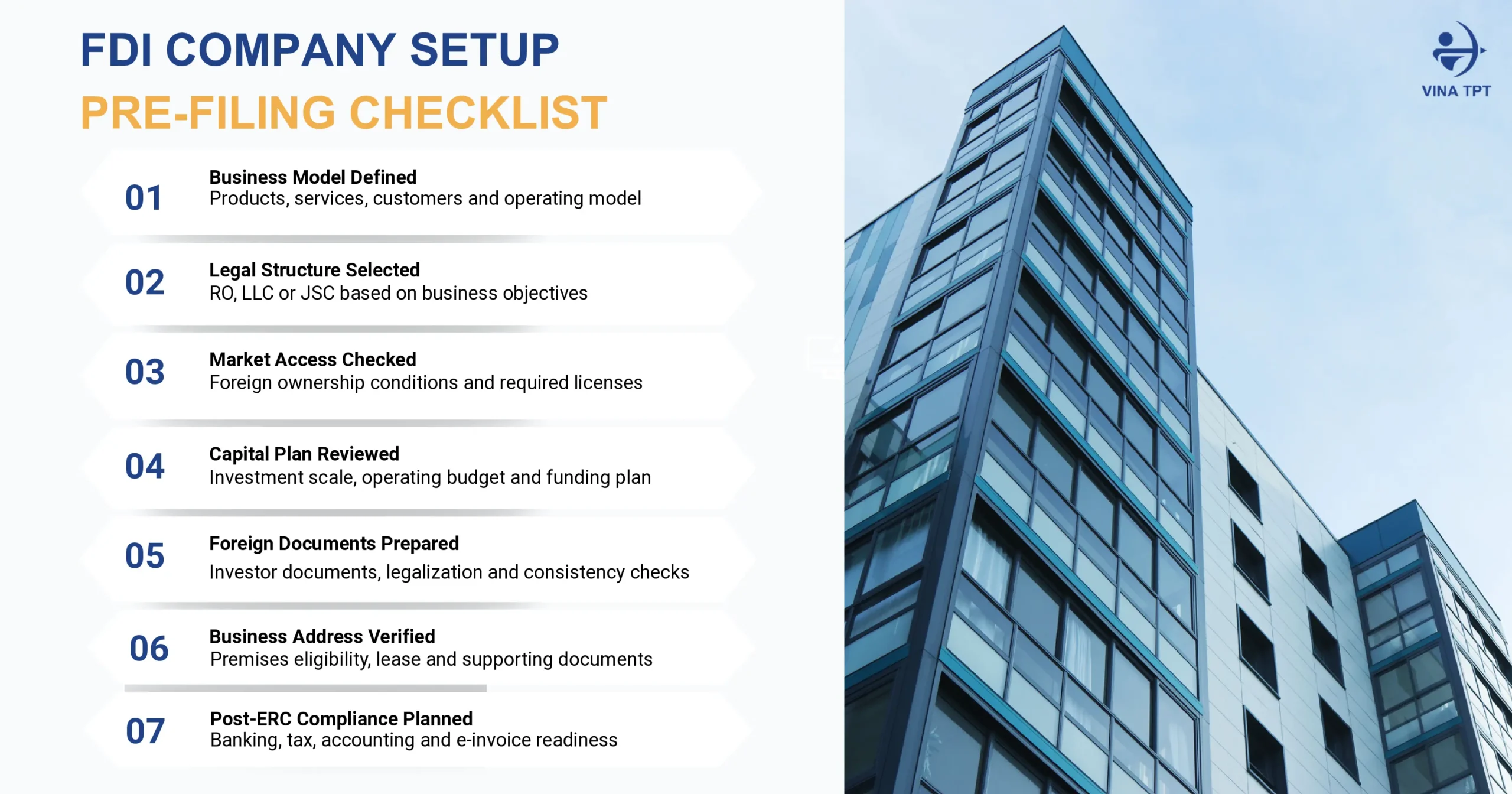
A Practical Pre-Filing Checklist for FDI Company Setup Vietnam
Below is a comprehensive checklist for founders to review before officially submitting the investment registration file:
- Business Model Defined: Clearly describe the business model (what goods/services are sold, to whom, and how operations are conducted).
- Legal Structure Selected: Choose the correct legal-entity form (LLC or JSC; do not use an RO if the objective is to generate revenue).
- Market Access Checked: Accurately check the foreign-ownership ratio and accompanying sub-licenses.
- Capital Plan Aligned: Registered capital matches the 6–12 month operating budget and a capital-contribution cash-flow plan within 90 days is in place.
- Foreign Documents Legalized: Foreign documents have been consularized (within the 30-day validity window) and 100% information consistency has been checked.
- Address Legally Reviewed: The head-office address has had its legal file reviewed before the lease contract is signed or a deposit is placed.
- Post-ERC Compliance Ready: A roadmap and budget have been prepared for the Chief Accountant, DICA account opening, digital signature, VNeID, and e-invoice.
How Vina TPT Supports Your Company Setup Vietnam
At Vina TPT, our company setup in Vietnam services go beyond preparing and submitting IRC/ERC applications. We help foreign investors identify potential legal and operational risks before filing and prepare for the compliance requirements that follow incorporation. Based on more than 20 years of practical experience in FDI investment advisory, VAS accounting, and corporate legal services, Vina TPT accompanies investors through an end-to-end implementation process:
- Business Model & Market-Access Advisory: Analyze the actual business model to determine the optimal legal structure (LLC/JSC), the allowable VSIC industry codes, the foreign ownership ratio, and the list of accompanying sub-licenses. We immediately indicate if a Representative Office (RO) does not meet the objective of recording revenue.
- Legalization & Dossier Preparation: Prepare the list of original documents that need to be prepared (passport/parent company documents, proof of financial capacity), guide consular legalization and notarized translation. In parallel, Vina TPT drafts the domestic file and reviews 100% information consistency across all documents.
- Business Address Setup: Support a legally eligible shared-office solution to attach to the registration file, or review the legality of the premises contract if the investor already has a private office.
- IRC & ERC Support: Represent the client in filing the application and work with state authorities until the original IRC and ERC are handed over. The investor does not need to appear continuously; the execution timeline is only 3-6 weeks once the original file has been fully legalized.
- Post-Setup Compliance: Hand over the full post-licensing procedure package: seal, digital signature, initial tax registration, Chief Accountant appointment, DICA account opening and guidance on capital contribution within the 90-day deadline, e-invoice registration, VAS bookkeeping setup, and periodic FDI investment reporting.
Vina TPT’s objective is to eliminate all risks of timeline delays right before the file is submitted – from industry codes, capital structure, and registered office address to the accuracy of foreign documents.